7/23/1936: Justice Anthony Kennedy's birthday.

Mostly law professors | Sometimes contrarian | Often libertarian | Always independent | Est. 2002

My thoughts on this as a policy issue
There is an important issue that reached the Supreme Court in Biden v. Nebraska, 600 U.S. 477 (2023). President Biden and his Vice President, Kamala Harris, are on the record as favoring the use of presidential power to enact student loan relief without an appropriation by Congress. This is both a bad idea and is unlawful, as the Supreme Court explained in Biden v. Nebraska last year. Since then, President Biden has continued his unlawful attempts to spend money without an appropriation from Congress, an appropriation that is required under Article I, Section 9 of the Constitution.
It is worthwhile, however, to consider the merits of this as a policy idea. Retroactive relief from student loans seems unfair to those who have been paying student loan debt or who never borrowed money in the first place. There are some, however, like Sen. Bernie Sanders, who are on the record as believing that federal money ought to be used to pay for anyone's college tuition. Is this a good idea?
It is certainly true that college tuition, which costs more than $100,000 a year, is unaffordable by 99% of the American people. I am acutely aware of this, having paid for my four children's college tuition myself. Should taxpayers play a role in financing a college education? This is an important public policy question, which will certainly come up in the next two years.
As a law professor for the last 34 years, I have a special window into understanding the forces that are driving historically unprecedented tuition increases in academia. I believe that one of the main drivers of tuition increases is not faculty salaries, which have been stagnant, but instead increases in the size of university bureaucracies. These increases in my view are often harmful to the academic mission. They also impose an insurmountable burden on the American people.
Faculty members are powerless in addressing this problem because tuition is set by University administrators and not by a vote of the faculty. I think alumni and faculty are often unaware of how unaffordable tuition has become. They are also unable to do anything about it. There thus exists a huge problem with record high college tuitions and with essentially no market forces constraining it.
I have, quite reluctantly, come to the conclusion that the unaffordability of college to 99% of the American people must be addressed in the same way as was done in the 1880's for monopoly railroad rates when the Interstate Commerce Commission (ICC) was created. I regrettably see no way of addressing the roots of this problem except by creating a new federal regulatory commission with the power to regulate any college tuition increase above the national rate of inflation.
I do not like the idea of empowering the government in this way over academia, but I see no other way out of a situation that has become a crisis. The government already plays a huge role in academic life as a result of many federal statutes, and as a result of the role the Department of Education plays. The creation of a federal agency with the power to regulate tuition increases beyond the rate of inflation will not undermine academic freedom anymore than existing federal laws have already done.
Such a commission should consist of two members from both political parties plus a chair of the president's party who serve for five year terms. Commissioners should serve at will, and the Commission must be a part of the executive branch. Commissioners should be nominated by the president subject to confirmation by the Senate. Presidents and senators should be admonished to appoint people of judgment and impartiality to this commission. There should be a requirement that commissioners be at least forty years old and that they have knowledge about the forces that are driving tuition increases.
One of many problems with Sen. Bernie Sanders' idea of making federal taxpayers responsible for paying all college tuition is that it addresses none of the root problems that are driving increases in college tuition, which have nothing to do with faculty salaries. My proposal at least addresses the root causes of the huge increases in college tuition that have occurred during the last 34 years.
Putting federal taxpayers on the hook for paying for increases in university bureaucracies will only cause the problem to get worse. Universities and colleges would respond to such a federal subsidy by doubling the size of university bureaucracies, which would aggravate the underlying problem. Such a reaction would be more of a threat to academic freedom than would be the creation of an ICC-like federal regulatory commission.
Dan Epps and I discuss Loper Bright and Corner Post on the latest episode of Divided Argument
In the most recent episode of Divided Argument, "Evil Batman," Dan Epps and I talk about the Court's two big non-constitutional administrative law cases from this term: Loper Bright Enterprises v. Raimundo (overruling Chevron deference), and Corner Post v. Federal Reserve Board of Governors (statute of limitations for facial challenges to regulations). We conclude that it's far too hasty to say that either case, or both together, spell the end of the administrative state.
Court relies on Rahimi in support of liberalized gun carry permits.
Anyone hoping that the Supreme Court's Rahimi decision (which I analyzed here) would represent a roll-back in recognition of Second Amendment rights must be in for a surprise with the Eighth Circuit's decision in Worth v. Jacobson. Authored by Judge Duane Benton, the court affirmed the decision of the district court and held that Minnesota's limitation of gun carry permits to persons 21 years old and over violates the right to bear arms of persons aged 18-20.
This is the first decision by a circuit court of appeals, mind you, to rely on Rahimi, which was rendered on June 21. Several courts have put off action in Second Amendment cases while awaiting the decision in Rahimi. While Worth liberally relied on Heller and Bruen, the following focuses on the extent to which Rahimi is already a new sword in defense of Second Amendment rights.
Plaintiffs in the 18-20 age group along with firearm associations mounted a facial challenge to the Minnesota statute. The court first cited Rahimi for the proposition that such challengers must "establish that no set of circumstances exists under which the Act would be valid." That rule was the death knell for Mr. Rahimi's challenge to the federal law banning possession of firearms by a person subject to a court order finding him to be a credible threat to the physical safety of an intimate partner. But it would have no bearing in Worth. Here's why.
Minnesota argued that at the Founding, states restricted guns in the hands of "irresponsible or dangerous groups, such as 18 to 20-year-olds." (In reality, no state banned carrying guns by that age group.) Quoth Rahimi: "[W]e reject the Government's contention that Rahimi may be disarmed simply because he is not 'responsible.'" That concept is too vague and elusive.
Many states have enacted laws curbing exclusionary zoning and other regulations that block new housing construction.

A new Mercatus Center study documents encouraging progress on housing reform so far this year. The scope and pace of reform is greater than last year, which was covered in Mercatus's previous survey (which I discussed here). Here is a summary by authors Eli Kahn and Salim Furth:
Last year, we reported on the accelerating pace of state-level housing supply reform, with major victories in four states and laws being enacted across the country. This year, state legislatures kept up the pace, with 263 individual bills under consideration that would contribute to easing the regulatory burdens on homebuilding, touching on areas from accessory dwelling unit (ADU) permitting to building code reforms. With most state legislatures having adjourned for the year, we can take stock of this year's successes and failures:
In the first six months of 2024, states enacted 50 housing supply bills, compared with 30 enacted during the same months in 2023.
In the past 12 months, 65 housing supply bills have been enacted in 20 states (see figure 1).
Several states that had previously enacted major housing supply bills (such as California, Florida, and Rhode Island) continued to advance legislation building on or refining their previous reforms.
Colorado and Arizona were the year's comeback stories, enacting major housing packages after very public failures last year.
Two more high-cost states, Hawaii and Maryland, made strong opening bids in the zoning reform game.
The year's new trend is building code reforms. Five states took steps toward allowing "single-stair" multifamily building designs up to six stories.
Legislators in Vermont and Kentucky moved in the opposite direction, reversing housing supply reforms. Another counterproductive tactic cropped up in 10 states, where legislators introduced bills to prohibit institutional investors from buying single-family homes. However, none of those bills has passed.
With the exception of the last item on their list, this is all good news. And it is particularly notable that two big states - Arizona and Colorado - enacted major reforms this year, after failing last year. But, as the authors recognize, much work remains to be done. Exclusionary zoning still severely increases housing, blocks millions from "moving to opportunity," reduces economic growth, and restricts property rights.
Still, this is a sign that the cross-ideological "YIMBY" movement continues to make progress in many places. At the same time, it is also important to remember that "NIMBY" opposition to housing deregulation also cuts across ideological lines, and studies of public opinion on the subject arrive at mixed results depending on framing and question wording. Survey data indicates that many harmful "populist" supply restrictions also enjoy considerable public support. The restrictions on corporate investment in housing described in the Mercatus study may be an example of that. They attract support from both many left-wingers, and some on the populist right, such as GOP VP candidate J.D. Vance.
Elsewhere, I have argued that most exclusionary zoning is unconstitutional because it violates the Takings Clause of the First Amendment (see also shorter nonacademic version published in the Atlantic), and that the YIMBY movement should combine litigation and political action. Past successful social movements show that the two approaches together can accomplish more than either alone. The optimal mix of strategies may vary from state to state.
What's on your mind?
The judge concludes Fox's statements about Jankowicz's plans as Executive Director of the DHS Disinformation Governance Board, and the circumstances of her leaving the position, were constitutionally protected opinion—and, even if they were viewed as factual assertions, were substantially true.
From today's decision by Chief Judge Colm Connolly (D. Del.) in Jankowicz v. Fox News Network:
According to the Complaint, [Nina] Jankowicz is "an internationally recognized expert in disinformation" who served as the Executive Director of the now-defunct Disinformation Governance Board (the Board) housed within the Department of Homeland Security (DHS)…. The Complaint alleges that Jankowicz resigned from the Board's Executive Director position "as a result of Fox's false statements and the ensuing harassment." In the Complaint's words:
Fox made three categories of repeated false claims about Jankowicz. First, over the course of over a year, Fox built a narrative calculated to lead consumers to believe that Jankowicz intended to censor Americans' speech.
Anyone consuming Fox starting in April 2022 understood that Fox was telling them that Jankowicz and the Board were out to censor them and that they should be afraid of her.
Second, Fox hosts, guests, and/or commentators said that Jankowicz was fired from DHS. In fact, as Fox knew, Jankowicz had resigned due to harassment arising from Fox's defamation.
Third, Fox hosts, guests, and/or commentators said that Jankowicz wanted to give verified Twitter users the power to edit others' tweets. They relied extensively on an obviously manipulated video—the full version of which was publicly available—to transform her description (and indeed, skepticism) of a developing beta feature on Twitter into a false declaration that she would supposedly police online speech on the platform.
Jankowicz sued Fox for defamation, but the court granted Fox's motion to dismiss:
Let voting parents cast ballots for their children.
Kids don't vote. That means nearly a quarter of American citizens don't have their interests defended at the polls. But parents can vote, and they could vote on behalf of their children. This bipartisan idea, with support ranging from Cornel West to J.D. Vance, would be the most significant expansion of the franchise since the Nineteenth Amendment—and it's something that any state legislature could do on its own, without waiting for a divided Congress to act.
Josh Kleinfeld and I have a new paper, forthcoming in the Notre Dame Law Review, that explains how. As we argue, voting parents should be able to cast ballots on behalf of their otherwise-qualified children; so should the court-appointed guardians of people who can't vote due to mental incapacity. From the abstract:
Many of America's most significant policy problems, from failing schools to the aftershocks of COVID shutdowns to national debt to climate change, share a common factor: the weak political power of children. Children are 23% of all citizens; they have distinct interests; and they already count for electoral districting. But because they lack the maturity to vote for themselves, their interests don't count proportionally at the polls. The result is policy that observably disserves children's interests and violates a deep principle of democratic fairness: that citizens, through voting, can make political power respond to their interests.
Yet there's a fix. We should entrust children's interests in the voting booth to the same people we entrust with those interests everywhere else: their parents. Voting parents should be able to cast proxy ballots on behalf of their minor children. So should the court-appointed guardians of those who can't vote due to mental incapacity. This proposal would be pragmatically feasible, constitutionally permissible, and breathtakingly significant: perhaps no single intervention would, at a stroke, more profoundly alter the incentives of American parties and politicians. And, crucially, it would be entirely a matter of state law. Giving parents the vote is a reform that any state can adopt, both for its own elections and for its representation in Congress and the Electoral College.
And from the introduction:
Perhaps the most vivid lesson of the COVID pandemic, from the standpoint of the democratic process, was the weak political power of children. When bars and restaurants reopened, schools stayed closed; when it became clear that children were less likely to infect others or become seriously ill themselves, schools stayed closed; when it became clear that school closures caused children significant harm, schools stayed closed; when it became clear that the poorest children were harmed most, schools stayed closed. The COVID closures were a singularly clear case of the balancing of interests that marks all politics: if some institutions would be allowed to open to keep society functioning, and others would be closed for the sake of public health, politics would decide who'd bear the cost. In that balancing, children lost.
Yet the COVID experience really just made evident a larger political pattern. The performance record of American schools—whatever one's preferred solution—reflects the political weakness of children. So does the limited supply of housing for new families, the state of public transportation and public parks, anemic support for working parents or responses to child poverty, and many aspects of crime and public-safety policy. Too often our political decisions hand out benefits in the present while shifting costs to the future—from growing public debt to
unfunded entitlement programs to long-term environmental worries such as climate change.The common thread is that, in policy contexts that put children's interests particularly at stake, children lose. And there's a simple explanation why. "Kids don't vote," and their parents can't vote for them. American policy is observably and significantly distorted by the political weakness of children, whose interests aren't adequately defended at the polls.
The most important thing to realize about this problem is its sheer scale. Roughly 23% of all American citizens, or nearly a quarter, are children under 18. The tendency in the United States and elsewhere has been to accept as if it's a fact of nature that, as children can't vote for themselves, their interests will go proportionally underrepresented in politics (at 23%, radically underrepresented). But why? It is a fact of nature that children aren't ready to defend their own interests. Yet the overwhelming majority of these children have parents who are also citizens, who have the right to vote, and who legally represent their children in virtually every other circumstance. Why accept the assumption that these parents can vote only for themselves?
This Article is about that assumption. Today it's so unquestioned that even pointing it out can seem like a silly provocation rather than a serious policy proposal. Deep assumptions are like that: questioning them always seems crazy at first. The suggestion that women should be allowed to vote once spurred derision, until wave upon wave of challenging assumptions produced the Nineteenth Amendment. Of course, there's a crucial difference: unlike the women who demanded their right to vote, children really are incompetent to vote their interests, at least at a sufficiently young age. One might disagree whether 18 is the right line, but surely something is: 8-year-olds aren't competent to vote their interests.
So our claim isn't that children should be able to vote from birth; our claim is that their parents should cast votes for them. State legislatures should change their election laws to let voting parents cast ballots for their too-young-to-vote children. This Article's aim is to move this idea from provocation to serious policy proposal: one that's mandated as a matter of frst principles, pragmatically feasible, robust to objections, and within each of the fifty states' legal control. Called "parent proxy voting," "parent voting," or sometimes "Demeny voting" afer demographer Paul Demeny, the idea has been proposed in a few foreign countries and endorsed by commentators from both sides of the aisle, from presidential candidate Cornel West to vice-presidential candidate J.D. Vance. But it's largely remained an academic curiosity, without much analysis of its philosophical foundations, its legal underpinning, or its detailed implementation.
Ideas about voting rights have always changed slowly. Yet the remarkable thing, we submit, shouldn't be the idea that parents might vote on behalf of their children, but that we have a group of citizens with legitimate interests constituting almost a quarter of the country, that they're plainly disadvantaged in the political process, and that we don't make the obvious repair.
Our proposal isn't only about children. Citizens with severe mental disabilities are similarly excluded from the ballot. They have real interests that deserve to be counted in a democratic republic, but they lack the ability or legal right to defend those interests through voting. And their numbers may not be small either—or, at least, won't remain so. (By 2050, when over a fifth of Americans may be over 65,8 as many as 15 million Americans may have dementia—nearly 4% of the entire population.) Many of these citizens are under the legal care of court-appointed general guardians, who are already empowered to act for their charges, already obliged to look out for their interests, and already capable of voting in U.S. elections. These guardians could and should be permitted to vote on behalf of their charges.
We focus primarily on children, though, because they're far more numerous. A 23% share of the citizenry is so breathtakingly large that it's hard to think about it clearly—enough disenfranchised fellow citizens to elect 102 of the 435 Representatives in the House. The number of citizen children is roughly sixteen times larger than the roughly 1.4% of Americans barred from voting due to felonies (long a cause célèbre among reformers), and six times larger than the number of noncitizens who lawfully and permanently reside in the United States (some of whom, of course, are children themselves). Children and parents together represent about 42% of America's population but only one-quarter of its voting-age population: the other 58% of Americans have three-quarters of the votes.
It's likely, of course, that parents already think about their children when voting. But each parent is just one vote; there aren't enough of them to defend their own interests and their children's interests at the same time. When state governors decide on school closures, legislators restrict access to child care, or Senators reimpose tariffs on baby formula, they can write off in their political calculations the citizens most affected by their policies, asking what the median adult voter will think instead. The magnitude of this under-counting is so extreme that one should take a deep breath and ask what could possibly justify a political process which excludes children's interests if there's any other choice available.
It's also important to see clearly the status quo. The illusion is that current law is neutral—that it makes no decision about representing children—and that our proposal would disturb this baseline. But in fact our political system already counts children in apportioning seats in Congress, allocating electoral votes among states, and drawing legislative district lines. Because children can't vote, though, their numerical influence just flows to the median adult voter who lives in their district. In substance, then, proxy voting for children is what we have today: we already let other people vote for children, we just insist that they be strangers. For example, the children who lived in Connecticut in 2020 earned the state an extra House seat, but they couldn't vote for the seat; other people did. The most powerful voter in America is a childless adult in a district with plenty of children.
The status quo also means that a household of six Americans—say, two parents, three children, and an incapacitated grandparent—wields the same political power within their district as a neighboring household of only two adults. That's obviously unfair. And it gives the lie to claims that letting parents vote for their children would be unfair to the childless. A family of six "contains more human beings than a family of two"; if our proposal gives these extra citizens their proportional influence in the political system, that's hardly "some shady sleight of hand." Our proposal doesn't give parents extra votes for being parents, the way Oxford and Cambridge graduates used to get extra votes in England. Instead, our proposal recognizes that these other citizens exist, that they matter politically, and that their interests are better represented by the people closest to them than by strangers. It isn't about extra votes, but extra people. By contrast, the status quo is effectively the Oxford-Cambridge arrangement on behalf of the childless. Our proposal restores the otherwise broken promise of "one person, one vote."
So the choice isn't between counting children and not counting them, or between avoiding a policy decision about them and forcing one. The choice is between counting children for their numbers but discounting their interests, or counting children for their numbers and their interests both. Our proposal wouldn't increase any state's share of seats in Congress or the Electoral College; again, children already count for that purpose. We'd simply re-assign children's existing political power to their parents, rather than to random and unrelated adults.
Faced with a reform of this magnitude, it's natural to wonder about the details: "Would parents fill out multiple ballots?" "What if they disagree about how to cast them?" "What about orphans?" "What about children who are citizens but whose parents aren't?" And so on. We offer detailed answers below, but the short answers are as follows. We argue that, if someone is unable to vote for reasons of age or incapacity, and if she has a parent or guardian who under her state's law is eligible to vote and who's generally charged with her care and able to act in her name, then this parent or guardian should be able to cast a proxy vote on her behalf. The right to vote is important enough—to each citizen and to our democracy—that no one but a parent or guardian should be able to act for another, and that no one but a lawful voter should be able to cast a vote.
As to mechanics, we suggest that parents be added to the rolls as proxy voters in advance, through the voting registration process. When it comes time to vote, a parent could cast a ballot marked with the number of people it represents. For example, a single parent with one child could receive a ballot indicating that it counts for two. When there's more than one parent registered, each could cast a fractional vote: two parents with three children could cast one-and-a-half proxy votes each, so that five total votes are cast by a family of five. (One person, one vote.) Admittedly, such fractional voting is unfamiliar. But the math is simple and would be automated, the information needed is readily available to state governments already, and the injustice of the current system is plain.
Indeed, the problem is one of such screaming, urgent magnitude that the most important response to objections of detail is to ask: what would you do instead? Refusing to account for a quarter of the population's interests is so great a democratic failure that the only justification for doing nothing is that nothing can be done. A country isn't morally obligated to do the impossible. But in this case, there's a solution. We should give parents the vote.
As they say, read the whole thing!
Another Burger Court precedent is about to be “abandoned” or “overruled” like Roe, Lemon, Chevron, Abood, and Bakke.
I've finally had a chance to finish Jarkesy v. SEC. There is no reason for that opinion to have been nearly 100 pages. The Justices need to grant more cases, reduce the time of oral argument, and spend less time writing encyclopedias. I could read Atlas Shrugged three times, and it would still take less time than reading through all the Court's decisions from this term. Some of the majority opinions are longer than the John Galt speech. Speaking of Rand…
From the 1930s through 2010, the Securities and Exchange Commission (SEC) would seek civil penalties in federal court. But that practice changed with the Dodd Frank Act, which gave the SEC the choice to bring suit in federal court, or through "in-house" adjudications before an ALJ. Unsurprisingly, the SEC prefers Door #2. The government is more likely to win before an administrative law judge. Moreover, the rules favor the government, as the Federal Rules of Civil Procedure and Evidence do not apply to these internal proceedings. And if the defendant appeals the agency's ruling to federal court, the ALJ's findings are nearly dispositive. Justice Gorsuch's concurrence well explains how this process is stacked against the accused.
The crux of Chief Justice Roberts's majority opinion is that the SEC must bring suit for civil penalties in a federal court, where a jury trial is available under the Seventh Amendment. To be frank, I'm not sure that Jarkesy really cares about having a jury. Rather, he would prefer to be in a federal court with a neutral Article III judges, and all of the protections of the Federal Rules of Civil Procedure and Evidence. I question how many SEC suits brought in federal court wind up before a jury trial. The Seventh Amendment is a means to an end.
Jarksey split 6-3. Justice Sotomayor wrote a vigorous dissent. In her view, Jarkesy was controlled by Atlas Roofing Co. v. Occupational Safety and Health Review Comm'n (1977). This case upheld the use of in-house adjudication for the Occupational Safety and Health Administration. Chief Justice Roberts did not mention Atlas Roofing until a footnote on page 18 of his majority opinion. And he buries his analysis of that precedent at the tail-end of his decision.
Justice Sotomayor charges:
It should be obvious by now how this case should have been resolved under a faithful and straightforward application of Atlas Roofing and a long line of this Court's precedents. The constitutional question is indistinguishable. The majority instead wishes away Atlas Roofing by burying it at the end of its opinion and minimizing the unbroken line of cases on which Atlas Roofing relied.
The Court distinguishes Atlas Roofing, and finds it "does not extend to these civil penalty suits for fraud" by the SEC so "that case does not control." Justice Sotomayor finds this distinction is non-existent. I won't get into that debate here. Rather, it is far more important that Atlas Roofing is being set up to be overruled. Here, Atlas Roofing may join other Burger Court chestnuts that have roasted over an open fire, including Roe, Abood, Chevron, and Bakke.
Roberts explains that the reasoning of Atlas Roofing does not withstand scrutiny, and is inconsistent with later decisions--all factors that cut against stare decisis:
The reasoning of Atlas Roofing cannot support any broader rule. The dissent chants "Atlas Roofing" like a mantra, but no matter how many times it repeats those words, it cannot give Atlas Roofing substance that it lacks
Roberts, who usually scoffs at law professors, cites his preferred stable of scholars to show that Atlas Roofing is an outlier:
Reading the dissent, one might also think that Atlas Roofing is among this Court's most celebrated cases. As the concurrence shows, Atlas Roofing represents a departure from our legal traditions. See post, at 12–20 (opinion of GORSUCH, J.). This view is also reflected in the scholarship. Commentators writing comprehensively on Article III and agency adjudication have often simply ignored the case. See, e.g., R. Fallon, Of Legislative Courts, Administrative Agencies, and Article III, 101 Harv. L. Rev. 915 (1988) (no citation to Atlas Roofing); J. Harrison, Public Rights, Private Privileges, and Article III, 54 Ga. L. Rev. 143 (2019) (same); W. Baude, Adjudication Outside Article III, 133 Harv. L. Rev. 1511 (2020) (same).
The Court stops short of overruling Atlas Roofing. The Court did "not reach" Jarkesy's argument that Granfinanciera, S. A. v. Nordberg (1989) "overruled Atlas Roofing." Though Chief Justice Roberts does leave open the possibility that Atlas Roofing was already "abandoned" like Lemon:
The dissent chides us for "leav[ing] open the possibility that Granfinanciera might have overruled Atlas Roofing." Post, at 25, n. 8 (opinion of SOTOMAYOR, J.). But the author of Atlas Roofing certainly thought that Granfinanciera may have done so. See Granfinanciera, 492 U. S., at 79 (White, J., dissenting) ("Perhaps . . . Atlas Roofing is no longer good law after today's decision."); see also id., at 71, n. 1 (Granfinanciera "can be read as overruling or severely limiting" Atlas Roofing).
Justice Gorsuch's concurrence goes further, and explains that Atlas Roofing cannot be squared with original meaning:
From Judge James Donato's opinion Wednesday in In the Matter of the Request Extradition of Artt (N.D. Cal.):
In 1992, the United States, at the request of the United Kingdom, initiated extradition proceedings in this District against Kevin John Barry Artt and other individuals who had escaped from a prison in Northern Ireland after convictions for acts of violence. The United Kingdom eventually dropped the extradition request, and Artt appears to have remained in the United States. The extradition case was presided over by District Judge Charles Legge, who retired from the bench in 2001.
Dan Lawton was an attorney who represented Artt in immigration matters in the 1990s. In February 2024, Lawton filed a request to unseal and obtain documents submitted by the United States in 1995 for in camera review by Judge Legge in connection with a discovery dispute in the extradition case. The documents concerned an investigation by the Royal Ulster Constabulary (RUC) into the shooting of Peter Heathwood in Belfast, Northern Ireland, in 1979. Based on personal research, Lawton believes that Heathwood was shot by "mistaken identity" when "Loyalist paramilitaries" broke into his house to "assassinate" Artt, who rented a room there. Lawton wants access to the RUC investigation documents because he thinks they will evidence a Loyalist plot against Artt and "regards Mr. Heathwood as a friend who deserves to know why what happened to him, happened to him." Lawton says that he "withdrew completely" from representation of Artt in 2000, and that he does not represent Heathwood.
The United States opposed Lawton's request. The United States represents that the government of Northern Ireland also opposes the request. The United States represents that Artt does not object to allowing access to the investigation documents, but asks that other materials about "stops, encounters, and sightings" of Artt by United Kingdom law enforcement personnel not be disclosed.
7/22/1937: The Senate voted down President Roosevelt's Court-Packing plan, 70-20.
"The only avenue for a permanent solution to the Israeli-Palestinian conflict remains the negotiation framework set out in the United Nations and bilateral agreements."
In Part II of my series on my mission to Israel, I discussed what I learned about international law. I signaled that the International Court of Justice (ICJ) would soon issue an opinion concerning the status of the West Bank, known as Judea and Samaria. That ruling came on Friday. To no one's surprise, the ICJ found that Israel was occupying the territory in violation of international law.
There is a single opinion of the Court, combined with fourteen separate writings. (There are fifteen members of the Court). You can save yourself some time, and jump to the only member who dissented from the entire decision, Judge Julia Sebutinde of Ugande. Here is the summary of her opinion:
The Court has jurisdiction to entertain the request for an advisory opinion - However, in exercising its discretion judiciously and maintaining the integrity of its judicial role, the Court should have refrained from rendering the advisory opinion requested - The Advisory Opinion omits the historical backdrop crucial to understanding the multifaceted Israeli-Palestinian dispute and is tantamount to a one-sided "forensic audit" of Israel's compliance with international law - The Advisory Opinion does not reflect a balanced and impartial examination of the pertinent legal and factual questions - It is imperative to grasp the historical nuances of the Israeli-Palestinian conflict, including the competing territorial claims of the parties in former British Mandatory Palestine, as well as the previous and ongoing efforts to resolve the conflict through the negotiation framework identified by the Security Council - The Court lacks adequate, accurate, balanced and reliable information before it to enable it to judiciously arrive at a fair assessment and conclusions on the disputed questions of fact - The Advisory Opinion not only circumvents Israel's consent to the Court's resolution of the issues involved, but also circumvents and potentially jeopardizes the existing internationally sanctioned and legally binding negotiation framework for the resolution of the Israeli-Palestinian conflict - The Advisory Opinion also contains several shortcomings, in particular with respect to its answer to Question 2 - The timeline proposed by the Court for Israel's withdrawal from the occupied territories is impracticable and disregards the matters agreed upon in the existing negotiating framework, the security threats posed to Israel and the need to balance competing sovereignty claims - The Court's application of the principle of full reparation is not appropriate in the circumstances of the Israeli-Palestinian conflict - The Court has misapplied the law of belligerent occupation and has adopted presumptions implicit in the question of the General Assembly without a prior critical analysis of relevant issues, including the application of the principle of uti possidetis juris to the territory of the former British Mandate, the question of Israel's borders and its competing sovereignty claims, the nature of the Palestinian right of self-determination and its relationship to Israel's own rights and security concerns - The only avenue for a permanent solution to the Israeli-Palestinian conflict remains the negotiation framework set out in the United Nations and bilateral agreements.
Sebutinde captures, to a tee, how I understand the proceedings before the ICJ: a one-sided effort to use legal principles to force Israel to capitulate on a complicated diplomatic situation. It is a myth that some elite lawyers in the Hague can solve with an opinion what the Israelis and Palestinians have struggled with for decades.
You may not think of Uganda as a staunch defender of Israel, but Sebutinde has consistently dissented on the various rulings the ICJ issued against Israel with regard to Gaza. Regrettably, President Biden's appointee to the court, Judge Sarah Cleveland, concurred with the majority.
Robert Nicholson in the Wall Street Journal provides some background on Sebutinde that could explain her jurisprudence:
More intriguing is the phenomenon Judge Sebutinde represents. She is an African woman steeped in Pentecostal Christianity who feels a natural kinship with one side of the conflict. If Judge Salam's Muslim identity shapes his views, Judge Sebutinde's Christianity no doubt shapes hers—and she is no outlier. In a crucial geopolitical development of the last century, American missionaries seeded evangelical Christianity across Africa, Asia and Latin America—and with it, the famous evangelical penchant for Zionism. The political consequences are only now emerging.
I agree with Robertson's conclusion:
The Israel-Palestinian conflict will be solved by a political process based on negotiations between the parties, Judge Sebutinde wrote, not a judicial settlement in The Hague. She is nothing if not brave, breaking ranks with her peers in asserting the legality of Jewish rights in all of Mandatory Palestine. She cites the legal documents and principles that justify those rights, recounts the history of Palestinian intransigence, and notes a Jewish presence in the land going back to ancient times. "Israel," she wrote, "is not a colonizer."
Judge Sebutinde also points out how a "pro-Palestinian group of states" is hijacking institutions like the ICJ to create on paper what they can't build on the ground. This group of states speaks in legal language, but its goals and motives flow from anything but law. After rejecting seven peace offers and mismanaging the West Bank and Gaza, the Palestine Liberation Organization is waging a multifront legal intifada designed to sway public opinion and prompt the U.N. Security Council to act.
To date, President Biden has been fairly solid on Israel, but things could change now. As a lame duck, he is no longer seeking the nomination, or even votes in the general election. Moreover, given his decline in mental capacity, it is unclear who is actually calling the shots. Whatever committee is making decisions will now be faced with a choice of how to respond to the ICJ's decision. The President could call out the decision for the reasons Sebutinde explains, and stand with Israel. Or the President could call for sanctions. Or the President, could do nothing.
Vice President Harris, who likely will be the Democratic nominee, may agree with President Biden, or may disagree with him. Whether there is any daylight between them could create some chaos and consternation with our foreign policy. This six-month lame duck period, combined with the President's declining mental faculties, will present many novel difficulties for the unitary executive.
Billy Binion had a piece on Reason about this on Wednesday, which I think is generally quite right. An excerpt, though there's more at the link:
Whatever your feelings on the former president, cheering on his assassination attempt is, in fact, wrong. It is also wrong to weaponize your millions of followers to turn a random woman into a national pariah, siccing a mob on her and rendering her unable to support herself—and possibly her family—because she made a tasteless comment on social media. These two things are true at the same time.
Cancel culture comes in different forms. But this is arguably its purest. We're not talking about someone who wielded considerable influence over society, whether in Hollywood or on Capitol Hill in Washington, D.C. We aren't even talking about a public school teacher who said this to a classroom full of students. We are talking about a woman who worked at a big box retail store, whose ability to pay for housing and food is potentially now up in the air for saying something gross on the internet.
It's ironic that the people leading this mob are some of the same individuals who have repeatedly—and rightly—decried mob justice over the last several years.
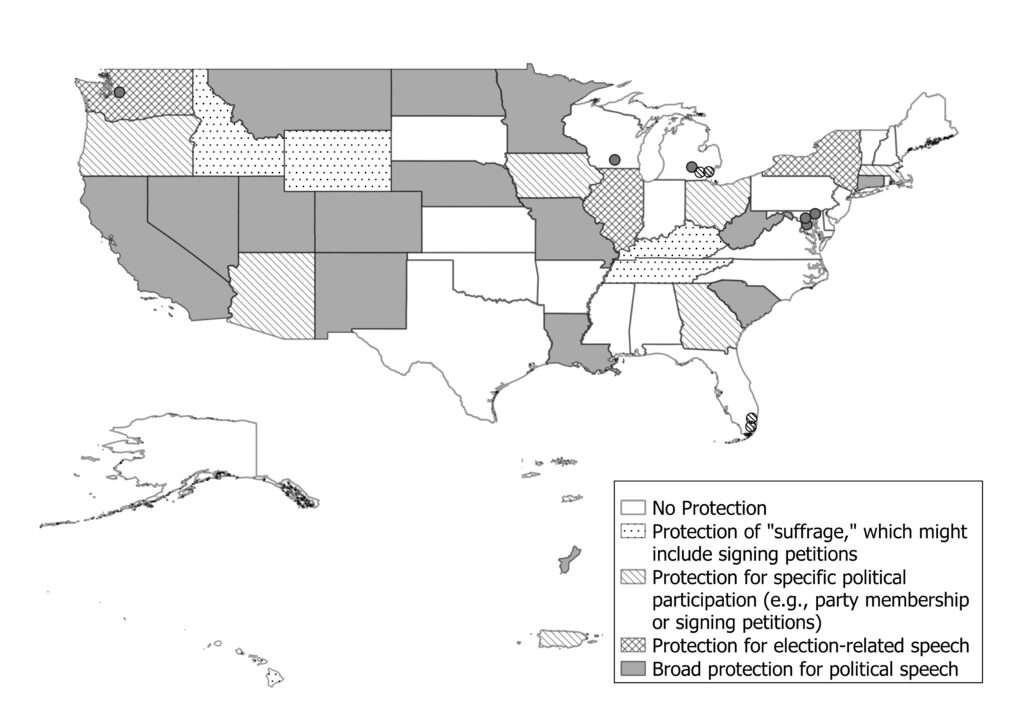
Binion's piece is fundamentally about the right and wrong of the situation; but if you're interested in whether it's legal for private employers to fire employees for such speech, see this article, which canvasses the state and local laws on the subject. Here also is a map that summarizes this (from this article); the dark gray states are the ones where this sort of firing is most likely to be illegal:
For a case bearing on whether government employers may fire employees for saying, after an assassination attempt on the President, "If they go for him again, I hope they get him," see Rankin v. McPherson (1987); the Court there held that firing an employee for such speech violated the First Amendment.
To be sure, Rankin is not completely on point: On one hand, it dealt with on-the-job speech, and off-the-job speech would presumably be even more protected. On the other, the speech was just to a friend, and the Court noted that "Nor was there any danger that McPherson had discredited the office by making her statement in public," though perhaps this was just because McPherson was an employee at a law enforcement office—it's not clear that a concern about discrediting the office would apply to, say, a firefighter. But whatever the legal analysis might be, Binion's ethical analysis strikes me as correct.
On Day 3 (July 11) of the law professor mission to Israel, we had the opportunity to watch the 45-minute film of the Hamas atrocities on October 7 that was created primarily from the GoPro cameras worn by the Hamas soldiers, but also includes footage from security cameras and CCTV. During the attacks, the Hamas soldiers uploaded their GoPro videos to the internet and blasted them out on social media to hundreds of thousands of Israelis' social media accounts on October 7. The IDF spokesperson unit spent two days taking thousands upon thousands of these videos down from the internet.
I will not describe or detail any of the film's horrors, and so you can read this post knowing that you will not be ambushed with a nightmare that will haunt you for the rest of your days. I will say the film is horrific. In fact, it's beyond horrific. But if one is to bear witness to evil so that one can better defend the good (Israel) and speak out against evil (genocidal antisemitism and supporters of this nihilism in the West), one must know the evil of which one speaks. Thus, I considered it important for me to see the film, but given the shocking and sickening content of this film, I don't begrudge anyone not watching it.
But not, unfortunately, for good reasons
Having heard Ingrid Andress' performance at the MLB Home Run Derby Monday night, I think we may now be able to retire the coveted trophy for Worst Rendition of the National Anthem at a Major US Sporting Event. Have a listen.
To my ears, it is considerably worse - more grotesquely out of tune - than the only real competition, Fergie's rendition at the 2018 NBA All-Star Game. [I have eliminated Roseanne Barr's spectacularly awful 1990 performance before a San Diego Padres game from consideration because she clearly wanted it to be awful, and that violates the rules of the competition.]
I don't mean to pile too much criticism onto Ms. Andress, who admitted after the performance that she had been drunk. She's got, obviously, a pretty serious alcohol problem - to get drunk before the most important performance, by far, of your life is a pretty terrifyingly self-destructive act. She has subsequently checked herself into rehab, and I genuinely wish her well, although the message she sent out on Instagram announcing her decision was not encouraging, and was meant, I hope, to be taken as sarcasm:
"I'm not gonna bullshit y'all, I was drunk last night. I'm checking myself into a facility today to get the help I need…. I'll let y'all know how rehab is! I hear it's super fun."
And speaking of national anthems, the recent international soccer tournaments in Europe and in the US revived my fondness for national anthems - there's nothing quite like hearing 30,000 or so people belting out La Marseillaise, or Il Canto degli Italiani, or O! Canada!, to get the blood running.
It makes me wonder whether there has ever been a good comparative study of the world's national anthems. They're pretty interesting, I think, insofar as they all - every last one, as far as I can tell - sound like they were written in Vienna or Dresden around 1880. There's a wonderful compilation of all of them here - pick a few at random and have a listen. China, Cameroon, El Salvador, Bahrain, Uruguay, Pakistan, …
It's quite bizarre, when you think about it. All of these countries - … Nicaragua, Senegal, the Comoro Islands, Malaysia, Tunisia, Argentina … - each with their own very distinctive domestic musical traditions, and each one has, as its "national anthem," something that sounds like it came out of Johann Strauss' workshop.
Obviously, much of the explanation for this astonishing homogeneity is that it is a holdover from colonial days. But many, many artifacts of the increasingly distant Colonial Era have been dispensed with - constitutions have been re-written, new languages have been declared "official," public school curriculums have been revised, etc. Why has nobody changed its national anthem? Might be an interesting subject for a book.
"[A]nyone who has used Facebook is aware that it is a platform that breeds spiteful and juvenile exchanges."
From Massachusetts Superior Court Judge John Pappas's opinion in Lucey v. Kinnon, decided last month but just posted on Westlaw; seems correct to me:
Mr. Kinnon's allegedly defamatory statement was made to … Mr. Lucey … in response to a comment Mr. Lucey made under a post Mr. Kinnon published on the Facebook Group, "Malden (MA) Politics." The group has over 2000 members, and "is a forum for discussion of local events and political issues relevant to Malden and the surrounding area." Mr. Lucey alleges that he and Mr. Kinnon have a history of online exchanges "dating back years," and that Mr. Kinnon has engaged in casting "obnoxious" insults at him, including those attacking his skill as an attorney and his intellectual prowess…. The [allegedly defamatory] comment, in full, reads as follows:
I am beginning to wonder if you are capable of reading. Might want to read again and anyone who would hire you as an attorney God Bless them, because someone must have taken the bar exam for you. Read below again for my answer to Mr. Bernstein, it might help you.
Read in its entirety, it is clear that Mr. Kinnon's comment is not making any factual assertions, but instead uses hyperbolized language meant to insult Mr. Lucey. For example, although Mr. Kinnon is clearly aware that Mr. Lucey is not illiterate, given his history of engaging in written exchanges with Mr. Lucey, Mr. Kinnon derisively states, "I am beginning to wonder if you are capable of reading." Mr. Kinnon then writes "someone must have taken the bar exam for you." This statement is clearly an exaggeration following Mr. Kinnon's obvious frustration with Mr. Lucey's previous comment.
"It is their care in all the ages to take the buffet and cushion the shock."
The recent computer outage reminded me of one of my favorite poems, Kipling's The Sons of Martha. It has been at times, I'm told, an anthem of engineers; maybe it should be more broadly.
The poem is a reference to a Bible passage from Luke 10:38-42. (The passage, it turns out, immediately follows the story of the Good Samaritan, which is triggered by question from a lawyer—but that's the end of any legal connection.) Indeed, I would say it's something of a criticism of the passage, which runs:
[38] … [Jesus] entered into a certain village: and a certain woman named Martha received him into her house.
[39] And she had a sister called Mary, which also sat at Jesus' feet, and heard his word.
[40] But Martha was cumbered about much serving, and came to him, and said, Lord, dost thou not care that my sister hath left me to serve alone? bid her therefore that she help me.
[41] And Jesus answered and said unto her, Martha, Martha, thou art careful [i.e., full of cares] and troubled about many things:
[42] But one thing is needful: and Mary hath chosen that good part, which shall not be taken away from her.
Here then is the Kipling poem; my favorite parts are the first two lines of each stanza (except the last), but of course you have to read it all:
The Sons of Mary seldom bother, for they have inherited that good part;
But the Sons of Martha favour their Mother of the careful soul and the troubled heart.
And because she lost her temper once, and because she was rude to the Lord her Guest,
Her Sons must wait upon Mary's Sons, world without end, reprieve, or rest.It is their care in all the ages to take the buffet and cushion the shock.
It is their care that the gear engages; it is their care that the switches lock.
It is their care that the wheels run truly; it is their care to embark and entrain,
Tally, transport, and deliver duly the Sons of Mary by land and main.
Celebrate your independence with a subscription to Reason magazine, your most trusted source of honest, insightful news and analysis.