
Monday Open Thread
What's on your mind?

Mostly law professors | Sometimes contrarian | Often libertarian | Always independent | Est. 2002
What's on your mind?
The N.Y. Times reports that about 95.0% of all votes have been counted, with Harris at 71.7M and Trump at about 75M:

These 95.0% amount to 148.8M, so that means there are about 7.8M uncounted (that's 148.8M / 0.95 * 0.05), for a total number of about 156.6M. (All numbers are approximations.)
Most of those not yet counted votes are in California (4.2M there, since 25% of the votes there remain uncounted); quite a few are from Oregon, Washington, Arizona, Utah, and Colorado. These on balance tilt Democrat; so far California and Washington have split roughly 60-40 Democrat, though the other states are closer to 50-50 (and Utah has been splitting 60-40 Republican). This suggests that the 7.8M will split roughly 4.3M Harris to 3.3M Trump or thereabouts. Put together that means a likely final total of roughly 76M Harris and 78.3M Trump or so, give or take a few hundred thousand. (Maybe 2.3M or a bit more will go to third-party candidates.)
Again, when thinking about the 2020-to-2024 vote gulf, it's important to compare the 2020 final results with projected 2024 final results (or just wait until the 2024 final results are in), rather than 2020 final results with early 2024 results.
The article is here; the Introduction:
Every spring, hot button issues of social policy are debated on the pages of corporate proxy statements. Recent examples include abortion rights, climate activism, discrimination against racial and religious groups, and transgenderism. In these debates, the affirmative side is taken by a shareholder putting forward a resolution for reform—a "shareholder proposal"—while the negative side is taken by the company, which seeks to persuade its shareholders to reject the proposal. The company publishes and disseminates the resolution along with the arguments of both sides in its annual proxy materials.
Shareholders submitted 889 proposed resolutions in 2023. A substantial majority of these (582 or 65%) raised questions of social policy. Of the social policy proposals, 188 (32%) urged action relating to climate change and greenhouse gas emissions. Meanwhile, 394 (68%) focused on other social issues, such as racial equity audits and diversity, equity, and inclusion (DEI) initiatives. Slightly more than half of all the shareholder proposals received by corporations in 2023 were ultimately voted upon. In some cases, proposals failed to reach the ballot because corporations successfully excluded them. More often, proposals were withdrawn in connection with a negotiated settlement in which the corporation agreed to some of the proponent's requests. Of the 483 shareholder proposals that went to a vote in 2023, 25 (5%) passed.
Why do American companies become laboratories of democracy during proxy season? Is it that managers sense some competitive advantage in turning their attention from the product market to the marketplace of ideas? Or is it that investors are more likely to subscribe to public offerings if the company promises them an opportunity to speak their mind on social issues? Neither is the case. While it may be true that some corporations have chosen to lean in to the culture wars, it is equally certain that many corporations would prefer to lean out and avoid such issues altogether, fearing distraction or backlash. But companies cannot opt out of shareholder proposals. Their participation is compelled by the government.
Companies publish and distribute shareholder proposals because Rule 14a-8 of the Securities and Exchange Commission compels them to do so. Subject to a set of exceptions and exceptions-to-the-exceptions, the shareholder proposal rule requires corporations to include shareholder resolutions and supporting statements of up to 500 words in the company's own proxy materials. Publication of proposals raising controversial social issues are compelled either (1) under an exception to the "relevance" exemption, requiring companies to include proposals that "raise issues of broad social or ethical concern related to the company's business" even if they are not quantitatively relevant to corporate revenues or assets, or (2) under an exception to the "ordinary business matter" exemption, requiring companies to include proposals that "raise[] issues with a broad societal impact, such that they transcend the ordinary business of the company." These exceptions have swallowed the rule to the point that the majority of shareholder proposals now raise controversial issues of social policy.
But government compulsions to speak are constitutionally suspect. The First Amendment of the U.S. Constitution prohibits the government from "abridging the freedom of speech," and Supreme Court doctrine has long held that speech is abridged both when it is restricted and when it is compelled. Rule 14a-8 compels speech. Through it the SEC, an agency of the government, compels corporations to speak on social controversies. While the government does not choose the words spoken—the matters are put forward by shareholders, not the government—the government compels speech by requiring companies to publish shareholder proposals that comply with the SEC rule. Moreover, the structure of the rule and the choices made by the SEC in applying it regulate the content of speech in a way that is not "content-neutral." This raises the question: Does Rule 14a-8 violate the First Amendment?
N.Y. law provides for some judicial review of private universities' actions, when a university fails to "adhere[] to its own published rules," thus rendering its "actions were arbitrary or capricious"; but that standard, the court holds, wasn't met here.
From last week's decision by trial court judge Nicholas Moyne in Columbia Students for Justice in Palestine v. Trustees of Columbia Univ.:
After reviewing the record, the Court finds that Columbia University's decision to temporarily suspend the petitioners from their status as recognized student groups was neither arbitrary or capricious, irrational or in violation of clearly established University policies. Accordingly, the petition is denied and the cross-motion to dismiss the petition is granted.
All students and student groups at Columbia are subject to and required to comply with Columbia's Special Events Policies which govern, inter alia, when, where and how events on campus, including protests and demonstrations, may be held and what notice needs to be given to university officials prior to the commencement of any student group events, demonstrations or protests. Following the horrific events of October 7 and the intense divisions and controversies that occurred in their aftermath, Colombia University amended its policies because, in its words, the "University has an obligation to ensure that all members of our community can participate in their academic pursuits without fear for their safety."
The Special Events Policies has previously required that only recognized student groups can organize events and that they must work with administrators in advance to reserve space and secure approval for campus events. After October 7, changes were made to the policies concerning the consequences of non-compliance. For example, a new provision was added to the University Event Policy on October 24, 2023 to provide that "University groups … who proceed with Special Events, Vigils or Demonstrations that have not been approved … will be subject to discipline and sanctions," expressly warning that "[s]tudent groups proceeding without approval may lose the right to sponsor events and/or become ineligible for University recognition or funding."
Ruminating on what happened last week.
Well, we (see below) did it! We elected the guy who had tried to overthrow the duly elected government of the United States to be our President. Like a lot of people, I'm trying to understand what that means, both for the moment and going forward.
Bret Stephens, in a NY Times essay Eugene referred to in an earlier post, chides Harris supporters who rationalize their loss to a man "they saw as a twice-impeached former president, a felon, a fascist, a bigot, a buffoon, a demented old man …" by adopting the theory that "a nation prone to racism, sexism, xenophobia and rank stupidity fell prey to the type of demagoguery that once beguiled Germany into electing Adolf Hitler." This, Stephens asserts, illustrates the "broad inability of liberals to understand Trump's political appeal except in terms flattering to their beliefs, [which] is itself part of the explanation for his historic, and entirely avoidable, comeback."
OK, fine. Let's have that conversation. Let's put aside all talk of racism, sexism, xenophobia, homophobia, or stupidity. What happened on Tuesday was not about any of that; it was about taxes and trade, and/or the overall state of the economy, and/or the rights of trans people, and/or immigration policy, and/or access to abortions, and/or vaccine mandates, and/or any of all of the many other issues on which Harris and Trump had vastly differing views.
My problem with that is that I can't get past the threshold. As I've said before, for me, involvement in, or overt support for, an attempt to subvert the peaceful transfer of executive power through unconstitutional extra-judicial means is absolutely disqualifying in a presidential candidate.
[I should add that I am not talking about a legally-enforceable disqualification, such as the one enacted as part of the 14th Amendment, or criminal liability, or anything of that nature. I'm talking about my vote - my personal determination of who I think is fit to lead the country.]
I had always thought, to the extent I had occasion to think about it, that pretty much everyone felt pretty much the same way. There's not much, in our system of government, more fundamental than the idea that we get to choose those who govern us, and that our choice, whatever it may be, will be respected. We can throw the bums out, as needed. We express our choice(s) through the ballot box. We have a process, worked out over the last 200+ years, to count up the votes and to declare a winner and a loser, at which point the losers make way and the winners take over. It's pretty basic and pretty straightforward, no?
Obviously, not everyone feels the same way. Many of my fellow-citizens - perhaps even a majority - disagree with me. I'm trying to understand how that can be true. Just as a matter of logic, it must be that either (a) they don't think that Trump was a participant in the scheme to overturn the 2020 election results, or (b) they don't think that participation in such a scheme is disqualifying in this sense.
Precisely because the American people are not stupid, I rule out (a). I mean, come on. It's not like Trump has backtracked, disavowed the scheme, apologized, or, as far as I can recall, said a single critical thing about the members of the armed mob that broke into the Capitol (reserving his criticism for those who refused to carry out their parts in the scheme, like Mike Pence and Brian Kerr). He was with them in spirit - the pressure on Pence, the fake electors, the phone calls to State election officials, the failure to step in for four hours after the Capitol perimeter was breached, . . . Everybody gets what was going on, right? He did what he did, and he's proud of it.
So it must be (b).
That, I admit, makes me pretty nervous. I don't know what kind of country we have if we no longer have a shared vision of the inviolability of our election results. I guess I'm about to find out.
Is this a case of "trying to understand Trump's appeal in terms that are flattering to my beliefs," in Stephens' terms? Maybe. I'll let you decide.
So that's the "it" in "we did it." Let me say a few words about the "we."
Americans are proud - justifiably - of living in a place where "we, the people," get to decide who our rulers are going to be. We weren't the first to come up with the idea, but we were the first to implement it on a large geographic scale, and the processes we have developed to do that, imperfect though it surely is, has stood us in reasonably good stead for over 200 years. We get, more or less, the government we want, and we resolve our differences about precisely what it is that we want through the ballot box.
Obviously, I didn't elect him. But he didn't steal the election (though I strongly suspect that he would have tried, as he tried before, had he needed to). He didn't even need the built-in small-state bias of the Electoral College. As far as I can tell, he won, fair and square.
So that's who we are: The kind of people who would elect this guy to be our President. He speaks now for all of us, including those of us who can't stand him and didn't vote for him. That's the way it works.
So I suppose that means that I can't really complain if he brings about the kind of change he talked about: imposing high tariffs on imported goods, deporting large numbers of undocumented immigrants (and policies designed to stanch the flow of new immigrants into the country), dismantling Obamacare, no new restrictions on armed weaponry, elimination of the child tax credit, relaxation of environmental standards across-the-board, dismantling the federal civil service and the Department of Education, . . . That's what we want, so it's going to be hard to complain if/when he tries to give it to us - at least, not if he does so via legal and constitutional means.
To my way of thinking, it's a nightmare scenario. But it's apparently what we want, and it might well be what we get. I don't think the American people will like living in that country. I could be wrong about that, but I'm already looking forward to the 2026 midterms.
From Zundel v. City of Jamestown, handed down Thursday by the North Dakota Supreme Court (opinion by Justice Jerod Tufte):
… Thomas Zundel attempted to buy a firearm, but the purchase was denied when a background check using the National Instant Criminal Background Check System (NICS) revealed a 1990 simple assault charge in Jamestown Municipal Court. NICS showed the charge was continued for a year and Zundel was ordered to participate in counseling. NICS failed to confirm a conviction. Zundel filed a voluntary appeal of the NICS denial with the FBI. The FBI determined the 1990 case was a "potential prohibitor" and told Zundel to contact the Jamestown Police Department to obtain the missing information on the charge within 88 days or the file could not be processed.
Zundel attempted to obtain records from the Stutsman County Clerk of Court and the Jamestown Municipal Clerk of Court, but both responded that they had no records relating to his arrest or conviction or any other records of a court case. He also requested records from the Jamestown Police Department, Jamestown City Attorney, North Dakota BCI, and FBI. None had any records beyond the criminal background check reflecting a 1990 arrest by the Jamestown Police Department for simple assault annotated as "CONTINUED FOR 1 YR PENDING COUNSELING OUTCOME." Zundel explained to the FBI that his search for records had failed and requested a favorable adjudication.
The FBI denied the appeal, holding the absence of a final disposition meant the potentially prohibiting record could not be nullified.
The court refused to just close the assault case outright in a way that would restore Zundel's rights:
Zundel … argues this Court should declare he was not convicted of domestic violence in relation to his November 1990 simple assault charge and his right to possess a firearm was not legally impaired…. Zundel asks us to resolve whether the facts underlying the Jamestown Municipal Court simple assault case from November 1990, or the nature of any resulting conviction, involved domestic violence without any evidence in the record on which we could make such a finding.
But it orders the lower courts to search and, if necessary, supplement the records:
From Judge Arun Subramanian's opinion Friday in U.S. v. Combs (S.D.N.Y.):
On October 20, 2024, defendant Sean Combs moved for an order prohibiting prospective witnesses and their attorneys from making extrajudicial statements that he argues will substantially interfere with his right to a fair trial. In terms of who those "prospective witnesses" are, Combs clarified that the category includes "all those who claim to be victims." …
Combs's authorities don't support a gag order applicable not only to trial participants, but also to any alleged victim and their lawyer. Local Rule 23.1 doesn't authorize this kind of relief. The limitations of that rule don't even apply to witnesses, let alone prospective ones that haven't yet been identified. They certainly don't apply broadly to any alleged victims and their lawyers.
Even Local Rule 23.1(h), which allows the Court to issue "special order[s]" related to extrajudicial statements, only applies to "parties and witnesses." And to impose a special order, the Court must consider whether it "will be necessary to ensure an impartial jury and must find that other, less extreme available remedies, singly or collectively, are not feasible or would not effectively mitigate the pretrial publicity and bring about a fair trial." Among the remedies that the Court is required to consider are "a searching voir dire, emphatic jury instructions, and sequestration of jurors," matters that Combs hasn't addressed. A "gag order" under Rule 23.1(h) is an extreme remedy "to be issued only as a last resort." What Combs seeks goes even further.
Combs's Sixth Amendment authorities don't support his proposed order either. In Sheppard v. Maxwell (1966), the Supreme Court observed that the "trial court might well have proscribed extrajudicial statements by any lawyer, party, witness, or court official which divulged prejudicial matters," but it did not indicate that blanket restrictions on potential witnesses, or even more broadly, all alleged victims, would be appropriate. In Neb. Press. Ass'n v. Stuart (1976), the Court only suggested that "trial courts [could] in appropriate cases limit what the contending lawyers, the police, and witnesses may say to anyone."
Why constitutional theory needs more theory.
Recently I posted a new paper on SSRN, "In Praise of Ignoring Facts." It's a critical review of Jack Balkin's book Memory and Authority: The Uses of History in Constitutional Interpretation, part of a symposium on the book organized by the William & Mary Bill of Rights Journal. Here's the abstract:
Lawyers and judges invoke history for lots of reasons, some of them purely rhetorical or instrumental. That's why we academics have to hold their feet to the fire, sifting through their arguments for the implicit theories that treat some historical facts as more significant than others. Yet much modern con-law literature takes precisely the opposite tack, criticizing this effort at theoretical abstraction and parsimony as a form of intellectual blinders.
Jack Balkin's Memory and Authority offers an admirable account of how American lawyers make use of history. But treating every use of history, including every instrumental use, as equally authoritative for the law is fatal to any theoretical project. That includes Balkin's own "thin" theory of constitutional law, which stretches itself past the breaking point to accommodate the changing winds of social movements or modern demands for legitimacy. Instead, constitutional theory needs more theory: less court- or lawyer-watching and more effort to distinguish the content of the law from everything else that shapes what courts and lawyers do.
And from the introduction:
An Introduction To Constitutional Law Video Library: Lochner v. New York (1905), Muller v. Oregon (1908), Buchanan v. Warley (1917), Adkins v. Children’s Hospital (1923), Meyer v. Nebraska (1923), Pierce v. Society of Sisters (1925), O’Gorman & Young, Inc. v. Hartford Fire Insurance Co. (1931), Nebbia v. New York (1933), West Coast Hotel v. Parrish (1937), United States v. Carolene Products (1938), Williamson v. Lee Optical (1955)
Q: Judge Amul Thapar of the Sixth Circuit recently criticized the law clerk hiring boycott that you and others launched earlier this year against Columbia. Judge Kevin Newsom of the Eleventh Circuit made similar criticisms on a podcast hosted by The Dispatch. On the other hand, Judge Matthew Solomson of the Court of Federal Claims has been quite vocal in defending your efforts, including an extended interview with me here. Other than joining the judges' letter, I don't think you've said anything publicly about Columbia to date. Would you like to say anything here, just as Judge Solomson did?
Sure, but let me start by explaining why I haven't been speaking about the boycott. I gave my speech about Yale in 2022, and about Stanford in 2023. At that time, Judge Solomson publicly stated that he didn't agree with the boycott. Then, earlier this year, as conditions at Columbia worsened following October 7, he called me out of the blue and asked if I would consider extending the boycott to Columbia. I responded that, if he wanted to lead such an effort, of course I would support him.
I've been very happy for Judge Solomson to take the lead. He has demonstrated inspiring leadership. There's absolutely nothing wrong with people changing their minds. Indeed, I applaud and admire him for doing it—just as I deeply admire Judge Lisa Branch of the Eleventh Circuit for being the first to jump in. I sincerely hope others will do the same.
It's in that spirit that I wish to warmly welcome Judge Thapar to the conversation. He's made clear that it's absolutely appropriate for judges to be troubled about what's happening on campus, and to want to do something about it. We're just negotiating over terms at this point.
He proposes to have donors and legislators do the heavy lifting of divesting from intolerant institutions. I'm delighted, of course, for any citizen to take action to protect our country against the bigotry and intolerance being spread by certain institutions.
What I'm not interested in doing, however, is passing the buck. Why shouldn't judges stand up and take responsibility as well? Why can't we do both?
My colleagues say they worry about the impact of a boycott on individual law students. I'll confess that I have never understood this argument. Because it's a losing attitude. We should have a winning attitude. If we only focus on losses if a boycott fails, then no one would ever boycott. That's not how rational people make decisions. Rational people look at the benefits of success as well as the costs of failure. They also consider the probability of success vs. failure. As I tell my law clerks, there are two types of people in the legal profession—fighters and climbers. Fighters always assume that we have a chance to win. And smart fighters make rational, intelligent decisions about when to fight.
So imagine this: If a dozen or two dozen federal circuit judges all took this action, how would these schools respond? Would they say, well, that's okay, our students will just go to law firms, they'll find other places to work. Or will they care about clerkships?
I'd submit that it should cost essentially nothing to take this action. Enough of us would have a major impact. Schools would stop the intolerance to regain the prestige. And there would be no cost to anyone as a result. Indeed, Lisa and I have both heard from a number of folks—at Yale and elsewhere—who say that just the two of us have made a meaningful impact.
For many years, Justice Brennan hired exclusively from Harvard. Then he boycotted Harvard (for far less publicly spirited reasons—e.g., he didn't like how Harvard professors treated him and his work). After boycotting for three years, he eventually got what he wanted from Harvard (public displays of respect). So he went back to hiring from Harvard (although much less frequently). See Stephen Wermiel, Justice Brennan and His Law Clerks, 98 Marquette L. Rev. 367, 372 (2014); Owen Fiss, Pillars of Justice 46 (2017); Seth Stern & Stephen Wermiel, Justice Brennan 204-5, 276-77 (2010).
Justice Brennan isn't the only Justice to view law clerk hiring as a means to a broader end. During oral argument in the Harvard case, Justice Kagan noted that many judges make special efforts to hire racially diverse law clerks out of a desire to further social change. Surely other judges can adopt hiring policies out of a desire to combat antisemitism and religious bigotry at certain colleges and universities.
Look, let's not pretend that every federal judge looks at clerkship applicants without regard to which law school they went to. Justice Scalia said publicly that he would never hire a law clerk from Ohio State—even though he personally knows extraordinarily well qualified students who graduated from Ohio State.
The only question is which schools we choose to favor or disfavor, and why. Countless judges hire only from certain schools, or have a strong preference for their alma mater, or prefer schools in their geographic region. I hire from a broader range of law schools than many of my colleagues. But I'm not excited about hiring from law schools that welcome intolerance.
Q: Speaking of academia: You recently said that, "in the six years that I've been a judge, I've come to an understanding about academic commentary about the Supreme Court: Too many academics regard the views of half the country as garbage." Would you like to explain? Read More
11/11/1975: Virginia State Bd. of Pharmacy v. Virginia Citizens Consumer Council, Inc. argued.
I look forward to four more years of outrage based on misunderstandings of the Constitution.
We are only a few days removed from Trump's victory in the 2024 election, and his social media is already causing consternation about constitutional clauses.
Today, Trump tweeted:
Any Republican Senator seeking the coveted LEADERSHIP position in the United States Senate must agree to Recess Appointments (in the Senate!), without which we will not be able to get people confirmed in a timely manner. Sometimes the votes can take two years, or more. This is what they did four years ago, and we cannot let it happen again. We need positions filled IMMEDIATELY! Additionally, no Judges should be approved during this period of time because the Democrats are looking to ram through their Judges as the Republicans fight over Leadership. THIS IS NOT ACCEPTABLE. THANK YOU!
As could be expected, the Washington Post completely misconstrued the argument here:
Trump, who last year promised that he will be dictator "for Day One" of his presidency and has repeatedly expressed admiration for authoritarian leaders, insisted that the next Senate Republican leader make it possible for him to fast-track his nominations over any opposition.
Writing on Truth Social on Sunday, Trump said: "Any Republican Senator seeking the coveted LEADERSHIP position in the United States Senate must agree to Recess Appointments (in the Senate!), without which we will not be able to get people confirmed in a timely manner."
In April 2020, frustrated with the Senate's speed in confirming his nominees, then-President Trump threated [sic] to take the unprecedented step of unilaterally adjourning Congress to make recess appointments. Next year, Republicans are on track to have at least 53 senators, a comfortable majority to approve nominations, but Trump seemed to indicate that wasn't sufficient for his choices for federal jobs and judicial vacancies.
There are so many things wrong with this reporting.
First, there is no longer a judicial filibuster for executive branch appointments. Nothing would stop the majority party from confirming Trump's nominees with at least fifty votes, plus Vice President Vance's tie-breaking vote if needed. The reason why there may be delays would be due to Senate Democrats. As always, the minority party can use a range of procedural blocks to slow down the process, even if they cannot block the nomination outright. Trump's reference to votes taking up to two years reflects this sort of gridlock. The Recess Appointment Clause would only allow Trump to expedite appointing people if the minority party is throwing up roadblocks.
Second, in order for the President to make a recess appointment, the Senate must adjourn for (presumptively) ten days. I say presumptively, because Justice Breyer in Noel Canning couldn't have been bothered to provide a bright line rule. What does it take for the Senate to adjourn for ten days? The House would also have to agree for an adjournment of that length. Remember, one House cannot adjourn for more than three days without the consent of the other House. In other words, it would take a majority vote in the Senate, and a majority vote in the House, to create a recess of the requisite length. The Senate cannot allow Trump to make a recess appointment unilaterally. While confirming a nominee with fifty votes allows Senate Democrats to throw up procedural roadblocks, requiring the House's consent to adjourn creates even more opportunities for House Democrats to throw up procedural roadblocks. And the Republicans will likely have a razor-thin majority in the House. The Recess Appointment route does not seem that much simpler. More likely than not, if the House and Senate are an extended recess during the Summer or Christmas break, there would be no pro forma sessions, and Trump could make some recess appointments.
Third, there is nothing dictatorial about the the President and Senate using a process spelled out in the Constitution. The Recess Appointment Clause appears in Article II. If there is a recess of ten days, the President can make a recess appointment. Much fault lies with the Obama Administration, which attempted to make a recess appointment during the three-day breaks between pro forma sessions. That move was rejected 9-0 in Noel Canning. If President Trump makes an appointment during a ten-day break, he will have complied with Noel Canning. He would not be a dictator. Moreover, the Adjournment Clause is also in the Constitution. And Noel Canning cited that provision as a mechanism for the President to deal with congressional intransigence:
The Constitution also gives the President (if he has enough allies in Congress) a way to force a recess. Art. II, §3 ("[I]n Case of Disagreement between [the Houses], with Respect to the Time of Adjournment, [the President] may adjourn them to such Time as he shall think proper"). Moreover, the President and Senators engage with each other in many different ways and have a variety of methods of encouraging each other to accept their points of view.
[Update: I previously wrote that this quotation appears in Justice Scalia's Noel Canning concurrence; it appears in the majority.] The adjournment clause has never been invoked. I wrote about Trump's consideration of using it in April 2020. And in December 2020, a prominent progressive professor said Biden should use it. Hardball, as they say. Of course, the Court can revisit Justice Scalia's, and hold (correctly) that the vacancy must arise during the recess of the Senate. But until then, Trump is entitled to rely on the same Supreme Court precedents that all presidents can rely upon.
I look forward to four more years of outrage based on misunderstandings of the Constitution.
Donald Trump will have at least one less federal district court vacancy to fill.
In October 2023, Judge Algenon Marbley of the Southern District of Ohio announced his intention to assume senior status upon the confirmation of his successor. The White House never nominated someone to fill Marbley's seat, however. Senators Sherrod Brown and J.D. Vance could not agree on a suitable replacement, so no pick was named.
Last week, Judge Marbley informed the White House of a change of plans. Judge Marbley no longer intends to take senior status, presumably because he does not want Donald Trump to nominate his replacement.
Judge Marbley's decision means that Trump will have one less federal judicial vacancy to fill -- and there are likely to be fewer judicial vacancies in the next four years than there were over the past four years or during Trump's first term.
Will Judge Marbley be the only judge to rescind a previously announced intention to go senior? We will see. According to the Administrative Office of the U.S. Courts, there are eight additional federal judges who have announced an intention to go senior and retire, but for which no potential replacement has been nominated. Some have identified a date certain upon which they expect to leave active service, others have not. There are an additional eleven judges who have announced an intent to leave active service for which the Biden White House has nominated a replacement.
In 1968 Chief Justice Earl Warren announced his intention to retire upon the confirmation of his successor, thinking that President Johnson would name his replacement, but it was not to be. The Senate refused to elevate Associate Justice Abe Fortas to Chief Justice, and so Homer Thornberry was not confirmed to the Court before the election. There is little doubt Chief Justice Warren was displeased that newly elected President Richard Nixon would name his successor, but he apparently thought it would be inappropriate to rescind his retirement announcement due to election results, lest his decisions appear too political. This gave Nixon the opportunity to appoint Warren Burger as Chief Justice, and the rest is history.
Featuring comments from Joshua Windham, and my response.
I recently posted about the open fields doctrine of Fourth Amendment law, the rule that it is not a "search" under the Fourth Amendment for the government to trespass on to your open field. In my post, I argued that the contrary rule argued by some advocates, that passage onto a person's land should be a search, conflicts with the text of the Fourth Amendment. The constitutional language specifically protects "persons, houses, papers, and effects," and it's hard to argue, as a matter of text, that an open field is one of those four enumerated things. Open land is not a person, a house, a paper, or an effect.
Joshua Windham of the Institute for Justice has written in with a response disagreeing with me. In the interests of furthering a debate on this topic, I have reprinted his response in full below. And after that, also below, I have replied and explained why I think Mr. Windham is incorrect. Who has the better argument? You decide.
First up, here's Mr. Windham's response:
Professor Orin Kerr recently defended the "open fields" doctrine on textualist grounds. That doctrine holds that the Fourth Amendment's ban on "unreasonable searches" does not extend to land beyond the curtilage of a home. The original—and current—basis for the doctrine is that land "is not one of those protected areas enumerated in the [text]." It seems Professor Kerr agrees: "[I]f you take text seriously," he writes, "the thing searched has to be a person, house, paper, or effect" to enjoy Fourth Amendment protection. And, because land is not on that list, "you don't get protection on the land itself."
I disagree. And not just as a "policy" matter, as Professor Kerr's article suggests. As I see it, the open fields doctrine rests on an acontextual reading of the phrase "persons, houses, papers, and effects." For reference, start with what the Fourth Amendment actually says:"The right of the people to be secure in their persons, houses, papers, and effects, against unreasonable searches and seizures, shall not be violated, and no Warrants shall issue, but upon probable cause, supported by Oath or affirmation, and particularly describing the place to be searched, and the persons or things to be seized."
Hold that text in your mind. We'll come back to it. For now, the point is simply that the Fourth Amendment contains 54 words—not merely the five words on which Professor Kerr focuses. So, what do I mean when I say that his reading is "acontextual"?
I mean that it fails to use context clues to understand what the text means—to grasp, not only what the text says (in semantic isolation), but how we're meant to understand and use it. Here's a simple example. If you walk into an elementary school classroom, you'll likely see a list of rules posted on the wall. And one rule you'll surely see is "keep your hands to yourself." How should we read the rule? Are handshakes and hugs forbidden, because that would mean touching others? Can students kick and throw things at each other, because the rule refers only to hands? No. These aren't sensible readings.
The better reading is that the rule does not exhaust, but evinces, a broader principle: Do not physically disrupt your classmates. We know that because the rule was adopted in a context: a classroom, where learning is the goal and peace is a precondition, and where it would be impossible to list out every kind of physical disruption that might break the peace. The rule doesn't specify hands because they're uniquely disruptive. It lists hands because punching is a paradigm case of the problem the rule seeks to solve. Kicking isn't listed, but if we read the rule in context, it's forbidden. Kids understand this (at least my wife, a teacher, tells me they do).
trying to get their point across by shouting louder in a language only they understand."
A great line from Chuck Lane (Washington Post). Just to be clear, it is easy to imagine Republicans doing the same in a future election.
The 2024 election results suggest just the opposite.
There was a constant theme in the #Resistance litigation during President Trump's first term in office: he is a bigot, and everything he does is tainted by bigotry. The prime example was the travel ban. Federal judges in Hawaii, Maryland, Brooklyn, and elsewhere gleefully cited President Trump's tweets to show that he had animus against Muslims. As I wrote at the time, they tarred Trump with the brush of bigotry. Similar reasoning was raised in the challenge to the cancellation of DACA. The New York Attorney General argued that the policy could not be wound down due to Trump's animus against Hispanics. The AG cited Trump's interview with Jorge Ramos, lines about "bad hombres," and countless other tweets. At the time, I wrote that even if these "comments should have given pause to his voters, courts cannot properly consider them in evaluating this policy."
Now, as the second term begins, the #Resistance is already starting to whirl again. But will these same animus arguments work? Can California and New York and Maryland once again argue that everything Trump does is tainted by bigotry against Hispanics and Muslim people? Is Trump perpetually tainted? I'm sure they'll try to make that argument. But there is some countervailing evidence. The 2024 election returns!
For starters, Trump won the most votes in Dearborn, Michigan, the city with one of the highest Arab populations in the country!
Unofficial results released by the city of Dearborn show that Mr. Trump won 42 percent of the vote in Dearborn, compared with 36 percent for Ms. Harris and 18 percent for the Green Party candidate, Jill Stein.
In 2020, similar results released after the election showed that Mr. Biden had won almost 70 percent of votes by Dearborn residents. . . .
This week, the sentiments of Arab and Muslim Americans in Dearborn were heard through the ballot. In interviews with The Times on Tuesday outside polling stations, voters backing Mr. Trump said they wanted to give him a chance to rein in wars across the world and bring peace to the Middle East.
Despite everything that we have been told over the past decade, a significant share of Muslim voters chose Donald Trump over Kamala Harris. Certainly they know more about Muslim animus than some cloistered judges on the Acela corridor.
The trends were even greater for Hispanic voters:
President-elect Donald Trump was backed by 46% of Latino voters Tuesday, surpassing Ronald Reagan and George W. Bush to win the biggest share of the national Latino vote by a Republican presidential contender in modern times, a new exit poll shows.
These mini vignettes concretize how much the #Resistance movement overplayed their hand. Calling Trump a bigot every day for a decade has had no actual impact on voters. None. The Times observed regarding Muslims:
Many voters brushed aside comments Mr. Trump has made that were critical of Muslims, and some of them cited his willingness to visit Dearborn and bring prominent local Muslim leaders onstage at a recent campaign rally as evidence of an olive branch.
And Axios reported about Hispanics:
Latino voters appeared to look beyond the racist rhetoric Trump's used to describe undocumented immigrants in an election in which the economy and inflation were top concerns of many voters.
All of the attacks on Trump were mostly noise. It was Lawfare designed to cripple a presidency. Yet during the first term, courts sopped this slop up.
What happens in Trump's second term? You might say that courts should not take cognizance of electoral returns. I agree, and I'll raise you one more: courts should have never performed a "judicial psychoanalysis of [Trump's] heart of hearts," to quote McCreary County. But psychoanalyze they did. And if judges are going to go off script, they may as well consider improper evidence that supports Trump.
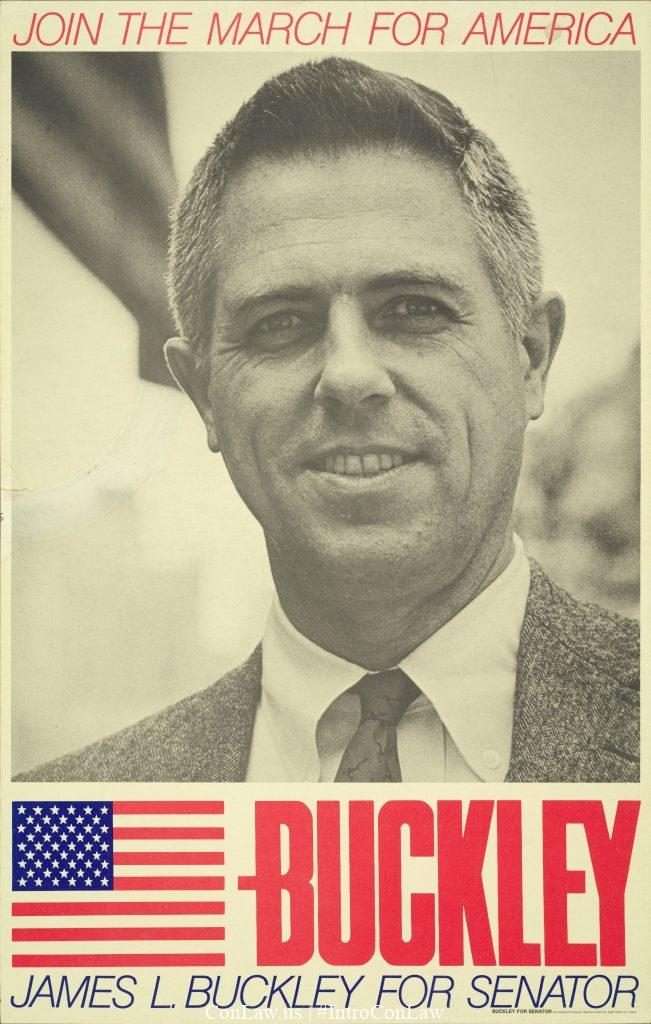
11/10/1975: Buckley v. Valeo argued.
From Judge Terrence Berg's opinion on Election Day in ACLU of Mich. v. Does 1-6:
The ACLU asserts that Defendants are actively engaged in activities to threaten, intimidate, harass, and deter voters from participating in the 2024 election. The ACLU submitted four affidavits from Michigan residents in support….
Raimi served as a poll watcher on Election Day in four different locations. At the polling location in Derby Middle School, Birmingham, Raimi saw three men with cameras who had been filming people going into and out of the polling station. One of them was wearing a baseball cap that said "DON'T ANNOY ME, I'M AN ASSHOLE. MY RIGHTS DON'T STOP WHERE YOUR FEELINGS START." The other two were described as wearing "patriotic" shirts. Raimi told them they could not film people coming in and out of a polling location, but they responded that it was their First Amendment right to film.
Other people passing out flyers near the polling station told Raimi that the three men had blocked a family from leaving the polling station, despite the family asking them not to record them. At the polling station at Oakland Schools Technical Campus Southeast, in Royal Oak, Michigan, Raimi saw one of the same three men who had been filming. The man was now wearing a gaiter that covered his nose and mouth and was accompanied by three other individuals who appeared intimidating to Raimi. Raimi indicated the individuals had cameras and were filming the polling location.


New from Reason: a look into what Javier Milei has accomplished and what it will take to make the most of Argentina’s window for real change. Out now for subscribers.

