The Volokh Conspiracy

Mostly law professors | Sometimes contrarian | Often libertarian | Always independent | Est. 2002

The Volokh Conspiracy

Free Speech

State Constitution Tool

A great free resource for lawyers, judges, academics, and students doing cross-state constitutional law research.

|

Check it out, at https://stateconstitutiontool.org (from American Juris Link); the site lets you easily find state constitutional provisions related to a particular topic, and then compare them.

Thus, for instance, say you're writing about a state constitutional right to bear arms, free speech, open government, privacy, etc. You can select that option, and then either select "all states" or some set of states in which you're interested. That will then show you those provisions in all state constitutions, and let you compare them further, or search their text for particular keywords.

Each state, of course, has its own constitution, and many provide more rights than the federal Constitution does (or provide the same rights but with different, and potentially more capacious, language). They also have very different sorts of non-rights provisions, for instance statutory single-subject rules, prohibitions on certain kinds of special laws, and more.

The Tool is focused on text; users will still need to do their own caselaw research about how various textual provisions have been interpreted. But the text is the first place to start (among other things because it can help show which other state provisions are similarly written, and can thus help guide the user's followup research). And though it was just released very recently, it has already been cited in an Alabama Supreme Court concurrence:

Read More

Politics

Grey's Anatomy Goes Bad

|

Last Wednesday's decision by Chief Judge Thomas Kleeh (N.D. W. Va.) in Balise v. Jackson, stems from a "consensual romantic relationship" between plaintiff, a surgical resident at West Virginia University, and defendant, a registered nurse:

Plaintiff claims that he ended his relationship with Defendant in March 2022, and began a new relationship shortly thereafter. According to Plaintiff, Defendant contacted Ruby Memorial Hospital [where she worked and where Plaintiff had privileges -EV] in August 2022 and made false reports to administrators … that (1) Plaintiff is an alcoholic; (2) a previous medical condition during Plaintiff's residency was caused by alcohol abuse; (3) Plaintiff was treated for alcohol withdrawal with Benzodiazepines; (4) hospital residents, Dr. Ballou and Dr. Ringer, removed alcohol from Plaintiff's apartment more than once; (5) Plaintiff made patient care decisions based on Defendant's work assignments; and (6) Plaintiff encouraged Defendant to get tested for a sexually transmitted disease after their relationship ended. Defendant allegedly made these false statements, two weeks after Plaintiff got engaged, to injure Plaintiff's employment and profession….

Due to the allegedly false and defamatory statements, Ruby Memorial Hospital terminated Plaintiff's privileges and West Virginia University terminated Plaintiff's employment. Plaintiff further claims that Defendant's conduct hurt Plaintiff's professional relationship with West Virginia University and future employers.

Balise sued Jackson for defamation and tortious interference with business relations, and the court allowed the claim to go forward:

Read More

Free Speech

Mother's Derogating Father to Children Leads Appeals Court to Order That Father Get Custody,

Reversing a trial court decision that awarded custody to mother.

|

From In re Marriage of Shada, decided Wednesday by the Iowa Court of Appeals, in an opinion by Judge Gina Badding, joined by Judges Samuel Langholz and Michael Mullins:e

David … challenges the district court's decision to place their three minor children in Nicole's physical care. He argues that Nicole "is not supportive of the children's emotional needs, she is profane in her communications with the children and does not support the children's relationship with [him]." The court discussed those issues but found they were outweighed by Nicole's role as the children's primary caretaker. We disagree on our de novo review of the record and modify the decree to place the children in David's physical care….

Because David does not contest the district court's decision to deny joint physical care, the only issue before us is which parent should serve as the children's primary caretaker. Our focus in resolving this issue is the best interests of the children…. Generally, courts … the suitability of parents, whether the children will suffer from lack of contact with and attention from both parents, quality of parental communication, the previous pattern of caregiving, and each parent's support of the other.

With those factors in mind, David argues that he is the more suitable parent because Nicole's "attitude toward her daughters … is quite negative," she generally dismisses the children's feelings and mental health, she places the children in the middle of parenting issues, and she does not support the children's relationship with David….

Read More

Free Speech

Fired College Security Chief's Libel Claim (Over Allegations That He Mistreated Black Alumnus) Can Go Forward

The court concluded that the Director of Safety and Security at a small private college didn't qualify as a "public official or public figure" for purposes of the state's anti-SLAPP statute.

|

From McMurtrie v. Sarfo, decided Sept. 12 by the Tennessee Court of Appeals (Judge John W. McClarty, joined by Judges Thomas R. Frierson, II and Kristi M. Davis:

Plaintiff-Appellee John McMurtrie ("Plaintiff") was formerly employed as the Director of Safety and Security for Maryville College, a private liberal arts college. The parties agree that the college is not a part of any government or governmental agency. Plaintiff's job was to oversee campus security and supervise the college's five security guards who worked in rotating shifts. Plaintiff is a former Pennsylvania state trooper and former FBI agent, but he had retired from those jobs before accepting the position at Maryville College in 2018. Neither Plaintiff nor the other security guards who worked under him were sworn law enforcement officers. They were not deputized officers of any city or county. They did not carry weapons and had no authority to seize or arrest anyone. They would call the Maryville Police Department for issues needing law enforcement. The college's streets are generally open to the public.

On July 9, 2021, Defendant-Appellant Ransford Sarfo, a 2010 graduate of Maryville College who lives out-of-state, was visiting campus in a rented Toyota Prius. As Plaintiff approached a sharp turn in front of Carnegie Hall on Circle Drive, he observed the Prius stopped in the middle of the roadway with its four-way emergency flashers activated. It was steadily raining and dark due to storm clouds overhead, and Plaintiff believed the car posed a hazard due to its position in the roadway and the low visibility. Plaintiff then observed an arm emerge from the driver's side window as if to wave him to go around, at which point Plaintiff pulled his vehicle around and stopped beside Sarfo's Prius, on the driver's side. Sarfo glanced at Plaintiff. Plaintiff lowered his passenger side front window to speak with Sarfo, who did not engage with him. Plaintiff then tapped his horn. Sarfo then lowered his own driver's side window. Still seated in his vehicle, Plaintiff asked Sarfo "why are you parked in my driveway?" Plaintiff maintains that he meant this as a joke.

Sarfo replied that he had stopped for a photograph because he used to live in Carnegie Hall and that, as an alum, he had a right to be there. Sarfo also advised Plaintiff that he was having trouble shifting the rented Prius out of park. Plaintiff told Sarfo that he still needed to move his car out of the middle of the road and could continue taking photographs from one of the several open parking spaces in front of Carnegie Hall. Sarfo asked Plaintiff to identify himself, so Plaintiff told him his name and title of Director of Safety and Security. Sarfo, uncomfortable and offended, advised Plaintiff that this would not be the end of the matter. Plaintiff then drove away. He observed Sarfo drive away, too. The entire interaction between the two men lasted approximately one minute. There is no evidence in the record to suggest that Plaintiff knew Sarfo was a person of color when he first approached him about the improperly parked car.

The next day, Sarfo wrote an email about his interaction with Plaintiff to Maryville College's President, Bryan Coker, and six other college officials. The subject line was "MC Alumni harassed on campus." The email stated, in part:

I was deeply troubled that [Plaintiff] did not ask why my hazard lights were on, but assumed that I did not belong on the campus. In my years at the College, I never heard a staff member refer to any part of the campus as their property to justify their reasoning for another person to leave. It is very disheartening that I came back to a place I call home and was told by a staff member that I was on their property and asked to leave. I AM HURT! I will be reaching out to every alumni committee that I know to share my experience yesterday. Dr. Gerald Gibson would be deeply troubled to hear that we have staff members who do not understand the true meaning of community. I felt bullied, unwelcomed, and mistreated on the very college campus that I lived for 4 years. This is not the Maryville College that I knew in 2010.

Read More

Criminal Justice

It's Time to Confront Failures of Justice (Part II)

Serious crime and failures of justice aren't going away.

|

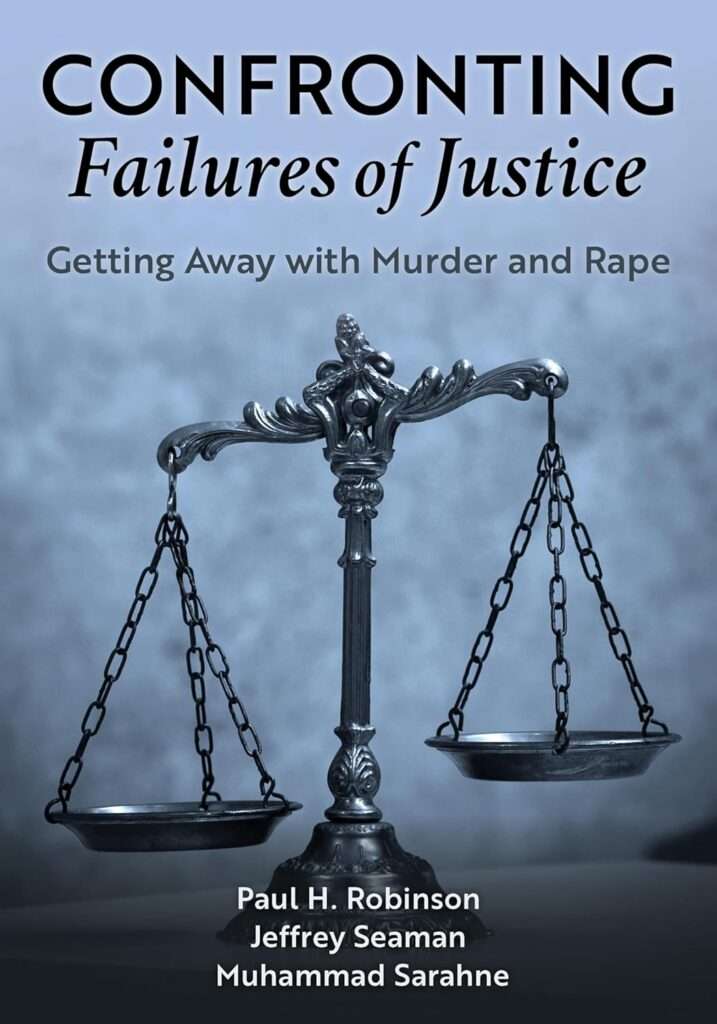
This is the second in a five-part series where we're guest blogging about our new book Confronting Failures of Justice: Getting Away With Murder and Rape, available here. In the last post we introduced the largely overlooked problem of failures of justice—instances where guilty offenders escape punishment entirely or receive a clearly inadequate punishment. But perhaps focusing on instances of unpunished crime is unnecessary because the problem is solving itself? One common response to worries over crime and lack of punishment is that it reflects perennial fearmongering about an ever-diminishing crime problem. Aren't we enjoying historically low rates of crime? Are failures of justice really a pressing problem for policymakers if serious crime is continually shrinking? We consider this argument about crime rates in our book's first chapter.

[T]he truth is that America is not enjoying historically low rates of crime, and serious crimes such as murder, rape, and aggravated assault are on the rise again, especially in urban jurisdictions, after falling from their peak in the early 90s. If the graph showing crime rate trends is framed to start in the 1970s, 80s, or 90s, this may suggest that America is enjoying historically low crime rates.

But, in reality, those three decades represented America's abnormal highs in crime. If one looks at the broader historical record, it becomes clear that when compared to before the devastating crime wave starting in the late 1960s, our current crime rates are higher today. For example, comparing the FBI's crime data reported by the Library of Congress from 1960 with 2019 (the last year the Library of Congress chose to report these inconvenient statistics) shows that total offenses per 100,000 increased from 1,887 to 2,489, a 32% increase. Violent crime increased even more dramatically, as shown in the table below. Modern violent crime rates are well above double the 1960 benchmark, mainly due to the explosion in aggravated assault:

Year Total Offenses
per 100,000
Violent Murder Forcible Rape Robbery Aggravated Assault
1960 1,887.2 160.9 5.1 9.6 60.1 86.1
2019 2,489.3 379.4 5.4 42.6 81.6 250.2

Read More

Sixth Circuit

Was the Federal Government's Defense of Race-Based Debt Relief for Farmers and Ranchers "Substantially Justified"?

An interesting question divides a panel of the U.S. Court of Appeals for the Sixth Circuit.

|

Today, in Holman v. Vilsack, a panel of the U.S. Court of Appeals for the Sixth Circuit split over whether the federal government was "substantially justified" in defending race-based debt relief for "socially disadvantaged" farmers and ranchers und the American Rescue Plan Act. The question matters because prevailing plaintiffs are not entitled to attorneys fees where the federal government's position was "substantially justified."

Judge Stranch wrote the majority opinion, joined by Judge Davis. She summarized the case as follows:

This appeal concerns a litigant's petition for fees under the Equal Access to Justice Act (EAJA). Plaintiff Robert Holman successfully obtained a preliminary injunction freezing a debt-relief program that used racial categories to remedy prior discrimination against farmers and ranchers. Following additional proceedings, but before final judgment, Congress repealed the challenged program. Holman now seeks fees associated with the litigation. The district court denied that request because, in its view, Holman was not a "prevailing party" under the EAJA. We neither adopt nor definitively reject that conclusion. Instead, we find that the Government's position during the litigation was "substantially justified" within the EAJA's meaning.

As Judge Stranch explains, prevailing parties under the EAJA are not entitled to fees if "the position of the United States was substantially justified." While rejecting the federal government's argument that courts should presume the standard is satisfied where (as here) the government, the court concluded that the government was sufficiently justified in defending the program's race-based classifications, even though such programs are subject to strict scrutiny.

the Government provided evidence of intentional USDA discrimination against socially disadvantaged farmers and ranchers generally, and buttressed that evidence with specific examples of intentional discrimination against nearly every group included in the socially disadvantaged category. That is categorically distinct from the evidentiary presentation in Vitolo, which did "not identify specific incidents of past discrimination" and relied entirely on "general social disparities." Id. at 361-62. Nor is this a case in which the Government provided "absolutely no evidence of past discrimination" against most of the categories included in a race-conscious program. J.A. Croson Co., 488 U.S. at 506 (emphasis removed). The notion that the Government was clearly required, at the preliminary injunction stage, to provide specific examples of intentional discrimination against every category included in a race-conscious program is also difficult to square with the Supreme Court's instruction that narrow tailoring does not demand perfection. See Fisher, 570 U.S. at 312; Grutter, 539 U.S. at 339; accord J.A. Croson Co., 488 U.S. at 510 (holding that "evidence of a pattern of individual discriminatory acts can, if supported by appropriate statistical proof, lend support to a . . . government's determination that broader remedial relief is justified."). It was Holman's duty to make a clear showing of likely success on the merits, Skrmetti, 83 F.4th at 471—but here, "a reasonable person could think" that the Government's evidence supporting Section 1005's constitutionality sufficiently undermined Holman's required showing. Pierce, 487 U.S. at 566 n.2. As a result, the Government's position on this aspect of the litigation was substantially justified.

Judge Larsen dissented, rejecting the government's claim its position was "substantially justified" and ultimately concluding the plaintiffs were prevailing parties under the EAJA. Her dissent begins:

A "prevailing party" in a civil case against the United States is entitled to fees and costs unless the government's position was "substantially justified" or "special circumstances make an award unjust." So, to get fees and costs, Holman must show that he is a prevailing party. Even if he does, though, the government may avoid paying if it shows that its position was substantially justified or that special circumstances make an award unjust. The majority, rightly recognizing that the prevailing-party issue is difficult, instead concludes that the government's position was substantially justified. I cannot agree. I first explain that disagreement and then tackle the more difficult question of whether Holman is a prevailing party. I then address the special-circumstances question. I conclude that Holman is a prevailing party because the preliminary injunction in this case turned primarily on the likelihood of success on the merits and afforded enduring and material relief; the government's position was not substantially justified because it was flatly at odds with controlling caselaw; and no special circumstances make an award unjust. Holman is therefore entitled to fees and costs, so I respectfully dissent.

On the specific question of whether the government's arguments were substantially justified, Judge Larsen writes:

The government, of course, does not have a compelling interest in remedying past discrimination that never happened. And when a government program seeks to remedy past discrimination against a number of different groups, it bears the burden to demonstrate "past intentional discrimination against the many groups to whom it grants preferences." Id. (faulting the "schedule of racial preferences detailed in the government's regulation—preferences for Pakistanis but not Afghans; Japanese but not Iraqis; Hispanics but not Middle Easterners—[a]s not supported by any record evidence at all"). The majority concludes that the government provided evidence of USDA discrimination against "many specific groups" defined as "socially disadvantaged." Maj. Op. at 9 (emphasis added). But what about the others? The government referred to no evidence of past intentional discrimination by USDA against Native Hawaiian and Pacific Islander farmers and ranchers. And the government relied only on broad assertions and statistical disparities to show discrimination against American Indian, Asian, and Native Alaskan farmers and ranchers. We might assume that such discrimination happened, but that is not enough. See Vitolo, 999 F.3d at 362 ("[W]hen it comes to general social disparities, there are simply too many variables to support inferences of intentional discrimination."). The government cannot claim a compelling interest in remedying discrimination without first showing that the discrimination happened. Croson, 488 U.S. at 505. That is reason enough to conclude that its position was not substantially justified.

That is not to say, in this preliminary posture, that the government made no compelling-interest showing. I agree with the majority that the government cited evidence of past intentional discrimination against Black farmers and ranchers. But if the government is going to use racially exclusionary measures as a remedy, the government's policy must be narrowly tailored to that particular interest. And "a policy is not narrowly tailored if it is either overbroad or underinclusive in its use of racial classifications." Vitolo, 999 F.3d at 362. Here, the program extends debt relief to farmers and ranchers in groups never shown to have been discriminated against. Giving Native Hawaiian farmers and ranchers debt relief cannot remedy past discrimination against Black farmers and ranchers. The glaring "mismatch" between means and ends is far too much for strict scrutiny to bear. Students for Fair Admissions, Inc. v. President and Fellows of Harvard Coll., 143 S. Ct. 2141, 2168 (2023). There is no "reasonable basis in law and fact" to find this policy narrowly tailored. Pierce, 487 U.S. at 566 n.2.

The majority contends that the Government was not "clearly required, at the preliminary injunction stage, to provide specific examples of intentional discrimination against every category included in [its] race-conscious program." Maj. Op. at 11. The Supreme Court says otherwise. To justify a "resort to race-based government action," the government had to show that it was "remediating specific, identified instances of past discrimination that violated the Constitution or a statute." Students for Fair Admission, Inc., 143 S. Ct. at 2162 (emphasis added). And the preliminary posture of the litigation does not absolve the government of its burden. See Gonzales v. O Centro Espirita Beneficente Uniao do Vegetal, 546 U.S. 418, 429–30 (2006). Absent at least some specific evidence of intentional discrimination against each racial group, the government cannot show a compelling remedial interest in benefitting that group. It has not shown there is anything to remedy. See Croson, 488 U.S. at 505–06. The government's position—that § 1005 should not be preliminarily enjoined—was not substantially justified because the government presented arguments "flatly at odds with the controlling case law." Griffith, 987 F.3d at 564 (quoting Taucher v. Brown-Hruska, 396 F.3d 1168, 1174 (D.C. Cir. 2005)) (cleaned up).

She concludes:

My best read of our cases is that Holman is entitled to fees and costs because he is a prevailing party, the government's position was not substantially justified, and no special circumstances make an award unjust. I therefore respectfully dissent.


Eminent Domain

My Chapter on "Land Use Regulation" For the Forthcoming Routledge Handbook on Classical Liberalism

It provides an overview of several major issues in land-use policy.

|

A draft of my chapter on "Land Use Regulation" for the forthcoming Routledge Handbook on Classical Liberalism (edited by Richard Epstein, Liya Palagashvili, and Mario Rizzo) is now available on SSRN. Here is the abstract:

Land use regulation is a major function of every government in the world. It raises many issues for classical liberalism. This chapter provides an overview of three of the most important areas of land-use policy: the use of eminent domain to forcibly take property for government-approved projects, regulations that restrict property owners' use of their land, and the relationship between property rights in land and migration restrictions.

Part I covers the use of eminent domain to take private property, and arguments for its limitation to genuinely "public" projects, as opposed to coerced transfers between private owners. Advocates of the latter argue they are needed to overcome "holdout" problems. But unconstrained use of eminent domain is a serious threat to property rights and hampers economic development.

Part II considers regulatory restrictions on land use that do not involve physical occupation of property. There is a longstanding debate about the value of such restrictions and whether the government should pay owners compensation. The most significant regulatory restrictions of this type in many nations are zoning rules restricting housing construction.

Finally, Part III provides a critical overview of property-rights rationales for restricting mobility, particularly in the form of international migration. Such theories justify severely constraining the liberty and property rights of both migrants and natives.

In addition to contributing to this volume on classical liberalism, I am also a contributor to Routledge Handbook of Libertarianism, edited by Jason Brennan, Bas van der Vossen, and David Schmidtz, and the Cambridge Handbook of Classical Liberal Thought, edited by M. Todd Henderson. Yet, I'm far from clear on what differentiates libertarianism and classical liberalism, or even if there really is a meaningful difference between the two. I explored that question in more detail in a previous post.

Supreme Court

Kannon Shanmugam on the Legitimacy of the Supreme Court

A prominent appellate practitioner responds to recent attacks on the justices and the Court.

|

Political attacks on the Supreme Court and individual justices are increasingly commonplace. Those who disagree with the court's rulings are not content with criticizing the Court's holdings, rationales, and reasoning. They increasingly target the Court itself, and question the integrity of the justices.

The Supreme Court bar, by and large, has been relatively quiet in the face of these criticisms. Last week, however, noted appellate practitioner Kannon Shanmugam delivered remarks at Duke Law School in defense of the Supreme Court's legitimacy. His remarks are notable, and have attracted attention (as in this WSJ editorial). [The whole speech is available here.]

Here is a taste:

I have been reluctant to give formal speeches about the law in general or the Supreme Court in particular. You see, I have always thought of myself as a practicing lawyer, not a pundit, and a country lawyer at that—the kid who improbably went from a trailer park in Kansas to a corner office on K Street. As a lawyer, my job is to play in the game; I leave the task of color commentary to others.

But today, I am breaking that habit to address the recent criticisms of the Supreme Court's legitimacy. I am doing so for a simple reason: because I revere the Supreme Court. I had the fortune of a lifetime to clerk at the Court for one of the greatest Justices of this generation or any other, Antonin Scalia. Since then, I have devoted my professional life to the Court, having spent the last 20 years arguing cases there. My wife and I even got engaged on the Court's front steps. And I firmly believe that, for all the challenges it faces, our Supreme Court is the finest high court in the world—a model for other countries to follow.

Perhaps for that reason, I have found the recent attacks on the Court to be dispiriting. At the risk of giving away the punch line to my remarks, I believe that the criticisms of the Court's legitimacy are unfounded. But more than that, I believe that attacks on the Court's legitimacy are dangerous—undermining public confidence in the Court and imperiling the rule of law. Finally, I believe that critics of the current Court would be better served engaging with the Court's work on the merits.

Now, I am aware that, in defending the Court, I will inevitably be subject to criticism myself: specifically, the criticism that I am kowtowing to the Court before which I practice. I hope that my track record refutes that criticism. I have never testified for or otherwise endorsed a Supreme Court nominee; in fact, with one exception for a longtime colleague, I have never signed a letter supporting a judicial nominee at any level. And I am at a stage of my career where I have little to gain personally from weighing in on these issues. But if I am criticized, so be it. I believe that those of us who practice regularly before the Court, and who thus have a unique familiarity with the Court and its work, should speak up when we believe the Court is being unfairly attacked.

As Shanmugam notes, attacks on the Court's legitimacy have potentially far reaching effects.

the greatest danger the attacks present is to the rule of law itself. The phrase "rule of law" has rather lost its meaning, with both sides in the political debate often using it simply as a shorthand for decisions with which they agree. But what the "rule of law" truly connotes is that we live in a society where all of us adhere to the law, including judicial decisions. Justice Breyer has frequently spoken about how remarkable it was that, when the Supreme Court effectively resolved the 2000 presidential election in Bush v. Gore, everyone immediately agreed to abide by it. And when I was first asked about whether the Supreme Court was "legitimate"—on a panel at NYU almost exactly two years ago—I expressed skepticism that there could ever come a time when elected officials or citizens would refuse to obey a Supreme Court decision.

But now, I am less confident. Over the last two years, we have seen the President criticizing the Court, in the wake of adverse decisions, in increasingly strident terms. I believe we are not so far from a President saying, in the manner of Andrew Jackson, "John Roberts has made his decision; now let him enforce it." And if you are unsure about that, ask yourself this question: if the Court ever has to resolve another presidential election, how confident are you that either side would simply acquiesce in the Court's decision?

And it's not just a question of presidential elections. One could imagine presidential defiance of Court decisions on a wide range of subjects. And it is perilous (and naive) to assume that any future defiance of a Court order would come from a progressive president resisting a conservative court.

The Court is hardly above criticism. Indeed, many of its decisions are quite deserving of criticism. Yet there is an important difference between saying the Court is wrong and claiming it is illegitimate.

Free Speech

Court Allows Plaintiff to Proceed Pseudonymously, Without Disclosing Name to Defendant

The court stresses, though, that "The complaint includes no claims brought solely on behalf of Plaintiff Doe," and "Based on the description of the claims, including when and where the alleged vandalism took place and photographs of the vandalism, it appears defendants could adequately defend themselves against the claims without knowing Plaintiff Doe's identity."

|

From Magistrate Judge Alice Senechal's decision in N.D. Human Rights Coalition v. Patriot Front, which was handed down under seal early this year and was then released (with modest redactions) in response to my motion to unseal (I'm writing about this now to accompany my post on the recent decision denying the motion to dismiss in the case):

Plaintiffs move, ex parte, for leave for "Plaintiff Doe" to proceed under a pseudonym in order to protect [redacted] physical safety and personal privacy.

The North Dakota Human Rights Coalition, Immigrant Development Center, and Plaintiff Doe filed a complaint on September 1, 2023, against the group Patriot Front, Thomas Rousseau, Trevor Valescu, and ten John Does. Plaintiffs allege multiple claims under 42 U.S.C. §§ 1985, 1986 and 1981, and claims of conversion, trespass, trespass to chattel, and civil conspiracy. According to the complaint, on September 3 and September 5, 2022, persons affiliated with Patriot Front trespassed onto and vandalized the International Market Plaza in Fargo, North Dakota. The complaint describes the International Market Plaza as a large indoor community space filled with African, Middle Eastern, and Latin American immigrant-owned shops, restaurants, and grocery stores.

According to photos included in the complaint, the front of the market and multiple murals were defaced with spray-painted Patriot Front links in September of 2022….

Historically, courts have allowed the use of pseudonyms if identification of a party would pose a risk of retaliatory harm to them. Specific past incidents of violence or vandalism have been found to show a risk of retaliatory harm. Fear of retaliatory action can be sufficient to satisfy this factor. This factor also takes into consideration innocent non-parties' risk of retaliatory physical or mental harm.

Read More

Libertarianism

My New Dispatch Article on Updating Libertarianism

Libertarian ideology remains generally sound. But I argue it could use a few updates.

|

NA

Today, The Dispatch published my article on updating libertarian ideology. The piece was inspired, in part, by insightful articles on the same topic by Randy Barnett and Timothy Sandefur, though my take on the issue is significantly different from theirs. Here is an excerpt from my article:

In a recent essay, Georgetown Law professor and libertarian legal scholar Randy Barnett offered a provocative indictment of American libertarianism. The movement needs several updates, he argued, most notably regarding what he considers to be abuses of private power. Instead of evolving, libertarianism according to Barnett has been "frozen in amber since the 1970s."

The state of libertarian thought may seem of little importance to anyone but committed libertarians (some of whom disagreed thoughtfully with Barnett's piece). After all, libertarians are far from being a dominant force in either major political party. The Trump-era GOP has repudiated libertarian ideas it previously had some affinity for, such as promoting free trade and cutting entitlement spending. Democrats are far from libertarian as well. The idea—propounded by some conspiratorially minded people on both left and right—that libertarians secretly dominate American public policy is patently false.

Though I don't agree with most of Barnett's assessment, I do think he's right that libertarianism still needs some updates—just not the ones he proposes. Its traditional core remains valid, even more so than ever in some ways. Nevertheless, libertarianism needs a better theory of the tradeoffs between natural rights and utility; it needs better strategies to address large-scale public goods problems; and it needs to recognize that nationalism is the greatest threat to liberty in most parts of the world today.

The rest of the article outlines the three areas where updates are needed in greater detail. I also explain why I think the core of libertarianism remains sound, and why I differ with Randy Barnett's view that libertarian thought has been "frozen in amber since the 1970s." Libertarian thinkers have, in fact, made important advances since then. But there is room for further progress, particularly (though not exclusively) on the three issues I highlight.

Race Discrimination

Federal and State Civil Claim Against Patriot Front for Alleged Vandalism of Fargo Market Can Go Forward

|

From N.D. Human Rights Coalition v. Patriot Front, decided Sept. 9 by Chief Judge Peter Welte (D.N.D.):

This case involves the vandalism of the Market [International Market Plaza in Downtown Fargo] in September 2022. As alleged, individuals affiliated with Patriot Front, which is alleged to be a "white supremacist group," trespassed onto the Market and spray-painted Patriot Front designs across the front of the Market's building. A few days later, Patriot Front members also vandalized the Market's street-facing wall….

An earlier order noted that "the complaint describes the International Market Plaza as a large indoor community space filled with African, Middle Eastern, and Latin American immigrant-owned shops, restaurants, and grocery stores."

The N.D. Human Rights Coalition and the Executive Director of the entity that owns the Market sued the Patriot Front and "Thomas Rousseau, who is alleged to be the National Director of the Patriot Front, and Trevor Valescu, who is alleged to be a member of the Patriot Front and the Network Director of the organization's Network 11, which supervises activities in North Dakota." The court allowed the case to go forward:

Under 42 U.S.C. § 1981, all persons within the jurisdiction of the United States shall have "the same right … to make and enforce contracts … as is enjoyed by white citizens." This includes "the making, performance, modification, and termination of contracts, and the enjoyment of all benefits, privileges, terms, and conditions of the contractual relationship." The elements of a § 1981 claim include (1) membership in a protected class, (2) discriminatory intent on the part of the defendant, (3) engagement in a protected activity, and (4) interference with that activity by the defendant….

Rousseau and Valescu argue that the Plaintiffs have not identified any specific contracts that were interfered with as a result of the vandalism. To be sure, the factual allegations identifying contracts in the complaint are thin, but the Plaintiffs do allege some deprivation of financial benefit in rental and lending contracts. Whether the Plaintiffs will be able to identify any specific contracts that the Defendants interfered with to survive summary judgment is certainly an open question. But at this stage of the litigation, the focus is on plausibility and whether there are sufficient factual allegations to support the claim. That standard is met as to this claim—the complaint plausibly alleges a § 1981 claim, and the motion to dismiss that claim is denied.

Read More

Free Speech

Court Upholds Conviction for Threatening Attack on the FBI

|

From Friday's U.S. v. Miah, decided by Judge Felipe Restrepo, joined by Chief Judge Michael Chagares and Judge Arianna Freeman:

In September 2020, FBI Special Agent Nick Edquist and an officer from the Joint Terrorism Task force went to Miah's apartment to interview him about his comments on several social media platforms. Miah's comments drew the FBI's attention because they suggested he believed in a "particular extremist ideology," consisting of a "vengeful, violent form of Islam." {Agent Edquist testified at trial that the tweets included incendiary language encouraging violence against Christian-majority countries, an "explicit call to attack Jews," and the glorification of the September 11, 2001 terrorist attacks. The FBI's physical surveillance revealed that Miah frequently went alone to the local shooting range.} Miah was not cooperative during the initial interview and in fact filed a complaint against the FBI. He agreed to another interview the following day but was again uncooperative, refusing to answer the agents' questions about his online conduct.

On October 8, 2020, Miah created a Twitter account named after Agent Edquist's wife that contained pictures of her and her personal information, including her approximate age, place of employment, education, and religion. The next day agents executed a warrant to search Miah's home and devices. {The search of the devices revealed that Miah had gone to gun stores to research different types of weapons, "specifically weapons that had suppressors on the gun and things like that." The devices contained photographs of assault rifles and Miah dressed in a manner that appeared to the agents as emulating ISIS fighters. They also contained multiple pictures of the Tsarnaev brothers, who committed the 2013 Boston Marathon terrorist attack.}

Read More

Free Speech

Free Speech Unmuted: I Know It When I See It: Free Speech and Obscenity Laws

|

Jane Bambauer and I discuss the various rules the Court applies in obscenity cases and the forthcoming Free Speech Coalition v. Paxton decision, which deals with "obscene-as-to-minors" material (not to be confused with child pornography). Fun fact: Associate Justice Potter Stewart, who wrote the "I know it when I see it" line in a 1964 obscenity opinion, later concluded that any such obscenity test would be unconstitutionally vague.


Free Speech

Kamala Harris, Satire, and Where the Wild Things Are

|

[1.] California recently enacted a new law banning election-related "materially deceptive content" 120 days before and 60 days after an election. "Materially deceptive content" is defined as

audio or visual media that is intentionally digitally created or [significantly] modified, which includes, but is not limited to, deepfakes, such that the content would falsely appear to a reasonable person to be an authentic record of the content depicted in the media.

One question is: How will this affect satirical videos mocking candidates, such as this one:

California Gov. Gavin Newsom says the bill will make the video illegal:

A newly filed lawsuit by the creator of the ad, Kohls v. Bonta, seeks a preliminary injunction against enforcing the law with respect to the ad. Who is likely to win? More broadly, how does the law treat satire?

[2.] It turns out that the legal system has had to deal with this question often. A defendant in a libel case might argue that his speech wasn't a factual accusation but satire. A defendant who is prosecuted for impersonation might argue that his speech was jocular and not serious. A defendant who is prosecuted for making a threat might likewise argue that his speech was a joke.

Read More

Politics

It's Time to Confront Failures of Justice (Part I)

Academia and policymakers shouldn't ignore the problem of unpunished crime.

|

This is the first in a five-part series where we're guest blogging about our new book Confronting Failures of Justice: Getting Away With Murder and Rape, available here, which asks the question nobody seems to want to ask in legal academia: why is the justice system so bad at punishing crime? If one listened to modern academics, one might believe America's justice system punishes everyone, everywhere, for everything. But the truth is that our "carceral state," for all its supposed punitiveness, barely punishes serious crime at all. The following is an excerpt from the book's first chapter.

Most killers get away with murder. In 2020, there were around 22,000 murders in America, and police solved just over 10,000—less than 50%. Commonly, almost half of these solved cases result in no homicide conviction. Even more troublingly, homicide has the best victimization-conviction ratio of any offense. Most other crimes are rarely punished. Of more than 980,000 aggravated assaults annually, only around 7.4% end in a conviction. Of more than 460,000 rapes and sexual assaults annually, 97.2% end in no felony conviction. Hundreds of thousands of murderers, assaulters, and rapists remain free. What explains these regular failures of justice?

This book attempts to answer that question by examining the doctrines, practices, and conditions in the criminal justice system that allow serious criminals to escape the punishment they deserve. There are few simple fixes. Our analysis of the many justice-frustrating rules and practices does not conclude that all such doctrines should be eliminated. Most of these rules and practices are not irrational. Almost all are designed to protect some legitimate societal interest. However, there is reason to believe that lawmakers and system actors seriously undervalue the societal costs of failing to do justice and the societal benefits of doing it.

This volume examines the competing costs and benefits of justice-frustrating doctrines, including such topics as limitations on police investigative procedures, investigative errors, restraints on the use of investigative technology, witness intimidation, poor police-community relations, the exclusionary rule, plea bargaining, the use of anti-justice distributive principles in criminal law codification and sentencing, executive clemency, and many more. In each instance, we consider the nature and extent of the justice-frustrating problem, evaluate the competing interests, discuss reforms that could strike a more appropriate balance between the competing interests, and ultimately recommend what we think is the most important and feasible reform to make in each area.

Read More

More