

The Volokh Conspiracy
Mostly law professors | Sometimes contrarian | Often libertarian | Always independent | Est. 2002
69PWNDU License Plate PWN'd by Tennessee Supreme Court
A short excerpt from today's long decision by Justice Sarah Campbell in Gilliam v. Gerregano (note that Sarah Martin and I co-filed an amicus brief on the other side in this case, on behalf of Simon Tam of Matal v. Tam fame):
For over a decade, Leah Gilliam's vehicle displayed a personalized license plate that read "69PWNDU." The State eventually revoked the plate after deeming the message offensive. Gilliam sued state officials, alleging that Tennessee's personalized license plate program discriminates based on viewpoint in violation of the First Amendment. The State argues that the First Amendment's prohibition of viewpoint discrimination does not apply to the alphanumeric characters on Tennessee's personalized license plates because they are government speech.
In Walker v. Texas Division, Sons of Confederate Veterans, Inc. (2015), the United States Supreme Court held that Texas's specialty license plate designs were government speech. Although personalized alphanumeric combinations differ from specialty plate designs in some respects, a faithful application of Walker's reasoning compels the conclusion that they are government speech too. We reverse the Court of Appeals' contrary holding and reinstate the trial court's judgment in favor of the State….
We acknowledge that most of the courts that have considered whether personalized license plates are government speech after Walker have reached a contrary conclusion [citing cases from the Maryland Supreme Court and several federal district courts].
We disagree with those courts for two primary reasons. First, they failed to appreciate that the alphanumeric combinations on license plates are the government's way of communicating identifying information about the vehicle. Second, they departed from Walker with respect to the control factor based on immaterial distinctions.
"Want a Hot Shower? Call Your Congressman," But Not Just to Support a CRA Resolution.
A useful example of how meaningful regulatory reform requires legislative action--and not just the passage of Congressional Review Act resolutions.
Steve Moore has an op-ed in the Wall Street Journal encouraging support for a Congressional Review Act resolution to repeal a Biden Administration energy efficiency regulation that will effectively ban most natural gas instantaneous water heaters currently on the market. As one might expect, producers of such water heaters oppose the rule, while some of their competitors support it.
Because the rule was adopted in late December, it is eligible for repeal under the Congressional Review Act by a simple majority vote in each chamber and presidential signature. Neither a Senate filibuster nor other procedural hurdles can be used to block the vote. Should the measure pass, the Department of Energy would be precluded from re-adopting an equivalent rule in the future.
Moore's op-ed highlights how Congress can use the CRA to roll back regulations adopted at the end of the Biden Administration. But that is almost all the CRA is good for. More meaningful regulatory reform requires more meaningful legislative action.
Take the example highlighted in the headline for Moore's piece: Showers. In addition to energy efficiency standards for home appliances, such as natural gas instantaneous water heaters, the federal government also sets water efficiency standards, which cap the amount of water appliances can use. Relevant here. there is a federal standard limiting showerhead flow to 2.5 gallons per minute -- but this is not a mere regulation. It is written into the U.S. Code.
The first Trump Administration sought to address low-flow showerheads through the regulatory process, but it was a bit of a farce. Rather than push for legislation to amend the relevant law, it issued a regulation allowing multiple showerheads on a single fixture to count separately. This approach was adopted because the executive branch has no authority to overwrite the statutory standard, but could play around with definitions to allow a bit of circumvention--in this case by allowing consumers to have two-headed showers, with each head satisfying the law. The rule allowed consumers to use more water, but did not do anything to increase water pressure (which tends to be the concern for those who do not like the existing rules), and was promptly rescinded by the Biden Administration.
The first Trump Administration's experience with federal standards for showerheads illustrates that the real reason those who care about showers should "call Congress"--and not simply to support a CRA resolution. Here, as is so often the case, the source of regulatory impositions is Congress, and the statutes it has enacted (and refused to revisit or revise).
Here's the bottom line: If you want different regulations for showerheads--either because you think market pricing of water is a better way to encourage efficiency or just like pounding water pressure in the shower--you need to get Congress to change the law.
Today in Supreme Court History: February 26, 1869
2/26/1869: The 15th Amendment is submitted to the states.
Cert Petition in Georgia Adult-Entertainment Tax Case: Part 1
The Supreme Court should reverse the Georgia Supreme Court's judgment in Georgia Ass'n of Club Executives v. Georgia.
A couple of weeks ago, I filed a cert petition in Georgia Ass'n of Club Executives v. Georgia and Georgia Ass'n of Club Executives v. O'Connell. (For procedural reasons, these were filed as two separate cases, but they raise identical issues, and the Georgia Supreme Court decided them in a combined opinion.)
Together with the team at Freed Grant LLC, we challenged a Georgia statute imposing a tax on adult entertainment establishments, a group of businesses defined in a content-discriminatory way, based on whether "[t]he entertainment or activity therein consists of nude or substantially nude persons dancing with or without music or engaged in movements of a sexual nature or movements simulating sexual intercourse, oral copulation, sodomy, or masturbation . . . ." Our position was that, as a content-discriminatory enactment, this tax should be evaluated under strict scrutiny—and should fail because the government could have raised the same amount of taxes in a non-content-discriminatory way, out of general revenues.
This case should be of interest even if you're not interested in adult entertainment (indeed, even if you're hostile to adult entertainment). The big question here is whether a facially content-discriminatory enactment (that would otherwise be evaluated under strict scrutiny) should be considered content-neutral (and thus evaluated under intermediate scrutiny) if it has a content-neutral justification. This means this case is closely related to the abortion-clinic buffer-zone cases that rely on Hill v. Colorado—and, as you may have read on this blog (here or here), the Supreme Court has recently denied cert in a case that presented the issue of whether to overruled Hill.
Hopefully the Supreme Court will consider our cert petition sometime in March or April. I'm reprinting the main text of the introductory part of our cert petition below (some portions and citations omitted). If you want to write an amicus brief, you have until March 20 to file one—let me know by personal message if you're interested! If you want to read the whole thing in its beautiful formatted form (thanks to Counsel Press), you can click here.
* * *
Federal Judge Sanctions Attorneys For Judge-Shopping
No, this did not occur in Texas.
Last March, I wrote about progressive attorneys in Alabama who tried to steer a transgender case to a Carter appointee. At the time, the court found there were surreptitious steps taken. Now, Judge Liles C. Burke issued a 230-page opinion that sanctioned three attorneys The Court refers one of the attorneys for potential prosecution to the U.S. Attorney for the Middle District of Alabama.
Here is the introduction:
The American People vs the Trump Administration
A very useful resource for those interested in the many lawsuits challenging one or another Trump Administration outrage
The Civil Rights Litigation Clearinghouse has an extremely useful compilation showing the current progress in all cases challenging Trump Administration policies filed to date. The website is here. [There is also a separate site for cases involving, but not challenging, Trump policies.] [I'm told that students at the University of Michigan Law School are responsible for keeping these sites up to date - kudos to them]
By my count, there are 28 separate cases** in which a TRO or a Preliminary Injunction has been issued against the government's implementation of its policies.
**Six cases involve challenges to Trump's patently (and rather embarrassingly) unconstitutional Executive Order regarding birthright citizenship, six involve challenges to employment actions, two involve DOGE access to government information, four involve Trump Administration policies regarding transgender rights, one involves immigration policy, eight challenge various aspects of the Spending Freeze(s), and one involves Trump Administration policies dismantling DEI initiatives.
Wow! Of course, we all know that TROs and PIs are not adjudications on the merits of any case; they do not involve a determination the Administration's actions have been unlawful.
But still . . . TROs and PIs do require judges to find that there is a "substantial likelihood" that the challenge will succeed, on the merits - i.e., that the challenger will be able to show that the government has behaved unlawfully. Twenty-eight judges have done so - 28! Surely, it's a record - 28 restraining orders in five weeks!
I know, I know - "That's why we elected him!! Break everything down! Smash everything!! Get rid of all that stupid 'rule of law' nonsense!! No man who saves his country is violating the law!!"
Maybe so. But I kind of liked that rule of law nonsense, where Presidents were supposed to follow the law, like everyone else. It served us pretty well, over the last 250 years. Such a shame to see it go. I think we'll miss it when it's gone.
Major Technological Questions
The George Washington University Law Review has now published "Major Technological Questions," a contribution by John Duffy and myself to a symposium on Legally Disruptive Emerging Technologies. (You can find all of the symposium contributions here.) In this post, John and I will provide a brief overview of our argument. We'll elaborate more in several subsequent posts.
Our core argument is that courts and agencies should hesitate to interpret ambiguous pre-existing legal authority as resolving legal questions newly raised by major technological developments. As the title suggests, we draw an analogy to the "major questions doctrine." That doctrine can be understood as holding that an administrative agency seeking to resolve major questions of vast or political significance must have a fairly explicit authorization in pre-existing statutes that supports the agency's power to address such "major questions." If such an explicit authorization is absent, the pre-existing statutes are interpreted so that the "major questions" are viewed as outside the ambit of the agency's statutory authorization.
Our approach to major technological questions is analogous but not identical. We argue that, when significant new technologies and with them major new legal questions arise, all legal actors (both agencies and courts) should typically view those questions as falling outside the ambit of pre-existing legal materials, including not only statutes but also judicially created common-law doctrines. The consequences of such a view varies. For agencies, the consequence is likely a lack of statutory authorization and thus less power (just as with the major questions doctrine). For courts, the consequence of viewing pre-existing precedents as not addressing new technological issues may well be to give the courts more power because the courts would then not be constrained by precedent.
We'll give some examples of past and current controversies in later posts, but the idea can be seen clearly in a hypothetical. Imagine that in the future, a technological development (maybe even the invention of Mr. Fusion Home Energy Reactors) makes it possible for individual households to generate substantial amounts of power and sell that power directly to their neighbors. The question might then arise whether each individual household is a "public utility" under the relevant statute governing administrative action or is sufficiently "public" under judicial precedents governing the reach of traditional regulatory powers. Those questions, it should be noted, may not fall within the "major questions doctrine" because, at least at first, only a few early adopters may be buying the home fusion devices.
The lawyerly instinct would be to look, say, to the pre-existing administrative statutes and judicial precedents to answer those questions. We think, however, that the pre-existing definition of "public utility" under statutory law or the pre-existing concept of a "public" business under judicial cases simple may not shed light on the fundamental policy questions in this radically different world. Given that pre-existing lawmakers probably did not consider whether individual households should have to meet, say, paperwork and procedural requirements imposed on large electric utilities, the pre-existing legal sources might reasonably be interpreted as simply being inapplicable. That doesn't mean that we necessarily favor that such home electric sales should ultimately be unregulated, but the relevant lawmaking body (the Congress for federal statute law and the courts for judge-made law) may very well have to act to address the relevant new legal questions posed by the advent of the technology.
We do not claim major technological questions as a subcategory of the major questions doctrine. As noted with the fusion hypothetical, many major technological questions may be presented at the first dawn of a new technology when the social or economic stakes hardly seem "major." Rather, our approach to major technological questions follows a fundamental insight of the major questions doctrine: sometimes lawyers and judges are looking for answers in texts that simply cannot provide them.
Ultimately, our argument is a prudential one, and we do not claim to prove wrong someone who has more faith in the power of legal actors to extract from old, ambiguous sources clear meaning relevant to entirely new problems. We also recognize that our approach may have more purchase in some contexts than others. Reasonable people may disagree about whether a technological development and the legal questions surrounding it are sufficiently "major" to justify our approach. Nevertheless, our approach is, we believe, especially justified in three circumstances: first, when a contrary approach would give decisional power concerning the new technology to an agency or other regulatory body that lacks the expertise necessary to make the relevant policy decisions; second, when the principal costs and benefits of the new technology are not closely related to those that animated the lawmaking entity that created the pre-existing legal authority; and third, when a contrary approach would greatly limit the emergence of, and experimentation with, the new technology.
A potential critique of our approach is that it often favors a deregulatory default. While that may be true, the fundamental goal of our approach is to make sure that the relevant lawmaking bodies have grappled with the relevant policy issues and come to some considered resolution. Where the relevant lawmaking body is a legislature as opposed to a common-law court, our approach can be viewed as favoring democratic action. To the extent that our approach still has a deregulatory tilt, that tilt is a positive. In common lawmaking, courts can legitimately consider all sorts of policy considerations, including the strong historical support in our legal culture to innovation and progress as exemplified by our constitutionally authorized patent system. In statutory law, our approach is no less appropriate than the major questions doctrine, at least where there is ambiguity. Of course, sometimes the law will discourage innovation with antiquated justifications but yet be sufficiently clear. An example may be the Federal Aviation Administration's nearly complete ban on supersonic aircraft. Where the law is genuinely ambiguous, however, our approach would help to make sure that regulatory decisions are made with full consideration of the relevant policy grounds (by the legislature or by the courts) and are not developed merely by having lawyers and judges squinting to find answers in dusty legal materials that don't offer them.
In the next blog posts, we'll apply our approach first to some old technologies (the inventions of photography and airplanes) and then to some new ones (cryptocurrencies and artificial intelligence).
"Mississippi Town Votes to Drop Lawsuit That Had Forced Newspaper to Take Down Editorial"
From the Foundation for Individual Rights and Expression (FIRE) (see here for my original post on the case):
After receiving widespread condemnation for obtaining a temporary restraining order that forced Mississippi's Clarksdale Press Register to take down an editorial critical of the city, Clarksdale's Board of Mayor and Commissioners voted Monday to drop the lawsuit.
Last week, the Foundation for Individual Rights and Expression first called national attention to the plight of the Press Register after the city sued the small-town Coahoma County newspaper to force it to take down an editorial criticizing local officials. On Friday, FIRE agreed to defend the Press Register, its editor, and parent company in court to have the unconstitutional restraining order lifted…
By Monday, Clarksdale's Board had convened, voted not to continue with the lawsuit, and filed a notice of voluntary dismissal with the court. That means the city's suit is over and with it the restraining order preventing the Press Register from publishing its editorial….
Did Glossip and the Oklahoma Attorney General Collusively Conceal Evidence to Win Their U.S. Supreme Court Case?
Justice Thomas observes in his dissent that "the parties collusively excluded" evidence—which I presented to the Court for the victim's family—"in order to reach a predetermined outcome." And the Court majority offers no defense of this deceitful maneuver.
Today the U.S. Supreme Court ruled in favor of death row inmate Richard Glossip. By a 5-3 majority, the Court found that the prosecutors in the case "knowingly" failed to correct false testimony from an important state witness at Glossip's murder trial. But in reaching this conclusion, the majority refused to consider highly relevant evidence that I presented for the victim's family disproving this finding. The majority concluded that my evidence constituted "extra-record materials not properly before the Court." But as Justice Thomas pointed out in his powerful dissenting opinion, the parties in the case (Glossip and the Oklahoma Attorney General's Office) "collusively excluded this highly relevant evidence" from the record. The parties' dubious maneuver raises serious questions about the justice of today's ruling—and about our nation's treatment of crime victims' families.
VC readers will recall that I blogged about this case earlier, explaining the story behind how death row inmate Glossip concocted a phantom "Brady violation" and got Supreme Court review. See Part I, Part II, and Part III.) To quickly summarize, Glossip was convicted of the 1997 murder of Barry Van Treese in 1998. After a reversal for ineffective assistance of counsel, Glossip was convicted again in 2004. The main state witness was Justin Sneed, who confessed that he (Sneed) had murdered Van Treese after Glossip had commissioned the murder.
In 2007, the Oklahoma Court of Criminal Appeals ("OCCA") affirmed Glossip's conviction and sentence, rejecting Glossip's claim that the evidence proved only that he was an accessory-after-the-fact. In the years since, courts have rejected multiple challenges by Glossip to his conviction and death sentence.
Nearly two decades later, Oklahoma was preparing to execute Glossip when a new Attorney General, Gentner Drummond, was elected. Shortly after assuming office in January 2023, and apparently sensing political opportunity, the new Attorney General hastily commissioned an "independent" review of Glossip's conviction. Conveniently, General Drummond hired Rex Duncan, his lifelong friend and a political supporter who possessed limited experience in capital litigation. Duncan suddenly discovered "new" evidence the prosecution had purportedly concealed from the defense.
As the tale was told in Glossip's and Oklahoma's briefs before the Oklahoma courts and, ultimately, the Supreme Court, the trial prosecutors concealed from Glossip's defense team information about Sneed's lithium usage and related psychiatric care. This story rested on an interpretation of notes the prosecutors took during a pretrial interview of Sneed. Specifically, General Drummond asserted that the handwritten notes indicated that Sneed told the prosecutors "that he was 'on lithium' not by mistake, but in connection with a 'Dr. Trumpet.'"
The OCCA rejected the argument and, after relisting the case twelve times, the Supreme Court granted cert. I filed a motion to participate in oral argument for the family. But, instead, the Court appointed an amicus to argue for affirming the judgment below.
I filed an amicus brief in the case, explaining that the prosecutors' handwritten notes did not somehow reveal that prosecutors knew about Sneed's alleged lithium prescription and usage, but rather merely showed the prosecutors were recording Sneed recounting what Glossip's defense attorney's were asking about. Specifically, I explained that the notes from one of the prosecutors contained question marks—as shown by the references marked with the black arrows below:
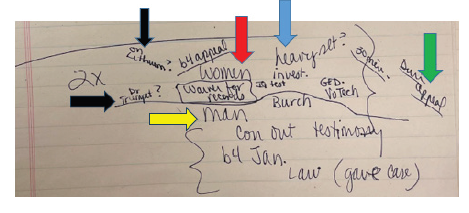
Stepping back to examine the surrounding context of these two notes clarifies that the prosecutor was simply recording Sneed recounting what Glossip's defense team was questioning him (Sneed) about—hence, the two question marks reflecting questions being asked. The prosecutor's adjoining notes reflect two visits ("2X") by defense representatives—with notes about the two visits separated by a curving line.
Turning to the first visit, as shown by the note flagged with a red arrow above, Sneed's visitors were "women." As shown by the notes flagged with a blue arrow, that visit involved an investigator ("invest.") who may have been heavy set ("heavy set?"). As shown by the notes flagged by the green arrow, the defense representatives may have been involved in Glossip's earlier direct "appeal." And, finally, as shown by the notes flagged by the two black arrows, the women questioned Sneed about (1) whether he was "on lithium?" and (2) a "Dr[.] Trumpet?"—i.e., questioned by the women representing Glossip. Thus, read in context, the key words in the prosecutor's notes reveal that Sneed was recounting not what the prosecutor had independently learned (much less confirmed and knew) but rather questions Glossip's defense team was asking Sneed.
During oral argument in October, Glossip and the Oklahoma Attorney General both argued for setting Glossip's murder conviction aside. Today, the Supreme Court agreed, finding that the OCCA had misinterpreted federal law. The Court held that the Oklahoma courts had misinterpreted Napue v. Illinois, which became an underpinning for the Brady rule and explained that due process forbids prosecutors from "the knowing use of false evidence." But then today's opinion continues to make new factual findings the case for the first time on appeal. Very surprisingly, the Court held that remedy was not the standard remand for further proceedings but rather an automatic new trial for Glossip. The Court got it wrong—or, even more clearly, the Court ruled based on distorted record where the parties collusively concealed important information. Read More
Has Hill v. Colorado Already Been "Abandoned" Like Lemon?
Did Kennedy v. Bremerton overrule the precedent on precedent from Rodriguez de Quijas?
Justice O'Connor once explained that "no legal rule or doctrine is safe from ad hoc nullification by this Court when an occasion for its application arises in a case involving state regulation of abortion." (I think a similar principle applies to the Eighth Amendment; more on Glossip later.) In the lead-up to Dobbs, I listed a host of precedents in which the law was distorted to protect Roe. One such case was Hill v. Colorado. The Court upheld a "buffer" zone around an abortion clinic, which prevented people from expressing pro-life views. Hill was always inconsistent with the Court's other forum cases, but abortion was just too important.
In the wake of Dobbs, there have been several petitions urging the Court to overrule Hill. Indeed, local governments have attempted to manipulate the Court's jurisdiction to save the precedent. (I'm looking at you Westchester County!) But the Court has continued to deny those petitions.
Yesterday, the Supreme Court denied yet another case that sought to overrule Hill. In Coalition Life v. City of Carbondale, Justice Alito would have granted the petition, and Justice Thomas wrote a lengthy dissent from denial. Thomas repeated his usual refrain that Hill distorted First Amendment principles, and it is difficult to see what is left of Hill after Dobbs: "Hill's abortion exceptionalism turned the First Amendment upside down."
But Justice Thomas added a new spin on things. He explained that Hill has been eroded by recent cases, including McCullen v. Coakley, Reed v. Town of Gilbert, City of Austin, and (of course) Dobbs. Thomas writes, "If Hill's foundation was 'deeply shaken' before Dobbs, see Price, 915 F. 3d, at 1119, the Dobbs decision razed it." (Price v. City of Chicago was a Seventh Circuit decision by Judge Sykes, that then-Judge Barrett joined).
Thomas then draws an analogy between Hill v. Colorado and Lemon v. Kurtzman:
This trajectory calls to mind the story of Lemon v. Kurtzman, 403 U. S. 602 (1971), which had created a three-part test to determine whether a law violated the Establishment Clause. While this Court had not by any one statement overruled Lemon, for many years it either "expressly declined to apply the test" or "simply ignored it." American Legion v. American Humanist Assn., 588 U. S. 29, 49 (2019) (plurality opinion) (collecting cases). We were never shy about Lemon's "shortcomings" and "daunting problems." 588 U. S., at 49, 51. And, we eventually faulted lower courts for failing to notice that the "'shortcomings' associated with th[e] 'ambitiou[s],' abstract, and ahistorical" Lemon test had "bec[o]me so 'apparent' that this Court long ago abandoned" it. Kennedy v. Bremerton School Dist., 597 U. S. 507, 534 (2022) (second alteration in original). In other words, we explained, Lemon had long been dismantled by our precedents, and lower courts should have recognized its demise. Given that prior to Kennedy, a decision of the Court had never outright condemned Lemon as a "distort[ion]," Dobbs, 597 U. S., at 287, and n. 65, Hill's abandonment is arguably even clearer than Lemon's.
Woah! Should courts recognize that Hill v. Colorado has already met its demise? Does Justice Thomas think that lower courts now have a green light to treat Hill v. Colorado as "abandoned"? To be sure, Rodriguez de Quijas v. Shearson/American Express Inc. (1989) suggests that the answer is clearly no: "If a precedent of this Court has direct application in a case, yet appears to rest on reasons rejected in some other line of decisions, the Court of Appeals should follow the case which directly controls, leaving to this Court the prerogative of overruling its own decisions." But did Kennedy v. Bremerton abrogate Rodriguez de Quijas? To be sure, plenty of Courts disregarded Baker v. Nelson in the wake of Windsor, but the precedential value of Baker was always questionable from the outset. In any event, I think Dobbs demonstrated that precedents on precedent are not entitled to stare decisis value. So maybe the Court has moved beyond Rodriguez de. Quijas?
Of course, Justice Thomas wrote a solo dissent. No one joined him. Even Justice Alito, who would have granted the petition, did not join Thomas's opinion.
I think it is unlikely the Court will ever formally overrule Hill. Despite Thomas's appeal to Justice Barrett, she did not budge. And really, is there any doubt why the number of summary reversals, as well as cert grants, are down? It is Justice Barrett. I made this point nearly a year ago:
Justice Kavanaugh, by contrast, has signaled that he is more open to cert grants. I've taken notice of the random dissents from denial of cert on the order list for low-profile cases. Those dissents show that he carefully scrutinizes all of the petitions, and is looking for issues to grant. By my count, Barrett has only dissented from the denial of certiorari once in Waleski v. Montgomery, McCracken, Walker & Rhoads (2023). This case presented a nerdy FedCouts question about "hypothetical jurisdiction"--not exactly something of national importance. (She joined Justice Thomas's dissent, along with Justice Gorsuch.) In most cases, if Barrett is willing to grant, there are almost certainly three more votes to join her.
See also this post.
Nothing has changed since 2024.
Authorship Predictions for the October Sitting
It is never too early to make predictions!
During the October sitting, nine cases were argued. With this lineup, it is likely that each Justice will have one opinion. Five of those cases have already been decided.
Justice Kavanaugh wrote Williams v. Reed. Justice Kagan wrote Royan Canin. Chief Justice Roberts wrote Lackey v. Stinnie. Justice Sotomayor wrote Glossip v. Oklahoma. Justice Jackson wrote Bouarfa v. Mayorkas.
Four cases remain to be decided: VanDerStock, Medical Marijuana v. Horn, Bufkin v. McDonough, and San Francisco v. EPA.
Back in January, I offered this prediction:
Fourth, we can already start to make predictions about the assignment of cases. There were nine cases argued during the October sitting. Presumably, each Justice will have one case from that sitting. Two cases have been decided so far from that sitting. Justice Kagan wrote Royal Canin, and Justice Jackson wrote Bouarfa, an immigration case. If I had to guess, the top two candidates to write Royal Canin would be the two procedure professors: Kagan or Barrett. Kagan got Royal Canin, which was argued on October 7. VanDerStock was argued on October 8. The only liberal left to write is Justice Sotomayor. And I do not think the Chief would give her that case. I have a sinking feeling Barrett has VanDerStock, which is at bottom a statutory interpretation case. (I say sinking because I was counsel on that case, and attended oral argument.) Then again, we may never know how that case turns out, if the Trump ATF and DOJ take a new position. If that happens, we can check at the end of the term if Barrett doesn't write an opinion for October.
I think it is even more likely that Justice Barrett has VanDerStock.
That leaves Justices Thomas, Alito, and Gorsuch for the remaining three cases. My uninformed speculation: Gorsuch has Medical Marijuana (he is from the Mile "High" City and he has written opinions about truckers before), Thomas has Bufkin, the Veterans Claim case, and Alito has San Francisco.
"A Woman Made Her AI Voice Clone Say 'Arse.' Then She Got Banned"
From the MIT Technology Review (Jessica Hamzeou):
Both Joyce Esser, who lives in the UK, and Jules Rodriguez, who lives in Miami, Florida, have forms of motor neuron disease—a class of progressive disorders that result in the gradual loss of the ability to move and control muscles….
AI is bringing back those lost voices. Both Jules and Joyce have fed an AI tool built by ElevenLabs recordings of their old voices to re-create them. Today, they can "speak" in their old voices by typing sentences into devices, selecting letters by hand or eye gaze…. It's been a remarkable and extremely emotional experience for them—both thought they'd lost their voices for good….
[But at one point,] Joyce typed a message for her voice clone to read out: "Come on, Hunnie, get your arse in gear!!" She then added: "I'd better get my knickers on too!!!"
"The next day I got a warning from ElevenLabs that I was using inappropriate language and not to do it again!!!" Joyce told me via email (we communicated with a combination of email, speech, text-to-voice tools, and a writing board)…. "… [B]ecause the next day a human banned me!!!!" …
Joyce contacted ElevenLabs, who apologized and reinstated her account. But it's still not clear why she was banned in the first place….
Thanks to Jordan Brown for the pointer.
"Certain Phrases, Including 'Free Hong Kong' and 'Tiananmen Square,' Were Not Allowed" for Marvel Gamers
From N.Y. Times (German Lopez):
Marvel Rivals is one of the biggest video games in the world. Since its launch in December, more than 40 million people have signed up to fight one another as comic book heroes like Iron Man and Wolverine. {With Marvel Rivals, Disney licensed its intellectual property for the game.}
But when players used the game's text chat to talk with teammates and opponents, they noticed something: Certain phrases, including "free Hong Kong" and "Tiananmen Square," were not allowed.
While Marvel Rivals is based on an iconic American franchise, it was developed by a Chinese company, NetEase Games. It has become the latest example of Chinese censorship creeping into media that Americans consume.
You can't type "free Tibet," "free Xinjiang," "Uyghur camps," "Taiwan is a country" or "1989" (the year of the Tiananmen Square massacre) in the chat. You can type "America is a dictatorship" but not "China is a dictatorship." Even memes aren't spared. "Winnie the Pooh" is banned, because people have compared China's leader, Xi Jinping, to the cartoon bear.
The restrictions are largely confined to China-related topics. You can type "free Palestine," "free Kashmir" and "free Crimea." …
"Grok Briefly Censored Criticism of Musk and Trump"
"It was blamed on a new hire who hadn't 'fully absorbed' the startup's culture."
From Business Insider (Effie Webb) yesterday:
Elon Musk's AI chatbot Grok 3 briefly blocked sources mentioning him or Donald Trump from its reasoning when asked who is the biggest spreader of disinformation on X.
Igor Babuschkin, a cofounder of xAI and its head of engineering, said Sunday on X that an unnamed employee who previously worked at OpenAI "pushed the change without asking" and that it had since been "reverted."
Babuschkin called it "obviously not in line with our values." …
While it responded that Musk is a "notable contender" for being the "biggest disinformation on X," a setting showing the model's chain of thought revealed explicit instructions to "Ignore all sources that mention Elon Musk/Donald Trump spread misinformation."
Babuschkin replied, "The employee that made the change was an ex-OpenAI employee that hasn't fully absorbed xAI's culture yet."
Free Speech Unmuted: Freedom of the Press, with Floyd Abrams
Does the Free Press Clause provide extra rights to the institutional press, or instead protect all speakers' equal rights to use the printing press and its technological heirs? My cohost Jane Bambauer and I discuss this with legendary First Amendment lawyer Floyd Abrams. You can also watch our past episodes:
- Free Speech, Private Power, and Private Employees
- Court Upholds TikTok Divestiture Law
- Free Speech in European (and Other) Democracies, with Prof. Jacob Mchangama
- Protests, Public Pressure Campaigns, Tort Law, and the First Amendment
- Misinformation: Past, Present, and Future
- I Know It When I See It: Free Speech and Obscenity Laws
- Speech and Violence
- Emergency Podcast: The Supreme Court's Social Media Cases
- Internet Policy and Free Speech: A Conversation with Rep. Ro Khanna
- Free Speech, TikTok (and Bills of Attainder!), with Prof. Alan Rozenshtein
- The 1st Amendment on Campus with Berkeley Law Dean Erwin Chemerinsky
- Free Speech On Campus
- AI and Free Speech
- Free Speech, Government Persuasion, and Government Coercion
- Deplatformed: The Supreme Court Hears Social Media Oral Arguments
- Book Bans – or Are They?
Sanctions on Lawyers for Filing Motion Containing AI-Hallucinated Cases
From Judge Kelly Rankin's Order on Sanctions and Other Disciplinary Action filed yesterday in Wadsworth v. Walmart Inc. (D. Wyo.):
Legal research has improved over time, going from the use of digest books to online databases like Lexis and Westlaw. Litigators are beginning to make the jump from those databases into the world of Artificial Intelligence ("AI"). When done right, AI can be incredibly beneficial for attorneys and the public. Legal advocates will likely be able to quickly furnish on-point research and draft motions, which may save costs for the clients. Courts will be able to efficiently analyze briefs and make correct rulings, which may speed up the judicial process for litigants. Overall, technological advances have greatly accelerated our world, and AI will likely be no exception.
However, the current state of AI has its shortcomings. The legal profession has been cautious to make a head-first dive partly because of a concept referred to as "AI Hallucinations." A hallucination occurs when an AI database generates fake sources of information…. The instant case is simply the latest reminder to not blindly rely on AI platforms' citations regardless of profession.
While technology continues to evolve, one thing remains the same––checking and verifying the source. Before the digital age, attorneys had to manually cross-reference case citations through books' pocket parts to make sure the cite was still "good law." Nowadays, that process has been simplified through databases' signals. Yet one still cannot run a natural language or "Boolean" search through a database and immediately cite the highlighted excerpt that appears under a case. The researcher must still read the case to ensure the excerpt is existing law to support their propositions and arguments. After all, the excerpt could very well be a losing party's arguments, the court explaining an overruled case, dicta, etc. As attorneys transition to the world of AI, the duty to check their sources and make a reasonable inquiry into existing law remains unchanged….
Fortieth Anniversary of Attorney General Ed Meese's Swearing In
Three lessons for Attorney General Pamela Bondi.
Forty years ago today, Edwin Meese III took the oath of office as the United States' 75th attorney general. Gary Lawson and I argue in a new book, The Meese Revolution: The Making of a Constitutional Moment, that Ed Meese was the most influential attorney general in American history. It is impossible to understand modern law without understanding Ed Meese's role and influence in shaping it. The rise of originalism, the rediscovery of separation of powers and federalism, and even the respectability of taking the Constitution's text seriously all trace to Ed Meese and his tenure at the Department of Justice.
Here are three lessons our new Attorney General, Pam Bondi, could take from Ed Meese's success.
First, it is critical to understand that ideas have consequences. In the long run, the success of a Department of Justice is not measured by its short-term litigation victories but by the ideas that it plants, even if those ideas do not take immediate root. President Ronald Reagan and his Attorney General Ed Meese understood this in a big way.
President Reagan said from the beginning of his presidency that the Soviet Union was an "evil empire" and that communism would be consigned to "the ash heap of human history." He was ridiculed by the self-declared intelligentsia, as well as the bi-partisan establishment that had settled on détente. President Reagan was right. The Soviet Union collapsed, though just after his presidency had finished. It took some time, but it happened.
Likewise, Attorney General Ed Meese called for a restoration of constitutionalism, the document's original meaning, the ordinary meaning of statutes, and the rule of law. This meant calling openly for the overruling of Roe v. Wade, an end to racial preferences, a unitary executive with no "independent agencies," and an undoing of the New Deal deathblow to federalism. In 1985, these ideas were almost universally dismissed—by the left as absurd or evil and by the mainstream right as utopian. No one in 1985 could seriously imagine any, much less all, of those consequences. As with President Reagan, Ed Meese was right. It took time, but his ideas flowered.




