The Volokh Conspiracy

Mostly law professors | Sometimes contrarian | Often libertarian | Always independent | Est. 2002

The Volokh Conspiracy

Politics

N.Y. Times Columnist on the Deception Surrounding the COVID-19 Origin Debate

|

From yesterday's column by Prof. Zeynep Tufekci:

[T]o promote the appearance of consensus [that the COVID-19 pandemic was definitely caused by natural transmission], some officials and scientists hid or understated crucial facts, misled at least one reporter, orchestrated campaigns of supposedly independent voices and even compared notes about how to hide their communications in order to keep the public from hearing the whole story. And as for that Wuhan laboratory's research, the details that have since emerged show that safety precautions might have been terrifyingly lax….

The first {influential publication[] that quite early in the pandemic cast the lab leak theory as baseless} was a March 2020 paper in the journal Nature Medicine, which was written by five prominent scientists and declared that no "laboratory-based scenario" for the pandemic virus was plausible. But we later learned through congressional subpoenas of their Slack conversations that while the scientists publicly said the scenario was implausible, privately many of its authors considered the scenario to be not just plausible but likely. One of the authors of that paper, the evolutionary biologist Kristian Andersen, wrote in the Slack messages, "The lab escape version of this is so friggin' likely to have happened because they were already doing this type of work and the molecular data is fully consistent with that scenario." …

Andersen later testified to Congress that he had simply become convinced that a lab leak, while theoretically possible, was not plausible. Later chat logs obtained by Congress show the paper's lead authors discussing how to mislead Donald G. McNeil Jr., who was reporting on the pandemic's origin for The Times, so as to throw him off track about the plausibility of a lab leak.

The second influential publication to dismiss the possibility of a lab leak was a letter published in early 2020 in The Lancet. The letter, which described the idea as a conspiracy theory, appeared to be the work of a group of independent scientists. It was anything but. Thanks to public document requests by U.S. Right to Know, the public later learned that behind the scenes, Peter Daszak, EcoHealth's president, had drafted and circulated the letter while strategizing on how to hide his tracks and telling the signatories that it "will not be identifiable as coming from any one organization or person." The Lancet later published an addendum disclosing Daszak's conflict of interest as a collaborator of the Wuhan lab, but the journal did not retract the letter….

There's much more; much worth reading.
Free Speech

Ex-Wife May Not Distribute Memoir in Which She Accuses Ex-Husband of Abuse, Because That May Harm Child

|

From Clark v. Clark, decided Mar. 5 by South Carolina Court of Appeals Judge Paula Thomas, joined by Judges Blake Hewitt and Jerry Vinson:

Mother published a book (The Book) depicting the circumstances surrounding the parties' marriage and divorce, as well as other aspects of Mother's life; and it has been published, marketed, and sold by national book retailers. The cover of The Book contains a photograph of Mother, made up of puzzle pieces, with a black eye drawn with makeup. Included in The Book are allegations by Mother claiming physical, mental, emotional, and sexual abuse at the hands of Father. [The book appears to be "Soul Pieces," subtitled "memoirs of self-discovery after domestic violence and divorce." -EV]

In addition to national book retailers, Mother promotes The Book on her personal website. Mother also testified she was an ambassador at a private 501(c)(3) non-profit that offers services to survivors of domestic abuse. Mother promotes her book through the non-profit and local speaking engagements. Mother and Minor Child are pictured on Mother's website, along with promotions for The Book and a book authored by Minor Child published on December 19, 2019. {Minor Child's book is marketed and sold on Mother's website. The website contains a tab labeled "About [Minor Child]" which provides a brief biography and photograph of Minor Child.} The "About" tab on Mother's website reads, in part, "As a mother of a young daughter, Amika wants to change the narrative and cycle for her daughter and give a voice to personal, internal thoughts." …

Mother testified the contents of The Book were truthful and accurate descriptions of the emotional, physical, and mental abuse she suffered at the hands of Father. She admitted to writing Father was "full of bullshit and lies" during the marriage. Mother further admitted that she accused Father of being mentally ill. Mother was asked about a portion of The Book in which she discusses an affidavit she wrote for an expedited hearing. Father's counsel asked Mother to confirm she wrote: "My shield became impossible when her father screamed expletives and belligerent names at me during story time which she witnessed her father follow me from room to room berating me no matter how much I tried to remove myself from the situation. Mother's bond is unwaveable [sic]…. She hears her dad yelling and screaming at me, she comes to what she calls 'mommy's rescue.'"

Read More

Some Family And Immigration Law Questions About Birthright Citizenship

|

One virtue of birthright citizenship is simplicity. A child born in the United State is a citizen, and the government does not need to make any inquiries about either parent.

But let's assume, for argument's sake, that the Constitution does not provide for birthright citizenship in all cases. A host of questions would be raised that do not have simple answers.

First, let's start with a question under current law. The example that everyone seems to agree with is that the child of an ambassador is not a birthright citizen. The answer is a simple no, right? Not so fast. What happens if an ambassador has a child with a U.S. citizen? Would that child then be a citizen? In other words, does the "exception" to birthright citizenship only apply if both the father and mother were part of a diplomatic mission from abroad?

During debates over the Fourteenth Amendment, the status of diplomats was often discussed. But I suspect it was assumed that an ambassador would be married, if at all, to a woman from his home country. Many states had prohibitions on miscegenation, which would further restrict the ability of some ambassadors to marry American women. Certainly diplomats have fathered children with American women over the years. Were those kids citizens at birth? A child born to an unmarried couple would generally be considered illegitimate, or a bastard. Would a bastard receive birthright citizenship if his mother was a citizen and his father was an ambassador?

Second, moving away from the ambassador example, how would citizenship work if one parent was a citizen and the second parent was not a citizen. Morales-Santana held that Congress could not apply one set of rules when the mother was a citizen and another set of rules when the father was a citizen. Such disparate treatment, Justice Ginsburg found, violates the Equal Protection Clause of the Fifth Amendment (even if such a provision of the Constitution actually existed.) But my question is a bit different. In the absence of any statutory implementing legislation, how would the Citizenship Clause apply to a child with one parent who is a citizen and one parent who is not a citizen? I don't think there is a clean answer. I suspect people in the 1860s would have presumed that a person who was not a citizen would marry someone who was of the same status but I am confident there were exceptions.

Third, assuming that the Fourteenth Amendment does not grant birthright citizenship, what would happen to the child of an illegal alien who was granted some form of statutory lawful presence, such as DACA? Would that statutory grant of temporary protection overcome the presumption against birthright citizenship for the child of an otherwise removable person?

Fourth, would the child of a person seeking asylum be eligible for birthright citizenship? Scholars who argue against birthright citizenship focus on concepts like loyalty and allegiance. But a person seeking asylum is affirmatively rejecting an allegiance to his home nation. Indeed, the asylum applicant fears that if he returns to his home country, he would be subject to persecution. Would a claim of asylum provide the requisite allegiance to justify birthright citizenship.

Fifth, how would birthright citizenship interact with surrogacy? Is citizenship determined based on the status of the mother who carries the child to term? Or the woman who donated the egg? The man who donated the sperm? And so on. I'm sure other countries that lack birthright citizenship have considered these questions.

These questions bring me back to the early days of the DAPA litigation. In December 2014, I wrote:

In the run-up to NFIB v. Sebelius, health care lawyers suddenly had to become experts in constitutional law, and constitutional lawyers had to become experts in health care law. My sense (from personal experience) is that with rare exception, neither group fully succeeded. There is a similar dynamic now with the immigration executive action. Immigration lawyers are being asked to opine on the scope of the President's duty to take care that the laws are faithfully executed, and constitutional lawyers are being asked to weigh in on the complicated immigration code. At this point, there is still quite a gap between the two.

I don't profess to be an expert on immigration law, but I have written extensively about the intricacies of the INA over the years--something that not all constitutional law scholars have bothered to learn. That background has helped me see current debates over birthright citizenship a bit more cleanly.

Yet, I find that many scholars writing on the constitutional issues underlying birthright citizenship have not fully considered the technical issues of immigration law. Conversely, scholars of immigration law have not fully considered all of the competing arguments based on constitutional law. People just assume that the side they agree with is obviously correct. I still think the correct answer is that the Fourteenth Amendment provides birthright citizenship, but I freely acknowledge there are some competing arguments and complexities.

Radio

Trump's Awful Decision to Gut Voice of America and Radio Free Europe/Radio Liberty

Trump is destroying a valuable source of American "soft power" and an inspiration to people suffering under authoritarian regimes.

|

RFE/RL

Yesterday, President Donald Trump issued an executive order essentially gutting Voice of America, Radio Free Europe/Radio Liberty, and other US government-supported media aimed at getting news and information to populations living under authoritarian regimes. The EO has resulted in a freeze of their congressionally allocated funds, and puts all or most staff on leave (presumably in preparation for laying them off permanently).

Trump's order is a blow to America's "soft power" and to dissidents battling anti-American authoritarian regimes. VOA, RFE/RL and other similar media are among the few federal programs whose value far exceeds the money expended on them.

During the Cold War, millions of people living under communist regimes listened to these networks, and got news and analysis that countered regime propaganda. These media helped inspire dissident movements, and the eventual overthrow of communism in the USSR and Eastern Europe in 1989-91. My own parents were among the many Soviet citizens who clandestinely listened to VOA broadcasts, and it helped solidify their opposition to the regime.

In more recent years, VOA and RFE/RL operate on the internet as much or more than on traditional radio. But they continue to be valuable resources for dissidents and others living under authoritarian regimes, such as those of Russia and Belarus. Radio Free Asia and Radio Marti provide similar services for China and Cuba, respectively.

Shutting these programs down is an obvious boon to dictators like Vladimir Putin and Xi Jinping. As Russian opposition leader Vladimir Kara-Murza puts it, Trump's EO is "One more champagne bottle opened in the Kremlin." It is, sadly, of a piece with the Trump Administration's increasing estrangement from other liberal democracies, and alignment with despots like Putin.

Nor can it be said that the order will save any significant amount of money. The annual budget of the US Agency for Global Media (USAGM), which oversees all these broadcasters, is only about $950 million, barely a rounding error in the $7 trillion federal budget. For that small investment, we significantly weaken some of America's principal enemies by bolstering internal opposition to their regimes. We thereby also augment the "soft power" of the appeal of American liberal democracy.

Since 2014, I have often been an (unpaid) guest commentator on Russian-language RFE/RL, and a few times on VOA.  I was proud to do it, as a small partial repayment of the debt I and others owe to these organizations.

One of the strengths of RFE/RL and VOA is that they have a measure of editorial independence from the administration in power. Thus, they often have commentators critical of various aspects of US policy. For example, in my very first RFE/RL interview, back in 2014, I criticized the Obama Administration for usurping Congress' war powers. In later appearances, I was also critical of Trump and Biden on various issues. Obviously, RFE/RL and VOA often host defenders of the administration in power, as well. When I appeared, it was often together with another expert advocating the opposite view. But the willingness to host critics strengthens these outlets' credibility with the target audience, and provides it with valuable lessons on how a free media operates.

This editorial independence may well be what attracted Trump's ire. A few days ago, he became angry when a VOA reporter (correctly) pointed out that Trump had advocated expelling the civilian population of Gaza. Although Trump denied it, he had in fact previously advocated exactly that. It may be no accident that the EO targeting VOA came just two days later.

Regardless of Trump's motives, the apparent shuttering of VOA and RFE/RL is a blow to people living under oppression and a needless gift to America's enemies. With measures such as this and the betrayal of Ukraine, Trump's foreign policy is making anti-American authoritarians great again.

NOTE: As indicated above, I have been a guest commentator on Russian-language RFE/RL and VOA. As also noted, this is an unpaid role. However, cynics might still argue I am only opposed to Trump's order because it somehow hurts my career. The truth of the matter is that appearing on Russian-language media does little or nothing for my career, because hardly any of the people with influence over my career prospects (mostly other US law professors) follow such media or even know Russian. I appeared on these programs as a (very small) public service because I am one of the few Russian speakers available to them who have relevant expertise on the kinds of law and policy issues they interviewed me about.

Politics

A Mother's Complaint

"Something always seemed off and not quite right with the way my children's grades and GPA were displayed .... [M]y children [were] overlooked for school awards, academic scholarships and grant opportunities that they otherwise would have been eligible for, the opportunity to be valedictorian, salutatorian ...."

|

From Doe v. Edoff, decided Mar. 6 by Judge Sean Cox (E.D. Mich.):

Plaintiff's [pro se] complaint names more than forty individuals as Defendants and purports to assert federal claims against them. Aside from listing the names of the various Defendants, Plaintiff's complaint includes no factual allegations specific to the Defendants. Plaintiff states her claim in the following paragraph:

Something always seemed off and not quite right with the way my children's grades and GPA were displayed on Powerschool and in 2022 the fraud surfaced of multiple staff members employed with L'Anse Creuse Middle School North, L'Anse Creuse High School North and L'Anse Creuse Public School System; illegally manipulated the Powerschool and Schoology systems and illegally Falsifying Public School Records which resulted in my children being overlooked for school awards, academic scholarships and grant opportunities that they otherwise would have been eligible for, the opportunity to be valedictorian, salutatorian as well as kept them ineligible to have their California, New York and Illinois entertainment permits renewed from 2022 until the present.

The district court holds plaintiff can't proceed under a pseudonym, and that she needs to file an amended Complaint that identifies herself. The court also signals to the plaintiff that she might want to offer some more details when she files an amended complaint.

Immigration

Trump Invokes Alien Enemies Act as Tool for Deportation - Federal Court Issues Temporary Restraining Order Against it [Updated]

If courts allow Trump to get away with using the Act in peacetime, it would set a dangerous precedent.

|

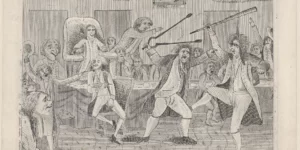
Cartoon depicting congressional debate over the Alien and Sedition Acts. (NA)


Today, President Donald Trump issued an executive proclamation invoking the use of the Alien Enemies Act to detain and deport members of Tren de Aragua Venezuelan drug gang. A few hours earlier, a federal court issued a temporary restraining order blocking the executive from using the Act to deport five Venezuelans who were apparently about to be deported on that basis.

The Alien Enemies Act was one of the notorious Alien and Sedition Acts of 1798, the only one that is still in force. If courts let the Administration use it, they could potentially detain and deport even legal immigrants with little or no due process. But the Act can only be used in the event of a declared war, or an "invasion" or "predatory incursion" perpetrated by a "foreign nation or government." As explained in detail in my earlier writings about this issue, illegal migration and cross-border drug smuggling do not qualify  as an "invasion" or "predatory incursion." Even if they did, they aren't being perpetrated by a "foreign nation or government." Tren de Aragua is an awful criminal organization. But it is not "invading" the United States, and it is not a "foreign nation or government."

Even if the administration is right to claim that Tren de Aragua has some connections to Venezuelan government officials, that does not mean the gang is itself a nation-state. Lots of organized crime groups bribe or otherwise suborn government officials to facilitate their black market activities. That doesn't turn these drug cartels into governments, nor does it convert their criminal activities into an "invasion."

In my last post about this issue, I  explained in more detail why drug cartel activities don't qualify as an "invasion" and why a contrary ruling by the courts would set a dangerous precedent. Among other things,  States would be authorized to "engage in war" in response (even without congressional authorization), and the federal government would empowered to suspend the writ of habeas corpus, and thereby detain people - including US citizens - without charges or trial.

Moreover, although the current proclamation is limited to members of Tren de Aragua, if it is upheld there would be little to prevent the administration from using the Alien Enemies Act against other immigrants, including legal ones. Moreover, even under the current proclamation, the lack of of meaningful due process protections under the AEA (there is no right to a hearing, for example) means that some people could be detained or deported merely because the government claims they are members of Tren de Aragua, even if there is no real proof that they are.

In its brief appealing today's temporary restraining order, the administration takes the position that invocations of the Act are a "political question" that the judiciary has no power to review. If this position prevails, the president could use the AEA against any immigrants from any country anytime he wants, simply by declaring there is a "invasion" going on and the people he seeks to detain and deport are somehow connected to it. Moreover, as noted above, such an unreviewable declaration would trigger other sweeping powers, such as the power to suspend the writ of habeas corpus - even for US citizens.

Much is at stake in the litigation over this issue. And not just for immigrants.

I have previously explained why invocations of the AEA and the definition of "invasion" should not be considered unreviewable political questions here, and here. Here's an excerpt outlining some of the reasons:

There is no good reason to hold that the definition of "invasion" is a political question, especially if doing so would give the president a blank check to usurp power over… Congress and suspend the writ of habeas corpus anytime he wants. Such a vast concentration of power would surely go against the original meaning, as it would enable the president to engage in arbitrary detention at will – exactly the kind of abuse early Americans had experienced at the hands of the British and sought to prevent in the future. "Invasion" has a clear definition readily susceptible to judicial interpretation…

The TRO issued by the district court lasts for fourteen days. In the meantime, the court is likely to consider whether to issue a more permanent injunction. Litigation over this vital issue will surely continue for some time to come, possibly even reaching the Supreme Court.

UPDATE: US District Court Judge James Boasberg has now expanded the temporary restraining order to cover "all noncitizens in U.S. custody"  covered by Trump's invocation of the Alien Enemies Act.

Immigration

My US News and World Report Article on Trump's Dictatorial Immigration Power Grabs

The article is coauthored with Cato Institute scholar David Bier.

|

Yesterday, US News and World Report published my article, "Trump Claims Dictatorial Powers on Immigration," coauthored with David Bier. Here is an excerpt:

During his campaign for president, Donald Trump said he'd only be a dictator on "Day One," when he would "close the border" to nearly all immigrants. True to his word, when Trump entered office, he signed executive orders that sought to rewrite the Constitution and explicitly override the law to restrict immigration.

But those executive orders didn't expire on Day Two. The president is still exercising dictatorial powers on immigration, and it isn't yet clear that anyone will stop him. Several court decisions have sought to rein him in, and the Supreme Court should also intervene, if necessary. Whatever one thinks of immigration, any limits must be imposed lawfully.

Trump's theory of presidential control over immigration goes well beyond his predecessors'. In an executive proclamation issued within hours of being inaugurated, Trump asserted that he has total power to shut down virtually all legal immigration and ignore laws that protect immigrants from wrongful detention and deportation.

The president indicated that he can unilaterally suspend Congress' immigration laws because they are "ineffective," even though the Constitution gives Congress – not the president – the authority to make laws.

To justify ignoring laws such as the Refugee Act of 1980, which allows those who claim they are escaping persecution to enter the U.S. to apply for asylum, Trump relied on the idea that the president is constitutionally authorized to stop "invasions." But illegal migration is not an invasion. Under the Constitution, as Founding Father James Madison put it, "Invasion is an operation of war," not a civilian violating a bureaucratic regulation on where to cross a border….


Free Speech

Anti-DEI Executive Orders Can Go Forward, for Now, Says Federal Appeals Court

A district judge had "found the provisions likely unconstitutional and issued a nationwide injunction" against them; the Fourth Circuit just stayed that injunction, pending full consideration of the issue on appeal.

|

From yesterday's decision in Nat'l Ass'n of Diversity Officers in Higher Ed. v. Trump, by Chief Judge Albert Diaz, with Judges Pamela Harris and Allison Rushing concurring:

Pending before the court is the government's Motion for a Stay Pending Appeal. The case concerns two Executive Orders [14,151 & 14,173] that instruct executive agencies to end "diversity, equity, and inclusion" (or "DEI") programs within federal grant and contract processes. The plaintiffs—the Mayor and City Council of Baltimore, Maryland and three national associations—moved to preliminarily enjoin the government's enforcement of the Orders, challenging the constitutionality of three of the Orders' provisions under the First and Fifth Amendments.

The district court found the provisions likely unconstitutional and issued a nationwide injunction barring defendants from enforcing those provisions against both the plaintiffs and "similarly situated non-parties." After the government appealed that injunction to this Court, the district court entered an order clarifying that its preliminary injunction "applies to and binds Defendants … as well as other federal executive branch agencies, departments, and commissions, and their heads, officers, agents, and subdivisions." The government now seeks a stay of the district court's preliminary injunction, or asks that it be limited only to the plaintiffs and named defendants.

Having reviewed the record, the district court's opinion, and the parties' briefing, we agree with the government that it has satisfied the factors for a stay under Nken v. Holder (2009). We therefore grant the government's motion for a stay of the preliminary injunction. The Clerk will set an expedited briefing schedule after consultation with the parties.

Chief Judge Diaz also wrote a separate opinion:

Read More

Paul, Weiss Next on the Chopping Block

War is Peace. Freedom is Slavery. Ignorance is Strength. And Donald Trump is "Ending the Weaponization of Government"

|

Yesterday the President issued another Executive Order, this time targeting all "employees of Paul, Weiss" - quite coincidentally, the 2024 AmLaw and 2024 NY Law Journal "Law Firm of the Year"! - "and Mark Pomerantz," a lawyer formerly, but no longer, employed by the firm.**

Under the terms of the Executive Order, (1) security clearances for every one of the thousands of Paul Weiss employees (and Mark Pomerantz) are "immediately suspended, pending a review of whether their access to sensitive information is consistent with the national interest"; (2) the government "will halt all material and services . . . provided to Paul Weiss and restrict its employees' access to government buildings"; (3) the government "will terminate contracts that involve Paul Weiss"; and (4) federal agencies will "refrain from hiring Paul, Weiss employees unless specifically authorized."

** Pomerantz was of counsel to the litigation department at Paul Weiss when, in 2021, he left the firm to join the New York City DA's office as a Special Assistant DA, to assist DA Cyrus Vance Jr. in his investigation of Donald Trump's business and financial dealings. He resigned that position in 2022, when the new DA, Alvin Bragg, announced that the office would not be pursuing an indictment of the former president.  Pomerantz wrote an angry letter of resignation, and he wrote an angry book about his experience in the DA's office (The People v. Donald Trump). According to a Paul, Weiss spokesperson, he has no current affiliation with the firm.

That is, to put it mildly, a pretty serious blow to the firm's business activities. And what had Paul, Weiss done to deserve all this? The Order spells it out in gruesome detail: Read More

Politics

The Bondi Sentencing Memorandum Has Important Implications in the Criminal Prosecution of Boeing

The Justice Department's new guidance requiring prosecutors to disclose to a sentencing judge all relevant facts should require that, in any new plea deal, Boeing must acknowledge that it directly and proximately killed 346 people.

|

Today I made a filing for the victims' families in the criminal case against Boeing, flagging an important point about how the new Administration's approach to criminal sentencing should lead to a more transparent plea agreement with Boeing. Under the Bondi Memorandum, the new Administration now requires prosecutors to disclose all relevant facts to the sentencing judge—a requirement of "complete candor." As the Justice Department and Boeing continue negotiating a new agreement for Boeing to plead guilty to its conspiracy of defrauding the FAA, an extremely relevant sentencing fact will have to be candidly disclosed: that Boeing killed 346 people.

For the last several years, I have represented (pro bono) families who lost loved ones in the two crashes of Boeing 737 MAX aircraft. (See earlier posts here, here, and here.) The families want Boeing held fully accountable for the harms stemming from its federal crime of defrauding the FAA about the safety of the 737 MAX—a crime that the district judge handling the matter (Judge Reed O'Connor in the Northern District of Texas) has found directly and proximately killed 346 people.

Several years ago, the Justice Department and Boeing reached a deferred prosecution agreement (DPA), requiring Boeing to take appropriate steps to comply with federal anti-fraud laws. In exchange, Boeing's prosecution was deferred for three years to give it time to get its house in order. During the deal's three-year term, Boeing failed to meet its obligations—a failure shockingly brought to light on January 5, 2024, when a door plug on a new Boeing 737 MAX blew out, causing an uncontrolled decompression of the aircraft. In May of last year, the Justice Department found that Boeing had breached its obligations under the DPA. And in July of last year, the Justice Department and Boeing reached a plea agreement, under which Boeing would plead guilty to the pending conspiracy charge. But the plea deal did not require Boeing to acknowledge that its crime killed 346 people--the deadliest corporate crime in U.S. history.

On behalf of the families I represent, last July I objected to the plea deal. And last December, Judge O'Connor agreed that the agreement should be rejected, citing concerns about a DEI requirement and other problems in the agreement's corporate monitoring provisions. Since then, the Department and Boeing have been working on negotiating a new plea deal.

Today, the Department and Boeing filed their third motion for a continuance to allow further plea negotiations, citing the need to brief the new leadership in the Justice Department. The parties sought until April 11 to report back to the district court. I filed a notice that the families did not object to the third continuance now, but would object to any further continuances. In addition, my notice discussed how the Bondi Memorandum (which is a later iteration of an earlier Bove Memorandum) would require a new plea agreement that was more forthcoming about the deadly consequences of Boeing's crime:

The families appreciate that the parties' discussion will require extensive revisions to the earlier plea agreement that the Government agreed to under the previous Administration. In the opening days of the current Administration, the Justice Department announced new guidance for how criminal cases such as this one are to be handled. On January 21, 2025, the Justice Department released the "Bove Memorandum," which restored the Department's long-standing charging position articulated in the May 10, 2017, Memorandum entitled, "Department Charging and Sentencing Policy." As required by the recent Bove Memorandum—and as articulated in the 2017 Memorandum (and even earlier guidance dating back to the Bush and Reagan Administrations)—it is once again Department policy that prosecutors must reveal to a sentencing judge all relevant facts in the case:

prosecutors must disclose to the sentencing court all facts that impact the sentencing guidelines or mandatory minimum sentences, and should in all cases seek a reasonable sentence under the factors in 18 U.S.C. § 3553. In most cases, recommending a sentence within the advisory guideline range will be appropriate. Recommendations for sentencing departures or variances require supervisory approval, and the reasoning must be documented in the file.

As the families explained last summer in objecting to the proposed plea agreement negotiated during the previous Administration, that (now-rejected) plea agreement failed to reveal that Boeing's conspiracy crime directly and proximately killed 346 passengers and crew on two 737 MAX flights. See ECF No. 268-1 at 11-19; see also ECF No. 268-2 at 816. The truth about Boeing's lethal crime is quite obviously relevant to sentencing, and yet it was not mentioned. While such factual omissions were apparently allowed during the previous Administration, they are (quite properly) forbidden in the current Administration by the Bove Memorandum. The families' filings straightforwardly set out how to correct that omission and appropriately describe Boeing's deadly conspiracy crime in any future plea agreement.

Notice of Victims' Families (citing U.S. Dept. of Justice, Bove Memorandum (Jan. 21, 2025), citing U.S. Dept. of Justice, Charging Memorandum (May 10, 2017) (emphasis added)). Read More

Free Speech

Utah Court Strikes Down Injunction Banning Speech "Annoy[ing] or Caus[ing] Distress" to Neighbor Running a Mental Health Residential Treatment Center,

but upholds limits on speech to plaintiff (or her visitors).

|

A short excerpt from the long opinion in Ragsdale v. Fisher, decided yesterday by Utah Court of Appeals Judge Gregory K. Orme, joined by Judges Ryan M. Harris and John D. Luthy:

For over ten years, George Fishler has shown his vehement opposition to Kristi Ragsdale operating her residential treatment center in his neighborhood by displaying provocative yard signs and by mouthing or shouting profanities, coupled with rude hand gestures, at anybody entering, leaving, or on the business's property…. Ragsdale is the founder and owner of the Eva Carlston Academy (ECA)—a residential treatment center for adolescent girls experiencing mental health issues, including anxiety and depression. In 2013, ECA opened a location at the end of a cul-de-sac in a Salt Lake-area neighborhood. Fishler and his wife are long-time residents of the cul-de-sac. Their home is located directly north of ECA.

Fishler and other neighbors vehemently opposed the opening of the ECA location in their neighborhood. Several neighbors voiced their opposition at community council meetings and displayed yard signs concerning "commercial businesses 'invading' the neighborhood." Fishler drafted a flier that he distributed to neighbors that stated, without specifically identifying Ragsdale or ECA, that the "commercial enterprise will degrade th[e] neighborhood" and urged neighbors to contact the local authorities.

Despite Fishler's and the neighbors' efforts, ECA was able to obtain the necessary permits, and it began operating in the cul-de-sac. Believing that the resulting noise and traffic "ruined the neighborhood," Fishler continued to "protest" ECA. He did so by displaying two yard signs—one in the front and one in the back of his property—stating,

TROUBLED TEEN MONEY MACHINE BECOME DISABLED FOR ONLY $10,000/MONTH

Read More

Free Speech

Cornell Students and Student Group Face Possible Suspension for Disrupting Event

|

[UPDATE 3/14/2025, 7:25 pm: My headline originally erroneously said "Suspended," but the students and the group at this point have been referred for possible disciplinary measures, and face the possibility of suspension; they haven't actually been suspended. My apologies for the error, and thanks to reader Jordan Brown for the correction.]

From a statement released Tuesday by the Cornell Interim President:

The Pathways to Peace event Monday night provided an educational discussion on the complex history of the Israeli-Palestinian conflict and negotiations. Cornell successfully hosted a panel of esteemed former Middle East leaders and U.S. ambassadors who shared historical perspectives and unique insight for achieving a peaceful future. The hundreds of members of the Cornell community who came to Bailey Hall to listen, learn, and respectfully debate experienced an evening of information, introspection, and critical self-examination.

Unfortunately, the event was marred by disappointing disruptions. The ability of speakers to present opinions and ideas, and to engage in thoughtful dialogue with the university community, is critical to the educational process and fundamental to university life. Individuals attempting to shout down speakers and disrupt dialogue seriously compromise our values. Those who disrupted the Pathways to Peace event were swiftly removed.

Cornell University Police identified 17 people responsible for this unacceptable disruption. Nine students will be referred to the Office of Student Conduct and Community Standards for appropriate action, including the imposition of interim measures up to and including suspension. Staff members involved in the disruption will be referred for disciplinary actions through Human Resources. Outside disrupters will be issued persona non grata status, barring them from Cornell's campus.

Additionally, for advertising and organizing this disruption, Students for Justice in Palestine (SJP), a student-run organization, faces suspension as a registered campus organization.

Read More

Guns

Indiana Defendants Get "Benefit of Hindsight When It Reveals Their Conduct Was Necessary in Self-Defense," …

"even though that necessity wasn't fully apparent in the moment."

|

A brief excerpt from Wednesday's 11,000-word Indiana Supreme Court decision in Turner v. State, written by Justice Derek Molter:

This is a case about a good guy with a gun shooting a bad guy with a gun when the only choices were to shoot or be shot.

Antonio Turner was one of three students studying organic chemistry at a classmate's home, tucked away in a quiet neighborhood just outside of Indianapolis. While they were studying, the classmate's jealous love interest, Dequan Briscoe, repeatedly called her. And when he learned Turner was at her home, Briscoe twice threatened to "pull up" on Turner—to attack him—which Turner heard over the speakerphone.

Shortly after hearing the threat, Turner walked outside to his car, and moments later, he sensed that the unfamiliar car screeching towards him down the sleepy street was an ambush. Since he didn't have time to reach the house and had nowhere to hide, he turned while running and fired four shots into the car, wounding Briscoe. Turner fired based on his intuition—he didn't recognize the car, couldn't see through its darkly tinted windows, and wouldn't have recognized Briscoe if he saw him. But that intuition proved prescient. It turns out Briscoe was aiming a handgun to shoot Turner just before Turner began firing.

Because Turner shot Briscoe before Briscoe shot Turner, Turner is the defendant rather than the victim in this case; the State charged Turner with battery by means of a deadly weapon, a Level 5 felony. And following a bench trial, the magistrate judge convicted him. Yet the judge agreed with Turner that, in hindsight, it was necessary for Turner to fire at Briscoe to avoid being shot.

Read More

More