

4/15/1931: Stromberg v. California argued.
The Volokh Conspiracy
Mostly law professors | Sometimes contrarian | Often libertarian | Always independent | Est. 2002
Liberty Justice Center and I File Lawsuit Challenging Trump's "Liberation Day" Tariffs
It was filed today in the US Court of International Trade.
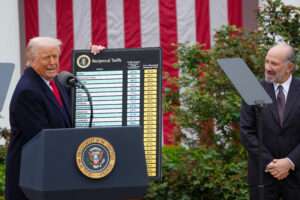
Today, the Liberty Justice Center and I filed a lawsuit in the US Court of International Trade challenging the legality of Donald Trump's gargantuan "Liberation Day" tariffs, on behalf of five US businesses that import goods from many of the countries targeted by the tariffs. The case is entitled VOS Selections, Inc. v. Trump.
In previous posts, I previewed our key arguments and explained why Trump's partial pause of the tariffs does not end the madness or obviate the need to challenge this usurpation of legislative power in court.
To briefly summarize, we argue that the International Emergency Economic Powers Act of 1977 (IEEPA) doesn't authorize tariffs at all, that even if it does the bilateral trade deficits targeted by the "Liberation Day" tariffs do not qualify as an "emergency" or as an "unusual and extraordinary threat" (both prerequsites to invoking IEEPA), that Trump's use of IEEPA for this purpose runs afoul of the "major questions" doctrine, and that - if these actions are authorized by IEEPA - it would violate constitutional limits on delegation of legislative power to the executive. If we prevail on any one of these points, we win the case.
The complaint is available here.
Here is an excerpt from the Liberty Justice Center press release announcing the case:
On April 14, the Liberty Justice Center filed a lawsuit challenging the Trump Administration's authority to unilaterally issue the "Liberation Day" tariffs, which are devastating small businesses across the country. The lawsuit argues that the Administration has no authority to issue across-the-board worldwide tariffs without congressional approval.
The lawsuit, filed in the U.S. Court of International Trade, highlights the unprecedented nature of the tariffs, including a global 10% tariff on nearly all imports, with additional higher tariffs targeting dozens of countries based on dubious calculations of foreign trade barriers.
The President invoked the International Emergency Economic Powers Act (IEEPA) to justify the "Liberation Day" tariffs, as well as the tariffs on Mexico, Canada, and China. But under that law, the President may invoke emergency economic powers only after declaring a national emergency in response to an "unusual and extraordinary threat" to national security, foreign policy, or the U.S. economy originating outside of the United States. The lawsuit argues that the Administration's justification— a trade deficit in goods—is neither an emergency nor an unusual or extraordinary threat. Trade deficits have existed for decades, and do not constitute a national emergency or threat to security. Moreover, the Administration imposed tariffs even on countries with which the U.S. does not have a trade deficit, further undermining the administration's justification.
And as the Complaint explains, IEEPA does not authorize the President to impose across-the-board tariffs—it does not even authorize tariffs at all; and even if the IEEPA did extend such power to the President, that would be an unconstitutional delegation of Congress's power to impose tariffs.
"No one person should have the power to impose taxes that have such vast global economic consequences," said Jeffrey Schwab, Senior Counsel at the Liberty Justice Center. "The Constitution gives the power to set tax rates—including tariffs—to Congress, not the President."
"If starting the biggest trade war since the Great Depression based on a law that doesn't even mention tariffs is not an unconstitutional usurpation of legislative power, I don't know what is," said Ilya Somin, co-counsel, law professor, Scalia Law School, George Mason University.
The case is filed on behalf of five owner-operated businesses who have been severely harmed by the tariffs and highlights the human and economic toll of unchecked executive power….
All Vapes Are Flavored Vapes, Some Just Have Cigarette Flavors
A plea for more accurate descriptions of non-combustible nicotine products.
Why do we only call some vaping products "flavored"? I ask because every vaping product on the market is flavored. Those that taste like tobacco have flavor added just like those that taste like menthol or vanilla or berries. So some vaping products taste like combustible tobacco products (with either tobacco or menthol flavor) and some do not. It is possible to make unflavored vaping products, but there is no market for such products so no one does.
In order to be more accurate--and better communicate the underlying reality--I would suggest a revised nomenclature: We should refer to vaping products as either cigarette-flavored (i.e. tobacco and menthol) and non-cigarette flavored. This would be more accurate and, insofar as there are any health concerns about flavor additives, make clear that there are no unflavored products (and also that the FDA "deemed" vaping products to be tobacco products; they do not actually contain tobacco).
This change in nomenclature would also help clarify the nature of the FDA"s policy choice to only consider approving vaping products that taste like cigarettes. It might also raise further questions about the wisdom of the FDA's approach. After all, the FDA is denying smokers the ability to transition away from smoking by using products that would sever the connection between nicotine and the taste of cigarettes. The FDA is also ensuring that insofar as youth or other experiment with vaping, they are using products that taste like cigarettes.
This change in nomenclature might also help some people understand why there is a growing body of evidence that non-cigarette-flavored vaping products can help smokers quit (by helping them associate nicotine with a different flavor, and may pose less of a "gateway" risk for smoking, particularly for youth. Restricting non-cigarette vaping flavors appears to increase smoking, particularly among youth.
Perhaps clarifying the language will help clarify the policy choices the FDA and others are making.
"Necessary to Maintain Peak Lethality"
From an April 1 Justice Department press release:
Today, a Federal Judge accepted a guilty plea to destruction of records in a federal investigation from a former employee of a contractor that provided operation and maintenance services to the U.S. Army Corps of Engineers for U.S. military installations in South Korea.
According to the information filed in the Western District of Texas, in or about July 2021, David Cruz, 37, deleted text messages with Hyuk Jin Kwon and Hyun Ki Shin. Kwon and Shin were separately charged for fraud and conspiring to rig bids and fix prices on millions of dollars in maintenance and repair subcontracting work provided to the U.S. Army Corps of Engineers in South Korea and remain fugitives. At Kwon's suggestion, Cruz deleted text messages after receiving a litigation hold notice from his employer requiring him not to destroy or delete communications. Cruz then covered up the deletion of those text messages after being specifically advised by his employer that there was an ongoing federal investigation.
In the deleted text messages, Cruz discussed with Kwon and Shin the need to get additional bids from their competitor to satisfy the U.S. Army Corps of Engineer's competitive bidding requirements for subcontract work. Kwon had previously told Cruz that Cruz should contact him instead of requesting bids directly from Kwon's competitors….
"Bid rigging and other acts of fraud against the U.S. Army not only undermine the integrity of critical procurement efforts but also put our Soldiers at risk by providing them capabilities and services which do not meet the high standards necessary to maintain peak lethality," said Special Agent in Charge Michael DeFamio of the Department of the Army Criminal Investigation Division (Army CID), Far East Field Office….
Today in Supreme Court History: April 14, 1873
4/14/1873: The Slaughter-House Cases argued.
Monday Open Thread
Over Eighty Universities File Amicus Brief in Case Challenging Trump's Speech-Based Deportations of Non-citizen Students
It's a good step. But the schools should also file their own lawsuit challenging this awful policy.

In a previous post, I urged universities to band together to file a lawsuit challenging Donald Trump's policy of speech-based deportation of foreign students and academics. So far, I have had little, if any, success in persuading schools to do so. Many individual academics have expressed support for the idea (originated by the faculty of the Tufts Fletcher School of Law and Diplomacy), but no university administrations have acted on it.
Still, I am happy to see that 86 colleges and higher education associations filed an amicus brief in a case challenging the deportations filed by the the Knight First Amendment Institute on behalf of the American Association of University Professors (AAUP) and the Middle East Studies Association (MESA).
Notable institutions joining the brief include Fordham, Georgetown, the Association of Catholic Colleges and Universities, Swarthmore, and my undergraduate alma mater Amherst College, among others. This is one of the very few issues on which Amherst agrees with traditional rival Williams College (which also joined the brief)!
While I commend the schools that joined the brief, it is not an adequate substitute for filing a lawsuit of their own. The case filed by AAUP and MESA could get thrown out of court on procedural grounds - most notably because court might hold that these groups are not clearly or directly enough harmed by speech-based deportations to get "standing" to sue. By contrast, universities have a strong basis for standing to challenge the deportation of students and employees based on the fact that deportation of the former causes them to lose tuition funds, and deportation of the latter causes them to lose valuable labor. That's particularly true of the many schools whose students or employees have already been targeted for speech-based deportations.
To be clear, I believe AAUP and MESA do deserve to get standing, in part because of my general opposition to strict standing restrictions. But I am not sure whether federal courts will agree. Universities have a clearer case for standing.
If universities are not willing to stand up for the free speech and academic freedom of their students and faculty, then what, if any, values do they stand for? Now is the time for schools to use their standing rights to stand up and be counted fighting for a just cause. Perhaps that takes the "standing" metaphor too far; but I trust readers will get the point.
In earlier posts, I have explained why deportation and other immigration restrictions are not exempt from the constraints of the First Amendment, and why speech-based deportations pose a serious threat to free speech and academic freedom on campus - and not just that of foreign students and faculty.
Blackfeet Nation Indians File Lawsuit Challenging Trump's Canada Tariffs
They argue the tariffs violate the constitutional separation of powers and their tribal treaty rights.

I missed this when the case was first filed. But two members of the Blackfeet Nation, a Native American tribe, have filed a lawsuit challenging Donald Trump's Canada tariffs on constitutional grounds, and also because they violate tribal treaty rights:
Two citizens of the Blackfeet Nation on April 4 filed a lawsuit against the federal government, alleging tariffs the Trump administration is imposing on Canada violate the U.S. Constitution and tribal treaty rights.
State Sen. Susan Webber, D-Browning, and Jonathan St. Goddard, a rancher on the Blackfeet Reservation, named the U.S. Department of Homeland Security, Secretary Kristi Noem and the United States of America in the suit, which was filed in Montana federal district court. The plaintiffs are represented by Monica Tranel, who ran as a Democrat for Montana's western congressional seat in 2022 and 2024….
This lawsuit specifically pertains to several Executive Orders, including one Feb. 1 that expanded an emergency declaration to include "the flow of illicit drugs" across the U.S.-Canada border and one April 2 that announced global "reciprocal tariffs." The lawsuit also regards two Feb. 10 proclamations that impose tariffs on steel and aluminum products.
Plaintiffs allege the orders violate the U.S. Constitution, which gives Congress, not the president, the power to regulate commerce. Trump declared several national emergencies (due to U.S. trade deficits and to the flow of illegal drugs over the Northern border) and invoked the International Emergency Economic Powers Act to issue tariffs. But the two Blackfeet citizens say the president had no legal basis to do so, arguing the IEEPA statute does not include the power to tariff….
Complainants in the Montana case further allege the Canada tariffs violate the Jay Treaty, which was signed in 1794 by the U.S. and Great Britain to ease Revolutionary War tensions. While the treaty primarily focused on the two countries, it also recognized the rights of Native Americans to freely cross over the U.S.-Canada border. It also stipulated that American Indians were not to pay duties or taxes on their own goods when crossing the border.
The plaintiffs' complaint in Webber v. Department of Homeland Security is available here.
This lawsuit targets only various tariffs imposed on Canadian goods, and is therefore much narrower than the case the Liberty Justice Center and I are about to file challenging the entirety of Trump's "Liberation Day" tariffs. But there are important overlaps between the arguments in the two cases, most notably with respect to executive usurpation of congressional authority, and the issue of whether the IEEPA authorizes the imposition of tariffs at all (we say not).
I think the Blackfeet plaintiffs would also do well to raise the issue of whether the major questions doctrine applies to the various tariffs against Canadian goods. I have previously argued that imposing massive new tariffs on one of our biggest trading partners does so qualify, even if it is not quite as obviously a "major" economic and political issue as the global trade war started by the "Liberation Day" tariffs.
I lack the expertise needed to assess the argument that the Trump tariffs violate Native American treaty rights. But it does strike me as highly plausible, at the very least.
I wish the Blackfeet plaintiffs every success with this case. It is not just Native American tribes, but all Americans who have an interest in preventing the executive from imposing massive unconstitutional tariffs on goods imported from our northern neighbor and major trading partner.
UPDATE: The original version of this post had an incorrect link to the complaint in the case. I apologize for the mistake, which has now been fixed.
Today in Supreme Court History: April 13, 1896
4/13/1896: Plessy v. Ferguson argued.
Today in Supreme Court History: April 12, 1945
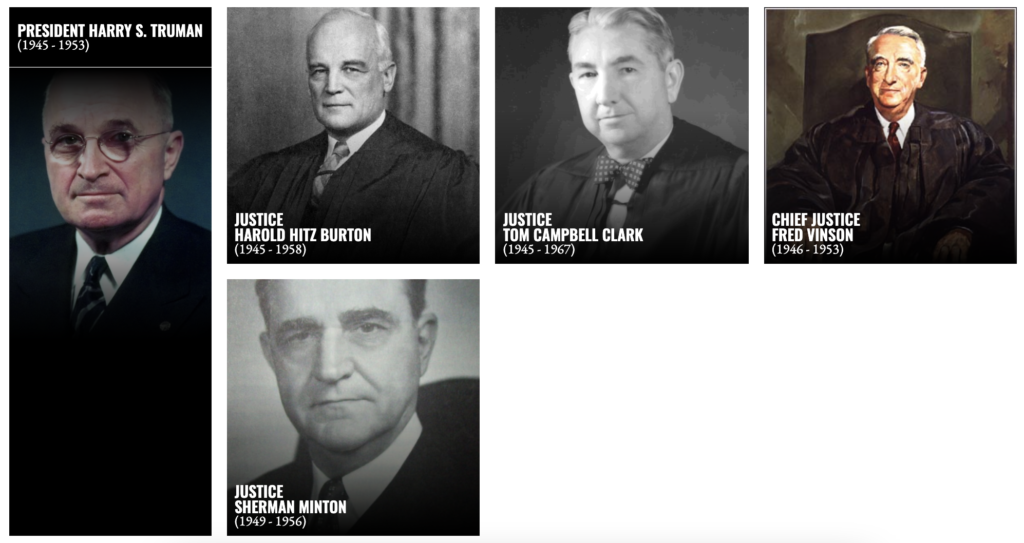
4/12/1945: President Harry Truman's inauguration. He would make four appointments to the Supreme Court: Chief Justice Vinson, and Justices Burton, Clark, and Minton.
Short Circuit: An inexhaustive weekly compendium of rulings from the federal courts of appeal
White House press passes, Wikipedia edits, and same-sex weddings.
New on the Short Circuit podcast: We recorded an episode at our tenth anniversary show last week. Hear from Eugene Volokh and Raffi Melkonian about video dissents and one arbitration to rule them all. Read More
Should A Federal District Court Hold Contempt Proceedings While An Emergency Appeal Is Ongoing?
Maybe judges should hold off on ordering the executive branch to show cause until the Supreme Court finishes its review.
The Supreme Court's decision in Trump v. J.G.G. divested Judge Boasberg of the jurisdiction to further adjudicate the matter. It also cast in serious doubt whether he could continue his contempt proceedings against the executive branch. Earlier this week, I wrote "it is not clear if the District Court has power to hold the executive branch in contempt where it lacks jurisdiction over the case." I still don't know the answer to that question, but as a practical matter, Judge Boasberg will likely stand down.
My colleague Seth Barrett Tillman ruminated on holding litigants in contempt in the context of emergency orders.
If the DOJ refused to abide by a federal trial court judge's order, and that order was granted ex parte, but subsequently it was set aside, then what should the judge do? My view is that holding the prevailing party in contempt should not be predicated on mere disobedience standing alone. Contempt's normative justification is tied to fair play and due process, but where the process is ex parte, contempt is too harsh. What is driving the public mind (or part thereof) to press for contempt in the recent immigration cases is that a large part of the public believes the Trump-47 policies are lawless or heartless or both. But if the policies are lawless, that's a merits determination. If the order was set aside on appeal, then the merits standing alone should not be sufficient cause to elicit a contempt order. As for heartless, I am sure that the majority of federal judges think that too. But that is a policy and values judgement—we hold elections to make those decisions—we do not issue contempt citations for being on the wrong side of a naked moral judgment untethered to established law.
Where an ex parte TRO is set aside, I think a federal trial court judge has a narrow window of opportunity to hold a disobedient defendant in contempt. The judge must establish that the defendant's conduct during and in the course of the litigation was illegal or inequitable. Here I am speaking not to the litigant's underlying or out-of-court conduct, but his conduct in relation to his representation before the trial court. The conduct would have to be something akin to unclean hands (albeit, that doctrine usually applies to plaintiffs' seeking equitable relief, as opposed to defendants' opposing an application for equitable relief).
To put it another way, when a trial court's ex parte TRO is on its way up through the court system on appeal, a judge should refrain from discussing contempt, in full public view, for noncompliance during that time. After the appellate process is over, then that's the time to consider a contempt citation, and it should be done in full public view. Otherwise, the judge will look vicious, officious, and biased. And that cannot be right.
As usual, I find Seth's reasoning persuasive. Let me extend Seth's point a bit further.
Imagine two counterfactuals. What if Judge Boasberg had held the executive branch in contempt before the Supreme Court ruled that he lacked jurisdiction? Maybe he sought to fine, or even incarcerate a DOJ lawyer, or someone higher up in the administration. Alternatively, what if the contempt proceedings elicited information that could have caused the Supreme Court to rule differently. For example, the judge demanded that the Secretary of Homeland Security testify in open court about classified matters. These hypotheticals raise what I think has been an unstudied question: should a federal district court even hold contempt proceedings while an emergency appeal is ongoing? In other words, if a case is rocketing up the shadow docket, should judges hold off on ordering the executive branch to show cause until the Supreme Court finishes its review?
I think the answers to these questions have to be no and yes. The entire case went from the trial court to the Supreme Court in about a month. There really was no need to hold any contempt proceedings while the appeal was ongoing--especially in light of the fact that the government contested the court's jurisdiction. But more fundamentally, the question of whether the government engaged in contempt very much turns on whether the court's order was lawful.
It is true that in the normal course, the way to challenge a trial court's ruling is through the appellate process. But this was not a normal case. Here the court instructed a coordinate branch of government how to exercise its constitutional authority when there was no practical time for an appeal. Can it be that a single district court judge can exercise absolute authority over the executive branch, even for a limited time? Should the government be held in contempt for not immediately turning planes around over international waters? At best for the court, this is in something of a zone of twilight where the allocation of powers between the judiciary and executive branch is unclear. I would remind everyone that the Truman Administration did not immediately obey an unstayed district court order in the Steel Seizure case. At worst, Judge Boasberg's order, issued orally without the benefit of full party presentation, should not form the basis for a contempt citation.
The first phase of the Trump litigation was unappealable TROs. The second phase entailed preliminary injunctions that were appealed to the Supreme Court, but were vacated through some compromises. The third phase, I predict, will be hostile contempt proceedings where district court judges try to reassert their authority over the executive branch, even in the face of SCOTUS reversals. We may not have a special counsel like Robert Mueller to launch inquisitions against the Trump Administration, but district court judges in D.C. and Maryland will gladly assume that role. Soon enough, we will be talking about "obstruction of justice" all over again. We might spend the next four years inquiring about what Trump knew about the airplanes. This very well might form the basis of future articles of impeachment. It is 2017 all over again.
I'll close with an unpopular opinion. When a judge feels the need to hold the executive branch in contempt, he should recuse and let another fresh judge decide if the contempt proceedings are justified. I think it is tough for a judge to simultaneously decide which party has the better reading of the law, while lurking in the background is the question of whether the government flouted the court's order about that disputed question of law. I made this point concerning an unusual case from South Dakota where a District Court judge sought to hold the U.S. Marshal in his contempt. The District Court Judge actually appointed a special prosecutor to prosecute the Marshal, akin to the Donziger case. But to his credit, the District Court judge recused and let another judge handle the matter. At the time, I opined:
Recusal seems like an obvious move. This judge has clearly made up his mind. The case is so personal. There is no pretense of objectivity at this point. The case is styled United States of America v. John Kilhallon, et al. But the Plaintiff is not the United States. It is a single judge who abused his discretion. Judge Kornmann makes Judge Emmet Sullivan seem reasonable by comparison.
Unsurprisingly, cooler heads prevailed, and the new judge dismissed the contempt proceedings against the Marshal.
If any further contempt proceedings are to be had, I think recusal would be appropriate here for Judges Boasberg, Xinis, and any other judge seeking to hold the administration in contempt. No matter how hard a judge tries, these sorts of cases become personal.
The case would not be J.G.G. v. Trump. It would be J.E.B. v. Trump. And Trump has some experience with moderates named Jeb!
There is no harm in letting a fresh set of eyes review the matter.
Justice Kavanaugh Stays District Court Order in Ohio Ballot Initiative Dispute
Not all of the action on the shadow docket involves President Trump.
On Wednesday evening, in Yost v. Brown, Justice Brett Kavanaugh entered a stay of a district court order in requiring Ohio Attorney General Dave Yost to publish two contested ballot initiative summaries. Justice Kavanaugh also called for a response by next Wednesday.
The underlying dispute concerns the wording of the ballot initiative summary prepared by the initiative proponents. Attorney General Yost rejected the summary prepared by the proponents on the grounds that it is not fair and truthful and the proponents sued. The district court entered an injunction requiring the AG to publish the summary, and this order was affirmed by a divided panel of the U.S. Court of Appeals for the Sixth Circuit.
Judge Karen Moore wrote the majority, joined by Judge Andre Mathis. Judge John Bush dissented.
Judge Moore's opinion begins:
Ohio Attorney General Dave Yost has eight times rejected a proposed summary of a proposed constitutional amendment, preventing its proponents from circulating a petition and collecting signatures needed to place it on the ballot. Each time, Yost concluded that the petition summary was not a fair and truthful summary of the proposed constitutional amendment. The district court held that this likely violated the ballot initiative proponents' First Amendment rights and entered a preliminary injunction ordering Yost to certify two ballot initiative summaries proposed by Plaintiffs here. However, upon Yost's request, the district court stayed the preliminary injunction pending appeal. Because we agree with the district court that Plaintiffs' First Amendment rights were likely violated here, and because the other stay factors do not weigh in Yost's favor, we GRANT Plaintiffs' motion to lift the stay and LIFT the stay entered by the district court.
Judge Bush's dissent begins:
I would deny the motion to vacate the stay of the district court's injunction. All the relevant legal factors support continuance of the stay. The driving consideration here is that the Ohio Attorney General is likely to prevail in this action because the First Amendment does not bar the State from regulating the content of a certified initiative summary. The summary is a legislative action that, at most, constitutes government, not private, speech. But even if it were private speech, the Attorney General's regulation of its content would still be permissible because the summary would constitute speech that occurs within a discretionary government benefit program, which the Supreme Court has held may be subject to content-based regulation. I explain these points more fully below.
Given the underlying First Amendment issue, it is conceivable that the Court accepts this case for argument. We shall see.
Yost v. Brown is not the only non-Trump action on the shadow docket. Earlier today the Court denied the application for a stay of execution in Mahdi v. Stirling.
Friday Open Thread
What's on your mind?
"The Supreme Court Is Not Cowering Before Trump on the Shadow Docket"
"Nor is it taking a new approach."
A very interesting analysis at Executive Functions by Prof. Jack Goldsmith (Harvard), a leading scholar of executive power and of the separation of powers; an excerpt, though you should read the whole thing:
I have heard from a few people in recent days who think the Supreme Court is cowering before the Trump administration or, at least, is not adequately standing up to it.
Adam Liptak gave voice to a version of this view a few days ago. In contrast to the Court's "signature . . . sweeping claims about the meaning of the Constitution," he argued, the Court in the Trump cases has been issuing "a series of narrow and legalistic rulings that seem calculated to avoid the larger issues presented by a president rapidly working to expand power and reshape government." Liptak said this "new approach" was designed in part "to avoid a showdown with a president who has relentlessly challenged the legitimacy of the courts."
Liptak's stance is a little hard to understand. The cited cases with "sweeping claims"—on abortion, affirmative action, the Second Amendment, and the like—were decided on the Court's merits docket. But the Trump cases have occurred on the emergency orders or "shadow" docket where, as Liptak acknowledges, the Court must move quickly, with impoverished briefing and process, to "decide whether to pause lower court rulings, themselves preliminary and tentative." In this context, he correctly says, it is "understandable … that the justices may be reluctant to make grand pronouncements."
I am not sure how to square these views, but I agree with this last point, and will flesh it out below. The Court as of this posting has issued six emergency orders on Trump 2.0 actions, including last night's order in Noem v. Garcia. It is too early to know whether the Court is acting wisely on its emergency docket. Yet thus far it has neither bowed to the president nor proceeded in an untoward way.
The Fantastical Showerhead Executive Order
A simple and quite symbolic presidential decree that symbolizes quite a bit, but accomplishes very little.
President Trump issued a flurry of additional executive orders and presidential memoranda this week, many of which concerned regulatory policy. One EO in particular, "Maintaining Acceptable Water Pressure in Showerheads," symbolizes much of what we are seeing from the early stages of Trump's second term. The EO sends a message, but might not quite do what the President wants or what you might think (and has been characterized inaccurately by early media reports). It also highlights how the White House continues to make policy pronouncements that agency officials (attorneys in particular) will have to figure out how to implement.
Let's start with the title. The EO promises to increase or maintain shower water pressure, but it will not do that. The EO itself does not rescind the federal requirement limiting showerhead flow to 2.5 gallons per minute. This is because this limit is written into the U.S. Code (as the White House Fact Sheet acknowledges). If you are someone who wants a torrent of water beating down on you for your morning shower, this EO does not offer any relief from federal law.
What, then, does the showerhead EO do? It rescinds a regulatory definition of showerhead that had the primary effect of defining multi-nozzle showers as a single showerhead for purposes of the rule. The first Trump Administration did the same thing, but it was undone in the Biden Administration. The text of the EO makes all of this clear.
Section 1. Purpose. Overregulation chokes the American economy and stifles personal freedom. A small but meaningful example is the Obama-Biden war on showers: Twice in the last 12 years, those administrations promulgated multi-thousand-word regulations defining the word "showerhead." See Energy Conservation Program: Definition of Showerhead, 86 Fed. Reg. 71797 (December 20, 2021); Energy Conservation Program for Consumer Products and Certain Commercial and Industrial Equipment: Test Procedures for Showerheads, Faucets, Water Closets, Urinals, and Commercial Prerinse Spray Valves, 78 Fed. Reg. 62970 (October 23, 2013). To the extent any definition is necessary for this common piece of hardware, the Oxford English Dictionary defines "showerhead" in one short sentence.
Sec. 2. Ordering the Repeal of the 13,000-Word Regulation Defining "Showerhead". I hereby direct the Secretary of Energy to publish in the Federal Register a notice rescinding Energy Conservation Program: Definition of Showerhead, 86 Fed. Reg. 71797 (December 20, 2021), including the definition of "showerhead" codified at 10 C.F.R. 430.2.
Those who don't bother to pay attention to the details may cheer or condemn the EO, but it really will not do much. Indeed, even if the EO were capable of rescinding the federal limit on showerhead water flow, it is not clear it would have much effect on water use. To the contrary, there is empirical evidence that reducing showerhead water flow can increase water consumption because it causes some people to take longer showers. Among other things, they can can lengthen the time it takes for water to get up to temperature and cause people to rinse for longer periods. So, if we want more water flow, that is a job for Congress, and if we want to conserve water, we would be better off with market pricing.
A particularly striking feature of the EO for us administrative law types is how it instructs the Energy Secretary to implement the President's demand.
Notice and comment is unnecessary because I am ordering the repeal. The rescission shall be effective 30 days from the date of publication of the notice.
At one level, this is a breath-taking assertion of presidential authority--and one that will almost certainly be rejected by the courts. While the President is not an agency for purposes of the Administrative Procedure Act, a Presidential order does not insulate executive branch officials from complying with the APA's requirements. The rescission of a regulation is not exempt from the APA's procedural requirement, nor is a presidential decree, by itself, enough to constitute "good cause" for avoiding those requirements.
Does this mean rescinding the Obama-Biden showerhead definition will have to go through notice and comment? Not necessarily. While there is no mention of it in the EO or the White House Fact Sheet, the Department of Energy may have a way to quickly rescind the rule: Declare the definition to be no more than a non-binding "interpretative rule" exempt from the notice-and-comment requirements of Section 553 of the APA. After all, the definition is, at its core, an official interpretation of a statutory term and need not be understood to impose any sort of legal obligation. Insofar as the definition is relied upon for the implementation and enforcement of other, substantive rules--such as those setting forth the water-flow testing requirements for showerheads--this could get sticky, but I suspect attorneys within the Energy Department could use this route to quickly eliminate this regulation from the books.
In the end we have an EO that is more bluster than substance. It will do very little to change most people's shower routine, and insofar as it is actually implemented, it is unlikely to be through the route the President directs, but it may be possible to execute quickly if the agency lawyers do their jobs. In these respects, it may be symbolic of the Trump Administration's deregulatory efforts overall.
* * *
Note: For those seeking to keep track, here is a link to President Trump's EOs that have been published in the Federal Register. Note that it typically takes a few days before new EOs are published, so this listing is sometimes a few days behind. (For example, at the time this is posted, the showerhead EO is not yet included.)
No Closed Trial, Pseudonymity at Trial, or Audio-Only Testimony for Billion-Dollar Maine Lottery Winner
"However legitimate [plaintiff's] concerns, a party's wealth alone is not a legitimate reason to restrict the right of public access."
Some short excerpts from yesterday's long decision by Judge John Woodcock (D. Me.) in Doe v. Smith:
On November 14, 2023, John Doe, a pseudonym for the father of a minor daughter, filed a lawsuit against Sara Smith, a pseudonym for the mother of the same minor, seeking an injunction and other relief against Ms. Smith for disclosure of information subject to a Non-Disclosure Agreement (NDA) between them. Specifically, Mr. Doe, a winner of the Maine State Lottery, claimed that Ms. Smith violated the NDA by informing third parties about his winnings….
Mr. Doe notes the Court "hit the nail on the head" when it observed in a January 10, 2025 status conference that he is faced with a "Catch-22" if this case were to proceed to a public trial: "even if Plaintiff were to win on his claims, his identity and confidential information would be revealed to the public and the media; he would effectively lose the privacy war and subject himself and his minor daughter to the irreparable harm he brought suit to avoid."
He thus files this motion for a closed trial and informs the Court of his intent to seek interlocutory appeal of the Court's ruling if necessary. Mr. Doe specifically requests that any trial in this matter be closed in its entirety to the public and media, or alternatively that all testimony of the parties and their family members to be submitted to the jury be taken by telephone or audio-only Zoom along with "appropriate safeguards, including, but not limited to, the partial closure of any trial to the public and media where appropriate, in order to ensure that the identities and other personal identifying information of the Parties and their family members remain anonymous." …
The court said no to the closed trial request:
Offices and Officers of the Constitution Part VI: The Ineligibility Clause
The latest in the ten-part Tillman-Blackman series on Offices and Officers of the Constitution
I am pleased to announce that the South Texas Law Review has published the sixth installment in the Tillman-Blackman series on the offices and officers of the Constitution.
Here is the abstract of Offices and Officers of the Constitution Part VI: The Ineligibility Clause.
This Article is the sixth installment of a planned ten-part series that provides the first comprehensive examination of the offices and officers of the Constitution. The first installment introduced the series. The second installment identified four approaches to understand the Constitution's divergent "office"- and "officer"-language. The third installment analyzed the phrase "Officers of the United States," which is used in the Appointments Clause, the Impeachment Clause, the Commissions Clause, and the Oath or Affirmation Clause. Part IV traced the history of the "Office . . . under the United States" drafting convention. Part V considered the meaning of the phrase "Office . . . under the United States," which appears in the Incompatibility Clause, the Impeachment Disqualification Clause, the Foreign Emoluments Clause, and the Elector Incompatibility Clause. This sixth installment, Part VI, will turn to the phrase "Office under the Authority of the United States," which appears uniquely in the Ineligibility Clause. The Ineligibility Clause provides, "No Senator or Representative shall, during the Time for which he was elected, be appointed to any civil Office under the Authority of the United States, which shall have been created, or the Emoluments whereof shall have been [i]ncreased during such time; and no Person holding any Office under the United States, shall be a Member of either House during his Continuance in Office."
This Article proceeds in five sections. Section I describes the drafting history of the Ineligibility Clause during the Constitutional Convention This drafting history lends some support for our view that the phrase "any civil office under the Authority of the United States" refers to a category of appointed, and not elected, positions. Section II contends that the President and Vice President do not hold "civil offices under the Authority of the United States." This argument flows from the text of the Ineligibility Clause, which applies to "appointed" positions. As a general matter, the President and Vice President are not appointed; rather, they are elected by electors, or they are elected or chosen by the House and Senate.
Section III puts forward the position that members of Congress do not hold "civil offices under the Authority of the United States." If senators or representatives held "civil offices under the Authority of the United States," then Congress might be able to manipulate its own membership by modifying the compensation for these elected positions. Generally, members of Congress are "elected," and not "appointed." Section IV identifies several positions covered by the Ineligibility Clause. In our view, the phrase "Office under the Authority of the United States" refers to a specific category of appointed officers—a category more expansive than both "officers of the United States" and "office . . . under the United States." Section V turns to the interaction between the Ineligibility Clause and the Religious Test Clause. The latter provides "no religious Test shall ever be required as a Qualification to any Office or public Trust under the United States." There may be a handful of irregular positions that are an "Office under the Authority of the United" but not an "Office under the United States" or a "public trust under the United States." Such positions would not be subject to the Religious Test Clause.
The Ineligibility Clause is very useful to understand the difference between the meaning of "elect" and "appoint."
Parts seven through ten of our series should be published over the next year or so. This project began in earnest in 2017, and our first installment was written in 2020. Even though the courts may have lost interest in officer-stuff, we have not!




