The Volokh Conspiracy

Mostly law professors | Sometimes contrarian | Often libertarian | Always independent | Est. 2002

The Volokh Conspiracy

Second Amendment Roundup: 2nd Circuit Upholds Connecticut's Semiautomatic Firearm Ban

The court substitutes an “unusually dangerous” test for Heller’s “dangerous and unusual” test.

|

In National Association for Gun Rights v. Lamont, the Second Circuit decided that a Second Amendment challenge to Connecticut's ban on many semiautomatic firearms does not have a likelihood of success.  The court assumed that possession of the firearms is constitutionally protected per Bruen's textual step 1, but held that the ban is consistent with our Nation's historical tradition of firearm regulation under step 2.  That conclusion is in blatant conflict with Heller's holding that arms that are in common use are protected by the Second Amendment and may not be banned.

Connecticut defines "assault weapon" to include a semiauto centerfire rifle that accepts a detachable magazine and one "military-style" feature, a .22 rimfire rifle with two such features, a list of firearms based on make and model, and an "other" category which applies to a pistol with a stabilizing brace.  The feature of the pistol grip is supposedly for "spray[ing] … a large number of bullets … without having to aim," which would actually mean fewer hits.  If that is true, why do single-shot rifles and even airguns, including those used in the Olympics, have similar pistol grips?  Check out the precision Feinwerkbau air rifles here.

A "telescoping stock" supposedly makes a rifle "easier to conceal," even though it still meets the minimum overall length for rifles.  Flash suppressors allegedly "help shooters avoid detection," but in reality reduce blinding in low-light conditions, such as home defense at night.  Such are the usual clichés that bear no relation to reality, as I've explained in detail in America's Rifle.

Plaintiffs brought a facial challenge but provided no evidence for many of the law's provisions, and thus could not show that no set of circumstances existed under which the entire statute would be valid under the Salerno rule.  The court thus focused on the law as applied to AR-15 type rifles, a .300 Blackout "other" firearm, and magazines with a capacity of over ten rounds.  Following Supreme Court precedent, the distinction between facial and as-applied challenges "goes to the breadth of the remedy employed by the court, not what must be pleaded in a complaint." See Citizens United v. Fed. Election Comm'n (2010).

The court thus decided that it could "consider partial invalidation … when evaluating facial challenges," adding that it "accept[ed] Plaintiffs' theory that we may consider their challenge as limited to the portions of the statutes restricting possession of their desired firearms and magazines and proceed to consider the constitutionality of only those specific sections of the statutes."

The court quoted U.S. v. Miller (1939) as holding "that the sorts of weapons protected were those 'in common use at the time,'" to which D.C. v. Heller (2008) added that limitations on Second Amendment protections for certain types of arms are "fairly supported by the historical tradition of prohibiting the carrying of 'dangerous and unusual weapons.'"  The court then proceeds blatantly to reject that test.  While "assuming arguendo that the desired firearms and magazines are 'typically possessed' and 'in common use," for lawful purposes, the court states, they may nonetheless be banned if they are "unusually dangerous," a term never used by the Supreme Court.

Under Heller, once it is clear that the arms that are banned are in common use, that ends the matter – the ban is unconstitutional.  D.C. argued that handguns are used in most violent crimes, including mass shootings, and are unnecessary for self-defense.  D.C.'s amicus Violence Policy Center recounted such tragedies, noting, "In the recent Virginia Tech shooting, a single student with two handguns discharged over 170 rounds in nine minutes, killing 32 people and wounding 25 more."  Heller rejected those arguments and held that handguns are in common use for self-defense by American citizens, and they – not the government – get to decide their preferred arms.

Bruen repeated that holding and added that a ban on carrying handguns was not justified by proper historical analogues.  Bruen also reflected: "While the historical analogies here and in Heller are relatively simple to draw, other cases implicating unprecedented societal concerns or dramatic technological changes may require a more nuanced approach."  (Emphasis added.)  Heller's common-use test applicable to arms-ban cases, and Bruen's text-history test applicable to carry-ban cases, are simple to follow and are not the "other cases" that are subject to "a more nuanced approach" based on "unprecedented societal concerns or dramatic technological changes."  Such "concerns" and "changes" have no application to the tests that Heller and Bruen have decided.  For a detailed analysis, see Mark W. Smith, What Part of "In Common Use" Don't You Understand? How Courts Have Defied Heller in Arms-Ban Cases—Again, JLPP (2023).

That leaves Connecticut's ban on firearms and magazines that are not "dangerous and unusual" (i.e., in common use) unconstitutional.  Heller, Bruen (5 times), and Rahimi consistently used the term "dangerous and unusual," as did James Wilson and other treatise writers quoted by the Court.  The term "dangerous or unusual" appears only when the Court quoted Blackstone, who wrote that "riding or going armed with dangerous or unusual weapons, is a crime against the public peace, by terrifying the good people of the land." That described the offense of an affray, which requires riding or going armed to terrorize others, not mere possession of any type of arm.

Departing from the Supreme Court's clear statements, the court asserts that "both the conjunctive and disjunctive formulations were traditionally understood as meaning 'unusually dangerous.'"  For that it cites nothing more than the declaration of non-lawyer, history professor Saul Cornell.  Doubling down, Judge Nathan states in his concurring opinion, joined by the other two panel judges: "It would seem a serious subversion of our commitment to history to enshrine a conjunctive test based on the Heller opinion's possible misquote of Blackstone."  So Supreme Court "misquotes" must be corrected by a supposed expert witness.

"Unusually dangerous," the court continues, identifies weapons that legislators presume "are not used or intended to be used for lawful purposes," contrary to the actual use and intended use by millions of Americans.  The overwhelming actual use of AR-15 rifles is target shooting, and their intended use for countless Americans includes self-defense.

The court repeats the Fourth Circuit's characterization in Snope v. Brown of Heller's common-use test as a "trivial counting exercise" that would sanction protection for "the W54 nuclear warhead" if it became popular before the government could ban it.  As Justice Thomas wrote dissenting from denial of cert in Snope, "To fend off the fantastical threat of Americans lobbing nuclear warheads at one another, the Fourth Circuit has allowed the very real threat of the government depriving Americans of the rifle that they most favor for protecting themselves and their families."

The court finds that "assault weapons" represent "dramatic technological changes," ignoring that semiautomatic rifles that use detachable magazines have been commonly possessed since the turn of the twentieth century.  Heller characterized the argument as "bordering on the frivolous, that only those arms in existence in the 18th century are protected by the Second Amendment," which "extends, prima facie, to all instruments that constitute bearable arms, even those that were not in existence at the time of the founding."  Heller's common-use test already accounts for technological changes by ensuring that the Second Amendment's protection extends to all firearms that are in common use at the time a court conducts the "in common use" analysis.

While historically "mass murders … involved the use of multiple people and multiple weapons," the court continues, the banned firearms allow "a single gunman carrying out a mass murder in seconds."  Heller rejected such arguments in invalidating the handgun ban.  And it goes without saying that there are few limits to the depravity that may occur regardless of the type of weapon.  One arsonist murdered 87 people at the Happy Land Nightclub in the Bronx in 1990.  Mass stabbings occur in countries that ban firearms, e.g., Japan's 2016 Sagamihara massacre in which a knife wielder murdered 19 people and injured 26.

The court states that "the AR-15 is more lethal … than ordinary handguns," but it is no more lethal than the semiautomatic Ruger Mini-14 which, the court concedes, Connecticut does not ban.  Both rifles are available in the .223 Remington cartridge, which the court fantastically claims "exacts serious injuries tantamount to being shot 'with a Coke can.'" Seriously?  That round is not even powerful enough for deer hunting!

The court further asserts that "the AR-15, unlike an ordinary handgun, has features that actually limit its usefulness for self-defense."  It's supposedly "more difficult to use," although many find a rifle easier to use than a handgun.  Recall that the District of Columbia and its amici argued in Heller that rifles are more suitable for self-defense than handguns.  And Heller held that the people, not the state, get to decide what to use for self-defense.

The court next moves on to the following dramatic claim about historical "comparators": "Like the weapons regulated by the challenged statutes, dirk and Bowie knives were technological advancements over ordinary defensive arms because they were designed 'expressly for fighting,' with longer blades, crossguards to protect fighters' hands, and clip points to facilitate cutting or stabbing adversaries."  Technological advancements?  Medieval daggers and other edged weapons had those features and more.  A visit to the arms and armor collection at the Museum of Art in Philadelphia brings that technology to life.

Moreover, the court ignores Bruen's contrast between medieval lances and daggers as follows: "In the medieval period, '[a]lmost everyone carried a knife or a dagger in his belt.' … While these knives were used by knights in warfare, '[c]ivilians wore them for self-protection,' among other things…. Respondents point to no evidence suggesting the Statute [of Northampton] applied to the smaller medieval weapons that strike us as most analogous to modern handguns."

As the court concedes, the antebellum states that regulated edged weapons mostly only banned concealed carry.  The court partially quotes Aymette v. State (Tenn. 1840), that "[t]he Legislature … ha[d] a right to prohibit the wearing or keeping [of] weapons dangerous to the peace and safety of the citizens…." But the court deleted the rest of the sentence adding "and which are not usual in civilized warfare, or would not contribute to the common defence." Aymette thus upheld the right to keep the very kinds of "military-style" arms that the court says can be banned.

The court also cites Cockrum v. State (Tex. 1859), which rejected a constitutional challenge to a law imposing higher penalties for murder committed with a Bowie knife or dagger.  Far from supporting a possession ban, Cockrum stated, "The right to carry a bowie-knife for lawful defense is secured."  Nor does the court's position  find support in State v. Workman (W. Va. 1891), which opined that the "arms referred to in the [second] amendment" are "the weapons of warfare to be used by the militia."

The court concludes that it joins "the First, Fourth, Seventh, Ninth, and D.C. Circuits (every Circuit to address the question) in approving restrictions on assault weapons and large capacity magazines."  That's because most states don't ban such arms and the courts in those states thus do not have occasion to opine thereon.  All the more reason for the Supreme Court to take up this issue, as Justice Kavanaugh suggested when cert was denied in Snope, stating that "this Court should and presumably will address the AR-15 issue soon, in the next Term or two."

 

Tariffs

Supreme Court Will Hear Our Case Challenging Trump's Tariffs - and Two Other Related Cases

The cases will be considered on an accelerated schedule.

|

NA

Today, the Supreme Court decided to review V.O.S. Selections, Inc. v. Trump, our case challenging President Trump's "Liberation Day" tariffs. The case was filed by the Liberty Justice Center and myself on behalf of five small businesses harmed by the tariffs. It is consolidated with a similar suit filed by twelve state governments, led by the state of Oregon. Both challenge massive tariffs Trump has imposed using his supposed authority under the International Emergency Economic Powers Act of 1977 (IEEPA), and both will now be heard on the same accelerated schedule. The Supreme Court also decided to hear Learning Resources v. Trump, a case challenging many of the same tariffs, filed by two importers in a different federal court.

We, the twelve states, and the Learning Resources plaintiffs all prevailed in the lower courts, and I hope the Supreme Court will also recognize the IEEPA tariffs are illegal for a variety of reasons. Fundamentally, these cases come down to whether the president has virtually unlimited power to impose taxes in the form of tariffs on the American people, much like an absolute monarch. The Framers of the Constitution deliberately denied the executive the kind of unbridled tax authority claimed by power-grabbing English kings, like Charles I.

The Court's order is short. For convenience, I reprint it here in full:

LEARNING RESOURCES, INC., ET AL. V. TRUMP, PRESIDENT OF U.S., ET AL. [24-1287]
TRUMP, PRESIDENT OF U.S., ET AL. V. V.O.S. SELECTIONS, INC., ET AL. [25-250]

The petition for a writ of certiorari before judgment in No. 24-1287 is granted. The motion to expedite and the petition for a writ of certiorari in No. 25-250 are granted. The cases are consolidated, and a total of one hour is allotted for oral argument. Respondents in No. 24-1287 and petitioners in No. 25-250 shall file an opening brief on the merits on or before Friday, September 19, 2025. Any amicus curiae briefs in support or in support of neither party shall be filed on or before Tuesday, September 23, 2025. Petitioners in No. 24-1287 and respondents in No. 25-250 shall file response briefs on the merits on or before Monday, October 20, 2025. Any amicus curiae briefs in support shall be filed on or before Friday, October 24, 2025. A reply brief shall be filed by Thursday, October 30, 2025. The cases will be set for argument in the first week of the November 2025 argument session.

The Liberty Justice Center has issued a statement about the order, which I reprint below. No one will be surprised that I agree with it! Here it is:

Today, the Supreme Court granted the government's expedited request for Supreme Court review (writ of certiorari) in V.O.S. Selections, Inc. v. Trump, agreeing to review whether the Trump Administration's "Liberation Day" tariffs exceed the President's legal and constitutional authority. Given the importance of the issues and the need for a prompt resolution, the Liberty Justice Center agreed to the government's request.

The Liberty Justice Center, along with legal scholar Ilya Somin, filed this case on April 14 in the U.S. Court of International Trade (CIT) on behalf of five American small businesses harmed by the tariffs. The CIT held that the International Emergency Economic Powers Act, or IEEPA, does not give the President unlimited unilateral authority to impose tariffs on the American people whenever he wants, at whatever level he wants, for whatever countries and products he wants, and for as long as he wants.

The government appealed to the U.S. Court of Appeals for the Federal Circuit, where the Liberty Justice Center was joined by leading appellate lawyers and constitutional scholars, Judge Michael W. McConnell and Neal Katyal. And on August 29, in a 7–4 decision, the Federal Circuit affirmed the CIT's decision, holding that IEEPA does not authorize the President's so-called "Liberation Day" tariffs. The Supreme Court will now decide whether to affirm those rulings.

Recognizing the urgency of the matter, the Supreme Court has now set this case on an expedited schedule, with oral argument to take place the first week of November.

"We are confident that the Supreme Court, like the CIT and the Federal Circuit, will recognize that the President does not have unilateral tariff power under IEEPA," said Jeffrey Schwab, Senior Counsel and Director of Litigation at the Liberty Justice Center. "Congress, not the President alone, has the constitutional power to impose tariffs."

The issues in the case are covered in much greater detail in our various legal filings (see the Liberty Justice Center site for a compilation), and in my earlier writings about this litigation.

Free Speech

Ninth Circuit Blocks Default Restrictions on "Like Counts" for Minors' Social Media Accounts, Upholds Default of "Private Mode"

|

From today's panel opinion in Netchoice, LLC v. Bonta, by Ninth Circuit Judge Ryan D. Nelson, joined by Judges Michael Daly Hawkins and William A. Fletcher:

Addressing the growing concern that our youth are becoming addicted to social media, California passed a law regulating how internet platforms allow minors to access personalized recommendation algorithms. NetChoice sued, arguing that the law violates the First Amendment. The district court preliminarily enjoined some provisions but largely left the law in place. NetChoice appeals the district court's denial of injunctive relief. With one exception, we affirm the district court.

There's a lot going on there, and some of the analysis turns on procedural or remedial features of the case, but here's a substantive First Amendment analysis as to one facet of the law:

NetChoice also raises an as-applied challenge to the Act's requirement that minors' accounts operate with certain default settings, which can be turned off by a parent. Two such default settings are at issue: (1) that covered platforms cannot show minors the number of likes or other feedback on a post; and (2) that minors' accounts must be on "private mode" ….

We disagree that the whole Act is content based, but agree that the like-count provision itself is….

Read More

Free Speech

Sixth Circuit Judges on Restrictions on Parents' School Board Meeting Comments

|

From today's concurrence by Sixth Circuit Judge Amul Thapar and Eric Murphy in Moms for Liberty v. Wilson County Bd. of Ed. You can read the panel opinion by Judge Jane Stranch, which is also joined by the other two judges, here. But there's a lot of procedural detail in the panel opinion, so I thought I'd focus on the simpler concurrence, which represents the view of a majority of the panel members, and lays out the constitutional issues (and briefly explains the procedural ones at the end):

For parents, few things matter more than their children's education. But when a group of moms began voicing concerns to their local Tennessee school board, they discovered that their input wasn't welcome. They now challenge the set of policies that restricted the tone, content, and format of their remarks. While I agree with the majority that the moms are not entitled to a preliminary injunction, I write separately to emphasize the troubling nature of the Board's rules.

Start with the Board's policy of cutting off "abusive" comments. The Board offers no guidance to distinguish "abusive" comments from critical or insulting ones. That distinction matters because the First Amendment prevents the government from discriminating against a speaker based on her viewpoint—regardless of whether that view is offensive or polite. When the Board bars offensive remarks but not flattering ones, it necessarily picks and chooses between opposing perspectives. This act of selection arguably makes the abusive-speech restriction an "egregious form of content discrimination" that is "presumed to be unconstitutional."

Put another way, the Board can't implement the equivalent of a "happy-talk" requirement that forces speakers to make their remarks "grammatically palatable to the most squeamish among us." In a free society, after all, the listener—not the government—decides whether remarks are worthwhile. And the price of that freedom is often unkind, offensive, or insulting speech.

Read More

Religion and the Law

Excluding Religious School That "Forfeited a Girls' Playoff Basketball Game to Avoid Playing a Team with a Transgender Athlete" Violated Free Exercise Clause

So the Second Circuit held today, concluding that the facts surrounding this particular exclusion showed hostility to religion, and not just the neutral application of generally applicable rules.

|

From today's decision by Second Circuit Judge Michael Park, joined by Judges Richard Wesley and Richard Sullivan, in Mid Vermont Christian School v. Saunders:

Mid Vermont Christian School forfeited a girls' playoff basketball game to avoid playing a team with a transgender athlete. The school believes that forcing girls to compete against biological males would affirm that those males are females, in violation of its religious beliefs. In response to the forfeit, the Vermont Principals' Association ("VPA") expelled the school from all state-sponsored extracurricular activities….

We conclude that Plaintiffs are likely to succeed in showing that the VPA's expulsion of Mid Vermont was not neutral because it displayed hostility toward the school's religious beliefs; Plaintiffs are therefore likely to prevail on their Free Exercise claim….

"At its heart, the Free Exercise Clause of the First Amendment protects the ability of those who hold religious beliefs of all kinds to live out their faiths in daily life through the performance of religious acts." It "guarantees to all Americans the right to believe and profess whatever religious doctrine they desire, even doctrines out of favor with a majority of fellow citizens."

Of course, the protections afforded under the First Amendment are not limitless. The Supreme Court has recognized that the Free Exercise Clause "does not relieve an individual of the obligation to comply with a valid and neutral law of general applicability." Nonetheless, even under a neutral law of general applicability, the government still "fails to act neutrally when it proceeds in a manner intolerant of religious beliefs." The First Amendment, in other words, guarantees not only that our laws be neutrally drafted, but that they subsequently "be applied in a manner that is neutral toward religion." … A plaintiff may therefore "prove a free exercise violation by showing that 'official expressions of hostility' to religion accompany" actions taken by the government to enforce its laws, and in such cases courts may set aside the adverse results of tainted enforcement proceedings "without further inquiry." …

Read More

Free Speech

Oklahoma AG on the First Amendment and Drag Shows

Such drag shows are protected unless they fit within the (fairly narrow) category of obscenity, which is limited to certain material that depicts sexual conduct (not just cross-dressing).

|

From Opinion No. 2025-13, released Aug. 29:

  1. Is a performance by an individual dressed in drag included in the definitions of "obscene material" in title 21, section 1024.1?
  2. Is a performance by an individual dressed in drag included in the definitions of "adult performance" in title 21, section 1024.6(A)(1) (Supp.2025)?
  3. Does a performance by an individual dressed in drag, in view of a minor in a public place, violate the provisions of title 21, section 1024.6(B)(1) (Supp.2025)?
  4. Is a performance by an individual dressed in drag protected speech under the First Amendment? If so, under what circumstances can said speech be regulated by the state or other political subdivisions? …

The answer to all four questions depends upon whether the drag performance contains "obscene material" …. The definition of "adult performance" … requires the performance to contain "obscene material." For a performance to be prohibited by section 1024.6(B)(1), it likewise must also contain "obscene material." Finally, the performance is not protected by the First Amendment to the extent it contains "obscene material." Miller v. California (1973). As a result, a drag performance violates Oklahoma law only if it contains "obscene material." …

Under Oklahoma law, "obscene material" includes any representation, performance, depiction, or description of sexual conduct that meets three criteria: (a) it is patently offensive as judged by the average person applying contemporary community standards; (b) it appeals to prurient interest in sex as its dominant theme; and (c) it lacks serious literary, artistic, educational, political, or scientific value when taken as a whole.

Importantly, the definition of "obscene material" as established by the Miller test and adopted in Oklahoma first requires the performance to contain "sexual conduct." Oklahoma's statutory definition of "sexual conduct" comprises the following acts: sexual intercourse, oral or anal sodomy, masturbation, sadomasochistic abuse, excretion in a sexual context, and exhibiting genitals or pubic areas {[and, e]ffective November 1, 2025, "acts of sexual activity with an animal" and "exhibiting genitalia, breast, or pubic area for the purpose of the sexual stimulation of the viewer"}.

Read More

The Troubling Case of Dowd v. United States

|

I haven't posted on the Volokh Conspiracy in over a decade, because SCOTUSBlog is a better vehicle for my usual posts about Supreme Court minutiae.  But one of my cases involves one of the more egregious miscarriages of justice I recall seeing in more than thirty years of practice. Yes, it involves a client of mine, but I try to take a detached view of the strengths and weaknesses of my cases.  I've handled a lot of clients over the years, and this is the first case of mine that I'm blogging about.

The case against Andrew Dowd

At the center is Dr. Andrew Dowd, a 69-year-old orthopedic surgeon with no criminal history (beyond traffic tickets).  He ran a hugely successful medical practice, with 10 offices that treated hundreds of patients annually.  He was convicted of conspiring to operate on patients who claimed to have slipped and injured themselves at various properties, thereby inflating insurance settlements.  The defense maintained that a pre-existing conspiracy—led by a disgraced former chiropractor, another doctor, and lawyers—funneled Dowd patients precisely because his high-volume practice made him unlikely to spot their fraud, and they knew Dowd was likely to operate on the patients based on their medical records and complaints.

The evidence that Dowd knew the patients were fraudulent was thin. The trial witnesses all arrived with MRI reports showing soft-tissue damage, and since the conspirators preferred recruiting people with genuine injuries (just not from where they claimed!), four of the five patients who testified actually had knee damage—and Dowd accurately noted after surgery that the fifth lacked the injury her MRI suggested. The other conspirators chatted openly about the scheme in emails and texts, but none looped in Dowd. When an insurer launched an investigation, the group discussed it, but no one alerted Dowd—implying even they didn't think he was "in on it." Dowd was convicted on a "conscious avoidance" theory: that he deliberately turned a blind eye to signs of fraud.

Dowd recently began serving an 8 ½-year sentence and was ordered to forfeit $8.1 million. While numerous aspects of his case strike me as unjust, three stand out as especially outrageous.

When a judge becomes an advocate: a call for recusal

In an earlier trial, the scheme's mastermind and one of his "runners" (who recruited patients) testified against fellow runners. Dowd was repeatedly named as one of two doctors the group used. The presiding judge didn't just observe; he actively prodded prosecutors to broaden their probe, declaring, "I would urge the government to continue their investigation here, because, based on this testimony, the lawyers and the doctors were heavily involved," and voiced his "hope" that the feds were "pursuing … the corrupt doctors who were involved in this scheme."

Fast-forward: The government indicted Dowd and others, and the case landed randomly with a different judge. But prosecutors filed a "related case" letter, and it got reassigned to the very judge who'd pushed for the expansion. Dowd moved for recusal under 28 U.S.C. § 455(a), arguing that a judge who takes the rare step of lobbying the U.S. Attorney's Office for the Southern District of New York—not exactly a timid outfit—can't reasonably appear impartial when presiding over the resulting trial. While the judge may "not likely have all the zeal of a prosecutor" after calling for the prosecution, "it can certainly not be said that he would have none of that zeal." In re Murchison, 349 U.S. 133, 137 (1955).

Botched "harmless error" review

No direct evidence showed Dowd knew about the fraud—just circumstantial bits supporting the "conscious avoidance" claim. To shore it up, prosecutors called Tara Arce, a professional insurance-fraud investigator, as a "lay" (non-expert) witness. Ms. Arce had no first-hand knowledge of the alleged conspiracy.  Everything she knew about the case came from reviewing insurance files.  Based on those files (much of which were undisputedly hearsay), she opined that there were "red flags" of obvious fraud in the claim files.  But only four files involved Dowd, and the "red flags" that Arce identified involved non-medical details a treating physician wouldn't have known about, like the fact that accidents had no witnesses. The trial judge admitted the testimony anyway, even though lay witnesses can only describe what they observed, not draw expert conclusions.

The Second Circuit assumed error—credit where due—but dismissed the error as "harmless" in a superficial review that fixated on the government's "significant proof" elsewhere, without assessing the error's effect over the jury. (Pet. at 24-27.) That flouts Kotteakos v. United States, 328 U.S. 750 (1946), which requires evaluating whether the mistake had a "substantial and injurious effect" on the verdict, not just gauging the prosecution's overall strength. In this razor-thin, inference-heavy case, Arce's improper testimony painted Dowd as ignoring blatant fraud signals—fueling the government's core theory. Worse, the Second Circuit rested its decision on objective record errors, claiming the government "never mentioned [Arce's] testimony in its closing argument." In reality, prosecutors invoked it repeatedly in closing and rebuttal. We flagged that inaccuracy in a rehearing petition, but the court didn't even correct the opinion.

$8 million in restitution without a hearing

In the first trial, the judge set an explicit briefing schedule for restitution. For Dowd, though, the government started the process by emailing the judge in chambers demanding $8.1 million—more than double what earlier defendants paid for the harm caused by the same scheme. No docket filing, no response deadline, no hearing. We didn't even know the email's official status—after all, it wasn't on the public docket, so how could we respond? Local rules grant 14 days to oppose docketed motions. But the judge imposed the full $8.1 million on day 10, without waiting for our filing.

Astonishingly, the Second Circuit ruled no due process violation, claiming Dowd had notice and an opportunity to respond. How? The judge's offhand remark at sentencing that the government had "90 days on restitution" to gather materials. But that vague statement didn't tell the defense they'd lose even the standard 14 days to file a responsive pleading—and besides, the judge actually ruled on day 86 post-sentencing, not day 90. (He'd taken between 96 and 131 days to impose restitution on the other defendants after giving the government the same 90-day period.) We were eager to challenge the prosecution's restitution calculation, given insurer documents stating that some patients weren't "part of [the] pattern."

What's next?

We quickly filed our cert petition seeking review of these three issues, supported by a strong amicus brief filed by the Cato Institute.  But the government waived its right to respond after waiting long enough to ensure that the case would be considered at the Court's end-of-summer "Long Conference," where the odds of grants are statistically lowest.

The Court hasn't granted cert in decades without first calling for a response. So unless a Justice demands one, our petition is headed for the "dead list"—the pile of automatic denials.

Over the years, numerous Justices have forced the government to defend judgments in troubling criminal cases by requiring briefs in opposition. Indeed, it was happening so much that in 2023, the Justice Department had to hire more Assistants to the Solicitor General just to write them all.

It would be interesting to see a government response in Dowd's case—particularly on the sufficiency of due process before imposing an $8.1 million judgment on a person without even allowing him the ordinary 14 days to file a response, but also on whether it satisfied the appearance of justice to have a judge who openly "urged" a prosecution to preside over it. The Solicitor General likely would be able to come up with a justification for denying cert, but visible unease with certain rulings could cause him to propose some other resolution (such as a remand to permit Dowd the opportunity to contest restitution).

For now, we wait.

Politics

Third Circuit Holds Fired "Alt Right" Prof. Jason Jorjani's Speech Was Constitutionally Protected,

though it remands for a decision on whether he would have been fired in any event based on other misconduct.

|

[1.] From Jorjani v. N.J. Inst. of Tech., decided yesterday by Judge Paul Matey, joined by Judges Cheryl Krause and Peter Phipps:

New Jersey Institute of Technology declined to renew a lecturer's contract based on his private comments about race, politics, and immigration. But NJIT's regulation of speech outside the classroom and off the campus is subject to the restraints of the First Amendment, and the school documented no disruption to its educational mission….

NJIT hired Jason Jorjani in 2015 to teach philosophy, and twice renewed his contract in 2016 and 2017. During this time, Jorjani "formed the Alt Right Corporation," to "widen the message of his philosophy, which he describes as an affirmation of the Indo-European Tradition" and "the idea that European cultures are intimately related to those of Greater Iran and the Persianate World, Hindu India and the Buddhist East and are the sources the [sic] world's greatest scientific, artistic and spiritual developments." He spoke at conferences and published an essay titled "Against Perennial Philosophy" on "AltRight.com," a website he helped found. In the essay, he argued that "human racial equality" is a "left-wing myth" and that a great "Promethean" "mentality" rests on a "genetic basis" which "Asians, Arabs, Africans, and other non-Aryan peoples" lack.

The essay also argued that, through "genetic engineering" and eugenic "embryo selection," Iran could produce great philosophers by "restor[ing] the pre-Arab and pre-Mongol genetic character of the majority of the Iranian population within only one or two generations." Jorjani did not discuss these outside associations with his students or colleagues, nor did he disclose them as required by NJIT policy.

Then, in 2017, a person posing as a graduate student contacted Jorjani to discuss "how the Left persecutes and silences Right wing thought in academia." But he was working with a group called "Hope Not Hate," whose goal is to "deconstruct[ ]" individuals it deems "fascist" or "extremist." The two met at a pub where the undercover operative recorded their conversations, at first with Jorjani's consent. But later, apparently assuming the recording had stopped, Jorjani commented on matters concerning race, immigration, and politics.

Read More

Free Speech

Free Speech Unmuted: A Conversation with FIRE's Greg Lukianoff

FIRE is one of the leading free speech advocacy and litigation groups in the country, and Greg is not only its long-time head but also coauthor of several books, including Coddling of the American Mind (with psychologist Jonathan Haidt) and War on Words: 10 Arguments Against Free Speech—And Why They Fail (with law professor and former ACLU President Nadine Strossen).

|

Our past episodes:

Read More

Free Speech

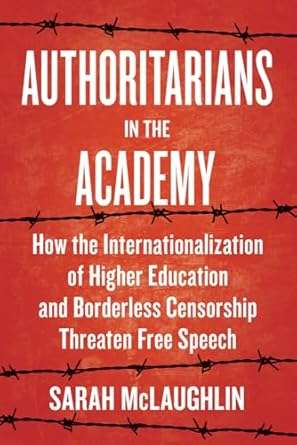
"Authoritarians in the Academy": Satellite Campuses and the Perils of Local Law

|

There are many ways that universities interact with the wider world, whether by coordinating study abroad programs or welcoming students from dozens of countries onto their campuses. But one of the most complex ties universities form is in their satellite campuses, in which they put down roots in other nations, usually in close coordination with local government officials.

These campuses have created the potential for a monumental clash between American-style academic freedom commitments and restrictive foreign legal systems. In some cases, that potential has borne out. When put to the test by local authorities, universities' promises to import their speech commitments overseas have been found wanting.

In a just-released Aug. 5 interview with Northwestern's outgoing president Michael Schill, the House Committee on Education and Workforce asked Schill about Northwestern's campus in Qatar. His answers cut directly to the heart of the disconnect between how universities both commit to abiding by local law and also offering the same speech protections as their home campuses.

Q Does Northwestern Qatar operate in accordance with all Qatari laws?

A I believe it has to.

Q This includes Qatari censorship laws, correct?

A I don't—so I—I don't know the answer to that as a legal matter. I believe that we have Qatar, the university—NU-Q has the same academic freedom and free speech that our domestic campus has in the United States, that we have in Evanston.

Schill also said he had "no idea" whether Qatari officials would allow Northwestern community members to criticize the government.

In today's guest post for my book Authoritarians in the Academy: How the Internationalization of Higher Education and Borderless Censorship Threaten Free Speech, I share an excerpt detailing how we already know Northwestern's values clash with local law—and who wins out:

Read More

Justice Kavanaugh Continues To Be The Only Justice To Explain Emergency Docket Orders

And Justice Kavanaugh has come a long way since using the term "noncitizen" instead of "illegal alien."

|

On Monday, the Supreme Court granted a stay in Noem v. Perdomo. The vote was (likely) 6-3. Justice Kavanaugh wrote a ten-page concurrence. Justice Sotomayor, joined by Justices Kagan and Jackson, wrote a twenty-page dissent.

This case was first filed on August 7, and briefing was completed on August 13. The Justices in the majority had about a month to put together a majority opinion. They didn't. Why? Perhaps the majority could not come to a consensus on a single line of reasoning--whether on Article III standing or the Fourth Amendment. Perhaps the majority simply didn't feel the need to write a majority opinion, because this is only an interim order. Or maybe a book tour got in the way of writing something. Well, it's hard to read the opinion when there isn't an opinion to read.

I don't have any particular expertise on the interaction between Article III standing and police stops, or on the Fourth Amendment issue. But I will commend Justice Kavanaugh, once again, for explaining his thinking. I don't know if Kavanaugh's views command a majority of the Court, but it is difficult to think of any other basis on which a stay could have been granted. We've seen some lower courts favorably cite dissents on the emergency docket. I think the judges in California would be prudent to cite Justice Kavanaugh's concurrence over Justice Sotomayor's dissent.

Justice Kavanaugh writes that the two "most critical" factors when deciding to grant a stay are certworthiness and irreparable arm

To obtain a stay from this Court, the moving party must demonstrate a fair prospect that, if the District Court's decision were affirmed on appeal, this Court would grant certiorari and reverse. The moving party also must show a likelihood that it would suffer irreparable harm if a stay were not granted. Those two factors are the "most critical." Nken v. Holder, 556 U. S. 418, 434 (2009).

I didn't remember Nken calling those two factors the "most critical." And it didn't. Rather, Nken found that the two "most critical" actors were likelihood of success on the merits and irreparable harm. Cert-worthiness was not discussed at all in Nken. But this factor was discussed in Hollingsworth v. Perry, which Justice Barrett amplified in Does v. Mills. Justice Kavanaugh is tweaking the standard here. He very well might be right about what are the two most factors in his view, but I don't think that comes from Nken.

I continue to think cert-worthiness is not a useful factor. Each Justice has a different threshold for whether a case is cert-worthy. Justice Kavanaugh, to his credit, signals that he wants to grant more cases. Same for Justices Thomas, Alito, and Gorsuch. Justice Barrett is the most stingy justice with cert-grants. We should not pretend cert-worthiness adds much to the equation, beyond a Justice's subjective valuation of how important a case is.

Because Justice Kavanaugh thinks that the case is cert-worthy, and the government will suffer irreparable harm in the absence of a stay, he turns to balancing the harms and equities. But Justice Kavanaugh immediately pivots, and explains that balancing the harms and equities is really tough in a case like this:

Read More

Farewell to the TaxProfBlog

Blogging can be a thankless and burdensome task. We should all be grateful for Dean Paul Caron's many year or service.

|

In 2011, while clerking on the Sixth Circuit, I entered the academic job market. At the time, I checked Paul Caron's TaxProfBlog regularly. Paul compiled information about VAPs, fellowships, and other aspects of academia. I reached out to Paul, and asked if he would meet. He graciously agreed!

I'll never forget the meeting. We caught up at a Starbucks near the campus of the University of Cincinnati. Who walks in, but the former mayor of Cincy: Jerry Springer. Yes, that Jerry Springer. Paul offered some invaluable advice about the academic market and how to approach the meat market. And Jerry offered some useful advice of how to handle conflicts at faculty meetings. (Okay, I made up the last point, but it would be hilarious to see Jerry manage a hiring meeting.)

Since then, I have been fortunate to keep Paul in my circle of contacts. I still read his blog daily, and often will email him about certain items he may wish to cover. Paul's output is staggering. He has published more than 55,000 posts, on top of his full-time job as a Dean! Paul also answers emails at all hours of the day, a remarkable feat. He doesn't miss a thing.

Alas, all good things come to an end. In 2023, I offered a requiem for SCOTUSBlog, which seemed destined to drift away, though thanks to a bizarre turn of events, it is not being bolstered by The Dispatch. But now, a pillar of the legal blogosphere will draw to a close. TypePad, the once-popular blogging software, is shutting down at the end of September. Paul has announced that he is shutting down TaxProfBlog. I will preserve his final post since the current page will soon vanish:

TaxProf Blog has been a labor of love these past 21 years. I have been puzzling over when would be the right time to stop. Typepad, the platform on which TaxProf Blog is hosted, made the decision for me when it announced on August 27th that it will discontinue all blogs effective September 30th. At this stage in my life, I am not interested in starting anew on a different platform. I hope to find another home for the massive content of my 55,780 TaxProf Blog posts. If I do, I will post the link on this post before September 30th and notify the subscribers to my tax and legal education email lists.

I am proud of the role TaxProf Blog has played in the tax and legal education communities over the past 21 years. My boyhood dream was to be a sports reporter covering the Boston Red Sox on a daily basis for The Boston Globe (after it became obvious even to me that my dream of playing first base for the Red Sox would not pan out). My wife Courtney early on said the blog scratched that itch for me in academics rather than sports.

Before TaxProf Blog sunsets on September 30th, I would greatly appreciate it if readers who have enjoyed my tax, legal education, and/or faith coverage through the years would drop a short note in the comment section at the bottom of this post. When I eventually retire, I will cherish the memories of the time I spent writing this blog for over two decades in the hope that it enriched your lives just a little bit.

Other legal blogs may also shut down, including the valuable Mirror of Justice. What a loss.

Blogging can be a thankless and burdensome task. We don't earn any actual income for doing it, and receive countless attacks from people who may never write any publicly. Indeed, social media for better or worse, has supplanted much of what made the legal blogosphere so important. I started blogging in the Fall of 2009, and still enjoy the process. But I do not write nearly as much as I used to, and I see diminishing returns.

We should all be grateful for Dean Paul Caron's many year or service. No one will replace him.

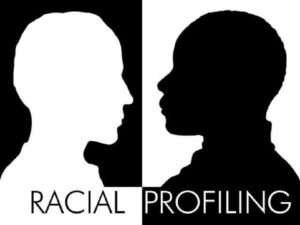
Racial Profiling

Supreme Court Issues Dubious "Shadow Docket" Ruling Staying Injunction Against Racial Profiling in Immigration Enforcement

There is no majority opinion, so the reasoning is unclear. But Justice Kavanaugh's concurring opinion undercuts principle that government must abjure racial discrimination.

|

NA

Today, the Supreme Court issued a "shadow docket" ruling staying a district court decision that had enjoined ICE from engaging in racial and ethnic profiling in immigration enforcement in Los Angeles. The decision was apparently joined by the six conservative justices; the three liberals dissented. As is often the case with "emergency"/shadow docket rulings, there is no majority opinion. Thus, we cannot know for sure what the majority justices' reasoning was. We have only a concurring opinion by Justice Brett Kavanaugh. But that opinion has deeply problematic elements. Most importantly, it is fundamentally at odds with the principle that government must be "color-blind" and abjure racial discrimination.

The district court found extensive use of racial profiling by ICE in immigration enforcement in the LA area, and issued an injunction barring it. Justice Kavanaugh, however, contends that the profiling is not so bad, and does not necessarily violate the Fourth Amendment because,  while "apparent ethnicity alone cannot furnish reasonable suspicion," it could count as a "relevant factor when considered along with other salient factors."

But even if it is not the sole factor, its use still qualifies as racial or ethnic discrimination. And, at least in some cases, it will be a decisive factor, in the sense that some people will be detained based on their apparent ethnicity, who otherwise would not have been. Imagine if the use of race and ethnicity were permitted in other contexts, so long as it is not the "sole" factor. Government could engage in racial discrimination in hiring (so long, again, as other factors were considered), voting rights, access to education, and more.

Moreover, in this case, race and ethnicity clearly were major factors in ICE decision-making, not just peripheral ones. That is evident from the fact that ICE arrests in Los Angeles County declined by 66 percent after the district court issued the injunction the Supreme Court stayed today.

In  SFFA v. Harvard the Supreme Court's 2022 ruling against racial preferences in university admissions, Chief Justice John Roberts wrote that "eliminating racial discrimination means eliminating all of it." If this is a sound constitutional principle - and it is - there cannot be an ad hoc exception for immigration enforcement, or for law enforcement generally. As Justice Sonia Sotomayor emphasizes in her dissent, joined by all three liberal justices, "We should not have to live in a country where the Government can seize anyone who looks Latino, speaks Spanish, and appears to work a low wage job." Or at least that's true if the Constitution genuinely requires government to abjure racial and ethnic discrimination.

Today's case is under the Fourth Amendment, while SFFA v. Harvard was decided under the Equal Protection Clause of the Fourteenth. But it makes no sense to conclude that racial and ethnic discrimination is generally unconstitutional, yet also that its use is "reasonable" under the Fourth Amendment.

In assessing the desirability of staying the injunction Justice Kavanaugh also argues that illegal migrants have little or no legitimate interest in avoiding immigration detention, while citizens and legal residents are only slightly inconvenienced because "reasonable suspicion means only that immigration officers may briefly stop the individual and inquire about immigration status. If the person is a U.S. citizen or otherwise lawfully in the United States, that individual will be free to go after the brief encounter." This ignores the reality that ICE has detained and otherwise abused numerous US citizens and legal residents for long periods of time. As the district court ruling and Justice Sotomayor's dissent describe, there are plenty of examples of this problem in the record of this very case. Moreover, even actual illegal migrants have a constitutional right to be free of racial discrimination. The relevant constitutional provisions aren't limited to citizens or to legal residents.

Justice Kavanaugh also argues that the plaintiffs in this case - including people victimized by earlier incidents of ICE profiling - lacked standing to seek an injunction against future racial profiling because they cannot prove that the profiling will recur. He cites City of Los Angeles v. Lyons, a 1983 Supreme Court decision in which a victim of a police chokehold was denied standing to seek an injunction against future such incidents. But, as Sotomayor notes, ICE has a systematic policy of racial and ethnic profiling that it seeks to continue on a large scale, at least in the LA area at issue in this case. That makes the situation fundamentally different from Lyons, where the court found there was no evidence that LA police had a systematic policy of using illegal chokeholds in situations likely to affect the plaintiffs.

There are some other issues covered by Kavanaugh and Sotomayor, which I will not attempt to go over here. But the above points suffice to show how problematic Kavanaugh's position is.

In fairness, while Kavanaugh and possibly other conservative justices (depending on why they voted to impose the stay) are inconsistent on issues of racial discrimination, the same is true of the liberals. The arguments Kavanaugh uses to excuse racial profiling by law enforcement here are similar to those many left-liberals routinely use to justify affirmative action racial preferences in employment and university admissions. Just as Kavanaugh argues that race is just one of several factors used by ICE to decide who to detain, so defenders of affirmative action argue that race is just one of several factors in a "wholistic" process.

Kavanaugh also suggests that the use of race and ethnicity here may be understandable, given the large population of illegal migrants in the LA area, and the correlation (even if imperfect) between illegal status and the appearance of Hispanic ethnicity. As Kavanaugh notes, people who "come from Mexico or Central America and do not speak much English" are disproportionately likely to be illegal migrants. As I have been saying for many years, this kind of argument is very similar to standard rationales for affirmative action, which hold that there is a large population of ethnic minorities (particularly Blacks and Hispanics) who are disproportionately likely to be victims of past discrimination or to contribute to "diversity" in higher education. These correlations, it is said, justify the use of racial preferences, even if they are often inaccurate in a given case.

Conservatives and others who rightly reject this kind of rationale for affirmative action preferences should not accept the same flawed reasoning in the law enforcement context. Either it is acceptable for government to use race and ethnicity as a crude proxy for other characteristics, or it is not. If we truly believe in color-blind government, we cannot make an exception for for those government agents who carry badges and guns and have the power to arrest and detain people.

Nor can the exception be cabined to immigration enforcement. If preventing illegal migration is sufficient reason to authorize racial discrimination (so long as it isn't the only "sole" factor), why not preventing murder, rape, assault, or any number of other, more serious violations of the law? For that matter, why not pursuing racial justice - the traditional rationale for affirmative action (before it was displaced by the "diversity" theory, thanks to Supreme Court rulings blessing the latter)?

Today, the Supreme Court took a step in a badly wrong direction. But, since this is a shadow docket ruling issued without an majority opinion, it creates little, if any, binding precedent. Perhaps some of the five majority justices who didn't join Kavanaugh have different and narrower grounds for their stance. Hopefully, a majority will reach a different conclusion when and if they take up this kind of issue more systematically. We shall see.

Immigration

My New Boston Globe Article Making Case for Abolishing ICE and Giving the Money to State and Local Police

It builds on an earlier piece in The Hill.

|

NA

On August 27, I published an article in The Hill, advocating abolishing ICE and giving the money to state and local police. The Boston Globe asked me to adapt the earlier piece into an article for them. That new article was published earlier today. Here is an excerpt:

The Immigration and Customs Enforcement agency has a history of horrific abuses, which have gotten worse under the second Trump administration. They include violations of civil liberties, large-scale racial profiling, and terrible conditions for detainees. Those abuses are of special interest to the Boston area, given the region's large immigrant population and that the administration is apparently planning a surge in ICE activity in Boston.

ICE's cruel actions have made the agency highly unpopular, with recent polls showing large majorities disapprove of it. But most Democrats, including most Massachusetts leaders, still shy away from calling for its abolition, likely for fear of being seen as "soft on crime" or against law enforcement. But there is a way out of this dilemma: Advocate for abolishing ICE and giving the money to state and local police.

In the new article, I took the opportunity to address some objections left-liberals (like, perhaps, many Globe readers) might have, such as this one:

Many studies show that putting more police on the streets can reduce crime. Indeed, diverting law enforcement resources from deportation to ordinary policing can help focus more effort on the violent and property crimes that most harm residents of high-crime areas. Deportation efforts, by contrast, target a population with a lower crime rate than others…..

Some progressives might nonetheless oppose transferring funds to conventional police. The latter, too, sometimes engage in abusive practices, including racial profiling. I share some of these concerns and am a longtime advocate of increased efforts to combat racial profiling. But comparative assessment is vital here. Despite flaws, conventional police are much better in these respects than ICE, with its ingrained culture of brutality and massive profiling. They have stronger incentives to maintain good relations with local communities and don't need to rely on racial profiling nearly as much to find suspects. A shift of law enforcement funds from ICE to conventional police would mean a major overall reduction in racial profiling and other abuses.

Survey data show most Black people (the biggest victims of profiling) actually want to maintain or increase police presence in their neighborhoods, even as they (understandably) abhor racial profiling. Grant money transferred from ICE could potentially be conditioned on stronger efforts to curb racial profiling and related abuses, thereby further reducing the problem. It should also be conditioned on spending it on combatting violent and property crime, and structured in a way that prevents excessive dependence on federal funding.

Right of Access

Past Copyright Settlement Agreements Needn't Be Sealed When Directly Related to Merits of Current Claim

|

From Judge Thomas Rice (E.D. Wash.) Aug. 29 in Prepared Food Photos, Inc. v. Pool World, Inc., a copyright case in which the question is whether defendant has to redact certain materials from its summary judgment papers:

Defendant's motion for summary judgment rests on a statute of limitations defense, specifically that the discovery rule [under which the statute of limitations sometimes runs from when defendant discovered the infringement, rather than from when the infringement began -EV] is unavailable to Plaintiff as a matter of law in part due to Plaintiff's pattern of inequitable conduct toward Defendant and past accused infringers. The information Defendant seeks to [file not under seal] pertains to prior subscription fees and infringement settlement payments previously received by Plaintiffs. This information directly relates to the merits of Defendant's dispositive motion, and the "compelling reasons" standard [for determining whether the information should be sealed -EV] is appropriate….

Plaintiff asserts that settlement agreements entered into by Plaintiff and any infringer are subject to confidentiality clauses requiring the contracting terms be kept confidential. Therefore, unsealing documents that identify the infringer subject to the settlement agreement and the amount of the settlement paymhent would constitute a breach by Plaintiff for every respective settlement agreement. Plaintiff argues confidentiality of these terms is needed to protect both the infringer from revealing that it utilized copyrighted material and settled for a specified amount, thus inviting other copyright holders to pursue litigation against it, and Plaintiff from having prior settlements leveraged against it in future infringement claims.

The Court does not find compelling reasons exist to seal the payment terms of the settlement agreements but the payors identifying information may [be] redacted. While the Ninth Circuit has found private confidentiality agreements to satisfy the "good cause" standard for sealing non-dispositive motions and supporting documents, without more, they do not constitute a compelling reason to seal the information…. "That [the parties] agreed among themselves to keep the settlement details private, without more, is no reason to shield the information from … the public at large." ….

Read More

Copyright

The U.S. Can't Afford AI Copyright Lawsuits

It's time for President Trump to invoke the Defense Production Act and resolve the crisis.

|

I have a new post at Lawfare making this argument. Here's a summary:

Anthropic just paid $1.5 billion to settle a copyright case that it largely won in district court. Future litigants are likely to hold out for much more. A uniquely punitive provision of copyright law will allow plaintiffs who may not have suffered any damage to seek awards in the trillions. (Indeed, observers estimated that Anthropic dodged $1 trillion in liability by settling.)  The avalanche of litigation, already forty lawsuits and counting, doesn't just put the artificial intelligence (AI) industry at risk of spending their investors' money on settlements instead of advances in AI. It raises the prospect that the full bill won't be known for a decade, as different juries and different courts reach varying conclusions.

A decade of massive awards and deep uncertainty poses a major threat to the U.S. industry. The Trump administration saw the risk even before the  Anthropic settlement, but its AI action plan offered no solution. That's a mistake; the litigation could easily keep the U.S. from winning its race with China to truly transformational AI.

The litigation stems from AI's insatiable hunger for training data. To meet that need, AI companies ingested digital copies of practically every published work on the planet, without getting the permission of the copyright holders. That was probably the only practical option they had. There was no way to track down and negotiate licenses with millions of publishers and authors. And the AI companies had a reasonable but untested argument that making copies for AI training was a "fair use" of the works. Publishers and authors disagreed; they began filing lawsuits, many of them class actions, against AI companies.

The American public will likely have little sympathy for a well endowed AI industry facing the prospect of hiring more lawyers, or even paying something for the works it copied. The problem is that peculiarities of U.S. law—a combination of statutory damages and class action rules—allow the plaintiffs to demand trillions of dollars in damages, a sum that far exceeds the value of the copied works (and indeed the market value of the companies). That's a liability no company, no matter how rich and no matter how confident in its legal theory, can ignore. The plaintiffs' lawyers pursuing these cases will use their leverage to extract enormous settlements, with a decade-long effect on AI progress. At least in the United States. China isn't likely to tolerate such claims in its courts.

This is a major national security concern. The US military is already building AI into its planning, and the emerging agentic capabilities of advanced AI holds out the prospect that future wars will become contests between armies deploying coordinated masses of autonomous weapons. Even more startling improvements in AI could come in the next five years, with transformative consequences for militaries that capitalize on them as well as those that don't. Not surprisingly, China is also pursuing military applications of AI. Given the US stake in making sure its companies do not fall behind China's, anything that reduces productive investment in AI development has national security implications. As Tim Hwang and Joshua Levine laid out in an earlier Lawfare article, this means the U.S. can't afford to let the threat of enormous copyright liability hang over the AI industry for the decade or more it could take the courts to reach a final ruling.

The Trump administration should cut this Gordian knot by invoking the Defense Production Act (DPA) and essentially ordering copyright holders to grant training licenses to AI companies on reasonable terms to be determined by a single Article I forum. This is the only expeditious way out of the current mess. It is consistent with the purpose and with past uses of the DPA. And it creates a practical solution that copyright holders have long used in similar contexts.

More