9/24/1755: Chief Justice John Marshall's birthday.

Mostly law professors | Sometimes contrarian | Often libertarian | Always independent | Est. 2002

9/24/1755: Chief Justice John Marshall's birthday.
I just saw one in a recent filing from an AmLaw top 20 law firm (by gross revenue rankings).
[I posted a version of this post in 2020 and 2024, but I've seen the problem enough since to think it was worth mentioning again.]
I have often run across documents written by lawyers that looked redacted—but all the supposedly secret information in them could be extracted with literally three keystrokes (ctrl-A, ctrl-C, ctrl-V). One was a court filing that was filed pursuant to a court order authorizing the redaction; but the material so carefully marked secret proved not to be secret at all.
Another carefully tried to hide the real name of a litigant whom the lawyer was trying to keep pseudonymous; but the name was one copy-and-paste away from being visible. What's more, when the documents were posted online in searchable spaces, search engines indexed the supposedly hidden material, so searching for the real name would find the document in which the lawyer had been trying to redact the name.
For at least one of the documents, I know what improper redaction mechanism was used: The lawyer used Google Docs to highlight passages using black highlighter, and then saved the document as a PDF. That looked blacked out on the screen; but the underlying text still remained in the PDF document—as far as the software was concerned, the text wasn't removed but was just set in a different color. (Something similar would happen with Microsoft Word.)
From an excellent N.Y. Times op-ed by Greg Lukianoff (FIRE):
If you're a free-speech lawyer, you face a choice: Either expect to be disappointed by people of all political stripes — or go crazy. I choose low expectations.
Again and again, political actors preach the importance of free speech, only to reach for the censor's muzzle when it helps their side. If, like me, you defend free speech as a principle rather than invoke it opportunistically, you get distressingly accustomed to seeing the same people take opposite positions on an issue, sometimes within the space of just a few months….
And he closes (after offering a good deal of detailed evidence),
I don't like having to make a case for human rights such as freedom of speech by appealing to self-interest; these are supposed to be rights whose importance transcends one's personal needs. But for political partisans, it's often the only argument that cuts through. So here's my practical warning: The weapon that you reach for today will be used against you tomorrow…. [T]he point of the principle of free speech is that how we respond to ideas we don't like is ultimately not about our opponents' rights — it's about ours.
Ash Bhagwat is an expert on federal communications law, as well as on the First Amendment; he is also Jane Bambauer's and my co-Executive-Editor on the Journal of Free Speech Law.
Our past episodes:
David Lat (Original Jurisdiction) has the story. A brief excerpt:
AI mistakes are no longer the province of the wantonly stupid. They can even be committed by leading litigators at famous firms.
The firm is Boies Schiller Flexner, "one of the most prestigious and profitable law firms in the nation. It's currently #55 in the Vault 100, the nation's 100 most prestigious law firms, and #118 in the Am Law 200, the country's 200 largest law firms based on revenue." Big firm lawyers (like all lawyers), take note.
Here's the declaration from the partner involved, filed together with a brief correcting the hallucinations:
Critics of Prof. William English's survey sometimes miss the mark, but also raise valid questions.
Georgetown professor William English conducted a "2021 National Firearms Survey," which is available on SSRN.com. The latest version, the "expanded report," was published in 2022. In 2024, five professors, led by Harvard's Deborah Azrael authored a critique of the survey, forthcoming in the SMU Law Review. Her coauthors are Joseph Blocher (Duke, law), Philip J. Cook (Duke, public policy), David Hemenway (Harvard, public health), and Matthew Miller (Northeastern & Harvard, public health). In November 2024, English published a detailed response to the critique, as a working paper for the University of Wyoming's Firearms Research Center, where I am a senior fellow. Then in December 2024, Azrael et al. revised their article to include an addendum (pages 24-26) responding English's November paper. In this Post, I will evaluate the pro/con arguments presented by the various authors. [Bracketed inserts] in summaries of what the authors said are by me.
In short:
Jimmy Keene, on whom the Apple TV miniseries Black Bird was based, sues Google alleging its AI hallucinated accusations that he's a convicted murderer serving a life sentence.
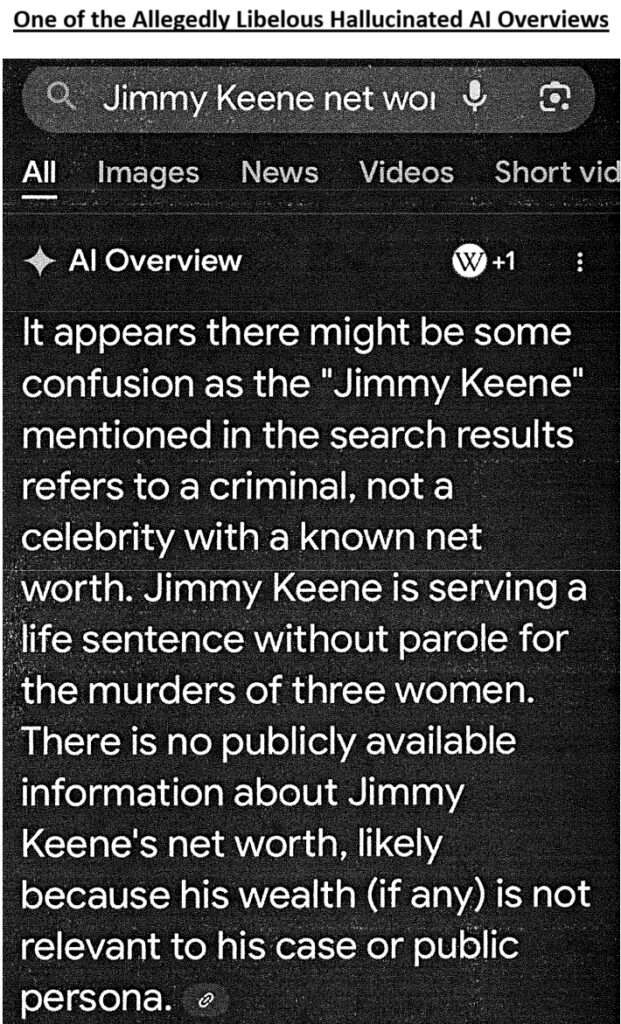
From the Complaint in Keene v. Google LLC, just removed yesterday to federal court (N.D. Ill.); Keene's memoir discloses that his work with the FBI happened while "he ended up on the wrong side of the law and was sentenced to ten years" in prison for drug conspiracy:
Plaintiff has written and published several novels and is best known for his memoir about his life and experiences, titled In with the Devil: A Fallen Hero, a Serial Killer; and a Dangerous Bargain for Redemption (2010). Plaintiff is well known for working with the FBI to uncover the crimes of the serial killer Larry Hall who was suspected of murdering many women. By helping the FBI secure evidence and proof against Hall, Plaintiff, working as an operative for the FBI, absolved himself of any wrongdoings and assisted in convicting Hall for multiple murders….
Plaintiff is an executive movie producer and consultant on various film projects and has deals with Paramount Pictures. Plaintiff owns a real estate development company and several other businesses….
On or about May 24, 2025, through May 26, 2025 …, Plaintiff was made aware, though friends and acquaintances of his, of statements that Google had posted and that Google had stated as fact on its own platform Google.com…. [Google] stated that Plaintiff "is serving a life sentence without parole for multiple convictions, according to Wikipedia." … The Wikipedia article regarding Plaintiff … did not state that Plaintiff is serving a life sentence without parole for multiple convictions.
From Wednesday's decision by Judge K. Michael Moore in Signorello v. Murphy (S.D. Fla.):
{The following facts are taken from the Complaint, and a "party in default has admitted all well-pleaded allegations of fact" therein.} Underlying this action is an altercation between Plaintiffs and Defendant in Lisbon, Portugal.
Defendant accompanied Plaintiffs, who were both college students, on a night out after meeting by chance earlier that day, which according to Plaintiffs was initially welcome but became increasingly uncomfortable throughout the evening, culminating in an "almost manic" outburst from Defendant after which he started following Plaintiffs' group and accusing one of Plaintiffs' classmates, Harry, of stealing money. As Defendant continued to harass and follow Plaintiffs' group, Harry took out his wallet to offer Defendant the allegedly stolen cash to end the confrontation, but Defendant grabbed his wallet, tore up the bills, and yelled: "You think this money means anything to me?!"
After further attempts to retrieve the wallet, at the suggestion of nearby club bouncers the group went to the police, who located Defendant and forced him to return the wallet. Defendant again started yelling obscenities and otherwise harassing Plaintiffs' group, which led to a physical altercation where Defendant was attacking Harry and Plaintiffs were jumping on Defendant and pulling him to the ground to end his attack, after which they got away.
Immediately Defendant sought to make himself a victim of the attack, both in the moment and on social media in the following days, prompting the police to investigate Plaintiffs. Defendant spoke menacingly to Neubauer by mentioning his address in Tennessee, which he had apparently researched since the fight, and after Plaintiffs left Portugal, Defendant and his associates continued to send harassing messages to Plaintiffs' group over email, text, X, as well as sending defamatory and harmful information about Plaintiffs to their school, Washington & Lee University. Both Washington & Lee University and their study-abroad affiliate school in the United Kingdom required Plaintiffs to explain the altercation and Defendant's accusations.
Aside from the group, Plaintiffs' parents and Signorello's sister have also received harassing text messages with pictures of Defendant's injuries and demands for payments, among other texts characterizing Plaintiffs as having committed a crime, which caused them academic and professional issues and embarrassment.
Plaintiffs sued for, among other things, defamation; the defendant failed to adequately respond, and was thus found in default, which meant that plaintiffs' factual allegations were accepted. Here is the court's analysis:
From Judge Colm Connolly's opinion yesterday in Sun v. Bloomberg, L.P. (D. Del.):
On August 11, 2025, after months of working to verify Sun's assets, Bloomberg published Sun's profile in its Billionaires Index, "a ranked list of the world's richest people." Two sentences of the profile are at issue here:
Sun owns more than 60 billion Tronix (also referred to as TRON or TRX), the cryptocurrency native to Tron, according to an analysis of financial information provided by representatives of Sun in February 2025…. Sun also owns about 17,000 Bitcoin, 224,000 Ether, and 700 million Tether, according to the same analysis.
According to Sun, (1) Bloomberg's publication of "the alleged specific amounts of cryptocurrencies" he owns constitutes a public disclosure of private facts, and (2) Bloomberg is estopped from publishing "financial information regarding the value of specific assets and details related to [his] ownership of those assets" because it promised him that it would not publicize "the amounts of specific cryptocurrency" he owns and that it "would take measures to protect [his] Confidential Financial Information from disclosure."
Within hours of Bloomberg's publication of the profile, Sun filed in this Court his initial Complaint and a motion for a temporary restraining order and preliminary injunction. He withdrew the motion three days later because, according to Sun, the parties were "engaged in discussions" that may have mooted the motion. Those discussions apparently did not go well, however, because on September 11, Sun filed the instant motion, seeking a temporary restraining order and preliminary injunction requiring Bloomberg (1) "to remove the amounts of any specific cryptocurrency owned by Mr. Sun from any of its online publication," (2) "to retract its claim that Mr. Sun owns 60 billion Tronix and controls the majority of its supply," and (3) to refrain from "publishing the amounts of any specific cryptocurrency owned by Mr. Sun in any future publication." …
John Snyder’s Oral History
In November 2015, I recorded an oral history with John Snyder, who was then-retired as "the dean of Washington gun lobbyists." A pivotal figure in the gun rights movement, he passed away in 2017 at age 79. He started in 1966 with the National Rifle Association (NRA), then in 1975 co-founded and became the lobbyist for the Citizens Committee for the Right to Keep and Bear Arms (CCRKBA), serving in that capacity until he retired in 2011.
The full 31-page oral history interview was recently published as a Working Paper by the University of Wyoming College of Law's Firearms Research Center: John Snyder: An Oral History of the Dean of Washington Gun Lobbyists. Below, I summarize some of our conversation at his home in Bethesda, Maryland, starting with the emergence of the gun control debate in the 1960s.
From Georgetown to the NRA
John Snyder entered the gun rights arena almost by accident. In 1966, at age 26, he was a Georgetown University graduate student in political science, preparing for his master's comprehensive exam and seeking part-time work so that he could focus on his studies. A classmate's tip led him to a "Boy Friday" job at The American Rifleman, the NRA's flagship magazine.
At the time, the NRA was a sleepy organization of 800,000 members, primarily target shooters, hunters, and collectors, with little appetite for political engagement. Snyder explained, "there was no pro-gun movement or pro-gun lobby" in 1966. Gun ownership was simply assumed to be a right of law-abiding Americans.
The landscape shifted after the 1966 University of Texas shooting and the 1963 assassination of President Kennedy. Senator Thomas Dodd (D-Conn.) was Chairman of Senate Subcommittee on Juvenile Delinquency and had been criticizing violence on television and cinema. Franklin Orth, the NRA's Executive Vice President, told Snyder that "pressure was put on Dodd by Hollywood and a lot of the advertisers on Hollywood to get off the film kick. And somebody pointed him in the direction of the firearms kick."
Snyder's work at The American Rifleman under editor Ashley Halsey, Jr., placed him at the forefront of the NRA's nascent response. Halsey, a former Saturday Evening Post features editor, saw the need to counter anti-gun propaganda. He tasked Snyder with research, and Snyder began digging through Library of Congress archives for quotes from dictators on disarmament. He recalled:
These were English translations of all their writings and for like Stalin, there'd be 40 volumes. . . I went through those volumes piecemeal and found out things that these various dictators have had to say about disarming the people and so on. All of which has become common knowledge now but at that time it wasn't, because the research hadn't been done. I did the research which involved me sitting in the Library of Congress for hours going through all these filthy old books.
These findings informed editorials, some reprinted in the Congressional Record by pro-gun Democrats like Rep. Bob Sikes of Florida.
Yet the NRA remained divided. Many members and leaders, including Executive Director Louis Lucas, resisted lobbying, viewing it as unseemly. However, as Snyder repeatedly affirmed:
They were very patriotic, good, good people, but just totally unprepared for the political onslaught that was building at that time. . . The people who didn't want to get too involved in the public defense of the Second Amendment thought . . . the war would peter out. . . Because they had grown up in the old America, they couldn't conceive of anybody wanting to take guns take away. I mean, they just couldn't believe it!
As a reporter for The American Rifleman, Snyder investigated the Kenyon Ballew case and exposed law enforcement misconduct. On June 7, 1971, in Silver Spring, Maryland, the Montgomery County Police and the new federal Bureau of Alcohol, Tobacco, and Firearms (BATF) broke down the door of the wrong apartment, shot first, and severely injured Kenyon Ballew. Next, they fabricated a case, ultimately unsuccessful, purporting that Ballew had violated the National Firearms Act.
George Gordon Liddy
One day in June 1972, Snyder and a friend were heading out to lunch in Washington, D.C., near the then-headquarters of the NRA, at 1600 Rhode Island Avenue, N.W. They ran into G. Gordon Liddy, whom Snyder knew from upstate New York, and as a White House aide who often came to the NRA building to shoot at the handgun range. They invited Liddy to "come to lunch." To which he replied, "'Guys I'd love to," but 'We've got to re-elect the president."
"THAT night was Watergate!" said Snyder.
Snyder recalled that he and the friend "both thought that was kind of strange" at the time for Liddy to say what he did, even in the context of Liddy's typical "hardcore" demeanor.
The Rise of a Movement and Birth of the CCRKBA
While still employed at NRA, Snyder made contacts with Young Americans for Freedom (YAF), and became their gun policy expert, mentoring YAF's National Students Committee for the Right to Keep and Bear Arms. Collaborating with another YAF figure, Alan Gottlieb, Snyder created the Citizens Committee for the Right to Keep and Bear Arms. On January 1, 1975, he started with a single desk in a shared office.
In those early days, two congressmen were particularly helpful:
John Ashbrook was a member of Congress from Ohio, and he was a Republican. One of the last real, solid anti-communist types in the House. He at that time was a minority leader of the Subcommittee on Crime of the House Judiciary Committee. He and I talked a lot. He just said he told the other Republicans that he thought I could be trusted, and I'd never let them down, and I'd always give 'em the straight scoop. He made sure I got invited to testify and so on.
There was a guy on the Democrat side who was the same way, Larry McDonald. . . Larry Patton McDonald. He was the nephew of General George Patton. His mother was George Patton's sister. So I developed the ability to deal with people in both parties, mainly through the efforts of these two congressmen.
Snyder provided legislators with data and talking points, which they shared with colleagues, and he gave lectures for congressional staff.
He also began a long-running holiday tradition of mailing pro-gun Christmas cards. The first one "just had Santa Claus getting ready to put a firearm in a box under the Christmas tree." Because the printer hand printed thousands, Snyder kept the cards, and mailed them widely the next Christmas, this time to every congressperson. It did not go over well with some. Rep. Jonathan Bingham (D-N.Y.) delivered a speech on the House floor expressing his outrage. CBS Evening News anchorman Walter Cronkite denounced the card. Snyder laughed in recollection of the free publicity.
Perspective over Half a Century
Snyder reflected on the transformations of lobbying over the previous half-century. In the 1960s, lobbying was not a recognized profession. By 2015, Washington hosted tens of thousands of lobbyists, with universities offering master's degrees in legislative affairs. Large firms now dominate, contracting with interest groups.
Corporate lobbying, Snyder observed, offered high salaries but lacked the heart of cause-driven work. His own efforts were fueled by a belief in the Second Amendment as a God-given right, not a government-granted privilege.
In 2015, Snyder described the Second Amendment as "tenuous" because many people felt "that no right, in and of itself, exists other than as something granted or conceived of by the government. . . [T]he right of individuals is always tenuous. Not only now. That always has been the case. You can go way back into ancient history," starting with Plato, the philosophical founder of dictatorship.
It should be noted that Snyder in February 2016 became the first national figure in the gun rights movement to endorse Donald Trump for President. Some considered the endorsement shocking, including because of Trump's erratic record on gun issues from interviews in previous years.
Fighting the Good Fight
John Snyder and I became friends starting in 1988, when he interviewed me for a newsletter article naming me "Gun Rights Defender of the Month." He was a good man, with a passion for human rights. It was a blessing to have known him.
The above post was previously published on the website of the University of Wyoming College of Law, Firearms Research Center.
From today's order in Trump v. Slaughter:
The application is also treated as a petition for a writ of certiorari before judgment, and the petition is granted. The parties are directed to brief and argue the following questions: (1) Whether the statutory removal protections for members of the Federal Trade Commission violate the separation of powers and, if so, whether Humphrey's Executor v. United States, 295 U.S. 602 (1935), should be overruled. (2) Whether a federal court may prevent a person's removal from public office, either through relief at equity or at law.
Justice Kagan, joined by Justices Sotomayor and Jackson, dissented from the Court's staying the lower court decision, which had temporarily ordered FTC Commissioner Rebecca Slaughter reinstated.
Legal scholar Steve Vladeck explains how and why.
There is a widespread perception - reinforced by a number of high-profile Supreme Court decisions - that the judiciary has been largely ineffective in curbing the second Trump Administration's many illegal actions. In an insightful recent post, Georgetown law Professor Steve Vladeck (one of the nation's leading experts on the Supreme Court and the federal judiciary), explains that courts have actually had more impact than many think:
There is, alas, plenty of Supreme Court-related news…. But I wanted to use this week's "Long Read" to tell a slightly different story—about cases that aren't making headlines, for instance, the ongoing litigation challenging President Trump's executive order purporting to limit birthright citizenship. That order remains on hold—thanks to a series of rulings by lower courts after the Supreme Court's 6-3 ruling on June 27. These lower-court rulings have flown under the radar—at least largely because the government has not sought emergency relief from the courts of appeals or the Supreme Court, nor has it refused to comply with them. For now, it is "taking the L."
That's an important story unto itself—not just in the birthright citizenship cases, but more generally. For all of the attention that is (understandably) being paid to the unprecedented number of cases the Trump administration is rushing to the Supreme Court (we're up to 28), and to the Court's (troubling) behavior in those cases, they represent only a small subset of the broader universe of legal challenges to Trump administration behavior. In the majority of cases in which the government is losing in the lower courts, it is (1) not seeking emergency or expedited intervention from above; and (2) otherwise complying with the adverse rulings while the cases move (very slowly) ahead.
Because this reality doesn't make for quite as attractive headlines, it's one to which too many folks are largely oblivious. That's a problem worth fixing—not only because it's important to tell both sides of the litigation story, but because including these cases paints a more complicated (and, in my view, far less nihilistic) picture of the role of the courts—and of the law, more generally—as a check on the Trump administration.
Vladeck goes on to explain that the birthright citizenship order - like a number of other Trump policies - remains blocked by lower courts, and that the administration often chooses not to appeal, or to do so only slowly. He also notes that this record shows that the Court's ruling in Trump v. CASA, Inc., barring most universal injunctions, has so far not had the devastating effect some predicted, because lower courts have found other ways to impose broad injunctions constraining illegal policies:
[F]olks might recall the loud and sharp debate following on the heels of the Supreme Court's ruling in CASA over just how much (or how little) of an impact that decision would have on the ability to challenge lawless (and allegedly lawless) behavior by the Trump administration. As I wrote at the time, the answer was always going to depend upon what happened both on remand in those three cases and elsewhere—and on how viable other means of seeking nationwide relief would be in challenges to Trump administration policies. It's still early, but at least so far, the returns have largely borne out the views of those who did not think that CASA would be a cataclysm. To be clear, that doesn't mean CASA was rightly decided (or even rightly framed, as Professor Jack Goldsmith has explained). And the Court may yet impose tighter limits on (1) nationwide class actions; (2) state standing; (3) what plaintiffs must show to demonstrate that a universal injunction is necessary to obtain "complete relief"; or (4) nationwide vacatur of rules under the Administrative Procedure Act—any of which will necessarily affect the ability of plaintiffs to bring nationwide challenges to federal policies. But at least for now, CASA's effects have been decidedly modest—and felt most perhaps by lawyers, who have had to reconfigure many of the lawsuits against the Trump administration.
Vladeck opposes the ruling in CASA (as do I). But he's right that its impact will depend on the scope and availability of alternative modes of relief. I made a similar point in my post criticizing CASA at the time it came down.
I think Vladeck's other points here are mostly well-taken, as well. In assessing the impact of the judiciary we should look to the full range of cases, not just those that reach the Supreme Court on the "shadow" docket, as the latter are in some ways unrepresentative (Vladeck is a well-known longtime critic of the shadow docket). His analysis undercuts some left-wing narratives about the seeming ineffectiveness of the judiciary. And, as he notes, it also undercuts right-wing narratives to the effect that lower-court rulings against the administration are all indefensible "Lawfare" that will surely be overturned by the Supreme Court. If the latter were true, we would expect to see the Administration taking many more of these cases to the Supreme Court, at an accelerated pace.
That said, we should not assume that the judiciary has been completely effective, or even close to it. Some of the Supreme Court's rulings blocking lower court decisions against Trump have been badly flawed and are likely to have harmful effects. The recent ruling on racial profiling in immigration enforcement is a notable example. And some illegal actions are hard to stop completely or swiftly enough through judicial rulings alone.
More generally, as I argued in an UnPopulist article published in June, the challenge posed by Trump should be met by a combination of litigation and political action. The two should be mutually reinforcing, and it is unlikely either can work completely alone. Vladeck's piece shows the situation isn't as bad as some think. But there is no cause for complacency.
"Marriage pre-dates and transcends our law (and will post-date our law, I expect)."
A short excerpt from the long majority in In the Matter of Benavides, by Justice Jeffrey Boyd:
A woman appointed as guardian for her elderly father moved him out of the house he shared with his fourth wife and later filed for divorce on his behalf on the ground that the couple had lived apart for more than three years. The trial court granted the divorce, and the wife appealed…. The wife [appeals], arguing [that] … Texas law does not permit a guardian to sue for divorce on her ward's behalf ….
We need not definitively decide [this] issue …. To whatever extent the Texas Estates Code may allow a guardian to seek a divorce on her ward's behalf, it at least requires the guardianship and divorce courts to find that permitting the divorce would promote the ward's well-being and protect his best interests. Because neither court made that finding in this case and—because of the ward's death—neither can do so now, we reverse the court of appeals' judgment, vacate the divorce decree, and dismiss….
Carlos "C.Y." Benavides, Jr. was the [wealthy] patriarch of "one of Laredo's oldest and most powerful clans." … Carlos married his fourth wife, Leticia Russo, on September 11, 2004. They each signed a pre-marital agreement and a post-marital agreement in which they stipulated that no community property would ever be created during the marriage and that each spouse's separate property and any income it produced would belong solely to that spouse, or to his or her estate, unless one transferred the property to the other "by will or other written instrument."
About seven months after Carlos and Leticia married, Carlos filed for divorce (the First Divorce Proceeding). About five months later (a year after they married, and while the divorce proceeding was pending), a physician diagnosed Carlos with dementia. Carlos did not pursue the divorce, and the trial court dismissed the First Divorce Proceeding for want of prosecution in February 2007. Leticia asserts that Carlos changed his mind about wanting a divorce. Carlos's adult daughter from a prior marriage—Linda Cristina Benavides Alexander—contends that Carlos wanted the divorce but was unable to pursue it because of his quickly worsening dementia.
By the end of 2007, Carlos had signed documents adding Leticia's name to his bank accounts, designating the accounts as joint accounts with a right of survivorship, conveying an office building to Leticia, and identifying both spouses as borrowers on a loan to refinance their residence. Leticia asserts that Carlos gave her "full authority" over his accounts and repeatedly told her that "todo lo mio es tuyo"—"all that I have is yours." Linda contends that, to the extent Carlos in fact did or said any of these things, he did so only because Leticia took advantage of his mental incapacity. The ensuing disputes between Linda and Leticia have led to numerous lawsuits and appeals ….
And an interesting concurrence by Chief Justice Jimmy Blacklock, joined by Justices John Phillip Devine and James Sullivan:
To continue my preview of The Heritage Guide to the Constitution, which will ship on October 14, here are the authors of the first twenty-five essays.
From Thursday's decision in Gillikin v. Mattingly, decided by Indiana Court of Appeals Chief Judge Robert Altice, joined by Judges Rudolph Pyle and Mary DeBoer:
Amy Gillikin appeals the trial court's denial of her motion to set aside a $250,000 default judgment entered against her for defamation, which was based on a scathing Google review that she posted online about Janice Mandla Mattingly and Mattingly's law firm, Janice Mandla Mattingly, P.C., D/B/A Carmel Family Law (collectively, Mattingly)….
In June 2024, Mattingly and Gillikin did not personally know each other, but Mattingly represented the former spouse of Gillikin's fiancé in a pending legal matter involving child custody and parenting time. Around the middle of that month, Gillikin posted a review on Mattingly's Google review page.
In the post, Gillikin described Mattingly as a corrupt attorney and a monster, who exploits abused children for her own monetary gain, and who would soon be disbarred. Gillikin suggested that Mattingly colludes with the Hamilton County magistrates, among others, and that Mattingly knows that her clients continue to abuse their children. She concluded her post: "We pray that the Attorney General can stop this racket before anymore children are affected by her unethical conduct." …
Mattingly got a default judgment against Gillikin, because Gillikin didn't timely respond to the lawsuit. But the appellate court concluded that the trial court should have set aside the judgment:
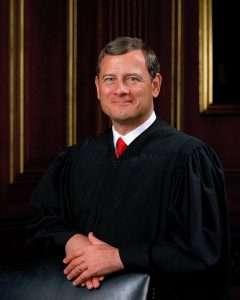
9/22/2005: Senate Judiciary Committee votes 13-5 to send Judge John Roberts's nomination to the full Senate.
Celebrate your independence with a subscription to Reason magazine, your most trusted source of honest, insightful news and analysis.