The Volokh Conspiracy

Mostly law professors | Sometimes contrarian | Often libertarian | Always independent | Est. 2002

The Volokh Conspiracy

Takings

More Historical Evidence Showing that the Public Use Clause of the Fifth Amendment Does Not Allow Takings that Transfer Property to Private Parties

Harvard law Prof. Maureen Brady uncovers relevant evidence from late-nineteenth century state constitutional conventions.

|

NA

The Supreme Court's controversial 5-4 ruling in Kelo v. City of New London (2005), held that private "economic development" is enough to satisfy the Fifth Amendment requirement that the government can only condemn property for a "public use." In so doing, it rekindled a longstanding debate over whether takings that transfer property to private parties violate the public use requirement. Harvard law Professor Maureen "Molly" Brady - one of the nation's leading property and takings scholars - has uncovered additional new evidence on this topic. And it counts against the decision reached in Kelo.

In an insightful post at the Brennan Center State Court Report, and an article for the recent Yale Journal on Regulation symposium on the 20th anniversary of Kelo (which I co-edited), Brady assesses debates over public use in late-nineteenth century state constitutional conventions, mostly in western states. She finds that several western states included specific provisions in their new state constitutions authorizing the use of eminent domain for some private purposes, such as drainage and mining. But, importantly, they did so explicitly, specifically outlining these categories as exceptions to the general requirement that takings must be for a "public use."

While Brady does not quite fully draw the connection, the fact that these private-use takings had to be explicitly authorized indicates that most delegates to these state constitutional conventions did not believe that a standard authorization of takings for "public use" was sufficient to allow condemnations for transfer to private parties, so long as the latter might benefit the public in some way (the  interpretation eventually adopted by the federal Supreme Court in its terribly reasoned decision in Berman v. Parker (1954) and reiterated in Kelo). Rather, they assumed that "public use" only allowed condemnation for publicly owned projects, with the possible exception of private owners who have a legal duty to serve the entire public (such as public utilities).

This evidence is relevant to the interpretation of the federal Public Use Clause because many originalists argue that the relevant period for understanding the original meaning of the Bill of Rights as applied to state and local governments, is that around 1868, when the Fourteenth Amendment was enacted, thereby "incorporating" the Bill of Rights against the states. The state constitutional conventions Brady analyzes mostly occurred within a few years of 1868, and therefore illuminate understandings of the meaning of "public use" during this period.

One might wonder why state constitutional framers enacted provisions allowing for takings that were banned by the federal Fifth Amendment. One likely reason is that, during this period, the Supreme Court had not yet ruled that the Fifth Amendment (or the rest of the Bill of Rights) had indeed been incorporated against the states. It did not do so until well into the twentieth century, a history discussed in Chapter 2 of my book The Grasping Hand: Kelo v. City of New London and the Limits of Eminent Domain,

In The Grasping HandI also cover a wide range of other evidence of the meaning of public use in 1868, including state court decisions, legal treatises, and more. This evidence, too, largely supports the narrow definition of "public use" over the broad one adopted in Berman and Kelo. The same is true of the admittedly more limited evidence on the understanding of "public use" in 1791, when the Fifth Amendment and the rest of the Bill of Rights were initially ratified. This evidence, too, is covered in my book.

Brady argues that the nineteenth century state conventions also highlight the importance of the "necessity" requirement as a constraint on eminent. Necessity - a doctrine adopted in many states' eminent domain jurisprudence - requires proof that condemnation is needed in order to achieve the public use supposedly justifying the taking. While federal courts would do well to give greater consideration to necessity, it is not a substitute for restoring the correct meaning of "public use." A condemnation that is "necessary" for a private use is still unconstitutional.

In the aftermath of Kelo, many states enacted reforms constraining eminent domain abuse. But abusive takings still continue in many parts of the country, and state action is not a sufficient substitute for systematic nationwide enforcement of the Fifth Amendment's public use requirement.

I hope the Supreme Court eventually reconsiders its badly flawed "public use" jurisprudence, and reverses Kelo and Berman. Molly Brady's excellent work provides additional reasons for moving in this direction.
Free Speech

#TheyLied Defamation Plaintiff, Suing Over Rape Allegations, Can Prove Reputational Harm with His Own Testimony

|

In Apperson v. Kaminsky, decided Friday by the Missouri Supreme Court (opinion by Justice Paul Wilson, Apperson sued his ex-romantic partners Kaminsky and Norman for defamation (see the intermediate appellate decision for more factual details):

After [their] involvements ended, Norman told more than one person Apperson raped and abused her, and Kaminsky told others (in person and through an extensive social media campaign intended to reach those with whom Apperson dealt personally and professionally) that Apperson stalked and raped her, was a serial rapist and serial abuser, was restrained from coming within 500 feet of her, and threatened to kill both her and Norman.

As a result of these statements, Apperson was confronted in his home by a group of people (several of whom were armed) supporting Kaminsky and Norman. Because of this confrontation, Apperson was forced out of his home for seven months. Kaminsky's statements also resulted in Apperson being asked not to patronize a local coffee shop, being made to disassociate himself from two organizations he founded, and losing a speaking engagement. Finally, Apperson was involuntarily removed from shared office space after Kaminsky told the management Apperson raped her and insisted management take action against him….

Missouri precedents, unlike those in many other states, require evidence of actual damages in a reputation case; damages may not merely be presumed. The trial court read those precedents as also requiring that the evidence had to go beyond just plaintiff's testimony on the issue, and thus granted a directed verdict in defendants' favor. But the Missouri Supreme Court disagreed:

True, a plaintiff's conclusory assertion of reputational damage is insufficient. A plaintiff's entirely subjective belief her "integrity" has been damaged also is insufficient. But such holdings are mere applications of the general rule there must be evidence (or a reasonable basis for inferring) the defendant's defamatory statement caused damage to the plaintiff's reputation…. If the plaintiff can testify competently to such damage, doing so will suffice to make a submissible case on the issue of reputational injury as readily as evidence from any other source.

Read More

Free Speech

Israeli-American Doctor's Federal Conspiracy Claim Against CAIR and Other Critics Can Go Forward for Now

|

From today's decision by Judge Thomas Thrash (N.D. Ga.) in Winer v. Mohammad:

This action arises out of alleged defamatory statements that Defendant Umaymah Mohammad, a student at the Emory University School of Medicine ("SOM"), made about Plaintiff Joshua Winer, a physician and professor at Emory. Mohammad, who is Palestinian, sent an email to the entire SOM student and faculty body on January 17, 2024, in which the Plaintiff alleges she "praised terrorism against Israel, expressed her hatred towards Israel and the United States, and stated that Israel, the United States, and Emory are perpetrating a genocide against Palestinians in Gaza."

Nearly two months later, in March 2024, the Plaintiff published an op-ed piece in an Israeli news publication sharing his decision to travel to Israel to volunteer as a physician in the Israeli Defense Force ("IDF") following the October 7th Hamas attack on Israel. The Plaintiff identifies as Jewish and maintains dual American and Israeli citizenship. He is a surgical oncologist at Emory Winship Cancer Institute, a professor in the Department of Surgery, Division of Surgical Oncology at the SOM, and serves as the SOM Surgical Clerkship Director.

In April 2024, Mohammad participated in an interview for a news organization called Democracy Now!. In the interview, Mohammad was asked about the email she sent and was asked to explain the importance of the issue to her. As part of her response, Mohammad referenced Winer by stating that

one of the professors of medicine we have at Emory recently went to serve as a volunteer medic in the Israeli Offense Force [sic] and recently came back. This man participated in aiding and abetting a genocide, in aiding and abetting the destruction of the healthcare system in Gaza and the murder of over 400 healthcare workers, and is now back at Emory so-called teaching medical students and residents how to take care of patients.

Mohammad was ultimately suspended from the SOM for one year based on her comments in the Democracy Now! interview. In November 2024, Mohammad participated in a podcast hosted by the International Union of Scientists in which she made similar statements about the Plaintiff. In January 2025, she made more statements about the Plaintiff's IDF service in the online publication Mondoweiss. In the Mondoweiss piece, Mohammad alluded that the Plaintiff "believe[d] in the legitimacy of apartheid, and that some human lives are not as important as others."

Read More

Protest, Worship, and the Core of Free Exercise

On the anti-ICE protest at Cities Church in Minnesota

|

During a recent Sunday worship service at Cities Church, a Southern Baptist congregation in the Minneapolis–St. Paul area, protesters entered the sanctuary and interrupted the service, chanting slogans related to immigration enforcement and ICE. The incident was captured on video, including the church's livestream. Church leaders and congregants later described the intrusion as frightening and deeply disruptive.

Given the early stage of the proceedings, one can't draw firm conclusions about either the facts or the law. But we do know enough for some early observations.

At a high level, the episode sits at the intersection of three familiar principles. Political protest lies at the core of First Amendment protection. At the same time, the First Amendment does not confer an entitlement to enter private property or to substantially disrupt a private gathering simply because one has something important to say. A church sanctuary during worship is not a public forum; it is a private religious space dedicated to a specific purpose. For that reason, incidents like this are often addressed through ordinary, content-neutral state criminal law, such as trespass or disorderly conduct.

The Minnesota authorities don't seem inclined to prosecute, though. But the feds do. According to recent reports, federal authorities have arrested two protest organizers. I don't think the precise charges have been publicly clarified, but the feds had previously indicated that they were investigating potential civil-rights violations.

One statute they reportedly are considering is the Freedom of Access to Clinic Entrances Act, or FACE Act, 18 U.S.C. § 248. In addition to its application in the clinic-access context, the Act makes it unlawful to use "force," "threats of force," or "physical obstruction" to intentionally "injure, intimidate or interfere with" a person "exercising or seeking to exercise" the right of religious freedom at a place of worship. Whether those elements are met here will depend on the facts—for example, whether protesters physically blocked worshippers' movement, whether they employed threats or intimidation, etc. The statute does not criminalize protest as such.

Whatever the ultimate legal analysis, these issues matter beyond this particular episode. People debate what the free exercise of religion means, legally and philosophically. But, at least as far back as John Locke, the right to worship peacefully has been understood to lie at its core. If free exercise doesn't mean the right to worship peacefully in your own sanctuary without being interrupted by outside protesters, it's hard to know what it would mean. Protecting that right is essential to religious pluralism and to living together amid deep disagreement.

I discuss these issues in more detail in a short Legal Spirits episode, available here.

Free Speech

"Celebrating Buckley v. Valeo: A Landmark of Political Freedom," by Joel M. Gora

"An original Buckley litigator shares the inside story of one of America’s most important political speech victories."

|

From an Institute for Free Speech symposium on the 50th anniversary of Buckley, which I've been cross-posting; this is by Prof. Joel M. Gora (Brooklyn Law School), who was one of the lawyers who argued Buckley (on behalf of the ACLU) before the Supreme Court:

It is an honor to participate in this celebration of the 50th anniversary of the landmark case of Buckley v. Valeo. I have been privileged to spend my entire professional career working in the area of constitutional law, and especially the protections of the First Amendment. As a full-time lawyer at the American Civil Liberties Union for a decade, and then as a volunteer lawyer for many years after, I started my teaching career at Brooklyn Law School. I estimate that I have worked on more than 100 Supreme Court cases, the majority of them dealing with rights under the First Amendment. Of all those cases, the one I am proudest to have worked on, and the one I think has had the greatest positive impact on political freedom, is the Buckley case decided by the Supreme Court on January 30, 1976. It was a watershed moment for the Court, and for the country.

Years later, when politicians sought to pass increasingly restrictive federal campaign finance laws, a Democratic leader was asked about whether they posed a problem under the First Amendment. His response was, in effect, you can either have free speech or fair and healthy elections, but you can't have both. My response was that precisely the opposite was true: You can't have one without the other.

Free speech is not the enemy of democracy; free speech is the engine of democracy. It is the most powerful political tool we have to control the government. To allow the government to control free speech is to take away that most powerful tool. That was what was at stake in the Buckley case. And the Court did an outstanding job, but not a perfect one, of protecting that vital tool.

The Origin Story: Five Years Earlier

Read More

Third Circuit Denies Petition for Rehearing En Banc of Alina Habba Disqualification as U.S. Attorney

Could this case end up in the Supreme Court?

|

Back in December, the U.S. Court of Appeals for the Third Circuit affirmed a district court order concluding that Alina Habba was not lawfully acting as the U.S. Attorney for the District of New Jersey.

Yesterday, the Third Circuit denied a petition for rehearing en banc. Of the twelve judges eligible to participate in the en banc vote, three noted their dissent from the order (Judges Phipps, Matey, and Mascott), one of which (Mascott) "will file a separate dissent sur rehearing on a later date."

The question now is whether the Administration will seek to bring this case to the Supreme Court.

My co-blogger Paul Cassell offered commentary on the Third Circuit's "curious" initial decision here.

New in Civitas Outlook: "Anti-Semitism and Anti-Christian Zionism On The Right"

"It is perverse to include Anti-Zionists and cozy up to antisemites."

|

Today is International Holocaust Remembrance Day. We often repeat, reflexively, "Never again." Yet far too many people forget the "again" part. Antisemitism has been with us since the beginning of recorded history. While it is important to study the Holocaust, modern education fixates on that Shoach at the expense of obscuring the long train of hatred towards Jewish people that continues to this day. That education also portrays Jews as victims, and teaches that anything short of mass extermination is not that big of a deal.  I would commend a new op-ed in the Wall Street Journal, titled "Holocaust Education Obscures Antisemitism." It begins:

On Holocaust Remembrance Day, Jan. 27, it's important to reflect on, mourn and remember the six million Jews murdered by the Nazis. As time passes and the Holocaust fades further from memory, this somber day grows increasingly important. Yet with antisemitism surging and Jews being murdered in attacks worldwide, it's clear that remembering is no longer enough. If our understanding of Jew-hatred remains locked in the past, there's a risk that current and future forms of antisemitism will spiral out of control.

Today is a very fitting day to publish my new essay in Civitas Outlook, titled Anti-Semitism and Anti-Christian Zionism On The Right. From the introduction:

On the political left, antisemitism has long been cloaked under the garb of anti-zionism. Those advocating for Palestinian rights insist they have no animosity towards Jews, but simply reject Zionism: the belief that Israel is the Jewish state. The defense of Zionism invariably falls to Jewish people, who explained that this purported anti-zionism was little more than a ruse for anti-semitism. And in recent times, Jews found allies on the right with Christians who zealously supported Zionism as both a matter of policy and faith. But a rupture is forming. A rising tide on the right is attacking Zionists and Christian Zionists alike. In every civilization, antisemitism has morphed to match the circumstances of the day on all sides of the political spectrum. Regrettably, this movement to oppose Christian Zionism is little different than left-wing anti-Zionism on college campuses. As the very bounds of conservatism continue to ebb and flow, stark lines are being drawn of how those on the right view Israel and the Jewish people. Conservatives need to account for how this shift is drastically altering American domestic and foreign policy.

It is tempting to start this analysis with Kevin Roberts's ill-fated defense of Tucker Carlson. But we should step back a bit further. It has been widely reported that Carlson did nothing to push back against Nick Fuentes, a Holocaust denier, when Carlson interviewed him. But Carlson did express some opinions of his own. He described Christian Zionists as a "Christian heresy" whom he "dislikes more than anybody." Among these heretics were Ambassador to Israel Mike Huckabee, Senator Ted Cruz, former President George W. Bush, and others. Carlson actually said that Cruz was "serving for Israel." Tucker charged that this Zionism is a "brain virus." The implication was clear: disloyal American Jews have infected Christians to advance Israeli interests over American interests. Stop me if you've heard this trope before.

And from a somewhat hopeful conclusion:

Perhaps there is some room for hope. In a recent interview, the New York Times asked President Trump, "Do you think there's room within the Republican coalition, the Make America Great movement, for people with antisemitic views?" Trump replied, "No, I don't. I think we don't need them. I think we don't like them." Trump is right. It is perverse to include Anti-Zionists and cozy up to antisemites. Christian Zionists should be welcomed, and antisemites excluded. 

Never again means never again.

Free Speech

Conviction for Posting Mayor's Office Phone Number, Which Led to Hundreds of Threatening Calls from Poster's Followers

|

From a decision in November in Hendry v. State, written by Indiana Court of Appeals Judge Leanna Weissmann, joined by Judges Mark Bailey and Elaine Brown:

Craig Hendry became a frequent visitor to city hall in the small town of Clinton, where he filmed confrontational interactions with employees and posted the videos to his YouTube channel. After he uploaded his first video from Clinton and listed the phone number of the mayor's office in the video's caption, city hall received hundreds of threatening phone calls and voicemails [apparently over about 30 days]….

There's a lot going on in the case, including a conviction for "target[ing] the mayor's assistant, P.K., banging on her closed office door and filming her through her closed blinds," and "follow[ing] P.K. to her car." But I was particularly struck by the prosecution for posting the phone number:

Hendry acknowledges that the phone calls and voicemails constituted harassment. The harassment statute at issue here criminalizes the placement of phone calls with the intent to "harass, annoy, or alarm" and without the intent of legitimate communication. After Hendry posted his video in April 2022, the city received over 350 threatening voicemails, and only a few conveyed actual matters of city business. Hendry acknowledged at trial that many of the messages were "disgusting and threatening," and on appeal concedes that those threatening messages "constitute an 'abuse' of the right to free speech." Hendry also does not refute the connection between his videos and the messages. Threatening calls spiked just after the videos were posted and continued in significant numbers in the weeks that followed. Most of the messages referred to the people and events depicted in Hendry's videos….

Read More

Free Speech

One Judge's Perspective on Quoting Epithets

|

From Judge Jamal Whitehead (W.D. Wash.) Friday in Young v. Boeing Co. (W.D. Wash.):

According to Troglia—who identifies as "mixed race (Hispanic) and not 100% Caucasian"—Young became frustrated and called Troglia a "bitch ass nigger"1 on February 24, 2023, while the two were working together….

1 Throughout this order, the Court uses the phrase "N-word" when speaking in its own voice. But when quoting the record, the Court reproduces the actual language used. Judicial opinions that euphemize the record risk obscuring the very conduct at issue. Where, as here, the use of a racial slur is central to an employer's termination decision and the plaintiff's claims, the Court declines to place a thumb on the scale by softening the language that drives the dispute.

Of course, as Randy Kennedy and I noted in our The New Taboo: Quoting Epithets in the Classroom and Beyond, different judges exercise their discretion differently on such matters: Some judges avoid expurgation altogether (see, e.g., this decision from last week); others expurgate some slurs; others expurgate a wide range of vulgarities; and others expurgate some mentions of a slur but not others (e.g., not direct quotations from the record). In any event, this example struck me as worth noting.

Eighth Circuit Suspends Injunction Related to Federal Immigration Enforcement in Minnesota

|

From the opinion by Judges Bobby Shepherd and David Stras in Tincher v. Noem:

The district court entered a preliminary injunction with respect to federal immigration-enforcement operations in Minnesota. The injunction is unlikely to survive the government's … appeal, so we stay it pending a final decision in this case.

Six individuals who have "observed" and protested Operation Metro Surge, the ongoing immigration-enforcement effort in the Twin Cities, sued on behalf of "[a]ll persons who do or will in the future record, observe, and/or protest against" it. The preliminary injunction covers all of them and limits what federal agents who take part in the operation or respond to the protests can do while carrying out their official duties. Included in the district court's order are prohibitions on "[r]etaliating against" anyone "engag[ed] in peaceful and unobstructive protest activity" and stopping vehicles without "reasonable articulable suspicion that [the occupants] are forcibly obstructing or interfering with" immigration-enforcement activities.

For at least two reasons, the government has made "a strong showing" that its challenge to the injunction "is likely to succeed on the merits." First, the grant of relief to such a broad uncertified class is just a universal injunction by another name. See Trump v. CASA, Inc. (2025) (holding that "federal courts lack authority to issue them"). Even if "courts may issue temporary relief to a putative class," this one has no chance of getting certified. A.A.R.P. v. Trump (2025). And overlooking the difficulties of certification, as the Supreme Court did in A.A.R.P., is not necessary "to preserve our jurisdiction." …

We accessed and viewed the same videos the district court did. What they show is observers and protestors engaging in a wide range of conduct, some of it peaceful but much of it not. They also show federal agents responding in various ways. Even the named plaintiffs' claims involve different conduct, by different officers, at different times, in different places, in response to different behavior. These differences mean that there are no "questions of law or fact common to the class" that would allow the court to decide all their claims in "one stroke."

Read More

The Voting Rights Act Asymmetry Splices Staten Island

In New York City, Republicans are the discrete and insular minority.

|

Staten Island was a curious place to grow up. Though it is one of the five boroughs of New York, culturally, it felt very different. And politically, it is a different world. Staten Island has consistently voted for Trump and other Republican candidates, even as the rest of New York sprints down the road to Democratic Socialism serfdom.

From a perspective of geography, Staten Island is also unique. There are several bridges that connect Staten Island: three go to New Jersey, and one, the Verrazzano-Narrows Bridge, goes to Brooklyn. (Fun fact: you only pay the toll when you enter Staten Island, not when you leave.) The Staten Island Ferry connects Staten Island with lower Manhattan. (There are some other smaller ferries that connect to different piers in Manhattan.)

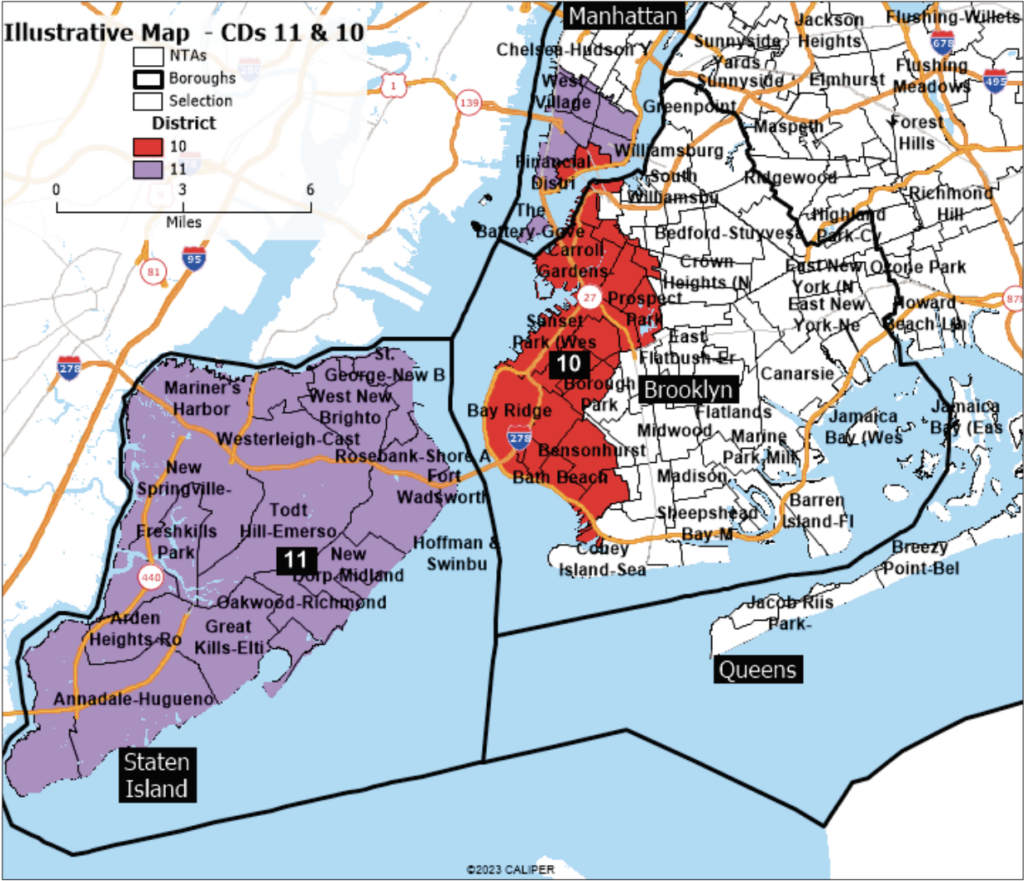
How should congressional representation for Staten Island work? Well, its population is not high enough to justify its own district. So for the past four decades, Staten Island's congressional district has included parts of Brooklyn (mostly Bay Ridge). That move made sense as a matter as geography, as it was the only contiguous land mass that Staten Island was connected to.

But Marc Elias had other ideas. As I wrote in October, Elias filed suit in state court, arguing that New York's maps dilute the votes of black and Hispanic voters in Staten Island. Elias argues this dilution violates the New York Voting Rights Act. His preferred map would form a single congressional district out of Staten Island and parts of lower Manhattan, including the financial district and the West Village. Again, there is no contiguous natural or manmade connection between Staten Island and Manhattan. There is only a ferry service that travels between the spots. (You can also take a lengthy bus ride that goes through Brooklyn or New Jersey.)

Of course, the upshot of this suit is that the only Republican district in New York City would vanish. This is the Voting Rights Asymmetry. The law only helps Democrats at the expense of Republicans. None of these regimes are about racial discrimination, especially in a deep blue state that will likely never elect another Republican statewide in my lifetime.

Alas, a trial court has agreed with Elias's case. The Wall Street Journal has this editorial, titled Democrats Try to Steal Staten Island.

Read More

Free Speech

"Express Advocacy at 50," by Allison R. Hayward

"Do you believe in magic words?"

|

From an Institute for Free Speech symposium on the 50th anniversary of Buckley, which I've been cross-posting; this is by Allison R. Hayward, who is now a Board member of the Foundation for Individual Rights and Expression (FIRE), and has served as the Head of Case Selection for the Facebook Oversight Board, Commissioner on the California Fair Political Practices Commission, Co-Chair of the Board of the Office of Congressional Ethics, and Vice President of Policy at the Center for Competitive Politics (now the Institute for Free Speech):

Pity (for a second) the Supreme Court in Buckley v. Valeo. Presented with a multifaceted challenge to the ambitious and bloated 1974 amendments to the Federal Elections Campaign Act (FECA 1974), the Justices heard oral arguments on November 10, then met and corresponded over the 1975 holiday season to produce a decision that would land well before the 1976 election. This statute raised constitutional issues beyond its First Amendment implications, but I'll focus on its speech-restrictive aspects.

One key Buckley holding is the express advocacy standard. Briefly, express advocacy was Buckley's interpretation of the FECA 1974 provision limiting independent expenditures to $1,000 per year. The Court observed that the statute's description of such an expenditure as "relative to a clearly identified candidate" was unconstitutionally vague. As a fix, the Court interpreted the phrase to reach "only to expenditures for communications that in express terms advocate the election or defeat of a clearly identified candidate for federal office." Helpfully, the Court added in a footnote (likely at the suggestion of Justice Brennan) "communications containing express words of advocacy of election or defeat, such as "vote for," "elect," "support," "cast your ballot for," "Smith for Congress," "vote against," "defeat," "reject." This litany has been derisively called "magic words" by detractors. It was obviously a refinement to the statute made by judges—not legislators.

The Court interpreted the clause to save it from unconstitutional vagueness, but then held that the $1,000 independent expenditure limit was itself unconstitutional. In part, this was because the narrowing construction made the limit ineffective. That might prompt someone to wonder whether the Court's redrafting of the statute (as opposed to declaring it unconstitutionally vague and leaving the wordsmithing to Congress) was sound. But such restraint would have thrown key provisions of campaign law into flux for the 1976 election. Yes, the Court should resist the temptation to write law. In practice, however, the Court provided the answer that political actors needed in January 1976.

Did "express advocacy" apply only to a now moot expenditure limit? Not so fast. "Expenditures" also trigger reporting requirements. The definition needed narrowing there, too. For spenders who are not political committees or candidates, the Court affirmed FECA's independent expenditure reporting requirements, but only if limited to expenditures containing express advocacy.

Read More

Free Speech

Arab-American Muslim Woman's Discrimination Claim Can Go Forward Over Cancellation of Law Firm Job Offer for Statements Related to October 7 Actions

|

From Judge Sharon Johnson Coleman (N.D. Ill.) today in Chehade v. Foley & Lardner, LLP:

[O]n October 7, 2023, … [Jinan Chehade, a Muslim woman of Arab descent,] shared this message on social media:

"As you see Palestine in the news, keep two things in mind:

  1. Colonization is inherently violent. Occupation is violent. Israel's existence was brought about by violence. Never equate the violence of the oppressed with that of the oppressor. The colonized with the colonizer.
  2. If you support Palestine understand that necessitates supporting our right to defend ourselves and liberate our homeland by any means necessary. The colonizing power determined what was necessary when they colonized us by force and continue to genocide Palestine. You cannot claim to stand with Palestine if you prefer us to be slaughtered without fighting back. Freedom has only ever been achieved through resistance.

#FreePalestine #WithinOurLifetime"

Chehade made further remarks at a public meeting of the Chicago City Council on October 11, 2023. At the City Council meeting, Chehade opposed a resolution condemning the Hamas attack, which she explained was "completely one-sided and made no mention of Palestinians." She said:

"The Western Zionist controlled media machine would have you believe that this was an unprovoked attack. However, this is the natural response to 75 years of occupation, such that this resistance is a legal right for the Palestinian people according to international law… I'm sorry the people of Gaza did not sit quietly."

Chehade was scheduled to start her position at Foley on October 23, 2023. The week before, on October 16, a Legal Recruiting Assistant at Foley named Ayesha Karim searched for Chehade online. She claimed that she needed to find a photo of Chehade for Foley's "2023 New Associate Directory." Karim came across Chehade's statements and brought them to the attention of Amy Moynihan, Foley's Director of Legal Recruiting. Later that day, Moynihan wrote to a group including Foley's Chairman and CEO, Daljit Doogal; former Managing Partner, Stanley Jaspan; Chair of Foley's National Recruiting Committee, Robert Scher; and Chief Talent Officer, Jennifer Patton.

Read More

More