

The Volokh Conspiracy
Mostly law professors | Sometimes contrarian | Often libertarian | Always independent
Today in Supreme Court History: January 28, 1916
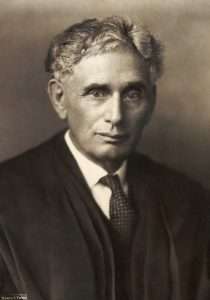
1/28/1916: President Wilson nominates Louis Brandeis to the Supreme Court. He would be confirmed on June 1, 1916.

Editor's Note: We invite comments and request that they be civil and on-topic. We do not moderate or assume any responsibility for comments, which are owned by the readers who post them. Comments do not represent the views of Reason.com or Reason Foundation. We reserve the right to delete any comment for any reason at any time. Comments may only be edited within 5 minutes of posting. Report abuses.
Please to post comments
Brandeis (along with another Wilson pick, McReynolds, and Holmes) dissented in Myers v. U.S., the executive removal case.
Brandeis was known for writing long separate opinions to discuss the purpose of things that the Court's majority might have thought differently about. Some legislation, for instance, or the value of free speech (Whitney v. California ) or privacy (Olmstead v. U.S.). He also co-wrote a famous law review argument promoting a common law right to privacy before his tenure.
He dissented in Gilbert v. Minnesota (advocacy of pacifism) in part noting:
Thus, the statute invades the privacy and freedom of the home. Father and mother may not follow the promptings of religious belief, of conscience, or of conviction, and teach son or daughter the doctrine of pacifism. If they do, any police officer may summarily arrest them.
It is an early recognition that freedom of speech should apply to the states & that "liberty" includes some sort of right to privacy.
IIRC, the right of privacy discussed by Brandeis and that coauthor of his was the right not to have newspapers pry into your private life.
What's the status of the right to privacy, thus defined, today?
From the article by Brandeis and Other Guy:
"The press is overstepping in every direction the obvious bounds of propriety and of decency. Gossip is no longer the resource of the idle and of the vicious, but has become a trade, which is pursued with industry as well as effrontery. To satisfy a prurient taste the details of sexual relations are spread broadcast in the columns of the daily papers. To occupy the indolent, column upon column is filled with idle gossip, which can only be procured by intrusion upon the domestic circle."
https://en.wikipedia.org/wiki/The_Right_to_Privacy_(article)
His 1890 law article (one account notes he largely wrote it) is notable for various reasons.
https://groups.csail.mit.edu/mac/classes/6.805/articles/privacy/Privacy_brand_warr2.html
[1] An examination of how the common law develops.
[2] A general concern for privacy, which would have open-ended implications ["securing to the individual what Judge Cooley calls the right "to be let alone"]
[3] Limits with public and private implications ("Under our system of government, he can never be compelled to express them (except when upon the witness stand")
[4] A particular focus on the excesses of the press that offer a private realm mixed with limits ("in whatever connection a man's life has ceased to be private")
There is a wider protection of the freedom of the press today than traditionally supplied. There remain limits on freedom of expression, including relief in some cases for invasion of privacy.
The proper reach of privacy protections is a matter of scholarly debate. See, e.g., The Fight for Privacy: Protecting Dignity, Identity, and Love in the Digital Age by Danielle Keats Citron.
So who was Samuel D. Warren, the Zeppo to Brandeis' Groucho?
Oh, this is unpleasant:
"Warren committed suicide by firearm at his Dedham, Massachusetts, country home on the night of February 18, 1910, putting to an end the dispute over the family trust. His family disguised his suicide and the date of his death. The New York Times reported that he died of apoplexy on February 20. Following a funeral service at his Boston residence, he was buried in Mount Auburn Cemetery on February 23.
"The Warren Trust case became a point of contention during the 1916 Senate hearings on the confirmation of Brandeis to the Supreme Court, and it remains important for its explication of legal ethics and professional responsibility."
https://en.wikipedia.org/wiki/Samuel_D._Warren_II


