

The Volokh Conspiracy
Mostly law professors | Sometimes contrarian | Often libertarian | Always independent
The Voting Rights Act Asymmetry Splices Staten Island
In New York City, Republicans are the discrete and insular minority.
Staten Island was a curious place to grow up. Though it is one of the five boroughs of New York, culturally, it felt very different. And politically, it is a different world. Staten Island has consistently voted for Trump and other Republican candidates, even as the rest of New York sprints down the road to Democratic Socialism serfdom.
From a perspective of geography, Staten Island is also unique. There are several bridges that connect Staten Island: three go to New Jersey, and one, the Verrazzano-Narrows Bridge, goes to Brooklyn. (Fun fact: you only pay the toll when you enter Staten Island, not when you leave.) The Staten Island Ferry connects Staten Island with lower Manhattan. (There are some other smaller ferries that connect to different piers in Manhattan.)
How should congressional representation for Staten Island work? Well, its population is not high enough to justify its own district. So for the past four decades, Staten Island's congressional district has included parts of Brooklyn (mostly Bay Ridge). That move made sense as a matter as geography, as it was the only contiguous land mass that Staten Island was connected to.
But Marc Elias had other ideas. As I wrote in October, Elias filed suit in state court, arguing that New York's maps dilute the votes of black and Hispanic voters in Staten Island. Elias argues this dilution violates the New York Voting Rights Act. His preferred map would form a single congressional district out of Staten Island and parts of lower Manhattan, including the financial district and the West Village. Again, there is no contiguous natural or manmade connection between Staten Island and Manhattan. There is only a ferry service that travels between the spots. (You can also take a lengthy bus ride that goes through Brooklyn or New Jersey.)
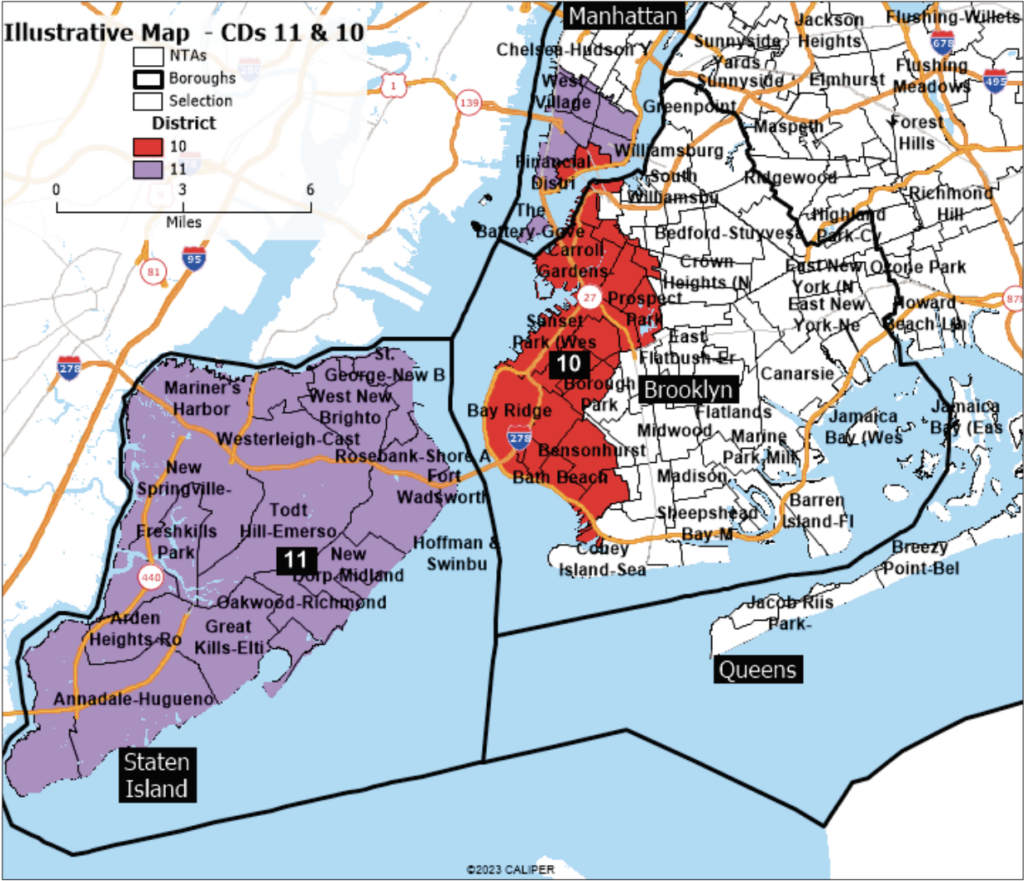
Of course, the upshot of this suit is that the only Republican district in New York City would vanish. This is the Voting Rights Asymmetry. The law only helps Democrats at the expense of Republicans. None of these regimes are about racial discrimination, especially in a deep blue state that will likely never elect another Republican statewide in my lifetime.
Alas, a trial court has agreed with Elias's case. The Wall Street Journal has this editorial, titled Democrats Try to Steal Staten Island.
Justice Pearlman cites figures showing that Staten Island has become more diverse since 1980. Then it was 85% white. Today it's 57% white, 20% Latino, 9% black and 12% Asian, he says. A provision to the New York constitution, passed by amendment in 2014, requires drawing districts so that minority groups, "based on the totality of the circumstances," do not "have less opportunity" to choose representatives.
The constitution provides "no guidance" on what this is supposed to mean in real life, Justice Pearlman writes, so it falls on him to "establish a standard." He cites an expert witness who says that in federal, state and city elections from 2017-24, the district's black voters stuck together 91% of the time, and Latinos did 88%. Under the current House map, they're "essentially guaranteed to have their votes diluted," the judge says. Therefore he orders the state to redo the lines.
There is a simple truth here. In New York City, black and Hispanic voters are not politically powerless. Indeed, even if certain residents of Staten Island cannot elect the representative of their choice, their policies are adequately protected by the entire New York congressional delegation. On the other hand, Republican voters are a discrete and insular minority. They have no other representation outside of the Staten Island district.
It is difficult to describe what it is like to be a conservative in New York City. At present, I live in a blue city in a red state. Democrats in Houston fare just fine, control most of the local government, and effectively fight most intrusions by the state. But a red borough in a blue state is a different story. The conservatives on Staten Island are truly on an island alone. They have no way to affect local policy, with regard to education or social services. And they have no way to affect state-wide policy.
This is an issue that I have long given thought. Back in 1994, when I was in the fourth grade, I argued that Staten Island should secede from New York City. I found this clipping from the Staten Island Advance from February 19, 1994, which was shortly after Mayor Rudy Giuliani began his first term.
They know that secession would mean Staten Island becomes its own city, and would not be a part of New York City any more. They also talk about what would happen if we do secede. A teacher, Sheena McGowan, talked about it with her class at PS 42 in Eltingville yesterday. She said that if Staten Island becomes its own city, all the open lots "would be owned by us." Then, New York City couldn't cut down the trees and put up buildings. Some students do not think secession is a good idea. They wonder if Staten Island will be able to pay for all the police trucks and fire trucks the borough will have to buy. Others think that taxes might cost more, and more people will be poor. In some classes, students collected newspaper articles and gave speeches. Joshua Blackman gave a speech saying he thought secession was a good idea. He told his class that Staten Island would be divided into 15 districts, so that every neighborhood will be represented. Michelle Cammarota agreed. She said a city of Staten Island would be a "big, clean, caring place." She also said she "would plant two to three trees for every one that was cut down." New plans for Staten Island Borough President Guy V. Molinari told residents yesterday about some of the new things that will happen on Staten Island this year. Molinari said even though he likes Mayor Rudolph Giuliani, he still wants Staten Island to become its own city, or secede. The new mayor is really helping out the Island now, but Molinari said Giuliani won't always be the mayor.
Some things never change. You can see my focus was on representing the varied neighborhoods of Staten Island, and not trees. (I shared many other clippings back in 2010.)
One of my blue sky constitutional amendments would be to allow all the people to redraw their political boundaries in a jubilee year. I discussed it in this post from January 2025:
Fourth, I've long thought about a constitutional amendment that would allow the people to redraw the state boundaries everyone so often by popular referendum. The states would be required to accept incoming property and to surrender outgoing property. The number of states would have to remain fixed, and the moves would have to be contiguous. But the people, perhaps on a county-by-county basis, can jump around. Consider a few examples. My home town of Staten Island could vote to join New Jersey. Eastern Washington and Oregon could vote to join Idaho. Northern and Eastern California could join Nevada (California would stretch from Sacramento to San Diego). Northern Virginia could join Maryland. El Paso could leave Texas and join New Mexico. The Florida Panhandle could join Alabama. The people of upstate New York can join Vermont. The Upper Peninsula of Michigan could join Wisconsin (and generation of Michiganders would no longer have to demonstrate where they live by holding out their hands). Western New York could join Pennsylvania. Philadelphia could join Delaware to basically become its own state. Some parts of Western Pennsylvania could join Ohio. And Northern Maryland could join Pennsylvania--rejigger the Mason-Dixon line. Maybe the state of Alberta could be stretched out to reach Alaska! This proposal would allow people to join states that more closely align with their values. Red states would become redder, blue states would become bluer, and purple states would be harder to find.
Were Staten Island to become part of New Jersey, the Garden State would immediately become purple.

Editor's Note: We invite comments and request that they be civil and on-topic. We do not moderate or assume any responsibility for comments, which are owned by the readers who post them. Comments do not represent the views of Reason.com or Reason Foundation. We reserve the right to delete any comment for any reason at any time. Comments may only be edited within 5 minutes of posting. Report abuses.
Please to post comments
The reality of Josh's asymmetry posts is that a prior state of affairs was unfair to disfavoured groups, legislation or changing values rectify the unfairness, which correctly is asymmetrical, but Josh thinks that asymmetry is inherently unfair.
14A - asymmetrical
CRA - asymmetrical
VRA - asymmetrical
The horror, the horror
Asymmetries that favor conservatives: barely an advantage. Normal stuff, really. Needed to offset liberal advantages, and anyone pointing it out is probably a coastal elite.
Asymmetries favoriting liberals: unfair, cheating, a scourge on our democracy we need new laws and judges willing to bend or repeal the rules asap to allow more conservative advantages.
This is how you maintain shimetry, which is like symmetry but kinda skewed.
So what symmetries favor Republicans in NY?
Congressional delegation:
19 Dem 73%
7 Rep 27%
2024 vote:
55% Dem
45% GOP
That's a general characteristic of FPTP voting systems - tends to over-represent the highest vote, and is not a rare feature of NY favouring Democrats.
> New York sprints down the road to Democratic Socialism serfdom.
Josh, no one is going to take you seriously as long as you write this kind of pulpy partisan trash.
I come to Reason for insightful analysis. I can red meat anywhere.
Josh, no one is going to take you seriously as long as you write this kind of pulpy partisan trash.
Ship sailed too long ago to remember.
Torn between posting:
Damn, it must suck to be a minority group surrounded by members of a hostile majority on all sides. Wonder if a law could be passed to help solve that?
or:
Damn, it's kinda strange how no Volokh Conspiracy contributors have ever taken a serious or systematic stab at writing about foot voting before. Maybe Blackman can be the first.
My bottom line is that Trump was a fool to start a gerrymandering war with troops who weren't committed to winning it. Staten Island is just collateral damage from that stupid decision.
And, yeah, they probably should consider moving, if elections are important to them; Voting is going to be an act of total futility for the rest of their lives, otherwise.
Unbelievable. Trumpists whining about unfair redistricting.
I wonder how strenuously Josh objected to Texas' 2025 redistricting.
Waiting with bated breath for a Blackman post about the Alex Pretti shooting.
He's still trying to figure a justification. Not easy.
There likely is no justification other than confusion poor training and human error.
But that is hardly new in Minnesota whether federal officers or local.
In the last few years you had the Philandro Castillo shooting, Officer panics and shoots CCW holder when he informs him he is armed as required by law."The Philando Castile shooting occurred on July 6, 2016, when he was fatally shot by police officer Jeronimo Yanez during a traffic stop in Falcon Heights, Minnesota."
the Noor shooting. "Mohamed Noor, a former Minneapolis police officer, fatally shot Justine Damond, an unarmed woman who had called 911 to report a possible sexual assault, on July 15, 2017."
George Floyd and Derick Chauvin.
the Daunte Wright shooting."Kim Potter, the former Minnesota police officer who said she mistook her gun for a Taser when she shot and killed Daunte Wright in 2021, was released from prison early Monday."
And now we have Alex Pretti.
Probably the closest to the Pretti shooting was the Castillo shooting, that officer was aqutted and served no time.
https://www.cbsnews.com/minnesota/news/jeronimo-yanez-teaching-license-appeal-denied-philando-castile/
FWIW in the case of the Castile shooting, I contemplated the counterfactual - Castile actually shoots the officer after the latter had drawn his gun, saying he was in fear of his life and it was self-defence, and he would almost certainly have been convicted.
Blackman is the Officers and Supreme Court Internal politicsts guy.
Orin is THE 44th Amendment guy.
Adler is the Admisrative law guy.
Ilya is the Immigration and Imminent Domain snd Zoning and Rational Ignorance and Irrational TDS guy.
EV is the first Amendment, 2nd Amendment, Libel law guy.
Bernstein might write about it if it happened on a Kibbutz, or Pretti identified as Hispanic but was actually Portuguese.
So really it would probably be Ilya, or EV who might post on it, although use of force las wouldn't be there thing. Orin might right sometime because 4th amendment does desl with use of force, but it would more likely be on X than here.
They aren't trained seals that bark when you throw them a fish, and you aren't even shelling anything out for trash fish anyway.
They don't usually take requests.
-
'Staten Island was a curious place to grow up. Though it is one of the five boroughs of New York, culturally, it felt very different. And politically, it is a different world. Staten Island has consistently voted for Trump and other Republican candidates, even as the rest of New York sprints down the road to Democratic Socialism serfdom."
Hmm. Perhaps "the rest of New York" is not a fan of fascist serfdom and Trumpian corruption.
Fascists were also socialists.
This is the type of thing 18 year-olds in undergraduate political philosophy courses say.
Only the ones who routinely slept through their alarms and missed class.
Only leftists can be so dumb as to think socialism is not coercive, or that Fascists and Nazis were not socialists.
Oh?
So what is "the rest of New York" a fan of?
This should be good.
Gerrymandering can't be avoided when governments draw districts. It is impossible for representation to match voter makeup unless there is only one allowed factor: political party, race, religion, personal pronouns, whatever you choose cannot match multiple factors. And if you insist on matching your one chosen factor, you ought to be honest about it and switch to at-large representation; but then California, for instance, would have ballots with a hundred candidates for all those statewide at-large representative. Thus states end up with district representatives who cannot actually represent voter makeup.
One of the goals of my Chartertopia fantasy is to prevent government from defining itself, such as government judges interpreting government laws and the Constitution, whether government police and prosecutors have violated government laws and the Constitution, etc.
This applies to districts too. US representatives have to have equal-sized districts because all representatives have the same single vote in the House, and each pretends to represent everyone, including those who voted against him. I invert the process: each district elects three winners, each of whom casts as many votes in the legislature as they won in the election; I call it proxying. A fourth "amateur" representative is chosen at random from all voters, or from voter suggestions, who of course can decline the honor until someone is chosen, and this amateur proxies all the remaining election votes. The intent is to actually represent all voters. The amateur doesn't represent disgruntled voters, but is at least not a professional who campaigned for office. There are three winners to try to limit the two-party mess we have. It could also be everyone with more than 5% or 10% of the total votes.
This is NOT a reinvention of parliamentary systems, because they still pay lip service to one voter per representative or have at-large party votes where voters don't even choose representatives.
This means that districts no longer need be equal sized, and government no longer needs to have a census and redraw districts every ten years. So parcel owners define district boundaries. If a district border crosses a parcel, the owner can move it, at any time, without the government having any say in the matter; he does have to tell election officials, but they get no say other than limiting changes to some reasonable limit, like once a week or once per election. Parcel owners can also create a new district wholly within their parcel, split it, or merge with a neighboring district. It makes no difference to representation; just tell election officials. There are practical limits, such as how many legislators can fit in the building, but that's easily solved by not requiring physical presence. There's no real benefit to forcing physical presence. They can certainly work remotely in this day and age, and their speechifying is for press releases and soundbites, not to persuade each other.
Does a city regularly vote in ways that you detest? If you're a parcel owner, you can shift or split out of the city. Same with states, counties, mosquito abatement districts, and all representative districts. Gerrymandering would be impossible.
Stop letting government define its limits.
"Gerrymandering can't be avoided when governments draw districts."
It's perfectly possible to avoid gerrymandering if you define it as it was defined for most of history. Since "Gerrymandering" just means drawing non-compact districts to guarantee a particular electoral outcome, you largely make it impossible just by mandating that the districts be compact and equal population.
Once you redefine "gerrymandering" as "not replicating the outcome of proportional representation" it becomes inevitable, sure, but that's not what the word MEANS. Even if I happen to LIKE proportional representation, that's still not what the word means.
"I invert the process: each district elects three winners, each of whom casts as many votes in the legislature as they won in the election; I call it proxying."
I've advocated a variant of this system myself, and it does make gerrymandering impossible. Best of luck getting it past a government full of incumbents who would have to expect to lose most of their power if the system changed.
Redrawing districts truly compactly requires splitting cities and neighborhoods. There are geographical features to consider -- rivers, lakes, mountains. There are any number of reasons to twist "compactly" all out of reason.
Gerrymander is inevitable. It only outrages the media and politicians when it goes against them.
ETA that I have no illusions about my fantasy ever coming true. I do it to have a baseline against which to understand the real world.
That's the wrong argument.
Here's the issue with this lawsuit. It argues that "Hispanic and African American voters aren't being given the right to choose their own candidate". It looks at NY's 11th Congressional district which isn't gerrymandered (unlike many of NY's other congressional districts), in that it includes Staten island as a whole, then the area of Brooklyn closest to it. The proposed changes instead remove Brooklyn, and sweep significantly father up north to hit a swath of Manhattan
District 11 includes ~18% Hispanic Voters and ~6% black voters. The proposed changes don't actually meaningfully change that ratio. What you instead get is a large group of heavily democratic white voters in Manhattan being shifted into the district. What you'll most likely get is a white Democrat representing the district. And...that's not what the civil rights act is meant for.
The Civil Rights Act was designed to put communities of interest together. So, you could draw a majority Hispanic or majority black district, and then a member of that group would be elected, regardless of party. But...this lawsuit and logic does something a little twisted.
1. It assumes the minority will always vote Democratic.
2. It ignores the demographics in the Democratic Primary
In essence, what it can ensure is that the minority group is always a minority in the Democratic Primary (which would mean a white person would win the Democratic minority*) but then assumes the minority group "gets their choice" in the general election. But you never actually get the minority person representing the district. They are a minority of a piece. In some ways it makes it even harder. The minority candidate doesn't even get to run in the general election for either party. That removes more random chance of them winning.
New York has several other congressional districts (4th District, 3rd District, 10th district) where you have a White Democrat representing a population that has similar levels of minorities. I think we need to ask...are these legal? If so, why? Are minorities "really getting their choice"...if you don't look at the primaries?
*(Yes, you can have random chance and occasionally people will cross lines to vote for an individual of a different race.)
Of course it is, although that's certainly not how it has been applied in practice. It's meant to protect minority voters, not minority candidates. (Of course, in 1965 it would have been rational to assume that a white elected Democrat would not be looking after the interests of black constituents quite as zealously as a black elected Democrat would, but this isn't 1965.)
Heaven forbid. Vermonters have hated New Yorkers ever since New York sheriffs tried to annex Vermont in 1771.
Still fighting off the cognitive dissonance from Democrats that geographic gerrymandering is okay if it denies Republicans any additional representation.
I don't exactly agree with Blackman's asymmetry argument here, because party is not race. But race is not also party.
I don't see why it would be okay to do to Staten Island Blackman's hypothetical, if it would also be illegitimate (if not illegal by some non-racial reapportionment rules) to divide up an urban center with a large minority population among 4 districts in the surrounding inner suburbs that are similarly party monolithic but of the predominant race. I thought one of the core principles of district creation was a geographic connection or history.
Yes, what I described would run likely run afoul of VRA, but it's also largely what is being disputed right now with VRA. Disputing my hypothetical is an implicit accusation of racism against their very own party, that other party members will not fairly represent them. Maybe Blackman's asymmetry does have a bit of merit, I don't know. One cannot split a predominantly minority region according to the VRA, but can split or disadvantage a region with the predominant race.
I know math is hard, but this is wrong. Staten Island's population just isn't that big. 2024 was a uniquely terrible year for Dems in NY/NJ, and yet Harris still wins NJ handily if you bundle Staten Island's votes in with NJ's.


