U.S. Fever Trends Suggest COVID-19 Rates Could Soon Decline
"3 to 7 days after a stay-at-home order is enacted, fevers in that community start to drop."


"3 to 7 days after a stay-at-home order is enacted, fevers in that community start to drop."

Surgeon General Jerome Adams wants us to believe the CDC realized the danger posed by asymptomatic carriers only last week.

Early and wide testing helps curtail the epidemic while casting light on the prevalence and lethality of the virus.
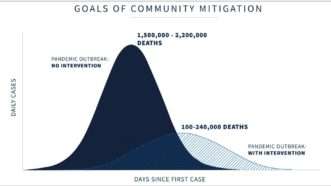
The real action in the coming months lies between those two extremes.

The combination of limited evidence and conflicting priorities has resulted in whipsawing messages from experts.

Germany's crude case fatality rate is currently less than 1 percent, compared to 1.8 percent in the U.S., 6.4 percent in the U.K., and 11.4 percent in Italy.

"They always overshoot," Anthony Fauci says. "Generally, the reality is somewhere in the middle."

So far politicians have been acting as if only one side of the ledger matters.

But he stands by his reasoning and predicts that global deaths will peak under 50,000.

The mortality rate is much lower than the official numbers suggest, and adaptive behavior affects the transmission rate.

The "panic" Andrew Cuomo has in mind is a rational response to the threat of an economically ruinous government overreaction.

The worst-case scenarios projecting millions of deaths don't take into account adaptive behaviors.

It depends on how widely the virus spreads, which is difficult to predict.

In two weeks we will know if his public health measures are too little, too late.

It's too early to tell, but there are reasons for (relative) optimism.

Efforts to control the flow of information fail, but they muddle the quality of what people share in defiance of the censors.

This will fail and more pressing problems will be neglected

Is this just another example of epidemiologists torturing the data until they confess to a spurious but headline-grabbing statistical significance?
Nutrition nannies launch new cancer scaremongering campaign.

Consuming whole fat dairy foods lowers mortality and cardiovascular risks, according to a new Lancet study.
Implausible estimates of benefits or risks associated with diet reflect almost exclusively the magnitude of nutrition researchers' cumulative biases.
Nevertheless, U.S. cancer rates are stable for women and declining for men.
On the other hand, drinking may also reduce cardiovascular risks and boost your income. It's also a pleasure.
A new book offers a potent antidote to toxic misinformation.
Exploring the absurdities of modern nutritional epidemiology.
Hypothesis: More sugar causes both more diabetes and more obesity
Getting Risk Right is a potent antidote to the toxic misinformation peddled by activist scaremongers
Getting Risk Right reviewed by Ronald Bailey
Toxicologists liken the endocrine disruption hypothesis to homeopathy.
"Science, the pride of modernity, our one source of objective knowledge, is in deep trouble."
Absurdly precautionary International Agency for Research on Cancer admits it was wrong
Sitting all day will kill you. Well, maybe not.
Add milk to your diet of salt, red meat, and eggs.
Environmental activists favor secret science
Celebrate your independence with a subscription to Reason magazine, your most trusted source of honest, insightful news and analysis.