A New Bill Reflects the Bipartisan Backlash Against Flock-Enabled Mass Surveillance
Criticism from Trump allies and recent survey results show that resistance to widespread deployment of automated license plate readers spans the political spectrum.
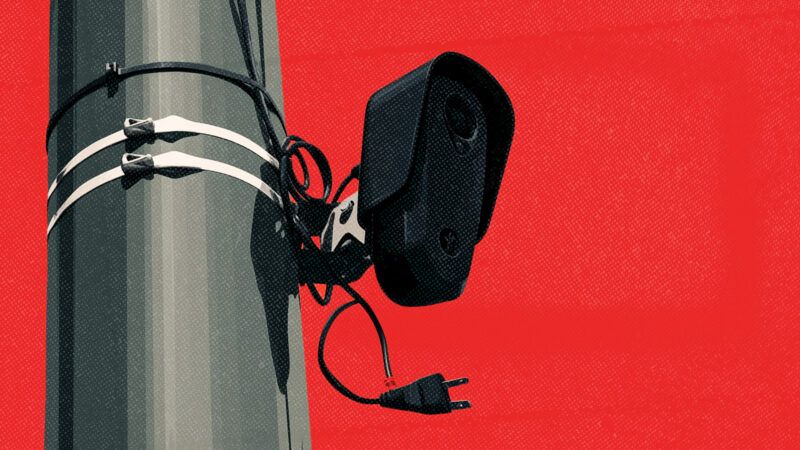
Reps. Thomas Massie (R–Ky.) and Eric Burlison (R–Mo.) this week introduced the Flock-Off Act, a bill that would bar federal funding of automated license plate readers (ALPRs) except at the border or for toll enforcement. "The federal government shouldn't provide 'security' grants to cities and police departments that have gone beyond the pale and turned their communities into a version of 1984," Massie said on Wednesday. "Federal taxpayers should not be forced to fund the surveillance state."
The bill—the name of which calls out Flock Safety, the leading ALPR vendor—is cosponsored by Rep. Ro Khanna (D–Calif.) along with four Republicans: Reps. Lauren Boebert (Colo.), Paul Gosar (Ariz.), Chip Roy (Texas), and Victoria Spartz (Ind.). It illustrates the bipartisan, trans-ideological nature of the backlash against AI-assisted ALPRs, which cities across the country installed without giving much thought to privacy concerns or the potential for abuse. During the last year or so, Americans across the political spectrum, including national politicians, local legislators, and police officials, have belatedly recognized the implications of a nationwide surveillance network that operates without judicial oversight and often without meaningful supervision of any sort.
"On the right, critics typically attack the cameras as government overreach," Vox writer Caitlin Dewey noted last week. "On the left, critics frequently link the cameras to corporate surveillance, racist policing, the erosion of abortion rights, and immigration enforcement."
Civil liberties groups such as the Institute for Justice, the American Civil Liberties Union, and the Electronic Frontier Foundation have been sounding the alarm about ALPR surveillance for years. But thanks partly to revelations about blatant police abuse of ALPR databases, including cops who have used them to stalk ex-girlfriends, possibly unfaithful spouses, objects of romantic interest, or personal nemeses, public opinion is starting to reflect those organizations' concerns.
In a national YouGov survey conducted last week, 46 percent of respondents said they would oppose the use of ALPRs "for law enforcement purposes" in their communities, including 31 percent who were "strongly" opposed. Just 38 percent favored ALPRs, while 17 percent were unsure. A year ago, by contrast, YouGov found that 45 percent of Americans supported ALPRs, while 33 percent opposed them, including 20 percent who were "strongly" opposed, and the rest were undecided.
In both surveys, Democrats and independents were more likely than Republicans to oppose ALPRs. But last week's survey suggested growing qualms among Republicans, 33 percent of whom were against police use of the technology, up from 29 percent last year, including 20 percent who had strong views on the subject, up from 18 percent in 2025.
A few weeks ago, a NextGen survey in Arizona, a state that President Donald Trump won in 2016 and 2024, found even stronger opposition to Flock cameras: 63 percent of registered voters opposed police use of ALPRs, while 82 percent were "concerned" about "misuse." Even more striking: Around the same time, a Spry Strategies survey of likely voters in decidedly Republican and conservative Knox County, Tennessee, found that 58 percent opposed Flock cameras, including 42 percent who were "strongly" opposed.
Florida Gov. Ron DeSantis, one of the most prominent Republicans to express sympathy for that view, seems to know which way the wind is blowing. ALPR cameras are "out of control," he told reporters last week. "I'm all about law enforcement having tools to hold criminals accountable….No one's been stronger on law enforcement than me. But I don't want to have this become a surveillance state."
Notably, DeSantis alluded to outrageous examples of what can happen when police officers across the country have easy, essentially unsupervised access to ALPR databases they can use to track drivers, predict their itineraries, identify other vehicles near them, and, with the help of other records, assemble detailed information about their lives. The Institute for Justice has identified "well over 100 incidents of ALPR abuse," which it notes "may be just the tip of the iceberg" given the reality of lax oversight and widespread, often informal sharing of ALPR data. "When I see, like, a police officer using this to track, like, an ex-girlfriend," DeSantis said, "I'm like, you know, what the hell's going on?"
Local officials are beginning to ask the same question. The Institute for Justice counts "157 local governments" that have canceled or declined to renew ALPR contracts since the beginning of 2025. While that represents a tiny share of the 7,000 or so U.S. law enforcement agencies that use Flock cameras, the trend is not positive for a company whose CEO until recently dismissed privacy concerns about his equipment and software, condemning "terroristic organizations like DeFlock," which has used crowdsourcing to map more than 138,000 ALPR cameras in the United States.
In contrast with the political breakdown in the YouGov surveys, the congressional reaction to those cameras has been driven almost entirely by Republicans. The Surveillance Accountability Act, which Massie introduced in April, would generally require that police obtain a warrant to search ALPR data, which is similar to the policy that the Institute for Justice favors. That medicine evidently is too strong for Massie's colleagues, only one of whom, Boebert, has cosponsored the bill so far.
The PRIVACY Act, which Rep. Keith Self (R–Texas) introduced on July 15, has attracted a bit more support. That bill would bar federal law enforcement agencies from using state or local ALPR information to "circumvent warrant requirements." It has attracted half a dozen cosponsors, all Republicans, including Burlison.
The Protection Against Mass Surveillance Act, which Rep. Tim Burchett (R–Tenn.) introduced on July 21, would prohibit federal agencies from "purchasing or accessing automated surveillance systems that identify, track, or record individuals." It has seven cosponsors, including Burlison and six other Republicans.
Although that is not exactly a groundswell of congressional concern, the reaction from conservative Republicans shows that objections to ALPRs are not limited to libertarian or left-leaning critics. The right-wing, Trump-supporting Epoch Times, for instance, recently gave sympathetic coverage to the anti-Flock backlash, noting concerns about misuse of ALPR data for personal purposes, mistaken identification of suspects, and violation of the Fourth Amendment's ban on unreasonable searches.
Last week, Sen. Josh Hawley (R–Mo.), no one's idea of a libertarian, announced that he was launching an investigation of Flock's "collection, retention, and dissemination of the data generated by its artificial intelligence surveillance cameras." He noted that "the overwhelming majority of the Americans captured in those records did nothing wrong," adding that "Americans do not surrender their privacy rights when they drive to work, drop their kids off at school, or go to church." The Supreme Court, he emphasized, has recognized that "a comprehensive, retrospective record of a person's movements is different in kind from ordinary observation in public."
Along similar lines, Texas Agriculture Commissioner Sid Miller, a conservative Republican, last month urged Gov. Greg Abbott to freeze state funding of ALPR systems until legislators have "studied their risks and enacted firm constitutional protections." Miller emphasized the cumulative impact of ALPR deployments: "Enough cameras can reveal a person's routines, associations and private activities. That is the foundation of a mass-surveillance network."
Miller may have been taking a cue from David Dunmoyer, associate vice president of campaigns at the Texas Public Policy Foundation. "Flock has struck a nerve and given rise to a national conversation that our privacy and freedom demand," Dunmoyer wrote in a July 29 Daily Wire essay, describing the company's cameras as "an assault on your constitutional freedoms."
Dunmoyer proposed several legislative reforms: "Require a warrant. Put a hard clock on retention measured in days, not years. Bar sharing with out-of-state and federal agencies without a Texas judge's signature. Publish the audit logs. Give Texans standing to ensure our privacy is not violated."
Although a bunch of Trump's political allies have expressed similar concerns, their criticism does not seem to have made much of an impression on him. This year's National Drug Control Strategy describes ALPRs as "a critical technological tool for domestic drug interdiction, acting as a significant force multiplier for law enforcement on our nation's highways." The Trump administration also has made extensive use of ALPRs for immigration enforcement—an application resisted by blue states that have tried, without much success, to stop the feds from using ALPR data to nab unauthorized residents.
"You have pros and cons," Trump told a reporter who asked for his take on the Flock controversy a couple of weeks ago. "It's being studied right now. We'll have an answer sort of as to our views on it over the next couple of weeks."