

Trump Wants To Force Data Centers To 'Make Their Own Electricity.' Deregulation Would Work Better.
The president joins a long list of politicians who think the government knows best when it comes to data centers.
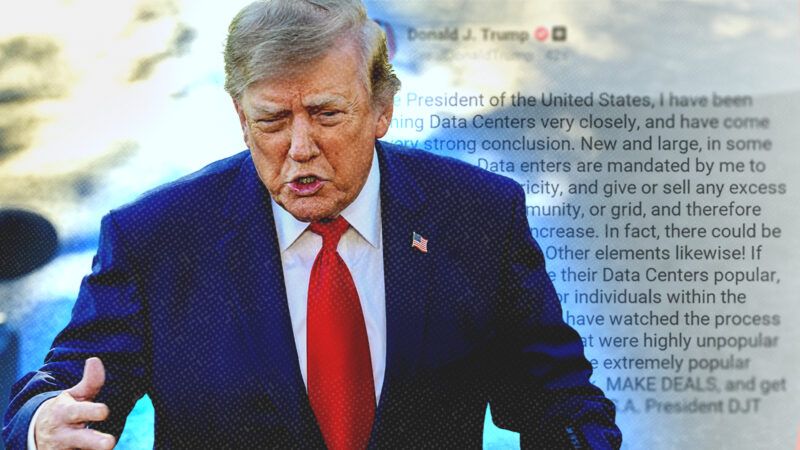
With public opposition toward data centers growing and midterm elections on the horizon, politicians across the spectrum have introduced overreaching policies to stymie data center development and ease voters' minds. These politicians now include President Donald Trump, who has historically been a staunch supporter of the industry.
"New and large, in some cases gigantic, Data Centers are mandated by me to make their own electricity, and give or sell any excess back to the local community, or grid," Trump declared on Truth Social on Wednesday. "If companies want to make their Data Centers popular, pay the community, and/or individuals within the community, a 'dividend.' I have watched the process closely, and Data Centers that were highly unpopular in a certain area have become extremely popular when a financial deal is struck."
While Trump has suggested that power plants pay for their own power before, these comments are in stark contrast to him saying less than a couple of months ago that "the only reason that communities throughout the U.S.A. should not want Data Centers is if they want to end up being backward and poor." Still, the president is not wrong that the strategy could boost data centers' popularity; polling regularly shows that concerns over higher energy prices are one of the main reasons people oppose data centers in their communities.
However, mandating that these power plants "make their own electricity" is the wrong way to accomplish this objective, in part because generation costs are not the leading factor in higher electricity prices—transmission infrastructure, such as wires and poles, is. And regulatory barriers, as well as a lack of competition in the building of this infrastructure, are mostly to blame.
Regardless, if the goal is to have data center companies produce their own electricity, easing regulations would have more impact than imposing a mandate. As Travis Fisher, director of Energy and Environmental Policy Studies at the Cato Institute, tells Reason, "If a tech company buys electricity from the owner of a power plant, in most states the power plant owner then becomes a public utility (even if the transaction occurs off-grid), which brings heavy scrutiny in the form of economic regulation."
To ease these regulatory barriers, Fisher and other experts have advocated for a Consumer Regulated Electricity model that allows large-load customers to connect directly to unregulated power producers off the grid.
Fisher also notes that lower power costs don't automatically translate into lower utility rates. He tells Reason, "Even if a data center were to bring a matching or beating amount of supply relative to their demand, based on the way retail rates work, I am not convinced that that guarantees that prices will fall."
On top of not solving the main driver of higher electricity prices, the mandate isn't needed because many data centers have already begun to produce their own power. A report from energy research firm Cleanview shows that operating power capacity dedicated to data centers has nearly doubled since June, while capacity under construction has roughly quadrupled. Additionally, companies including Anthropic and Microsoft are already volunteering to cover consumers' electricity costs.
By calling on power producers to make their own electricity, Trump joins the growing chorus of politicians who are convinced that the government, not the market, is best equipped to dictate how data centers grow and operate. And, in typical Trump fashion, a "mandate" on social media without any legal action behind it has left the public and investors to guess what, if anything, is actually coming.
Building power plants requires long-term planning and investments meant to last decades, making Trump's tendency to impose abrupt policy changes less than ideal. "The fact that the rules change, not just every four years, but occasionally overnight via tweet," says Fisher, does not make for "a great investment environment."



