
If You Give a Bear a Badge, Will It Respect Your Rights?
Despite their general ignorance of constitutional law, bears pose a much less grave threat to your civil liberties than humans do.
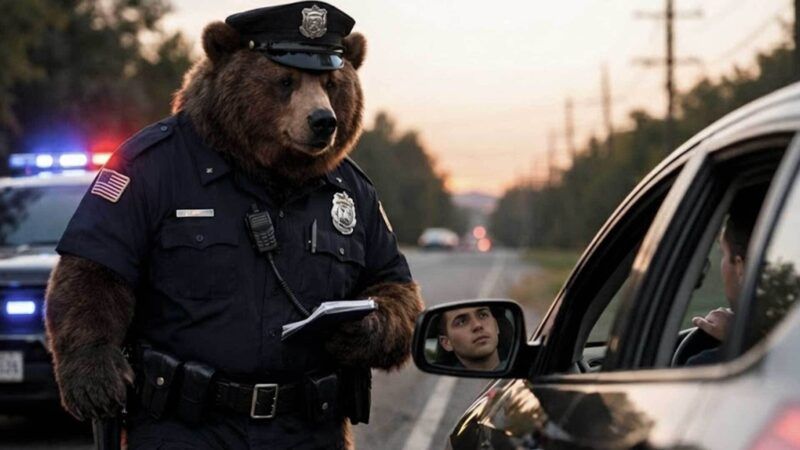
A few years ago in Connecticut, Mark and Carol Brault complained that state officials had strapped a camera to the neck of a black bear that was known to frequent their property. They alleged that the Connecticut Department of Energy and Environmental Protection (DEEP), which suspected them of illegally feeding bears, was employing the furry spy in an attempt to back up that allegation. That DEEP strategy, the Braults argued, violated their Fourth Amendment right to "be secure in their persons, houses, papers, and effects" against "unreasonable searches and seizures."
The couple's claim was complicated by the Supreme Court's "open fields" doctrine, which says private property beyond the immediate vicinity of a home, a.k.a. the "curtilage," is not protected by the Fourth Amendment. But it seemed unlikely that Bear Number 119, the camera-carrying animal that Mark Brault had photographed "near the center of our property," was familiar with the finer points of Fourth Amendment case law. Assuming it was not, there was no assurance that it would confine itself to the Braults' "open fields" and avoid the "curtilage" around their home.
If police need a warrant to deploy a drug-sniffing dog on the porch of a suspected marijuana grower's house, as the Supreme Court held in the 2013 case Florida v. Jardines, similar restrictions presumably would apply when the government deploys camera-toting bears against people suspected of feeding them. The problem is that the paths of unsupervised bears do not necessarily follow judicial guidelines.
That case illustrates the point that enlisting bears in law enforcement can be legally risky. But we should not be too hasty in concluding that bears are completely incapable of complying with constitutional requirements and respecting civil liberties. In some respects, they may be better than humans.
'As Old as the Common Law'
The Braults, who own 114 acres of forested land in Hartland, Connecticut, operate a private nature preserve that charges admission to visitors interested in seeing bears and other wildlife. In a 2020 lawsuit, the town of Hartland accused them of violating a local ordinance against feeding bears, a charge they denied.
In the midst of that dispute, Mark Brault encountered a bear he recognized, but it was wearing a new outfit. On the morning of May 20, 2023, he reported, "I observed Bear Number 119 near the center of our property, within 200 yards of our residence." The bear "was wearing a video camera," which was "affixed to a collar" that DEEP "apparently had placed" on the animal. "I have known that bear for a long time," Brault said. "I know it frequents my property and adjacent properties. I know that it was tagged by [DEEP] previously, but not collared."
That affidavit was attached to a lawsuit that Brault and his wife filed in the U.S. District Court for the District of Connecticut 10 days after his unnerving encounter with the camera-equipped bear. DEEP "is conducting warrantless ground-level photographic surveillance of the interior of [our] property," the Braults alleged. Although the area was "clearly posted with 'no trespassing' signs," they said, DEEP "did not have a search warrant authorizing or permitting photographic surveillance of the interior of [our] property." The bear presumably did not have a warrant either.
According to the Supreme Court, however, neither the presence of signage nor the absence of a warrant was constitutionally significant. "The special protection accorded by the Fourth Amendment to the people in their 'persons, houses, papers and effects,' is not extended to the open fields," Justice Oliver Wendell Holmes Jr. wrote for a unanimous Court in the 1924 case Hester v. United States, which involved illegal whiskey production in South Carolina. "The distinction between the latter and the house is as old as the common law."
The Court reaffirmed that principle in the 1984 case Oliver v. United States, which involved a marijuana farm discovered by Kentucky state police. "In the case of open fields, the general rights of property protected by the common law of trespass have little or no relevance to the applicability of the Fourth Amendment," Justice Lewis F. Powell Jr. wrote in the majority opinion. Although the marijuana growers "erected fences and 'No Trespassing' signs around the property," the Court rejected "the suggestion that steps taken to protect privacy establish that expectations of privacy in an open field are legitimate."
The implication was that "open fields" need not actually be open. Even when private property is fenced and marked with "No Trespassing" signs, the Court said, "no expectation of privacy legitimately attaches to open fields." At the same time, it acknowledged that the Fourth Amendment does apply to "the 'curtilage,' the land immediately surrounding and associated with the home."
Under the "open fields" doctrine, the Supreme Court ruled three years later in United States v. Dunn, police likewise did not need a warrant to approach a barn located about 50 yards from a home, even though they had to cross several fences on the way. Nor did they need a warrant to peer into the barn, where they ultimately found a laboratory producing the methamphetamine precursor phenylacetone, because at that point they were still located in "open fields." The majority concluded that "the barn and the area around it lay outside the curtilage of the house."
'Ill-Founded Reasoning'
The "open fields" doctrine is misbegotten, the Institute for Justice argues. The civil liberties group says the "distinction" that Holmes deemed "as old as the common law" in Hester was based on a misunderstanding.
"The sole citation to support this historical assertion was to three pages of Blackstone's Commentaries," Institute for Justice attorneys Robert Frommer and Anthony Sanders noted in a 2017 Supreme Court brief. "The problem with Justice Holmes' citation is that in those pages, Blackstone was not talking about open fields, officers of the law, or even trespass. Instead, he was discussing the elements of burglary. Blackstone simply lays out the rule that to commit burglary, among other elements, the burglar must break into a home, and do it at night."
Holmes "took this distinction between burglary and other crimes and gave it constitutional significance by applying it to an area—an open field—that Blackstone does not even address," Frommer and Sanders added. "By the same, ill-founded reasoning, Hester could have stated that the Fourth Amendment does not apply to the government entering homes during the day, or entering buildings such as barns and warehouses at all, all areas Blackstone contrasted to a break-in of the home at night."
That highly improbable result, Frommer and Sanders argued, "is the logical conclusion once the citation to Blackstone is actually examined. In short, the citation to Blackstone did nothing to support the Court's refusal to apply the Fourth Amendment to an 'open field.'"
Given the persistence of this exception to the Fourth Amendment, however, it is not surprising that DEEP argued, in its motion to dismiss the Braults' lawsuit, that "all the activity alleged in the complaint falls squarely within the 'open fields' doctrine." Nor did Frommer think the Braults were likely to prevail in arguing that DEEP's ursine surveillance violated the Fourth Amendment. Their best bet, he suggested shortly after they filed their complaint, would be to emphasize the unpredictable meandering of camera-bearing bears.
"The problem with slapping a camera onto a bear and then unleashing it into the wild is that you can't control where that bear goes," Frommer said. "For all the officer knows, the bear could park itself right outside somebody's house, with the camera capturing everything therein." Or as he put it in a more colorful turn of phrase, "turning wildlife into unguided surveillance drones is unbearable," and "Connecticut should paws its animal camera program so as not to infringe on Nutmeggers' privacy and security."
'Not Practicable To Secure a Warrant'
While the distinction between "open fields" and "curtilage" might escape the average bear, that does not necessarily mean bears cannot be trusted to follow other Fourth Amendment principles laid down by the Supreme Court. In the 1988 case California v. Greenwood, for example, the Court ruled that people do not have a reasonable expectation of privacy in the trash they leave on the curb for collection. Bears seem to instinctively understand that you don't need a warrant to rummage through someone's garbage.
A century ago in Carroll v. United States, the Supreme Court likewise held that police do not need a warrant to search motor vehicles. The case involved two suspected Michigan bootleggers whom federal prohibition agents stopped as they were driving west on the road from Detroit to Grand Rapids. The agents searched the car and found 68 bottles of whiskey and gin hidden behind the upholstery of the seats. "Contraband goods concealed and illegally transported in an automobile or other vehicle may be searched for without a warrant," the Court ruled.
As the majority saw it, that leeway was a practical necessity. "It is not practicable to secure a warrant" in such cases, Chief Justice William Howard Taft explained, "because the vehicle can be quickly moved out of the locality or jurisdiction in which the warrant must be sought." But there was a catch: Police still need "probable cause for believing" a car contains contraband.
The Supreme Court has said probable cause is equivalent to a "substantial chance" or a "fair probability" that evidence of a crime will be discovered. The Court has not defined the concept more precisely than that. Since humans struggle to understand what probable cause means in practice, it seems unrealistic to expect that bears will do any better. The evidence suggests they are not even trying.
If bears did worry about probable cause, they might be able to supply it with a simple sniff of the air. In the 2013 case Florida v. Harris, the Supreme Court unanimously held that an "alert" by a dog trained to detect illegal drugs is enough, by itself, to justify a car search. Although the Court has not addressed bears in this context, there is reason to think it also would view them as four-legged probable cause generators.
"Bears are known for their exceptional sense of smell," the San Diego Animal Sanctuary notes. "In fact, their olfactory abilities are often considered the best among all animals on Earth."
They've got numbers to back that up: "The average dog's sense of smell is roughly 100 times better than that of a human. A bloodhound, which is one of the best tracking dogs, is 300 times better. But a bear's olfactory ability is 7 times better than a bloodhound's."
With certain notable exceptions, however, bears are unlikely to be sniffing for drugs, as opposed to honey, berries, porridge, or picnic baskets. And even if they do decide to search a car, we can be pretty sure they will not assert the right to seize any cash they come across, as human police officers routinely do under civil forfeiture laws.
Watching the Watchers
Just as bears have no interest in your money, they generally do not seem to mind, or even notice, when people record them as they go about their business. Sometimes they even seem to like it. That also stands in sharp contrast with the behavior of human cops, who frequently object (or worse) when bystanders use cell phones to document their official conduct, even though several federal appeals courts have held that people have a First Amendment right to do that—a point on which the U.S. Department of Justice concurs.
Bears also compare favorably to humans when it comes to the use of deadly force. While more than 600 people are killed by American law enforcement officers each year, The Alaska Frontier counted just eight fatal bear attacks in the United States from 2020 through 2022, an average of fewer than three a year. That is pretty reassuring, even taking into account the fact that the United States has more cops (about 720,000) than bears (around 340,000).
On balance, it is fair to say that bears, despite their general ignorance of constitutional law, pose a much less grave threat to your civil liberties than humans do. But the factors that weigh in favor of bears—a lack of interest in your contraband or money, a tendency to mind their own business, and a disinclination toward violence unless they perceive a threat to themselves or their cubs—probably make them ill-suited to careers in law enforcement.
