My favorite stanza, very loosely translated (I translate it more precisely below; note that the rhyme in the original, unsurprisingly, is much less banal):
Протянулась здесь на километры
С близкими невидимая нить,
А времени безжалостные ветры
Рвут всё то, что стоило ценить.
Over the many miles had stretched
The hidden thread connecting to our nearest,
But the winds of time, so pitiless
Now tear apart all that is dearest.
(Compare, from an earlier post, "*Every* bond between Ukrainians & Russians - familial, cultural, historical - is being broken.")
The song is "Trifles," by the band "Leningrad" (led by Sergey Shnurov); the video below has had nearly 1.5 million views since being posted two days ago.
Here's my loose and not-free-from-doubt translation:
Plaintiff expresses that she would like the entire case sealed because she is "experiencing violations and disruptions in my life due [to] very personal and medical information being public." {Plaintiff filed suit alleging disability discrimination and failure to accommodate under the ADA and the Rehabilitation Act. A clerk's entry of judgment against the Plaintiff was entered in May 2019 and the case is closed.} While the Court understands Plaintiff's concerns, Plaintiff has not overcome the strong presumption of public access to judicial documents….
There is a general principle favoring public access to federal court records, and it is only after balancing competing interests that a court may take the step of limiting such access. Indeed, "[w]hat happens in the federal courts is presumptively open to public scrutiny. Judges deliberate in private but issue public decisions after public arguments based on public records… Any step that withdraws an element of the judicial process from public view makes the ensuing decision look more like fiat and requires rigorous justification." Even in cases involving substantial countervailing privacy interests such as state secrets, trade secrets, and attorney-client privilege, courts have refused requests to seal.
In today's Austin v. U.S. Navy Seals 1–26, the Supreme Court stayed "[t]he district court's January 3, 2022 order, insofar as it precludes the Navy from considering respondents' vaccination status in making deployment, assignment, and other operational decisions … pending disposition of the appeal in the United States Court of Appeals for the Fifth Circuit and disposition of the petition for a writ of certiorari, if such writ is timely sought." (The Fifth Circuit had earlier denied the stay.) The Court didn't explain its reasoning, but one member of the majority, Justice Kavanaugh, did:
I concur in the Court's decision to grant the Government's application for a partial stay of the District Court's preliminary injunction for a simple overarching reason: Under Article II of the Constitution, the President of the United States, not any federal judge, is the Commander in Chief of the Armed Forces. In light of that bedrock constitutional principle, "courts traditionally have been reluctant to intrude upon the authority of the Executive in military and national security affairs." As the Court has long emphasized, moreover, the "complex, subtle, and professional decisions as to the composition, training, equipping, and control of a military force are essentially professional military judgments." Therefore, it is "difficult to conceive of an area of governmental activity in which the courts have less competence." …
[E]ven accepting that RFRA applies in this particular military context, RFRA does not justify judicial intrusion into military affairs in this case. That is because the Navy has an extraordinarily compelling interest in maintaining strategic and operational control over the assignment and deployment of all Special Warfare personnel—including control over decisions about military readiness. And no less restrictive means would satisfy that interest in this context.
The Court "should indulge the widest latitude" to sustain the President's "function to command the instruments of national force, at least when turned against the outside world for the security of our society." That fundamental principle applies here. As Admiral William Lescher, Vice Chief of Naval Operations, explained: "Sending ships into combat without maximizing the crew's odds of success, such as would be the case with ship deficiencies in ordnance, radar, working weapons or the means to reliably accomplish the mission, is dereliction of duty. The same applies to ordering unvaccinated personnel into an environment in which they endanger their lives, the lives of others and compromise accomplishment of essential missions."
In sum, I see no basis in this case for employing the judicial power in a manner that military commanders believe would impair the military of the United States as it defends the American people.
(Note that Justice Kavanaugh isn't arguing, as I understand it, that the President has exclusive powers here; article I, after all, gives Congress the power "To make Rules for the Government and Regulation of the land and naval forces," and RFRA, as applied to the military, may well be such a rule. Rather, I take it that he's arguing that courts ought to be especially hesitant preempting the Executive's judgment in applying any such legislation to the military's operations.)
Justices Thomas, Alito, and Gorsuch would have denied the application; Justice Alito explained his reasoning thus, joined by Justice Gorsuch:
By rubberstamping the Government's request for what it calls a "partial stay," the Court does a great injustice to the 35 respondents—Navy Seals and others in the Naval Special Warfare community—who have volunteered to undertake demanding and hazardous duties to defend our country. These individuals appear to have been treated shabbily by the Navy, and the Court brushes all that aside. I would not do so, and I therefore dissent….
The [religious] exemption procedure that the Navy set up included no fewer than 50 steps, and during the first 35 steps, none of the various officials who processed requests gave any consideration to their merit. Instead, a form letter rejecting each request was prepared and sent to seven offices for review. A package of rejection letters was then assembled, together with a memo asking the vice admiral who served as a deputy chief of naval operations to sign the rejection letters. Only at step 35 was someone in this chain told to read the exemption requests, but it appears that this individual was not given an opportunity to recommend that a request be granted. Instead, this person's sole task was to record pertinent information on a spreadsheet and send the package on to the vice admiral.
Please enjoy the latest edition of Short Circuit, a weekly feature from the Institute for Justice.
Last call for Short Circuit Live! RSVP now for our live recording of the Short Circuit podcast at the National Press Club on Wednesday, April 6 at 6:30 p.m. Featuring Paul Clement, Lisa Blatt, and Kelsi Brown Corkran, the event is nearly full!
Plus, just released on the Short Circuit podcast, lemon lawyer and YouTube celebrity Steve Lehto joins the panel to talk about an arrest over f-bombs at an Ohio county fair as well as a takings case in Minneapolis.
Despite losing its RLUIPA case in the First Circuit, it does seem that the Shrine of St. Nicholas the Wonderworker, Patron of Sailors, and Brewers and Repentant Thieves will be allowed to proceed with the renovation of its brewery (operated by Orthodox Christian monks), chapel, and fellowship hall in Marblehead, Mass. God be praised.
Disgruntled fantasy baseball players sue Major League Baseball, the Red Sox, and the Astros, alleging that they would have done better in their fantasy leagues—and won more money—if the Sox and the Astros hadn't broken the rules on electronic sign-stealing and if MLB hadn't covered it up. Second Circuit: MLB never claimed that its league was free of cheating—a regrettable reality in sports—which means there was no fraudulent misrepresentation.
Police officers are not entitled to absolute prosecutorial immunity for omitting exculpatory information on an arrest warrant affidavit, says the Second Circuit. And, over a dissent, neither are these East Hartford, Conn. officers entitled to qualified immunity.
In return for not reporting her, Virgin Islands inspector seeks sexual favors from unlicensed manicurist who is in the country illegally (and who adroitly downloaded a call-recording app, allowing his solicitations to be played before the jury). Third Circuit: He's probably guilty of something, but not bribery. Conviction vacated.
We're not saying we don't appreciate the Hamilton references strewn throughout this Fifth Circuit opinion, we're just saying we're disappointed the dissent did not challenge the majority to a rap battle.
After a Louisiana state court awards some $10.5 mil to property owners who claimed a New Orleans flood control project took their property, the city declines to pay. Indeed, the state constitution makes clear that such judgments are just unenforceable IOUs, and state courts have no means to order cities to pay up. Fifth Circuit: Frustrating! But perhaps the city will someday do the right thing. There is no federal right to timely payment of judgments. (Click here for a IJ amicus brief urging the court to reach the opposite conclusion.)
Under federal law, a tax credit is available if you mix a taxable fuel (like butane) with a liquefied petroleum gas (like butane), but not if you mix a taxable fuel (like butane) with another taxable fuel (like butane). Sparks fly as this Fifth Circuit panel weighs what to do about lighter fluid.
Man is kicked out of sex offender treatment program for failing polygraph tests and sent to prison, where he remains for nearly 13 years. Yikes! Polygraphs are not only junk science but also inadmissible as evidence under Texas law, and a state court orders him freed. Can he sue Dallas County over its purported polygraph policy? Fifth Circuit: That depends on whether the Dallas County District Attorney—who may be elected by county voters, may exercise his authority exclusively in the county, and may have "complete dominion" over county policies—was acting on behalf of the county or the state. And since the DA was acting on behalf of the state, no, the man can't sue.
A one-time use of a racial epithet doesn't always make for a viable hostile work environment claim, says the Fifth Circuit, but in this instance—where a Hispanic supervisor allegedly called a Black employee the N-word in front of other employees—the claim is indeed viable. Claim undismissed.
Detroit high school freshman winds up with a broken jaw, among other injuries, after he is allegedly slammed to ground and kneeled on by (230-lb.) assistant principal and then struck by (230-lb.) police officer. Excessive force? Sixth Circuit: To a jury this must go. No qualified immunity.
Ohio University police officer sexually assaults high school student for several months—not the first time he'd been accused of such conduct—after meeting her at "career day" on the university's campus. Can she sue the university? The Sixth Circuit says no, because her complaint didn't sufficiently allege, as is necessary under Title IX when plaintiff is a nonstudent (at the university), that the career day was an "education program or activity."
Salinas, Calif. church buys a new building on Main Street, but the local zoning code prohibits it from hosting worship services on the first floor (a fact the church was aware of when they bought the building). After unsuccessfully seeking a zoning code amendment and a conditional-use permit, the church sues under the RLUIPA. Ninth Circuit: Even though the church has now sold the building, they sought $1 in damages, so the case is live. But have they considered holding their services on the second floor?
Portland, Ore. police officer pepper sprays woman outside City Hall. Might the officer have thought she was attempting to drag another officer into a crowd of angry protesters? Or did she merely grasp the officer briefly to steady herself after he pushed her off some steps? Ninth Circuit (over a dissent): To a jury this must go. No qualified immunity. (See 23:25 to decide for yourself. But steel yourself for expletives.)
Ninth Circuit: It's clearly established and also obvious that police shouldn't shoot people who pose no immediate threat, even if they are armed and the situation is volatile. So no qualified immunity for a Riverside County, Calif. police officer who shot and killed a man, who was holding a bat or maybe a stick, six times without warning. A jury should decide if the deceased was threatening or not.
Allegation: After transgender inmate tells investigators that she was raped in Colorado federal prison, she's put back in general population anyway, where she is again raped. Can she sue the investigators? District court: No, she's claiming they were deliberately indifferent to risk posed by other inmates, and we only have precedent about deliberate indifference to risk from a medical condition. Tenth Circuit: Instead, we say she pled herself out of court when she wrote in her complaint, without the assistance of a lawyer, that the investigators did not "comprehend and realize the seriousness of the situation," which means they couldn't have been deliberately indifferent at all. Qualified immunity. (Click here for an IJ amicus urging the court to reject the district court's reasoning.)
Nusret Gökçe, better known as the internet-famous Salt Bae, has made a mint bouncing kosher salt off his forearm and selling $1k gold-covered ribeyes to suckers gourmets. But did he also violate federal labor law by applying a mandatory 18 percent service charge at his restaurants toward employee wages, rather than treating the charge as a tip? Eleventh Circuit: Customers may not like adding tips on top of mandatory service charges on top of overpriced meals, but the service charge remains a service charge, not a tip.
And in amicus brief news, IJ is asking a federal district court to apply strict scrutiny to a New York law that prohibits non-lawyers from giving individualized advice on how to respond to debt-collection lawsuits. The law would impose criminal penalties on a pastor in the Bronx who started a nonprofit to assist low-income congregants who face such lawsuits without any legal help.
And in more amicus brief news, IJ is asking the Fourth Circuit to reverse a district court's grant of qualified immunity to a Winterville, N.C. officer who prevented a passenger at a traffic stop (initiated over a minor alleged infraction) from livestreaming the encounter. The district court ruled that while there may be a clearly established right to record the police, that does not mean there is a clearly established right to livestream the police.
And in further amicus brief news, IJ is the asking the Fifth Circuit to reconsider its grant of qualified immunity to a Fort Worth, Tex. officer who wrenched a restrained, unresisting 18-year-old's arm up and behind her back, admittedly to cause pain, when she didn't answer his questions with sufficient alacrity.
For just shy of a century, and thanks to an old-timey bootlegger case in which the U.S. Supreme Court misread Blackstone and established the "open fields" doctrine, it's been blackletter law in federal court that the government doesn't need a warrant to search private land (beyond the immediate confines of a home). But this week, a three-judge state circuit court panel ruled that Tennessee's Constitution "offers a broader guarantee of security for an individual's real property" and that it won't do for officials to roam around at will. Hear, hear for state constitutions! Click here for more.
I've been listening to, and much enjoying, this series of short Russian-language verse satires. They started 4 years ago, but of course in the last month they have focused on the invasion of Ukraine; I've found them to be witty and incisive.
The performer's persona is a slightly dense and naive old man, who on the surface appears to be endorsing (or at most musing about) the authorities' official party line, but of course is actually mocking it. Very nicely done; if you know Russian, I think you'll enjoy it. Here's a simple:
As best I can tell, "Archimedes" is just a funny rhyme in Russian for "Дед," which here means old man (though it can also mean grandfather); I don't know of any other meaning it would have, nor any connection to the great ancient Greek.
There's been lots of talk recently about "heckler's vetoes"; I thought I'd note that this phrase actually has two different meanings, with different legal significance, though they are related.
[1.] Most commonly, "heckler's veto" refers to (to quote Black's Law Dictionary), "The government's restriction or curtailment of a speaker's right to freedom of speech when necessary to prevent possibly violent reactions from listeners." Here's an early reference from the Supreme Court (Brown v. Louisiana (1966)):
Participants in an orderly demonstration in a public place are not chargeable with the danger, unprovoked except by the fact of the constitutionally protected demonstration itself, that their critics might react with disorder or violence. See Cox v. Louisiana; Wright v. Georgia; cf. Terminiello v. Chicago…. See generally on the problem of the "heckler's veto," Kalven, The Negro and the First Amendment, pp. 140-160 (1965).
Generally speaking, such a heckler's veto violates the First Amendment, because it involves the government restricting speech based on its communicative effect (and the potential "disorder of violence" stemming from listeners' reactions to that effect). By extension, one can imagine a similar heckler's veto at, say, a private university, with the university stopping a speech because of the threat of attack by objectors to the speech. That wouldn't violate the First Amendment, but I think it's inconsistent with academic freedom principles.
[2.] "Heckler's veto" could also refer to a more direct form of suppression: Again to quote Black's Law Dictionary, "An interruptive or disruptive act by a private person intending to prevent a speaker from being heard, such as shouting down the speaker, hurling personal insults, and carrying on loud side-conversations." (See, e.g., Harcz v. Boucher(W.D. Mich. 2021).)
For my earlier post on the incident, see here; three follow-ups:
[1.] Dean Erwin Chemerinsky (Berkeley Law)—one of the most prominent liberal constitutional law scholars in the country—and Chancellor Howard Gillman (UC Irvine) had a Washington Post op-ed, "Free speech doesn't mean hecklers get to shut down campus debate"; an excerpt:
Freedom of speech does not include a right to shout down others so they cannot be heard…. It is profoundly disturbing that some students assert a right to determine what messages are acceptable on a campus and try to deprive others within the community of their right to invite or listen to speakers of their choice.
If such a "heckler's veto" is allowed, the only speech that occurs will be that which no one cares enough about to shout down. If the Hastings protesters believe that they are entitled to drown out speakers invited by the Federalist Society, then they must accept that nothing prevents Federalist Society members from drowning out speakers that they support. Before too long, no one would be able to hold any events worth attending.
[2.] David Lat had a follow-up, "Free Speech At Yale Law School: One Progressive's Perspective / You don't need to be conservative to be troubled by goings-on at YLS." An excerpt, quoting a progressive student with whom Lat was corresponding [UPDATE: My editing originally edited out the fact that this was a quote from a progressive student; my apologies for the error]:
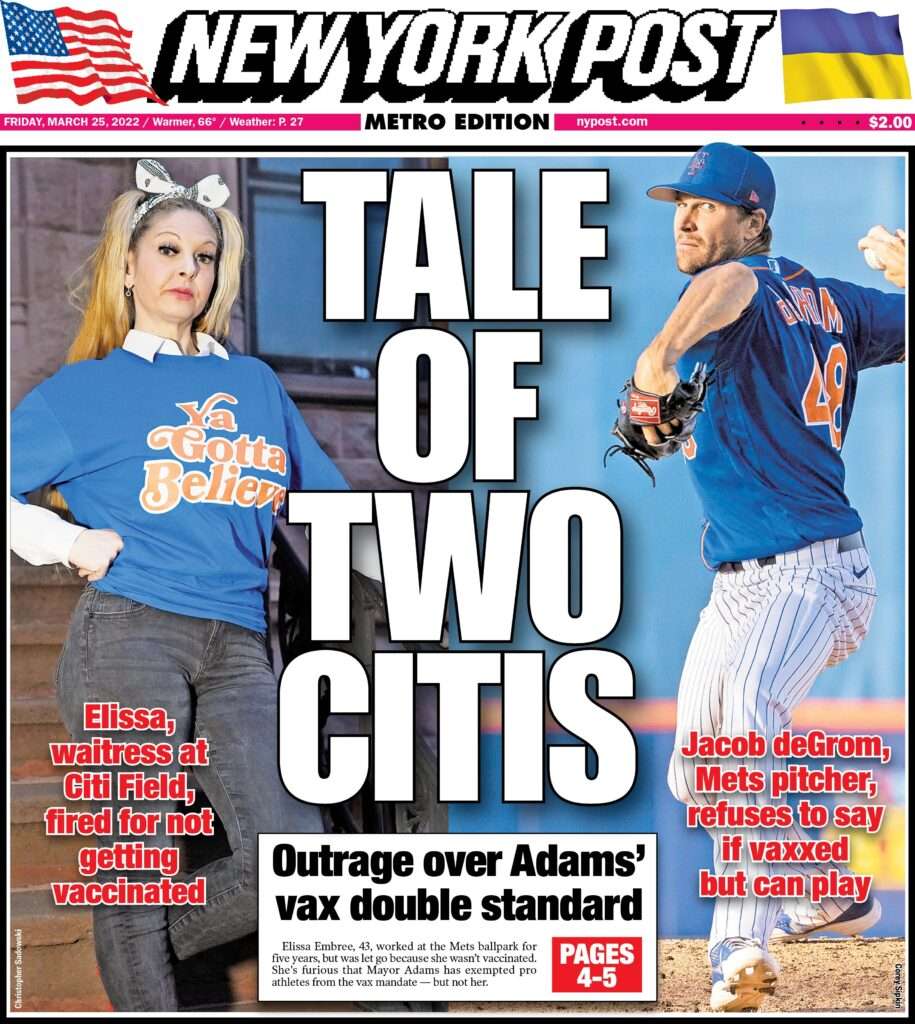
Just in time for opening day of baseball, New York City has exempted athletes from its citywide vaccine mandate. Now Kyrie Irving and other unvax'd athletes can play in professional sports. Meanwhile, all other employees in the stadiums are subject to the requirement. The New York Post captured the scene with the headline, "Tale of Two Citis."
New York City Mayor Eric Adams was quite candid why he created an exemption for rich athletes, but not other people, including those with sincerely held religious beliefs:
"A small number of people have an outsized impact on our economy."
Yes, he said the quiet part out loud. From the earliest days, of the pandemic. COVID policy was always dictated first by the policy preferences of those in power, and second by #science. The Governor of Pennsylvania deemed the Peeps marshmallow factory to be an "Essential" business, but gun stores were not. Governor Cuomo allowed 7,000 fans to watch a Buffalo Bills game, even as people were barred from assembling for religious gatherings. And now, the Mayor created a Kyrie carveout to help wealthy athletes. Oh, and the Yankees, Mets. and Yankees have been lobbying the Mayor to change the policy.
But privately, efforts were already underway by the owners and executives of some of the wealthiest and most influential sports franchises in the country to persuade Mr. Adams to change his mind.
The Yankees president, Randy Levine, personally reached out to the mayor's team and encouraged officials to consider that baseball is played outdoors where Covid transmission rates are lower than indoors.
Steven A. Cohen, the hedge fund manager and Mets owner who last year gave $1.5 million to a super PAC supporting Mr. Adams's mayoral campaign, has been paying $10,000 a month to a lobbying firm, Moonshot Strategies, to push state officials and City Hall on several issues, including Covid protocols.
Both baseball teams are believed to have players who remain unvaccinated, with opening day now two weeks away.
Corey Johnson, the former speaker of the City Council who now runs his own lobbying firm, is receiving $18,000 a month from the Nets's holding company, and lobbying records suggest that he recently contacted the mayor, his chief counsel and his chief of staff.
Yet, more than 1,500 city employees were fired for not being vaccinated. They probably were not able to afford such an expensive lobby effort. Rent seeking is tough.
In light of Fulton, these exemptions for athletes undermine the state's compelling interest to mandate vaccines. But don't worry. The mayor checked with his lawyers:
Dr. Jay Varma, an epidemiologist and health adviser to Mr. de Blasio, wrote on Twitter on Wednesday evening that vaccines work "unless you're rich and powerful, in which case lobbying works."
Dr. Varma called the new policy the "Kyrie Carve Out" and said he was concerned that the legal standing of the city's vaccine mandates could now be challenged in court as "arbitrary and capricious."
Mr. Adams rebutted that criticism on Thursday: "I would not be standing here today if I did not speak to the attorneys, and they said that this passes legal muster."
Sooner or later, a case will come to the courts that is not on an emergency basis. For example, an employee who lost his pension due to the termination will sue for damages. And in light of Fulton, and the Kyrie Carveout, the employees should prevail.
Today's decision in Judge Chad Kenney (E.D. Pa.) in Greenberg v. Goodrich holds unconstitutional the revised Pennsylvania Rule of Professional Conduct 8.4(g):
It is professional misconduct for a lawyer to: … in the practice of law, knowingly engage in conduct constituting harassment or discrimination based upon race, sex, gender identity or expression, religion, national origin, ethnicity, disability, age, sexual orientation, marital status, or socioeconomic status. This paragraph does not limit the ability of a lawyer to accept, decline or withdraw from a representation in accordance with Rule 1.16. This paragraph does not preclude advice or advocacy consistent with these Rules….
[Comment 3] For the purposes of paragraph (g), conduct in the practice of law includes (1) interacting with witnesses, coworkers, court personnel, lawyers, or others, while appearing in proceedings before a tribunal or in connection with the representation of a client; (2) operating or managing a law firm or law practice; or (3) participation in judicial boards, conferences, or committees; continuing legal education seminars; bench bar conferences; and bar association activities where legal education credits are offered. The term "the practice of law" does not include speeches, communications, debates, presentations, or publications given or published outside the contexts described in (1)- (3).
[Comment 4] "Harassment" means conduct that is intended to intimidate, denigrate or show hostility or aversion toward a person on any of the bases listed in paragraph (g). "Harassment" includes sexual harassment, which includes but is not limited to sexual advances, requests for sexual favors, and other conduct of a sexual nature that is unwelcome.
[Comment 5] "Discrimination" means conduct that a lawyer knows manifests an intention: to treat a person as inferior based on one or more of the characteristics listed in paragraph (g); to disregard relevant considerations of individual characteristics or merit because of one or more of the listed characteristics; or to cause or attempt to cause interference with the fair administration of justice based on one or more of the listed characteristics.
The court finds that the Rule violates the First Amendment; here are some excerpts, though there is much more going on in the opinion as well (it's 78 pages long):
[Speech vs. conduct:] The first point of contention between the parties is whether the Amendments regulate speech, as Plaintiff asserts, or conduct and potentially incidentally burden speech, as Defendants claim. The Court finds that the Amendments regulate speech, not merely conduct, and therefore the burden placed on freedom of expression is not incidental to the enforcement of Rule 8.4(g). Unfortunately for Defendants, "[t]he government cannot regulate speech by relabeling it as conduct." Otto v. City of Boca Raton (11th Cir. 2020). Furthermore, "a State may not, under the guise of prohibiting professional misconduct, ignore constitutional rights." NAACP v. Button (1963)….
In many areas of constitutional law, the Court allows a constitutional right to be overcome when a restriction passes "strict scrutiny"—i.e. (to oversimplify slightly), when the government can show that restricting the right is the "least restrictive means" of serving a "compelling government interest."
In some fields, such as free speech or race classifications, the inquiry is "strict in theory but [almost] fatal in fact": Very few restrictions pass the test. But in other areas, such as religious exemptions governed by RFRAs or RLUIPA (statutes that borrow the strict scrutiny test from constitutional law), a lot of restrictions must pass—no Justice thinks, for instance, that people should get religious exemptions from laws banning homicide or theft or vandalism or trespass, or for that matter from most tax laws and other important regulatory regimes. At the same time, a lot of others should fail. The details of how strict scrutiny plays out end up being quite important, but while the Court has a lot of precedents applying strict scrutiny, many of the key questions (such as how one can tell whether an interest is "compelling") remain unresolved.
[T]he Court's holding implicates significant issues about how the Court decides whether a State's asserted interest is sufficiently "compelling" and how the Court assesses whether less restrictive means could satisfy that compelling interest. This case illustrates both the difficulty of those inquiries and the important role that history and state practice often play in the analysis.
The eviction moratorium and Title 42 "public health" expulsion cases have many parallels that may have been ignored because of their differing ideological valence. Both strengthen the case for nondeferential judicial review of the exercise of emergency powers.
My forthcoming article "Nondelegation Limits on COVID Emergency Powers: Lessons from the Eviction Moratorium and Title 42 Cases," is now available on SSRN. Here is the abstract:
Two legal battles over Covid pandemic emergency measures highlight the dangers of excessive delegation of emergency power to executive branch agencies: the recently concluded litigation over the Centers for Disease Control nationwide eviction moratorium, and the still-ongoing legal battle over that same agency's Title 42 "public health" expulsions of immigrants. While superficially different, the two legal battles actually raise very similar issues. Both involve exercises of power by the exact same federal agency, utilizing authority it claims was delegated to it under consecutive provisions of the Public Health Service Act of 1944. Both measures were first adopted under the Trump Administration, and later continued—with some modifications—under the Biden Administration. The bipartisan nature of the policies suggests that the problems they raise are not limited to one party, nor to one side of the political spectrum.
Both policies were open to serious challenge under the constitutional nondelegation doctrine, and under the related "major question" doctrine. These vulnerabilities eventually led to the judicial invalidation of the eviction moratorium, and may have contributed to the DC Circuit's partial invalidation of the Title 42 expulsions. Finally, it is notable that both policies caused great harm, while doing little to stop the spread of the disease; both were enacted by the executive despite skepticism from public health experts.
Part I of this article provides an overview of the eviction moratorium and Title 42 policies, and the resulting litigation. In Part II, I explain why both policies violate the constitutional nondelegation principles. Part III shows how, for very similar reasons, both also run afoul of the major question doctrine. Finally, Part IV outlines some lessons that can be gleaned from these cases. Among other things, they strengthen the case for nondeferential judicial review of emergency powers and delegations to supposedly expert executive agencies. They also highlight the need for greater cross-ideological cooperation and dialogue on these issues. Nondelegation and major question limits on emergency powers will be on firmer ground if they enjoy cross-ideological support and cannot be stigmatized as mere partisan tools of one side of the political spectrum.
The article is part of an NYU Journal of Law and Liberty Symposium on "Responding to Emergency: A Blueprint for Liberty in A Time of Crisis" (co-sponsored by the Pacific Legal Foundation). Prof. Steve Vladeck (University of Texas) has posted his own contribution to the same symposium, which critically assesses the Supreme Court's treatment of religious-liberty challenges to Covid-era public health restrictions.
NOTE: I previously authored an amicus brief in the Title 42 case, on behalf of the Cato Institute. The plaintiffs in some of the lawsuits against the eviction moratorium (though not the one the Supreme Court ruled on in August) are represented by the Pacific Legal Foundation, where my wife works (though she herself did not work on these cases). I myself played a minor (unpaid) role in advising PLF on this litigation. For the record, my wife did not play any part in PLF's decision to invite me to participate in this symposium.
From Alaska bill SB 214, sponsored by state senators Lora Reinbold and Mia Costello:
[B]ullying and harassing behavior are prohibited on social media platforms. A social media platform shall take steps to prevent bullying and harassing behavior and shall provide a platform user who hosts a page a mechanism to establish and enforce rules of decorum to prevent bullying and harassing behavior on the platform user's page.
Note that simply requiring platforms to give users who host pages a tool to delete others' comments on those pages, or to block users from posting further comments, might be viewed as a constitutional content-neutral requirement (though it's not open and shut). But the bill would also outright forbid "bullying and harassing behavior," whatever that means, and would also require platforms to take unspecified "steps" to prevent it.
That's what Alaska bill SB 214, sponsored by state senators Lora Reinbold and Mia Costello would do in part.
I think some restrictions on platforms' deleting posts might be constitutional (see my Social Media Platforms as Common Carriers?article, or these posts excerpted from that article): To quote Justice Breyer (from a dissenting opinion, but on a point which with the majority didn't disagree with, and which other majority opinions endorsed),
Requiring someone to host another person's speech is often a perfectly legitimate thing for the Government to do.
But banning fact checking doesn't just require platforms to host speech on their property—it expressly bars them from engaging in their own speech, since "fact checking" simply means "speech that expresses the platform's view, or the view of someone selected by the platform, about whether some statement is accurate." That violates the platforms' First Amendment rights.
But bureaucratic obstacles and other constraints might reduce the effectiveness of these policies. More needs to be done to open the door to Ukrainian refugees, and also to Russians fleeing Vladimir Putin's increasingly oppressive regime.
Russia's brutal invasion of Ukraine has created what may be the biggest refugee crisis since World War II. Over 3.5 million Ukrainians have fled the country, and that number is likely to continue to increase. Earlier today, the Biden Administration announced that it will accept some 100,000 Ukrainian refugees:
The Biden administration will announce plans to welcome 100,000 Ukrainian refugees and others affected by the Russian war on Ukraine, the Biden administration announced Thursday.
Not all will be admitted through the refugee program or during this fiscal year. A full range of pathways will be utilized, including humanitarian parole and immigrant or nonimmigrant visas.
But, with these kinds of policies, the devil is often in the details. At this point, it is not yet clear exactly how the administration plans to admit the 100,000 Ukrainians. But it is not a good sign that reports indicate many will be funneled through the ordinary refugee system, and will not be allowed to enter during the current fiscal year. Conventional refugee admissions are so backed up in bureaucratic sludge that the US had a record-low of just 11,145 such entrants during the 2021 fiscal year, despite Biden's increasing the refugee cap for the year to 62,500, above the very low level of 15,000 set by Trump. Biden should instead grant parole to arriving Ukrainians, which would enable them to enter into the US much faster. In addition, he should eliminate the 100,000 cap.
A statement issued by the White House indicates they will use "the full range of legal pathways, including the U.S. Refugee Admissions Program." But it's not clear, at this point, what that means.
A second limitation of the Canadian policy is that it requires applicants outside of Canada to submit "biometrics" (fingerprints). This might not seem like a big deal. But finding a properly certified fingerprinting facility while fleeing a war zone is likely to be difficult or impossible for many refugees. If Canadian authorities really believe the fingerprints are essential, why not collect them after the refugees arrive in Canada?
Obviously, most Ukrainian refugees are likely to stay in European countries closer to Ukraine. But the US and Canada have large Ukrainian diasporas and more open labor markets than most European countries there. As a result, these two countries may be better able to absorb refugees. And, as I describe in my NY Times article, Ukrainian (and Russian) immigrants could make major contributions to our economies, if only we give them the chance to do so.
Despite their limitations, The newly announced US and Canadian policies are steps in the right direction. But much more needs to be done. Among other things, we should also open our doors to the rapidly growing number of Russians fleeing Putin's increasingly repressive regime (see also here). Like with Ukrainian refugees, there is a strong case for accepting Russian migrants on a combination of moral, economic, and strategic grounds.
What of the argument that it's wrong to open our doors to Russians and Ukrainians, but not to refugees fleeing from war and oppression elsewhere? This point has some validity. I addressed it here:
Critics may worry that it would be unjust to open doors to Russians and Ukrainians but not to those fleeing other oppressive regimes. Several of the European nations now welcoming Ukrainians have been far more hostile to refugees from Africa and the Middle East. I have long advocated welcoming all fleeing oppression, regardless of their race, ethnicity or country of origin, including Syrian refugees and those fleeing China's cruel regime.
But the right way to achieve equity in this sphere is not by barring Russians and Ukrainians but by expanding migration rights for others. In the meantime, the best should not be the enemy of the good. We should seize this opportunity to simultaneously aid large numbers of victims of war and oppression and secure valuable strategic and economic advantages.
UPDATE: Reason's Fiona Harrigan makes some related points about the new US policy on Ukrainian refugees here.
High-profile sharp splits in religious exemption cases (such as Hobby Lobby or Fulton v. City of Philadelphia), whether as to the result (in Hobby Lobby) or the reasoning (in Fulton), can make people think that religious exemption claims always so divide the Supreme Court. That's not so, as the unanimous decisions in Gonzales v. O Centro Espírita Beneficente União do Vegetal (2006) (win for religious exemption from the federal drug law banning hoasca, a hallucinogen) and Holt v. Hobbs (2015) (win for Muslim inmate seeking exemption from a prison no-beards policy).
Today's 8-1 decision in Ramirez v. Collier, which held that a condemned murderer was entitled to have his Baptist pastor in the execution chamber to audibly pray and to lay hands on him during the execution, shows that the Court can still be nearly unanimous, not just as to the result but also as to the rationale, in religious exemption cases. (The case was litigated under RLUIPA, the Religious Land Use and Institutionalized Persons Act, which generally provides for religious accommodations from, among other things, prison rules, unless the government can show that denying the accommodation is necessary to serve a compelling government interest.) Some excerpts:
To begin, we think Ramirez is likely to succeed in proving [for purposes of getting a preliminary injunction] that his religious requests are "sincerely based on a religious belief." Ramirez seeks to have his pastor lay hands on him and pray over him during the execution. Both are traditional forms of religious exercise. As Ramirez's grievance states, "it is part of my faith to have my spiritual advisor lay hands on me anytime I am sick or dying." Pastor Moore, who has ministered to Ramirez for four years, agrees that prayer accompanied by touch is "a significant part of our faith tradition as Baptists." And neither the District Court nor the Court of Appeals doubted that Ramirez had a sincere religious basis for his requested accommodations.
Prof. Howard Wasserman (Florida International University) had this post Monday at Prawfsblawg, as a follow-up on the SB8 debates, and kindly agreed to let me post it:
Those insisting that SB8 is unprecedented and those warning of every new law "modeled" on SB8 ignore that we have been leaving in a similar world for some time. Two Ninth Circuit cases show the prevalence of such laws and the broaderimplications of the surrounding procedural arguments.
California law requires businesses to post signs when their produces contain certain carcinogens. "Any person in the public interest" may bring suit against a business that fails to post signs; the penalty is $ 2500 per violation per day, with "any person" keeping 25% plus attorney's fees. Like California's former false-advertising laws, private enforcement is not exclusive and the AG and other public officials can initiate enforcement actions.