The Volokh Conspiracy

Mostly law professors | Sometimes contrarian | Often libertarian | Always independent | Est. 2002

The Volokh Conspiracy

Free Speech

Crime to Speak in Favor of One Side in a War -- in Which Your Country Isn't Even Fighting?

|

NPR (Rachel Treisman) reports:

Two German states have outlawed public displays of the letter "Z," which has become synonymous with support for Russia's war in Ukraine.

Authorities in Bavaria and Lower Saxony said over the weekend that anyone who displays the symbol at public demonstrations or paints it on cars or buildings could face a fine or up to three years in jail, the English-language site The Local reports. And an Interior Ministry spokesperson told reporters on Monday that people throughout Germany who display the letter to endorse Russia's aggression could be liable to prosecution.

Read More

Threepeat for transatlantic privacy

Episode 400 of the Cyberlaw Podcast

|

With the U.S. and Europe united in opposing Russia's attack on Ukraine, a few tough transatlantic disputes are being swept away – or at least under the rug.  Most prominently, the data protection crisis touched off by the Court of Justice of the EU in Schrems 2 has been resolved in principle by a new framework agreement between the U.S. and the EU.  Michael Ellis and Paul Rosenzweig trade insights on the deal and its prospects before the CJEU. The most controversial aspect of the agreement is the lack of any change in U.S. legislation. That solution is the result of simple vote-counting if you're from Washington, but the CJEU clearly expected that it was dictating legislation for the U.S. Congress to adopt, so Europe's acquiescence in a no-legislation solution may simply kick the can down the road until the next CJEU ruling. The lack of legislation will be felt in particular, Michael and Paul aver, when it comes to providing remedies to European citizens who feel their rights have been trampled.  Instead of going to court, they'll be going to an administrative body with executive branch guarantees of independence and impartiality. Well, it's worth a try. We congratulate several old friends of the podcast who patched this solution together.

The Russian invasion of Ukraine, meanwhile, continues to throw off new tech stories. Nick Weaver updates us on the single most likely example of Russia using its cyber weapons effectively for military purposes – the bricking of Ukraine's (and a bunch of other European) Viasat terminals. Alex Stamos and I consider whether the social media companies recently evicted from Russia, especially Instagram, should be induced or required to provide information about their former subscribers' interests to allow microtargeting of news that might break through Putin's information management barriers; along the way we examine why it is that tech's response to Chinese aggression has been so less vigorous. Speaking of microtargeting, Paul gives kudos to the FBI for its microtargeted "talk to us" Russian language ads, only visible within 100 yards of the Russian embassy in Washington. Finally, Nick Weaver and  Mike mull the significance of Israel's determination not to sell sophisticated cell phone surveillance malware to Ukraine.

Returning to Europe-U.S. tension, Alex and I unpack the European Digital Markets Act, which regulates a handful of U.S. companies as "digital gatekeepers." I think it's a plausible response to network-effect monopolization, but ruined by anti-Americanism and the persistent illusion that the EU can regulate its way to a viable tech industry. Alex has a similar take, noting that the adoption of end-to-end encryption was a big privacy victory, thanks to WhatsApp, an achievement that the Digital Markets Act may undo in its attempt to force standardized interoperable messaging on gatekeepers.

Nick walks us through the surprising achievements of the gang of juvenile delinquents known as Lapsus$. Their breach of Okta offers an occasion for speculation about how lawyers skew cyber incident response in directions that turn out to be very bad for the breach victim. Alex vividly captures the lawyerly dynamics that hamper effective response.  While we're talking ransomware, Michael cites to a detailed report on corporate responses to REvil breaches, authored by the minority staff of the Senate Homeland security committee. Neither the FBI nor CISA comes out of it looking good.  But the bureau earns more criticism, which may explain why no one paid much attention when the FBI demanded changes to the cyber incident reporting bill.

Finally, Nick and Michael debate whether dream pop musician (and Elon Musk sweetheart) Grimes could be prosecuted for computer crimes after confessing to having DDOSed an online publication for an embarrassing photo of her. Just to be on the safe side, we conclude, maybe she shouldn't go back to Canada. And Paul and I praise a brilliant WIRED op-ed proposing that Putin's Soviet empire nostalgia deserves a wakeup call; according to the authors (Rosenzweig and Baker, as it happens), least ICANN should kill off the Soviet Union's out-of-date .su country code.

And many thanks to the loyal listeners who turned up on line today to watch us record this episode live and with video. It was fun, and we'll do it again some time soon.

 Download the 400th Episode (mp3)

You can subscribe to The Cyberlaw Podcast using iTunes, Google Play, Spotify, Pocket Casts, or our RSS feed. As always, The Cyberlaw Podcast is open to feedback. Be sure to engage with @stewartbaker on Twitter. Send your questions, comments, and suggestions for topics or interviewees to CyberlawPodcast@steptoe.com. Remember: If your suggested guest appears on the show, we will send you a highly coveted Cyberlaw Podcast mug!

The views expressed in this podcast are those of the speakers and do not reflect the opinions of their institutions, clients, friends, families, or pets.

Free Speech

Epidemiologist's Criticism of "Daysy" Fertility Tracker are Constitutionally Protected

|

From today's Second Circuit opinion in Valley Electronics AG v. Polis, decided by Judges Jose Cabranes, Reena Raggi, and Susan Carney:

Valley Electronics AG [and related companies] … allege[] that Polis, a reproductive health epidemiologist, made defamatory statements regarding the marketing of Valley's product Daysy, which is designed to "identify the fertile and infertile phases of the menstrual cycle" using basal body temperature. The allegedly defamatory statements appear on Polis's blog on her personal website, in a BuzzFeed article quoting her, and in comments she wrote in response to others' Instagram posts.

The statements generally fall into two categories. In her "Science Statements," Polis allegedly misrepresented the soundness of the studies supporting Daysy's efficacy and disparaged Daysy's advertising in reliance on those studies. {See Compl. ¶¶ 18 (Daysy is marketed "without solid evidence"), 19 ("Daysy misrepresented their evidence-base"; Valley provides "[n]o reliable estimate" of Daysy's efficacy; and a retracted favorable study is "junk science"), 21 ("[N]o scientific publications demonstrat[e] how accurately Daysy [tells users when they are fertile]"), 23 (promoting Daysy "put[s] people in harms [sic] way").}

In her "Ethics Statements," Polis allegedly inaccurately impugned Valley's integrity. {See Compl. ¶¶ 18 (Valley is not "interested in providing accurate information to its potential consumer base"), 19 (Valley "made many other outrageous claims[;] … far too many to list"; "has no shame or integrity"; and "recklessly rejected" the retraction of a study), 21 (Valley is "particularly unethical").} …

Context suggests that Polis's statements were opinions [and thus not actionable libel].

Read More

Free Speech

Colorado Supreme Court Strikes Down Electronic Harassment Ban

|

From People v. Moreno, decided today by the Colorado Supreme Court, in a unanimous opinion written by Justice William W. Hood, III:

As relevant here, section 18-9-111(1)(e) states that

[a] person commits harassment if, with intent to harass, annoy, or alarm another person, he or she … [d]irectly or indirectly initiates communication with a person or directs language toward another person, anonymously or otherwise, by telephone, telephone network, data network, text message, instant message, computer, computer network, computer system, or other interactive electronic medium in a manner intended to harass or threaten bodily injury or property damage, or makes any comment, request, suggestion, or proposal by telephone, computer, computer network, computer system, or other interactive electronic medium that is obscene….

Merriam-Webster defines the verb "harass" as to: "exhaust, fatigue"; "to annoy persistently"; and "to create an unpleasant or hostile situation for[,] especially by uninvited and unwelcome verbal … conduct." The definition of "harassment" in Black's Law Dictionary means "[w]ords, conduct, or action (usu. repeated or persistent) that, being directed at a specific person, annoys, alarms, or causes substantial emotional distress to that person and serves no legitimate purpose; purposeful vexation." … [T]his broad meaning of the term "harass" covers protected speech….

Read More

Guns

Does Ban on Carrying Weapons "Inside Any Building in Which Judicial Proceedings Are in Progress" …

apply to a judge's home when the judge is participating in judicial proceedings remotely?

|

Nope, says the Tennessee Attorney General in a Mar. 14 opinion (No. 22-04) that was just posted on Westlaw:

The prohibition in Tenn. Code Ann. § 39-17-1306 against carrying weapons in buildings in which judicial proceedings are in progress may be reasonably construed to apply only to those buildings in which a judge customarily conducts judicial proceedings, such as courthouses and criminal justice facilities. It does not appear that the General Assembly intended Tenn. Code Ann. § 39-17-1306 to apply to buildings from which a judge conducts a judicial proceeding remotely by conference call or videoconference, such as the judge's private residence or another similar building {[or] to other buildings such as private residences, business offices or other similar buildings from which non-judicial participants—e.g., attorneys or witnesses—might participate in judicial proceedings by conference call or videoconference.} …

Read More

Free Speech

From Yale Law's Dean on the March 10 Protest

"This is an institution of higher learning, not a town square, and no one should interfere with others' efforts to carry on activities on campus. YLS is a professional school, and this is not how lawyers interact."

|

Posted today (as usual with various quotes on this blog, I've added some paragraph breaks):

As we return from spring recess, I write to reflect on the protest that occurred earlier this month at the Law School. Shortly before break, a group of students protested the Federalist Society's decision to bring a speaker from Alliance Defending Freedom to campus because of the organization's position on LGBTQ rights, including same-sex marriage and the treatment of transgender people.

Under the University's free expression policy, student groups have every right to invite speakers to campus, and others have every right to voice opposition. Our commitment to free speech is clear and unwavering. Because unfettered debate is essential to our mission, we allow people to speak even when their speech is flatly inconsistent with our core values.

In accordance with the University's free expression policy, which includes a three-warning protocol, those protesting exited the room after the first warning, and the event went forward. Had the protestors shut down the event, our course of action would have been straightforward—the offending students without question would have been subject to discipline. Although the students complied with University policies inside the event, several students engaged in rude and insulting behavior as the event began; a number made excessive noise in our hallways that interfered with several events taking place; and some refused to listen to our staff.

This behavior was unacceptable; at a minimum it violated the norms of this Law School. This is an institution of higher learning, not a town square, and no one should interfere with others' efforts to carry on activities on campus. YLS is a professional school, and this is not how lawyers interact. We are also a community that respects our faculty and staff who have devoted their lives to helping students. Professor Kate Stith, Dean Mike Thompson, and other members of the staff should not have been treated as they were.

Read More

Assassination as a Tool of Foreign Policy

|

In light of some recent discussions, I thought I'd repost some tentative thoughts on the subject (based on a 2005 post of mine), and see what the rest of you think.

1. Morality: Government-sponsored assassination is essentially an act of war; it's an attempt to affect another nation's government policy by military force. Nonetheless, if an invasion is morally justified, it seems to me that an assassination is if anything more so. It would be an odd morality that allowed the killing of enemy soldiers, many of whom are personally morally innocent, but forbade the killing of their commander-in-chief—or even ostensibly civilian leaders of the enemy government—who may be morally culpable indeed.

Idi Amin was ultimately driven from power by a Tanzanian invasion (which was prompted by a Ugandan invasion of Tanzania, but would have been eminently justified even without that). If the Tanzanians or others could have stopped Amin's murders by assassinating Amin, and without killing any Ugandan soldiers, that would have been even better.

The same goes for many other tyrants, though naturally not for every leader you dislike: Just as invasions are unjustified in most certain circumstances, so are assassinations (especially of democratic leaders, where the people's self-government as well as the leader's right to live are implicated). My point is simply that assassinations are no morally worse than other acts of war, and likely morally better than many such acts.

(I set aside for purposes of this post questions about whether and when such assassinations violate either domestic law or international law; the "morality" inquiry is about whether they're inherently wrong, not just about whether they violate the legal rules, since presumably we can change any executive orders or statutes, or withdraw from any treaties, that we think are too constraining. For an item on one corner of the legal question, see here.)

Note that I use the term "assassinate" because I don't want to sugarcoat what would be happening—the deliberate killing of a particular person. But if you think that "assassinate" inherently carries a connotation of improper deliberate killing (or has a particular legal meaning that excludes legitimate killing), just mentally replace the use of "assassinate" throughout this post with "targeted killing."

2. Practicality: The chief problems with assassination, it seems to me, are practical ones.

Read More

Supreme Court

SCOTUS Agrees to Hear Significant Dormant Commerce Clause Case

National Pork Producers Council v. Ross could have implications far beyond bacon prices in California.

|

Today the Supreme Court granted certiorari in three cases. One of the cases, National Pork Producers Council v. Ross, concerns the extent to which the Dormant Commerce Clause limits state regulations that have alleged extraterritorial effects. As a consequence, this case could have implications far beyond the specific regulations concerning the sale of pork products in California.

NPPC v. Ross involves a challenge to California's Proposition 12, which bans the sale of animal products from animals that were raised in conditions contrary to the proposition's standards for animal confinement. Because many animal products sold in California are produced in other states, the petitioners claim that this proposition violates the Dormant Commerce Clause.

Proposition 12, the petitioners charge, is prohibiting the sale of products not due to any characteristic of the products themselves, but rather based upon the conduct of the producers in other jurisdictions. As the petitioners see it, this imposes excessive burdens on interstate commerce and amounts to unconstitutional "extraterritorial" regulation, as it represents an effort by California to impose its policy preferences on how farm animals are treated in other jurisdictions. There would be no issue were the California law to merely specify how farm animals are treated within the state, but because the costs of complying with California's standards would only be borne by in-state producers, they might be placed at a competitive disadvantage.

This case could have far-reaching implications, and not merely for agricultural law. State energy and climate regulations have also been subject to Dormant Commerce Clause challenge. If the Supreme Court were to conclude Proposition 12 is unconstitutional, it may also cast doubt on state laws that regulate fuel sources based upon their life-cycle carbon emissions, for example.

This case is also interesting because it is unclear where the current justices are on Dormant Commerce Clause questions. Business groups and some conservatives like the doctrine, as it clears away regulatory obstructions to interstate commerce, which was part of the purpose of replacing the Articles of Confederation with the Constitution in the first place. Others, however, believe the doctrine is an atextual judicial invention, and believe it should be applied sparingly, if at all. Justices Thomas and Gorsuch are almost certainly in this latter camp, but the other conservative justices might not be. This case may also give us an early glimpse of how Justice Ketanji Brown Jackson approaches federalism and structural constitutional questions.

Were that not enough, one must remember the case concerns bacon -- and everything is better with bacon.

"Fear in My Heart and Gunfire All Around": The Song of the Ukrainian Tank Soldiers

|

I came across this one a few days ago, though it was originally posted on Feb. 27, in the first days of the war; many thanks to Iryna Onyshchenko for the translation (here are the Ukrainian lyrics, and also what appears to be the original Facebook post with the video). As you can see, the production values are minimal, but I think that here that makes the song more effective. I think the reference to "fear" rather than fearlessness makes it more effective, too.

Note also that the introduction and closing are in Russian; for many patriotic Ukrainians, Russian is their native language, and much of the resistance to Russia has been carried on in Russian. I'm still trying to learn the name of the author, who is apparently also the one singing the song, and a tank soldier in Kharkiv; if I learn it, I'll post it.

[Introduction, in Russian:] [Inaudible.] Well, we found a guitar here, and so you don't get upset, here's a song from the Ukrainian tank soldiers.

[In Ukrainian:]
The dark nights are disturbed by flashes of light,
Fear in my heart and gunfire all around,
We must move forward, entering the battle,
Ukraine, we are your defenders.

Read More

Free Speech

No Qualified Immunity as to Firing of Assistant Principal for Rant About Democratic National Convention

|

From Thompson v. Central Valley School Dist. No. 365, decided a month ago by Chief Judge Stanley Bastian (E.D. Wash.) (now on appeal to the Ninth Circuit):

"[W]e … live in a time when a careless comment can ruin reputations and crater careers that have been built over a lifetime because of the demand for swift justice, especially on social media. For private employers, it is their prerogative to take action against an intemperate tweet or a foolish Facebook comment. But when the government is the employer, it must abide by the First Amendment." Moser v. Las Vegas Metro Police Dep't (9th Cir. 2021).

[From 1991 to] August 2020, Plaintiff was an assistant principal at Evergreen Middle School …. After watching the 2020 Democratic National Convention, Plaintiff posted his thoughts about the convention on Facebook.

There is some controversy about the text of the post; I include what the defendant claims he posted (which is what's relevant at this procedural stage of the case), but add in brackets some extra material or different material that plaintiff reports:

Demtard convention opens and the only facts spoken were the names. Lie after lie. The fact checkers could retire on Michelle Obama's rant alone. [What s hatefull racists bitch.] If you need to lie to try and win you are just shit. If you believe them you are even worse. Wake the f@#k [fuck] up America. You are being played by a fake media, athlete [athleats] and performers (who are really clueless and flyers with pedophile man) and the former DNC, now just the little puppet [bitch] of Marxist BLM, Antifa, and Soroas socialist. You are missing out on a great country and the rest of us are sick and tired of your act and going to take you to the woodshed for a proper education. May God help you to pull your heads out of your asses [so we will not have to]. Time for the red tide. Lets see how long until the FB liberal defenders take this one down.

Back to the opinion:

Read More

NYC's Private Anti-Idling Law Enforcers

A city program pays bounties to private citizens who report vehicles for excessive idling.

|

An increasing number of state and local jurisdictions place limits on how long trucks may sit idle with the engine running. Unnecessary truck idling is a significant contributor to local air pollution and results in additional greenhouse gas emissions to boot.

In New York City, private bounty hunters contribute to the anti-idling law's enforcement. As chronicled the New York Times, local citizens participate in the Citizens Air Complaint Program, submitting reports on trucks that idle longer then three minutes and collecting a portion of fines collected as bounties. As the Times reports:

Those who report collect 25 percent of any fine against a truck by submitting a video just over 3 minutes in length that shows the engine is running and the name of the company on the door.

The program has vastly increased the number of complaints of idling trucks sent to the city, from just a handful before its creation in 2018 to more than 12,000 last year. . . .

The bounty system appears to have been effective at enlisting local citizens to help enforce the law, but it has also led to conflict, as truck operators do not like being reported.

The program and the increased interest in filing complaints have brought a new game of cat and mouse to the city's streets, as citizen reporters prowl in search of idling trucks and drivers, perhaps stung by past fines, are increasingly wary of people with cameras. . . .

Despite efforts to evade citizen enforcers, the program brings in fines, and pays out significant bounties.

The city paid more than $724,000 in bounties last year alone, and $1.1 million since 2019. For its share, the city collected $2.4 million in fines last year, up 24 percent from when the program began in earnest three years ago.

Russia

The Case for Opening Our Doors to Russians Fleeing Putin - as Well as Ukrainians

Washington Post columnist Catherine Rampell explains how it can benefit the US economy while "draining Putin's brain."

|

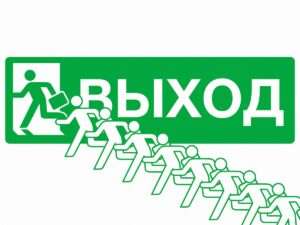
The Russian-language sign in this image says "exit."

Much attention has been paid to the massive Ukrainian refugee crisis caused by Vladimir Putin's attack on that country. Many commentators, myself included, have advocated that Western nations do more to take in Ukrainian refugees. In recent weeks, the US, Canada, and other countries have in fact opened their doors to Ukrainians more than before, though much more can and should be done.

But the US and its allies have done little to open the door to the growing number of Russians fleeing Vladimir Putin's increasingly repressive regime. In a recent column, Catherine Rampell of the Washington Post makes the case for doing so:

The United States, coordinating with Western allies, has deployed many economic weapons against Russia…. But we haven't, to date, gone after the country's most precious resource: its people.

I don't mean attacking the Russian people. I mean welcoming them here, particularly if they have significant economic and national security value to Russia….

We should start by expediting the most compelling humanitarian cases in the region. In Russia, these include dissidents and journalists risking their necks to challenge Vladimir Putin's unprovoked war. But we should also actively court those who might be less political: the technical, creative, high-skilled workers upon whom Russia's economic (and military) fortunes depend…

Already, Russian talent is rushing for the exits, in what might represent the seventh great wave of Russian emigration over the past century.

An estimated 50,000 to 70,000 IT specialists alone have recently left, according to a Russian technology trade group, which predicts another 100,000 might leave by the end of April. Others in the outbound stampede include entrepreneurs, researchers and artists. The pace of this brain drain is especially impressive given how difficult sanctions have made it to buy plane tickets or otherwise conduct transactions across borders, as well as how expensive travel has become….

Russian self-exiles are mostly flooding into nearby countries such as Turkey, Armenia and Georgia, but we could smooth their pathway to the United States. Congress already has one blueprint: In early February, the House passed the America Competes Act, which would, among other things, increase immigration of entrepreneurs and PhD scientists from around the world (not just Russia). Alternatively, Congress could tailor a measure toward Russian STEM talent, or the Biden administration could make Russians more broadly eligible for refugee status….

Scaling up immigration and refugee admissions is both the right thing to do and in our own interests. Refugees and other emigres have a long history of supercharging U.S. innovation, winning Nobel Prizes and contributing to our national security. These include Soviet defectors during the Cold War and a larger-scale exodus of mathematicians and scientists after the collapse of the Soviet Union. We would benefit from a comparable influx of talent today.

But the prospect of doing this while imminently draining Russia's talent pool should make the policy even more attractive.

Rampell goes on to point out that we should also allow Russian students already in the United States to stay here. At the very least, we should reject cruel and counterproductive proposals to expel them, advanced by some Democratic politicians.

She is by no means the only advocate of this approach to combating Putin's regime. Steve Chapman of the Chicago Tribune, conservative science writer Robert Zubrin in the National Review, Cato Institute immigration policy expert David Bier, and Canadian political commentator Scott Gilmore have made similar arguments. I myself did so in a March 8 New York Times article, where I also argued for taking in more Ukrainians.  Along related lines, I and others have advanced the idea of giving refuge to Russian soldiers who surrender in Ukraine (a proposal, to my knowledge, first developed by Duke University economist Timur Kuran).

I would add there is a strong moral case for giving refuge to Russians fleeing Putin, as well as a strategic one. Putin's government has become increasingly repressive - to the point of imposing a 15-year prison sentence for the crime of merely referring to the war in Ukraine as a "war" or an "invasion," rather than a "special military operation." Russians should not be forced to live under Putin's repression any more than Ukrainians, or anyone else. It is unjust to condemn people to life under tyranny, merely because of arbitrary circumstances of birth.

I hope Rampell's work and that of others will generate greater support for these ideas. Perhaps even enough that policymakers will begin to take serious notice.

Justice Kavanaugh Is Not Going To Lay A Hand On Employment Division v. Smith

Kavanuagh's concerns about the "compelling interest" test in RLUIPA do not bode well from him restoring that test to Free Exercise Clause jurisprudence.

|

On Thursday, the Supreme Court decided Ramirez v. Collier. Ramirez, a capital defendant, was scheduled for execution. But Texas did not allow Ramirez's pastor to lay hands on him, and engage in audible prayer, during the execution. On appeal to the Supreme Court, Ramirez argued that Texas's policy violated the Religious Land Use and Institutionalized Persons Act, or RLUIPA (one of my favorite acronyms). The defendant did not preserve arguments based on the Free Exercise Clause. (The Becket Fund sought to participate in oral argument to address First Amendment arguments.)

The Supreme Court ruled for Ramirez in a lopsided 8-1 vote. Chief Justice Roberts wrote the majority opinion, and Justice Thomas wrote a solo dissent.

The Court found that Ramirez was likely to prevail on his RLUIPA claim, and instructed the district court, if appropriate, to enter a preliminary injunction: the state must allow the pastor to lay hands and engage in audible prayer during the execution, subject to certain restrictions.

We hold that Ramirez is likely to prevail on the merits of his RLUIPA claims, and that the other preliminary injunction factors justify relief. If Texas reschedules Ramirez's execution and declines to permit audible prayer or religious touch, the District Court should therefore enter appropriate preliminary relief. The judgment of the United States Court of Appeals for the Fifth Circuit is reversed, and the case is remanded for further proceedings consistent with this opinion. 

This remedy may have a Marbury problem: the Court didn't simply review the lower court judgment--the denial of a stay of execution. Both the majority and dissent agree that the stay issue was already decided. Indeed, the stay on execution was dissolved, so the execution can go forward with religious accommodations. Rather, the Court ruled on an entirely new form of relief. No lower court passed on this injunction. Was the Court exercising appellate or original jurisdiction here? The Solicitor General raised similar objections in the OSHA vaccine litigation. For all the protestations about the insidious shadow docket, we may have an actual Article III problem here. I'll have more on this topic in another post. Here, I want to talk about the merits analysis.

RLUIPA, like RFRA, was enacted in the wake of Employment Division v. Smith. Through RLUIPA, Congress instructed the Courts to review federal laws burdening the free exercise of religion with something like strict scrutiny. Chief Justice Roberts laid out the test:

RLUIPA provides that "[n]o government shall impose a substantial burden on the religious exercise of a person residing in or confined to an institution"—including state prisoners—"even if the burden results from a rule of general applicability, unless the government demonstrates that imposition of the burden on that person—(1) is in furtherance of a compelling governmental interest; and (2) is the least restrictive means of furthering that compelling governmental interest." 42 U. S. C. §2000cc–1(a).

Chief Justice Roberts largely agreed that Texas had several compelling interests:

We do not doubt that prison officials have a compelling interest in monitoring an execution and responding effectively during any potential emergency. . . .

We agree that the government has a compelling interest in preventing disruptions of any sort and maintaining solemnity and decorum in the execution chamber. . . .

They point to three governmental interests they say are compelling: security in the execution chamber, preventing unnecessary suffering, and avoiding further emotional trauma to the victim's family members. All three goals are commendable. . . .

But Texas was not able to show their policy was the "least restrictive means of furthering" these compelling interests.

Justice Kavanaugh wrote a concurrence that criticized the "compelling interest" prong of RLUIPA:

Second, the Court's holding implicates significant issues about how the Court decides whether a State's asserted interest is sufficiently "compelling" and how the Court assesses whether less restrictive means could satisfy that compelling interest. This case illustrates both the difficulty of those inquiries and the important role that history and state practice often play in the analysis. . . .

But what does "compelling" mean, and how does theCourt determine when the State's interest rises to that level? And how does the Court then determine whether less restrictive means would still satisfy that interest? Good questions, for which there are no great answers. 

Kavanaugh expressed a strong discomfort with the judiciary determining which interests are compelling:

The compelling interest standard of RLUIPA—like the compelling interest standard that the Court employs when applying strict scrutiny to examine state limitations on certain constitutional rights—necessarily operates as a balancing test. See generally B. Kavanaugh, Two Challenges for the Judge as Umpire: Statutory Ambiguity and Constitutional Exceptions, 92 Notre Dame L. Rev. 1907, 1914– 1919 (2017).

Kavanaugh's position is not new. Indeed, Kavanaugh's further self-citation points us to his 2017 Notre Dame Law Review article. Kavanaugh explains at some length that determining whether an interest is compelling is inherently a "common law" inquiry.

These verbal formulations are challenging because judges have no objective way of deciding whether an interest is "compelling" or "important" without making a judgment about the desirability of that interest. . . . What is really going on with these tests, it appears, is old-fashioned common- law judging. This may be unavoidable, as I will explain. But we should be under no illusions that this is not what's happening when those tests are being applied.

Kavanaugh expressly cited RFRA as an example of a statute that adopted the "compelling interest" test. The article goes on to discuss the compelling interest in the context of abortion, affirmative action, and the Second Amendment. On this last point, Kavanaugh refers to his D.C. Circuit Heller II decision:

The litigation in the lower courts since Heller has centered on which gun regulations are constitutional and which gun regulations are unconstitutional. 28 Not surprisingly, this has played out as a battle over whether strict scrutiny or intermediate scrutiny applies. Must the regulations serve a compelling interest or merely an important interest? As I have stated, I view much of that debate as a smokescreen that is disguising basic common-law balancing and deciding what is reasonable versus what is unreasonable, what is important versus what is not as important. And in this context in particular, I view Heller as having already told us that the content of exceptions to the Second Amendment right is not to be assessed based on strict scrutiny or intermediate scrutiny. Rather, the exceptions are to be assessed by reference to history and tradition. I wrote an opinion to that effect, although I am the first to acknowledge that most other lower-court judges have disagreed. The issue has not returned yet to the Supreme Court. To be determined.

To be determined, indeed. NYS Rifle & Pistol remains pending.

None of this should come as a surprise. Unlike the most recent Supreme Court nominee, then-Judge Kavanaugh gave extensive thought to his judicial philosophy. Kavanaugh does not like strict scrutiny, and the compelling interest test. He prefers a test based on text and history, which he considers more determinate.

Kavanaugh's prior writings may shed some light on his Fulton concurrence. Recall that Kavanaugh, along with Justice Barrett, declined to overrule Employment Division v. Smith. Barrett's concurrence raised a phalanx of apparently-unanswered questions. But we didn't hear separately from Kavanaugh. I think his Ramirez concurrence speaks directly to his concerns: if Smith is overruled, the compelling interest test would (likely) be restored to Free Exercise Clause jurisprudence. And the "smokescreen" from Sherbert and Yoder would also be restored. Justice Kavanaugh may favor a text-and-history approach to the Free Exercise Clause, but would oppose strict scrutiny--the precise framework adopted by Justices Alito, Thomas, and Gorsuch in Fulton. Indeed, Kavanaugh's concurrence links his analysis to the strict scrutiny debate:

The strict scrutiny test requires the government to demonstrate a"compelling interest" in order to justify imposing a burden on certain constitutional rights. That test was first applied by this Court in certain First Amendment cases in the late 1950s and early 1960s. See R. Fallon, Strict Judicial Scrutiny, 54 UCLA L. Rev. 1267, 1270–1271 (2007); S.Siegel, The Origin of the Compelling State Interest Test and Strict Scrutiny, 48 Am. J. Legal Hist. 355, 356–357 (2006). The test can be difficult to apply because it arguably "permits and even requires judges to engage recurrently in only minimally structured appraisals of the significance of competing values or interests in many cases." R. Fallon, The Nature of Constitutional Rights: The Invention and Logic of Strict Judicial Scrutiny 66–67 (2019). In RLUIPA, Congress used the term "compelling" interest without further defining it.

And guess what case Fallon discussed on pages 1269, right before the pincite to 1270: Smith.

Reading through the Ramirez concurrence made me think of Justice Scalia's objections to the compelling interest prong. In Smith, Scalia wrote:

If the "compelling interest" test is to be applied at all, then, it must be applied across the board, to all actions thought to be religiously commanded. Moreover, if "compelling interest" really means what it says (and watering it down here would subvert its rigor in the other fields where it is applied), many laws will not meet the test. Any society adopting such a system would be courting anarchy, but that danger increases in direct proportion to the society's diversity of religious beliefs, and its determination to coerce or suppress none of them.

Who wants to court anarchy? Kavanaugh would, instead, turn to a historical approach:

In short, as this case demonstrates, the compelling interest and least restrictive means standards require this Court to make difficult judgments about the strength of the State's interests and whether those interests can be satisfied in other ways that are less restrictive of religious exercise. Although the compelling interest and least restrictive means standards are necessarily imprecise, history and state practice can at least help structure the inquiry and focus the Court's assessment of the State's arguments. 

Kavanaugh's approach is far more favorable than the methodology of his predecessor; Justice Kennedy also rejected the tiers of scrutiny, but preferred appeals to post-modern values like dignity and autonomy.

I think the upshot to this concurrence is that Justice Kavanaugh will not lay a hand on Smith, to borrow a phrase, if doing so means restoring the compelling interest test. He won't even touch Smith's foot. Advocates should instead focus on how historical practice undermines a state's interest to burden free exercise. Ditto for free speech. This approach will be useful in 303 Creative. Stay tuned.

Houston Community College v. Wilson Reaffirms That Elected Officials Have Free Speech Rights

This basic principle was contested during President Trump's second impeachment trial.

|

During President Trump's second impeachment trial, Seth Barrett Tillman and I wrote that elected officials, including the President, retained their First Amendment right to freedom of speech. (See here, here, here, and here.) We often quoted from Chief Justice Rehnquist's classic book about presidential impeachments, Grand Inquests. He observed that, during times of conflict, "[p]rovisions in the Constitution for judicial independence, or provisions guaranteeing freedom of speech to the President as well as others, suddenly appear as obstacles to the accomplishment of the greater good." Yet, some of our critics argued that elected officials had reduced First Amendment rights, and their speech was subject to the Pickering/Garcetti line of cases. In other words, elected officials would be treated in the same fashion as civil servants.

In Houston Community College v. Wilson, the Supreme Court reaffirmed that elected officials have free speech rights. Justice Gorsuch's unanimous majority opinion reflects this position--and it did not seem controversial at all.

First, the Court stated, directly, that elected officials retain their free speech rights. These accountable officials need to exercise those rights to fully represent their constituents.

First, Mr. Wilson was an elected official. In this country, we expect elected representatives to shoulder a degree of criticism about their public service from their constituents and their peers—and to continue exercising their free speech rights when the criticism comes. As this Court has put it, "[w]hatever differences may exist about interpretations of the First Amendment, there is practically universal agreement" that it was adopted in part to "protect the free discussion of governmental affairs." Mills v. Alabama, 384  U. S. 214, 218 (1966). When individuals "consent to be a candidate for a public office conferred by the election of the people," they necessarily "pu[t] [their] character in issue, sofar as it may respect [their] fitness and qualifications forthe office." White v. Nicholls, 3 How. 266, 290 (1845). 

Mills v. Alabama, the cited case, does not directly support the proposition that elected officials retain their free speech rights. But the Court stated the issue clearly: elected officials can "continue exercising their free speech rights when the criticism comes."

Second, Gorsuch expands on this reasoning. He explains that the elected members of the Houston Community College Board can use their free speech rights to censure Wilson, a fellow elected member:

Second, the only adverse action at issue before us is itself a form of speech from Mr. Wilson's colleagues that concerns the conduct of public office. The First Amendment surely promises an elected representative like Mr. Wilson the right to speak freely on questions of government policy. But just as surely, it cannot be used as a weapon to silence other representatives seeking to do the same. The right to "examin[e] public characters and measures" through "free communication" may be no less than the "guardian of every other right." Madison's Report on the Virginia Resolutions (Jan. 7, 1800), in 17 Papers of James Madison 345 (D. Mat-tern, J. Stagg, J. Cross, & S. Perdue eds. 1991). And the role that elected officials play in that process "'makes it all the more imperative that they be allowed to freely express themselves.'" Republican Party of Minn. v. White, 536 U. S. 765, 781 (2002).

Again, the First Amendment protects the rights of politicians to criticize other politicians. Their speech is not subject to the ad-hoc balancing test from Pickering.

Gorsuch's analysis recognizes that elected officials are accountable to the electorate, and not a bureaucracy. Those elected officials are expected to receive public criticism. But more importantly, those elected officials retain their free speech rights to respond to public criticism.

Gorsuch stressed over and over again that the case concerned elected officials:

Given these features of Mr. Wilson's case, we do not see how the Board's censure could qualify as a materially adverse action consistent with our case law. The censure at issue before us was a form of speech by elected representatives. It concerned the public conduct of another elected representative. Everyone involved was an equal member of the same deliberative body. 

These First Amendment rights are not diminished by entering elected office, as they perhaps would be by entering the civil service.

In January 2020, Tillman and I wrote:

As a general matter, we think it is a mistake to analogize the President, an elected official, to a full-time, permanent employee or civil servant. Elected public officials make policy; civil servants and other public employees carry out those policies. The case law permits the civil servants' speech to be muted so that the government-as-employer can carry out its policy goals. The goal is to ensure that elections remain meaningful, and that the government-as-employer can put forward its message, notwithstanding its employees who may take a different view. We do not suggest that the Pickering line of cases was correctly or incorrectly decided. Our point is more limited: Pickering offers civil servants some free speech protections, but it also allows the government-as-employer to impose some free speech limitations on its civil servants. Those free speech limitations make little or no sense when applied to elected officials.

I think HCC v. Wilson provides some support for our position.

South Texas College of Law SCOTUS Clinic Bests Yale Law School SCOTUS Clinic

In Houston Community College v. Wilson, Justice Gorsuch's unanimous decision faulted respondent for failing to file a cross petition.

|

On Thursday, the Supreme Court decided Houston Community College v. Wilson.  I'll take a point of personal privilege to highlight that the Petitioner was represented by Rick Morris, an alum of the South Texas College of Law Houston. And throughout the case, Rick worked closely with students at the South Texas College of Law Houston to prepare. Their work led to a unanimous majority opinion by Justice Gorsuch.

I am very, very proud of our students.

Respondent, on the other hand, was represented by McDermott Will & Emery and the Yale Law School Supreme Court Clinic. And Justice Gorsuch faulted Respondent for not filing a cross-petition:

But as merits briefing unfolded, Mr. Wilson did not just seek to defend the Fifth Circuit's judgment; he also sought to challenge it in part. Specifically, he argued that the Fifth Circuit erred to the extent that it upheld the Board's nonverbal punishments as consistent with the First Amendment. Generally, however, when a respondent in this Court seeks to alter a lower court's judgment, he must file and we must grant a cross-petition for review. See Genesis HealthCare Corp. v. Symczyk, 569 U. S. 66, 72 (2013). Mr. Wilson filed no such petition in this case. As a result, we decline to take up his challenge to the Fifth Circuit's judgment, and the only question before us remains the narrow one on which we granted certiorari: Does Mr. Wilson possess an actionable First Amendment claim arising from the Board's purely verbal censure?


At least in this case, a well-respected Houston law firm and the South Texas College of Law Houston bested a global law firm and Yale Law School. We'll take the victory. Rick now joins the ranks of other South Texas alum who argued at the Supreme Court, including Lynne Liberato.

More