Today's dissent from denial of certiorari in Love v. Texas (written by Justice Sotomayor and joined by Justices Breyer and Kagan) argues that Texas courts hadn't properly considered claims of racial bias based on a juror's answering "yes" to a voir dire question, "Do you believe that some races and/or ethnic groups tend to be more violent than others?"
In 2018, a jury convicted Love of capital murder in the course of a robbery that occurred in 2015. Prior to trial, prospective members of the jury filled out a questionnaire that included the following questions:
"68. Do you sometimes personally harbor bias against members of certain races or ethnic groups?
"69. Do you believe that some races and/or ethnic groups tend to be more violent than others?"
To the first question, No. 68, the prospective juror at issue answered, "No." But to the second question, No. 69, he answered, "Yes." He explained that "[s]tatistics show more violent crimes are committed by certain races. I believe in statistics."
During the voir dire proceeding that followed, both Love and the State questioned the prospective juror about his response to question No. 69. He explained that he understood "[n]on-white" races to be the "more violent races." He claimed that he had seen statistics to this effect in "[n]ews reports and criminology classes" he had taken.
He stated that his answer to question No. 69 was based on these statistics, rather than his "personal feelings towards one race or another," and he indicated that he did not "think because of somebody's race they're more likely to commit a crime than somebody of a different race." He told defense counsel that he would not feel differently about Love "because he's an African American."
Earlier today, Judge Mizelle vacated the CDC mask mandate. At present, I find myself (where else) aboard a United flight. And the flight attendant made the obligatory announcement that failure to wear a mask would result in a civil fine. Of course, all of the administrative lawyers in the air understand that the CDC rule is currently vacated, and, unless a stay is issued by the Eleventh Circuit or the Supreme Court, the rule has no effect. I could be the perfect test case if I take off my mask. But, I would still face privately-enforced sanctions from the airline, so I will pass. Still, I wonder if some enterprising lawyer, somewhere, contests the CDC mask mandate right now.
The federal requirement that masks be worn on board aircraft and in airports remains in effect for both customers and employees, despite the decision by a federal judge on Monday that struck down the federal mask mandate. The federal mandate originally went into effect in February 2021 but has been extended a number of times. We await additional information from the federal government on whether it will challenge the ruling or rescind the order. Until that time, the airport mask policy remains unchanged.
Still, a person who refuses to wear one in the present moment cannot be subject to civil fines.
This morning, the Supreme Court denied certiorari in New York v. Yellen without comment or noted objection. This should not be a surprise to anyone, and puts an end to one of the more fanciful legal claims put forward by state attorneys general.
This case involved a challenge to portions of the 2017 Tax Cuts and Jobs Act which capped the income tax deduction for state and local taxes. This reform had a disproportionate impact on wealthier taxpayers and on taxpayers in Blue states because they tend to have higher property taxes and income taxes.
New York and several other Blue states sought to argue that capping the SALT deduction was unconstitutional and contravened Supreme Court precedent. As I noted here (and Ilya Somin discussed here), the arguments put forward in defense of this proposition were laughably bad. There is nothing remotely unconstitutional about the decision to offer or rescind federal income tax deductions for state and local taxes. Although the case was heard by a fairly liberal district court judge, and a quite liberal three-judge panel of the U.S. Court of Appeals for the Second Circuit, the legal theories asserted by New York, et al. could not attract a single vote. Indeed, as the lower court opinions made abundantly clear, not a single judge even thought the claims presented a close question.
I wrote a few months ago, under the title "Everything Old Is New Again, Ukraine War Edition," about prominent Russian singer Boris Grebenshchikov singing, on occasion of the Ukraine war, a 105-year-old antiwar song by Alexander Vertinsky. The closing stanza was,
And no-one thought simply to kneel
And to tell these boys, that in this talentless nation
Even bright feats of valor are only steps
Into the endless abysses, to the inaccessible Spring.
A couple of days ago, I came across another song by Grebenschikov, called "Истребитель"; this means "fighter plane," but I think it might also carry a more sinister shading, since the literal translation is something like "exterminator."
You can see the Russian text here; it's deliberately poetically somewhat opaque, I think, but its general tone seems to be about brutality and war and the singer's and listener's complicity with them. As one commentator noted, it's about the Russian tendency to self-extermination.
In any event, the song was written in 1996, and now Grebenshchikov is singing it again on the occasion of the latest atrocity. And, to deliver on the comment I promised in the title, it's from commenter TheMrRadiator:
Удобно, когда в твоей стране более ста лет творится одно и тоже… Один раз песню написал и она всегда актуальна…
How convenient, when in your country for more than 100 years the same thing happens over and over. Write a song once, and it's always apt.
Plaintiff is "an officer in the United States Space Force" who currently "leads a team consisting of over 200 members in 24/7 operations at a $250+ million satellite ground station." As "a devout Catholic," plaintiff alleges that she "cannot comply with Defendants' vaccine mandate without violating her sincerely held religious beliefs" ….
Plaintiff argues that pseudonymity is justified because her "request for a religious exemption from the vaccine mandate necessarily involves revealing her deeply held religious beliefs, un-vaccinated status and personal health, all matters of utmost intimacy." She further explains that her "request for a religious accommodation required her to make written revelations" regarding "her religious beliefs (a matter she would not normally publicly discuss)."
While plaintiff's claims necessitate that she explain the source of her opposition to defendants' vaccine mandate—thereby acknowledging publicly her Catholic faith—there is no reason to believe that the litigation would require her to elaborate on those "deeply held religious beliefs," and indeed, plaintiffs regularly brings suits in their own names to protect their religious beliefs under RFRA. See, e.g., Wilson v. James (D.D.C. 2015) (RFRA challenge by member of Utah Air National Guard to disciplinary action taken against him); Boardley v. U.S. Dep't of Interior (D.C. Cir. 2010) (RFRA challenge to constitutionality of National Park Service regulations as applied to plaintiff). Without more, what plaintiff deems "personal intimate information" about her religious beliefs is insufficient grounds "to grant the rare dispensation of anonymity." …
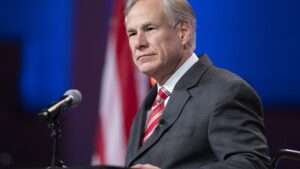
Earlier today, Texas Gov. Greg Abbott ended a system of onerous inspections he had previously imposed on trucks crossing into his state from Mexico. The official rationale for the inspections was the supposed need to curb cross-border drug smuggling and illegal migration. But, as Reason's Fiona Harrigan explains, the inspections caused great harm for little, if any gain:
The enhanced inspections, which bolster efforts already carried out by Customs and Border Patrol (CBP), have brought traffic to a standstill in the name of stopping the illegal transportation of drugs and migrants. "We weren't taken into consideration," said Ernesto Gaytan, chair of the Texas Trucking Association (TXTA), telling Reuters that migrants rarely attempt to enter the U.S. on commercial trucks at ports of entry….
"Unfortunately, this new initiative duplicates existing screening efforts and leads to significant congestion, delaying the products Americans rely on from our largest trading partner, Mexico," reads a statement from the TXTA. Mexico's National Chamber of Freight Transport reported that its member companies were losing millions of dollars each day due to delays. The Texas International Produce Association implored Abbott to modify his policy, with CEO Dante Galeazzi writing that "U.S. trucking companies are losing money as they sit around for days with no loads to haul." Galeazzi reported hearing "that a trucking company is refusing to send trucks south of San Antonio out of concern there will be no cargo available." Perishable goods run the risk of spoiling during long waits in the Texas heat.
Far from being a localized issue, the delays imposed by Abbott's new inspection measures have also irked federal border officials, who warn about broader supply chain challenges. CBP described recent wait times "exceeding five hours and commercial traffic dropping by as much as 60 percent," noting that its officials already "comprehensively" inspect and clear vehicles to enter the U.S. "The strength of the American economy relies heavily on the efficient flow of cross-border commerce," said CBP.
After an outcry by truckers and others, Abbott terminated the inspections. He has tried to claim victory by citing agreements reached with the governors of Mexican border states. But, in fact, as the Texas Tribune has documented, the agreements don't include any significant provisions beyond what the Mexicans were already doing:
Abbott said the deals with Chihuahua, Coahuila, Nuevo León and Tamaulipas were "historic," calling them an example of how border states can work together on immigration. But three of the four Mexican governors said they will simply continue security measures they put in place before Abbott ordered the state inspections.
The fourth, Nuevo León Gov. Samuel Alejandro García Sepúlveda — whose state shares only 9 miles of the 1,200-mile Texas-Mexico border — agreed to set up new checkpoints for commercial trucks.
This strongly suggests that the inspections were more about grandstanding for the benefit of Abbott's political base, than solving any genuine problem.
In addition, it is likely that they were also unconstitutional. The Dormant Commerce Clause of the Constitution restricts state regulations that impede interstate and foreign commerce. Most of the relevant legal precedents are about state laws that burden interstate commerce. But Supreme Court precedent makes clear that similar constraints apply to state regulation of international trade, which thereby infringes the "Dormant Foreign Commerce Clause."
The legal doctrine here is complicated, and I am by no means expert on all of it. But I would tentatively say that Abbott's inspection regime was a fairly obvious violation of the Dormant Foreign Commerce Clause. Supreme Court precedent is especially clear that the Dormant Commerce Clause forbids state regulations that target international or interstate commerce or discriminate against it. The Abbott inspections focused exclusively on cross-border trade, and were explicitly intended to target it. No similarly onerous inspections were imposed on purely domestic trucking.
I welcome correction by Dormant Commerce Clause experts. But if I have this right, it looks like an easy case. The issue may be moot, as the inspections have ended. However, it could arise again if Abbott or another border-state governor decides to institute a similar policy in the future. It is also possible that truckers and others harmed by Abbott's policies could sue for damages. The Supreme Court has ruled that Dormant Commerce Clause violations can sometimes give rise to damages lawsuits under 42 U.S.C. Section 1983.
Some conservative jurists, such as Supreme Court Justices Clarence Thomas and the late Antonin Scalia, have argued that the Dormant Commerce Clause doctrine lacks originalist support and should be abolished. If so, the neither Abbott's policy nor anything else could violate it. I won't try to assess the merits of this longstanding debate here, except to note that adopting Scalia Thomas' position would require reversal of longstanding Supreme Court precedent.
In recent years, there has been widespread concern that democracy is threatened by the spread of misinformation and "fake news" on social media and other similar new technologies. Rick Hasen's recent book Cheap Speech: How Disinformation Poisons Our Politics-and How to Cure It, is an important addition to the literature making this case. Hasen and others argue that the problem can be mitigated by public and private actions to restrict the spread of misinformation on social media (though Hasen advocates more modest regulatory measures than some other commentators).
In a recent symposium on Cheap Speech at the Balkinization blog, Harvard Law School Prof. Guy-Uriel Charles explains how this case is weakened by the reality that the the demand for misinformation may be a more significant menace than the supply:
I…. wonder how we ought to think about the problem of disinformation and misinformation if we assume that the market for political information is operating efficiently and that the problem is not one of market failure, which is how Rick frames the issue. Rick defines cheap speech as "speech that is both inexpensive to produce and often of markedly low social value," (21) and frames it as a problem of political market failure caused by information asymmetry (30). He uses as his model a pathbreaking paper by George Akerlof, the Nobel Prize winning economist, entitled The Market for "Lemons": Quality Uncertainty and the Market Mechanism. In that famous paper Akerlof explored how the information asymmetry between sellers and buyers with respect to the quality of certain goods might result in a market in which lower quality goods overwhelm high quality goods and in a reduction in the size of the market. For example, if you're a buyer in the used car market, you can't tell whether a seller is offering a reliable used car or a lemon, though the seller knows. To hedge the risk that you're buying a lemon, you make a lower offer. Potential sellers of quality cars are less likely to enter the market because buyers are unlikely to pay their asking price. The absence of sellers of quality cars leaves sellers of lemons in the market…..
It is unclear to me that the Akerlof model, which assumes that consumers are in the market for quality cars, is the right frame for thinking about political misinformation and disinformation. There are certainly some voters who are interested in truthful political information. But there are certainly a, perhaps larger, group of voters who are not in the market for truthful political information. We know, for example, that there is a relationship between partisanship and misinformation (see, e.g., here, here, and here). There's literature, and debate, on the role of motivated reasoning on assessing the accuracy of information (see, e.g., here vs. here). Moreover, as some researchers have demonstrated, the demand may be asymmetrical (see, e.g., here and here; conservative or Republican voters may be more likely to believe misinformation and there is evidence of partisan asymmetry with respect to cures to misinformation. If voters are filtering information based upon their partisanship or other identities that are salient to them or if they are seeking information that is consistent with their priors, then the Akerlof model is less apt….
To the extent that voters are seeking information that is consistent with their partisan identities or confirms their priors, then the market is working perfectly. There is no market failure, given that the market is supplying precisely what the people want. Republicans seek and get the information they like; Democrats seek and get the information they like. Everyone gets to live within their echo chamber, and no one must be confronted with ideas and information that makes them uncomfortable. Of course, this is no way to run a democracy.
Cheap Speech is extremely compelling on its own terms. At the same time, Rick's exhaustive exposition raises the question whether we have the right model for understanding the problem. If the problem of misinformation presents a demand-side problem, or to the extent that there is both a demand-side and supply-side problem, supply-side only solutions are not likely to resolve the problem. Similarly, to the extent that we have a supply-side problem, then demand-side solutions are not going to suffice…
If it is the case that political disinformation is at least about voter preferences as it is about politicians and social media platforms, solutions to the problem are much more complex. Modern democracies are not very good about figuring out what to do when voters get exactly what they want and what voters want is actually bad for democracy. Tweaking the law and relying upon private ordering is less than optimal, if the goal is a resolution of the problem. Rather, the focus will need to be on structural political and economic reforms.
I agree with almost every point Charles makes, and have made similar arguments in my own writings, including here, here, and here. The popularity of political misinformation is indeed due primarily to demand, rather than supply, which is why the problem long predates the rise of modern social media, and might well have been as bad or even worse in earlier eras dominated by what we today call the "legacy" media of newspapers and radio. The lies and disinformation that promoted fascism, communism, and other enormously harmful ideologies spread without the aid of Twitter and Facebook.
Charles is also right to emphasize that Akerlof's "market for lemons" is a bad analogy for the market for political information. Potential buyers of used cars generally want to know the truth about the condition of the vehicle in question. They have strong incentives to seek out the truth, because their decisions on whether or not to buy the car will make a big difference.
By contrast, the low odds that any one vote will make a difference to the outcome of an election ensure that many consumers of political information are acting not as truth-seekers, but as "political fans" eager to endorse anything that supports their position or casts the opposing party and its supporters in a bad light. These biases affect not only ordinary voters, but also otherwise highly knowledgeable ones, and even policymakers and politicians.
This demand for misinformation is the real root of the problem. If it were lower, the supply would not be much of a danger, and at the very least would not affect many voters' political decision-making.
In recent years, right-wingers' susceptibility to disinformation that confirms their priors has been especially notable, as in the case of Donald Trump's lies about how the 2020 election was supposedly "stolen" from him. But, unlike Charles, I'm not convinced that the left is generally less susceptible to this problem. Social science evidence indicates that bias in evaluation of political information is roughly equal across the political spectrum. Each side is relatively more susceptible to misinformation that confirms their priors. Examples that appeal disproportionately to the left include 9/11 "trutherism" (discussed in my book Democracy and Political Ignorance), and claims that GMO foods should be banned or tightly restricted because they are supposedly more dangerous than "natural" ones.
Finally, Charles is absolutely right that dealing with this demand-side problem requires "structural political and economic reforms." Restricting social media is unlikely to accomplish much, because the demand for misinformation can easily be met by other producers. Fox News, a traditional broadcast media operation, is likely a far more significant spreader of right-wing misinformation than anything on social media. Left-wing misinformation is also readily spread on more traditional media. Indeed, across the political spectrum, many more people get their political information from TV news or media websites than from social media.
In theory, government regulators could suppress misinformation across the board, regardless of whether the producers are traditional media or new ones. But, in addition to constitutional problems, such policies are objectionable because they would give political leaders vast power over the spread of information. It's far more likely they would use it to promote narratives that support their parties and policies than "objectively" promote truth in a "neutral" way. Even if you trust the current Democratic administration to wield such power responsibly, you probably don't trust the Republicans - and vice versa.
In previous writings, such as my book on political ignorance, and a more recent article in National Affairs, I have argued that the right structural reform is to shift more decisions to formats in which people can "vote with their feet," and thus have stronger incentives to seek out information and evaluate it objectively than ballot-box voters. This can be accomplished by limiting and decentralizing the power of government, thereby enabling people to vote with their feet over more issues.
The Akerlof "market for lemons" problem is a good example of how foot voting in the market can mitigate information problems. Because used-car buyers have strong incentives to seek out the truth, over time market mechanisms have arisen to provide relatively accurate and unbiased evaluations of used cars. Despite Akerlof's fears, good used cars have not been systematically driven out by lemons.
Thus, the last time I sold an old car of mine, the prospective buyer and I took it to an independent mechanic to have him evaluate its condition. The buyer had a strong incentive to take it to a neutral expert evaluator, and to assess the latter's report in an unbiased way. Few voters are willing to make the time and effort to do the same with political information. A world with more "markets for lemons" and fewer political markets would be a world where misinformation is a less serious danger.
Please enjoy the latest edition of Short Circuit, a weekly feature from the Institute for Justice.
From 2001 to 2018, now-retired Midland County, Tex. prosecutor Ralph Petty worked on over 300 cases as both the lead prosecutor and law clerk for the judge overseeing those cases, arguing by day and (among other improprieties) drafting orders in his own favor at night—unbeknownst to the defense. This week, Erma Wilson, who was falsely convicted of drug possession, joined with IJ to file suit against not only Petty, but also the district attorney who okayed the arrangement and the county. (The judge is deceased.) Read all about it in The Wall Street Journal. Big ups to USA Today for breaking the story last year. The complaint can be found here.
Two Brooklyn, N.Y. men who used quite a bit of violence to protect their illegal businesses (including conspiring to set fire to a rival gambling den, whichkilled two in an upstairs apartment) are convicted of, among a lot of things, racketeering and sentenced to over 16 years. Second Circuit: Affirmed. Dissent: It's not racketeering if it's just some guys doing felonies together. Their so-called syndicate had no name, no rules, no organizational structure, no secret handshakes. [Ed.: The fire nearly killed two. Thanks commenter apart!]
Allegation: Truck driver leaving Albany County, N.Y. bar causes accident that kills motorcyclist, but police don't do field sobriety testing or collect any evidence and they file a dishonest report. Did this violate the motorcyclist's mother's right of access to the courts? Second Circuit: She's actively litigating state-law claims against the truck driver and the bar, so, at least for now, her claims against the police must be tossed.
District court: I grant you leave to file your proposed amended complaint. Plaintiffs: Great, here's a totally different, way shorter amended complaint. District court: Boy, that complaint's not detailed enough. I'm dismissing it without prejudice in case you wanted to file a better complaint, like maybe that one from the first sentence of the summary. Plaintiffs: Nope, we appeal! Third Circuit: Guys. C'mon.
Initially unable to reach a verdict, jurors request the production of an enlarged freeze frame from an informant's video that shows a Myrtle Beach, S.C. cocaine seller's face reflected in a rearview mirror (a freeze frame that was not presented prior to deliberations). They also ask—and the court orders—the defendant to stand next to the photo. He's convicted and sentenced to 17 years. Fourth Circuit (over a dissent): Habeas granted. His lawyer was unconstitutionally ineffective for failing to object more strenuously.
Army staff sergeant serves 9 years in military prison; he's paroled, subject to a number of conditions, and supervised by a civilian parole commission. He's jailed for violating one of the conditions. But wait, does a civilian parole commission have the authority to impose parole conditions, rather than the court-martial that sentenced him? District court: No need to resolve this because he's been released, so his claim is moot. Fifth Circuit: Not so fast. He's been denied all veterans' benefits as a result of the parole violation, which may be sufficient to keep the case going.
Civilian contractor driving to work at a San Antonio, Tex. military training base is swept away on a flooded road on base—a road that officers are supposed to inspect and close when flooded. He drowns. Fifth Circuit: And his parents can sue the feds for failing to lock the gate. Case undismissed.
Family farmers devise a plan to have their land annexed into the town next door and rezoned for residential development, but the town zoning board scuttles the zoning application, after which the annexation request lapses. District court: You can't sue about the zoning decision because your land isn't even in the town. Case dismissed! Sixth Circuit: Right, but they're not in the town because of the zoning decision. Case un-dismissed!
If a town's planned removal of a dam will flood a property owner's land, can there be a ripe takings claim before the dam comes down, or must the owner wait until the flood actually comes? Sixth Circuit (over a dissent): Nothing in Article III requires property owners to actually be wearing arm floaties at the time they sue; case un-dismissed.
Plaintiff (pro se): Two Ramsey County, Minn. jail supervisors called me the n-word and ignored grievances about subordinates doing the same. The two supervisors: We have investigated and concluded we did not do that. Eighth Circuit: No doubt. Qualified immunity. (Some state-law claims are remanded, however.)
Allegation: Woman buys, among other things, a fleece jacket on sale for $19.99 that, per the price tag, had been marked down from $39.99. But wait! The higher figure was just a gimmick. Nobody ever pays list price. Can she file a class action against the retailer? Ninth Circuit: Before we answer that, we'll ask if the Oregon Supreme Court thinks anyone's being fleeced.
Man is convicted of tax crimes and sentenced to 21 months. But wait! He waived his right of counsel during pretrial proceedings (he was represented at trial) after a magistrate judge told him the max sentence was just 12 months. Eleventh Circuit (over a dissent): He couldn't knowingly waive his right to counsel if the judge gave him materially false info. Conviction vacated.
Reading between the lines just a tad, your humble editor wonders if this Eleventh Circuit panel thinks that it's easy to rip off Medicaid and Medicare so long as you don't go overboard. Like this now-former Valdosta, Ga. doctor, who regularly billed the feds for seeing over 50 nursing home patients per day (sometimes 150 patients), purporting to provide services that would take 70 or more hours in a 24-hour period, and once billing for services when he was actually in Vegas gambling. His conviction and 8-year sentence are affirmed.
Under federal law, the owner of a leased or rented car is generally not vicariously liable for any accidents their customers may cause. But what about the owner of a loaner vehicle—here a Mooresville, N.C. auto dealership that provided a car to a couple (who drove the car to Florida while theirs was in the shop)? Breaking out the law dictionary, the Eleventh Circuit says the dealership is protected from liability.
Victory! This week, the feds agreed to return 100 percent of the funds—approximately $1.1 mil—seized from IJ client Empyreal Logistics in California. The armored car company, which provides services to state-legal cannabis businesses (among other cash-intensive industries like restaurants and convenience stores) across the country, twice had its vehicles unlawfully searched and their contents seized by the San Bernardino County, Calif. sheriff's department last year. The sheriff then turned the money over to the feds for civil forfeiture through the DOJ's equitable sharing program. Empyreal's separate claims against the sheriff are not affected by the settlement. Click here for more.
New case! In 2020, Rochester, N.Y. police seized over $8k cash from Cristal Starling that she'd mostly earned from her mobile food cart business and that she'd intended to buy a food truck with. (Police suspected her now ex-boyfriend of drug dealing, but he was acquitted by a jury on all charges.) Cristal was never arrested or charged, and she did everything she could to navigate the procedural gauntlet necessary to stop her money from being forfeited. But along the way she missed a single deadline, and a federal district court ruled that that meant she lost by default. Now represented by IJ, she is asking the Second Circuit to apply the normal rules of civil procedure—where defaults are disfavored and parties without counsel are granted extra leeway in cases involving complex procedural rules—to civil forfeiture cases and to remand the case back to district court to hear the case on its merits. Click here to learn more.
Last week, the Senate confirmed Judge Ketanji Brown Jackson to a seat on the U.S. Supreme Court. This raised the question of whether the President could go ahead and appoint Jackson to the High Court, even though the seat for which she was nominated is still occupied by Justice Stephen Breyer.
A newly released memo from the Office of Legal Counsel in the Department of Justice addresses this question. The memo, "Authority of the President to Prospectively Appoint a Supreme Court Justice," is dated April 6, was signed by Assistant Attorney General Christopher Schroeder, and suggests presidents may appoint confirmed nominees to seats that are not-yet vacant.
From the memo:
Our Office has taken the position that prospective appointments are permissible for vacancies anticipated to occur during the appointing official's own term of office. . . . Consistent with this view, we conclude that, if the Senate votes to confirm Judge Jackson, the President may complete her appointment to the Supreme Court by signing her commission before Justice Breyer's resignation takes effect. Judge Jackson will not, however, assume the office of Associate Justice until Justice Breyer's resignation is effective. . . . Once his resignation is effective, she would then take the oaths as prescribed by the Constitution and statute.
While prompted by the confirmation of Judge Jackson, the memo's logic would seem to have broader ramifications. Among other things, it would suggest the President could nominate, and the Senate could confirm, another nominee to the Supreme Court in anticipation of another vacancy later in President's term -- a vacancy that might arise after control of the Senate has switched hands.
More from the memo:
Although . . . a vacancy does not arise until the effective date of the Justice's retirement, we have long recognized that the President may nominate in anticipation of such a vacancy. . . . Indeed, prospective nominations have become common with respect to anticipated vacancies on the Supreme Court. Since 1986, twelve individuals have been nominated prospectively to the Supreme Court, including Judge Jackson.
We have also recognized that, after the Senate provides its advice and consent, "[t]he President is authorized to make prospective appointments to any office the term of which begins before January 20 [of the year his term ends]." . . . As a "general rule," "a prospective appointment to fill a vacancy sure to occur in a public office, made by an officer who[]. . . is empowered to fill the vacancy when it arises, is, in the absence of a law forbidding it, a valid appointment, and vests title to the office in the appointee." . . . The President could not "forestall the rights and prerogatives of [his] own successors by appointing successors to offices expiring after [his] power to appoint has itself expired," . . . but there is otherwise no general limitation on the President's authority to make appointments in advance of an impending vacancy.
The examples cited in the memo generally involve the nomination, confirmation, and appointment of individuals to fill pending vacancies, such as arise when a judge or justice announces when he or she will be stepping down. The interesting question is whether the Biden Administration and Senate Democrats would seek to stretch this practice to reach nominations for vacancies that are "anticipated" in only the loosest sense, and confirm judges "just in case" certain seats become vacant later during President Biden's term.
UPDATE: At Bench Memos, Ed Whelan offers some thoughts on the OLC memo, and whether President Biden relied upon this memo to appoint Ketanji Brown Jackson anticipatorily to the Supreme Court.
Now that the Senate has consented to the appointment of Judge Ketanji Brown Jackson to the Supreme Court, the Biden White House is turning its attention to the 100-plus current and pending vacancies on lower federal courts.
On Wednesday, the White House announced its first lower court nominees in over two months: Two circuit court nominees and three district court nominees. With attention focused on filling a Supreme Court vacancy, lower court nominations were understandably put on hold. Yet if the White House plans to maximize its imprint on the federal judiciary, it will have to pick up the pace (as I discussed here).
A majority of current and pending circuit court vacancies lack judicial nominees, and some of these openings have been around for months. As this is an election year, and Senate Republicans are unlikely to cooperate in filling many seats, Senate Democrats will have to devote substantial time and effort on a shrinking calendar to moving nominees through the process.
One choice the White House may have to make is whether to seek more moderate, "consensus" candidates from states with Republican Senators that could be pushed through the process more quickly. Senate Democrats can get any nominee through for any vacancy, if they are willing to devote the time and effort to do it. Even when the Senate Judiciary Committee deadlocks on a nomination, Senate Democrats can bring the nominee to the floor, but this is a more time-consuming process than moving a nominee with a minimal degree of bipartisan support. Seeking an accommodationist path could help fill more seats more quickly, but it may come at the expense of the Biden Administration's efforts to name progressive stalwarts to the federal bench and discourage parts of the President's base. We'll see which approach the White House opts to follow in the coming weeks.
Plaintiff often handed out flyers and brochures, and he advocated for vegetarian or vegan eating. Plaintiff claims that the University's policy that placing regulations on speech on areas of campus is unconstitutional. More specifically, he claims that Defendants applied the policy, CRR 110.010, unconstitutionally against him and infringed on his First Amendment rights by restricting his speech based on content.
Plaintiff alleges that, in December of 2021, he was distributing literature at the University of Missouri-Columbia (MU) and was asked by a Jane Doe who identified herself as "with operations" to relocate to another location on campus. Plaintiff claims that Ms. Doe called University police after Plaintiff "declined to remove himself from his desired location." Plaintiff asserts that he spoke with a MU police officer for "approximately ten minutes," who purportedly told Plaintiff he would be removed from campus if he made students feel uncomfortable or if he was otherwise rude. He claims that "the University's actions interfered" with his protected speech activities and that the officer's presence "deterred some students from accepting a booklet from Hershey."
Plaintiff next alleges that, on August 23, 2021, he was distributing literature regarding vegetarianism on the University of Missouri-St. Louis (UMSL) campus. Plaintiff alleges that UMSL staff "demanded that he distance himself farther from his intended audience outside the [Millenium Student Center]." Plaintiff names as a defendant Dorian Hall ("Hall"), the Director of the Millenium Student Center, and claims that Director Hall "directed his staff to move Hershey farther away from the door." Plaintiff alleges that "UMSL's actions interfered with Hershey's lawful and protected speech activities" and that the "staff's presence" deterred students from accepting Hershey's literature."
This cause comes before the Court sua sponte. On February 2, 2022, Defendants filed a Notice of Compliance, stating that they submitted their proposed Stipulations of Material Facts for their respective Motions for Summary Judgment to Plaintiff and that Plaintiff never responded to Defendants' communications. Defendants then attached their proposed Stipulations of Material Facts. On the same day, Plaintiff filed a Notice of Compliance and attached "their proposed redline edits to Defendants proposed Stipulations of [] Material Facts," claiming that "Defendants submitted their own versions of their proposed [S]tipulations before giving Plaintiff a reasonable opportunity to include the edits shown on the attached [e]xhibits."
It seems the parties are not aware that a "stipulation" is, by definition, "[a] voluntary agreement between opposing parties concerning some relevant point." The Court is not the parties' paralegal, and it will not wade through redlined versions of Defendants' proposed Stipulations of Material Facts.
Accordingly, all of these filings are hereby STRICKEN as noncompliant with the Court's Case Management and Scheduling Order. The parties are DIRECTED to telephonically meet and confer and submit one Stipulation of Material Facts for each Motion for Summary Judgment on or before Friday, April 22, 2022. In addition, each Stipulation of Material Facts should delineate (1) which allegedly defamatory statements are at issue and (2) when those allegedly defamatory statements were published.
Not a single judge on the U.S. Court of Appeals for the Fifth Circuit sought to reconsider a stay of a district court opinion barring consideration of the Biden Administration's social cost of carbon estimates.
Unhappy with the stay, Louisiana and the other states that brought the initial suit filed a petition for rehearing en banc. Today that petition was denied in a brief order, which noted that "no member of the panel or judge in regular active service requested that the court be polled on rehearing en banc." In other words, not even one judge on the Fifth Circuit thought the question merited further review.
Undaunted by the latest order, Louisiana Attorney General Jeff Landry proclaimed he will file a petition for certiorari. The underlying case would not appear cert-worthy, particularly as the administrative law questions presented are rather straight-forward and uncontroversial. Universal challenges to agency consideration of the Social Cost of Carbon are premature and beyond the jurisdiction of federal courts unless and until such estimates are relied upon by an agency taking a distinct, discrete action that causes a justiciable injury.
The one wrinkle is that there is another case challenging the Biden Administration's Social Cost of Carbon pending in the U.S. Court of Appeals for the Eighth Circuit. In the unlikely event that the Eighth Circuit reaches a different conclusion about the viability of such suits, then Supreme Court review might be possible.