The Volokh Conspiracy

Mostly law professors | Sometimes contrarian | Often libertarian | Always independent | Est. 2002

The Volokh Conspiracy

Google's Spamgate

Episode 405 of the Cyberlaw Podcast

|

Retraction: An earlier episode of the Cyberlaw Podcast may have left the impression that I think Google hates mothers. I regret the error. It appears that, in reality, Google only hates Republican mothers who are running for office. But to all appearances, Google really, really hates them. A remarkable, and apparently damning study disclosed that during the most recent federal election campaign, Google's Gmail sent roughly two-thirds of GOP campaign emails to users' spam inboxes while downgrading less than ten percent of the Dems' messages. Jane Bambauer lays out the details, which seem to refute most of the excuses Google might offer for the discriminatory treatment. Notably, neither Outlook nor Yahoo! mail showed a similar pattern. Tatyana thinks we should blame Google's algorithm, not its personnel, but we're all eager to hear Google's explanation, whether it's offered in the press, before the Federal Election Commission (FEC), in court, or in front of Congressional investigators after the next election.

Jordan Schneider helps us return to China's cyber policies after a long hiatus. Things have not gotten better for the Chinese government, Jordan reports. Stringent lockdowns in Shanghai are tanking the economy and producing a surprising amount of online dissent, but with Hong Kong's coronavirus death toll in mind, letting omicron spread unchecked is a scary prospect, especially for a leader who has staked his reputation on dealing with the virus better than the rest of the world. Among the results is hesitation in pursuing what had been an aggressive techlash regulatory campaign.

Tatyana Bolton pulls us back to the Russian-Ukrainian war. She notes that Russia Is not used to being hacked at anything like the current scale, even if most of the online attacks turn out to be pinpricks. She also flags Microsoft's report on Russia's extensive use of cyberattacks in Ukraine. All that said, cyber operations remain a minor factor in the war.

Michael Ellis and I dig into the ODNI's intelligence transparency report, which inspired several different takes over the weekend. The biggest story was that the FBI had conducted "up to" 3.4 million searches for U.S. person data in the pool of data collected under section 702 of the Foreign Intelligence Surveillance Act (FISA). Sharing a brief kumbaya moment with Sen. Ron Wyden, Michael finds the number either "alarming or meaningless," probably the latter. Meanwhile, FISA Classic wiretaps dropped again in the face of the coronavirus. And the FBI conducted four searches without going to the FISA court when it should have, probably by mistake.

We can't stay away from the pileup that is Elon Musk's Twitter bid. Jordan offers views on how much leverage China will have over Twitter by virtue of Tesla's dependence on the Chinese market. Tatyana and I debate whether Musk should have criticized Twitter's content moderators for their call on the Biden laptop story. Jane Bambauer questions whether Musk will do half the things that he seems to be hinting. I agree, if only because European law will force Twitter to treat European sensibilities as the arbiter of what can be said in the public square.

Jane outlines recent European developments showing, in my view, that European policymakers aren't exactly running low on crazy. A new EU court decision opens the door to data protection class actions, undermining the jurisdictional limits that have made life easier for big U.S. companies. I predict that such lawsuits will also mean trouble for big Chinese platforms.

And that's not half of it. Europe's Digital Services Act, now nearly locked down, is a mother lode of crazy. Jane spells out a few of the wilder provisions – only some of which have made it into legal commentary.

Orin Kerr, normally a restrained and professorial commentator on cyber law, is up in arms over a recent 9th Circuit decision holding that a preservation order is not a seizure requiring a warrant. Michael, Jane, and I explore Orin's agita, but we have trouble sharing it.

In quick hits:

Download the 405th Episode (mp3)

You can subscribe to The Cyberlaw Podcast using iTunes, Google Play, Spotify, Pocket Casts, or our RSS feed. As always, The Cyberlaw Podcast is open to feedback. Be sure to engage with @stewartbaker on Twitter. Send your questions, comments, and suggestions for topics or interviewees to CyberlawPodcast@steptoe.com. Remember: If your suggested guest appears on the show, we will send you a highly coveted Cyberlaw Podcast mug!

The views expressed in this podcast are those of the speakers and do not reflect the opinions of their institutions, clients, friends, families, or pets.
I've Finished Reading The Apparent Dobbs Draft Opinion

The penultimate paragraph of Part IV provides the course of action going forward.

|

After my spate of blog posts from Monday evening (1, 2, 3, 4), I took the time to read the apparent Dobbs draft opinion. It is a tour de force. Justice Alito meticulously dissects, and forcefully responds to, every conceivable position in favor of retaining Roe and Casey. I could teach an entire law school seminar class on this opinion. It touches on nearly every facet of constitutional law. Moreover, the opinion carefully addresses the concerns of other members of the majority. Alito cites Justice Gorsuch's book. Alito discusses safe harbor laws, which seemed important to Justice Barrett. Alito repeatedly cites Justice Kavanaugh's Ramos concurrence, and calls on returning the issue to the democratic process. This is an opinion designed to hold five, as the saying goes.

Will this opinion, or a version of it, ever see the light of day? Who knows. We are now in uncharted territory. For all we know, the Court issues a one sentence per curiam opinion overruling Roe, and remanding the case to the Fifth Circuit for further proceedings.

Still, I think the penultimate paragraph in Part IV provides the course of action going forward:

We do not pretend to know how our political system or society will respond to today's decision overruling Roe and Casey. And even if we could foresee what will happen, we would have no authority to let that knowledge influence our decision. We can only do our job, which is to interpret the law, apply longstanding principles of stare decisis, and decide this case accordingly.

In a perverse way, due to the leak, the Court can foresee what will happen when the opinion is formally released. Turn on MSNBC and log onto Twitter. We know exactly what would happen. Still, that foresight should be irrelevant. The justices lacks "authority to let that knowledge influence [their] decision." Let the press do their job. And the Justices can will do their job.

And even more perversely, Justice Kagan's dissent became much more difficult to write. Predictably, she would warn about how this decision would harm the Court's institutional legitimacy, yadda yadda yadda. But that bandaid was already ripped off. Everyone knows how this decision will be received because--again--we can watch MSNBC and doomscroll through Twitter. It will be hard for Kagan to even address this issue without talking about the draft opinion that everyone has already seen. Josh Gerstein is the elephant in the room. Politico's leak deflated the inevitable Dobbs dissent.

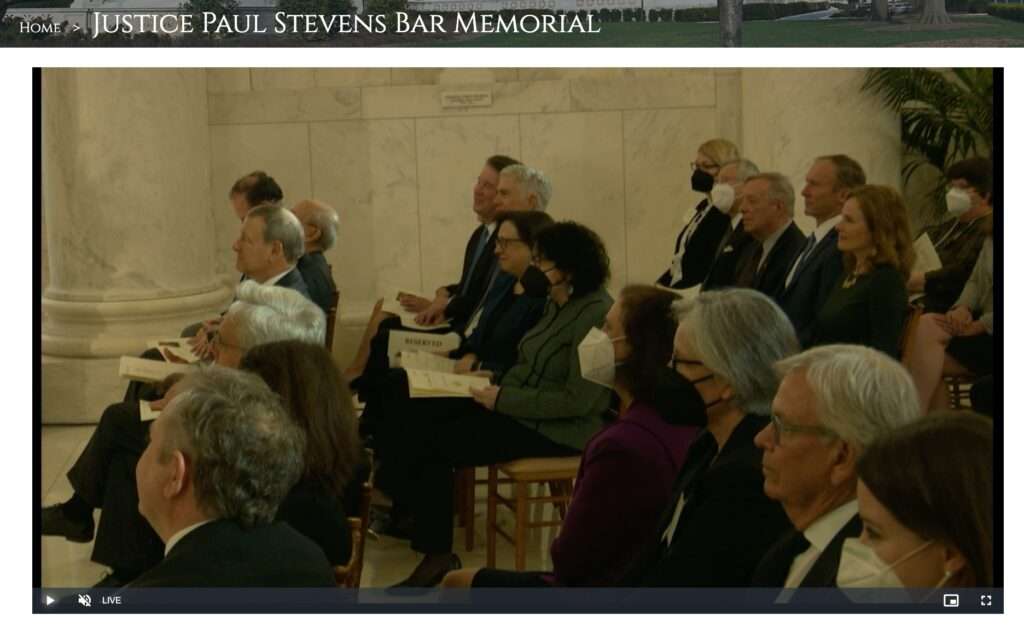
I do not know what Tuesday will bring, but we should hear from Chief Justice Roberts shortly. As of Monday afternoon, all nine Justices were in the Court for Justice Stevens's memorial. They may be called back to duty right away. Here they were in happier times:

Chief Justice Roberts's "Long Game" Was Turned Upside Down In An Instant

Once again, the "fatal conceit" of the long game becomes clear.

|

We've been told that Chief Justice Roberts is playing the long game. For the past two decades, he has been carefully moving pieces on a three-dimensional chess board. Indeed, Roberts has been setting the stage for this long-game since the Reagan administration. And, the crowning achievement of this plan--the White Whale!--would be overruling Roe v. Wade. Or so the story goes.

But in the interim, things did not go to plan. Justice Scalia suddenly died, and we almost had Justice Garland. But Senate Republicans refused to give him a hearing, Trump won, and we got Justice Gorsuch. Justice Kennedy retired, and we got Justice Kavanaugh. Then, Justice Ginsburg suddenly died, and we got Justice Barrett.

Tell me, can any "long game" possibly plan for all these eventualities? In 2017, I wrote that Roberts's "long game" suffers from what Hayek described as the "fatal conceit."

Fisher and Harris illustrate the fundamental problem with a long game. The notion that a single Chief Justice can single-handedly shape the law over the course of decades, as if he were moving pieces around on a three-dimensional chess set, suffers from what F.A. Hayek referred to as the "fatal conceit." Our society as a whole is infinitely more complex than any one person could ever possibly understand. It is the "fatal conceit" of central planners that they presuppose enough knowledge to control all aspects of human existence.

And Leakgate illustrates once again the problem with treating the Supreme Court like some chess match. No one--not even John Roberts--is omniscient enough to steward the Court as if it were a role-playing game. Indeed, I think many of the Court's current problems, including the leak, stem from Roberts's blatant attempt to rest his rulings on political currents. NFIB v. Sebelius established the playbook. It is not surprising that someone, no matter how poorly informed, though it would be a good idea to leak this draft.

Whodunnit?

Speculating on how the apparent Dobbs first draft from Feb. 10, 2022 was leaked.

|

I have now had a few hours to think through the apparent leaked Dobbs majority opinion. (My tentative thoughts are here). Let's play a game of whodunnit?

To begin, there are a few clues that can be derived from the document itself. First, at the top of the first page is the phrase "1st Draft." And it is highlighted in yellow. The rectangle around the phrase is perfectly angled. This was done with a digital highlight feature, and not a real highlighter. I can reasonably infer this document was printed on a color laser printer. Most people would simply print a 98 page document on a traditional black-and-white printer. Most high-quality color printers leave a watermark (tracking dots) on every page. Even though this document was scanned by Politico, the authorities can probably trace it.

Second, in the upper right-hand corner of the document is a distribution list. The document is from Justice Alito. It was circulated on February 10, 2022. Above Alito's name are the names of the other eight Justices. But none of those names are checked or highlighted in any way. It isn't clear to me that this specific document was ever actually distributed to the other chambers.

Third, Dobbs was argued on December 1, and this draft was circulated about two months later on February 10, 2022. Now, this draft is nearly three months old. There may have been changes. On quick skim, I found at least one typo. On page 61, the draft opinion cites Ferguson v. Schrupa; it is Ferguson v. Skrupa.

So whodunnit? I can think of three possible answers.

First, this leak may have come from the chambers of a liberal Justice. Under this theory, the leak was designed to create a backlash, and pressure a conservative Justice to defect from Alito's opinion. But this theory makes no sense. If anything, this leak from a liberal chamber will entrench the five-member majority to avoid the appearance that the pressure campaign worked.

Second, this leak may have come from the chambers of a conservative Justice. Under this theory, the leak was designed to prevent a conservative Justice from defecting from Alito's opinion. But this theory also makes no sense. If anything, this leak from a conservative chamber would infuriate a swing Justice, and push them out.

Any clerk must know that this sort of leak would ruin their careers, and lead to possible disbarment or criminal prosecution. And a Justice must know that authorizing this leak would probably lead to impeachment proceedings. I do not think this leak came from a chamber.

There is a third option: the leak did not come from a chambers. I hinted at that theory in my initial post.  Rather, the leak may have come from someone with access to the Supreme Court's draft opinions. And history suggests that this sort of leak is possible. Josh Gerstein (yes, that Josh Gerstein) wrote an essay for Politico tonight about past leaks from the Supreme Court:

In 1979, ABC News Supreme Court correspondent Tim O'Brien went on air with reports predicting the outcome of two decisions that were days away from release. Chief Justice Warren Burger launched an inquiry into whether anyone at the court had breached protocol, and a Government Printing Office employee involved in setting type for the court's rulings was transferred to a different division. The staffer denied leaking any information.

Here is my completely uninformed speculation. This document was typeset and printed in a formal fashion. This document was also likely not circulated to chambers, but was floating around. And whoever had this document does not yet have access to the more recent drafts, or draft dissents.

The Chief Justice should get to the bottom of this situation immediately, and be transparent about the investigation.

Making Sense Of The Apparent Leaked Opinion In Dobbs

My instant reaction to Leakgate.

|

By now, you should have seen the Politico story that links to a purported majority opinion in Dobbs. Yes, there was a leak. No, I am not going to link to the story. Here are my tentative thoughts.

First, where did the leak come from? Most people are presuming this leak came from someone with access to the opinion, such as a Justice or a clerk. That presumption is probably correct, but it is also possible there was some illegal exfiltration of the document. I don't want to make light of the situation, but a person self-immolated on the steps of the Supreme Court to draw attention to environmental justice. People who are fanatical about abortion may go to great lengths to support their cause.

Second, Roberts has an absolute obligation to conduct a thorough and transparent investigation. And at the end of that investigation, Roberts must publicly identify the persons who are responsible for this leak--that includes Justices and clerks. Heads must roll. Clerks cannot fall on their swords to save their bosses. Anyone implicated in Leakgate (yes, I dubbed a term) should be referred to the Department of Justice for potential criminal activity, including theft of government property. And now there may actually be a need for impeachment proceedings. If Roberts cannot resolve this situation, he must resign. Yes, I said he should resign two years ago, but now I really mean it.  A resignation would mean giving Biden another Supreme Court nomination. So be it. I don't care. Roberts has been an utterly ineffective Chief, who will never fill the shoes of his predecessor, Chief Justice Rehnquist. It's time to hang 'em up, Johnny. Not even Warren Burger presided over such a dysfunctional building. Can anyone say Chief Justice Garland?

Third, we may not be done with leaks. Politico only published a purported majority opinion from Justice Alito. And per Politico, it was joined by Justices Thomas, Gorsuch, Kavanaugh, and Barrett. We do not know how the Chief will vote. What if subsequent to this draft, one of the votes in the majority changed--as WSJ warned about? What if there is another circulating concurrence, or plurality opinion? If the majority opinion leaked, other separate writings may leak.

Fourth, Politico got the scoop. Not the Washington Post or New York Times or WSJ or NPR. Or, perhaps other outlets had a copy of the opinion, but only Politico was willing to run it. I still think WSJ had the opinion last week, in light of their editorial. The Supreme Court is in worse shape than I could have imagined.

Fifth, the Court should issue the Dobbs opinion as soon as possible. Do it tomorrow. Don't wait till Thursday, or next Monday, or the end of June. The longer this process drags on, the worse the Court will be.

Sixth, if any members of the majority changed their vote in response to the leak, that change will be seen as a direct response to this leak. I can't quote Chief Justice Rehnquist's admonition in Casey enough.

The joint opinion's insistence on preserving the form, if not the substance of the rule, can just as easily be viewed as a surrender to those who have brought political pressure in favor of that decision. Once the Court starts looking to the currents of public opinion regarding a particular judgment, it enters a truly bottomless pit from which there is simply no extracting itself.

At this point, the Court is stuck. The only way to escape the bottomless pit is to fight back against a campaign to alter votes.

Politico Published An Apparent First Draft of Dobbs, Which Overruled Roe

The purported majority opinion by Justice Alito is 98-pages long.

|

My speculation that there was a leak in Dobbs looks stronger. Josh Gerstein and Alexander Ward of Politico have published a scanned document that purports to be a first draft of Dobbs that was circulated on February 10, 2022. No, I am not going to link to it. I will discuss the import of this leak in another post.

Free Speech

Prof. Jeffrey Rosen on Musk and Twitter

|

Jeffrey Rosen, a law professor at the George Washington University Law School, President of the National Constitution Center, and former legal correspondent for The New Republic, has an essay about this at The Atlantic; an excerpt:

Elon Musk, in his effort to buy Twitter, signaled that under his ownership, the company would allow all speech that the First Amendment protects. "By 'free speech,' I simply mean that which matches the law," he tweeted on April 26. "I am against censorship that goes far beyond the law."

Many commentators were quick to point out that, as a private company, Twitter is not required to follow the First Amendment, which applies only to federal and state governments. And Musk has further been criticized by those who fear that harmonizing Twitter's content rules with First Amendment doctrine would lead to an explosion of hate speech, misinformation, and incendiary statements, content that Twitter currently moderates.

This deregulatory approach would make Twitter an outlier among the social-media companies; at the moment, Twitter, like Facebook and Google, has chosen to adopt content rules stricter than First Amendment standards. Facebook, for example, prohibits "hate speech" or "attacks," which it defines as "violent or dehumanizing speech, harmful stereotypes, statements of inferiority, expressions of contempt, disgust or dismissal, cursing and calls for exclusion or segregation." By contrast, the First Amendment generally protects hate speech unless it is intended, and likely, to cause imminent injury. Twitter's current definition of "hateful conduct," although narrower than Facebook's, still falls short of First Amendment standards.

But Musk's position is, in fact, convincing. Although private companies are not required to follow the First Amendment, nothing prevents them from doing so voluntarily. And in Twitter's case in particular, there are strong reasons to believe that the First Amendment should presumptively govern. All four of the main principles that have historically guided the Supreme Court in interpreting the First Amendment apply just as powerfully to social-media platforms as they do to governments….

Rosen discusses the reasons for this in more detail; see his essay for more. And I'm inclined to agree with him about this, given Twitter's size and importance to public debate (at least as to decisions to ban accounts on the grounds that they express harmful views).

Some of the details of the policy may need to differ from the First Amendment rules, especially when it comes to replies posted on others' Tweets (as opposed to the contents of Tweets that are read only by people who deliberately follow the author)—to take the clearest example, it likely makes sense for Twitter to try to block spam that may not be legally punishable but that may seriously interfere with Twitter conversations. But following the general thrust of the First Amendment seems like a valuable approach, for the reasons Prof. Rosen mentions.

Free Speech

Sign Restriction That Excludes Holiday Signs Is Unconstitutionally Content-Based

A “30-by-50-foot flag saying, ‘TRUMP 2020 Keep America Great’” was therefore wrongly forbidden by the City of Buffalo (Minnesota).

|

From today's opinion by the Minnesota Court of Appeals in Johnsonville, LLC v. City of Buffalo, written by Judge Sarah Wheelock and joined by Presiding Judge Jeffrey Bryan and Judge Lucinda Jesson:

In early 2021, Johnsonville displayed a 30-by-50-foot flag saying, "TRUMP 2020 Keep America Great," from atop a mobile construction crane on its agricultural zone in Buffalo. The city attorney issued three notices of administrative penalties to Johnsonville in April 2021 for violations of multiple provisions of chapter 13 of the Buffalo City Code (the sign ordinance or ordinance) because of the flag's size and manner of display. The notices imposed penalties for flying the flag from an extended crane on the property and for exceeding size restrictions deemed applicable to the flag….

[A.] [Johnsonville also] argues that because the sign ordinance permits larger holiday signs, the ordinance is not content neutral, and accordingly the sign ordinance's size restrictions must be subjected to strict scrutiny review, which the ordinance's content-based restrictions cannot withstand. {The holiday-signs provision allows the display of signs that "contain or depict a message pertaining to a religious, national, state or local holiday and no other matter" without an explicit limitation on size.} …

Read More

Refugees

Biden Administration Takes Incremental Steps to Open Doors to Ukrainian and Russian Refugees

The new policies include private refugee sponsorship for Ukrainians, and a possible plan to facilitate visas for Russians with high-tech skills. But much more remains to be done.

|

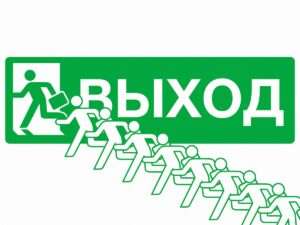
The Russian-language sign in this image says "exit."

So far, the US government has taken only modest steps to open doors to the vast flood of Ukrainian refugees fleeing Vladimir Putin's brutal war of aggression, and virtually none at all to welcome Russians fleeing the Putin regime's increasing repression at home. In recent days, however, the Biden administration may be changing this. It has opened up private refugee sponsorship for Ukrainians, and is considering making it easier for Russian tech workers to get visas to come to the US. These are steps in the right direction. But they don't go nearly far enough.

As Reason immigration policy writer Fiona Harrigan explains, private refugee sponsorship can help Ukrainian refugees get around the sclerotic and severely backlogged government refugee resettlement system. But she also notes some important limitations of the program, including that the Ukrainians involved will only get two years of residency rights, and will not be automatically eligible for green cards, as refugees admitted through conventional processes are.

Meanwhile, Bloomberg reports that the Biden administration is considering easing visa requirements for Russians with high tech credentials:

The Biden administration has a plan to rob Vladimir Putin of some of his best innovators by waiving some visa requirements for highly educated Russians who want to come to the U.S., according to people familiar with the strategy.

One proposal, which the White House included in its latest supplemental request to Congress, is to drop the rule that Russian professionals applying for an employment-based visa must have a current employer.

It would apply to Russian citizens who have earned master's or doctoral degrees in science, technology, engineering or mathematics in the U.S. or abroad, the proposal states.

A spokesman for the National Security Council confirmed that the effort is meant to weaken Putin's high-tech resources in the near term and undercut Russia's innovation base over the long run -- as well as benefit the U.S. economy and national security.

Specifically, the Biden administration wants to make it easier for top-tier Russians with experience with semiconductors, space technology, cybersecurity, advanced manufacturing, advanced computing, nuclear engineering, artificial intelligence, missile propulsion technologies and other specialized scientific areas to move to the U.S.

As the Bloomberg article notes, since the outbreak of the Ukraine war, there has been a massive exodus of tech workers from Russia. Luring these people to the US could simultaneously benefit our economy, weaken Putin's war machine, and serve as a victory for the US in the war of ideas against Putin's authoritarian nationalism.

But the administration proposal described above seems severely limited. Among other things, it is confined to people with master's degrees or doctorates, and even then only those who got them outside of Russia (if I understand the reference to getting them "abroad" correctly). Obviously, many valuable Russian workers in tech and other industries either don't have graduate degrees at all or got them within Russia.

In addition, the proposal would only eliminate one obstacle to giving these people visas (the employer requirement), while leaving others in place. In my view, both moral and strategic considerations indicate the need for much broader openness to Russians fleeing Putin (as well as Ukrainians, of course).

Both private refugee sponsorship and visas for tech workers are policies that should be expanded beyond the specific cases of Russia and Ukraine. The former is an idea long advocated by refugee policy experts; it would do much to facilitate openness to refugees from around the world, while reducing associated government expenditures. Early in his administration, Biden even issued an executive order promoting private sponsorship, though little appears to have been accomplished as a result.

Similarly, there is good reason for a broader policy of facilitating migration of tech workers from abroad, especially - though by no means exclusive - those fleeing repressive regimes hostile to the US, such as China. As in the case of Russia, such migration simultaneously bolsters our economy, while weakening adversaries and advancing our cause in the war of ideas. Of course, migrants who currently lack high-tech credentials can also make major economic and social contributions.

Hopefully, the federal government will expand on these two useful, but so far modest initiatives.

For those interested, in a previous post, I outlined more fully my position on claims that policies favoring Ukrainian refugees are unjust, given the continued exclusion of many mostly non-white refugees fleeing comparable oppression and danger elsewhere.

Free Speech

TV Station Must Turn Over Outtakes from Interviews for Use in Civil Case

|

From Gaines v. Chicago Bd. of Ed., decided Friday by Magistrate Judge Sheila Finnegan (N.D. Ill.); note that the result might have been different in other federal circuits, which do recognize journalist's privileges of varying strength:

Plaintiffs Asia Gaines, for herself and as next friend of her minor child JC, filed suit against the Chicago Board of Education, Kristen A. Haynes, and Juanita Tyler to recover for physical and psychological injuries JC allegedly suffered in connection with a beating at his elementary school on September 20, 2018….

Plaintiffs allege that on September 20, 2018, Haynes (JC's homeroom teacher) invited Tyler (a distant relative of JC) to come to the school for the purpose of beating JC with belts in the boys bathroom. According to Plaintiffs, Haynes supplied the belts and physically forced JC to go to the bathroom with Tyler, who conducted the beating.

A few weeks after this incident, Tyler spontaneously answered questions from Savini on camera as she was walking down the street after leaving the courthouse following a hearing in the criminal matter related to the case. Also around this time, JC sat for an extended recorded interview with Savini in which he described what occurred during the incident. A small portion of the statements made by both Tyler and JC appeared in the publicly aired story, along with statements from others whom Savini also interviewed. (See https://chicago.cbslocal.com/2019/02/06/george-tilton-elementary-school-student-beaten-belt/; https://chicago.cbslocal.com/2019/02/07/lawsuit-filed-child-beating-case-cps-student/.) …

Read More

Free Speech

Boston Can't Exclude Christian Flag from City Hall Flagpole When It Allows Many Other Groups to Fly Flags

So the Supreme Court held this morning, though it made clear that a city could pick and choose which flags it flies, if it makes clear that the flags are its own speech.

|

From today's Shurtleff v. City of Boston:

When the government encourages diverse expression—say, by creating a forum for debate—the First Amendment prevents it from discriminating against speakers based on their viewpoint [including based on its conveying a religious message]. See Rosenberger v. Rector (1995).

But when the government speaks for itself, the First Amendment does not demand airtime for all views. After all, the government must be able to "promote a program" or "espouse a policy" in order to function. Walker v. Texas Div., Sons of Confederate Veterans, Inc. (2015). {Boston could not easily congratulate the Red Sox on a victory were the city powerless to decline to simultaneously transmit the views of disappointed Yankees fans. The Constitution therefore relies first and foremost on the ballot box, not on rules against viewpoint discrimination, to check the government when it speaks.} The line between a forum for private expression and the government's own speech is important, but not always clear.

This case concerns a flagpole outside Boston City Hall. For years, Boston has allowed private groups to request use of the flagpole to raise flags of their choosing. As part of this program, Boston approved hundreds of requests to raise dozens of different flags. The city did not deny a single request to raise a flag until, in 2017, Harold Shurtleff, the director of a group called Camp Constitution, asked to fly a Christian flag. Boston refused. At that time, Boston admits, it had no written policy limiting use of the flagpole based on the content of a flag.

The parties dispute whether, on these facts, Boston reserved the pole to fly flags that communicate governmental messages, or instead opened the flagpole for citizens to express their own views. If the former, Boston is free to choose the flags it flies without the constraints of the First Amendment's Free Speech Clause. If the latter, the Free Speech Clause prevents Boston from refusing a flag based on its viewpoint.

We conclude that, on balance, Boston did not make the raising and flying of private groups' flags a form of government speech. That means, in turn, that Boston's refusal to let Shurtleff and Camp Constitution raise their flag based on its religious viewpoint "abridg[ed]" their "freedom of speech." …

The majority opinion, written by Justice Breyer and joined by Chief Justice Roberts and Justices Sotomayor, Kagan, Kavanaugh, and Barrett, applied the three-factor analysis that the Court had used in Pleasant Grove City v. Summum (2009) and Walker:

Read More

Lemon, Avatars, and Irritable Observers

Justice Gorsuch's Shurtleff concurrence places yet another nail in Lemon's crypt.

|

Last week during oral argument in Kennedy v. Bremerton School District, Paul Clement urged the Court to overrule Lemon. Even if American Legion effectively limited Lemon to a very narrow subset of cases, lower courts, and more importantly, government officials, continue to cite Lemon. But why? Justice Gorsuch's concurrence in Shurtleff offers a theory: Lemon allows government officials to reach the result they want. Lemon is like a video game!

Ultimately, Lemon devolved into a kind of children's game. Start with a Christmas scene, a menorah, or a flag. Then pick your own "reasonable observer" avatar. In this game, the avatar's default settings are lazy, uninformed about history, and not particularly inclined to legal research. His default mood is irritable. To play, expose your avatar to the display and ask for his reaction. How does he feel about it? Mind you: Don't ask him whether the proposed display actually amounts to an establishment of religion. Just ask him if he feels it "endorses" religion. If so, game over.

And, invariably, when playing the Lemon game, judges can select the "reasonable observer" that feels the utmost umbrage:

First, it's hard not to wonder whether some simply prefer the policy outcomes Lemon can be manipulated to produce. Just dial down your hypothetical observer's concern with facts and history, dial up his inclination to offense, and the test is guaranteed to spit out results more hostile to religion than anything a careful inquiry into the original understanding of the Constitution could sustain. Lemon may promote an unserious, results-oriented approach to constitutional interpretation. But for some, that may be more a virtue than a vice.

Perhaps the "reasonable observer" standard should be relabeled the "irritated secularist" standard.

Still, Gorsuch overdid the Lemon analogies a bit much. I counted three separate "grave" references.

Dragging Lemon from its grave may be your only chance.

Second, it seems that Lemon may occasionally shuffle from its grave for another and more prosaic reason. 

To justify a policy that discriminated against religion, Boston sought to drag Lemon once more from its grave. 

We got the point after the first disinterment. Sometimes, less is more.

Alas, only two Justices joined this concurrence. The lower courts have a green light to keep using Lemon. SCOTUS can't catch them all.

Justice Alito Identifies The Problems With Justice Breyer's "Factorized" Jurisprudence

"And like any factorized analysis, this approach cannot provide a principled way of deciding cases."

|

Whenever I read a new Justice Breyer majority opinion, I brace myself. Not because I will disagree. But because the decision will be impossible to teach. Breyer will identify a host of factors, that can be weighed in indeterminate ways, which yield a result that cannot be clearly explained. I will miss Justice Breyer's quirky questions from the bench, but I will not miss his confounding caselaw.

Breyer's majority opinion in Shurtleff v. City of Boston was true to form. It includes this paragraph:

In answering these questions, we conduct a holistic inquiry designed to determine whether the government intends to speak for itself or to regulate private expression. Our review is not mechanical; it is driven by a case's context rather than the rote application of rigid factors. Our past cases have looked to several types of evidence to guide the analysis, including: the history of the expression at issue; the public's likely perception as to who (the government or a private person) is speaking; and the extent to which the government has actively shaped or controlled the expression.

Justice Alito responds forcefully to Justice Breyer's "factorized" jurisprudence:

The factors relied upon by the Court are thus an uncertain guide to speaker identity. But beyond that, treating these factors as a freestanding test for the existence of government speech artificially separates the question whether the government is speaking from whether the government is facilitating or regulating private speech. Under the Court's factorized approach, government speech occurs when the government exercises a "sufficient" degree of control over speech that occurs in a setting connected with government speech in the eyes of history and the contemporary public, regardless of whether the government is actually merely facilitating private speech. This approach allows governments to exploit public expectations to mask censorship. . . .

And like any factorized analysis, this approach cannot provide a principled way of deciding cases. The Court's analysis here proves the point. The Court concludes that two of the three factors—history and public perception—favor the City. But it nonetheless holds that the flag displays did not constitute government speech. Why these factors drop out of the analysis—or even do not justify a contrary conclusion—is left unsaid. This cannot be the right way to determine when governmental action is exempt from the First Amendment.

If my math is right, this case will likely be Justice Breyer's final First Amendment decision. Regrettably, courts will have to struggle with the Shurtleff factors for years to come.

One other note on Justice Alito's concurrence. He flags an issue that may become important: do states have free speech rights with respect to the federal government?

That is because the government-speech doctrine is not based on the view—which we have neither accepted nor rejected—that governmental entities have First Amendment rights. FN2

FN2: The text of the First Amendment also seems to exclude the possibility that the Federal Government has a constitutional right to speak, since it prohibits "Congress" and other federal entities and actors from "abridging the freedom of speech." A different analysis might be called for in a case in which the Federal Government attempts to restrict the speech of another sovereign. If the States had First Amendment rights against the Federal Government at the time of ratification, it is not obvious why that right would be eliminated by the incorporation of the speech rights of private citizens against the States through the Fourteenth Amendment. 

Howard Wasserman writes at Prawfs:

A different issue--and possible future bomb--involves whether government has speech rights. Alito drops a footnote arguing the federal government does not have such a right, but that states might have free-speech rights against the federal government. The text of the First Amendment--prohibiting Congress from abridging--eliminates any free-speech right for the federal government against itself. But extending that restriction to state governments in the 14th Amendment as to private individuals does not answer the question of the speech rights of states as to the fed. So is the next line of lawsuit against anything policy from a Democratic administration going to be a claim that it violates Texas' free-speech rights?

Stay tuned.

Justice Breyer Takes a Flood v. Kuhn-Esque Detour On Boston Architecture

"Built in the late 1960s, Boston City Hall is a raw concrete structure, an example of the brutalist style."

|

Today, the Supreme Court decided Shurtleff v. City of Boston. Here, Boston allowed many private groups to raise flags at City Hall, but rejected a flag that included a cross. The city argued that the flag-raising program was government speech. The First Circuit agreed. The Supreme Court unanimously reversed.

Chief Justice Roberts assigned the majority opinion to Justice Breyer. This assignment makes sense. Breyer wrote the majority opinion in Walker v. Texas Division, Sons of Confederate Veterans. And Breyer is very much a son of Boston. He no doubt walked down Cambridge Street many times, and saw the flags flapping in the wind. That experience no doubt informed the first paragraph of Part I-A of the majority opinion:

The flagpole at issue stands at the entrance of Boston City Hall. See Appendix, infra. Built in the late 1960s, Boston City Hall is a raw concrete structure, an example of the brutalist style. Critics of the day heralded it as a public building that "articulates its functions" with "strength, dignity, grace, and even glamor." J. Conti, A New City Hall: Boston's Boost for Urban Renewal, Wall Street Journal, Feb. 12, 1969, p. 14. (The design has since proved somewhat more controversial. See, e.g., E. Mason, Boston City Hall Named World's Ugliest Building, Boston Herald (Nov. 15, 2008), https://www.bostonherald.com/2008/11/15/boston-city-hall-named-worlds-ugliest-building.)

Breyer no doubt has the expertise to comment on the architectural style of Boston City Hall. After all, he is a juror for the Pritzker Architecture Prize. But this passage has absolutely nothing to do with the legal issue at hand. Nothing. (Well, "brutalist style" may describe how Justice Gorsuch savaged the Lemon test--more on that concurrence later.) This frolic and detour has no place in the U.S. Reports.

These sentences remind me of Justice Blackmun's opinion in Flood v. Kuhn. This case upheld the antitrust exemption for Major League Baseball. (Former-Justice Goldberg argued on behalf of baseball player Curtis Flood.)  Justice Blackmun's opinion is perhaps most remembered for Part I, which paid tribute to famous baseball players. He even quoted Casey at the Bat. This lengthy discussion was completely gratuitous and irrelevant to the legal issues at hand. In response, Justices White and Chief Justice Burger dissented from Part I of the majority opinion:

MR. JUSTICE WHITE joins in the judgment of the Court, and in all but Part I of the Court's opinion.

MR. CHIEF JUSTICE BURGER, concurring. I concur in all but Part I of the Court's opinion . . .

I would have dissented from Justice Breyer's discussion of architecture.

Justice Breyer had one more reference from Fenway, that Justice Sotomayor may have considered dissenting from:

Boston could not easily congratulate the Red Sox on a victory were the city powerless to decline to simultaneously transmit the views of disappointed Yankees fans.

Free Speech

Rape Victim Asks Court to Retroactively Redact Name from 16-Year-Old Opinion

Court redacts the name from the court-hosted official record, but refuses to order private sites to remove it.

|

From Graber v. Bobby, decided Thursday by Judge J. Philip Calabrese (N.D. Ohio):

In 2001, an Ohio jury convicted John Graber of committing rape and gross sexual imposition against two minor victims, for which he was sentenced to a total of twenty years imprisonment. Graber pursued numerous appeals to the Ohio Court of Appeals and the Ohio Supreme Court, each of which affirmed his convictions and sentences. In 2004, Graber filed a petition for a writ of habeas corpus in federal court pursuant to On February 9, 2006, the Court denied Graber's petition. In its opinion, the Court referred to the minor victims by name.

Recently, over sixteen years after the publication of that opinion, one of the minor victims learned that her full name, another minor victim's name, and details of the criminal offenses were publicly available. That minor victim, interested party Jane Doe, now seeks an order, in Graber's habeas proceeding, which last saw activity in 2007, (1) to redact the February 9, 2006 opinion, (2) to require the immediate removal of the opinion from any publicly available website that currently publishes it, and (3) to provide notice to any print publisher of the Federal Supplement that the redacted opinion should be used in future reprints. She contends that the published opinion has resulted in emotional harm and was erroneously maintained in the public file, given the protections intended by 18 U.S.C. § 3509….

Read More

Paternalism

Consistent Paternalists Should Back Restrictions on Voters, Too

In an important new article, political philosophers Jason Brennan and Christopher Freiman explain why standard justifications for paternalistic restrictions on consumers also apply to voters.

|

Over the last twenty years or so, a vast academic literature has arisen, attempting to justify various paternalistic policies on the grounds that cognitive biases lead consumers to make systematic mistakes. Even before then, such policies as the War on Drugs and restrictions on smoking were justified in part by claims that shortsighted irrationality would otherwise lead people to make foolish choices they would later regret. In a notable new article, political philosophers Jason Brennan and Christopher Freiman argue that supporters of such policies must, if they wish to be consistent, also take a paternalistic approach towards voting decisions. After all, voters are prone to cognitive biases as much as consumers - perhaps even more. Here is their summary of their thesis:

Recent findings from psychology and behavioral economics suggest that we are "predictably irrational" in the pursuit of our interests.…Paternalists from both the social sciences and philosophy use these findings to defend interfering with people's consumption choices for their own good.We should tax soda, ban cigarettes, and mandate retirement savings to make people healthier and wealthier than they would be on their own.

While there is an extensive literature arguing for paternalistic interference
with people's consumption choices, little has been said on behalf of paternalis
tic interference with people's voting choices. Brennan's work in defense of epistocracy, for instance, focuses on the ways in which incompetent voters wrongly harm others.Our thesis is instead that the standard arguments offered in support of restricting someone's consumption choices for their own good also imply support for restricting someone's voting choices for their own good. Indeed, the case for paternalistic restrictions on voting choices is in many ways stronger than the case for restricting personal consumption choices. So, paternalists face a dilemma: either endorse less interference with consumption choices or more interference with voting choices….

We begin with a sketch of the social scientific research on cognitive bias and its effects on decision making (section I). From there we explore how this research informs recent philosophical defenses of paternalism: due to the pervasiveness of cognitive bias, paternalists claim, the state will frequently be positioned to better advance the aims of citizens than citizens themselves (section II). Next, we show that the same considerations that purportedly count in favor of paternalistic interference with citizens' consumption choices also count in favor of paternalistic interference with citizens' voting choices (section III). We then consider a variety of objections, including the claim that political liberties occupy a special status that shields them from coercive restriction (section IV). In closing, we acknowledge that the extent to which paternalists ought to endorse interference with the vote is an empirical question but insist that they are committed to such interference in principle (section V).

Brennan and Freiman do not necessarily support paternalistic constraints on either voters or consumers. Their point is that consistency requires those who support the former to also back the latter - or at the very least be open to it.

The form of voter paternalism Brennan and Freiman seem most partial to is Brennan's own theory of "epistocracy," outlined in his important book Against Democracy. The idea is to give better-informed members of the electorate extra influence relative to others. I have expressed various reservations about epistocracy here and here.

But, as the authors recognize, there are also many other ways to implement paternalism in the voting sphere. For example, we can give greater power over government policy to scientists and other bureaucratic experts, or use "sortition" to transfer some decisions to randomly selected subsets of voters who are then given incentives to become better-informed about the issues at stake.

We actually already have some paternalistic constraints on voting. For example, we deny the vote to children, largely because we think they are too ignorant and otherwise incompetent to be good voters. The same goes for denying the franchise to some of the mentally ill (as many states do). Immigrants are not allowed to become citizens with voting rights unless they pass a civics test most native-born Americans would fail.

We also, of course, turn over control of many public policy decisions to experts at least partly insulated from electoral constraints. Among the most significant examples is the Federal Reserve's control over monetary policy.

A consistently paternalistic approach to voting rights might systematize these restrictions, and in some cases expand them. For example, if it is acceptable to exclude immigrants who can't pass a civics test from the franchise, why not apply the same standard to natives? If children are barred from voting because they are likely to be ignorant, irresponsible, or immature, why not take the same approach with comparably ignorant and immature adults? If monetary policy is too important and too complicated to be entrusted to officials directly accountable to voters, perhaps the same is true of other areas of policy.

Brennan and Freiman explain why voter ignorance and bias are actually likely to be much greater than that of consumers:

[T]he assumption of voter competence is even more doubtful than the assumption of consumer competence. A priori, we would expect that every flaw in consumers to be worse in voters because the expected cost of an uninformed and biased consumption choice is higher than an uninformed and biased voting choice. A consumer bears most of the cost of their decision to smoke.

But unlike consumers, voters never have unilateral decision-making power. Their votes are thrown in with everyone else's. Except in very tight elections, how individual voters vote (or whether they vote at all) has almost no effect; the expected utility of voting one way is the same as voting the other….

A massive body of evidence, collected over seventy years, indicates that the majority of voters are uninformed. We will spare you the details, but voters tend to be ignorant of political matters ranging from their local representative, which party controls Congress, or changes in economic performance, to changes in social indicators such as unemployment, recent changes in legislation, or the branches of government. They are not simply ignorant; rather, voters many have systematically mistaken beliefs about both basic political facts as well as basic social-scientific issues.

Voters, like consumers, are also subject to a variety of biases. Some biases are the same as those at play in the marketplace. Take motivated reasoning. Plenty of studies show that political partisans are selectively skeptical—they will accept evidence that confirms their preexisting policy commitments and reject evidence that threatens them. Just as a consumer may be motivated to rationalize their preference for an expensive luxury car, voters are motivated to rationalize their preference for the platform of their favorite party. So even when they are presented with relevant information, these voters will not update their beliefs appropriately….

Experimental evidence suggests that both political leaders and ordinary citizens are much more biased in their evaluation of political information than consumer information. Political ignorance is also likely to be deeper and more severe than consumer ignorance (I cover some of the relevant evidence in my book Democracy and Political Ignorance). To the extent that is true, the case for voting paternalism is actually stronger than that for consumer paternalism.

Brennan and Freiman effectively rebut a number of arguments suggesting that paternalism with respect to voting is inherently worse than consumer paternalism. One they do not consider is the danger that voter paternalism will be used in ways that discriminate against racial, ethnic, and other minorities.

There is, of course, a long history of invidious exclusion from the franchise on such grounds. But consumer paternalism has a comparably awful record of bias. The history of the War on Drugs is suffused with racism. Paternalistic regulation of sexual activity was for decades heavily influenced by homophobia.  Perhaps we can cleanse consumer paternalism of such prejudices. But, if so, maybe we can do the same with voting paternalism. At the very least, we cannot just assume that the latter is inherently more tainted by bigotry than the former.

My own view is that the cognitive biases used to justify consumer paternalism are overblown, and the dangers of paternalistic regulation in this field often underestimated. Mario Rizzo and Glen Whitman's recent book  Escaping Paternalism: Rationality, Behavioral Economics, and Public Policy,  provides a compelling exposition of both points (I reviewed it here).

For many of the same reasons as those outlined by Brennan and Freiman, I think voter ignorance and bias is a far more serious danger than consumer error. But I am skeptical of paternalistic solutions to the problem. I would instead prefer to shift more decisions to frameworks in which people can "vote with their feet," and thereby have stronger incentives to seek out relevant information and assess it in an unbiased way. Expanding foot voting opportunities can diminish the danger of voter ignorance and bias without concentrating vast power in the hands of a small elite, and without giving the government broader authority to determine who is and is not a competent voter.  This approach could also mitigate  some of the partisan hatred and irrationality that currently poison the political process.

Of course, there are a variety of other possible strategies for addressing voter incompetence without resorting to paternalism. For example, some scholars are more optimistic than I am that we can greatly increase voter knowledge through education or by reforming media coverage of politics. But, as Brennan and Freiman point out, believers in the efficacy of such strategies should also be committed to using them as a substitute for consumer paternalism, as well.

Ukraine War Music

"And Whomever You Ask in Russia / Everyone Will Say: 'Merci to the Leadership!'"

"Don't even doubt it / Or you will right away become a foreign agent."

|

From the prominent Russian band Leningrad; it now has over 1.25M views, though it was just posted Thursday. The band members, as I've mentioned before, aren't themselves particularly pro-Ukraine (see here and here)—they are more cynical and realist than ideological, it seems to me (see this song, which I blogged a month ago). But here, unless I'm completely missing things, the message is entirely against the Russian government.

Here is my translation, though of course much is doubtless lost in the translation (thanks to my mother Anne for help with some of the words); for the Russian lyrics, see here:

We are more spiritual than everyone in the world,
We are deeper than any seas,
Children, fuck yeah, are our priority
That's why we are kinder than everyone else.
We are the best and the most beautiful of all,
Smarter than everyone, jollier than everyone.
We will fuck up everyone else
And success awaits us everywhere.

In short, we are alone here against the darkness,
Let's save the whole world from digital prison.

Don't even doubt it
Or you will right away become a foreign agent.
Don't even doubt it
Or you will right away become a foreign agent.

Read More

More