
8/6/1792: Justice Thomas Johnson takes judicial oath.


Mostly law professors | Sometimes contrarian | Often libertarian | Always independent | Est. 2002

This is the fifth and last in in a series of posts summarizing an article titled Remand Without Vacatur and the Ab Initio Invalidity of Unlawful Regulations in Administrative Law, which is forthcoming in the BYU Law Review. The current draft is available on SSRN.
These posts, and the article on which they are based, criticize the doctrine of remand without vacatur. This last post discusses some implications of those criticisms for the debate about universal relief against the government – remedies in suits against the government that provide relief to everyone affected by agency action, not just the parties.
First, the ab initio invalidity of unlawful regulations shows that one leading argument in favor of universal relief against regulations is unsound. According to that argument, universal relief against unlawful regulations comes within the generally accepted principle that benefits to non-parties are permissible when they are indivisible from relief to parties. Relief is indivisible when vindicating the rights of parties inevitably entails benefiting non-parties. For example, an injunction against making excessive noise may provide benefits to neighbors who are not plaintiffs that cannot be separated from relief to plaintiffs.
Vacatur of unlawful regulations, the argument goes, is necessary to relieve the parties from their obligations under the regulation, and vacatur provides benefits to non-parties that are indivisible from the benefits to parties. Vacating a regulation renders it wholly inoperative, the way rescission by the agency would. A regulation that has been made wholly inoperative no longer binds anyone, party or not. Giving the parties relief by eliminating the rule's binding force inevitably and permissibly benefits everyone subject to the rule.
Because unlawful regulations are void ab initio, however, the reviewing court does not need to bring about invalidity in order to give the plaintiff a remedy. Rather, party-specific relief, like injunctions against enforcement against the plaintiff, or a declaration that the plaintiff has no duty to comply, are enough. Those party-specific remedies reflect the conclusion that the regulation was void when adopted, a situation the courts recognize but do not bring about. Vacatur is not needed to relieve the parties from a regulation that is already invalid. Injunctions against enforcement and declaratory judgments, as opposed to vacatur of a rule as such, are divisible relief. A court can enjoin proceedings against A without enjoining proceedings against B. A court can also declare A's legal relations with the government without declaring B's.
Second, recognizing ab initio invalidity reveals serious questions concerning the supposed remedy of vacatur, which operates on regulations as such and not only on parties. Ab initio invalidity might seem to rule out vacatur. How can a court invalidate an already-invalid regulation? Despite that difficulty, invalidation of an invalid regulation is in a sense possible. Whether that effect can be brought about by a court, however, is not clear.
Strange as it may seem, an invalid regulation can be invalidated. That odd possibility arises because regulations, like statutes, have more than one necessary condition for validity. To be binding, a statute must have been adopted pursuant to the Constitution's law-making process, its content must be consistent with the Constitution, and it must not have been repealed. Repeal deprives a statute of a necessary condition for validity that is independent of substantive constitutionality. For that reason, when Congress repeals a statutory provision that is wholly unconstitutional, a meaningful legal event takes place. In similar fashion, a duly-promulgated regulation that is wholly invalid because not authorized by statute, for example, can in a meaningful sense be repealed. Congress can pass new legislation that refers to the regulation and eliminates its legal force, and the agency can rescind it. A regulation, like a statute, can be deprived of one necessary condition for validity even if it already lacks another.
Both legislative and executive power can operate on rules as such, whereas the core operation of judicial power is on parties to lawsuits. Whether judicial power can operate on regulations the way legislative and executive power can is not clear. Courts cannot repeal statutes, so maybe they cannot rescind rules. A court can order an agency to rescind a rule, but an injunction directing rescission is an order to a party, not an act of law-making. Whether Congress has authorized the federal courts to deprive regulations of legal force is also not clear. In describing proceedings in which judicial review takes place, section 703 of the APA mentions suits for injunctions and declaratory judgments, which operate on parties. Section 703 does not list proceedings for vacatur. That provision does mention special statutory review proceedings; whether any of them contemplates that a reviewing court will directly change the content of the law depends on the meaning of those provisions.
The analogy between court-court and court-agency review obscures the question whether courts can change the content of regulatory law and the question whether Congress has empowered them to do so. Agencies and courts exercise different kinds of power, whereas appellate courts exercise judicial power just as lower courts do. An appellate court can displace the legal effects of a lower-court order by vacating it, because lower courts and appellate courts work together in deciding cases through the exercise of judicial power.
Agencies are not courts. The regulations agencies produce are more like statutes than like lower-court judgments, in that unlawful agency regulations are in general invalid, just as unconstitutional statutory rules are invalid. Courts should not tell regulated parties that they are obliged to comply with unlawful regulations while agencies seek to repair the regulations' flaws. The analogy between agencies and lower courts on which remand without vacatur rests is no more than an analogy, and often is misleading.
Measles, tough weeds, and a COVID hoax.
Please enjoy the latest edition of Short Circuit, a weekly feature written by a bunch of people at the Institute for Justice.
SCOTUSblog petition of the week: Does the Fourteenth Amendment require meaningful review of restrictions on the right to engage in a common occupation? IJ says not only yes, but also: oh my goodness gracious meaningful review is such a reasonable ask. Perhaps after you read the eminently readable petition you will agree. Click here for more on the case.
In 2009, a tree fell on Sarah Hohenberg's stately, historic home in Memphis, rendering it uninhabitable. When her insurance company refused to pay for the damage, she took them to court. But while that was pending, her neighbors sued her in Environmental Court—sort of a Star Chamber for code enforcement—a process that bankrupted her, rendered her homeless, nearly resulted in her arrest, and completely ruined her life. (And even after a forced sale of the house in bankruptcy, as of 2021 the house was still in disrepair.) This week, a federal district court took a hard look at the Environmental Court's lack of procedural safeguards (there are no records of proceedings; testimony isn't authenticated; witnesses don't swear to be truthful; people get sent to jail for being unable to afford repairs) and decided to dismiss the case on Rooker-Feldman grounds. Click here to learn more. And then maybe have a gander at Radley Balko's superb journalism on Nashville's similarly constituted Environmental Court.

From Thaler v. Vidal, decided today by the Federal Circuit (Judge Tony Leonard Stark, joined by Chief Judge Kimberly Moore and Judge Richard Taranto):
This case presents the question of who, or what, can be an inventor. Specifically, we are asked to decide if an artificial intelligence (AI) software system can be listed as the inventor on a patent application. At first, it might seem that resolving this issue would involve an abstract inquiry into the nature of invention or the rights, if any, of AI systems. In fact, however, we do not need to ponder these metaphysical matters. Instead, our task begins—and ends—with consideration of the applicable definition in the relevant statute.
The United States Patent and Trademark Office (PTO) undertook the same analysis and concluded that the Patent Act defines "inventor" as limited to natural persons; that is, human beings. Accordingly, the PTO denied Stephen Thaler's patent applications, which failed to list any human as an inventor. Thaler challenged that conclusion in the U.S. District Court for the Eastern District of Virginia, which agreed with the PTO and granted it summary judgment. We, too, conclude that the Patent Act requires an "inventor" to be a natural person and, therefore, affirm.
Thanks to Spencer Gibbs for the pointer.
An interesting line from Blackstone's letters:
"Precedents are Laws interpreted by Usage; & if there has been no Interpretation, we must resort to the Law itself."
"Letter 18. To Randle Wilbraham, 9 January 1753 [draft]," in The Letters of Sir William Blackstone 1744–1780, at 26 (W. R. Prest ed. 2006) (Selden Society Supplementary Series vol. 14).
"In Massachusetts, we have recently seen multiple incidents of groups espousing deeply offensive and hurtful ideologies displayed on our streets."
A press release Wednesday by the U.S. Attorney in charge of the federal prosecutor's office in Massachusetts, Rachael S. Rollins announced the rollout of an "End Hate Now" telephone hotline (emphasis added):
The "End Hate Now" hotline [1-83-END-H8-NOW] is dedicated for reporting hate-based incidents or potential criminal activity. Massachusetts residents and visitors are encouraged to call the hotline to report concerning or troubling incidents of hate, potential hate crimes, or concerns regarding individuals believed to be espousing the hate-filled views or actions we learn of far too often in the wake of mass shootings and/or acts of hate-based violent extremism. Callers are encouraged to leave their contact information but may remain anonymous….
Hate crimes are illegal acts committed based on a victim's perceived or actual race, color, religion, national origin, sexual orientation, gender, gender identity, or disability. Beliefs are not hate crimes. Distasteful ideologies, advocacy of political or social positions, use of discriminatory rhetoric, or the general philosophic embrace of biased or hate-filled beliefs are not crimes. Under federal law, investigations may not be based solely on an individual's beliefs or their protected First Amendment activity.
"With the uptick in horrific mass-shootings and unimaginable acts of racially motivated violent extremism we have seen across our country, people are scared. In Massachusetts, we have recently seen multiple incidents of groups espousing deeply offensive and hurtful ideologies displayed on our streets. A recent act of hateful vandalism at the future PRYDE senior housing facility in Hyde Park threatened burning and death against the LGBTQ+ community. Enough is enough. My office is offering our residents and visitors a new outlet for bringing these critical and concerning issues seeped in bigotry and hatred to the attention of law enforcement," said U.S. Attorney Rollins. "I am asking people – when you see hate, call this number and let us know. If you have serious concerns about a loved one, a friend, or even an acquaintance, call this number and let us know…." …
As I mentioned earlier this week, ten years ago I wrote a descriptive and analytical law review article called Private Employees' Speech and Political Activity: Statutory Protection Against Employer Retaliation, which aimed to catalog these often-little-known statutes. This year, I'm returning to the subject, trying to analyze the strongest arguments for and against such statutes. The article (Should the Law Limit Private-Employer-Imposed Speech Restrictions?) will be published later this year in a Journal of Free Speech Law symposium issue, together with other articles that stemmed from an Arizona State symposium on Non-Governmental Restrictions on Free Speech; and this week and next I'd like to serialize it here.
Tuesday and Wednesday, I blogged the Introduction and the beginning of the argument in favor of such statutes; today, I continue discussing some arguments against such statutes (and you can see the whole article right now, if you'd like, by looking at the PDF).
[* * *]
Freedom of Symbolic Expression
Nor can employers argue that firing employees based on their speech, or refusing to hire them, is symbolic expression protected by the First Amendment. In Rumsfeld v. FAIR, the Court rejected law schools' argument that excluding military recruiters from their on-campus recruiting programs was constitutionally protected symbolic expression. Such exclusion "is not inherently expressive," since "[a]n observer who sees military recruiters interviewing away from the law school has no way of knowing whether the law school is expressing its disapproval of the military, all the law school's interview rooms are full, or the military recruiters decided for reasons of their own that they would rather interview someplace else." And when "[t]he expressive component of a law school's actions is not created by the conduct itself but by the speech that accompanies it," those actions are "not so inherently expressive that [they] warrant[] protection under O'Brien." "[I]f an individual announces that he intends to express his disapproval of the Internal Revenue Service by refusing to pay his income taxes," the court need not "apply O'Brien to determine whether the Tax Code violates the First Amendment."[1]
The same would apply here. By itself, the firing of an employee (or the refusal to hire the employee) doesn't convey a message. An observer who learns of it "has no way of knowing whether the [employer] is expressing its disapproval of [the employee's speech, religion, race, sexual orientation, or the like]" or has instead found that this employee or applicant hasn't been doing a good job. "The expressive component of [the employer's] actions is not created by the conduct itself but by the speech that accompanies it." Indeed, that's why job discrimination based on other criteria, such as religion or race, isn't treated as constitutionally protected symbolic expression.
And even if firing someone is viewed as "inherently expressive," that would only subject the ban on discrimination based on speech to O'Brien scrutiny. That is generally a deferential test, which requires "narrow tailoring" (and not in the strong sense that term carries under strict scrutiny) to a "substantial government interest."[2] The interests in protecting political expression are likely to qualify as important enough, for the reasons given in Part I. And the law is likely to be narrowly tailored for the same reason that the ban on public accommodations discrimination in Roberts is narrowly tailored: Because employment discrimination "produce[s] special harms distinct from [its] communicative impact," an antidiscrimination law "'responds precisely to the substantive problem which legitimately concerns' the State and abridges no more" symbolic expression "than is necessary to accomplish that purpose."[3]
Freedom of Speech
To be sure, sometimes having to hire an employee who visibly holds particular views might undermine an employer's ability to express its chosen message, just as having to allow a gay rights activist to be an assistant scoutmaster was seen as undermining the Boy Scouts' ability to express its chosen message.[4]
This is the fourth in a series of posts summarizing an article titled Remand Without Vacatur and the Ab Initio Invalidity of Unlawful Regulations in Administrative Law, which is forthcoming in the BYU Law Review. The current draft is available on SSRN.
Earlier posts described the doctrine of remand without vacatur and argued that as applied to regulations imposing duties of conduct on private people the doctrine rests on a false premise. Courts that embrace the doctrine assume that unlawful regulations are binding on regulated parties until displaced by a court, the way lower-court decrees that rest on error are binding until displaced. In general, however, unlawful regulations are void ab initio.
This post broadens the inquiry in two directions. First, it extends the analysis concerning regulations that impose duties on private people to statutes that limit enforcement-stage judicial review. Second, this post discusses remand without vacatur and agency activities other than regulation of private conduct.
As discussed in the preceding post, one reason to conclude that unlawful regulations are void when adopted is the availability of judicial review in enforcement proceedings. Some statutes, however, provide a form of pre-enforcement review and make it the exclusive mode of judicial review, barring enforcement-stage review. A statute that allows only prospective judicial relief might be thought to imply that regulations are binding until a court acts. The reviewing court might be seen as displacing the regulation, the way an appellate court displaces a lower court's order. Congress's decisions about judicial review, however, are distinct from its decisions about agency power and procedure. Rules about the former do not imply changes to rules about the latter.
Barring enforcement-stage review is a strong measure, and the case that approved it, Yakus v. United States, 321 U.S. 414 (1944), has long been controversial. The World War II price control statute at issue in Yakus provided for pre-enforcement review of regulations and barred enforcement-stage review. Yakus was prosecuted for violating the price regulations, and sought to raise objections that were barred under the statute because he had not used the pre-enforcement proceeding. The Court, through Chief Justice Stone, approved the statutory arrangement, with some caveats. Even constitutional rights are subject to forfeiture, the Court reasoned, and by foregoing pre-enforcement review, Yakus had forfeited his right to a judicial hearing as to the regulations' lawfulness.
Yakus relied on forfeiture. The Court did not hold that Congress had provided that unlawful regulations would be binding until displaced by a court. Rather, the Court explained that it was not addressing the situation in which a regulated party is prosecuted while pursuing the statutory pre-enforcement review process. Chief Justice Stone recognized that statutory rules about litigation structures are distinct from statutory rules about agency power. Yakus-type review structures do not imply that unlawful regulations are binding until displaced by a court.
Today, the most important statute that uses a Yakus-type structure is probably the Clean Air Act. In the article on which these posts are based, I discuss issues specific to that statute, in addition to the implications of Yakus-type review in general. As to the Clean Air Act, I argue that it provides for ab initio invalidity of unlawful regulations, and that if it does not, the Act requires that reviewing courts provide a remedy for unlawful regulations. Either way, that statute does not support remand without vacatur.
So far, these posts have focused on regulations that impose duties on private people. Agencies engage in many other kinds of activities, and the vast bulk of them are subject to judicial review. Agencies often take steps that affect private legal positions but that do not impose general duties the way many regulations do. In addition to imposing general duties, agencies impose duties specific to parties, as in FTC cease-and-desist orders. Besides imposing duties, agencies often free private people from duties, as when they give licenses or other permissions. Sometimes agencies impose duties that are not about conduct, for example by charging user fees. In addition to governing future conduct, agencies impose sanctions for prior conduct, as in Checkosky v. SEC, 23 F. 3d 452 (D.C. Cir. 1994), in which Judge Randolph in a separate opinion rejected the doctrine of remand without vacatur, although not on the grounds I advance. Many agency activities do not purport to change private legal positions but do affect private people in other ways, as when the government builds a road or a naval base.
Agencies make decisions through different procedures, including formal adjudicatory proceedings, notice-and-comment rulemaking, and less structured processes. Judicial review takes place in different forms of proceeding, including suits in district courts by the government or regulated parties and special review proceedings brought in courts of appeals. The latter resemble review of one court by another, in that they proceed in appellate courts and fact-finding is largely the task of the agency.
The resemblance between special statutory review proceedings and appeals from lower courts is one reason courts have embraced remand without vacatur, analogizing all judicial review to that form of judicial review and analogizing that form of judicial review to appeals from one court to another. Analogizing agencies to lower courts fosters the assumption that unlawful agency action is binding until displaced. I have argued that that assumption is wrong as to regulations of private conduct. As to some agency activities, that assumption might be correct under the applicable statute. The SEC might be empowered to withdraw permission to practice before it as a punishment, as the agency did in Checkosky, with its decision being effective until countermanded by a reviewing court. Whether the SEC has that power depends on the securities statutes. The analogy between courts and agencies obscures the statutory issue, and leads courts to rely on an undefended assumption about agency action in general.
The assumption that unlawful agency action is legally binding is often wrong, it may sometimes be correct, and it is sometimes inapposite. Not all agency actions purport to bind private parties as to their legal positions. For actions that do not claim binding force, the question of ab initio invalidity does not arise, and vacatur is not a meaningful remedial option. Citizens to Preserve Overton Park v. Volpe, 401 U.S. 402 (1971), a leading case about judicial review of agency decisions, involved the construction of a highway. Concerned About Trident v. Rumsfeld, 555 F.2d 817 (D.C. Cir. 1976), a D. C. Circuit case that is now often regarded as an early example of remand without vacatur, involved a plan to build a submarine base. Concerned About Trident is seen as an example of remand without vacatur, because the court of appeals told the Navy to correct flaws in its Environmental Impact Statement, but did not enjoin the project while the Navy did so. The plaintiffs in those cases sought injunctions against physical acts, and the remedial principles applicable to those requests were the principles governing injunctions. Operation of bulldozers can be enjoined, but not vacated. Here too, the misleading analogy between agencies and lower courts obscures analysis.
Courts should recognize the variety of agency activities, of agency decision processes, and of forms of proceeding for judicial review. If courts treat all review of agencies as if it were appellate review of one court by another, they risk doing for administrative law what Procrustes did for his guests.
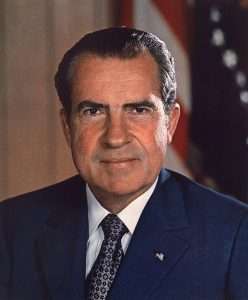
8/5/1974: Shortly after the Supreme Court decided United States v. Nixon, President Nixon released the "smoking gun" tape recorded in the Oval office.
What's on your mind?
Gov. Ron DeSantis has suspended Tampa-area elected state prosecutor Andrew Warren (see this executive order, and this article in the Tampa Bay Times [Lawrence Mower]) for "neglect of duty." The core of DeSantis's stated basis seemed to be this:
This helps show how varied executive government structures are in various jurisdictions in our country. In the federal system, of course, the President can generally fire any local U.S. Attorney, because the President is the one elected federal executive official who is in charge of the other executive officials. (There are some complications related to specially-appointed independent federal prosecutors, but that's a minor feature of the system.) In many states, on the other hand, prosecutors are elected by local voters and are basically answerable just to them. And in some other states, there's something of a mix, and indeed that seems to be the situation under the Florida Constitution, art. IV, sec. 7:
Can an active federal judge serve on a committee with the power to nominate another federal judge over the President's objection? You might think the answer is obviously no, but the D.C. Home Rule Act authorizes just such a process. And Judge Emmitt Sullivan (D.D.C.) chairs that committee. In 2020, Judge Laurence Silberman (C.A.D.C.) filed a misconduct complaint against Judge Sullivan. What happened after the complaint was filed is complicated. I described that complaint, and the ensuing proceedings, in a November 2021 blog post. I won't repeat the tortured posture here. Go read that post and come back. I'll wait. Welcome back.
Since November 2021, a lot has happened.
On February 14, 2022, the Judicial Council of the District of Columbia Circuit affirmed Chief Judge Srinivasan's ruling, which had dismissed Judge Silberman's complaint. Judge Silberman did not have a happy Valentine's Day. That order was joined by then-Circuit Judge Jackson, and District Judges Howell, Contreras, Cooper, and Chutkan. Judge Katsas wrote a dissent, which Judge Rao joined. Judge Walker seemed to agree with Judge Katsas's analysis, but would have affirmed the dismissal of the complaint. (For those keeping score at home, five Obama/Biden appointees were in the majority, and three Trump appointees were in dissent.)
Judge Katsas pithily summarized the dispute:
This misconduct proceeding arises from a dispute about whether a sitting federal judge may serve on a nominating commission for the District of Columbia courts. A divided committee of the Judicial Conference advised the judge in question that he may do so. Based on that advice, the Chief Judge of our circuit dismissed a misconduct complaint against the judge, and the Judicial Council now denies further review. In my view, the committee's advice was mistaken. For the D.C. courts as elsewhere, judicial selection is inescapably political. And it is thus improper for sitting federal judges to serve on the D.C. nominating commission, just as it would be improper for them to serve on nominating commissions for state or federal courts. The committee itself has long recognized the latter point, and its efforts to distinguish the D.C. commission are unpersuasive. Given the long history of sitting judges serving on the D.C. nominating commission and the advice of the committee, I would impose no sanction on the judge at issue for his past service on the commission. But I would conclude this proceeding only if the judge takes corrective action by resigning from the commission or ceasing to hear cases while serving on it. As my colleagues deny review unconditionally, I respectfully dissent.
Three days later, Judge Silberman noticed an appeal to the Executive Committee of the Judicial Conference of the United States and to the Committee on Judicial Conduct and Disability. The balkanized hierarchy of the various components of the Judicial Conference is extremely complicated. The Judicial Conference lists about twenty different committees, without any description of their function or membership. It wasn't clear to me, at least, which committee even had jurisdiction over Silberman's appeal. Ultimately, neither the Executive Committee of the Judicial Conference nor the Committee on Judicial Conduct and Disability would assert jurisdiction over the appeal. Instead, yet another committee would review the appeal.
On April 12, 2022, Judge Claire V. Eagan, the Chair of the Executive Committee of the Judicial Conference wrote back to Judge Silberman.
I am writing to inform you that your concern regarding the District of Columbia Home Rule Act requirement that a federal judge serving in the District of Columbia be appointed to and serve on the Judicial Nomination Commission for the selection of nominees for the District of Columbia courts has been referred to the Committee on the Judicial Branch for consideration of any issues that fall within its jurisdiction, with input from other Conference committees, as appropriate.
I was not able to find any meaningful information about the Committee on the Judicial Branch. Eagan's letter indicated that Judge Rodney W. Sippel (E.D.Mo.) chairs the committee. Who else serves, I could not tell you.
After jurisdiction was asserted by the Committee on the Judicial Branch, Judge Silberman withdrew his petition for review with the Judicial Conference Committee on Judicial Conduct and Disability. Silberman also sent a letter to Judge Sippel.
On August 1, 2022, Judge Sippel responded with a two page letter. The Committee concluded that "action on this matter, including any sort of recommendation from the Judicial Branch Committee to the Judicial Conference, is not warranted." Why is no recommendation warranted? Who knows. There is no actual analysis--just a bunch of conclusion. Don't take my word for it. Here is the entire explanation:
The Committee noted that there was no historical record to suggest that the Judicial Conference offered any comments to Congress when the D.C. Home Rule Act was pending or was amended. Furthermore, the Committee discussed that the statute had been operating without any concerns raised by members of the judiciary or the D.C. government prior to when you raised this issue in August 2020. After discussing the matter, including the composition of the Judicial Nomination Commission and the similarly situated Tenure Commission, the Committee concluded that the provision of the D.C. Home Rule Act requiring that a D.C. federal judge serve as a member of the Judicial Nomination Commission does not implicate separation of powers or entangle the serving judge in a political function such that it harms the reputation of the branch. In addition, the Committee concluded that the Home Rule Act did not seem to otherwise damage the reputation of the branch or enmesh the judiciary in local politics.
Judge Sippel explained that the Committee on the Judicial Branch discussed the issue at its meeting on June 15, 2022. It is not clear how this conclusory letter took six weeks to draft and deliver. No dissents were noted, but we do not know if the vote was unanimous. This Committee should be embarrassed with its work product. If any attorneys submitted such a shallow brief, the court would chew them out.
The following day, August 2, Judge Silberman wrote a letter to the Executive Committee of the Judicial Conference:
I am in receipt, as are you, of a rather puzzling letter from Judge Sippel, the Chairman of the Committee on the Judicial Branch. The Committee indicated that the prior correspondence and related documentation regarding my judicial misconduct complaint was "informative and helpful." Yet, its letter did not even cursorily engage with the extensive analysis in those materials. . . .
In sum, I have raised a serious question—no one doubts that—regarding judicial ethics and separation of powers. I believe the judiciary is entitled to a thoughtful analysis from the Judicial Conference. For the Conference to follow the advice of the Judicial Branch Committee would be an injudicious attempt to sweep under the rug a politically sensitive legal question.
Next up, the Executive Committee of the Judicial Conference will review this case. The members of this committee are appointed by Chief Justice Roberts. According to a February 2020 press release, the members are:
Judge Clair V. Eagan (N.D.OK) (Chair), Chief Judge Lavenski Smith (CA8), Judge Jeffrey Howard (CA1), Judge Sidney R. Thomas (CA9), Judge Robert James Conrad, Jr. (W.D.N.C.), and Judge L. Scott Coogler (N.D.AL).
The Press Release notes that Judge Robert Katzmann (CA2) was on the Committee, but he passed away. I'm not sure who replaced him. Moreover, James Duff was on the Committee, but he has stepped down, and was replaced by Judge Roselyn Mauskopf.
Judge Silberman does not seem confident with at least one member of the Executive Committee:
I note that a copy of the Committee's terse rejection of my position was sent to Judge Mauskopf. I suspect her involvement is unfortunate for me. Her predecessor, Jim Duff, had indicated sympathy for my views.
As I understand the structure, above the Executive Committee of the Judicial Conference is the Judicial Conference. The Chief Justice presides over the Judicial Conference, joined by the chief judge of each judicial circuit, the Chief Judge of the Court of International Trade, and a district judge from each regional judicial circuit. Who is on that Committee? I kid you not, the list of members on the Judicial Conference site has a broken link. Eventually, this issue will reach the top.
I can tell you that there will be an event in November on this topic. Stay tuned for more details.
As I mentioned yesterday, ten years ago I wrote a descriptive and analytical law review article called Private Employees' Speech and Political Activity: Statutory Protection Against Employer Retaliation, which aimed to catalog these often-little-known statutes. This year, I'm returning to the subject, trying to analyze the strongest arguments for and against such statutes. The article (Should the Law Limit Private-Employer-Imposed Speech Restrictions?) will be published later this year in a Journal of Free Speech Law symposium issue, together with other articles that stemmed from an Arizona State symposium on Non-Governmental Restrictions on Free Speech; and this week and next I'd like to serialize it here.
Tuesday and yesterday, I blogged the Introduction and the beginning of the argument in favor of such statutes; today, I turn to some arguments against such statutes (and you can see the whole article right now, if you'd like, by looking at the PDF).
[* * *]
Some have argued that employers have a constitutional right to refuse to associate with people whose political beliefs they reject.[1] But the Court has never extended the right not to associate that far.
The Court has held that the Constitution prohibits government action that substantially burdens "expressive association" by interfering with groups' ability to speak, including by choosing who speaks for them (more on this shortly).[2] It has held that the Constitution prohibits government action that substantially burdens "intimate association," so people would likely have a constitutional right to discriminate based on politics—as well as religion, sex, race, and other factors—in choice of spouses, adopted children, close friends, or roommates.[3]
But, in the words of Justice O'Connor's concurrence in the judgment in Roberts v. U.S. Jaycees, "there is only minimal constitutional protection of the freedom of commercial association";[4] she said this about membership decision by the Jaycees and similar nationwide organizations, but that even more clearly applies to employment. During the Lochner era, employers' right not to associate with people who engage in conduct of which they disapprove was indeed seen as protected by substantive due process[5]—but that time is long gone.[6]
This is the third in a series of posts summarizing an article titled Remand Without Vacatur and the Ab Initio Invalidity of Unlawful Regulations in Administrative Law, which is forthcoming in the BYU Law Review. The current draft is available on SSRN.
Regulations that are unlawful as that term is used in section 706(2) of the APA are void when adopted. The previous post reviewed the criteria that make a regulation unlawful under that provision, showing why satisfying any of the criteria makes a regulation void when adopted. This post sets out two more reasons for the conclusion that unlawful regulations are never binding.
First, review of regulations in enforcement proceedings, which the APA specifically contemplates, rests on the assumption that unlawful regulations are void before any court evaluates them.
"Except to the extent that prior, adequate, and exclusive opportunity for judicial review is provided by law, agency action is subject to judicial review in civil or criminal proceedings for judicial enforcement." 5 U.S.C. § 703. Section 706 governs the scope of review, so its criteria apply when review takes place in an enforcement proceeding. Enforcement proceedings often involve conduct that has already taken place; criminal enforcement proceedings always do so. If the enforcement court finds that the regulation being enforced is unlawful, the defendant prevails. That familiar result reflects the assumption that unlawful regulations are invalid before any court has the opportunity to find them so. If unlawful regulations were binding until displaced by a court, a violation of a regulation enforced by criminal punishment that took place before judicial displacement would be a crime. Violations of unlawful regulations are not crimes, because unlawful regulations are never valid.
Next, although the Supreme Court has not addressed the doctrine of remand without vacatur, it has had occasion to identify the features that make a regulation binding law. Chrysler Corp. v. Brown, 441 U.S. 281 (1979), concerned proprietary business information that Chrysler had submitted to the Defense Department. Chrysler sued Secretary Brown, seeking an order barring public disclosure of that information. Chrysler relied on the Trade Secrets Act, which forbade disclosure of specified business information "'to any extent not authorized by law.'" Id. at 295. As authorization for disclosure, the government pointed to a regulation issued by the Office of Federal Contractor Compliance Programs (OFCCP) of the Department of Labor.
To satisfy the Trade Secrets Act, the Court found, a regulation had to have the force and effect of law, and the OFCCP regulations lacked binding legal force. The Court concluded that the statutes on which the government relied as authorizing the regulations did not do so. Nor had the regulations been adopted through the procedure required to make binding rules, because the Department of Labor had characterized them as interpretative and had not conducted notice and comment rulemaking. Lacking statutory authorization and the correct procedure, the regulations were not legally binding.
The Court's conclusion in Chrysler Corp. is unsurprising. Of course statutory authorization and proper adoption procedures are necessary conditions for the promulgation of a legally binding regulation. The anomaly is not Chrysler Corp., but remand without vacatur. According to that doctrine, regulations have the force of law even if they rest on no statute, and even if they were not adopted through the process Congress requires.
As the preceding post and this post have shown, the principles that govern the ab initio validity of unlawful agency regulations are different from the principles that govern the binding force of lower-court decrees that rest on error. The latter are binding when issued, but the former generally are not. I say generally, because within constitutional limits, Congress has power to give an agency authority to act with provisionally binding effect, even when the agency acts contrary to a statutory directive. When Congress does that, it often can enable courts to take a step that undoes the agency's action and functionally resembles vacatur by an appellate court. With respect to regulations that impose duties of conduct on private parties, however, Congress rarely does so. The analogy between agencies and lower courts on which remand without vacatur rests is unsound.
The next post considers remand without vacatur in two additional contexts. First, it deals with statutes regulating private conduct that eliminate enforcement-stage judicial review, replacing it with a form of pre-enforcement review. Although systems of review of that kind might be thought to depart from the principle of ab initio invalidity of unlawful regulations, they do not. Second, the next post briefly discusses agency activities other than regulation of private conduct. I explain that the analogy between agencies and lower courts on which remand without vacatur rests hinders proper understanding of the courts' responses to the wide variety of agency activities.
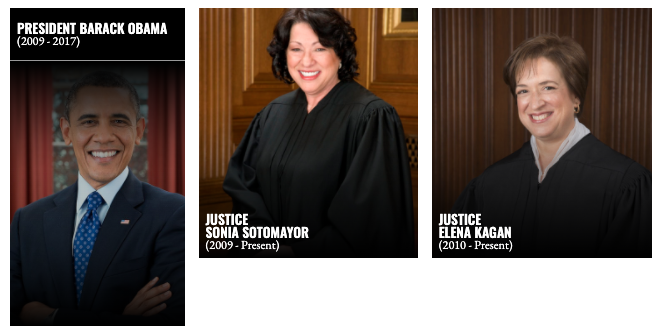
8/4/1961: President Barack Obama's birthday. He would appoint two Justices to the Supreme Court: Sonia Sotomayor and Elena Kagan.
This is the second in a series of posts summarizing an article titled Remand Without Vacatur and the Ab Initio Invalidity of Unlawful Regulations in Administrative Law, which is forthcoming in the BYU Law Review. The current draft is available on SSRN.
As the previous post explained, most of the federal courts of appeals adopt an administrative law doctrine called remand without vacatur. These posts and the article on which they are based are concerned mainly with the doctrine's application to agency regulations that impose duties on private people. Under the doctrine, a court that finds that a regulation is unlawful has the option whether to eliminate the regulation's binding legal effect – to vacate the regulation – or to leave that binding effect in place, while directing the agency to conduct further proceedings – to remand without vacating.
That line of reasoning rests on the assumption that unlawful regulations are binding when issued, despite being unlawful, until a court displaces them. That assumption is incorrect.
This post and the next will show that unlawful regulations are in general void when issued. By unlawful regulation, I mean a regulation described as such in section 706(2) of the APA. Section 706(2) tells the courts to "hold unlawful and set aside agency action found to be (A) arbitrary, capricious, an abuse of discretion, or otherwise not in accordance with law; (B) contrary to constitutional right, power, privilege, or immunity; (C) in excess of statutory jurisdiction, authority, or limitations, or short of statutory right; (D) without observance of procedure required by law."
This post examines the APA's criteria, showing that satisfying one of them entails ab initio invalidity, not initial validity combined with voidability by a reviewing court. The next post sets out two more grounds for the conclusion that unlawful regulations are void ab initio.
Regulations that are unlawful on any of the grounds set out in section 706(2) are void when adopted. Ab initio invalidity is clearest with respect to regulations that satisfy section 706(2)(B). Congress cannot authorize an agency to do what Congress itself cannot do: make a binding rule that is contrary to the Constitution. An unconstitutional statutory rule "is never really part of the body of governing law (because the Constitution automatically displaces any conflicting statutory provision from the moment of the provision's enactment)." Collins v. Yellen, 141 S. Ct. 1761, 1788-1789 (2021). Just as unconstitutional statutes never become part of the body of governing law, unconstitutional regulations never have binding force. Their invalidity does not wait for judicial action.
Also clear as to ab initio invalidity is section 706(2)(C), which has a constitutional foundation. Because executive and legislative power are separated, executive officials can impose binding duties on private people only with statutory authorization. As a limit on the power to make binding rules, that principle operates ab initio, just as limits on Congress's enumerated powers operate ab initio. Regulations that go beyond statutory authorization, which section 706(2)(C) describes as unlawful, are invalid when promulgated. If they were not, agencies could issue regulations that did not rest on any statutory authorization at all, and private people would have to comply until a court said otherwise.
Section 706(2)(A) is especially familiar to administrative lawyers, and as they know, it deals with both the substance of agency action and an agency's rationale for its decision. A regulation is arbitrary and capricious if it is objectively unreasonable, or if it is unsupported by sound agency reasoning. Both aspects of the requirement call for ab initio invalidity, not voidability.
A substantively irrational regulation is, by definition, one with which regulated parties should not have to comply. Substantively irrational regulations have that feature when they are adopted, so the reason regulated parties should not have to comply with them operates ab initio. A court that directed a private party to comply with an objectively unreasonable regulation, as a court can do under the doctrine of remand without vacatur, would itself be acting irrationally.
Matters are slightly more complicated as to the requirement that agency decisions be reasonably explained. Courts devised remand without vacatur mainly in cases in which the agency's reasoning was inadequate and the court found that the agency likely could repair the flaws in its explanation. Objectively rational and otherwise lawful regulations should not be displaced, the courts reasoned, because the agency's stated rationale had defects. Although that line of thinking has surface attraction, it fails because of the main reason for giving agencies regulatory authority: agencies' combination of substantive expertise and political accountability. A regulation that does not rest on the agency's properly articulated judgment does not have the underpinnings that justify compliance with it. A system in which inadequately reasoned regulations are binding but voidable by courts calls on the courts to make the judgments that only agencies may properly make when the courts decide to continue in force an inadequately reasoned regulation.
Section 706(2)(D) describes as unlawful regulations adopted without procedures required by law. Adoption through required procedures is a standard prerequisite for validity elsewhere in public law. A bill that does not become a law through the process set out in Article I, section 7 is not a binding statute, for example. If remand without vacatur is an option, Congress has not made procedural regularity a necessary condition for validity – regulations adopted without proper procedure are binding, albeit unlawful and subject to some form of judicial displacement. Congress does occasionally impose a procedural requirement while telling the courts that failure to follow it does not automatically make a regulation invalid. In general, however, Congress imposes procedural requirements, like notice and comment, because it has concluded that if those requirements are not followed, the output cannot be relied on as sound policy. That rationale applies at the point of adoption.
Section 706(2) does not use "unlawful" lightly. That word describes regulations that do not have the force of law.
My forthcoming article the good, the bad, and the likely implications of the Supreme Court's decision West Virginia v. EPA
In West Virginia v. Environmental Protection Agency, the Supreme Court correctly concluded that the Obama Administration and U.S. Court of Appeals for the D.C. Circuit embraced an overbroad understanding of the EPA's authority under Section 7411 of the Clean Air Act. The way the Court reached that conclusion left something to be desired, however. As I discuss in my forthcoming analysis of the case for the Cato Supreme Court Review, the Court front-loaded its consideration of the major questions doctrine and failed to fully engage with the relevant statutory provisions. It also missed an opportunity to refocus the major questions doctrine on what really matters in cases like this: What power did Congress delegate to the agency.
A draft of West Virginia v. EPA: Some Answers about Major Questions, is up on SSRN. Here is the abstract:
In West Virginia v. Environmental Protection Agency (WV v. EPA) the Supreme Court rejected an expansive reading of Section 7411 of the Clean Air Act. Expressly invoking the "major questions doctrine" for the first time in a majority opinion, the Court concluded Section 7411 of does not allow the EPA to require generation shifting to reduce greenhouse emissions. This decision rested on the longstanding and fundamental constitutional principle that agencies only have that regulatory authority Congress delegated to them. The Court further bolstered the argument that delegations of broad regulatory authority should not be lightly presumed, but also left substantial questions about the major questions doctrine unanswered. By skimping on statutory analysis and front-loading consideration of whether a case presents a major question, the also Court failed to provide much guidance for lower courts. While WV v. EPA represents a missed opportunity to clarify and ground the major questions doctrine, it remains a tremendously important decision, and will be cited routinely in legal challenges to new regulatory initiatives. While limiting the scope of Section 7411, the decision did not curtail the EPA's traditional air pollution control authorities, nor does it preclude the EPA from using such authorities to regulate GHGs. It does, however, make it more challenging for the EPA or other agencies to develop new climate change policies relying upon preexisting statutory authority directed at other problems.
I also blogged fairly extensively on the case. Some of the points I made in my posts made it into the article above, but some did not. Here are links to my various posts on WV v. EPA:
- Could the Supreme Court Revive the Trump Administration's ACE Rule? - Oct. 7, 2021
- Supreme Court Agrees to Hear Case Challenging EPA Authority to Regulate Greenhouse Gases (Updated) - Oct. 29, 2021
- Why the Supreme Court's Decision in NFIB v. OSHA May Be Even Worse News for Climate Regulation than You Thought - Jan. 24, 2022
- Does the Supreme Court Have Jurisdiction to Hear West Virginia v. EPA? - Feb. 2, 2022
- Standing in West Virginia v. EPA Revisited - Feb. 21, 2022
- Climate Change Returns to the Supreme Court: Previewing West Virginia v. EPA (Updated) - Feb. 23, 2022
- "Supreme Court Digs into Statutory Details More than Standing or Nondelegation in West Virginia v. EPA." - Feb. 28, 2022
- EPA Pushes Back Power Plant Greenhouse Gas Regulations While Awaiting Supreme Court Ruling - June 22, 2022
- Supreme Court Rejects Broad EPA Authority to Regulate Greenhouse Gases from Power Plants (Updated) - June 30, 2022
- Justice Kagan Throws Down the Gauntlet: We Are Not "All Textualists Now" - July 1, 2022
- Does West Virginia v. EPA Doom the SEC's Climate Disclosure Rule? (Updated) - July 13, 2022
I also recommend Tom Merrill's series of posts about the case. I do not agree with him in every particular, but his posts are quite worthwhile, and we seem to reach the same general bottom line. As he argues in his final post, the real question in cases like WV v. EPA is whether Congress actually delegated the power asserted by the agency, and that is a question courts must answer--and should answer without taking the sort of major-question-shortcut the Court took in WV v. EPA. Tom makes the case for this approach in his new book on Chevron, The Chevron Doctrine: Its Rise and Fall, and the Future of the Administrative State. I make a more rudimentary argument for this sort of approach in my recent book chapter, A "Step Zero" for Delegations.
Everything you ever wanted to know about dating apps and the search for love
I am happy to announce the launch of a new project concocted by psychologist Michelle Lange and myself: our podcast "Strangers on the Internet", which gives listeners an academic take on dating apps, love, safety, relationships, and much more. Its official website is here (click the link and then hit the "Follow" button to add the podcast on your preferred platform) and the direct link to its Apple Podcasts home is here.
So far, our episodes cover topics such as how to figure out if you're ready to be on dating apps, how to choose an app and build an effective profile, and how to handle first chats. We hope that this multidisciplinary project will be both informative and enjoyable, and we also invite listeners to join our Facebook group and follow us on Twitter and Instagram.
Celebrate your independence with a subscription to Reason magazine, your most trusted source of honest, insightful news and analysis.




