"Meanwhile, if a tree falls in the forest and there is nobody there to hear it, everyone will still tell the public what it sounded like and what it means."
Understandably, the nation is fixated on this election. This is a matter of great national importance, and its importance stretches far beyond Arizona's borders.
It is no surprise that there is great skepticism on one side of the political divide and there is unqualified trust on the other. Society has degraded to the point that many Americans are skeptical of the good faith, the competence, and the bias of governmental institutions. However, this skepticism almost always comes down as a "Red" versus "Blue" issue. If a Republican makes a claim, one can expect "Team Blue" to scream at the top of their lungs that she must be corrupt, or worse. If a Democrat does the same, the "Red Team" is not going to take her statement at face value. We then depend on the press, such as it is, to inform us all so that we can at least hope to know what in tarnation is going on.
Our press is no less divided than our electorate. Our press has descended into a morass of competing partisan reporting that is no longer something Edward R. Murrow or Ben Bradlee would respect. Nevertheless, when the Free Press clause was placed in the Constitution, our national press was possibly even more divided and biased than it is today…. Anyone with any degree of media literacy today would be unlikely to say that we have not returned to our roots. The only difference is that today, the mainstream press operates much like the Party Press of the early Republic, but they try and perpetrate the fiction that it is not so.
Meanwhile, if a tree falls in the forest and there is nobody there to hear it, everyone will still tell the public what it sounded like and what it means. National Public Radio will report that it happened because Donald Trump caused it with a post on Truth Social. This claim would be followed by a two hour exposé on how trees in forests are racist. Fox News will report the same story, but suggest that the tree fell because Hillary Clinton was trying to kill a frog who had information about her being on Epstein's island. Who are we to believe? We are all free to make that choice, but the greater the diversity of voices in the marketplace of ideas, the better informed the public.
Thinking back on the election—as one who had expected and hoped for a much better showing for the Republicans—I was reminded of Kipling's The Lesson, an English perspective on the Boer War. Naturally, there are many, many points of difference; yet I think there is still something helpful here:
Let us admit it fairly, as a business people should,
We have had no end of a lesson: it will do us no end of good.
Not on a single issue, or in one direction or twain,
But conclusively, comprehensively, and several times and again,
Were all our most holy illusions knocked higher than Gilderoy's kite.
We have had a jolly good lesson, and it serves us jolly well right! …
It was our fault, and our very great fault, and not the judgment of Heaven.
We made an Army in our own image, on an island nine by seven,
Which faithfully mirrored its makers' ideals, equipment, and mental attitude—
And so we got our lesson: and we ought to accept it with gratitude.
We have spent two hundred million pounds to prove the fact once more,
That horses are quicker than men afoot, since two and two make four;
And horses have four legs, and men have two legs, and two into four goes twice,
And nothing over except our lesson—and very cheap at the price….
Let us approach this pivotal fact in a humble yet hopeful mood—
We have had no end of a lesson, it will do us no end of good!
It was our fault, and our very great fault—and now we must turn it to use.
We have forty million reasons for failure, but not a single excuse….
Jane Doe works for the Defense Intelligence Agency; when she was an intern at the DIA, she competed in the Miss United Nations pageant, but as Miss China; according to the Complaint in Doe v. Austin,
Uncertainty about her employment … led her to be a late entrant. By the time Ms. Doe entered the pageant, the representative for the United States had already been selected. The pageant organizers recommended that she participate as Miss China; the previous year's Miss China had been an American citizen, someone that Ms. Doe knew personally.
Ms. Doe agreed to participate as Miss China based on her heritage, not her nationality, paying all the participation expenses out of her own personal funds and accepting no money from any domestic or foreign entity. She did not win the competition.
Doe claims that (among other things) she was subject to higher scrutiny at the DIA because of this:
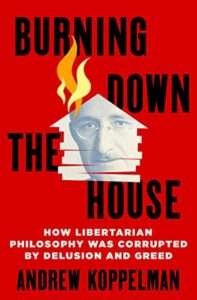
I have many reservations about this book. But it's hard to deny that it has helped kick off a debate about the strengths and weaknesses of modern libertarianism. And Yale Law School Prof. Jack Balkin has - with Koppelman's help - assembled an impressively diverse crew of commentators for the symposium.
Andrew Koppelman's Burning Down the House makes some worthwhile points, and I agree with more of it than I would have expected. But it is also something of a missed opportunity. Koppelman attempts a critical analysis of libertarian political thought and its impact on public policy. But he overlooks major aspects of both.
Let's start with a few points of agreement. Early in the book, Koppelman recognizes that free markets have made enormous contributions to human freedom and welfare… He also notes the validity of F.A. Hayek's classic critique of economic central planning, on the ground that governments lack the knowledge needed to plan economic production competently. Perhaps most strikingly, he points out that many on the left fail to recognize the contradiction between their support for diversity and their sympathy for socialism; the latter is likely to stifle the former. As Koppelman puts it, "[m]any on the left repudiate capitalism because they don't grasp the anti-socialist logic of their present views…"
Koppelman is also right to point out that some prominent advocates of libertarianism – most notably Ayn Rand and Murray Rothbard – have made a variety of weak and sometimes even downright silly arguments. Many of these weaknesses have been covered before, including by other libertarians. But Koppelman's listing of them is particularly helpful and accessible….
Sadly, Koppelman's relatively thorough dissection of Rand and Rothbard is coupled with neglect of more recent and more sophisticated thinkers. As a result, he overlooks crucial ways in which libertarians have addressed many of the points he raises. When it comes to effects on public policy, he overlooks many of the areas where libertarian ideas have had their biggest impact, while greatly overstating their effect in a few fields where he finds it particularly objectionable…..
This focus weakens many parts of the book. Here, I cover just a few examples related to my own areas of expertise.
To my mind, the Koppelman's single most significant omission is the neglect of modern libertarian critiques of democratic government, particularly those focused on voter ignorance and bias. After all, regulation and redistribution by democratic processes is the principal left-liberal alternative to libertarianism.
Prominent libertarian scholars such as Bryan Caplan and Jason Brennan have shown that the vast majority of voters are both ignorant of basic facts about politics and government, and highly biased in their evaluation of what they do know….
If the policies of democratic governments are heavily influenced by voter ignorance and bias, the quality of those policies is likely to be greatly reduced. This poses a particularly serious challenge for Koppelman and others who call for carefully calibrated policies that deftly balance competing considerations….
Another vital branch of libertarian scholarship that Koppelman overlooks is the study of private-sector solutions to public goods problems and externalities. This has been a major focus of libertarian thought at least since Nobel Prize-winning economist R.H. Coase's pathbreaking work in the 1960s…..
Libertarianism's supposed neglect of public goods and externalities problems is a major theme of Koppelman's book. Yet he does not seriously consider the extensive modern libertarian literature on these very issues.
Finally, despite his discussion of property rights focused on the classic writings of John Locke and Robert Nozick, Koppelman also overlooks the vast bulk of modern libertarian property scholarship….
Koppelman's excessively narrow focus also shows up in his discussion of libertarian impacts on policy, where he stresses the supposed effects of categorical rejection of redistribution, and climate denialism. He claims that "the Republican Party became increasingly Rothbardian: reflexively opposed to all taxation and regulation."
In reality, even in its most libertarian-friendly period under Reagan, the GOP never came close to rejecting "all taxation and regulation." At most, it advocated tighter restrictions on these policies.
In its more recent Trumpian "national conservative" incarnation, the Party has embraced large-scale protectionism, industrial planning, and massive migration restrictions….
The exaggerated focus on redistribution and climate change leads Koppelman to overlook multiple policy areas where libertarian ideas have had much greater impact. Examples include Milton Friedman's key role in the abolition of the draft, his remarkably successful advocacy of anti-inflationary monetary policy (adopted by numerous central banks), the rise of school choice in the US and Europe (another idea effectively popularized by Friedman), and the extensive role of libertarians in promoting stronger constitutional protection for property rights….
None of the modern libertarian ideas discussed above is unassailable, and most have generated significant counter-arguments…..
But sustained critical engagement with modern libertarianism cannot neglect these issues. It has to address the best of modern libertarian thought, and systematically consider those issues where libertarian ideas have had their greatest impact.
Today marks the 40th anniversary of our becoming U.S. citizens, seven years after we arrived here from what was then the U.S.S.R. It's been an excellent 40 years for us, and many thanks to our fellow citizens for that!
The Washington Post just had a big article on October 30 about racial and gender diversity among Supreme Court clerks, and followed it up with a smaller piece on November 1 about elite law-school hiring patterns for Supreme Court clerks. Since that second article quoted me on elite law-school advantage (and I use "elite" as a shorthand to refer to Harvard, Yale, and more generally any law school in U.S. News's Top 14 (T14)), I thought I would elaborate on my views, because one's full views are invariably more complex than what you get from reading a three-sentence soundbite.
When talking about clerk hiring, a few questions might be interesting: (1) Is there an elite-school hiring pattern for federal clerks at the highest level? (2) If yes, is that elite-school hiring pattern justifiable? (3) If the answer to (1) is yes, can law students at non-elite schools still get good clerkships? (4) If the answers to (1) and (2) are yes, and if I'm a professor at a non-elite school, am I a trustworthy law clerk advisor and recommender? Stay tuned for my four answers: yes, yes, yes, and yes! Specifically:
Yes, for U.S. Supreme Court clerks; much less so for other clerkships.
Yes, it's a not unreasonable preference for U.S. Supreme Court Justices who are busy and have to make decisions based on very incomplete information; I might well do the same if I were a Supreme Court Justice.
Yes: even on the U.S. Supreme Court, students from non-elite law schools can get clerkships, and there are so many positions at courts that are not the U.S. Supreme Court that many students from good-but-not-elite law schools can get excellent clerkships.
Yes: what a hypothetical me would do in a hypothetical situation if I had a different set of priorities has no bearing, either logically or in practice, on my willingness to help you, my actual students in the real world, get excellent clerkships.
We open this episode of the Cyberlaw Podcast by considering the (still evolving) results of the 2022 federal election. Adam Klein and I trade thoughts on what Congress will do. Adam sees two years in which the Senate does a lot of nominations, the House does a lot of investigations, and neither does much legislation. Which could leave renewal of a critically important intelligence authority, Section 702 of FISA, out in the cold. As supporters of renewal, Adam and I conclude that the best hope for the provision is to package it with trust-building measures to guard against partisan misuse of national security authorities.
I also note that foreign government cyberattacks on our election machinery, something much anticipated in election after election, once again failed to make an appearance. At this point, I argue, election interference falls somewhere between Y2K and Bigfoot on the "things we need to worry about" scale.
In other news, cryptocurrency conglomerate FTX has collapsed in a welter of bankruptcy, stolen funds, and criminal investigations. Nick Weaver lays out the gory details.
Nick also covers This Week in the Twitter Dogpile. He recognizes that this whole story is turning into a tragedy for all concerned, but he's determined to linger on the moments of comic relief. Dunning-Krueger makes an appearance.
Chinny and I speculate on what may emerge from the Biden administration's plan to reconsider the relationship between CISA and the Sector Risk Management Agencies that otherwise regulate important sectors. I predict that it will spur turf wars and end in new coordination authority for CISA. In addition, the Obama administration's egregious exemption of Silicon Valley from regulation as critical infrastructure should also be on the chopping block. Finally, if the next two Supreme Court decisions go the way I hope, the FTC will finally have to coordinate its privacy enforcement efforts with CISA's cybersecurity standards and priorities.
Adam reviews the European Parliament's report on Europe's spyware problems. He's impressed (as am I) by the report's willingness to acknowledge that this is not a privacy problem made in America. Governments in at least four European countries by our count have recently used spyware to surveil members of the opposition party, a problem that has been unthinkable for seventy years in the United States. Though maybe not any more, which, we agree, is another reason for Congress to quickly put into place more guardrails against such abuse.
Nick notes the US government's seizure of what was $3 billion in bitcoin. Shrinkflation has brought that value down to around $800 million. But it's worth noting that an immutable blockchain brought James Zhong to justice ten years after he took the money.
Disinformation – or the appalling acronym MDM (for mis-, dis-, and mal-information) – has been in the news lately. A recent paper counted the staggering cost of efforts to suppress "disinformation" during covid times. And Adam published a recent piece in City Journal explaining just how dangerous the concept has become. We end up agreeing that national security agencies need to focus on foreign government dezinformatsiya – falsehoods and propaganda from abroad – and not get in the business of policing domestic speech, even speech that sounds a lot like foreign leaders we don't like.
Chinny takes us into a new and fascinating dispute between the copyleft movement, GitHub, and a new kind of AI that writes code. The short version is that GitHub has been training an AI engine on all the open source code on its site so that an algorithm can "autosuggest" lines of new code as you're writing the boring parts of your program. Sounds great, except that the resulting algorithm tends to reproduce the code it was trained on --- without imposing the license conditions, such as copyleft, that were part of the original code. Not surprisingly, copyleft advocates are suing on the ground that important information was improperly stripped from their code, particularly the provision that turns all code that incorporates their open source into open source itself. I remind listeners that this incorporation feature is why Microsoft famously likened open source to cancer. Nick tells me that it's really more like herpes, demonstrating that he has apparently had a lot more fun writing code than I ever had.
In updates and quick hits:
I note that the nuclear spies who hid their stolen data in a peanut butter sandwich have been sentenced.
I celebrate the Russian government's acknowledgment of the Cyberlaw Podcast's reach by virtue of its designation of long-time regular Dmitri Alperovitch for Russian sanctions. Occasional guest Chris Krebs also made the list.
Adam and I flag DOJ's release of basic rules for what I'm calling the Euroappeasement Court: the quasijudicial body that will patiently attend to European complaints that the US isn't living up to human rights standards that no country in Europe even pretends to live up to.
You can subscribe to The Cyberlaw Podcast using iTunes, Google Play, Spotify, Pocket Casts, or our RSS feed. As always, The Cyberlaw Podcast is open to feedback. Be sure to engage with @stewartbaker on Twitter. Send your questions, comments, and suggestions for topics or interviewees to CyberlawPodcast@steptoe.com. Remember: If your suggested guest appears on the show, we will send you a highly coveted Cyberlaw Podcast mug!
The views expressed in this podcast are those of the speakers and do not reflect the opinions of their institutions, clients, friends, families, or pets
So held Judge Matthew Kacsmaryk (N.D. Tex.) Friday in Neese v. Becerra; the opinion is long, but here's an excerpt:
Section 1557 of the Affordable Care Act prohibits discrimination "on the basis of sex." See 42 U.S.C. § 18116(a) (incorporating, among other things, Title IX's prohibition of discrimination "on the basis of sex," 20 U.S.C. § 1681(a), into Section 1557). In Bostock, the Supreme Court held Title VII's "because of … sex" terminology prohibits "sexual orientation" and "gender identity" discrimination in employment. Citing Bostock, the United States Department of Health and Human Services ("HHS") announced it would "interpret and enforce" Section 1557's prohibition on discrimination "on the basis of sex" to include "on the basis of sexual orientation" and "on the basis of gender identity."
Plaintiffs—two Texas-based physicians—allege Defendants misread Bostock and argue that healthcare providers may continue sex-specific medical decisions relevant to "gender identity" "so long as one does not engage in 'sex' discrimination when doing so." Specifically, Plaintiffs allege neither Section 1557 nor Bostock prohibits such discrimination, "as long as they would have acted in the exact same manner if the patient had been a member of the opposite biological sex." Plaintiffs "object only to the Secretary's claim that Bostock defined 'sex' discrimination to encompass all forms of discrimination on the basis of sexual orientation or gender identity." Plaintiffs state they "fully intend to comply with Bostock and its interpretation of 'sex.'"
Plaintiffs make sex-specific decisions relevant to "gender identity" in their medical practices—and both receive federal money subject to Section 1557. Dr. Neese "has treated patients suffering from gender dysphoria in the past and has on occasion prescribed hormone therapy for them." But Dr. Neese "does not believe that hormone therapy or sex-change operations are medically appropriate for everyone who asks for them, even if those individuals are suffering from gender dysphoria, and she will on occasion decline to prescribe hormone therapy or provide referrals for sex-change operations." "Dr. Neese is categorically unwilling to prescribe hormone therapy to minors who are seeking to transition, and she is equally unwilling to provide referrals to minors seeking a sex-change operation." She "believes that it is unethical to provide 'gender affirming' care to transgender patients in situations where a patient's denial of biological realities will endanger their life or safety."
From In re Paxton, decided yesterday by the Fifth Circuit (Judge Stuart Kyle Duncan, joined by Judge Cory Wilson, with Judge Patrick Higginbotham agreeing on this point):
Believing Texas intends to enforce its abortion laws to penalize their out-of-state actions, Plaintiffs sued Texas Attorney General Ken Paxton. Paxton moved to dismiss the suit for lack of subject matter jurisdiction. Plaintiffs then issued subpoenas to obtain Paxton's testimony…. [T]he district court … ordered Paxton to testify either at a deposition or evidentiary hearing.
No, said the Fifth Circuit, for various reasons, including this:
"[E]xceptional circumstances must exist before the involuntary depositions of high agency officials are permitted." Before requiring such "apex" testimony, courts must consider: (1) the deponent's high-ranking status; (2) the substantive reasons for the deposition; and (3) the potential burden the deposition would impose on the deponent. A district court commits a "clear abuse of discretion" when it compels apex testimony absent extraordinary circumstances. No such circumstances exist here.
Only the second and third factors are disputed. As for the second factor, substantive need, the district court found Paxton's testimony was necessary to clarify his enforcement policy due to purported contradictions between his court filings and public statements. It concluded testimony was needed from Paxton himself because he had "unique, first-hand knowledge" from "ha[ving] inserted himself into this dispute by repeatedly tweeting and giving interviews about the [challenged law]." "Paxton alone," the district court thought, could "explain[ ] his thoughts and statements." We disagree.
In U.S. v. Harper, decided Sept. 30, 2022 by Chief Judge Leonard Strand (N.D. Iowa), but just posted on Westlaw, Harper is being prosecuted for being a felon in possession of a gun, as well as possessing a gun while an unlawful drug user. Harper raised, among other things, a RFRA defense, on the theory that "he is a Muslim who practices 'Sharia Law and its adherence to armed self-defense (including the possession of a firearm.).'" No, said the court:
Of course, the Government is not prosecuting Harper for practicing Sharia law. Rather, it is prosecuting him for possessing a firearm based on his status as a felon and unlawful user of a controlled substance and Harper is asserting his practice of Sharia law as a defense…. I must consider whether an accommodation should be made to prosecution under § 922(g)(1) and (3) based on Harper's religious belief that he is entitled to carry a firearm for self-defense that would still further the Government's compelling interest….
"Congress enacted RFRA in order to provide greater protection for religious exercise than is available under the First Amendment." RFRA provides that "Government shall not substantially burden a person's exercise of religion even if the burden results from a rule of general applicability," unless the Government "demonstrates that application of the burden to the person (1) is in furtherance of a compelling governmental interest and (2) is the least restrictive means of furthering that compelling governmental interest." "RFRA requires the Government to demonstrate that the compelling interest test is satisfied through application of the challenged law 'to the person'—the particular claimant whose sincere exercise of religion is being substantially burdened." …
I will assume without deciding that Harper's practice of possessing a firearm for self-defense was a sincerely held religious belief and that prosecution substantially burdened his exercise of religion. Therefore, it is the Government's burden to prove that prosecution of Harper is in furtherance of a compelling government interest and that it is the least restrictive means of furthering that interest. The Government argues "the gun control regime of the United States is a compelling governmental interest and can only be maintained by a systematic and uniform application."
Students and speakers at the University of California Hastings College of the Law will now have better protections for free speech. The school updated its policy on events and eliminated the heckler's veto.
As a result, protesters at the public university can no longer shout down speakers or cause a disruption with the goal of ending an event, according to the new policy….
The Event Policy prohibits "forms of protest that substantially disrupt an in-person or virtual event in a way that has the effect of silencing a speaker," but still recognizes and protects peaceful protest such as banner holding, counter events, and engaging in question and answer periods as part of the "essential right to protest."
"UC Hastings is committed to free expression, student support, and diversity, equity and inclusion," communications director Elizabeth Moore told The Fix via email. "Our new event policy—together with the supportive services that we offer to all students – works to achieve these values simultaneously."
Racial classifications by law have been as American as apple pie, since at least the 19th century. Modern Americans tend to shake their heads with revulsion when they think about or read about the lengths that government authorities went to back in the day to determine who was black for purposes of Jim Crow laws, or who was Asian for purposes of racist immigration and naturalization laws. But the irony is that while we don't really think about it very often, racial classification dictated by government rules is more common today than probably ever before in American history. So many common activities—when you register your kid for school, when you apply for a job, when you apply for a mortgage and many other everyday occurrences—involve checking a box saying first whether you're Hispanic or not and then which racial group you consider yourself to be a member of.
These modern racial classification norms did not arise spontaneously but are a product of maybe one of the most consequential government rules you've never heard of, a rule called Statistical Directive No. 15, which was promulgated by the Office of Management and Budget (OMB) in 1977. At the time, this was considered a rather modest rule change, because federal agencies had already been gathering data about various groups in the United States, but the data were inconsistent. For example, there were at least eight ways of identifying the groups that we now call Hispanic back in the '70s, so you had apples and oranges. You couldn't compare data from one agency to another because there were no consistent classifications and definitions of the classifications. So the OMB said, "Okay. We just have to regularize this." They formed a committee to do so, to which very little attention was paid, and eventually they came up with our modern classifications.
And Powerline turns my speech on racial classification at Berkeley Law into a podcast. And yes, I started the speech by lambasting the student groups who have implemented a "no one who thinks Israel should exist is allowed to speak here" policy.
In State v. Young, decided yesterday by the New Jersey Appellate Division (Judges Mary Gibbons Whipple, Hany Mawla and Morris Smith), defendant was arrested for drunk driving on April 7, 2020.
After officers advised defendant that she was under arrest, she resisted being handcuffed and began screaming profanities at the officers. As she was being placed into a police vehicle, she kicked an officer in the chest. According to the complaint summons, "following the arrest[,] … defendant … repeatedly coughed and verbally threaten[ed] … troopers with being exposed and infected with the COVID-19 virus." The arresting trooper's affidavit of probable cause stated: "While being transport[ed] … to the … [s]tation and while processing … defendant, she forcefully coughed and repeatedly [told t]roopers that she would give them the COVID-19 virus." …
A court grants summary judgment in a #TheyLied case, after the defendant had stopped defending it, concluding that "Ms. Abid's refusal to litigate is purposeful and consistent with her malign, manipulative character shown in this record."
From Reiterman v. Abid, decided yesterday by Judge William Jung (M.D. Fla.) (you can also see a summary of the facts as alleged by the plaintiff in his Motion for Summary Final Judgment, and you can also read more on the case from the Eleventh Circuit here):
This matter arose due to Defendant Farah Abid's aggressive, anonymous, and pervasive cyber-defamation campaign against Plaintiff Reiterman. The campaign was remarkably extensive and forceful, in effect seeking to destroy Reiterman by painting him in the most graphic terms as a racist and serial rapist. The matter first arose out of a brief personal relationship between Reiterman and Abid. Over a year after this relationship concluded, Abid reported Reiterman to local police and prosecutive authorities for sexual assault. These two offices investigated, and closed their file with no action, as did the Florida Attorney General's office. Thereafter, the cyber campaign began, which evinced the disturbed mind of Defendant Abid.
The Court need not here outline all the details of this cyber campaign. Suffice it to say, Farah Abid directed this cyber campaign to destroy Reiterman's tenure at law school, budding career, and life. It was multi-faceted, intricate and extensive, sly, anonymous, and horrible. Reiterman filed this lawsuit after Abid breached a prior court settlement in which she had agreed to stop this scheme, but then continued her cyber campaign.
The operative complaint is found at docket 1. Abid consented to jurisdiction in this Court by waiving service of process, and appearing on the merits with able counsel. Through her counsel, Abid moved to compel arbitration under the prior settlement. The Court held an evidentiary hearing on this motion, where Abid then lied under oath about her involvement and other material issues. The undersigned found that Abid lied under oath. The Court held that she had novated the subject arbitration clause through her earlier statements and actions. Abid then took an appeal, which the Eleventh Circuit denied with a written opinion after oral argument. Reiterman v. Abid, 26 F.4th 1226 (11th Cir. 2022).
Earlier today, a bipartisan group of senators reached agreement on a package of amendments to the Respect for Marriage Act (RMA) that ensure it will have at least 60 votes in the Senate, enough to defeat a filibuster. As I explained in a post on the original legislation, which passed the House of Representatives in July, RMA arose from fears that the Supreme Court's reversal of Roe v. Wade in Dobbs presages a reversal of Obergefell v. Hodges, the 2015 ruling striking down state laws barring same-sex marriage.
Section 3 of the original RMA bars states from denying recognition to marriages contracted in other states "on the basis of the sex, race, ethnicity, or national origin" of the parties to the marriage. Section 4 requires the federal government to recognize - for purposes of federal law - any marriage that is "valid in the State where the marriage was entered into or, in the case of a marriage entered into outside any State, if the marriage is valid in the place where entered into and the marriage could have been entered into in a State." It thereby negates a key provision of the 1996 Defense of Marriage Act.
According to a summary released by Sen. Tammy Baldwin (D-Wisconsin), the deal announced today includes the following modifications to the Respect for Marriage Act:
•Protects all religious liberty and conscience protections available under the Constitution or Federal law, including but not limited to the Religious Freedom Restoration Act, andpreventsthis bill from being used to diminish or repeal any such protection.
•Confirmsthat non-profit religious organizations will not be required to provide any services, facilities, or goods for the solemnization or celebration of a marriage.
•Guaranteesthat this bill may not be used to denyor alter any benefit, right, or status of an otherwise eligible person or entity–including tax-exempt status, tax treatment, grants, contracts, agreements, guarantees, educational funding, loans, scholarships, licenses, certifications, accreditations, claims, or defenses–provided that the benefit, right,or status does not arise from a marriage.
•For instance, a church, university, or other nonprofit's eligibility for tax-exempt status is unrelated to marriage, so its status would not be affected by this legislation.
•Makes clearthat the bill does not require or authorize thefederal government to recognize polygamous marriages.
•Recognizes the importance of marriage, acknowledges that diverse beliefs and the people who hold them are due respect, and affirmsthat couples, including same-sex and interracial couples, deserve the dignity, stability, and ongoing protection of marriage.
Most of these modifications don't actually alter the original bill in any meaningful way. For example, nothing in the original RMA in any way infringed on the religious liberty of churches and other private organizations. The bill only imposed obligations on state and federal governments, not private parties. Similarly, the original draft in no way threatened anyone's tax exemptions or accreditations.
The exception is the polygamy provision. As I explained in a previous post, the original RMA would indeed have required the federal government to recognize polygamous marriages if a state were to legalize them. The amendment in today's deal would prevent that. I myself have no objection to recognition of polygamous marriages. But many on both left and right feel otherwise, albeit for somewhat different reasons. In any event, this provision is of limited significance, because it is highly unlikely that any state will in fact legalize polygamy anytime soon.
If the now-revised RMA passes, it would provide significant protection for same-sex marriage. But it would not be a complete substitute for Obergefell, should the Supreme Court actually overrule the latter. I explained why in my previous post:
Our federalism objection to Section 3 of DOMA was that it sought to use federal power to push for a uniform nationwide definition of marriage…. By contrast, Section 4 of the Respect for Marriage Act does the exact opposite. It gives total deference to states' definition of marriage. If state law says that a given relationship qualifies as a marriage, that's good enough for Uncle Sam! Call it state autonomy on steroids….
It's worth emphasizing that Section 4 avoids federalism problems in large part because it does not actually compel states to recognize same-sex marriages, or indeed any other kind of marriages. It just says that if a state does recognize them, the federal government will, as well. In that respect, it falls short of offering the degree of protection for same-sex marriage that currently exists under Obergefell.
Section 4 bars states from denying recognition to same-sex marriages contracted elsewhere. But it does not require them to allow such marriages to be formed within their own territories. Nonetheless, Section 4 would potentially allow residents of states that bar same-sex marriages to enter into them in another state, and then come home, secure in the knowledge that their home state will have to recognize their marriage.
For reasons I summarized here, I think a reversal of Obergefell is highly unlikely. See also co-blogger Dale Carpenter's analysis of that issue. But the now near-certain enactment of the revised RMA will provide some valuable protection to same-sex couples in the event our predictions turn out to be wrong.
If Obergefell does get overruled, Section 4 could potentially be vulnerable to claims that it is beyond the scope of Congress' authority. In my view, it should be upheld against such challenges under Congress' authority under the Full Faith and Credit Clause. See also this analysis by Steve Sanders, a leading academic expert on the Clause.
The U.S. Court of Appeals for the Sixth Circuit has compiled an unenviable record of reversals in habeas cases under the Anti-Terrorism and Effective Death Penalty Act (AEDPA), including a fair number of summary reversals (as I have notedmanytimes on this blog). In a recent dissent from denial of an en banc petition in Cassaon v. Shoop, Judge Griffin of the Sixth Circuit noted twenty-two habeas reversals in the past twenty years. But is the Supreme Court losing its appetite for reversing the Sixth Circuit?
Back in June, the Supreme Court denied certiorari in the case that prompted Judge Griffin's comments. Justice Thomas dissented (joined by Justice Alito), noting he would have summarily reverse the Sixth Circuit.
Today the Court denied another petition for certiorari seeking review of a Sixth Circuit habeas petition grant in Shoop v. Cunningham. Again, Justice Thomas dissented (joined by Justices Alito and Gorsuch). An again Justice Thomas argued the case warranted summary reversal.
Justice Thomas' opinion expresses frustration with his colleagues' alleged unwillingness to correct the Sixth Circuit, as well as the lower court's unwillingness to take such cases en banc. His opinion concludes:
By denying certiorari, the Court once again permits the nullification of its jurisprudence. Just a few months ago, I dissented from the Court's refusal to correct a flagrant misapplication of AEDPA by the Sixth Circuit. See Shoop v. Cassano, 596 U. S. ___ (2022) (opinion dissenting from denial of certiorari). Today, the Court denies review of a case just as flagrant, if not more so. We should not shirk our responsibility to correct classic AEDPA abuses, especially when a lower court brazenly commits errors for which we have repeatedly reversed it. See Cassano v. Shoop, 10 F. 4th 695, 696–697 (CA6 2021) (Griffin, J., dissenting from denial of rehearing en banc) (collecting 22 cases in which this Court reversed the Sixth Circuit "for not applying the deference to state-court decisions mandated by AEDPA," including 12 summary reversals).
That said, while I disagree with the Court's newfound tolerance for recidivism, primary responsibility for the Sixth Circuit's errors rests with the Sixth Circuit. That court's record of "plain and repetitive" AEDPA error, Parker, 567 U. S., at 49, is an insult to Congress and a disservice to the people of Michigan, Ohio, Kentucky, and Tennessee. Federal habeas review imposes "profound societal costs," "frustrat[ing] both the States' sovereign power to punish offenders and their good-faith attempts to honor constitutional rights." Calderon v. Thompson, 523 U. S. 538, 554, 555–556 (1998) (internal quotation marks omitted). It also "disturbs the State's significant interest in repose for concluded litigation, denies society the right to punish some admitted offenders, and intrudes on state sovereignty to a degree matched by few exercises of federal judicial authority." Richter, 562 U. S., at 103 (internal quotation marks omitted). These problems are serious enough even when courts carefully observe the limits that Congress and this Court have laid down. When a lower court wields its habeas jurisdiction in overt defiance of those limits, the affront to federalism and the rule of law becomes intolerable.
The Sixth Circuit must do better, with or without this Court's help. Unfortunately, the Sixth Circuit's habeas jurisprudence suggests that certain circuit judges' "taste for disregarding AEDPA," Rapelje v. Blackston, 577 U. S. 1019, 1021 (2015) (Scalia, J., dissenting from denial of certiorari), has found its natural complement in other judges' distaste for correcting errors en banc, no matter how blatant, repetitive, or corrosive of circuit law. See, e.g., Issa v. Bradshaw, 910 F. 3d 872 (CA6 2018) (denying rehearing en banc); Mitts v. Bagley, 626 F. 3d 366 (CA6 2010) (same). Of course, reluctance in deploying en banc review is understandable. But only to a point. The Sixth Circuit's habeas problems are well past that point—as evidenced by the depressing regularity with which petitions like this one reach us.
The Court should have delivered that message by summarily reversing the judgment below. Accordingly, I respectfully dissent from denial of certiorari.