The Volokh Conspiracy

Mostly law professors | Sometimes contrarian | Often libertarian | Always independent | Est. 2002

The Volokh Conspiracy

Politics

Court Rejects Lawsuit Against Church for Disclosing Member's 30-Year-Past Touching of 15-Year-Old's Penis

|

From Tharp v. Hillcrest Baptist Church of Columbus, decided Dec. 27 by the Ohio Court of Appeals (Judge Keith McGrath, joined by Judges Julia Dorrian & Michael Mentel):

This is an appeal by plaintiff-appellant, Kevin Tharp, from a decision … in favor of defendants-appellees Hillcrest Baptist Church of Columbus, Ohio … and [Pastor] Timothy W. Lee ….

According to the allegations in appellant's amended complaint, "on August 21, 2017, * * * Pastor Lee, a reverend with the Church, held a private conference where '[Pastor] Lee asked [appellant] about a past encounter that occurred with another Hillcrest Baptist Church congregant over thirty years ago.'" The meeting was prompted because a current attendee of the church, "now an adult, had recently recognized [appellant] as the man that sexually molested him when he was fifteen years old." Although appellant's complaint "blandly describes this sexual abuse as 'a past encounter,' [appellant] admitted in discovery to a pattern of sexually abusing young boys."

During his deposition testimony, appellant "admitted having previously molested the then-teen." Specifically, appellant testified he touched this individual in the "[g]roin area," and acknowledged that he touched this individual's penis. According to appellant's deposition, this was not "the only minor that [appellant] abused." …

The trial court found that "[d]espite admitting to sexually abusing minors while they slept," appellant "took exception to characterizing that conduct as molestation." When asked during his deposition if he considered his conduct "to be molestation," appellant responded "[n]o," stating there was "no sexual intent." Appellant characterized his intent as "[s]howing affection." When asked why he touched the groin area, appellant stated: "Most pleasurable part for a person of the male species."

After confronting appellant "with this history, Pastor Lee held an emergency meeting at the Church to discuss [appellant's] admitted history of sexual abuse." During that meeting, "Pastor Lee informed the congregation that he'd consulted with professionals at Netcare, who opined in turn that [appellant] had an incurable disease, and that his conduct at the Church amounted to grooming children." … [T]he Hillcrest Board of Trustees, referred to as the 'Vision Team' at Hillcrest * * * convened a meeting and voted to remove [appellant] from church leadership and church membership." …

The Court of Appeals held that a secular American court had no jurisdiction over Tharp's ejection from the church:
Read More

Free Speech

Court Blocks N.Y. Law Mandating Posting of "Hateful Conduct" Policies by Social Media Platforms (Including Us)

|

From Volokh v. James, decided today by Judge Andrew L. Carter, Jr. (S.D.N.Y.):

"Speech that demeans on the basis of race, ethnicity, gender, religion, age, disability, or any other similar ground is hateful; but the proudest boast of our free speech jurisprudence is that we protect the freedom to express 'the thought that we hate.'" Matal v. Tam (2017).

With the well-intentioned goal of providing the public with clear policies and mechanisms to facilitate reporting hate speech on social media, the New York State legislature enacted N.Y. Gen. Bus. Law § 394-ccc ("the Hateful Conduct Law" or "the law"). Yet, the First Amendment protects from state regulation speech that may be deemed "hateful" and generally disfavors regulation of speech based on its content unless it is narrowly tailored to serve a compelling governmental interest. The Hateful Conduct Law both compels social media networks to speak about the contours of hate speech and chills the constitutionally protected speech of social media users, without articulating a compelling governmental interest or ensuring that the law is narrowly tailored to that goal. In the face of our national commitment to the free expression of speech, even where that speech is offensive or repugnant, Plaintiffs' motion for preliminary injunction, prohibiting enforcement of the law, is GRANTED….

The Hateful Conduct Law does not merely require that a social media network provide its users with a mechanism to complain about instances of "hateful conduct". The law also requires that a social media network must make a "policy" available on its website which details how the network will respond to a complaint of hateful content. In other words, the law requires that social media networks devise and implement a written policy—i.e., speech.

Read More

Free Speech

No First Amendment Protection for 12 Cypress Trees,

when plaintiff's "connection to his trees [was] rooted in a vague and indeterminate concept of spirituality, quantum physics, and cosmic mechanics."

|

From Joseph v. City of San Jose, a case brought by self-described "astrobiologist" Rhawn Joseph, and decided yesterday by Magistrate Judge Robert Illman (N.D. Cal.):

… Plaintiff's neighbor installed certain lighting equipment that had the effect of illuminating a portion of Plaintiff's home, as well as several trees and vines on Plaintiff's property. To put it briefly, Plaintiff was somewhat displeased with his neighbor's use of that lighting equipment so he erected certain large polyurethane panels to block the lights; {Plaintiff [had] believed that his neighbor's "lights were damaging Plaintiff's trees by attracting pests, and [] Plaintiff was concerned for the health of his trees which symbolized Plaintiff's religious beliefs as indicated by the Celtic Crosses in Plaintiff's yard and set within and between Plaintiff's [c]ypress trees."}

[W]hen the City of San Jose complained that the panels (as well as Plaintiff's cypress trees) were in violation of certain municipal code provisions, citations issued, and then administrative proceedings ensued, and the ultimate result was that Plaintiff removed the polyurethane panels himself but was not required to cut or remove his trees, or to pay any fines or fees, and the instant lawsuit nevertheless ensued. [Plaintiff was also required to prune certain vines between the trees] …

Plaintiff's first claim relies on the First Amendment and suggests that his "trees are expressions, symbols of his religious beliefs and are a protected form of speech" and that "Defendants' demand that Plaintiff destroy these trees is not only unlawful and without any legal authority … but a violation of the First Amendment: Freedom of religion and freedom of speech … Defendants must pay damages to Plaintiff, according to the formula of $2,500 per day per defendant, per cause of action, to compensate for the injuries suffered." …

{Plaintiff denies having any religious affiliation or—strictly speaking—any religious beliefs, instead, he described himself as subscribing to a more generalized and nebulous spirituality that he explained as being rooted in quantum physics and celestial mechanics as such:

[A]ctually they're more like spiritual beliefs and those beliefs are embedded in quantum physics in the sense that everything is related and everything is connected. The separation thing is an illusion on the quantum physics level and I believe that plants and trees have consciousness. When I go out in the forest, I can almost, like, feel the consciousness. I think some people mistake that as being fairies or ghosts, but I think there's a collective consciousness among trees and experiments have shown that plants are aware of threat. Using galvanic monitoring of plants, somebody says I'm going to burn you and the plant responds. And we also know that there's certain hormones and transmitters that plants—that are in the human brain or neurotransmitters involved of (sic) transition of though, and we know that some people feel like talking to their plants can help their growth.

Read More

Free Speech

Smartmatic's Libel Lawsuit Against Fox News Can Go Forward

|

From today's decision by the New York intermediate appellate court in Smartmatic USA Corp. v. Fox Corp.:

The causes of action for defamation were based on significant allegations that defendant Giuliani (and defendant Powell, against whom the action has been dismissed) made defamatory statements about plaintiffs' involvement in the 2020 Presidential election while knowing that the statements were false, or at least with reckless disregard for the truth.

Those causes of action also allege that defendants Fox News, Dobbs, and Bartiromo did not merely report the newsworthy fact that the President's campaign lawyers were recklessly making statements conveying false information. Rather, the complaint alleges in detailed fashion that in their coverage and commentary, Fox News, Dobbs, and Bartiromo effectively endorsed and participated in the statements with reckless disregard for, or serious doubts about, whether the assertions or implications that plaintiffs had participated in election fraud had any basis in truth or were supported by any reliable evidence.

In fact, according to the allegations in the complaint, Fox News, Dobbs, and Bartiromo stated that Smartmatic's election technology and software were widely used in the 2020 election and in Dominion machines to switch votes, when they actually knew, or easily could have known had they not purposefully avoided publicly available knowledge, that in 2020, the Smartmatic technology was used only in Los Angeles County and that the vote switching claims otherwise had no support. Based on the same reasoning, the claims against Pirro, which are based on similar allegations of defamatory statements made with actual malice, must be reinstated.

Read More

Property Rights

Was the Chinese Surveillance Balloon in U.S. "Near Space"?

The nation's control over the air above our heads is less settled than some may think.

|

Prompted by the Biden Administration's decision to down a Chinese government spy balloon and several additional objects over the weekend, today's Wall Street Journal features an interesting article highlighting that there is no international consensus, let alone a binding international agreement, governing the use of "near space" -- the area between 60,000 and 330,000 feet above the ground. While nations are generally understood to have control over their air space up to 60,000 feet, and various treaties provide that there are no sovereign claims above 330,000 feet (where satellites orbit), "near space" is neither governed by treaty, nor is it clearly subject to control by the nation below. (So much for ad coelum.)

From the WSJ:

The U.S. says the suspected Chinese spy balloon shot down Feb. 4 violated sovereign U.S. airspace. But when it crossed the U.S. at altitudes as high as 65,000 feet, the balloon floated into the murky zone aloft where no international consensus exists about which, if any, nation wields control. . . .

Countries with advanced space programs, including the U.S. and China, have blocked efforts to extend nations' sovereignty to the edge of space, according to meeting minutes of the United Nations body examining the issue. They have opted for the freedom to operate their own craft without restriction. . . .

In the U.S., the Federal Aviation Administration monitors and controls airspace up to 60,000 feet for commercial and military traffic, a level recognized under international agreement and employed by other countries. The three objects downed over the weekend over the U.S. and Canada all fell within that airspace, which also extends to each nation's internationally recognized maritime boundary 12 miles offshore. . . .

International treaties hold that nations have no sovereignty in the reaches of outer space where satellites orbit, typically understood to begin about 330,000 feet. While a handful of countries have laid claim to the heights between 60,000 feet and that boundary, an expanse often cited as "near space," those claims aren't recognized by international law.

The lack of international agreements does not mean that some nations are not beginning to make claims. Further from the article:

In 2017, New Zealand became the first country to include oversight of such high altitudes in its space law, requiring users to secure licenses to operate above its territory. New Zealand didn't define high altitude. A few other countries have followed suit, including the United Arab Emirates, which set a limit of roughly 262,000 feet for its oversight of high altitudes. But in those cases, other countries haven't accepted the UAE's claim.

Federal Trade Commission

FTC Chair's Activism Prompts a Commissioner to Resign

FTC Commissioner Christine WIlson is resigning from the Commission. (Updated)

|

Federal Trade Commission Chair Lina Khan has ruffled more than a few feathers since taking the Commission's helm. Not only has Khan outlined an aggressive policy agenda, she has also sought to expand the Commission's power and centralize control of the agency within her office, prompting Professor Richard Pierce to predict her term would be a "rollercoaster ride."

Khan's aggressive, progressive agenda has provoked strong opposition from portions of the business community. The FTC's move to eliminate the use of non-compete agreements has been labeled a "breathtaking power grab" and will provoke a serious legal challenge. Another case against Wal-Mart prompted the giant retailer to question the vitality of Humphrey's Executor and challenge the FTC's constitutionality.

Khan's agenda has also prompted discomfort within the FTC, and is apparently prompting one commissioner--Christine Wilson--to tender her resignation. Wilson writes in the Wall Street Journal:

Much ink has been spilled about Lina Khan's attempts to remake federal antitrust law as chairman of the Federal Trade Commission. Less has been said about her disregard for the rule of law and due process and the way senior FTC officials enable her. I have failed repeatedly to persuade Ms. Khan and her enablers to do the right thing, and I refuse to give their endeavor any further hint of legitimacy by remaining. Accordingly, I will soon resign as an FTC commissioner.

Since Ms. Khan's confirmation in 2021, my staff and I have spent countless hours seeking to uncover her abuses of government power. That task has become increasingly difficult as she has consolidated power within the Office of the Chairman, breaking decades of bipartisan precedent and undermining the commission structure that Congress wrote into law. I have sought to provide transparency and facilitate accountability through speeches and statements, but I face constraints on the information I can disclose—many legitimate, but some manufactured by Ms. Khan and the Democratic majority to avoid embarrassment.

That a Republican FTC Commissioner objects to Khan's agenda might not surprise. That Khan's leadership approach has also prompted dissension within the FTC's career ranks, on the other hand, may be more surprising.

From Wilson's WSJ op-ed:

I am not alone in harboring concerns about the honesty and integrity of Ms. Khan and her senior FTC leadership. Hundreds of FTC employees respond annually to the Federal Employee Viewpoint Survey. In 2020, the last year under Trump appointees, 87% of surveyed FTC employees agreed that senior agency officials maintain high standards of honesty and integrity. Today that share stands at 49%.

Many FTC staffers agree with Ms. Khan on antitrust policy, so these survey results don't necessarily reflect disagreement with her ends. Instead, the data convey the staffers' discomfort with her means, which involve dishonesty and subterfuge to pursue her agenda. I disagree with Ms. Khan's policy goals but understand that elections have consequences. My fundamental concern with her leadership of the commission pertains to her willful disregard of congressionally imposed limits on agency jurisdiction, her defiance of legal precedent, and her abuse of power to achieve desired outcomes.

That Khan's leadership style ruffles feathers or departs from precedent does not mean (necessarily) mean that she's doing anything wrong, nor does it mean that her policy initiatives won't survive legal challenge. On the other hand, the sorts of objections being made could be the sorts that could prompt judicial concern or suggest the sort of failure to engage in reasoned decisionmaking that often leads agencies to defeat in court.

UPDATE: Former FTC Commissioner Joshua Wright has an insightful Twitter thread on what Wilson's resignation could mean for the FTC going forward.

Donald Trump

New York Appeals Court Upholds Contempt Sanction Against Trump

A trial judge's decision to hold Donald Trump in contempt for failing to comply with a demand for documents is upheld.

|

Today a New York state appeals court upheld a $110,000 contempt sanction against Donald Trump for failing to comply with a court order demanding the production of particular documents necessary for an investigation into the former President's business dealings conducted by the New York state attorney general. The brief order is only the latest legal setback for the former President.

From a CNBC report on the decision:

The panel of five justices ruled that Trump's contempt fine for not complying with a subpoena for the records was a "proper exercise" of the discretionary power of Manhattan Supreme Court Judge Arthur Engoron.

The panel also said the fine of $10,000 per day "was not excessive or otherwise improper, under the particular circumstances." . . .

Engoron imposed the fine on Trump last April after ruling that he had repeatedly failed to give James' investigators business records from the Trump Organization that they were seeking for their probe of his real estate company.

"Mr. Trump has willfully disobeyed a lawful order of the court," Engoron said at the time.

Trump later paid the fine, but appealed Engoron's contempt finding.

Can The Vice President Invoke The "Speech or Debate" Clause?

The provision applies to "Senators and Representatives," not to the President of the Senate.

|

According to reports, former-Vice President Mike Pence will challenge the special counsel's subpoena by invoking the "Speech or Debate" Clause. Politico cites an unnamed source:

Pence allies say he is covered by the constitutional provision that protects congressional officials from legal proceedings related to their work — language known as the "speech or debate" clause. The clause, Pence allies say, legally binds federal prosecutors from compelling Pence to testify about the central components of Smith's investigation. If Pence testifies, they say, it could jeopardize the separation of powers that the Constitution seeks to safeguard.

"He thinks that the 'speech or debate' clause is a core protection for Article I, for the legislature," said one of the two people familiar with Pence's thinking, who spoke on condition of anonymity to discuss his legal strategy. "He feels it really goes to the heart of some separation of powers issues. He feels duty-bound to maintain that protection, even if it means litigating it."

The Speech or Debate Clause appears in Article I, Section 6, along with several other provisions:

The Senators and Representatives shall receive a Compensation for their Services, to be ascertained by Law, and paid out of the Treasury of the United States. They shall in all Cases, except Treason, Felony and Breach of the Peace, be privileged from Arrest during their Attendance at the Session of their respective Houses, and in going to and returning from the same; and for any Speech or Debate in either House, they shall not be questioned in any other Place.

The word "they" refers back to "Senators and Representatives," which appears at the outset of the paragraph. The Vice President is not a "Senator." Not a member of the legislative branch, or something to that affect. "Senator." Text matters. He was, without question, the "President of the Senate." But he was not a "Senator."

The Constitution expressly contrasts the President of the Senate and actual Senators. Article II, Section 1, spells out the role of the Vice President during the joint session.

The President of the Senate shall, in the Presence of the Senate and House of Representatives, open all the Certificates, and the Votes shall then be counted.

The President of the Senate is apart from the Senators.

Article I, Section 3, Clause 4 provides:

The Vice President of the United States shall be President of the Senate, but shall have no Vote, unless they be equally divided.

Senators have votes on all legislation. The Vice President does not.

There is a long-simmering debate about which branch of government the Vice President belongs in, for purposes of the separation of powers. But there is very strong textual evidence that the Vice President is not a "Senator" for purposes of the Speech or Debate Clause.

The bigger surprise is that Pence did not invoke executive privilege. It's possible this "Speech or Debate" gambit may be a not-so-serious effort to fight the subpoena, stand for some institutional prerogative, and eventually give the special counsel everything he wants. (Much of what Pence knows is probably already in his book.) It may not matter much, because Trump will try to invoke executive privilege to block Pence's testimony.

Update: Gravel v. United States (1972) includes this line:

It is true that the Clause itself mentions only 'Senators and Representatives,' but prior cases have plainly not taken a literalistic approach in applying the privilege.

I would hope that the Scaliafied judiciary takes a literal approach to the Constitution.

"Strangers on the Internet" Podcast Episode 22: Dating and Mental Health

This Valentine's Day, we share some reflections about caring for oneself and others

|

The 22nd episode (Apple Podcasts link here and Spotify link here) of Strangers on the Internet with co-host and psychologist Michelle Lange discusses how to handle mental health issues in dating and relationships.

Given that half of the population will receive a mental health diagnosis at some point in their lives, to what extent does there continue to be meaningful stigma around this issue? How early in dating should you disclose a mental health condition? And which mental illnesses are less likely to be treatable?

This episode also delves into the role that therapy, and couples' counseling specifically, can or should play in relationships - even before they run into trouble. Come hear me ask the hard questions on listeners' (literal and figurative) minds and Michelle dispense her therapist wisdom in response!

Free Speech

No Pseudonymity for Parent and Now-Adult Child Challenging School District's Supposedly Anti-White Curriculum

|

From B.L. v. Fetherman, decided last Wednesday by Magistrate Judge Jessica Allen (D.N.J.):

This case arises out of Plaintiffs' legal challenge to portions of Mountain Lakes School District's ("MLSD") public-school curriculum on the basis that it is discriminatory against white students…. [A]ccording to Plaintiffs, Defendants have unlawfully discriminated against [B.L.'s child] J.L., have violated his constitutional rights and have subjected him to a hostile educational environment. B.L. also brings his own claims, alleging that Defendants' responses to his concerns violated his constitutional rights….

Plaintiffs … seek[] leave to proceed under pseudonyms …. In support of their motion, B.L. claims that he has been portrayed as a "villain" for challenging MLSD's curriculum, and that he has received threats, causing him to fear for his and J.L.'s safety….

"[O]ne of the essential qualities of a Court of Justice [is] that its proceedings should be public," an "important dimension" of which is that the person using the court identify themselves. The use of pseudonyms "runs afoul of the public's common law right of access to judicial proceedings …." Federal Rule of Civil Procedure 10(a) reflects those principles, stating "[t]he title of the complaint must name all the parties …."

"While not expressly permitted under Federal Rule of Civil Procedure 10(a), in exceptional cases courts have allowed a party to proceed anonymously." To that end, courts have found such exceptional circumstances in cases involving subjects such as "abortion, birth control, transsexuality, mental illness, welfare rights of illegitimate children, AIDS, and homosexuality." The fact that a litigant may "suffer embarrassment or economic harm is not enough" to justify proceeding by pseudonym. "Instead, a plaintiff must show 'both (1) a fear of severe harm, and (2) that the fear of severe harm is reasonable.'"

The court concluded that plaintiff's case for pseudonymity was undermined by their having identified themselves to some other people in the community:

Read More

Politics

My New Seven-Monitor Office Workstation

|

In May 2021, I upgraded my home-office to include a 49" 32:9 Ultrawide HDR Display, and two 4K 32" Ergo Monitors. My office at school, however, has largely remained the same since I started teaching in 2012. Over the past few months, I finally had occasion to upgrade my workplace.

The centerpiece of the office are the monitors. I have a total of six external displays, in addition to my 14" MacBook Pro.

In the middle is the Samsung 49" Odyssey G9 Ultrawidescreen monitor. This curved screen is the equivalent of two widescreen monitors, placed side-by-side.  And due to the curvature, the center of the monitors is further away from the desk, and the edges are closer. This curvature makes it easier to see more, without having to crane your neck.

Read More

Free Speech

No First Amendment Right to March on a Freeway

|

From State v. Dornfeld, decided yesterday by the Minnesota Court of Appeals (Presiding Judge Francis Connolly, joined by Judges Michelle Larkin & Randall Slieter):

Appellant challenges her petty-misdemeanor conviction of being a pedestrian on a controlled-access highway, arguing … [among other things that] the statute under which she was convicted violates the First Amendment, she was singled out for discriminatory prosecution, and her prosecution was barred by government estoppel….

In November 2021, appellant Tess Dornfeld was charged with a petty misdemeanor for being a pedestrian on a controlled-access highway in November 2020, when she was participating in a demonstration as part of a group of about 600 people who walked onto I-94, a controlled access highway….

Appellant argues that "her arrest, prosecution, and conviction violate her constitutional right to freedom of speech" because: (1) her conduct on I-94, a controlled access highway, was protected speech; (2) Minn. Stat. § 169.305, subd. 1(c) (2022), providing that the commissioner of transportation may prohibit or regulate the use of any controlled access highway by pedestrians if that use is incompatible with the normal and safe flow of traffic, is a state regulation of free speech; (3) the constitutionality of such regulations is subject to intermediate scrutiny, meaning that the regulation must be narrowly tailored to serve a significant governmental interest and must leave open ample alternative channels for communication, and (4) the action of the police in arresting appellant was not narrowly tailored to serve the government's interest because the police did not permit protesters to leave I-94.

Read More

Free Speech

Phoenix's Delegation to NFL of Power Over Signs Near Super Bowl Violated First Amendment, and

was an unconstitutional delegation of government power, an Arizona trial judge held.

|

From Maricopa County (Ariz.) Judge Bradley Astrowsky's opinion in Paulin v. Gallego, handed down Feb. 3 but just posted on Westlaw:

The origin of this dispute began on October 12, 2022, when the Phoenix City Council … adopted Resolution 22073. The purpose of the resolution was to establish a Special Promotional and Civic Event area in downtown Phoenix to support events and activities related to Super Bowl LVII. This Resolution permitted the use of temporary signs that would ordinarily not be permitted in the downtown area, consistent with Phoenix Zoning Ordinance, Section 705.F.1.b. However, Resolution 22073 added to the ordinary sign approval process the requirement that all temporary signs needed to be authorized by the NFL or the Arizona Super Bowl Host Committee ….

Plaintiff owns two pieces of property in downtown Phoenix, including a property at the intersection of 1st Street and Moreland, near the Margaret T. Hance Park. In celebration of the Super Bowl, downtown Phoenix will host multi-day festivities, including a music festival and an "NFL Experience" event at Hance Park. Over 1.5 million people are expected to attend these events. Plaintiff desires to erect temporary signage on his property, particularly the one near Hance Park, to take advantage of the high public visibility any signage would garner during Super Bowl festivities. Plaintiff began looking into using his property for such purpose shortly after the City passed Resolution 22073. For example, Plaintiff communicated with Coca-Cola, but it was not willing to enter into any agreements with him because Plaintiff's property was in an area that required NFL or Host Committee approval for any such advertisements….

Plaintiff sued and prevailed:

Read More

Who Needs Hackers When You Have Balloons?

Episode 442 of the Cyberlaw Podcast

|

The latest episode of The Cyberlaw Podcast gets a bit carried away with the China spy balloon saga. Guest host Brian Fleming (filling in while I'm at the Canadian Ski Marathon), along with guests Gus Hurwitz, Nate Jones, and Paul Rosenzweig, share insights (and bad puns) about the latest reporting on the electronic surveillance capabilities of the first downed balloon, the Biden administration's "shoot first, ask questions later" response to the latest "flying objects," and whether we should all spend more time worrying about China's hackers and satellites.

Gus shares a few thoughts on the State of the Union address and the brief but pointed calls for antitrust and data privacy reform. Sticking with big tech and antitrust, Gus recaps a significant recent loss for the FTC and discusses what may be on the horizon for FTC enforcement later this year.

Pivoting back to China, Nate and Paul discuss the latest reporting on a forthcoming (at some point) executive order intended to limit and track U.S. outbound investment in certain key aspects of China's tech sector. They also ponder how industry may continue its efforts to narrow the scope of the restrictions and whether Congress will get involved. Sticking with Congress, Paul takes the opportunity to explain the key takeaways from the not-so-bombshell House Oversight Committee hearing featuring former Twitter executives.

Gus next describes his favorite ChatGPT jailbreaks and a costly mistake for an AI chatbot competitor during a demo.

Paul recommends a fascinating interview with Sinbad.io, the new Bitcoin mixer of choice for North Korean hackers, and reflects on the substantial portion of the DPRK's GDP attributable to ransomware attacks.

Finally, Gus questions whether AI-generated "Nothing, Forever" will need to change its name after becoming sentient and channeling Dave Chapelle.

To wrap things up in the week's quick hits, Gus briefly highlights where things stand with Chip Wars: Japan edition and Brian covers coordinated US/UK sanctions against the Trickbot cybercrime group, confirmation that Twitter's sale will not be investigated by CFIUS, and the latest on SEC v. Covington.

You can subscribe to The Cyberlaw Podcast using iTunes, Google Play, Spotify, Pocket Casts, or our RSS feed. As always, The Cyberlaw Podcast is open to feedback. Be sure to engage with @stewartbaker on Twitter.

Send your questions, comments, and suggestions for topics or interviewees to CyberlawPodcast@steptoe.com. Remember: If your suggested guest appears on the show, we will send you a highly coveted Cyberlaw Podcast mug! The views expressed in this podcast are those of the speakers and do not reflect the opinions of their institutions, clients, friends, families, or pets.

Harassment

White Employee Suing Seattle for DEI-Based Racial Harassment, Retaliation, and Discrimination

|

Robby Soave here at Reason has an interesting story on this; you can see the Complaint and the attached exhibits here. Of course, keep in mind that this is just the plaintiff's side of the story (Soave reports that the City "did not respond to a request for comment," which is common in litigation). An excerpt:

In November 2022 [Diemert] filed suit, alleging that the city's racially hostile work environment harmed his mental and physical health…. His tormenters, he argues, were motivated by so-called antiracism training under the auspices of the city government's Racial and Social Justice Initiative (RSJI).

"The city of Seattle believes that race representation is paramount, and they believe that people should not be judged by their individuality or their individual actions, but should be judged by their collective race," says Diemert. "In fact, they say that if you judge people by individuality, that was actually a tool of white supremacy used to oppress people of color."

The environment Diemert describes is almost too toxic and oppressive to be believed; in his account, Seattle's RSJI program sounds like a conservative's nightmare about a progressive workplace—something that would be brutally parodied on South Parkor Portlandia. But his complaint is well-supported by hard evidence: actual copies of documents from the bizarre antiracism training that the city uses. Indeed, these documents can still be found on the city's RSJI website.

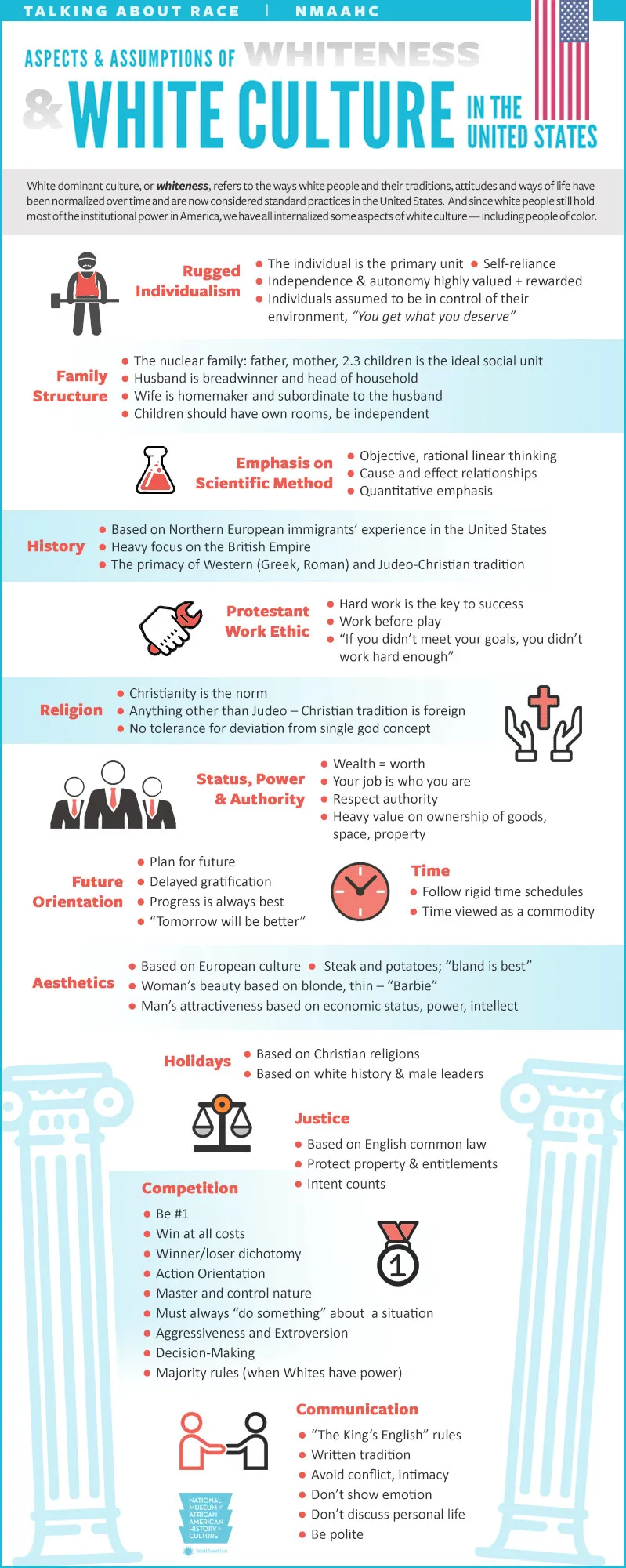
The training is based on the extremely controversial and much-criticized work of Tema Okun, a consultant who identifies perfectionism, timeliness, a sense of urgency, and writing things down as aspects of "white supremacy culture." (Okun is a white woman.) Okun has had a significant influence on the diversity and equity industry, and these ideas frequently come up in training materials for educational seminars. Similar work by the author Judith Katz—also a white woman—previously appeared on the website for the National Museum of African American History and Culture.

Okun was recently interviewed by The Intercept's Ryan Grim, who has reported at length on the dysfunction within progressive organizations. She expressed profound misgivings about the weaponization of her work and asked Grim to publicize an updated version in which she qualifies many of her original claims.

"It became clear to me that quite a few people were misusing it," she said….

Click here to see the entire story.

Second Amendment

The Sources Cited by the Supreme Court in Bruen

Guidance for judicial examination of legal history.

|

This post lists all the sources cited by the majority opinion in New York State Rifle & Pistol Association v. Bruen. The cites provide useful guidance to lower courts for analyzing Second Amendment cases.

Since the Supreme Court's June 2022 Bruen decision, government lawyers, with the assistance of gun prohibition lobbies, have been pushing courts to delay hearing Second Amendment cases. Allegedly, the governments need many months to conduct legal history research under the supposedly new legal history standard created by Bruen.

In fact, Bruen's focus on text as elucidated by legal history is nothing new in Second Amendment litigation. Attention to legal history was step one of the Two-Step Test used by most lower courts between Heller (2008) and Bruen (2022). As the Supreme Court explained, "Step one of the predominant framework is broadly consistent with Heller, which demands a test rooted in the Second Amendment's text, as informed by history." Bruen at 2127.

While delay-seeking government lawyers have been arguing that courts need the advice of history or political science professors who have no legal training, the Bruen case demonstrates the opposite. The large majority of the Bruen sources are straightforwardly accessible to anyone who can conduct legal research in databases such as Westlaw and HeinOnline. For other sources in Bruen, such as old books, I will describe the sources' availability in modern reprint editions or online.

There are 289 sources cited in Bruen. Of these, 288 are readily available online or in modern reprints of older books. The only obscure source cited by the Bruen majority was an 1853 case from the Worcester County Court, in Massachusetts, which was originally cited in a law journal article by history professor Saul Cornell, and which is cited in the journal as being "on file with author."

The Bruen methodology of the 288 easily accessible public source cites shows the methodology that lower courts should use. The lone Bruen cite to professor Cornell's private source was simply part of a refutation of an argument made by professor Cornell and the dissent.

The Bruen Court cited 45 Supreme Court cases, 22 Circuit cases, 3 federal statutes, 10 other U.S. government documents, 61 state statutes after 1900, 43 state/colonial/territorial statutes before 1900, 10 state cases after 1900, 28 state cases before 1900, 2 local laws, 1 state government document, 10 English statutes, 4 other English government documents, 6 English cases, 5 English treatises, 16 books published after 1900, 6 books before 1900, 10 law review and other scholarly articles, 2 newspaper articles, 1 item from an online state archive, and 3 amicus briefs.

In a future post, I will explain one of the advantages of courts using readily available sources, as opposed to sources that only exist in obscure offline archives: it is easier for courts to uncover fraudulent claims by advocates if legal claims are based on public sources rather than obscure ones.

Read More

More