The Volokh Conspiracy

Mostly law professors | Sometimes contrarian | Often libertarian | Always independent | Est. 2002

The Volokh Conspiracy

Donald Trump

A "Water Pistol Unnecessarily Preceding" a "Missile-Launching F-35 Attack": Thoughts on the New York Trump Indictment

Trump very much deserves to be prosecuted and punished. But the New York case is far more dubious than the other charges likely to be brought against him.

|

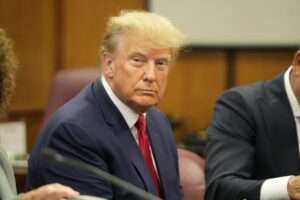
Former President Donald Trump sits in a New York City courtroom during his arraignment.
Former President Donald Trump sits in a New York City courtroom during his arraignment. April 4, 2023. (Steven Hirsch - Pool via CNP/picture alliance / Consolidated News Photos/Newscom)


Earlier this week, New York state prosecutor Alvin Bragg filed 34 state criminal law charges against Donald Trump, all arising from payoffs to his former mistress, porn star Stormy Daniels. Trump richly deserves to be prosecuted and punished for a variety of crimes. But this particular set of charges is unimpressive. Hopefully, they will soon become a relative sideshow, as Trump faces the music for at least some of his more serious wrongdoing.

There is nothing inherently wrong with charging a former president. Democracies around the world have tried and (in many cases) convicted current and former heads of government. Examples include France, Italy, Israel, and South Korea, among others. No one can seriously argue that these nations have become "banana republics" as a result.

In some cases, it is extremely important to try and punish high-ranking political leaders, as when their lawbreaking threatens basic liberal-democratic norms and institutions. Such a scenario can arise if the president tries to rig an election and stay in power after being defeated, to take a not-so-hypothetical situation. Punishing a president who participates in such a scheme is actually more important than punishing an ordinary person who tries to do the same thing, as the president's vast power and influence enable him to do much greater harm.

In most situations, however, we should not punish a prominent political leader for things that wouldn't get charged in the case of an ordinary person. If the average citizen won't get charged for jaywalking or for possessing a small amount of marijuana, neither should a former president. In a legal system with far too many petty laws, almost anyone can potentially be charged with something. We don't want to create a situation where prosecutors go on fishing expeditions to nail controversial celebrities or political adversaries.

When it comes to the New York charges, I largely agree with former Trump lawyer Ty Cobb (not to be confused with the legendary baseball Hall of Famer with the same name):

"I think the Bragg case is the water pistol unnecessarily preceding the missile-launching F-35 attack piloted by Jack Smith with [Attorney General] Merrick Garland as his wingman."

I won't go through all the potential flaws in Bragg's case. But prominent election law scholar Rick Hasen, Ian Milhiser of Vox, and former Cato Institute election law expert Andy Craig all have helpful analyses, and all have serious doubts about the soundness of the charges. Furthermore, none of them can easily be dismissed as Trump sympathizers eager to get him off the hook. Regular readers know that I'm no MAGA type myself, either.

I would add that, if New York courts decide the relevant law is ambiguous, that might still lead to a ruling in Trump's favor. Many states have abolished the rule of lenity, which requires ambiguities in criminal laws to be interpreted in the defendant's favor. New York, however, has not. In People v. Badji (2021), the New York Court of Appeals (the state's highest court), ruled that the rule of lenity applies "where the courts have the task of discerning the undeclared will of the legislature in an ambiguous statute," though it also went on to state that the ambiguity in question must be a "grevious" one.

I don't know if any of the issues raised by Craig, Hasen, and Millhiser rise to the level of "grevious" ambiguities. But some might. The difference between a "grevious" ambiguity and a regular ambiguity is itself often ambiguous!

It's not impossible that the prosecutor can ultimately prevail here. But his theory of the case is legally questionable and the underlying offense is pretty minor, especially compared to the genuinely awful things Trump has done. This isn't like getting Al Capone for tax evasion (a historical precedent to which Bragg's case has been compared). It's more like getting Capone for speeding a few miles over the limit in an area where the speed limit is unclear. And it's certainly reasonable to suspect these charges would not have been brought if the suspect were an ordinary Joe, as opposed to Trump.

The other likely charges against Trump are far stronger legally, and they relate to genuinely great evil on Trump's part (e.g. - attempting to stay in power despite having lost an election). The congressional January 6 Committee has recommended four potential charges related to Trump's efforts to reverse the outcome of the 2020 election and disrupt Congress' proceedings in certifying the electoral vote count (see pp. 98-118 of the Committee Report). I think at least three of these are very compelling (I have more doubts about the fourth charge of inciting, assisting, or providing aid and comfort to an insurrection). Georgia state prosecutors seem likely to file charges related to Trump's efforts to corrupt the election in that state. Those charges, too, seem likely to be strong. There is also the investigation into Trump's illegal retention of classified documents after he left the White House. The latter, like potential federal charges related to January 6, is under investigation by special counsel Jack Smith.

I hope and expect that Trump will go down for at least some of the above issues. In an ideal world, he would also deserve to serve time in prison for ordering the  brutal (and illegal) family separation policy. Sadly, various unjust immunity doctrines preclude that.

At the very least, when - as seems likely - charges are brought in some or all of these other cases, the New York Stormy Daniels case will - rightly - begin to seem insignificant by comparison. Given Trump's  extensive history of egregiously evil and illegal behavior, there is no need to resort to dubious legal theories about minor issues in order to give him his just deserts. Try and convict the man for his genuinely serious offenses.
Free Speech

Cornell University President's and Provost's Statement Rejecting Student Assembly Call for Trigger Warning Mandate

The call was for trigger warnings for "any traumatic content that may be discussed, including but not limited to: sexual assault, domestic violence, self-harm, suicide, child abuse, racial hate crimes, transphobic violence, homophobic harassment, xenophobia."

|

From a statement released Monday (see the Foundation for Individual Rights and Expression post for more):

Thank you for conveying Student Assembly Resolution #31, "Mandating Content Warnings for Traumatic Content in the Classroom." We cannot accept this resolution, as the actions it recommends would infringe on our core commitment to academic freedom and freedom of inquiry, and are at odds with the goals of a Cornell education.

Academic freedom, which is a fundamental principle in higher education, establishes the right of faculty members to determine what they teach in their classrooms and how they teach it, provided that they behave in a manner consistent with professional ethics and competence, and do not introduce controversial matters unrelated to the subject of their course. And freedom of inquiry establishes the right of students, researchers, and scholars to select a course of study and research without censure or undue interference.

Common courtesy would suggest that in some cases faculty may wish to provide notice, whether via the course syllabus or in the classroom, when they will be addressing topics that some may find challenging or painful. Similarly, it may also sometimes be appropriate for faculty to contextualize such topics, and explain why they are being introduced. But requiring that faculty anticipate and warn about all such situations—described in the resolution as content "including but not limited to: sexual assault, domestic violence, self-harm, suicide, child abuse, racial hate crimes, transphobic violence, homophobic harassment, xenophobia"—would unacceptably restrict the academic freedom of our community, interfering in significant ways with Cornell's mission and its core value of Free and Purposeful Inquiry and Expression.

Such a policy would violate our faculty's fundamental right to determine what and how to teach, preventing them from adding, throughout the semester, any content that any student might find upsetting. It would have a chilling effect on faculty, who would naturally fear censure lest they bring a discussion spontaneously into new and challenging territory, or fail to accurately anticipate students' reaction to a topic or idea. And it would unacceptably limit our students' ability to speak, question, and explore, lest a classroom conversation veer into an area determined "off-limits" unless warned against weeks or months earlier.

Read More

Supreme Court

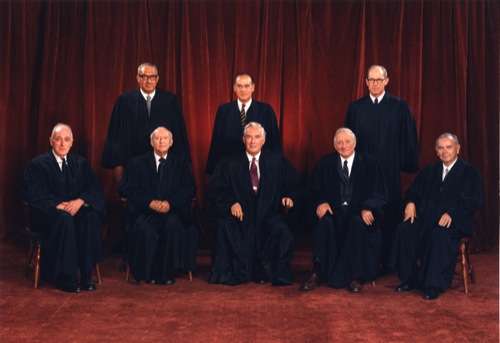
A Normal Supreme Court

|

I was invited to participate last Fall on a Wisconsin Law Review symposium panel on "Is the Court out of Control?," and I wrote up a short (12-page) article for that. I thought I'd post it in several pieces; I hope some of you find it interesting, and I also still have time to make any corrections, if need be. Here's the first part.

[* * *]

This Symposium panel asks, is the Court out of control? I suppose the question is: Control by whom?

[I.] Modes of Control

[A.] Control by the Political Branches

The Court is certainly out of control of the political branches, as to certain facets of its decision-making. But that has been a feature of the Court for a long time. Eric Segall makes excellent arguments—echoing ones that had been famously made by James Bradley Thayer and others[1]—that there ought to be more control of the Court by the political process. I remember Lino Graglia saying, thirty years ago and in his usual colorful way: "People complain about tyranny of the majority; but the alternative is tyranny of the minority!," meaning tyranny of five Justices on the Supreme Court (and perhaps of the socio-ideological class to which they belong).[2] Why should they make the decisions for the rest of us?

These are all eminently plausible arguments; but, rightly or wrongly, our national legal custom has indeed been for the Court to be largely outside majoritarian political control. To be sure, the Court has at times cut back on its own power, for instance when it overruled earlier economic substantive due process and Commerce Clause cases in the 1930s and 1940s. But then judicial supremacy roared right back in other areas, such as free speech, equal protection, criminal procedure, reproductive rights, and more.

What's more, at least as to Dobbs v. Jackson Women's Health Organization[3]—likely the decision that academics are most focusing on in the past year—the Court is returning control to the political branches.[4] Now as a policy matter, I support abortion rights, and I'm glad that, for instance, even in Kansas the voters have come out in support of abortion rights.[5] And of course one can argue that abortion rights should remain the federal constitutional rule, whether out of constitutional principle or for stare decisis reasons. But in any case, that's not the Court arrogating extra power to itself, except for the power to give the power back to the political process.

Read More

Second Amendment Roundup: Persons Aged 18-20 Are Entitled to Carry Firearms

Young adults are included in “the people” protected by the Second Amendment.

|

Several decisions have been rendered recently on whether persons aged 18 to 20 have a Second Amendment right to carry or purchase a handgun or any firearm.  I'd like to highlight the March 31, 2023, decision of U.S. district judge Katherine Menendez (D. Minn.), which is one of the most thorough decisions to date on the young-adult carry issue.  The case is Worth v. Harrington.

Judge Menendez granted summary judgment to the 18-to-20-year-old plaintiffs who were ineligible for carry permits under Minnesota law.  While the Supreme Court held in Bruen that carrying a handgun was within the plain text of the Second Amendment right to bear arms, the state argued that persons under 21 were not considered to be part of "the people" when the Amendment was adopted.  Worth rejected that argument for four reasons.

First, "the people" includes "all Americans who are a part of the national community," which includes persons eighteen and older.  That phraseology originated in the Supreme Court case of U.S. v. Verdugo-Urquidez (1990), which equated the meaning of "the people" in the First, Second and Fourth Amendments.  Worth agreed with the textual analysis in Firearms Pol'y Coal. v. McCraw (N.D. Tex. 2022), which invalidated the Texas law requiring permit holders to be at least 21.

Second, neither the Second Amendment nor any other provision in the Bill of Rights sets an age limit.  But the Founders knew how to set age limits when intended – the Constitution requires minimum ages for eligibility to be a Representative, Senator, or the President.

Third, "the people" as used elsewhere in the Bill of Rights includes persons eighteen and over.  The First and Fourth Amendments are not interpreted to exclude 18-to-20-year-olds.

Fourth and finally, Founding-era militia laws in every colony and early state, and in the federal Militia Act of 1792, required males 18 and over to provide their own arms and to enroll in the militia.  "And the fact that the Second Amendment itself discusses the 'well regulated militia' means the age-range of militia laws is of particular relevance to the reach of its protections."

Read More

Free Speech

San Francisco State Univ. Investigating Professor For Showing Image of Muhammad in Class

|

From the Chronicle of Higher Education (Emma Pettit):

Maziar Behrooz, an associate professor of history at San Francisco State University, does not yet know what a teaching decision he made might cost him.

In the fall of 2022, Behrooz was teaching the history of the Islamic world between 500 and 1700 and showed a drawing of the Prophet Muhammad. He's taught the course, and the image, for years. One student, a devout Muslim, strongly objected, outside of class. His main point, Behrooz told The Chronicle, was that it's not permissible for an image of the Prophet Muhammad to be shown in any shape or form.

"This is the first time that this has happened," Behrooz said. "I was not prepared for somebody to be offended, in a secular university, talking about history rather than religion."

Read More

Libertarianism

Libertarianism vs. Classical Liberalism: Is there a Difference?

It is hard to tell whether these are genuinely different ideologies or two words for the same thing.

|

My biggest project this week was finalizing the draft submission of my chapter on land-use regulation for the forthcoming Routledge Handbook of Classical Liberalism, edited by Richard Epstein, Liya Palagashvili, and Mario Rizzo. It so happens I was also a contributor to the Routledge Handbook of Libertarianism, edited by Jason Brennan, Bas van der Vossen, and David Schmidtz, and the Cambridge Handbook of Classical Liberal Thought, edited by M. Todd Henderson.

As a contributor to these three volumes, I should perhaps have a detailed understanding of  libertarianism and classical liberalism and how they differ. But I'd be lying if I said I truly have a definitive grasp of the difference between the two!

I've long thought that these are different terms for essentially the same thing (the branch of liberalism advocating very tight limits on government power across the board), and that the difference between them is primarily aesthetic. Thus, I've always preferred "libertarian" because it's easier to say and remember, sounds better, and is more widely known. But there are a wide range of theories about the difference between the two. And it's hard for me to say for sure which (if any) are correct.

Here are some possibilities:

1. Classical liberalism is a more moderate version of libertarianism. For example, classical liberals may be open to a wider range of government interventions than libertarians (though both favor far less than modern liberals do). Could be true. But note that some of the most prominent thinkers who call themselves "classical liberals" are not moderate, even as compared to many self-described libertarians. NYU law professor Richard Epstein is probably the most famous and distinguished scholar who calls himself a classical liberal (he is also the director of the Classical Liberal Institute, possibly the most prestigious intellectual organization that labels itself "classical liberal"). Moderate he is not - even by comparison with many who call themselves libertarians. CLI co-director Mario Rizzo, a prominent economist (and leading critic of paternalism) is also not particularly moderate.

2. Calling yourself a "classical liberal" is a way to disassociate from awful, toxic people who call themselves libertarians (racists, xenophobes, etc.). Such trolls are especially common on Twitter. But there are awful people who try to associate themselves with virtually any widely used ideological designation (conservatism, progressivism, socialism, etc.). If "classical liberal" avoids this problem, it's mainly because few people know the term.

3. "Classical liberal" thought is more closely connected with the great liberal thinkers of the Enlightenment and the 19th century (John Locke, Adam Smith, John Stuart Mill, etc.), while libertarians take their bearings from more modern thinkers (F.A. Hayek, Milton Friedman, Ayn Rand, Robert Nozick, etc.). The obvious problem here is that the latter group of thinkers are pretty obviously building on the former in many ways. Also, plenty of self-described libertarians are interested in the older thinkers, too, and many self-described classical liberals are interested in the modern ones.

4. Using "classical liberal" instead of "libertarian" signals greater intellectual sophistication. This may well be true, as only people with extensive knowledge of political theory are likely to know what the former means. But I'm not convinced this is the main reason most self-described classical liberals use the phrase. That said, I myself use "libertarian" in part because the term is better-known and therefore less likely to confuse non-experts.

5. I sometimes see it argued that libertarianism requires adherence to one specific core principle, such as self-ownershp or the "non-aggression principle," while classical liberalism is open to a wider range of justifications for strict limits on government power. But, in truth, there are important differences on core principles between libertarian thinkers. Some justify the theory on the basis of deontological rights-based arguments (e.g. - Robert Nozick), some on utilitarian consequentialist grounds (e.g. - many prominent economists), and some (myself included) on a combination of the two. Among those who fall in the rights-based camp, there are disagreements over the exact nature and basis of the rights in question.

6. Maybe it's all just a matter of self-definition. If you call yourself a "libertarian," then you are one! Ditto for "classical liberal." The problem with this idea is that it destroys the value of the terms. If there are no substantive constraints on what qualifies as a"libertarian" (or "classical liberal") view, then labeling a person or an idea with these words tells us nothing of value. To maintain the usefulness of the term, I want to be able to say that people who, e.g., support nationalism, socialism, or racism, are not true libertarians, regardless of whether they call themselves that. To be sure, there will always be gray areas where it's debatable whether a particular person (or policy) is genuinely libertarian or not. But there are also going to be cases that clearly fall on one side of the line or the other. See here for an explanation of why such insistence on boundaries doesn't run afoul of the so-called "No True Scotsman Fallacy."

I think 1 and 2 above are the most common motivations for the use of "classical liberal" by those who embrace it. But perhaps I have that wrong.

All of the above is an attempt to consider how the terms "libertarian" and "classical liberal" are used today. But it's obviously possible that their meaning will drift over time - as has that of "liberal," "conservative," and "progressive." Those whom we call progressives today are very different from the early 20th century movement that first popularized the term (e.g. - the latter had a strong racist streak, while the former does not).

For the moment, I tentatively still think there isn't much substantive difference between "libertarianism" and "classical liberalism," or at the very least that the overlap between the two is far greater than any divergence. But that could potentially change.

Free Speech

Connecticut S. Ct. Sharply Limits State's "Racial Ridicule" Law

Prosecutors and police had read the law, which restricts "advertisements," as broadly banning racial slurs; the Connecticut court read it, as written, to restrict only commercial advertisements.

|

Connecticut General Statutes § 53-37 provides:

  • "Any person who, by his advertisement,
  • "ridicules or holds up to contempt any person or class of persons,
  • "on account of the creed, religion, color, denomination, nationality or race of such person or class of persons,
  • "shall be fined not more than fifty dollars or imprisoned not more than thirty days or both."

Yet despite its text, Connecticut prosecutors haven't been enforcing the law as limited to "advertisement[s]." The two most-publicized recent incidents (see the UConn case and the Fairfield Warde High School case), for instance, involve nothing that could be labeled an advertisement. And in many recent incidents prosecutors and police seemed to be mostly enforcing the statute to prosecute or arrest people for race- or religion-based "fighting words": generally speaking, face-to-face personal insults that include racial slurs or, in one case I found, religious slurs. Such fighting words might be punishable through specialized statutes that cover racist fighting words alongside other fighting words. But by its text, the "racial ridicule" statute doesn't extend to them. Nor is there historical evidence suggesting that "advertisement" had some broader historical meaning: The statute was enacted in 1917, as "An Act concerning Discrimination at Places of Public Accommodation"; it really was aimed at "advertisement[s]" for businesses.

I'm glad to say that, in yesterday's Cerame v. Lamont, the Connecticut Supreme Court indeed read the statute narrowly, concluding that "the legislature intended to restrict the meaning of 'advertisement' to commercial speech."

Read More

Climate Change

Louisiana Loses Social-Cost-of-Carbon Lawsuit in the Fifth Circuit (Again)

The plaintiff states lack standing to challenge the Biden Administration's interim Social Cost of Carbon estimates

|

Today a unanimous panel of the U.S. Court of Appeals for the Fifth Circuit dismissed a red-state challenge to the Biden Administration's interim Social Cost of Carbon estimates due to a lack of Article III standing. This is not a surprise. While a district court had initially enjoined the Biden Administration's use of these estimates (in a tortured legal opinion), this decision was stayed by a different Fifth Circuit panel last year (and the Supreme Court refused to intervene after Louisiana failed to get a single vote for en banc review). A similar challenge was also rejected on standing grounds by the U.S. Court of Appeals for the Eighth Circuit.

Judge Wiener wrote for the unanimous panel, joined by Judges Higginson and Wilson. Judge Wiener's relatively brief opinion begins:

On January 20, 2021, the Biden Administration issued an executive order that re-established an interagency working group ("Working Group") to formulate guidance on the "social cost of greenhouse gases." That order directed the Working Group to publish dollar estimates quantifying changes in carbon, methane, and nitrous oxide emissions (collectively, "greenhouse gases") for consideration by federal agencies when policymaking. The Working Group has since published "Interim Estimates" based largely on the findings of its predecessor working group.

The Plaintiffs-Appellees States ("Plaintiffs") challenge E.O. 13990 and the Interim Estimates as procedurally invalid, arbitrary and capricious, inconsistent with various agency-specific statutes, and ultra vires. They obtained a preliminary injunction in the district court. Defendants-Appellants ("Defendants") appealed, and a panel of this court stayed the injunction.

We now dismiss this action because Plaintiffs have failed to meet their burden to prove standing. Plaintiffs' allegations of "injury in fact" rely on a chain of hypotheticals: federal agencies may (or may not) premise their actions on the Interim Estimates in a manner that may (or may not) burden the States. Such injuries do not flow from the Interim Estimates but instead from potential future regulations, i.e., final rules that are subject to their own legislated avenues of scrutiny, dialogue, and judicial review on an appropriately developed record.

For reasons that Judge Wiener explains, it is difficult to demonstrate Article III injury from an Executive Order until that order results in a specific agency action that harms the plaintiff.

Plaintiffs here allege that fiscal, procedural, and sovereignty-related harms might arise from regulations molded by the Interim Estimates. Although any one of these would satisfy "injury in fact," we conclude that the allegations here fail to do so. At the core of our conclusion is this: E.O. 13990 does not require any action from federal agencies. Agencies are neither punished nor rewarded for their treatment of the Interim Estimates. Agencies must exercise discretion in conducting their cost-benefit analyses and deciding to use the Interim Estimates as "appropriate and consistent with applicable law." Since nothing in E.O. 13990 requires States to implement the Interim Estimates, Plaintiffs rely on harms wrought by regulations that may result from the Interim Estimates. It is well accepted that the mere "possibility of regulation" fails to satisfy injury in fact. . . .

We find no "injury in fact" here, because Plaintiffs' alleged harms "rel[y] on a highly attenuated chain of possibilities." A federal agency must factor the Interim Estimates into its deliberations on a rule that harms the States. The actual rulemaking considerations of a federal agency are not determinable in advance. Rather, an agency's reliance on the Interim Estimates when crafting a future regulation is mere conjecture. Although we have found standing when the economic costs of a challenged policy were imminent and measurable,  the Interim Estimates are not certain to spawn the alleged harms. A panoply of reasons can underlie a regulation, and agencies are required to dictate and publicly report such reasons. It is through this process that we know that neither of Plaintiffs' specific examples of injurious regulation were brought about by the Interim Estimates: In both instances, the relevant agencies reported that their decisions were not premised on those Estimates. The alleged harms would have occurred with or without the Interim Estimates. . . .

We conclude that Plaintiffs have not established standing here, which ends our analysis. Plaintiffs contemplate harms that are several steps removed from—and are not guaranteed by—the challenged Executive Order or the Interim Estimates. The states cannot do away with their alleged parade of horribles in a single swipe at the duly elected executive. Although the "case-by-case approach that this requires is understandably frustrating [to plaintiffs]," this remains the "the traditional, and remains the normal, mode of operation of the courts."

This opinion is clear, direct, and correct. If states (or others) are to challenge the Biden Administration's Social Cost of Carbon estimates, they will have to challenge a discrete agency action that relied upon these estimates. They cannot challenge the estimates independently of an actual agency action that affects them.

[Note: Post edited for clarity and to add reference to en banc vote.]

SG Flips Position on Whether Removed Climate Change Cases Are "Inherently Federal In Nature"

"After the change in Administration and in light of those intervening developments, the United States has reexamined its position and has concluded that state-law claims like those pleaded here should not be recharacterized as claims arising under federal common law."

|

In 2021, the Supreme Court decided BP p.l.c. v. Mayor and City Council of Baltimore. In this case, the Charm City sued the oil company in state court for causing certain environmental harms. BP removed the case to federal court. The district court remanded the case to state court. On appeal, the Fourth Circuit held that it lacked jurisdiction to review the remand order. Justice Gorsuch's majority opinion reversed the Fourth Circuit.

In BP, the Trump Justice Department filed an amicus brief. The SG contended that removal was likely proper:

In this case, there may well be a valid alternative basis for federal jurisdiction. Petitioners have focused (Br. 37-45) on their contention that respondent's tort claims necessarily arise under federal common law. As the United States explained in an amicus brief filed in City of Oakland—another case brought by localities alleging tort claims against fossil-fuel-producing companies in response to climate-change-related injuries—claims may be removable under 28 U.S.C. 1441(a) on the ground that, although nominally couched as state-law claims, they are inherently and necessarily federal in nature. See U.S. Amicus Reh'g Br. at 6-12, City of Oak-land, supra (No. 18-16663).

Oral argument was held on January 19, 2021 (the day before the inauguration). The Assistant SG reaffirmed the government's position that these climate change cases are "inherently federal":

Clarence Thomas: And I know you said that you're not going to take a position or the government is not taking a position on whether or not we should get to the -- the federal common law issue, but do you have an opinion on where -- whether or not such a -- there is a federal common law principle on climate change injuries?

Brinton Lucas: Yes, Your Honor, we do think that Respondent's claims are inherently federal in nature.

Two years later, the Biden Justice Department has reversed course. The Solicitor General filed an amicus brief in Suncor Energy v. Board of County Commissioners of Boulder County. The SG explains the shift:

In an amicus brief filed in BP p.l.c. v. Mayor & City Council of Baltimore, 141 S. Ct. 1532 (2021), the United States took the position that claims involving crossboundary pollution "that seek to apply the law of an affected State to conduct in another State" "may well be" thought to "arise under" federal law for "jurisdictional purposes," "even if such claims may be displaced by the Clean Air Act." U.S. Amicus Br. at 26, 27, BP, supra (No. 19-1189) (emphasis omitted). The Court's decision in BP did not address the proper resolution of that jurisdictional issue, but simply made clear that the court of appeals on remand could consider all potential arguments for removal. 141 S. Ct. at 1543. Since then, all five courts of appeals that have considered the issue have rejected the position that the government took in BP. See pp. 16-17, infra. After the change in Administration and in light of those intervening developments, the United States has reexamined its position and has concluded that state-law claims like those pleaded here should not be recharacterized as claims arising under federal common law.

I've written about the phenomenon of "presidential reversals," as we have shifted from Bush to Obama, from Obama to Trump, and now from Trump to Biden.

Suncor filed a "supplemental brief" calling out this shift in position. (The petitioner is represented by Kannon Shanmugam of Paul Weiss who represented BP in the Baltimore case). The brief accuses the government of virtue signaling to environmentalist groups!

Now, the government has casually junked that position. With an all-too-familiar citation to the "change in Administration," it argues that the well-pleaded complaint rule precludes removal and that, in the wake of the Clean Air Act, federal law no longer exclusively governs claims alleging injury from interstate emissions. See Br. 7-16. Perhaps the current administration genuinely does have a different view on questions of federal jurisdiction than the last one. But given the federal government's institutional interest in taking a broad view of federal jurisdiction, it is hard to escape the conclusion that the change in position is being driven by the fact that the questions are arising in the context of climate-change lawsuits—and by a desire to signal virtue to political bedfellows who are behind these lawsuits.

And this virtue signaling, the brief contends, undermines the government's credibility:

Given that apparent motivation, it is difficult to take anything the government says here at face value. But even so, the government's arguments against review wilt under scrutiny. The government argues that no genuine circuit conflict exists, but it does so only by ignoring the Second Circuit's reasoning in City of New York v. Chevron Corp., 993 F.3d 81 (2021), and the decisions of other circuits expressly rejecting that reasoning. On the merits, the government parrots respondents' arguments, yet it makes no effort to grapple with petitioners' responses. At a minimum, the very fact that the last two administrations have taken contrary positions confirms that there are substantial legal arguments on both sides.

Recently, Judge Stras of the Eighth Circuit explained why certiorari is necessary:

After the government filed its brief, a prominent judge wrote that cases such as this one should give rise to federal jurisdiction and urged the Court definitively to re-solve whether they do. See Minnesota v. American Pe-troleum Institute, No. 21-1752, ___ F.4th ___, 2023 WL 2607545, at *8-*11 (8th Cir. Mar. 23, 2023) (Stras, J., concurring). It is preposterous to suggest that the fate of these cases—with their potentially enormous conse-quences for an entire sector of the global economy—should be left to handpicked state courts without a deci-sion by this Court sanctioning that outcome. Given the importance of the questions presented, the circuit conflicts on each question, the substantial arguments on both sides, and the prudential reasons for review in this particular case, the petition for a writ of certiorari should be granted. 

A grant here seems likely.

Free Speech

Washington Post on ChatGPT Making Up Defamatory Accusations

|

The article (Pranshu Verma & Will Oremus) (paywalled), which was prompted by Jonathan Turley's USA Today piece, just went up. The general analysis should be familiar to our readers (see the Large Libel Models thread), but here is a comment from an OpenAI spokesperson:

When users sign up for ChatGPT, we strive to be as transparent as possible that it may not always generate accurate answers. Improving factual accuracy is a significant focus for us, and we are making progress.

And one from Microsoft (which operates Bing, which uses GPT technology):

We have developed a safety system including content filtering, operational monitoring, and abuse detection to provide a safe search experience for our users… [U]sers are also provided with explicit notice that they are interacting with an AI system.

I think it's good to provide disclaimers, but I should note that they're not likely to be much of a defense for the companies in defamation lawsuits; more on that here.

Justice Janet Protasiewicz, Say Hello To Caperton v. Massey

The candidate, who spoke about her "values" on abortion and gerrymandering, received substantial financial support from donors who lobby for those two key issues.

|

On Monday, I spoke at the University of Wisconsin at Madison--my first time in the Badger State. As I drove from Milwaukee to the state capital, I scanned local radio stations. Virtually every commercial concerned the upcoming race for the state supreme court. Janet Protasiewicz (pronounced pro-tuh-SAY-witz), the "liberal" candidate, was facing off against Daniel Kelly, the "conservative" candidate. I use scare-quotes because the state does not provide party affiliation for judicial races, but everyone knew where the candidates stood. Indeed, the election had largely become a referendum on two primary issues: abortion and gerrymandering. The current Supreme Court, which has a 4-3 conservative majority, had upheld the maps drawn by the Republican-controlled legislature. And that same Court has not recognized a right to abortion under the state Constitution. The victor of the election would cast the deciding vote on these two issues, and many more. Unsurprisingly, money flooded into the state--more than $45 million. Protasiewicz, in particular, received about $9 million from the state Democratic party.

Moreover, the candidates themselves jumped into the fray. Kelly routinely attacked Protasiewicz as someone who would ignore the Constitution and rule of law. I heard him give a live interview on a conservative call-in program as I was driving back to the airport. It sounded like a speech any politician would give. Protasiewicz, on the other hand, seemed to strongly signal how she would vote on the abortion and gerrymandering. Don't take my word for it. Here is the New York Times:

Judge Protasiewicz, 60, shattered long-held notions of how judicial candidates should conduct themselves by making her political priorities central to her campaign. She made explicit her support for abortion rights and called the maps, which gave Republicans near-supermajority control of the Legislature, "rigged" and "unfair." . .  .

Judge Protasiewicz made a calculation from the start of the race that Wisconsin voters would reward her for making clear her positions on abortion rights and the state's maps — issues most likely to animate and energize the base of the Democratic Party.

In an interview at her home on Tuesday before the results were known, Judge Protasiewicz (pronounced pro-tuh-SAY-witz) attributed her success on the campaign trail to the decision to inform voters of what she called "my values," as opposed to Justice Kelly, who used fewer specifics about his positions.

"Rather than reading between the lines and having to do your sleuthing around like I think people have to do with him, I think I would rather just let people know what my values are," she said. "We'll see tonight if the electorate appreciates that candor or not."

Protasiewicz used the word "values" to avoid opining on the legal issues. But her statements, at a minimum, raise serious questions about her impartiality.

I flew home on Monday evening, and the election was held on Tuesday. Protasiewicz won by a comfortable margin. And those who supported her campaign, including Wisconsin Democrats, will soon reap the benefits:

Once Judge Protasiewicz assumes her place on the court on Aug. 1, the first priority for Wisconsin Democrats will be to bring a case to challenge the current legislative maps, which have given Republicans all but unbreakable control of the state government in Madison.

Jeffrey A. Mandell, the president of Law Forward, a progressive law firm that has represented Mr. Evers, said he would file a legal request for the Supreme Court to hear a redistricting case the day after Judge Protasiewicz is seated.

"Pretty much everything problematic in Wisconsin flows from the gerrymandering," Mr. Mandell said in an interview on Tuesday. "Trying to address the gerrymander and reverse the extreme partisan gerrymandering we have is the highest priority."

Remember how bad it was when the North Carolina Supreme Court revisited its earlier position on legislative maps? Well, now it will be good that the Wisconsin Supreme Court does the same thing. Everyone, switch sides!

I think it likely that Protasiewicz will face recusal motions on cases concerning abortion and gerrymandering. As I understand the protocol, if Protasiewicz denies the recusal motion, the matter would eventually be appealed to the full state supreme Court. And it seems likely that the bench would divide 3-3, thus leaving Protasiewicz on the case.

But there is another option for recusal in federal court. Caperton v. A. T. Massey Coal Co. (2009) held that in some "extreme" cases, the failure of a judge to recuse may violate the Due Process Cause of the Fourteenth Amendment. Justice Kennedy wrote the majority opinion in Caperton. Chief Justice Roberts wrote the principal dissent, which was joined by Justices Scalia, Thomas and Alito.

I won't even bother explaining the reasoning in Justice Kennedy's majority opinion because there isn't any. For Justice Kennedy, any problem could be cured by the Fourteenth Amendment. Thankfully he is retired. Alas, his precedents remain binding on the lower courts until expressly overruled. Justice Scalia's Talmudic dissent was, as always, right on point:

A Talmudic maxim instructs with respect to the Scripture: "Turn it over, and turn it over, for all is therein." The Babylonian Talmud, Tractate Aboth, Ch. V, Mishnah 22 (I. Epstein ed. 1935). Divinely inspired text may contain the answers to all earthly questions, but the Due Process Clause most assuredly does not. The Court today continues its quixotic quest to right all wrongs and repair all imperfections through the Constitution.

But I do want to flag the Chief's dissent. He listed four questions--err, sorry in the Passover spirit--forty questions that the majority failed to answer. Question #9 is especially relevant:

9.    What if the case involves a social or ideological issue rather than a financial one? Must a judge recuse from cases involving, say, abortion rights if he has received "disproportionate" support from individuals who feel strongly about either side of that issue? If the supporter wants to help elect judges who are "tough on crime," must the judge recuse in all criminal cases?

Justice Janet Protasiewicz, get ready for the Caperton claims.

Free Speech

Australian Mayor Threatening Lawsuit Over ChatGPT Libel

|

Financial Review (Australia) [Byron Kaye] reports (see also Reuters):

Brian Hood, who was elected mayor of Hepburn Shire, 120 kilometres north-west of Melbourne, last November, became concerned about his reputation when members of the public told him ChatGPT had falsely named him as a guilty party in a foreign bribery scandal involving a subsidiary of the Reserve Bank of Australia in the early 2000s.

Mr Hood did work for the subsidiary, Note Printing Australia, but was the person who notified authorities about payment of bribes to foreign officials to win currency printing contracts, and was never charged with a crime, lawyers representing him said.

The lawyers said they sent a letter of concern to ChatGPT owner OpenAI on March 21, which gave OpenAI 28 days to fix the errors about their client or face a possible defamation lawsuit….

Australian defamation damages payouts are generally capped around $400,000….

Free Speech

Prof. Andrew Koppelman's Thoughts for Law Students, from the Left to the Left

|

Very well put, I think; an excerpt:

The students who disrupt right-wing speakers – the protest against Judge Kyle Duncan, who tried to speak at Stanford Law School, is a prominent recent case – have been appropriately criticized for their obliviousness to the value of free speech.  I want to flag another issue: their piffling political ambitions. Today's left aims to protect minorities from offense.  It ought to aim to change the world.

The two aspirations are in conflict. Hypersensitivity to feelings, and the desire to vent them in the crudest possible way, enfeebles law students. It turns them into lousy advocates, useless to the social movements they hope to serve….

I'm an advocate of LGBTQ rights. I've fought Duncan and his allies for decades. I think it's a good thing when he presents his views, precisely because I want to defeat those views – to change the law, in ways that Duncan would hate.

The fundamental purpose of a law school is to give the next generation the skills to build a more just world. In order to develop those skills, the students need the experience of engaging with smart, skilled people like [Judge Kyle] Duncan who embrace ideas that they find hurtful and abhorrent. A good advocate must anticipate the strongest arguments on the other side – arguments that she may find painful to contemplate, especially when she has not yet figured out how to answer them.

That's true of all lawyers, but it's particularly pertinent to those who are trying to advance social change….

Read the whole thing.

Free Speech

Other Torts (Besides Libel) and Liability for AI Companies

|

Last week and this, I've been serializing my Large Libel Models? Liability for AI Output draft. For some earlier posts on this (including § 230, disclaimers, publication, and more), see here; one particular significant point is at Communications Can Be Defamatory Even If Readers Realize There's a Considerable Risk of Error. Today, I close with some thoughts on how my analysis, which has focused on libel, might be generalizable to other torts.

[* * *]

[A.] False Light

Generally speaking, false light tort claims should likely be treated the same way as defamation claims. To be sure, the distinctive feature of the false light tort is that it provides for a remedy when false statements about a person are not defamatory, but are merely distressing to that person (in a way the reasonable person test would recognize). Perhaps that sort of harm can't justify a chilling effect on AI companies, even if harm to reputation can. Indeed, this may be part of the reason why not all states recognize the false light tort.

Nonetheless, if platforms are already required to deal with false material—especially outright spurious quotes—through a notice-and-blocking procedure, or through a mandatory quote-checking mechanism, then adapting this to false light claims should likely produce little extra chilling effect on AIs' valuable design features.

[B.] Disclosure of Private Facts

Read More

More