From Silverman v. Ariz. Health Care Cost Containment Sys., decided Thursday by the Arizona Court of Appeals (in an opinion by Chief Judge Kent E. Cattani, joined by Judge Cynthia J. Bailey and Vice Chief Judge David B. Gass):
This public records case presents a narrow issue of potentially broad import. Arizona law does not require a public entity to create any new record in response to a public records request. But does using encryption to redact non-disclosable information stored in an electronic database necessarily constitute creation of a new record? We hold that it does not.
This concept is particularly important in a case like this one, in which the public entity uses non-disclosable data as a critical part of its database structure (as the relational keys linking different tables). Thus, requiring the agency to use a one-way cryptographic hash function to redact the non-disclosable data—substituting a unique hashed value that masks protected information without destroying its function in the database—is necessary to ensure a requestor receives, to the extent possible, a copy of the real record.
And because such encryption only hides a limited aspect of the record—without adding to, aggregating, analyzing, or changing any of the underlying information—it does not create anything new and does not result in the creation of a new record. Accordingly, and for reasons that follow, we reverse the superior court's dismissal of the journalists' public records lawsuit at issue here and remand for further proceedings consistent with this opinion….
I much appreciated the guest-post by Prof. Lorianne Updike Toler (Northern Illinois) on Brackeen back in November, based on her recent University of Chicago Law Review article, The Missing Indian Affairs Clause; now that Brackeen has been handed down, I thought I'd pass along this follow-up:
Halaand v. Brackeen, which upheld the Indian Child Welfare Act (ICWA) as an appropriate exercise of Congress' plenary power over native tribes, is being hailed as the Term's most important decision to use framing history. Although the decision is but a week old, much has already been written about the history found in Justices Gorsuch and Thomas' concurring and dissenting opinions, including an excellent post on this blog by Josh Blackman here, another by my colleague Evan Bernick on the Originalism Blog here, and my more humble post elsewhere, among others.
I write only to highlight that history provides an answer to whether ICWA is constitutional that no one on the Court considered, perhaps because it is hiding in plain sight: the Framers specifically chose not to grant Congress an Indian Affairs power in the Constitution, but believed any federal power to regulate tribes was covered by the Indian Commerce Clause, Treaty Power, War & Peace Power, Territory, or Spending Clauses. After Congress halted tribal treaty-making in 1871, the Court 's 1886 U.S. v. Kagama decision wrongly filled the power vacuum with Congressional plenary power, which was later associated with the Indian Commerce Clause. Rather than ratify this wrong turn, the Court in Brackeen should have corrected it by recognizing that when the federal government stopped treating with tribes in 1871, the authority to regulate tribes reverted not to the federal government (nor the state governments), but to the tribes themselves.
This case addresses the constitutionality of Florida Statute § 827.11. The state claims that this statute seeks to protect children generally from obscene live performances. However, … Florida already has statutes that provide such protection. Rather, this statute is specifically designed to suppress the speech of drag queen performers. In the words of the bill's sponsor in the House, State Representative Randy Fine: "…HB 1423…will protect our children by ending the gateway propaganda to this evil — 'Drag Queen Story Time.'" …
The statute defines [a prohibited] "adult live performance" as:
[A]ny show, exhibition, or other presentation in front of a live audience which, in whole or in part, depicts or simulates nudity, sexual conduct, sexual excitement, or specific sexual activities as those terms are defined in s. 827.001, lewd conduct, or the lewd exposure of prosthetic or imitation genitals or breasts when it:
[1.] Predominantly appeals to a prurient, shameful, or morbid interest;
[2.] Is patently offensive to prevailing standards in the adult community of this state as a whole with respect to what is suitable material or conduct for the age of the child present; and
[3.] Taken as a whole, is without serious literary, artistic, political, or scientific value for the age of the child present….
Plaintiff HM Florida-ORL, LLC … is a Florida for-profit business operating Hamburger Mary's Restaurant and Bar in Orlando. Plaintiff frequently presents drag show performances, comedy sketches, and dancing, including "family friendly" drag performances on Sundays where children are invited to attend….
When I was a 2L, I attended an event on Justice Scalia's book, Making Your Case. During the Q&A session, someone asked Justice Scalia what opinion he was most proud of. Without any hesitation, he said Crawford v. Washington (2004). This landmark decision applied an originalist framework to the Confrontation Clause. Prior to that Crawford, Ohio v. Roberts (1980) imposed a "reliability" standard to determine whether out-of-court testimony could be introduced. But in Crawford, Justice Scalia turned back the clock to the deep historical roots of the right to confrontation.
Great success! But not all facets of the Court's Confrontation Clause jurisprudence are premised on originalism. Case in point, Bruton v. United States (1968). This decision concerned a joint trial of two defendants. Defendant #1 had confessed, and implicated Defendant #2. A postal inspector testified about that oral confession by Defendant #1, which included the statement that implicated Defendant #2. The trial judge ruled that the testimony could be used to support Defendant #1's guilt, but instructed the jury that the testimony was inadmissible hearsay with regard to Defendant #2.
A prior decision of the Court, Delli Paoli v. United States (1957), held that the trial judge's limiting instruction was permissible. But on appeal, Bruton held that the limiting instruction was insufficient, and thus the introduction of the testimony violated the Confrontation Clause. Justice Brennan wrote the majority opinion. You can predict what happened. The Court reversed Delli Paoli without any discussion of stare decisis or precedent. Zero. And there is also no discussion at all about why the original meaning of the Sixth Amendment supports that result. Justice Brennan doesn't even bother quoting the text of the Confrontation Clause. The entire decision was premised on the risk that the jury would disregard the instruction, because of fairness concerns. That's how the Court rolled in 1968, which was probably the apogee (nadir) of the Warren Court's activism.
Fast-forward to the present-day, and Samia v. United States. In this case, Samia and his accomplices were tried jointly. One of the accomplices had confessed, and implicated Samia. The prosecutors introduced that confession. But to avoid running afoul of Burton, the witness substituted Samia's name for the phrase "other person." As a result, Samia was never directly implicated. And the trial court judge instructed the jury to not use that confession with regard to Samia. On appeal, the defendant asked the Supreme Court to extend the line of cases that began with Bruton, and reject the "other person" workaround.
By a 6-3 vote, the Supreme Court declined that invitation. Justice Thomas wrote the majority opinion, but you should start with Justice Barrett's short, but pointed concurrence. Barrett explains that the majority opinion relies on old-timey precedents from the "late 19th century and early 20th centuries" that "address the rules of evidence rather than the Confrontation Clause." Unlike in Crawford, there is virtually nothing in Samia that speaks to the original meaning of the Confrontation Clause, as understood in 1791. Barrett explains that the Court should emphasize history that does not bear on the original meaning of the Constitution:
I think they are facially constitutional, and Arkansas Times LP v. Waldrip (8th Cir. 2022) (en banc) was correct in upholding them (see also Prof. Michael Dorf's, Prof. Andrew Koppelman's, and my amicus brief on the subject, as well as Prof. Dorf's follow-up post). At the same time, they, like other antidiscrimination laws, might be unconstitutional as applied in certain situations, perhaps including selection of speakers at an academic conference (though the question is complicated when the government is acting as contractor). But yesterday's Eleventh Circuit decision by Judges Wilson, Branch, and Luck in Martin v. Chancelloravoids the question:
Abby Martin appeals the district court's dismissal of her 42 U.S.C. § 1983 suit … on the grounds of qualified immunity. She argues that the district court erred in dismissing her claim that Defendants violated her First and Fourteenth Amendment rights by refusing to contract with her to speak at an academic conference unless she signed a clause, required by Georgia law, promising she would not participate in a "boycott of Israel" for the duration of the contract. Specifically, Martin argues that, because it was clearly established that Defendants should have known that Georgia's law requiring the clause violated the Constitution, they are not entitled to qualified immunity.
The court disagreed with Martin's position; here's an excerpt:
Martin asserts that NAACP v. Claiborne Hardware (1982), which involved a consumer boycott of white-owned businesses in Mississippi, established the broad principle that the government cannot prohibit nonviolent, politically motivated boycotts and argues that principle "makes clear that [O.C.G.A. § 50-5-85, the anti-BDS statute] violates the First Amendment." But although the Court held that the "nonviolent elements of petitioners' activities are entitled to the protection of the First Amendment," the conduct at issue in Claiborne involved private actors rather than government officials, and there was no state statute involved in the case. Notably, the Court expressly reserved the question of whether "a narrowly tailored statute designed to prohibit certain forms of anticompetitive conduct or certain types of secondary pressure may restrict protected First Amendment activity."
The sanctions imposed on Sidney Powell and other attorneys raising frivolous challenges to the 2020 election were narrowed and slightly reduced, but largely upheld.
This afternoon the U.S. Court of Appeals for the Sixth Circuit largely upheld a district court order imposing significant sanctions on Sidney Powell and other "Kraken" lawyers who had filed various unsubstantiated and frivolous claims challenging the results of the 2020 Presidential election in Michigan. While trimming the total penalties awarded, and lifting the sanctions imposed on two named attorneys, the court's decision affirmed that the attorneys engaged in sanctionable conduct through a combination of filing frivolous claims and failing to exercise proper diligence as to the veracity of claims made in their filings.
Judge Kethledge wrote for the unanimous panel in King v. Whitmer, joined by Judge Boggs and Judge White. His opinion begins:
Three voters and three Republican nominees to the electoral college in Michigan brought this suit in a bid to overturn the results of the state's 2020 presidential election. The complaint plausibly alleged that Republican election challengers had been harassed and mistreated during vote counting at the TCF Center in Detroit, in violation of Michigan law. But the complaint also alleged that an international "collaboration"—with origins in Venezuela, extending to China and Iran, and including state actors in Michigan itself—had succeeded in generating hundreds of thousands of fraudulent votes in Michigan, thereby swinging the state's electoral votes to Joseph Biden. Many of those allegations—particularly the ones concerning Dominion voting machines—were refuted by the plaintiffs' own exhibits to their complaint. Other allegations arose from facially unreliable expert reports; still others were simply baseless. The district court found the entirety of the plaintiffs' complaint sanctionable, and ordered all of plaintiffs' attorneys, jointly and severally, to pay the defendants' and the City of Detroit's reasonable attorney's fees. We find only part of the complaint sanctionable, and thus reverse in part and affirm in part.
While rejecting the district court's conclusion that the evidence showed the attorneys had filed suit for an "improper purpose" under Rule 11(b)(1), the panel found ample basis for the district court's conclusion that the attorneys failed to fulfill their obligation to "engage in a reasonable prefiling inquiry to ensure that a pleading or motion is 'well grounded in fact[.]'" As the panel explained, "a court may sanction attorneys under Rule 11(b)(3) for factual assertions they know—or after reasonable investigation should have known—are false or wholly unsupported."
Among other things, the panel concluded the district court was correct that a "whole raft of allegations" concerning alleged foreign interference in election equipment was sanctionable, and that the attorneys' made readily falsifiable claims concerning equipment and systems used in Michigan, submitted "baseless" affidavits, and misrepresented others. For instance, the panel agreed that the "most provocative allegation" made about the Michigan election results--that ten of thousands of fraudulent votes were added to the election totals--lacked any "credible basis." Claims alleging violations of Michigan law were also found wanting. "The statute at issue here ran three pages," wrote Kethledge. "A reasonable prefiling inquiry as to all these allegations would have included reading it."
The court concluded that a few of the allegations were not sanctionable, and that two attorneys were sanctioned who should not have been, but otherwise affirmed the district court's conclusions, and reduced the financial award by a modest amount.
I expect Powell, et al., will file further appeals, but I doubt additional filings will produce different results.
Just wanted to highlight this Institute for Justice brief, which John Ross's Short Circuit post noted today, and summarized: "IJ and several men named David Sosa are asking the Supreme Court to grant another David Sosa's cert petition after the en banc Eleventh Circuit said the Constitution allows police to detain anyone for three days as long as there's a warrant out for the arrest of anyone with the same name somewhere in the country."
If any portion of a pleading or other paper filed on the Court's docket has been drafted utilizing generative artificial intelligence, including but not limited to ChatGPT, Harvey.AI, or Google Bard, the Court requires that all attorneys and pro se litigants filing such pleadings or other papers verify that any language that was generated was checked for accuracy, using print reporters, traditional legal databases, or other reliable means. Artificial intelligence systems hold no allegiance to any client, the rule of law, or the laws and Constitution of the United States and are likewise not factually or legally trustworthy sources without human verification. Failure to heed these instructions may subject attorneys or pro se litigants to sanctions pursuant to Federal Rule of Bankruptcy Procedure 9011.
From the syllabus of today's Connecticut Supreme Court decision in Khan v. Yale Univ., which summarizes the court's reasoning in a unanimous opinion by Justice Raheem Mullins:
In 2015, D accused the plaintiff [a Yale undergraduate] of sexually assaulting her in her dormitory, and the university suspended the plaintiff. The committee, however, stayed the disciplinary proceedings against the plaintiff pending the outcome of a criminal case that the state had filed against him. The plaintiff subsequently was acquitted on multiple counts of sexual assault, and, in 2018, he resumed full-time student status at Yale.
Shortly thereafter, however, as a result of the reporting in a student newspaper of additional allegations of sexual assault involving the plaintiff, the plaintiff agreed to undergo a mental health consultation, but he refused a request that he meet with university administrators. Subsequently, the university again suspended the plaintiff on the ground that it was necessary for the safety and well-being of the plaintiff and the university community.
Thereafter, the committee convened a hearing in connection with D's 2015 sexual assault complaint. [Details of the procedures at the hearing quoted below. -EV] The university ultimately expelled the plaintiff.
Plaintiff sued D for defamation and interference with business relations, claiming "that D had made false accusations in an effort to have him expelled as part of the #MeToo political movement and a personal vendetta stemming from D's alleged romantic advances toward the plaintiff." But the federal District Court threw out the claims, "concluding that the disciplinary proceedings were quasi-judicial in nature and that D, therefore, enjoyed absolute immunity under Connecticut law for any statements that she had made in the course of those proceedings" (much like witnesses in trials have such immunity from civil lawsuits).
Eventually the Second Circuit asked the Connecticut Supreme Court whether Connecticut law provided such immunity, and the court said no:
From Wednesday's Firefighters4Freedom v. City of L.A. (see here for more on the non-privacy-based challenges in the case), a part of the opinion that all three judges endorsed:
Firefighters4Freedom, a nonprofit corporation "whose mission is to support the constitutional rights of firefighters in the City of Los Angeles during the COVID-19 pandemic," sued the City of Los Angeles over the City's 2021 COVID-19 vaccine mandate for City employees. Firefighters4Freedom sought declaratory and injunctive relief based on allegations the vaccine mandate exceeded the City's authority under its police powers, violated the firefighters' right to privacy under the California Constitution, and violated the firefighters' due process rights….
"Unlike the federal Constitution, the California Constitution expressly recognizes a right to privacy: 'All people are by nature free and independent and have inalienable rights. Among these are enjoying and defending life and liberty, acquiring, possessing, and protecting property, and pursuing and obtaining safety, happiness, and privacy.'" …
In Hillv. NCAA (Cal. 1994) the Supreme Court articulated a two-part inquiry to determine whether the plaintiff's right to privacy under article I, section 1 has been violated. First, the plaintiff must demonstrate … "'(1) a legally protected privacy interest; (2) a reasonable expectation of privacy in the circumstances; and (3) conduct by defendant constituting a serious invasion of privacy.'" "Second, if a claimant satisfies the threshold inquiry, '[a] defendant may prevail in a state constitutional privacy case by negating any of the three elements … or by pleading and proving, as an affirmative defense, that the invasion of privacy is justified because it substantively furthers one or more countervailing interests.' [Citation.] 'The plaintiff, in turn, may rebut a defendant's assertion of countervailing interests by showing there are feasible and effective alternatives to defendant's conduct which have a lesser impact on privacy interests.'" …
Firefighters4Freedom alleged City firefighters have a legally protected privacy interest in their bodily integrity…. The right to bodily integrity (also called personal autonomy) is protected under article I, section 1 of the California Constitution. (See In re Qawi (Cal. 2004) ["The right of privacy guaranteed by the California Constitution, article I, section 1 'guarantees to the individual the freedom to choose to reject, or refuse to consent to, intrusions of his bodily integrity.'"].) …
In today's decision in United States v. Texas, the Supreme Court ruled 8-1 that the states of Texas and Louisiana lacked standing to challenge the Biden Administration's immigration enforcement guidelines. The guidelines had prioritized some undocumented immigrants for removal over others, most notably those who had committed serious crimes or acts of terrorism, and those who had crossed the border only recently. The states claimed these guidelines violated various statutes with provisions indicating the federal government "shall" detain or remove certain categories of migrants that were not prioritized under the guidelines.
The majority did not reach the merits of the case, but instead concluded the states lacked standing to raise the issue in the first place. I think the Court got the right result, but for the wrong reason. They would have done better to reach the merits and rule the executive has enforcement discretion here. Indeed, much of Justice Brett Kavanaugh's majority opinion makes more sense that way.
The standing ruling is a big win for the Biden Administration and for executive discretion in law enforcement more generally. Going forward, it will be very difficult for states (or anyone) to challenge executive decisions on enforcement priorities. Today's ruling also follows on last year's decision in Biden v. Texas, the "Remain in Mexico" case, where the Supreme Court did reach the merits, and also concluded the executive has broad discretion. So far, the primary result of Texas's efforts to use litigation to constrain Biden's immigration policies have been two Supreme Court decisions bolstering executive authority.
Justice Kavanaugh's majority opinion (joined by Chief Justice Roberts and the three liberal justices) argues that states lack standing to challenge most uses of executive discretion over enforcement decisions:
The States have not cited any precedent, history, or tradition of courts ordering the Executive Branch to change its arrest or prosecution policies so that the Executive Branch makes more arrests or initiates more prosecutions. On the contrary, this Court has previously ruled that a plaintiff lacks standing to bring such a suit.
The leading precedent is Linda R. S. v. Richard D., 410 U. S. 614 (1973). The plaintiff in that case contested a State's policy of declining to prosecute certain child-support violations. This Court decided that the plaintiff lacked standing to challenge the State's policy, reasoning that in "American jurisprudence at least," a party "lacks a judicially cognizable interest in the prosecution . . . of another." Id., at 619. The Court concluded that "a citizen lacks standing to contest the policies of the prosecuting authority when he himself is neither prosecuted nor threatened with prosecution." Ibid.
The Court's Article III holding in Linda R. S. applies to challenges to the Executive Branch's exercise of enforcement discretion over whether to arrest or prosecute.
Kavanaugh then gives a list of reasons why enforcement decisions are generally left to the executive:
Several good reasons explain why, as Linda R. S. held, federal courts have not traditionally entertained lawsuits of this kind. To begin with, when the Executive Branch elects not to arrest or prosecute, it does not exercise coercive power over an individual's liberty or property, and thus does not infringe upon interests that courts often are called upon to protect….
Moreover, lawsuits alleging that the Executive Branch has made an insufficient number of arrests or brought an insufficient number of prosecutions run up against the Executive's Article II authority to enforce federal law. Article II of the Constitution assigns the "executive Power"to the President and provides that the President "shall take Care that the Laws be faithfully executed." U. S. Const., Art. II, §1, cl. 1; §3. Under Article II, the Executive Branch possesses authority to decide "how to prioritize and how aggressively to pursue legal actions against defendants who violate the law." TransUnion LLC, 594 U. S., at ___ (slip op., at 13)….
That principle of enforcement discretion over arrests and prosecutions extends to the immigration context, where the Court has stressed that the Executive's enforcement discretion implicates not only "normal domestic law enforcement priorities" but also "foreign-policy objectives." Reno v. American-Arab Anti-Discrimination Comm., 525 U. S. 471, 490–491 (1999). In line with those principles, this Court has declared that the Executive Branch also retains discretion over whether to remove a noncitizen from the United States. Arizona v. United States, 567 U. S. 387, 396 (2012) ("Federal officials, as an initial matter, must decide whether it makes sense to pursue removal at all")….
In addition to the Article II problems raised by judicial review of the Executive Branch's arrest and prosecution policies, courts generally lack meaningful standards for assessing the propriety of enforcement choices in this area. After all, the Executive Branch must prioritize its enforcement efforts…. That is because the Executive Branch (i) invariably lacks the resources to arrest and prosecute every violator of every law and (ii) must constantly react and adjust to the ever-shifting public-safety and public-welfare needs of the American people.
This case illustrates the point. As the District Court found, the Executive Branch does not possess the resources necessary to arrest or remove all of the noncitizens covered by §1226(c) and §1231(a)(2). That reality is not an anomaly—it is a constant. For the last 27 years since§1226(c) and §1231(a)(2) [the statutes Texas relies on] were enacted in their current form, all five Presidential administrations have determined that resource constraints necessitated prioritization in making immigration arrests.
Kavanaugh also points out that a ruling in favor of the states would create a dangerous slippery slope of lawsuits challenging enforcement priorities in other areas of law:
If the Court green-lighted this suit, we could anticipate complaints in future years about alleged Executive Branch under-enforcement of any similarly worded laws—whether they be drug laws, gun laws, obstruction of justice laws, or the like. We decline to start the Federal Judiciary down that uncharted path.
Kavanaugh is right about most of these points. In a world where the federal government lacks the resources to pursue more than a small fraction of violations of federal law (a majority of adult Americans have committed a federal crime at some point in their lives), enforcement discretion is inevitable, and the Constitution largely gives that discretion to the executive, not the courts.
But this reasoning makes more sense as a decision on the merits than as a standing ruling. The states claim that Biden's enforcement priorities inflict financial costs on them (e.g. in the form of migrants spending more time in state detention and using various state services), and Kavanaugh's opinion acknowledges that financial losses are the type of injury normally sufficient to create standing.
That's true even if (as in this case) the migrants also create economic benefits for states that outweigh their losses. I don't see why financial losses resulting from enforcement discretion are somehow less "cognizable" than those resulting from other government policies. In a concurring opinion, Justice Amy Coney Barrett says she is "skeptical that these reasons are rooted in Article III standing doctrine." Her skepticism is well-justified! Barrett correctly explains that the precedents cited by Kavanaugh are mostly not actually about standing, but about the substantive scope of executive discretion.
The majority does note several situations where litigants will still have standing to challenge executive nonenforcement:
First, the Court has adjudicated selective-prosecution claims under the Equal Protection Clause. In those cases, however, a party typically seeks to prevent his or her own prosecution, not to mandate additional prosecutions….
Second, as the Solicitor General points out, the standing analysis might differ when Congress elevates de facto injuries to the status of legally cognizable injuries redressable by a federal court…. For example, Congress might (i) specifically authorize suits against the Executive Branch by a defined set of plaintiffs who have suffered concrete harms from executive under-enforcement and (ii) specifically authorize the Judiciary to enter appropriate orders requiring additional arrests or prosecutions by the Executive Branch….
Third, the standing calculus might change if the Executive Branch wholly abandoned its statutory responsibilities to make arrests or bring prosecutions….
Fourth, a challenge to an Executive Branch policy that involves both the Executive Branch's arrest or prosecution priorities and the Executive Branch's provision of legal benefits or legal status could lead to a different standing analysis. That is because the challenged policy might implicate more than simply the Executive's traditional enforcement discretion…
Fifth, policies governing the continued detention of noncitizens who have already been arrested arguably might raise a different standing question than arrest or prosecution policies.
The fourth point may be significant in cases where the executive combines non-enforcement with a possible grant of benefits to undocumented immigrants, as in the case of the grant of "lawful presence" to DACA recipients (though in my view the right approach here is just to rule against that provision of the policy while keeping the rest intact). But, overall, these five exceptions are likely to come up only rarely.
Like Kavanaugh's general points about executive discretion, these exceptions make more sense as an analysis of the scope of executive power than as a theory of standing. With the possible exception of post-arrest detention policies (the inclusion of which in this list makes little sense), they all apply to cases where the executive goes beyond exercising ordinary enforcement discretion or (in the case of the Equal Protection Clause) uses it in a way that violates suspects' constitutional rights.
In a concurring opinion joined by Justices Clarence Thomas and Amy Coney Barrett, Neil Gorsuch differs with the majority's analysis, but concludes the states lack standing for a different reason: redressability. He reasons that a ruling setting aside the Biden guidelines would not really redress the states' financial injuries, because there is no guarantee that federal officials would actually detain or deport the migrants in question. Even if the guidelines were rescinded, lower-level federal officials would still lack resources to deport more than a small fraction of all undocumented immigrants, and they would still have to exercise discretion over which ones to cover.
Gorsuch is right about much of this. However, if the states had prevailed, it is highly likely that federal officials would detain or deport at least a few migrants they would otherwise have left alone. And this in turn would save the states at least a little money on the types of expenditures they complain about. Usually, the ability to partially redress an injury, even in a small way, is enough for standing (Gorsuch admits as much). Gorsuch contends that statutes preclude federal courts from issuing injunctions in a case like this. But even if this is true, a decision invalidating the enforcement guidelines would likely lead to at least some additional deportations and detentions, thereby alleviating the states' claimed injuries at least to a small degree.
Gorsuch also argues at length that federal courts lack the power to issue "vacatur" orders negating administrative policies like the one in question. I will leave this issue to administrative law experts.
In a lengthy dissent, Justice Samuel Alito disputes the majority's and Gorsuch's standing analysis, often for good reason. He also claims the original meaning of the scope of executive power doesn't give the President the power to exercise enforcement discretion in this way. But virtually all the history he cites relates to the executive's possible power to "suspend" or "dispense" with laws, thereby rendering otherwise illegal actions legal. Here, the administration isn't asserting the power to make otherwise illegal migration legal. It merely adopts a policy prioritizing pursuit of some violators over others.
As the majority recognizes, such discretion is unavoidable in a situation where there are far too many lawbreakers for the executive to pursue more than a small fraction of them. And it is a core executive power.
So the California Court of Appeal has held, concluding that there is enough of a factual dispute (under California's plaintiff-friendly pleading standards) for the case to go forward.
From Wednesday's California Court of Appeal decision in Firefighters4Freedom v. City of L.A., decided by Justice John Segal, joined by Justice Dennis Perluss (read the opinion itself for much more, and there's also a discussion of a constitutional right to privacy claim that I blogged about separately):
Neil deGrasse Tyson once said in an interview, "The good thing about science is that it's true whether or not you believe in it." Under California's pleading rules, however, truth, scientific or otherwise, usually cannot be determined on demurrer…. "[T]he plausibility of the [plaintiff's] allegations has no role in deciding a demurrer under governing state law standards, which … require us to deem as true, 'however improbable,' facts alleged in a pleading …."
Firefighters4Freedom, a nonprofit corporation "whose mission is to support the constitutional rights of firefighters in the City of Los Angeles during the COVID-19 pandemic," sued the City of Los Angeles over the City's 2021 COVID-19 vaccine mandate for City employees. Firefighters4Freedom sought declaratory and injunctive relief based on allegations the vaccine mandate exceeded the City's authority under its police powers, violated the firefighters' right to privacy under the California Constitution, and violated the firefighters' due process rights.
The trial court sustained the City's demurrer to all three causes of action without leave to amend, primarily by taking judicial notice of facts contained in various documents submitted by the City, including that "COVID-19 vaccinations are safe and effective in protecting the health and safety of the public" and that "[t]here is consensus in the medical and scientific community that COVID-19 vaccines are a reasonable method to lessen the spread of COVID-19 during the present global pandemic." … [T]he trial court erred in taking judicial notice of the truth of the statements in the documents the City asked the court to judicially notice. Because the facts in the documents submitted by the City were not subject to judicial notice, Firefighters4Freedom's causes of action cannot be resolved on demurrer.
A trial court, of course, may take judicial notice of certain aspects of the COVID-19 pandemic, the disease caused by the virus, and the existence of certain government actions and publications concerning COVID-19. But the trial court here took judicial notice of the truth of disputed factual matters. And that was error….
In Wednesday's Sonya J. v. Robert M., the California Court of Appeal (in an opinion by Justice Ioana Petrou, joined by Justices Allison Tucher and Victor Rodríguez) largely upheld a restraining order that barred Sonya J. from harassing her ex-husband and her adult children (see the opinion for a long and detailed discussion of Sonya J.'s behavior); but it vacated (quite correctly, I think) a ban on various social media posts, holding that it was unconstitutionally vague:
A restraining order is unconstitutionally vague when the order does not clearly define the conduct prohibited…. As noted, item 23 [of the DVRO] states: "[Sonya] shall immediately take down from the Internet and social media any and all photos of the protected parties; and cease and desist from posting any photos, descriptions, references, or allusions to any of them for the duration of the protective order. [Sonya] will also cease and desist from posting anything directly or indirectly mentioning child/parental alienation as well as anything about Robert, including but not limited to that which may be immediately or remotely interpreted as demeaning or belittling to him."
Under this language, Sonya risks violating the DVRO by posting anything "directly or indirectly mentioning child/parental alienation," but what is meant by "child/parental alienation" is not explained, and not reasonably understood. Nor is it clear whether the restriction enjoins Sonya from writing about this topic as a general matter (which may raise overbreadth concerns) or specifically with respect to her children.
"[T]he Does cannot wield the constitutional right to parent as a sword to require the district to adopt policies that help them to direct and control their son's choices," and likewise as to the right to free exercise of religion.
From Judge Jill Parish's opinion Wednesday in Doe v. Alpine School Dist.(D. Utah), which strikes me as quite correct:
John and Jane Doe are the parents of JD, a minor student who attended Skyridge High School. [I couldn't find his age or grade in the record. -EV] On May 25, 2022, Mrs. Doe arrived at the school and attempted to check JD out of school; however, the Skyridge office staff informed her that the students were not in their classrooms because it was the last week of school…. [Mrs. Doe] located her son in the school parking lot after contacting his girlfriend….
Skyridge's Resource Officer, Mr. Sweeten, told [the Does] that although the district calendar indicated that the last week of school would follow a normal schedule, Skyridge had an informal custom of releasing students after only two hours of class time and of not enforcing attendance during that week. Administrators stated that this unofficial policy was followed so that students could check in with teachers about their grades….
The Does are members of the Church of Jesus Christ of Latter-day Saints and have raised their son under its doctrines and to follow its practices, one of which prohibits premarital sex. The Does had previously discovered that JD had begun having sex with his girlfriend and had placed restrictions on JD's activity to prevent him from having premarital sex thereafter, such as requiring him to be accompanied by other persons when he was with his girlfriend and requiring that JD travel to and from school with his older sibling. The Does learned that JD had had sex with his girlfriend in the parking lot next to the school during school hours three times during the final week of school.
The Does sued the school district and several administrators, alleging that their constitutional rights to parent their child and to free exercise of religion had been violated.
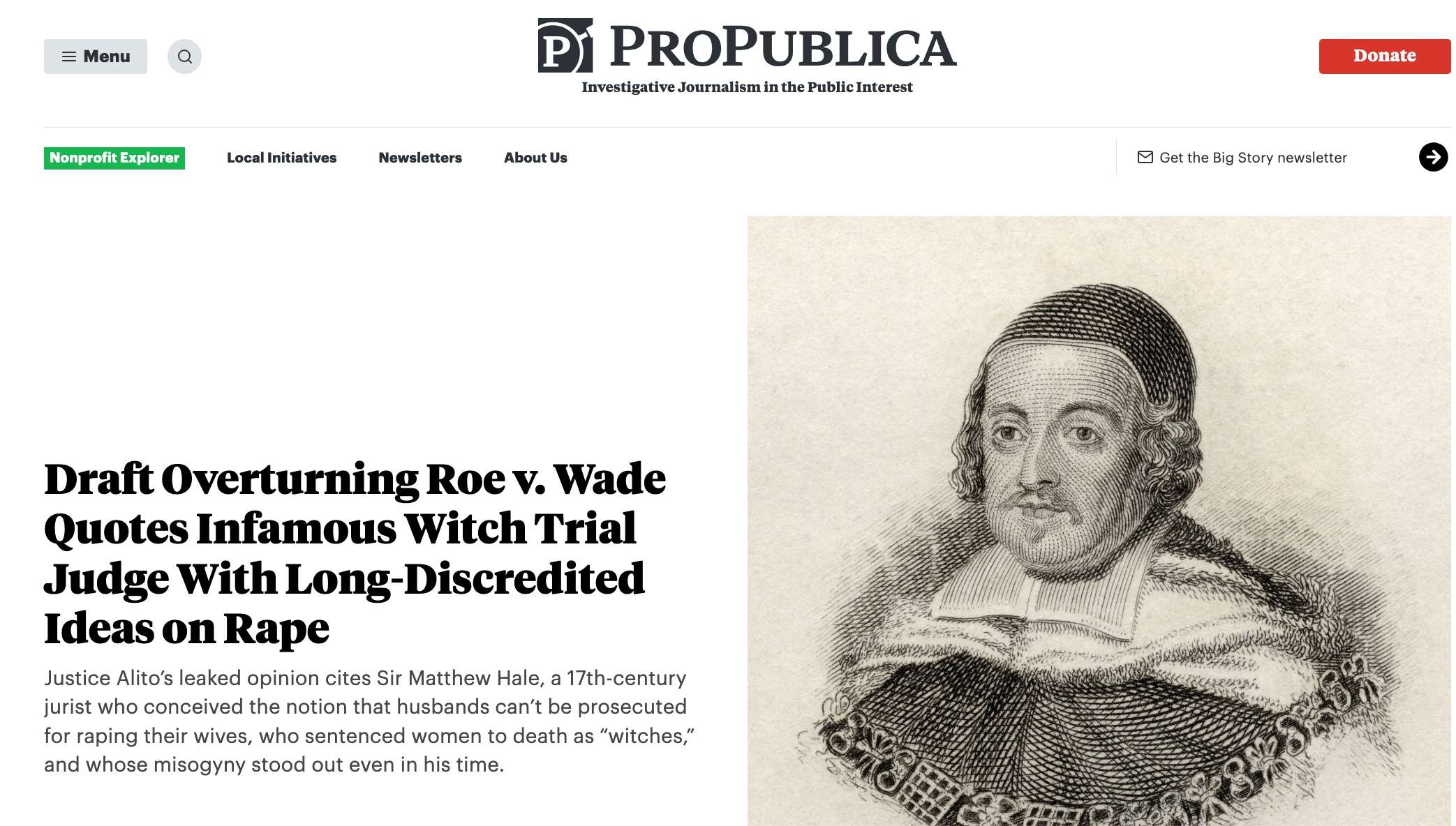
Last year, there was a bit of a stir when Justice Alito cited Sir Matthew Hale in the Dobbs draft, as ultimately in the published opinion. The well-known seventeenth century English judge sentenced two women to death for witchcraft. Therefore, everything the jurist wrote should be cancelled.
For those who still care about these things, Justice Sotomayor's dissent in Pugin v. Garland, which was joined by Justices Gorsuch and Kagan, also cites Hale. She cites Blackstone too. I'm sure he said some misogynistic things.
Although the Court quotes Blackstone's statement that " 'dis-suad[ing] a witness from giving evidence' " was an " 'impedimen[t] of jus-tice' " in support of its position, ante, at 8, Blackstone actually supports this dissent. The Court ignores that in historical usage "giving evidence" meant "testifying" at a proceeding. See, e.g., 3 W. Blackstone, Commentaries on the Laws of England 305 (1768) ("[E]very defence, which cannot be thus specially pleaded, may be given in evidence, upon the general issue at the trial"); 2 M. Hale, History of the Pleas of the Crown 280 (1736) ("If a reward be promised to a person for giving his evidence before he gives it, this, if proved, disables his testimony"). The majority also ignores that the Blackstone passage is discussing "[c]ontempts against the king's . . . courts of justice." 4 Blackstone, Commentaries, at 124 (1769). This context confirms Blackstone is referring to impeding a wit-ness from testifying at a proceeding, because otherwise it would not be a contempt against the king's courts.
Kagan had cited Hale in the past as well. Is there a problem? Hale no.
Last year ProPublica—yes that ProPublica—assailed Alito for quoting "infamous witch trial judge with long-discredited ideas on rape." I'm waiting for that venerable new organization to discover any Justice who was appointed by Presidents Obama or Biden.