The Volokh Conspiracy

Mostly law professors | Sometimes contrarian | Often libertarian | Always independent | Est. 2002

The Volokh Conspiracy

Free Speech

July 4 Injunction Bars Various Federal Departments from Encouraging Social Media Platforms to Delete Content

|

The opinion (Missouri v. Biden) by Judge Terry Doughty (W.D. La.) is here, and the injunction is here. The opinion is 45,000 words long, and I doubt I'll have a chance to fully analyze it for a while (I'm largely tied up for the next couple of weeks); but in the meantime, here's the opening:

The explosion of social-media platforms has resulted in unique free speech issues— this is especially true in light of the COVID-19 pandemic. If the allegations made by Plaintiffs are true, the present case arguably involves the most massive attack against free speech in United States' history. In their attempts to suppress alleged disinformation, the Federal Government, and particularly the Defendants named here, are alleged to have blatantly ignored the First Amendment's right to free speech.

Although the censorship alleged in this case almost exclusively targeted conservative speech, the issues raised herein go beyond party lines. The right to free speech is not a member of any political party and does not hold any political ideology. It is the purpose of the Free Speech Clause of the First Amendment to preserve an uninhibited marketplace of ideas in which truth will ultimately prevail, rather than to countenance monopolization of the market, whether it be by government itself or private licensee. Red Lion Broadcasting Co., v. F.C.C. (1969).

Plaintiffs allege that Defendants, through public pressure campaigns, private meetings, and other forms of direct communication, regarding what Defendants described as "disinformation," "misinformation," and "malinformation," have colluded with and/or coerced social-media platforms to suppress disfavored speakers, viewpoints, and content on social-media platforms. Plaintiffs also allege that the suppression constitutes government action, and that it is a violation of Plaintiffs' freedom of speech under the First Amendment ….

Read More

American Revolution

Writings on the Declaration of Independence and the American Revolution

A collection of links to some of my previous writings on these topics, which I think remain relevant today.

|

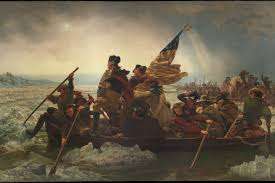
George Washington Crosses the Delaware. Famous Revolutionary War painting by Emanuel Leutze (1851). (NA)


Over the years, I have written a number of posts on the American Revolution and the ideals of the Declaration of Independence.. Some have obvious continuing relevance to such issues as identity politics, nationalism, immigration, the role of slavery in American history, and others.

In this post, which is an expansion of last year's similar compendium, I compile what I hope will be a useful list of links to those works. Enjoy!

"The Declaration of Independence and the Case for Non-Ethnic Secession," July 4, 2009.

"The Declaration of Independence and the Case for a Polity Based on Universal Principles," July 4, 2017.

"The Universalist Principles of the Declaration of Independence," July 4, 2019. Why it matters that the Declaration elevates universal liberal principles over racial, ethnic, and cultural particularism.

"The Case Against the Case Against the American Revolution," July 4, 2019. A rebuttal to longstanding claims - advanced by critics on both right and left - that the Revolution did more harm than good.

"Slavery, the Declaration of Independence and Frederick Douglass' 'What to the Slave is the Fourth of July?'", July 4, 2020. Douglass's famous speech sheds light on some of America's greatest evils - but also on the great good done by the Revolution and Founding.

"Juneteenth and the Universalist Principles of the American Revolution," June 19, 2021. Why there is no inconsistency in celebrating both July 4 and the abolition of slavery. Indeed, the two are mutually reinforcing.

"Immigration and the Principles of the Declaration of Independence," July 4, 2021.

"Juneteenth Celebrates a Great American Achievement," June 19, 2023. An extension of some of the key points made in my 2021 Juneteenth post, linked above.

"The Declaration of Independence Promotes Individual Liberty More than Collective Self-Determination," July 4, 2023.

American Revolution

The Declaration of Independence Promotes Individual Liberty More than Collective Self-Determination

This is true despite claims to the contrary by some on both the left and right.

|

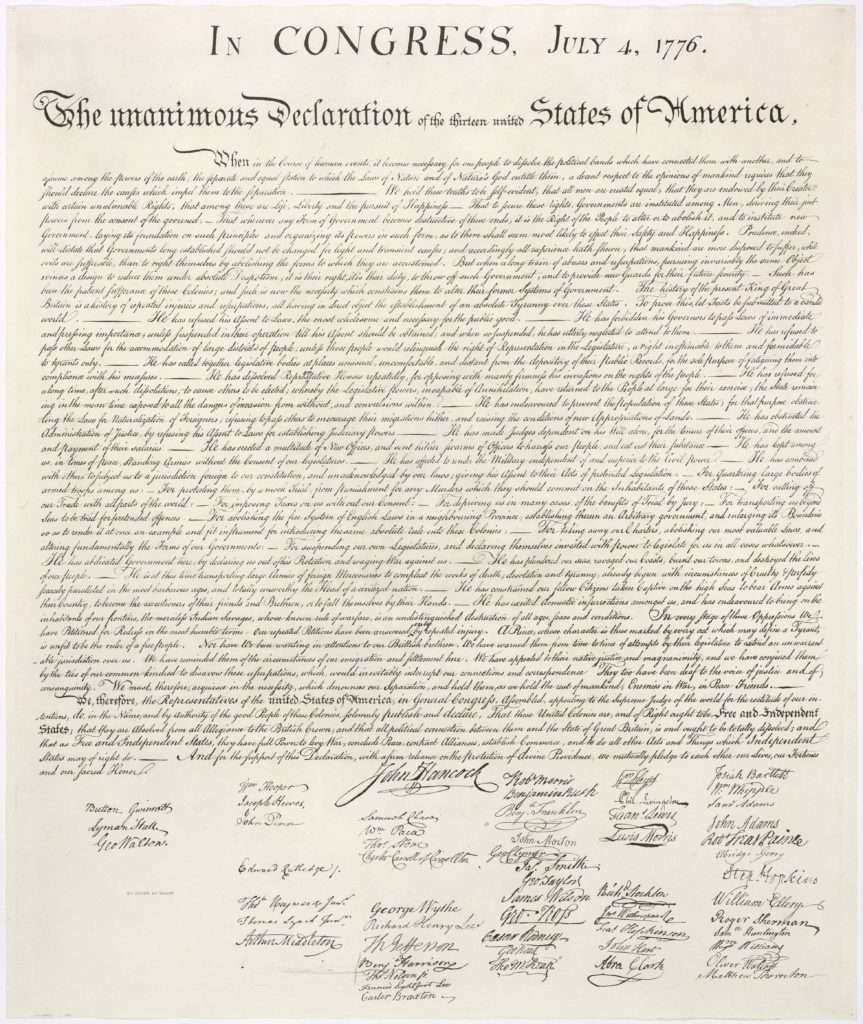
The Declaration of Independence. (National Archives.)


The connection between individual liberty and the principles of the Declaration of Independence should be obvious. After all, the most famous passage in the Declaration states that all men have the rights to Life, Liberty and the pursuit of Happiness" and that "to secure these rights, Governments are instituted among Men." But, in recent years, it has become common in some circles on both right and left to argue that the Declaration and the American Revolution were really about collective self-determination by a community.

For right-wing nationalists, this position enables them to assimilate the American experience to standard nationalist narratives under which governments exist primarily to advance the interests of a specific racial, ethnic, or cultural group. For left-wing critics of the Declaration and Revolution, such as legal scholar Kermit Roosevelt (see also here),  it allows them to highlight the slavery and racial inequality of early America and claim that our real Founding did not come until the abolition of slavery during and after the Civil War (if even then).

Such attempts to reinterpret the Revolution as being about collective rights are off-base. As already noted, the Declaration emphasizes that the protection of individual rights to life, liberty, and the pursuit of happiness is the main purpose of government. That's about as far from communitarian collectivism as you can get! To the extent collective self-determination matters, it is only in so far as it helps protect individual liberty and happiness.

Moreover, the Declaration does not claim that ethnic, racial, cultural or any other kinds of groups have any inherent collective rights to self-determination. Rather, it indicates that secession and revolution are justified only when the "Form of Government becomes destructive of these ends" (referring to the previously mentioned individual rights). And even then, overthrowing the government is only defensible in response to "a long train of abuses and usurpations." Complaints about "light and transient" causes  - or mere belief that a new government would fit the society's character better - are not enough.

The famous passage stating that governments derive "their just powers from the consent of the governed" is in some tension with the stricture that secession and revolution are justified only in extreme circumstances.  Perhaps the Declaration means that consent, once given, cannot be lightly withdrawn. More radically libertarian interpretations of the consent principle are also possible. No real-world government truly has the consent of the governed in more than a very minimal sense of the term. Regardless, the consent principle further reinforces the Declaration's focus on individual rights.

Perhaps most important, the Declaration omits any claim that Americans have a right to independence because they are distinct from the British in ethnicity, race, or culture. No such claim would have made sense, given that most Americans (at least white Americans) were of the same ethic and cultural groups as most Britons (English and Scots). Instead, the justification for independence is based on the British Empire's violations of universal liberal principles.

Most of the items on the list of grievances in the Declaration have to do with British violations of individual rights (e.g. - detention without trial and destruction of civilian lives and property) or undermining of institutions that protect those rights (e.g. - colonial assemblies; trial by jury). Nothing on the list has anything to do with protecting racial, ethnic, or cultural distinctiveness.

Indeed, the point condemning British interference with immigration is in part an appeal to liberal universalist principles of freedom of movement regardless of ethnic or cultural background. George Washington made that more clear in 1783. In his famous General Orders to the Continental Army, issued at the end of the war in 1783, he stated that one of the reasons the United States was founded was to create "an Asylum for the poor and oppressed of all nations and religions."

Roosevelt and many other critics of the Revolution rightly point out that the existence of slavery undermined the moral standing of the Revolution. There is obvious hypocrisy in simultaneously fighting for freedom, while keeping slaves yourself, as many of the rebels did. That, of course, includes Thomas Jefferson, the main author of the Declaration.

This blatant inconsistency is often taken to imply that Jefferson and the others didn't really mean it when they proclaimed that "all men are created equal." Perhaps they only had white men in mind. On this point, ironically, modern left-wing critics of the Revolution are in agreement with Chief Justice Roger Taney's notorious opinion in Dred Scott, and similar statements by other pre-Civil War defenders of slavery. They too argued that the Declaration was really only about self-determination for white men.

Many of the Founders were indeed hypocrites when it came to slavery. And they do deserve severe criticism for it. But many of them - Jefferson included - knew slavery was wrong. He famously denounced slavery as "a moral depravity" and "the most unremitting despotism."  Jefferson and many others recognized that slavery could not be squared with the principles they espoused.

For that reason, the Revolution gave a boost to the abolitionist cause in both the US and Europe. Most obviously, it gave rise to the First Emancipation - the abolition of slavery in the northern states, without which further abolition could not have occurred.

Roosevelt and others also point to the Declaration's language condemning the British for inciting "domestic insurrections amongst us," and suggest it implies that keeping slavery in place was a key motive for rebellion. The British did indeed promise to free Virginia slaves who fought for them against the rebels. But that measure was not the cause of the revolt. It was adopted in response to it. And in addition to trying to enlist freed slaves, the British also engaged in far more extensive recruitment of white American Loyalists.

It was still hypocritical of the rebels to condemn the freeing of slaves to engage in "insurrection" against them even as they themselves rebelled against Britain due to lesser injustices than slavery. But maintaining slavery was not the purpose of the Revolution, a point underscored by the way in which its success paved the way for large-scale emancipation.

Despite important progress, the revolutionaries failed to live up to their own principles, when it came to slavery, as well as a number of other issues. That failure deserves censure. But those principles were nonetheless about universal individual rights, not collective power or ethnic particularism. And the success of the Revolution led to major expansions of liberty - including key steps towards the abolition of slavery - even if it did not go nearly as far as it should have.

We haven't fully realized the principles of the Declaration and Revolution even today. Far from it. But much progress has been made, and there is room for much more.

Abraham Lincoln's famous 1857 assessment of the Declaration remains valid:

I think the authors of that notable instrument intended to include all men, but they did not mean to declare all men equal in all respects…. They did not mean to assert the obvious untruth, that all were then actually enjoying that equality, or yet, that they were about to confer it immediately upon them…

They meant simply to declare the right, so that the enforcement of it might follow as fast as circumstances should permit.

They meant to set up a standard maxim for free society which should be familiar to all: constantly looked to, constantly labored for, and even, though never perfectly attained, constantly approximated, and thereby constantly spreading and deepening its influence and augmenting the happiness and value of life to all people, of all colors, every where.

Frederick Douglass' 1852 speech "What to the Slave is the Fourth of July?" is also relevant here.  He forcefully condemned America's injustice and hypocrisy on slavery, but also praised key virtues of the Revolution, the Declaration, and the people responsible for them:

They were peace men; but they preferred revolution to peaceful submission to bondage. They were quiet men; but they did not shrink from agitating against oppression. They showed forbearance; but that they knew its limits. They believed in order; but not in the order of tyranny. With them, nothing was "settled" that was not right. With them, justice, liberty and humanity were "final;" not slavery and oppression.

What the Declaration of Independence Said and Meant

It officially adopted the American Theory of Government: First Come Rights; Then Comes Government to Secure These Rights

|

[This year, my annual post celebrating the Fourth of July is drawn from a chapter of Our Republican Constitution: Securing the Liberty and Sovereignty of We the People, and from a short essay on the same topic, The Declaration of Independence and the American Theory of Government: First Come Rights, and Then Comes Government." It also draws upon Sean Wilentz, No Property in Man: Slavery and Antislavery at the Nation's Founding]

The Declaration of Independence used to be read aloud at public gatherings every Fourth of July. Today, while all Americans have heard of it, all too few have read more than its second sentence. Yet the Declaration shows the natural rights foundation of the American Revolution, and provides important information about what the founders believed makes a constitution or government legitimate. It also raises the question of how these fundamental rights are reconciled with the idea of "the consent of the governed," another idea for which the Declaration is famous.

The adoption of the Declaration, and the public affirmation of its principles, led directly to the phased in abolition of slavery in half of the United States by the time the Constitution was drafted--as well as the abolition of slavery in the Northwest Territory. The Rhode Island gradual abolition law of 1784 read:

All men are entitled to Life, Liberty, and the Pursuit of Happiness, and the holding Mankind in a State of Slavery, as private property, which has gradually obtained by unrestrained Custom and the Permission of the Law, is repugnant to this Principle, and subversive of the Happiness of Mankind.

Later, the Declaration also assumed increasing importance in the struggle to abolish slavery. It became a lynchpin of the moral and constitutional arguments of the nineteenth-century abolitionists. As one New Yorker opposed to slavery wrote in 1797:

The right of property which every man has to his personal liberty is paramount to all the laws of property…. All I contend for at present is, that no claims of property can ever justly interfere with, or be suffered to impede the operation of that noble and eternal principle, that "all men are endowed by their Creator with certain unalienable rights–and that among these are life, liberty, and the pursuit of happiness.

Read More

Five Decades From Hardison to Groff

How could all of those courts get Hardison so wrong?

|

The most surprising case of the term was Groff v. DeJoy. I had no doubts that the postal worker would prevail. But the circuitous path by which the Court got there was shocking. Justice Alito wrote a unanimous opinion for the Court that reached a very careful compromise in a religious liberty case. Who had that on their SCOTUS bingo card?

What was the compromise? It turns out that TWA v. Hardison (1977) has been misread for five decades. Hundreds of judges throughout the federal judiciary consistently lacked the ability to read a Supreme Court decision. Even Judge Easterbrook, considered the paragon of textualism, misread the case. Justice Alito explains:

For example, two years ago, the Seventh Circuit told the EEOC that it would be an undue hardship on Wal-Mart (the Nation's largest private employer, with annual profits of over $11 billion) to be required to facilitate voluntary shift-trading to accommodate a prospective assistant manager's observance of the Sabbath. EEOC v. Walmart Stores East, L. P., 992 F. 3d 656, 659–660 (2021).

Now, in fairness, I think that Justice Alito's careful parsing of Justice White's majority opinion was illuminating. It really does seem that the "de minimis" line was not the Court's authoritative definition of "undue hardship." Justice Alito wrote:

The line read as follows: "To require TWA to bear more than a de minimis cost in order to give Hardison Saturdays off is an undue hardship." Id., at 84. Although this line would later be viewed by many lower courts as the authoritative interpretation of the statutory term "undue hardship," it is doubtful that it was meant to take on that large role. In responding to Justice Marshall's dissent, the Court described the governing standard quite differently, stating three times that an accommodation is not required when it entails "substantial" "costs" or "expenditures." Id., at 83, n. 14. This formulation suggests that an employer may be required to bear costs and make expenditures that are not "substantial." Of course, there is a big difference between costs and expenditures that are not "substantial" and those that are "de minimis," which is to say, so "very small or trifling" that that they are not even worth noticing.

Justice Alito is correct here. But how could the Supreme Court really have gone five decades without "clarifying" the doctrine? How many thousands of employees have been denied religious accommodations over the years because "jurists of wisdom" made so many errors. Indeed, the Supreme Court has denied review in several Hardison vehicles over the past few years.

At least the Court didn't just dismiss the "de minimis" language as dicta, like Chief Justice Roberts tried to do with the "viability" line from Roe.

On the plus side, all nine Justices formally buried the Lemon test. The majority opinion contained this line:

Just over three weeks later, the Court had handed down its (now abrogated)7 decision in Lemon v. Kurtzman, 403 U. S. 602 (1971) which adopted a test under which any law whose "principal or primary effect" "was to advance religion" was unconstitutional.

7 See Kennedy v. Bremerton School Dist., 597 U. S. ___, ___ (2022) (slip op., at 22).

Kennedy only said that Lemon was abandoned. Now, the majority agrees it was "abrogated." Lower courts, take note.

Goldilocks and the Four Non-Originalists

Counterman v. Colorado was a throwback to a different era.

|

In Bruen, Justice Thomas observed that the Second Amendment, like the First Amendment, should be interpreted with an originalist standard. Thomas wrote that with the freedom of speech, "to carry that burden, the government must generally point to historical evidence about the reach of the First Amendment's protections." Really? That was news to me. Throughout the entire twentieth century, the Supreme Court erected an elaborate and intricate free speech jurisprudence. There are tiers of scrutiny, balancing tests, categorical tests, and more. But very little of the free speech caselaw could be called originalist. Sure, in some cases, the Court talks about history. But this jurisprudence was manufactured from the ground up.

Nowadays, the Court seems to eschew this sort of free-floating judging. Even when the Court develops new doctrine, it tries to ground those principles in history. But Counterman v. Colorado felt like a throwback to a different era. This case considered what the proper mens rea was in a true-threats case. Justice Kagan wrote the majority opinion, which was joined by Chief Justice Roberts and Justices Alito, Kavanaugh, and Jackson. Should it be purposeful, knowing, or recklessness?  The majority chose a recklessness standard. Why recklessness? Justice Kagan explained:

Among those standards, recklessness offers the right path forward.

The Court struck a balance between punishing threatening behavior and avoiding the chilling of protected speech. There is no originalist case for this standard or that standard. Rather, the Court made an overt value judgment.

Justice Barrett wrote a dissent, joined by Justice Thomas. Justice Barrett charged that the majority was engaging in an inherently legislative task:

The optimal balance strikes me as a question best left to the legislature, which could calibrate the mens rea to the circumstance—for example, higher for the criminal context and lower for the civil. The reality is that recklessness is not grounded in law, but in a Goldilocks judgment: Recklessness is not too much, not too little, but instead "just right."'

In response, Justice Kagan owned her open-ended balancing:

The dissent accuses the Court of making a "Goldilocks judgment" in favoring a recklessness standard. Post, at 13 (opinion of BARRETT, J.). But in law, as in life, there are worse things than being "just right."

How would Justices Barrett and Thomas have resolved this issue? The starting point is not the Justices' own sense of propriety, but history:

So is the silence in the historical record. Since 1791, true threats have been excluded from the "speech" protected by the First Amendment. R. A.V., 505 U. S., at 382–383, 388. If Counterman could show that a subjective requirement has been inherent in the definition of "true threat" since the founding, he would have a compelling case. But Counterman cannot make that showing. For starters, he produces no evidence directly addressing the meaning of the First Amendment—nothing from state ratifying conventions, political commentary, or even early debates about efforts to regulate threats in ways that might threaten speech. That is not surprising at the federal level, because the Federal Government did not prohibit threats until the early 20th century. Elonis, 575 U. S., at 760 (THOMAS, J., dissenting). Some States, however, both regulated threats and guaranteed the right to free speech in their own constitutions. Id., at 760–761. Yet even at the state level, there was apparently no discussion about the implications of these statutes for the constitutional right.

What should the Court do in the absence of historical support for this rule? The Justices should decline to expand the protections of the"true-threat" doctrine:

At the end of the day, then, the best historical case for Counterman does not add up to much. He is plainly not asking the Court to enforce a historically sanctioned rule, but rather to fashion a new one.

Justice Thomas wrote a separate dissent. He analogized the made-up true threats doctrine to the "actual malice" standard from New York Times v. Sullivan:

Like the majority's decision today, "New York Times and the Court's decisions extending it were policy-driven decisions masquerading as constitutional law." McKee v. Cosby, 586 U. S. ___, ___ (2019) (THOMAS, J., concurring

Moreover, Justice Thomas faults the majority for extending further this "flawed" jurisprudence.

Many Members of this Court havequestioned the soundness of New York Times and its numerous extensions. See, e.g., Berisha, 594 U. S., at ___–___ (GORSUCH, J., dissenting from denial of certiorari) (slip op., at 5–8); Coughlin v. Westinghouse Broadcasting & Cable, Inc., 476 U. S. 1187 (1986) (Burger, C. J., joined byRehnquist, J., dissenting from denial of certiorari); Gertz, 418 U. S., at 370 (White, J., dissenting); Rosenbloom v. Metromedia, Inc., 403 U. S. 29, 62 (1971) (Harlan, J., dissenting); id., at 78 (Marshall, J., dissenting); Rosenblatt v. Baer, 383 U. S. 75, 92 (1966) (Stewart, J., concurring); see also E. Kagan, A Libel Story: Sullivan Then and Now, 18 L. & Soc. Inquiry 197, 207 (1993); J. Lewis & B. Ottley, New York Times v. Sullivan at 50, 64 DePaul L. Rev. 1, 35–36 (2014) (collecting statements from Justice Scalia); cf. Tah v. Global Witness Publishing, Inc., 991 F. 3d 231, 251–256 (CADC 2021) (Silberman, J., dissenting in part) (questioning the doctrine). It is thus unfortunate that the majority chooses not only to prominently and uncritically invoke New York Times, but also to extend its flawed, policy-driven First Amendment analysis to true threats, a separate area of this Court's jurisprudence.

The Court should not extend doctrine that itself has no grounding in the Constitution's original meaning. Justices Barrett and Thomas are exactly right.

Land of the Free Because Of The Brave

"The brave Justices who once sat on this Court decisively rejected those claims."

|

For three decades, Anthony Kennedy was America's moral arbiter. He alone got to decide what was legal and what was illegal. Abortion, sodomy, gay marriage, and so on. In Dobbs, the dissenters waxed nostalgia about Justice Kennedy, along with Justices O'Connor and Souter, as "judges of wisdom."

In 303 Creative, Justice Sotomayor's dissent expressed a similar yearning for the Hercules's of the day.

Around the country, there has been a backlash to the movement for liberty and equality for gender and sexual minorities. New forms of inclusion have been met with reactionary exclusion. This is heartbreaking. Sadly, it is also familiar. When the civil rights and women's rights movements sought equality in public life, some public establishments refused. Some even claimed, based on sincere religious beliefs, constitutional rights to discriminate. The brave Justices who once sat on this Court decisively rejected those claims. Now the Court faces a similar test.

No doubt, the "brave Justices" include Justice Kennedy, who single-handedly rewrote the law concerning gays and lesbians in America: Romer, Lawrence, Windsor, and Obergefell. In hindsight, Obergefell may seem like a foregone conclusion, but the three-decade trip from Bowers to Obergefell was anything but certain.

Still, I am not sure that the assignment of bravery is correct. Justice Kennedy was always extolled in elite circles for his progressive jurisprudence, while Justice Scalia and the dissenters were lambasted as bigots. Those dynamics were true a decade ago, but are even more stark now. Indeed, I think the bravest act is to rule against the sentiments of elite opinion. The six members of the majority did so with fearlessness.

Just The Facts, Ma'am

The importance of the trial records in Students for Fair Admissions and 303 Creative

|

Bench trials were held in both the Harvard and UNC cases. And both district court judges made extensive findings concerning how the universities used race in admissions. Did those findings matter to the Supreme Court? Probably not. In Students for Fair Admissions, Justice Sotomayor claims that the majority disregarded the findings of the trial court judges, and substituted its own facts.

The Court ignores these careful findings and concludes that Harvard engages in racial balancing because its "focus on numbers is obvious." Ante, at 31. Because SFFA failed to offer an expert and to prove its claim below, the majority is forced to reconstruct the record and conduct its own factual analysis. It thus relies on a single chart from SFFA's brief that truncates relevant data in the record. Compare ibid. (citing Brief for Petitioner in No. 20–1199, p. 23) with 4 App. in No. 20–1199, p. 1770. That chart cannot displace the careful factfinding by the District Court, which the First Circuit upheld on appeal under clear error review.

Justice Jackson made similar claims:

The majority cannot deny this factual finding. Instead, it conducts its own back-of-the-envelope calculations (its numbers appear nowhere in the District Court's opinion) regarding "the overall acceptance rates of academically excellent applicants to UNC," in an effort to trivialize the District Court's conclusion. I am inclined to stick with the District Court's findings over the majority's unauthenticated calculations.

Meanwhile, in 303 Creative, the web site designer and the state reached a series of factual stipulations. For example, the parties stipulated that Smith's web sites are "expressive" and Smith would create websites for gay and lesbian clients, so long as those web sites do not violate her beliefs. Did these facts matter to the majority? Yes, as it allowed the Court to skirt certain difficult questions about what types of speech are expressive. Justice Gorsuch's majority opinion relied extensively on those stipulations.

The Tenth Circuit held that the wedding websites Ms. Smith seeks to create qualify as "pure speech" under this Court's precedents. We agree. It is a conclusion that flows directly from the parties' stipulations. They have stipulated that Ms. Smith's websites promise to contain "images, words, symbols, and other modes of expression." They have stipulated that every website will be her "original, customized" creation. Id.. And they have stipulated that Ms. Smith will create these websites to communicate ideas—namely, to "celebrate and promote the couple's wedding and unique love story" and to "celebrat[e] and promot[e]" what Ms. Smith understands to be a true marriage.

In dissent, Justice Sotomayor downplays those stipulations. Indeed, the word "stipulation" appears nowhere in her opinion. Justice Gorsuch explains in his majority opinion:

When the dissent finally gets around to that question—more than halfway into its opinion—it reimagines the facts of this case from top to bottom. The dissent claims that Colorado wishes to regulate Ms. Smith's "conduct," not her speech. Forget Colorado's stipulation that Ms. Smith's activities are "expressive," App. to, and the Tenth Circuit's conclusion that the State seeks to compel "pure speech." The dissent chides us for deciding a pre-enforcement challenge.  But it ignores the Tenth Circuit's finding that Ms. Smith faces a credible threat of sanctions unless she conforms her views to the State's. The dissent suggests (over and over again) that any burden on speech here is "incidental." All despite the Tenth Circuit's finding that Colorado intends to force Ms. Smith to convey a message she does not believe with the "very purpose" of "[e]liminating . . . ideas" that differ from its own.

When the facts are on your side, argue the facts. If the law is on your side, argue the law. Otherwise, pound the table.

Just the facts, ma'am.

Fun fact: on the original Dragnet TV series, Joe Friday (played by Jack Webb) never actually said "Just the facts, ma'am," but that phrase has seeped into pop culture. It also appeared in the 1987 film starring Dan Aykroyd and Tom Hanks. If you have no idea what I'm talking about, you never watched Nick-at-night.

In Defense of KBJ's Harvard "Recusal"

Justice Jackson demonstrates why the usual recusal rules will not work for the Supreme Court.

|

Last year, I attended then-Judge Jackson's confirmation hearings. Most of the proceedings were utterly unmemorable. Perhaps the only important revelation came when Senator Ted Cruz of Texas asked if Jackson would recuse from Students for Fair Admission v. Harvard. "That is my plan, senator," she said. Up to that point, the Harvard and UNC cases were consolidated. But after Jackson took the bench, the Supreme Court unconsolidated the Harvard case from the UNC case. Why? Presumably to allow Justice Jackson to at least participate in the UNC case. And to be clear the eight Justices decided to do so on their own motion. No party made this request. I think the Court was working on a general assumption that a full bench should be present where possible. On the lower courts, a panel could have just drawn another judge at random. But on the Supreme Court, there are no substitutes.

The two cases were argued separately in October. Argument in the UNC case stretched nearly three hours, with Justice Jackson participating. Argument in the Harvard case stretched another two hours, with Justice Jackson absent. At the time, I expected the Supreme Court to resolve the statutory issue in the Harvard case and the constitutional issue in the UNC case. Justice Jackson would be able to write something in the former case, but not the latter. Alas, that outcome was not meant to be.

The majority decided to resolve the statutory and constitutional issues in a single opinion. Gratz stated that admission policies that violate the Equal Protection Clause also violate Title VI. (Justice Gorsuch is almost certainly correct this statement from Gratz is in error.) And, Chief Justice Roberts observed, "no party asks us to reconsider" that statement from Gratz. Therefore, the Court would "evaluate Harvard's admissions program under the standards of the Equal Protection Clause itself." (This conclusion in Footnote 2 led to the jarring locution that Harvard violated the Fourteenth Amendment.)

Once the Court chose this path, there would no longer be two separate opinions. What was Justice Jackson to do? The very last page of the majority opinion states that Justice Jackson "took no part in the consideration or decision of the case in No. 20-1199"--that is, the Harvard case. Justice Sotomayor's dissent included a similar footnote: "JUSTICE JACKSON did not participate in the consideration or decision of the case in No. 20–1199 and joins this opinion only as it applies to the case in No. 21–707"--that is, the UNC case. Justice Jackson's separate dissent included the same footnote.

Ultimately, Justice Jackson's eight colleagues all signed onto a statement that Justice Jackson "took no part in the consideration or decision of the case in No. 20-1199." Can that statement possibly be true? To be sure, Justice Jackson did not participate in the Harvard oral argument. She almost certainly did not vote at conference in this case. And the separate opinion she wrote only referenced the facts at UNC and not at Harvard. But beyond those obvious points, the "recusal" become more complicated. In many places, Justice Jackson responded to the Chief Justices's opinion concerning the Harvard case. I think it is a safe assumption that she reviewed the draft opinion in advance. Were those opinions redacted to remove any discussion of Harvard? Did she just skip over those pages? Were the memos circulated to the Jackson chambers likewise redacted? Does anyone believe these prophylactic steps actually happened?

On the lower courts, recusal means a judge has no contact with a case. Zero. She does not even see draft opinions that are being circulated. But on the Supreme Court, the practice apparently is different. The question turns on what "consideration or decision" means. Does that mean a Justice is hermetically sealed from a case? Or are the rules looser in a big case? I know it is en vogue to attack the Justices as ethically challenged, but here we have a clear case where a Justice said she would recuse, all nine Justices agreed she "took no part in the consideration or decision of the case," yet she obviously had at least some involvement.

Richard Re expresses a similar skepticism:

These facts make it hard to deny that Jackson participated in the consideration of the Harvard case. Again, Jackson read a draft of the majority opinion in that case. She wrote an opinion criticizing the core reasoning of the majority's draft. And the final version of the opinion for the Court in the case expressly responds to her objections. . .  . Yet the fact that Jackson did not write explicitly about Harvard shows, at most, that she did not participate in every aspect of the Harvard case's "consideration." Her dissent addressed only the case's core legal issues, rather than factual points. But both recusal principles and Jackson's disclaimer promise something more—namely, withdrawal from the entire case.

Richard goes one step further, and suggests that the Court had some sort of obligation to restructure the case so that Justice Jackson could fully participate, without any ruses:

The majority justices in particular should have arranged their work so as to maximize Justice Jackson's valuable participation without jeopardizing or undermining her recusal. Their collective failure to do so has turned recusal into a farce.

Here, I'll defend Justice Jackson--or more precisely, the principle that the Supreme Court needs to follow different recusal rules than the lower courts.

First, implicit in Richard's comment is a premise: a bench of nine is extremely important--so important that the Justices unconsolidated the cases. This unusual step reflects how disruptive a short-handed bench can be in a high-profile case. But ultimately, the Court reconsolidated the cases, with Jackson still quasi-recused. Why is nine so important? Look no further than the period between Justice Scalia's passing and Justice Gorsuch's confirmation. In many of these disputes, the Court reached "compromises" that didn't resolve pressing issues. Other cases were dumped 4-4.  Chief Justice Rehnquist addressed the value of nine when he declined to recuse in the Microsoft antitrust litigation. At the time, his son worked at a firm that represented the tech giant.

[B]y virtue of this Court's position atop the federal judiciary, the impact of many of our decisions is often quite broad. The fact that our disposition of the pending Microsoft litigation could potentially affect Microsoft's exposure to antitrust liability in other litigation does not, to my mind, significantly distinguish the present situation from other cases that this Court decides.  . . . . Finally, it is important to note the negative impact that the unnecessary disqualification of even one Justice may have upon our Court. Here–unlike the situation in a District Court or a Court of Appeals–there is no way to replace a recused Justice. Not only is the Court deprived of the participation of one of its nine members, but the even number of those remaining creates a risk of affirmance of a lower court decision by an equally divided court.

Second, and relatedly, critics want to increase the number of recusals on the Supreme Court. I think this number should be kept to a minimum. The obvious response is that Justices should not hear a case where there objectivity can be questioned. Does anyone honestly believe that Justice Jackson's vote on this issue would be affected by her service on the Harvard Board of Overseers? The Justices have very strong views on legal questions. They are nominated in large part because of those views. Those priors probably weigh on their votes far more than any prior service at Harvard. If we take conflicts of interest seriously, a Justice's deeply-held views on affirmative action should favor recusal far more than service on a board that had some tangential connection to the university's affirmative action policies. But if that were the rule, few high-profile cases could even muster a quorum.

Third, Justice Jackson presumably asked her colleagues for advice. Indeed, the other eight Justices would have to be personally familiar with the facts to state that Jackson took no part in the "consideration or decision." Again, a Justice could have objected to this statement, but no one did. I think it prudent that the Justices can rely on the advice of their other colleagues. And this co-counseling should likewise extend to concerns about other facets of legal ethics--including acceptance of gifts and reporting requirements.

Fourth, it would have been extremely problematic for Justice Jackson to seek advice from some other authority--whether lower court judges or some other body. The mere fact of seeking advice would have necessarily breached confidence. It would be impossible to counsel Jackson unless she explained the specific dynamics of the Court's private, internal deliberations. And we do not need to create the risk of more Supreme Court leaks.

With regard to Justice Jackson, the Supreme Court's internal ethics protocols worked exactly they were designed. Still, I will patiently wait for complaints from FixTheCourt, a demand letter from Senator Whitehouse, and an expose from ProPublica.

The Geopolitics of Extraditing Hackers

Episode 466 of the Cyberlaw Podcast

|

Geopolitics has always played a role in prosecuting hackers. But it's getting a lot more complicated, as Kurt Sanger reports. Responding to a U.S. request, a Russian cybersecurity executive has been arrested in Kazakhstan, accused of having hacked Dropbox and Linkedin more than ten years ago. The executive, Nikita Kislitsin, has been hammered by geopolitics in that time. The firm he joined after the alleged hacking, Group IB, has seen its CEO arrested by Russia for treason – probably for getting too close to U.S. cyber investigators. Group IB sold off all its Russian assets and moved to Singapore, while Kislitsin stayed behind, but showed up in Kazakhstan as a result of the Ukraine war broke out. Now both Russia and the U.S. have dueling extradition requests before the Kazakh authorities; Paul Stephan points out that Kazakhstan's tenuous independence from Russia will be tested by the tug of war.

In more hacker geopolitics, Kurt and Justin Sherman examine the hacking of a Russian satellite communication system that served military and civilian users. It's reminiscent of the Viasat hack that complicated Ukrainian communications, and a bunch of unrelated commercial services, when Russia invaded. Kurt explores the law of war issues raised by an attack with multiple impacts. Justin and I consider the claim that the Wagner group carried it out as part of their aborted protest march on Moscow. We end up thinking that the hack makes more sense as the Ukrainians serving up revenge for Viasat at a time when it might complicate Russian's response to the Wagner group.  But when hacking meets geopolitics, who really knows?

Paul outlines the legal theory – and antitrust nostalgia – behind the  FTC's planned lawsuit targeting Amazon's exploitation of its sales platform.  We also ask whether the FTC will file the case in court or before the FTC's own administrative law judge. The latter course may smooth the lawsuit's early steps, but it will also bring to the fore arguments that Lina Khan should recuse herself because she's already expressed a view on the issues to be raised by the lawsuit. I'm not Chairman Khan's biggest fan, but I don't see why her strongly held policy views should lead to recusal; they are, after all, why she was appointed in the first place.

Justin and I cover the latest Chinese law raising the risk of doing business in that country by adopting a vague and sweeping view of espionage.

Paul and I try to straighten out the EU's apparently endless series of laws governing data, from the General Data Protection Regulation (GDPR) and the AI Act to the Data Act (not to be confused with the Data Governance Act). This week, Paul summarizes the Data Act, which sets the terms for access and control over nonpersonal data. It's based on a plausible idea – that government can unleash the value of data by clarifying and making fair the rules for who can use data to create new businesses. Of course, the EU is unable to resist imposing its own views of fairness, thus upsetting existing commercial arrangements without really providing any certainty about what will replace them. The outcome is likely to reduce, not improve, the certainty that new data businesses want.

Speaking of which, that's the critique of the AI Act now being offered by dozens of European business executives, whose open letter slams the way the AI Act kludged the regulation of generative AI into a framework where it didn't really fit. They accuse the European Parliament of "wanting to anchor the regulation of generative AI in law and proceeding with a rigid compliance logic [that] is as bureaucratic …  as it is ineffective in fulfilling its purpose." And you thought I was the EU-basher.

Justin recaps an Indian court's rejection of Twitter's lawsuit challenging the Indian government's orders to block users who've earned the government's ire. Kurt covers a matching story about whether Facebook should suspend Hun Sen's Facebook account for threatening users with violence. I take us to Nigeria and question why social media thinks governments can be punished for threatening violence.

Finally, in two updates,

  • I note that Google has joined Facebook in calling Canada's bluff by refusing to link to Canadian news media, thus avoiding the Canadian link tax. For Cybertoonz's comment on Google's response, see below.
  • And I do a victory lap for the Cyberlaw Podcast's Amber Alert One week after we nominated the Commerce Department's much delayed and nearly invisible IT supply chain security program for an Amber Alert, the Department answered the call by posting the Executive Director job in USAJOBS.

Download 466th Episode (mp3)

You can subscribe to The Cyberlaw Podcast using iTunes, Google Play, Spotify, Pocket Casts, or our RSS feed. As always, The Cyberlaw Podcast is open to feedback. Be sure to engage with @stewartbaker on Twitter. Send your questions, comments, and suggestions for topics or interviewees to CyberlawPodcast@gmail.com. Remember: If your suggested guest appears on the show, we will send you a highly coveted Cyberlaw Podcast mug! The views expressed in this podcast are those of the speakers and do not reflect the opinions of their institutions, clients, friends, families, or pets.

And the latest from Cybertoonz:
Google responds

Free Speech

Alleged Panama Papers Leaker Allowed to Proceed Pseudonymously in Breach of Contract Lawsuit Against Germany

But the court insisted that the alleged leaker file identifying information under seal with the court, notwithstanding the alleged leaker's claim that the court computers could be hacked.

|

From Doe v. Fed. Republic of Germany, decided today by Chief Judge James Boasberg (D.D.C.):

Plaintiff claims to be the source of the Panama Papers, a set of leaked documents that revealed a global network of tax evasion and offshore holdings. He is proceeding pro se in this breach-of-contract lawsuit against Germany and its federal criminal police agency to recover money that they allegedly owe him as part of Germany's agreement to purchase the Panama Papers from him. See Panama Papers: Germany 'Pays Millions' for Leaked Data, BBC News (July 5, 2017) …. He requests pseudonymity because he claims that he faces a "real and imminent" threat to his safety from global actors committed to identifying and harming him in retribution for his production of the Panama Papers. As part of his request, Plaintiff also asks to seal his identity from the Court. But see LCvR 5.1(c)(1) (requiring that parties file "name[s] and full residence address[es]" and pro se parties also file telephone number).

Because Plaintiff has made the detailed showing required to overcome the presumption in favor of public disclosure, the Court will grant his request to proceed under a pseudonym in his public filings. It will, however, deny his unusual request to seal his identity from the Court. The Court uses male pronouns throughout this Opinion for convenience but does not thereby suggest anything about Plaintiff's sex….

Generally, a complaint must identify the plaintiffs. See Fed. R. Civ. P. 10(a); LCVR 5.1(c)(1) . That requirement reflects the "presumption in favor of disclosure [of litigants' identities], which stems from the 'general public interest in the openness of governmental processes,' and, more specifically, from the tradition of open judicial proceedings." A party moving to proceed pseudonymously thus "bears the weighty burden of both demonstrating a concrete need for such secrecy, and identifying the consequences that would likely befall it if forced to proceed in its own name." …

The first factor supports granting the Motion. Plaintiff seeks pseudonymity not "merely to avoid the annoyance and criticism that may attend any litigation," but … argues that he "is not concerned about [his] reputation or future career prospects so much as [his] safety." The Court agrees…. Plaintiff's identity has not been publicly disclosed and is itself sensitive in light of the risks to which its revelation could expose him. See Juliette Garside & Philip Oltermann, Panama Papers Whistleblower Speakers Out: 'Politicians Must Act — Now', The Guardian (July 22, 2022) ("The whistleblower said they could not take the risk of revealing their identity because they believed they were a target of the Russian government."); Chang v. Republic of S. Sudan, 548 F. Supp. 3d 34, 38 (D.D.C. 2021) (recognizing risk of retaliation from foreign government as relevant to [whether a plaintiff may proceed pseudonymously])….

Read More

"What a Difference Five Years Makes"

What would Masterpiece have looked like with Justice Kennedy still on Court?

|

On the Supreme Court, a lot has changed in the past five years. Justice Kennedy was replaced by Justice Kavanaugh. Justice Ginsburg was replaced by Justice Barrett. Many Kennedy-brokered compromises would now come out differently. Last term, Justice Sotomayor lamented, "What a difference five years makes." Here, she was counting the five years period from Trinity Lutheran Church v. Comer (2017) to Carson v. Makin (2022). Trinity was a 7-2 decision, that was joined by Justices Breyer and Kagan. Compromise was the name of the game back then. The Court held that the government could not discriminate a church for its religious "status," but the Court left open the question of whether the government could deny funding for religious "uses."  But over the ensuing five years, the Court retreated from that compromise. Carson, and before that Espinoza, made it very difficult for the government to deny funding for religious uses. The compromise fell apart. Justice Sotomayor's regrets that the Court circa 2017 would have never supported that holding.

Justice Sotomayor repeated this same five-year line in 303 Creative v. Elenis. Here, she was counting five years from Masterpiece Cakeshop v. Colorado (2018). This decision, handed down in Justice Kennedy's final term, avoided the Free Speech question, and instead ruled based on the Free Exercise Clause. Rather, in another 7-2 decision with Justices Breyer and Kagan on board, the Court found evidence of religious animus in the state proceedings, in violation of Lukumi. That decision avoided the question of whether a cake was protected speech. Again, Sotomayor's recalls that compromise was the playbook before Justice Kennedy retired. But there are new rules now. (I pause to stress that Justice Sotomayor dissented in both Trinity Lutheran and Masterpiece--no compromise on her part.) In 303 Creative, Justice Gorsuch wrote a full-throated defense of the website designer. Such an opinion would have been unfathomable in 2018.

What would Masterpiece have looked like if the Court did not decide the matter on free exercise grounds? Would Jack Phillips have lost on free speech grounds? I'm not sure that Justice Kennedy could have mustered that outcome. For sure, the Court would not have produced a rousing defense of free speech like the one that Justice Gorsuch delivered. In a way, the five year punt from 2018 worked out for the benefit of the Masterpiece Cakeshop and 303 Creative. Going forward, I remain uncertain how many of these cases will actually arise. I suspect tester plaintiffs will stop targeting the handful of vendors who decline to service same-sex weddings. These cases will simply fade away.

Speaking of five years, on the mop-up list, the Court GVR'd Klein v. Oregon Bureau of Labor and Industries. This case involves Sweet Cakes by Melissa, another baker who declined to make a wedding cake for a same-sex marriage. If this case sounds familiar, it should. In 2019, the Supreme Court GVR'd this case in light of Masterpiece Cakeshop. So the Supreme Court has now GVR'd the same dispute, twice, in light of landmark First Amendment cases. Has any case ever seen such treatment? Meanwhile, the Klein litigation has been ongoing for more than a decade. And, once again, the baker will have to slog through the Oregon courts. Now, did Justice Gorsuch's opinion resolve whether a baker is involved in expressive speech? I don't think so. The Oregon courts may once again rule against Klein. The Supreme Court will see this case again in another five years! And you wonder why Baronelle Stuzman settled the never-ending Arlenes Flower's case while 303 Creative was still pending.

Making Sense Of The Votes In Mallory v. Norfolk Southern Railway Co.

The decision this term that has the largest potential for a legal "jolt" was Mallory.

|

Last term, Chief Justice Roberts warned that Dobbs would cause a "serious jolt to the legal system." Which case from the term-that-just-finished caused the most significant jolt? It's not Students for Fair Admissions. Universities will quickly find ways to cheat the ruling and wait to be sued. It will take years to suppress the massive resistance--assuming the Court is committed to the enterprise. And don't say Moore v. Harper. The "strong" version of the Independent State Legislature Doctrine was never going to be approved. At most, a bare majority of the Court would probably adopt Chief Justice Rehnquist's concurrence from Bush v. Gore. (I remain flummoxed why scholars who rejected the existence of the ISL doctrine are claiming victory by a decision that accepted the "weak" version of ISL.) And don't say Allen v. Milligan. That decision, at most, will probably create a few more majority-minority districts in the South, which may flip the House, but the Court did not break much new legal ground.

No, the decision this term that has the potential to create the biggest legal "jolt" was Mallory v. Norfolk Southern Railway Co. The facts are fairly straightforward: Norfolk Southern Railways is headquartered in Virginia; the plaintiff is a citizen of Virginia; the plaintiff allegedly suffered injuries as an employee of the railroad in Virginia and Ohio. But the Plaintiff filed suit in Philadelphia, Pennsylvania. Why? Justice Alito hints at one possible answer: the venue "is reputed to be especially favorable to tort plaintiffs." Of course, that is the plaintiffs' decision. As a general matter, the plaintiff gets to decide where to sue a defendant. But the defendant has defenses--specifically, that a given court lacks personal jurisdiction over the defendant. And that's what Norfolk Southern argued. The railroad is not headquartered in the Pennsylvania, so there is no "general" jurisdiction. And the railroad did not have "minimum contacts" with Pennsylvania, so there is no "specific" jurisdiction. But Pennsylvania has an unusual law: any business that registers to transact business in the state submits to jurisdiction of Pennsylvania state courts. (Or at least this is how the plaintiff reads the statute.)

The conflict is palpable. Norfolk Southern wants to stay out of Philadelphia, which is reputedly favorable to plaintiffs. And Mallory, as Justice Alito suggested, chose that forum deliberately. The stakes of this case could not be greater. If Mallory prevails (and whether he ultimately prevails is still up in the air), every corporation that has registered to do business in Pennsylvania will now be at the mercy of Philadelphia trial courts. And other states can follow-suit: California, Illinois, Washington, and so on. This risk is severe for businesses. (The Washington Supreme Court, in particular, reads the Due Process clause through the lens of anti-racism.)

Mallory prevailed by something of a 5-4 vote. The split here may never repeat itself. Four justices held that the Pennsylvania registration statute complies with the Due Process Clause of the Fourteenth Amendment: Justice Gorsuch, joined by Justices Thomas, Sotomayor, and Jackson. Four Justices held that the statute violates the Due Process Clause: Justice Barrett, joined by Chief Justice Roberts, and Justices Kagan and Kavanaugh. And who was in the middle? Justice Alito. He agreed that Mallory should prevail under Pennsylvania Fire of Philadelphia v. Gold Issue Mining (1917), a very old Due Process precedent that arguably has been obviated by half a century of CivPro cases. He did not join much of Justice Gorsuch's historical analysis. Still, Justice Alito suggested that Pennsylvania's regime violates the Dormant Commerce Clause.  Here, Justice Gorsuch did not give Pennsylvania Fire the Lemon test treatment--no matter how many decisions abrogated that old precedent, it somehow survived.

If we had a "pro-corporation" Court, Mallory should have prevailed by a large vote. Yet Justices Gorsuch, Thomas and (mostly) Alito ruled in favor of Mallory. Why did Justice Alito join the majority in part? I doubt he has any sympathy for Philadelphia trial lawyers. Still, his decision to follow Pennsylvania Fire kept the case alive. And now the lower courts can declare the statute under the Dormant Commerce Clause. If the case returns, after Pork Producers, the Court will now have a chance to further clarify the doctrine, and bring it closer to the original meaning of the Constitution. The upshot of this theory, which Steve Sachs advanced, is that Congress retains the power to regulate interstate commerce, and could impose a nationwide standard on these sorts of registration statutes. But a ruling on the Due Process Clause, however, could only be remedied by constitutional amendment, or a new Supreme Court Justice--whichever comes first.

Next we get to the dissenters. Justice Barrett and Kagan, in particular, taught civil procedure for many years. They can probably recite the holding from International Shoe in their sleep. These cases are so deeply embedded in our law, and in casebooks, that Justice Barrett could not even countenance how Pennsylvania Fire could survive the New Deal. She derisively called the majority's theory "clever." (She also dismissed Eugene Volokh's theory in Hansen as "novel.")  I was piqued by Justice Barrett's suggestion that the Due Process Clause protects interstate federalism. This argument needs some work--it resembles the substantive due process slop that Justice Kennedy ladled in Windsor. The Due Process Clause protects "persons," not states. (Justice Alito's concurrence is exactly correct on this point.) Justice Barrett would not support the majority's "sea change" in the law. But Justice Gorsuch is "happy to see" these precedents go.

In any event, this case may yet return to the Supreme Court. Steve Sachs explained what may come next.

Education

The Case for Abolishing Legacy Preferences in College Admissions

They probably aren't illegal under current law. But they are nonetheless wrong for many of the same reasons as racial preferences.

|

The Supreme Court's recent ruling against racial preferences in higher education admissions has heightened longstanding controversy over "legacy" preferences that benefit children of alumni. Figures as varied as President Biden and GOP Senator and presidential candidate Tim Scott have called for their abolition.

Today, Lawyers for Civil Rights, together with several other groups, filed a complaint against Harvard with the Department of Education Office of Civil Rights, arguing that OCR should force Harvard to stop the practice because it disproportionately benefits white applicants at the expense of other groups, and thereby violates Title VI of the Civil Rights Act of 1964 (which forbids racial discrimination in education programs receiving federal funds). On Twitter, prominent left-wing Democratic Rep. Alexandra Ocasio-Cortez opined that "[i]f SCOTUS was serious about their ludicrous 'colorblindness' claims, they would have abolished legacy admissions, aka affirmative action for the privileged."

I am skeptical that LCR's complaint will prevail, unless they can prove that Harvard's legacy preferences were adopted or maintained for the purpose of benefiting whites (or keeping out non-whites). Title VI (and other current federal laws) do not ban legacy preferences as such. And courts are unlikely to invalidate them merely because they disproportionately help white applicants relative to those from other groups. As for AOC, the issue of legacy preferences was not before the Supreme Court in the cases it heard, and there was nothing the justices could have done to abolish that policy.

That said, legacy preferences are indeed a kind of "affirmative action for the privileged," just as AOC says. And they are unjust for much the same reasons as racial and ethnic preferences are. In both cases, some applicants are rewarded and others punished for arbitrary circumstances of ancestry that they have no control over, and that have no connection to academic or other skills that might make them better students or better members of the university community. The fact that your parents were black, white, or Latino says nothing about how good an applicant you are. And the same goes for the fact that mommy or daddy went to Harvard (or didn't).

Like race, legacy status may sometimes be correlated with academic or other skills. But university admissions offices need not rely on such crude and dubious proxies when they can simply rely on direct measures of the academic and other skills that interest them.

The usual rationale for legacy preferences is that they increase alumni donations to colleges. This might be a defensible argument for profit-making institutions whose primary goal is to make money for owners and investors. But most universities are public or non-profit institutions that - at least in principle - are supposed to prioritize other objectives, such as promoting education and research. Legacy preferences are pretty obviously inimical to those goals.

Moreover, it isn't even clear that legacy preferences really do increase donations significantly. A number of elite schools, such as Johns Hopkins, MIT, and my undergrad alma mater Amherst College, have recently abolished legacy preferences with few if any ill effects.

I know many elite college alumni from my own generation (the one now in its peak giving years). Very few support legacy preferences, and fewer still (if any) are likely to reduce their giving if their alma mater drops that policy. Polls indicate 75% of Americans oppose legacy preferences, a figure comparable to the level of opposition to racial preferences. I doubt the opposition among elite-college graduates is significantly lower than that in the general public. In my experience, it may well be higher.

As always, it's dangerous to generalize about public opinion from personal experience. Perhaps I know an unrepresentative set of elite-school alums. Maybe I'm too much of a commoner for the aristocratic types who like legacy preferences to condescend to associate with me! My point here is not that alumni donations definitely won't decline significantly if schools abolish legacy preferences, but that the claim they will should be viewed with some skepticism.

It's potentially possible to defend some form of legacy preferences on a different ground. When I applied to college in 1990, I (as a first-generation immigrant) was the first in my family to do so in the United States. Thus, I could not benefit from legacy preferences, and indeed was disadvantaged by having to compete with applicants eligible for them. My wife, though a native-born citizen, was also the first in her family to attend a national elite college (Dartmouth). If not for legacy preferences, perhaps my (then-future) wife and I would have attended higher-ranked schools or secured other benefits.

Today, my wife and I have undergraduate and graduate degrees from a number of elite colleges and universities. If legacy preferences are abolished at all these schools, our kids won't have the opportunity to benefit from them. Thus, the Somin family will never be compensated for the unfair disadvantages we faced in earlier years.

On this theory, children of first-generation elite college graduates should be offered legacy preferences to offset the disadvantages their parents faced. Note the parallel with arguments that past discrimination in admissions against blacks and other minority groups justifies compensatory discrimination in favor of them today.

Obviously, however, the harm done to past generations by legacy preferences is modest compared to that of slavery and segregation. And in both cases, we can't genuinely remedy historic wrongs through preferential policies today. Among other things, the people who benefit from today's compensatory preferences probably would not even exist in the first place if not for the wrongs of the past.

Although legacy preferences likely do not violate current antidiscrimination laws, legal scholar Carlton Larson has plausibly argued that those at public universities violate the Constitution's prohibition on titles of nobility, which - he contends - should be interpreted as banning state-granted hereditary privileges more generally. I am no expert on the Titles of Nobility Clause, and therefore not able to fully evaluate his argument. But it deserves serious consideration.

Larson's theory aside, legacy preferences probably aren't illegal under current law. But nothing prevents us from getting rid of them. State governments would do well to ban them at their public universities. And private schools would do well to voluntarily follow the example of Amherst, Johns Hopkins, and MIT.

Race Discrimination

A Lawyer Who Litigated Grutter Comments on the Court's College Admission Racial Preferences Cases

|

I've known Michael Rosman at the Center for Individual Rights for almost 30 years; he has litigated many important cases, including with regard to racial preferences, and was one of the lawyers in Grutter v. Bollinger. I'm therefore delighted to pass along his short reactions to Students for Fair Admission v. Harvard and Students for Fair Admission v. UNC, focused on the Court's opinion and the concurrences; all the remaining text of the post is Michael's:

  1. A Tribute: My first thought was of Will Consovoy, the great attorney who led the charge in these cases and who died at a young age before he could see them come to fruition. The outcome is a tribute to him—as well as the great firm he helped create (Consovoy McCarthy), the oral advocates (Patrick Strawbridge and Cameron Norris), Ed Blum, who helped put the cases together and kept them afloat, and all of the many attorneys who worked for so many years on them.
  2. Grutter Is Gone: I agree with Justices Thomas and Sotomayor that the Court essentially overruled Grutter. The most obvious (but not the only) support for this is the Court's description of the rule against using race as a "negative." First, the Court did not say that in Grutter or, as far as I can tell, in any other race-conscious affirmative action case, although it seems obvious that invidious discrimination is unconstitutional. As support, the Court's opinion cites a part of the Grutter decision that precludes race-conscious decisions from "unduly burdening" others, which strikes me as a different concept. And this becomes crystal clear when the Court holds that using race positively for members of one race is tantamount to using it as a "negative" for all others in any zero-sum game. (Slip op. 26.)  Which I think would apply to virtually all kinds of race-conscious decision-making, both within higher education and without.
  3. So, the conclusion I draw is that the Court did not explicitly overrule Grutter because it did not want to directly address Justice Sotomayor's substantial stare decisis arguments.
  4. The Missing Race?: The creation of a new "negative" requirement allowed the Court to sidestep one of the trickier issues in the cases. In the Harvard case, plaintiff had argued that Harvard had discriminated against Asians in the sense that, as a group, Asians were treated even worse than whites. (As a group, Asians had lower "personal ratings" than whites.) The district court had concluded that Harvard had not discriminated against Asians. Perhaps not wanting to wade into whether the district court abused its discretion in that holding, the Supreme Court never mentioned the issue.

Read More

Civil Liberties

How to Read 303 Creative v. Elenis

The speech compulsion it forbids is not limited to wedding-website designers who object to same-sex marriage, but its principles should apply only to a narrow range of commercial products

|

On Friday, the Supreme Court ruled in 303 Creative v. Elenis that Colorado cannot force a website designer to create messages celebrating same-sex marriages.  Eugene and I joined others in an amicus brief arguing that this potential application of a state public accommodations law would be an unconstitutional speech compulsion.  As Eugene has already noted, the Supreme Court agreed.

I read Justice Gorsuch's decision as broader in some respects than some may hope it is. It can't reasonably be cabined to all of its specific facts. The rationale for the vendor's message-based objection--religious or not, internally consistent or not, odious or not--does not matter. Op. at 24-25. Nor, in principle, are the speech protections the Court outlined limited to the creation of messages about same-sex marriage, marriage in general, or homosexuality.

On the other hand, the decision is also narrower in important ways than some progressives fear or some religious conservatives/libertarians may hope.  I read 303 Creative to hold that a vendor cannot be compelled by the government:

(1) to create customized and expressive products (whether goods or services) that constitute the vendor's own expression (op. at 9, 16);

(2) where the vendor's objection is to the message contained in the product itself, not to the identity or status of the customer (op. at 18 n. 3, 20).

Consider each part of this:

I.     The product must be customized and expressive

The Court repeatedly emphasized the unusual nature of the product Lorrie Smith, the website designer, proposed to sell: working closely with each individual customer to tailor specific and original messages by using Smith's own words and designs. Very few businesses take on such individualized commissions.  She was not selling grilled cheese sandwiches at a lunch counter.  Because of the requirements of customization and expressiveness, there will be no claim for the "vast array of businesses" selling "innumerable goods and services." Op. at 14.

First, almost all of the products we buy are neither customized nor expressive. From dairy to desks to dry cleaning, they are what the Court calls "ordinary commercial products."

Second, most customized products are not expressive.  Think of the Ford F150, which has literally millions of option combinations. Or a Whopper, which was once promoted with the tagline, "Have it your way," indicating Burger King's willingness to tailor the burger to customers' taste preferences. There will be no claim for businesses selling these kinds of products.

Of course, this analysis does not answer all questions on the margins. The biggest of these will be: what sorts of customized products count as expressive? (Given Colorado's stipulations and the nature of the proposed services for wedding website design, product expressiveness wasn't a close question in 303 Creative. Op. at 21-22).

Line-drawing itself is not a new problem in free speech cases. In particular, the Court has developed doctrines to distinguish what is protected speech from what is unprotected conduct. That test combines elements that are both subjective (the speaker's own intention to communicate a message) and objective (the onlooker's perception whether the message has actually been communicated). Under this test, conduct is sometimes expressive but most often not. What's new after 303 Creative is that courts will now need to apply similar principles to commercial products.

There is a risk that some lower courts will be too aggressive in constitutionally exempting non-expressive commercial products from anti-discrimination rules. That result would not only be harmful to the dignitary and material interests of buyers, but it would ultimately discredit and undermine the genuine First Amendment interests of speech creators.

Eugene and I have offered some guidelines for distinguishing expressive from non-expressive products in prior briefs (see, e.g. our amicus brief here at pp. 5-14, explaining in Masterpiece Cakeshop why cake-making is not generally expressive). Some kinds of products will be clearly expressive, and others will be expressive on the margins, but the vast majority won't be expressive. There will be hard and intensely fact-bound judgments to make, based on what has historically counted as expressive (e.g. parades, books, paintings, and films) and based on the use of intrinsically or inherently expressive elements in the work (e.g., speaking, writing, and deploying symbols). The mere fact that the vendor subjectively regards the product as "art" that expresses some message would not be enough to trigger First Amendment protection. A limousine driver may think he turns corners with a distinctive flair, but his craft is neither historically nor intrinsically expressive. A Subway "sandwich artist" might be creating something worthwhile, but it's not speech.

Before Friday, the answer of some scholars and organizations like the ACLU was that none of this matters because when you're selling things in the public marketplace you basically have no First Amendment rights. Your choices were to quit your trade or come to heel.  303 Creative is clear that this answer will no longer suffice. It never really did. Op. at 16-17, 23.

Third, most expressive products are not customized. Think of a store that sells paintings or sheet music or books. Lots of protected expression goes into these products, but they're not created according to the demands or preferences of the particular customer.  Since the artist or composer or writer has already created the product, the state has not compelled their creation. Refusing to sell these expressive products to protected classes of customers amounts to illegal status- or identity-based discrimination, which is not protected by the First Amendment. In general, if it's already on the shelf (physically or online) you have to sell it to all comers.

Here, too, there will be some cases at the margins of both customization and expression. As the dissent acknowledged, portrait photography is a generally expressive medium. Sotomayor dissent at 28.  But even in this presumptively constitutionally protected context, some settings are more like an F150 assembly line than Annie Leibovitz's studio. I don't think a photographer offering to take standard school photos, corporate headshots, passport photos, or pictures with a mall Santa truly customizes the product or expresses something to a degree that warrants constitutional protection. Such a claim would trivialize free speech protection in the way that the Court in Rumsfeld v. FAIR thought the law schools' objections to sending emails about military-recruiter meeting times and locations did.

A wedding photographer, on the other hand, does offer highly customized and expressive services, working closely with each customer to depict the wedding in a certain way. (Cato, Eugene, and I first made this argument a decade ago in an amicus brief supporting certiorari in Elane Photograhy LLC v. Willock. The Court denied cert.)

Similarly, a website designer who offers a preset menu of plug-and-play options for customers to create their own wedding websites is offering a product customized mainly by the buyer, not the designer. It's the customer's speech, not the vendor's.

By contrast, a website designer like Smith who consults with customers to compose original written messages and creative graphics is herself customizing the product. The product is collaborative. And while it's certainly the couple's expression, it's also importantly the designer's.

II.     The objection must be to the message in the product, not the customer's status

The vendor's objection also has to be to the message contained in the product, not to the status or identity of the customer. Businesses can't claim constitutional protection for a categorical rule that they won't sell commissioned products to gays, Jews, Blacks, or women. And of course they will not get a free-speech exemption from employing, insuring, housing, medically treating, or serving any particular class of people. 303 Creative reaffirms the cardinal rule that the First Amendment does not shield these acts of status-based discrimination.

There will be questions about whether the message-based objection is tantamount to a status-based one and therefore unprotected. Take this very case. As a matter of statute, Colorado regards discrimination based on opposition to same-sex marriage as a form of anti-gay discrimination in the same way that a ban of wearing yarmulkes is a form of discrimination against Jews. That seems justifiable in most regulatory and anti-discrimination contexts. For example, an employer who fires a worker because she's in a same-sex marriage has fired the worker based on her sexual orientation. State bans on same-sex marriage or denials of benefits to married same-sex couples similarly constitute sexual orientation discrimination.

But the federal government's argument that as a matter of constitutional law objections to same-sex marriages are necessarily status-based--equivalent to objections to gay people--won't fly for the compelled creation of expressive products. That's because, unlike in the regulatory context or where non-expressive discrimination occurs, the protected expression of another person is at stake "about a matter of major significance." Op. at 25. Massachusetts in Hurley and New Jersey in Dale were similarly free to treat privately organized parades and membership groups, respectively, as "public accommodations" for purposes of state law but those statutory applications could not prevail over First Amendment rights.

The New York Times print-edition headline on Saturday, "Website Designer Wins Right to Turn Away Gay People," was therefore misleading. (The online headline was more accurate.)  The Court explicitly rejected the dissent's contention that it was permitting vendors to refuse service to classes of people. Here the vendor only refused to create a message.

Taken together, I think the 303 Creative requirements for a successful speech claim (message-based objections to creating customized and expressive products) also mean that the business' objection must be based on expression contained in the product itself. It will not suffice to say that the very fact of the sale alone sends a message the vendor does not want to send.  For example, a baker could not refuse to sell a gay couple a premade wedding cake sitting in a display case on the grounds that the sale signals approval of their marriage.

It will also not suffice that the vendor objects simply to the purpose or occasion for which the customer intends to use a product.  If a transgender person wants to buy pink and blue streamers to celebrate their gender transition, the business can't refuse to sell the streamers based solely on the purpose for the use. Unlike the wedding websites in 303 Creative (op. at 5), the ultimate use and configuration of the streamers in the customer's home would not likely be understood by others as the vendor's speech or even as a collaboration between the vendor and customer.

In other words, as I read the Court's opinion, it has not approved protection for unadorned complicity objections, i.e., claims that any connection to, or facilitation of, an objectionable act or message is constitutionally shielded from legal compulsion.


More