On August 8, the Supreme Court issued an order staying an order by a district court in Texas, which the Fifth Circuit had affirmed, vacating new ATF regulations that expand the definition of "firearm" beyond what Congress enacted in the Gun Control Act (GCA). Justices Thomas, Alito, Gorsuch, and Kavanaugh would have denied the application for a stay.
The Fifth Circuit has also reversed an order denying a preliminary injunction against a different set of ATF regulations on the grounds that the plaintiffs are likely to succeed on the merits. The Fifth Circuit temporarily enjoined the regulations to allow the district court to consider the other preliminary injunction factors.
ATF adopted two final rules in 2022. In the first, ATF expanded the definition of "firearm" far beyond that enacted by Congress. In the second, ATF expanded the definition of "rifle" beyond that in the National Firearms Act (NFA) to include configurations that it previously deemed not to be rifles. Both of these new regulations increase ATF's grip on both the firearm industry and consumers, exposing them to a wider net of criminal prohibitions under the GCA and NFA.
The Fifth Circuit put the brakes on both sets of regulations. While the primary issue in both cases is whether ATF has power to expand the definitions set by Congress, the Second Amendment keeps gurgling below the surface. Here's the backstory.
disclosure of an elementary school student's YouTube video watching history to the school, which was investigating him for supposed sexual harassment of teacher.
From Magistrate Judge Virginia DeMarchi's opinion last week in M.K. v. Google LLC(N.D. Cal.):
The following facts are based on the allegations of the FAC [First Amended Complaint]. In 2020, M.K. was a student at a public elementary school in the District. In March 2020, due to the COVID-19 pandemic, the District closed its school buildings, and M.K. began attending school remotely using a Google platform. According to the FAC, "M.K's parents were not given an option to opt out or an alternative to receive education if they did not wish to submit M.K. to the risks of attending school on the Google platform."
The District assigned M.K. a Google account. Using this account, M.K. "[was] allowed to access online videos provided by Google's YouTube, a video sharing platform[,] as well as Google [Slide Show], a platform that allows individuals to watch videos as well as insert videos and messages into slideshows to watch." The District logged M.K. out of his Google account at the end of each school day.
According to the FAC, M.K. used multiple devices to access his Google account, including his personal iPad and, later, a Google Chromebook computer supplied by the District. M.K. watched videos on Google's YouTube and Slide Show platforms while logged into the Google platform for school. M.K.'s teachers informed his parents that M.K. was watching videos during class when he should have been focused on his lessons. M.K.'s teachers further advised M.K.'s parents that the teachers could see M.K.'s online activity during class time. Based on this information, M.K. alleges that Google gave the District and other unidentified third parties access to M.K.'s online activity.
On or about January 14, 2021, one of M.K's teachers reported receiving a sexually explicit communication from M.K. via a Google chat message. M.K. alleges that his Google account had been hacked and that he did not send the message. The District investigated the message incident. As part of that investigation, the District obtained and reviewed information about the dates and times M.K.'s Google account was accessed, the activities the account user engaged in while logged in to the account, and the IP addresses used to access the account.
According to the FAC, on or about January 27, 2021, M.K.'s teacher "scheduled a parent-teacher zoom call and made a teacher suspension on the basis of 'Sexual Harassment via Google Classroom.'" The [Complaint] describes the suspension variously as a "teacher removal from class," a two-day suspension from school, an exclusion from "his regular school day" that lasted "weeks," and a "permanent[ ]" removal from class. M.K. eventually stopped attending school in the District….
The court held that this sufficiently alleged a violation of the Video Privacy Protection Act:
The decision came despite the applicant's objection, ten months after the name change, that the change was needed to prevent "potential endangerment and/or discrimination through publicly disclosed record of the transgender applicant."
From In re: E.B.M., decided July 26 by Judge David A. Oblon (Va. Cir. Ct. Fairfax County):
The issue before the Court is whether it may seal from public inspection a name change order and related records 21-days after entry of the order. The Court holds it may not do so.
Even if the Court had authority to seal the name change order and related records, the movant in the present case failed to proffer a serious threat to her health or safety to justify sealing the public record.
For both reasons the Court will issue an Order denying the motion to seal….
Over ten months after the Court entered the name change order, on July 12, 2023, E.B.M. filed the present motion, citing no legal authority for the Court to seal the name change Order and related records so long after entry of the Order.
E.B.M. told the Court she wanted to seal the name change Order and related records due to a general fear of harm from transgender community opponents. She cited no current particularized or specific harm towards her arising from the public name change….
Survey data casts doubt on the textualist rationale for the major questions doctrine that I and others have advanced. But perhaps not as much doubt as it might seem.
The once-obscure "major questions doctrine" (MQD) has become one of the most controversial rules of legal interpretation applied by federal courts. Over the last two years, the Supreme Court has used it in several major cases, including the eviction moratorium decision, the OSHA large-employer vaccine mandate case, West Virginia v. EPA, and - most recently - Biden v. Missouri, the ruling striking down President Biden's plan to forgive $430 billion in student loan debt. The doctrine requires Congress to "speak clearly when authorizing an [executive branch] agency to exercise powers of vast 'economic and political significance.'" If such a broad delegation of power isn't clear, courts must rule against the executive's claims that it has the authority in question.
Critics of MQD have argued that it is incompatible with textualism, the theory - endorsed by many conservative jurists, among others - which holds that courts must generally interpret statutes in accordance with their "ordinary meaning." In turn, some defenders of MQD - myself included - have argued that the doctrine is actually compatible with textualism, because people ordinarily expect clearer, more unequivocal authorization for broad delegations of authority than relatively narrow ones. Most notably, Justice Amy Coney Barrett offered an argument along these lines in a concurring opinion in the student loan case.
In an important new article, legal scholars Kevin Tobia, Daniel Walters, and Brian Slocum (TWS) empirically test Barrett's now-famous "babysitter" hypothetical to see if ordinary Americans really do interpret these kinds of situations in the way Justice Barrett and other MDQ advocates expect. After all, if "ordinary meaning" is the relevant standard, than the views of ordinary people become crucial - perhaps more so than those of judges, academics, or other potentially unrepresentative elites.
The results are not favorable to MQD. We who defend the theory have to admit that. At the same time, the test is far from a conclusive one.
Here's Barrett's famous babysitter hypothetical:
Consider a parent who hires a babysitter to watch her young children over the weekend. As she walks out the door, the parent hands the babysitter her credit card and says: "Make sure the kids have fun." Emboldened, the babysitter takes the kids on a road trip to an amusement park, where they spend two days on rollercoasters and one night in a hotel. Was the babysitter's trip consistent with the parent's instruction? Maybe in a literal sense, because the instruction was open-ended. But was the trip consistent with a reasonable understanding of the parent's instruction? Highly doubtful. In the normal course, permission to spend money on fun authorizes a babysitter to take children to the local ice cream parlor or movie theater, not on a multiday excursion to an out-of-town amusement park….
TWS turned this scenario into a series of survey question and asked a representative sample of 500 people whether they thought the babysitter's actions were "reasonable" and whether she had gone beyond the parents' instructions. Specifically, they describe the following situation:
Imagine that Patricia is a parent, who hires Blake as a babysitter to watch Patricia's young children for two days and one night over the weekend, from Saturday morning to Sunday night. Patricia walks out the door, hands Blake a credit card, and says: "Use this credit card to make sure the kids have fun this weekend.
They then ask whether Blake violated the rule laid down by Patricia in various scenarios, including one where "Blake uses the credit card to buy the children admission to an amusement park and a hotel; Blake takes the children to the park, where they spend two days on rollercoasters and one night in a hotel."
To my surprise, only 8% of the sample thought Blake violated the rule in this situation. Like Justice Barrett, I initially thought it pretty obvious that the sitter was in the wrong here. But the survey results suggest most ordinary people think otherwise. That, in turn, implies most do not believe special clarity is needed to indicate a major delegation of authority, as opposed to a minor one.
As already noted, I have to admit this result is evidence against my view. Moreover, I was also wrong to assume my intuitions were shared by the general public. I routinely have occasion to warn students and others that the views of educated elites (including their own) are often unrepresentative. One of the reasons why we need survey data is precisely because our intuitions about public opinion are often unreliable. I should have been more mindful of my own strictures on this point!
In this instance, I was relying in part on my experience as both a parent and a babysitter (I did a lot of babysitting work as a teenager). But other parents and sitters (both groups are large enough that they likely had significant representation in the sample) may have different intuitions than I do.
However, a closer look at this question suggests it may not prove as much as it might seem. One crucial shortcoming is that a babysitter who is allowed to stay with the children by herself for an entire weekend and direct their activities throughout that time, already has sweeping authority. The addition of a road trip to an amusement park may be only a modest extension of that power.
That's true in terms of the amount of authority she has over the children. But it may also be true in purely monetary terms. A sitter trustworthy enough to entrust the children to for an entire weekend can, in this day and age, cost some $20-25 per hour, or even more. Some relatively simple math shows that the addition of what may be $200-300 for a one night hotel stay and amusement park tickets may not add that much compared to the baseline expenses of employing the sitter for two days.
On top of that, a sitter allowed to stay with the kids for an entire weekend, by herself, is likely to have a relationship of trust with the parents (or at least come highly recommended). If so, it might be understood that she has broad discretion to do as she wishes.
I don't know to what extent the survey respondents took account of these types of considerations. But the possibility that many of them did so makes this a less compelling test of MQD theory than it might seem at first sight. I don't blame the authors for overlooking these aspects of the scenario. I made the same mistake when I first read Barrett's concurrence. Only reading the TWS paper - and its (to me) unexpected results - prompted me to think about the situation more carefully.
But Justice Barrett herself actually anticipated the possibility there might be complications that make the babysitter's actions seem more defensible:
Perhaps there is obvious contextual evidence that the babysitter's jaunt was permissible—for example, maybe the parent left tickets to the amusement park on the counter. Other clues, though less obvious, can also demonstrate that the babysitter took a reasonable view of the parent's instruction. Perhaps the parent showed the babysitter where the suitcases are, in the event that she took the children somewhere overnight. Or maybe the parent mentioned that she had budgeted $2,000 for weekend entertainment. Indeed, some relevant points of context may not have been communicated by the parent at all. For instance, we might view the parent's statement differently if this babysitter had taken the children on such trips before or if the babysitter were a grandparent.
While Barrett may have viewed such complications as unusual exceptions to a general rule, many survey respondents may have assumed that such a relationship of trust or other "contextual evidence" is commonplace when parents entrust a sitter with their kids for an entire weekend.
In my own career as a babysitter, I usually had more discretionary power the more time I spent with the kids. More if I spent all day, as opposed to just a couple hours. And more if I had taken care of these particular kids several times before, than if this was my first time.
As a teenager doing occasional part-time work a few hours per week, I never stayed with any of my charges for an entire weekend. But such things are far more common for a professional sitter or nanny, particularly if that person is an adult who does childcare work full-time, or at least for many hours per week. When my wife and I leave the kids in the charge of a sitter overnight, it is almost always with such a trusted professional. And that person will enjoy considerable discretion, in part because we have confidence in her and her experience. That's very different from Congress delegating power to executive branch agencies that may well end up under the control of an opposing political party - if not now, then after the next presidential election. Of course, as already noted, it may be that other parents (and other sitters) have different experiences, and make different assumptions.
Despite these caveats, the TWS survey evidence does still undercut the case for MQD to some extent. But we need more and better survey data to get anything approaching a definitive understanding of popular attitudes on this subject. Ideally, I would want to ask a variety of different questions about various types of vague delegations of power to see whether respondents believe more precision is needed for a broad claim of authority, as opposed to a narrow one. The battery of questions should include both everyday examples (like the babysitter scenario), and hypotheticals involving interpretation of laws, as well. I think it should also include cases where, unlike in the babysitter scenario, there is not likely to be a preexisting relationship of trust, or a strong baseline understanding that the agent gets very broad discretion.
As TWS recognize, textualism is not the only possible rationale for MQD. It can also be defended on substantive grounds. MQD may also look stronger on some variants of textualism than others. For example, things may be different if we assume the relevant "ordinary meaning" is that understood by observers knowledgeable about the particular area of policy in question, as opposed to members of the general public, most of whom may know little or nothing about it.
There is much more to to the TWS article than the babysitter question. For example, they also use other survey data to develop an extensive critique of Ilan Wurman's textualist rationale for MQD, which is very different from Barrett's and mine. I have reservations about both Wurman's initial argument, and the TWS critique thereof (may post my rconcerns about the latter at some future time).
If you're interested in the debate over MQD, read the entire TWS article, as there's a lot there. Far more than I can hope to cover in this post.
See also Josh Blackman's post on TWS's analysis of the babysitter question. Josh suggests parents may have different views than non-parents. That may well be true. But, despite declining rates of childbirth, it's still the case that a majority of adult Americans have had at least one child. That makes it unlikely that the TWS result can be explained primarily by childless people being more willing to side with the sitter than parents.
In its Complaint, Plaintiff asserts a claim for defamation and a claim for conspiracy to defame against the Post. Compl. at ¶¶ 21-32. Plaintiff operates a social media platform called "Truth Social." Id. at ¶1. Plaintiff alleges that on May 13, 2023, the Post published an article allegedly reporting that plaintiff arranged an $8 million loan from a Caribbean bank associated with servicing the adult entertainment industry. Id. at ¶¶11-12. Plaintiff asserts causes of action for defamation and conspiracy. Plaintiff alleges compensatory damages of at least $2,780,000.00 and punitive damages of at least $1,000,000.00.
Plaintiff's Memorandum in Opposition to Defendant's Motion to Dismiss" (Doc. 17) is hereby stricken. Plaintiff's memorandum violates the page limitation imposed by Local Rule 3.01(b). The memorandum also appears to violate the typography requirements imposed by Local Rule 1.08. Plaintiff may file a memorandum in opposition that conforms to the Local Rules on or before August 14, 2023….
"Defendant WP Company LLC's Motion for Leave to File a Short Reply Brief" (Doc. 18) is denied. If necessary to resolve the pending motion, the Court will direct the parties to file supplemental memoranda or set a hearing to further address the legal issues and arguments in this case. Defendant's motion for leave criticized Plaintiff's responsive memorandum as violating the page limitations imposed by the Local Rules. Defendant's point is correct but, ironically, Defendant's motion for leave also violates the Local Rules. It offers substantive argument in violation of the prohibition on filing a reply without leave of court. See Local Rule 3.01(d). It also arguably exceeds the page limit of three pages "inclusive of all parts." Id….
Finally, the closing sentences included in both orders:
The parties are encouraged to adhere to the terms of Rule 1 of the Federal Rules of Civil Procedure, which provides that "[t]hese rules… should be construed, administered, and employed by the court and the parties to secure the just, speedy, and inexpensive determination of every action and proceeding." Unnecessary motion practice, nit-picking, gamesmanship, and "gotcha" litigation tactics are a complete waste of everyone's time and do not further the just, speedy, and inexpensive determination of the issues in this, or any other, proceeding….
So the Ninth Circuit held today (Teter v. Lopez), in an opinion by Judge Carlos Bea, joined by Judges Daniel Collins and Kenneth Lee.
The butterfly knife, also known as the "balisong," has a disputed origin. Some sources say it originated in France; others, the Philippines. It is anywhere from a few hundred to over a thousand years old. Regardless of its origin, the butterfly knife resembles an ordinary pocketknife, a tool that has been used by Americans since the early 18th century (at the very latest). See State v. Delgado (Or. 1984). Like a pocketknife, the butterfly knife comprises a handle and a folding blade, the cutting edge of which becomes covered by the handle when closed. Unlike a pocketknife, however, the butterfly knife's handle is split into two components. Together, these two components fully encase the blade when closed and rotate in opposite directions to open. With a few short, quick movements, an experienced user can open a butterfly knife with one hand….
From Doe 107 v. Giuffre, decided Wednesday by the Second Circuit, in an opinion by Judges José A. Cabranes, Rosemary S. Pooler & Reena Raggi (Doe 107 alleges that "the documents ordered unsealed identified her, among other things (and falsely, we assert) as having had sexual relations with Ms. Maxwell as well as witnessing sex acts between other named persons"):
Objector-Appellant Doe 107 appeals from the November 18, 2022 order unsealing certain litigation materials that identify her. Doe 107 argues that the District Court abused its discretion by "ignor[ing]" her assertion that identifying her "could place her in mortal danger in her culturally conservative home country," in which "'honor' killings are a real risk," and "instead concluding [that] she … offered no more than generalized concerns of adverse publicity." We assume the parties' familiarity with the underlying facts, the procedural history of the case, and the issues on appeal….
On the record before us, we cannot confidently hold that the District Court did not err in concluding that Doe 107's proffered facts constituted only "generalized concerns of adverse publicity [that] do not outweigh the presumption of public access." In her submission to the District Court, Doe 107 stated that she had received "'hate mail' from someone who saw [her] name listed as a witness who may have information regarding [Jeffrey] Epstein's and [Ghislaine] Maxwell's alleged illegal conduct." Doe 107 also stated that she resides in a country "where 'honor' killings are a real risk.".
We accordingly remand the cause so that the District Court may explore—with supplemental submissions from Doe 107 as necessary—whether Doe 107 has raised more than "generalized concerns of adverse publicity" that outweigh the presumption of public access to the litigation documents identifying her.
Doe is represented by Richard W. Levitt (Levitt & Kaizer).
From Edenfield v. State, decided Wednesday, in an opinion by Judge Bilbrey and joined by Judge Winokur, with Judge Long concurring in the result (for more on the Range case, see here):
We deny Appellant's amended motion for rehearing, rehearing en banc, and to certify a question of great public importance. We write to explain why we will not apply the reasoning in a federal appeals court decision, decided after our opinion affirming Appellant's conviction for possession of a firearm by a convicted felon, to Appellant.
Appellant argues that we should rely on Range v. Attorney General (3d Cir. 2023) (en banc), to grant rehearing. Range was convicted of "one count of making a false statement to obtain food stamps in violation of Pennsylvania law." This offense was a misdemeanor, but because Range faced a potential term of imprisonment exceeding one year, he was prohibited from possessing a firearm under federal law.
Range brought a challenge to section 922(g)(1) in federal court claiming that the law "violates the Second Amendment as applied to him." The Third Circuit agreed with Range. It held that the "law-abiding, responsible citizens" language from District of Columbia v. Heller (2008), was dicta. It also held that the Government failed in its burden to "show that § 922(g)(1), as applied to him, 'is part of the historical tradition that delimits the outer bounds of the right to keep and bear arms.'"
The holding in Range notwithstanding, we will continue to apply the "law-abiding, responsible citizens" language from Heller in upholding the constitutionality of the crime of possession of a firearm by a convicted felon. As the court in United States v. Rozier (11th Cir. 2010), explained there are two reasons to apply the "law-abiding, responsible citizens" language:
On July 24, the Fifth Circuit declined to stay the district court's vacatur of the "Frame or Receiver" rule. Three days later, on July 27, the Solicitor General filed an application for a stay of the district court's ruling. The next day, on July 28, Circuit Justice Alito entered an administrative stay and a briefing schedule:
Order issued by Justice Alito: Upon consideration of the application of counsel for the applicants, it is ordered that the June 30, 2023 order and July 5, 2023 final judgment of the United States District Court for the Northern District of Texas, case No. 4:22-cv-691, are hereby administratively stayed until 5 p.m. (EDT) on Friday, August 4, 2023. It is further ordered that any response to the application be filed on or before Wednesday, August 2, 2023, by 5 p.m. (EDT).
The briefing was completed, but no ruling came on August 2 or 3. On August 4, Circuit Justice Alito further extended the administrative stay:
Order issued by Justice Alito: Upon further consideration of the application of counsel for the applicants, the responses, and the reply filed thereto, it is ordered that the stay issued on July 28, 2023, is hereby extended until 5 p.m. (EDT) on Tuesday, August 8, 2023.
What do we make of this four-day delay? Two broad possibilities. First, a majority opinion has already coalesced--either to grant the stay or deny the stay--and the dissenters need some time to prepare a dissent. Second, a majority opinion has not coalesced, and more time is needed to conference the issue. (I think certiorari before judgment may be in the cards here.)
I did a quick search of the phrase "Upon further consideration of the application of counsel for the applicants, the responses, and the reply filed thereto" in the Supreme Court database. This language has been used about 7 times to vacate a stay. But I onyl found two other cases where this language was used to extend a stay: the mifepristonecases. Circuit Justice Alito extended an administrative stay of the Fifth Circuit's ruling by seven days. And, after those seven days lapsed, the Court exercised its spooky shadow docket power, and stayed the Fifth Circuit. Why was there an extension of time? Perhaps Justice Alito needed more time to write a dissent. (Justice Thomas dissented without opinion.) Or, perhaps negotiations were in flux, and Alito was trying to scrounge more votes, but ultimately was unsuccessful. I could not find any other instance in which an administrative stay was extended with this language.
If past is prologue, the Court will stay the Fifth Circuit again in the "Frame or Receiver" case. Or, the Court may be cobbling together votes for cert before judgment. Plus don't forget the recently-decided "Pistol Brace" case from the Fifth Circuit, which should be coming to the shadow docket soon. If these cases are granted, along with Rahimi, we will have a very Fifth Circuit gun-centric term ahead of us.
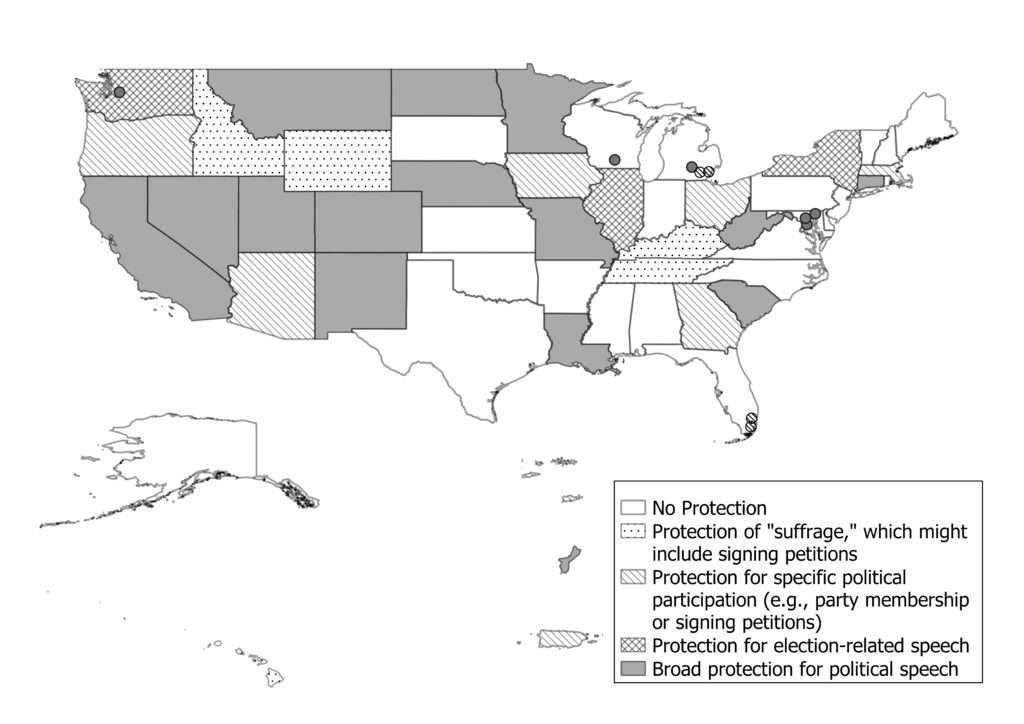
More people than one might imagine, chiefly because many states, counties, and cities have laws that ban private employers from discriminating against their employees based on certain kinds of speech.
"Unfairly treated," I take it, means in context treated in ways that the law recognizes as unfair and therefore civilly actionable. Who might benefit from that? (I focus here on American law, since that's the only sort of law I know.)
[1.] Many people are unaware of this, but many states, counties, and cities ban even private employers from firing or otherwise disciplining their employees based on the employees' speech or political activity. What's covered varies widely: Some jurisdictions protect a very broad range of speech; others protect "political activity" defined broadly enough to protect a wide range of speech related to political matters; others protect only election-related speech (whether about candidates or ballot measures).
Lawfare and my Cato Institute colleague Walter Olson have recently posted valuable articles explaining the criminal charges filed against Trump for his efforts to overturn the results of the 2020 election, and clearing up some common misconceptions about them.
The Lawfare article, coauthored by six experts, systematically goes over the legal issues involved in all four counts against Trump. In the process, they clear up some notable misunderstandings, particularly claims - advanced by the editors of National Review and conservative legal commentator Andrew McCarthy - that the definition of "fraud" under federal law isn't broad enough to cover Trump's actions. While that may be true under the federal wire fraud statute and some other laws, it is not true under the statutes whose violation Trump is actually charged with.
For example, 18 U.S.C. § 371 makes it illegal for two more people to "conspire either to commit any offense against the United States, or to defraud the United States, or any agency thereof in any manner or for any purpose." As the Lawfare article explains,the Supreme Court has long interpreted this as going beyond financial fraud, to include any actions that "interfere with or obstruct one of its lawful governmental functions by deceit, craft, or trickery, or at least by means that are dishonest."
Lawfare also covers 18 U.S.C. § 241, the Reconstruction-era law which makes it a criminal offense for "two or more persons [to] conspire to injure, oppress, threaten, or intimidate any person … in the free exercise or enjoyment of any right or privilege secured to him by the Constitution or laws of the United States…" National Review is wrong to suggest that this law only criminalizes "violent intimidation and forcible attacks against blacks attempting to exercise their right to vote." As Lawfare notes, longstanding Supreme Court precedent has enabled prosecutors to use Section 241 to "prosecute a range of election interference schemes, including those aimed at preventing individuals from casting votes as well as those seeking to deprive cast votes of their lawful effect." Trump's efforts to substitute fake electors for the real ones, pressure state officials to falsify vote counts, and compel Vice President Mike Pence to illegally block certification of the electoral vote all qualify under this rubric.
For his part, Walter Olson has a helpful critique of claims that prosecuting Trump on these charges violates the First Amendment:
Nothing in the charges filed Wednesday seeks to punish the former president for speech or advocacy as such. While the indictment does recite many things Trump said and calls them false, it identifies each such statement as being part of an overall course of conduct satisfying the elements of a crime under one of four federal statutes: conspiracy to defraud the United States, 18 U.S.C. section 371; conspiracy to obstruct an official proceeding, 18 U.S.C. section 1512(k); obstruction of and attempt to obstruct an official proceeding, 18 U.S.C. section 1512(c); and conspiracy to deprive persons of protected rights, 18 U.S.C. section 241.
It is long established and ordinarily uncontroversial that speech can lose the protection of the First Amendment if, for example, it seeks to intimidate a public official into shirking a legal duty, or if it consists of the submission of forged documents to a government agency, or if it solicits or facilitates crime generally (this past term's Supreme Court decision in United States v. Hansen, criticized by colleague Thomas Berry on a different issue, reiterated that last simple truism). Speech that is part of a conspiracy to accomplish those things may be unprotected as well.
Walter also explains why this prosecution is fundamentally different from efforts by some on the political left to criminalize political "misinformation," which he (and I) have long opposed. In addition, he goes over several other issues involved in the prosecution, including covering some of the same ground as Lawfare.
In addition, he has some useful commentary on the issue of whether Trump must be acquitted because he genuinely believed the election was stolen from him. I discussed that issue in some detail in my own previous post about the indictment. As noted there, and more fully described by Orin Kerr, there is in fact extensive evidence that Trump knew he had lost. Additional evidence on that point comes from his Attorney General, William Barr, who discussed the election with Trump extensively at the time, and recalls that "he knew well he lost the election."
Furthermore, it's far from clear that proving Trump knew this is essential to get a conviction conviction. Even if Trump genuinely thought he won, it was still illegal for him to try to substitute fake electors for the real ones, and to pressure Pence into trying to block the electoral vote count despite lacking any legal authority to do so. I made some additional points on this issue here.
The pieces by Lawfare and Walter Olson won't be the last word on the debate over this indictment. But they do advance the discussion by going over key issues in detail, and refuting some common misconceptions.
The Seventeenth Amendment provides that each state shall have two senators, elected through popular elections. But what if a vacancy arises through death, resignation, or expulsion? The Seventeenth Amendment provides a two-part process. First, "When vacancies happen in the representation of any State in the Senate, the executive authority of such State shall issue writs of election to fill such vacancies." And what happens before that election is held? Second, "the legislature of any State may empower the executive thereof to make temporary appointments until the people fill the vacancies by election as the legislature may direct."
It is clear enough that a state legislature is not required to allow a Governor (that is, the "executive") to make a temporary appointment. According to Pew Research, forty-six states have granted such authority. Once the state legislature vests the Governor with that power, can the state legislature constrain the Governor's selection? Again, according to Pew, eleven of those states impose certain constraints on the selection. Specifically, the Governor must select a nominee from the previous senator's political party. This approach makes sense from a pragmatic perspective. If the people elected a Republican/Democrat Senator for a six-year term, the people should be represented by a Republican/Democrat during a temporary vacancy.
Kentucky is one such state. Senate Bill 228 establishes an intricate framework for how a Senate vacancy can be filled:
The Governor shall fill vacancies in the office of United States Senator by appointment and the appointee shall serve until a successor has been elected and qualified under . . . The appointee shall be selected from a list of three (3) names submitted by the state executive committee of the same political party as the Senator who held the vacant seat to be filled, shall have been continuously registered as a member of that political party since December 31 of the preceding year, and shall be named within twenty-one (21) days from the date of the list submission.
The Republican-controlled legislature passed the bill over the veto of Governor Andy Beshear, a Democrat. The veto message highlighted the federal constitutional objections to the bill:
I am vetoing Senate Bill 228 because it improperly and unconstitutionally restricts the Governor's power to fill vacancies in the United States Senate. The purpose of the Seventeenth Amendment to the United States Constitution was to remove the power to select United States Senators from political party bosses. Senate Bill 228 violates the very purpose of this Amendment by returning that power to political parties in the case of a vacancy. . . . The Seventeenth Amendment does not authorize legislatures to direct how the Governor makes an appointment to fill vacancies, and the legislature may not impose an additional qualification on who the Governor may appoint beyond the qualifications set for a United States Senator set forth in the Constitution.
Beshear also identified a concern under the state constitution:
The bill also is unconstitutional under the Kentucky Constitution. Section 152 of the state constitution provides that the Governor "shall" fill by appointment vacancies in offices for the State at large. No conditions, qualifications, or limits are placed on that appointment power.
This issue, however, may not remain academic. Mitch McConnell, the longtime Senator from Kentucky, has had health issues. The Republican leader's term will conclude in January 2027. And the Democratic Governor's term will conclude in December 2023. If a vacancy arises over the next five months, or longer if Beshear is re-elected, Senate Bill 228 would be put to the test.
Already, a prominent Democrat attorney in Kentucky said that Beshear may not follow the law, consistent with his veto message. There are two possible paths. First, Beshear could simply ignore the list, and pick whomever he wants. Second, Beshear could go on offense and seek some sort of declaration that the statute is unconstitutional.
"Beshear either says, 'hey, Republican Party, thank you for your list, but I'm appointing whoever I want' and then that immediately gets challenged in court, or you could see Beshear taking the route of filing a lawsuit," Abate said. "I mean, he's got the guts to defy it," Abate added.
This decision can have national implications, as McConnell is the leader of the Republican caucus. (The Washington Times offered some commentary.)
Here, I will not opine on the Seventeenth Amendment issue. (I will do so later). Rather, I want to opine on the procedural aspects of the process.
First, Beshear can simply ignore the list, and appoint whomever he wants. We could expect prompt litigation from members of the state executive committee. But what remedy would the committee seek? Beshear would have already fulfilled his authority under the Seventeenth Amendment and selected a temporary Senator. Beshear could make that appointment quietly, as soon as a vacancy arises. Before any litigation is filed, the Senator can appear at the Capitol and present his credentials. At that point, I am not certain that a judge, whether federal or state, could undo the appointment. Whether the Senator is recognized would seem to be a political question under Baker v. Carr. The United States Senate could decline to recognize the Senator, perhaps due to the Governor's failure to comply with state law. But the Senators could determine, like Governor Beshear, that the statute itself is unconstitutional. As a matter of real politic, I suspect every Democratic Senator would gladly welcome a Democratic replacement for McConnell.
For the second option, the Governor could sue the executive committee, and argue that the constraint violates the federal and state constitutions. This suit can be brought in federal court or state court. In federal court, at least, such a suit would seem to be not-yet-ripe prior to a vacancy arising. The Governor would probably have to wait until the executive committee provides a list of names. The rules may be different in state court. If the Governor sues in state court, and there is only a claim under the state constitution, I don't think the case could be removed to federal court under the Mottley rule.
There is a third option. Members of the executive committee can go on offense, and seek a declaration that the Governor is bound by the state law before any vacancy arises. Such a suit would not-yet-be-ripe in federal court, but it could work in state court. Again, I don't profess to be an expert on Kentucky procedure. The upshot of this latter approach would be to avoid a stealth selection, which cannot be undone. The downside, of course, is the morbidity of the topic. Senator McConnell is still serving, and it is unsettling to even discuss a potential future vacancy. I know all too well that people were unhappy with a post I wrote about Chief Justice Roberts being unable to preside at President Trump's impeachment. But it is far better to talk about a succession crisis before it happens, not during the process.
Please enjoy the latest edition of Short Circuit, a weekly feature written by a bunch of people at the Institute for Justice.
For over 10 years, Louisiana prison officials have held more than a quarter of inmates past their release dates—an extra 525 days in the case of IJ client Percy Taylor. Next month, the Fifth Circuit will consider whether the head of the state's prison system can be held accountable. Click here to read Taylor's brief.