The Volokh Conspiracy

Mostly law professors | Sometimes contrarian | Often libertarian | Always independent | Est. 2002

The Volokh Conspiracy

Immigration

Biden Administration Extends Temporary Protected Status for Ukrainians in the United States

This measure will enable Ukrainians in the US to live and work here legally until April 19, 2025. It's a step in the right direction, but Congress still needs to pass an adjustment act giving them permanent residency.

|

Today, the Biden Administration extended and redesignated Temporary Protected Status for Ukrainians in the United States who arrived here by August 16, 2023. TPS gives a foreign citizen the right to live and work in the US for a set period of time. The status is generally used for people whose home countries are in the throes of war, oppression, or a natural disaster.

In plain English, that means that the thousands of Ukrainians  (the administration estimates their numbers at about 26,000) who currently have TPS in the US will be eligible for an extension through April 19, 2025. Otherwise, their status will run out on Oct. 19. Ukrainians currently in the US who do not have TPS, will be able to apply to get the status. That's important for the 140,000 or more who entered under the Uniting for Ukraine private sponsorship program, and whose residency rights (granted by parole) will otherwise run out in 2024 or early 2025 (including my own sponsorees). DHS estimates the total number of Ukrainians now eligible to get TPS status, despite not having it previously at 166,700.

However, the grant of TPS status may extend their residency or work rights only a few months past when they would have expired otherwise. It's possible that the president will address this problem by giving Ukrainian parolees a chance to apply for a two year extension of their parole status, as has already been done with Afghan parole recipients in a similar situation.

While this is a useful step, it is not a substitute for giving Ukrainians (and others in similar straits) permanent residency rights. Congress still needs to pass an adjustment act to do that; I outlined the case for doing so here.

The extension will in time expire. Moreover, what Caesar giveth he can taketh way (or his successor can). So this isn't the end of this issue. But it's an improvement, and it also gives more time for Congress to (hopefully) act.

For those on the watch for signs of ethnic bias or inconsistency, I remind readers that I am well aware that Ukrainians are not the only ones who need an adjustment act granting permanent status. I have repeatedly advocated taking the same step for other immigrant groups in similar situations, most recently in a post on the Afghan Adjustment Act.

Today, the Administration also extended and redesignated TPS for Sudanese in the United States (a total of about 4000 people are affected). Like Ukraine, Sudan has been wracked by a terrible war, and accompanying atrocities.

Supreme Court

My UnPopulist Article on Supreme Court Politicization and Dangers of Schemes to Undermine Judicial Review

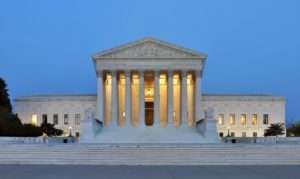
While there is some genuine politicization, it is not as great as often claimed. Proposals to undermine judicial review could easily end up empowering the very sort of authoritarian president progressives fear.

|

Wikimedia

The UnPopulist recently published my article on judicial politicization and the dangers of schemes to undermine judicial review. While some of my recent writings primarily annoy conservative Republicans, this one is likely to have the opposite valence. Here is an excerpt:

In recent years, it has become commonplace to claim that the U.S. Supreme Court is deeply politicized. The court's current 6-3 conservative majority is often seen as pursuing a partisan or ideological agenda, and views on the Court's rulings often break down along partisan and ideological lines. For some on the left, this perceived politicization justifies drastic measures like court-packing or executive defiance of judicial decisions.

In some ways, the judiciary is indeed politicized. But there are many occasions where conservative judges have prioritized jurisprudential values over any partisan or ideological goals, showing that the court is much more than a merely political body. Moreover, resorting to steps like court-packing in response to real or imagined judicial excesses risks destroying or gravely weakening judicial review—a cure far worse than the disease, one that would leave the country more vulnerable to aspiring authoritarians….

While accusations of judicial politicization are often overblown, the court's critics aren't completely wrong. In recent decades, political conflict over judicial appointments has increased, largely as a result of the increased polarization of U.S. politics….

There is, therefore, some basis for claims that the judiciary has become politicized. Indeed, it has never been completely free of politics.

But claims of politicization are also dangerously overstated. They overlook or minimize a wide range of important issues on which conservative judges have elevated legal and constitutional principles over partisanship and thereby curbed dangerous right-wing initiatives and abuses of power.

Such cases are not hard to find. Perhaps the most obvious and important example is that conservative judges serving on both lower courts and the Supreme Court rejected Trump's and other GOP efforts to overturn the result of the 2020 election….

Undermining judicial review through tools like court-packing is a standard tactic of incipient illiberal authoritarians like Hungary's Viktor Orban and Venezuela's Hugo Chavez as they seek to concentrate power in the executive; it's especially useful in the early stages of authoritarian consolidation. American progressives readily see this when it comes to countries like Russia, Turkey, Hungary and—most recently—Israel, where the right-wing government has been trying to eviscerate the power of that country's judiciary….

The point applies here at home, too. If you think Trump and other Republicans pose a grave danger to liberal democracy, you should be wary of dismantling one of the major institutions standing in their way. Imagine, for example, if Trump had been able to successfully resist judicial rulings against his efforts to overturn the 2020 election.

Even some controversial U.S. Supreme Court decisions opposed by the left bolster safeguards against authoritarianism. For example, the court's "major questions doctrine" requires Congress to "speak clearly when authorizing an [executive branch] agency to exercise powers of vast 'economic and political significance….'"

[I]f you fear concentration of power in a potentially authoritarian and illiberal executive, this doctrine is just the sort of approach you should support, since it prevents the president from using vaguely worded statutes to engage in massive power grabs. Even if you trust President Biden to wield such authority, you probably do not have similar faith in the next Republican president, who could well be Donald Trump, Ron DeSantis, or someone with a similar mindset….

The courts are far from perfect, and there is indeed a degree of politicization that impacts them. But conservative judges' willingness to rule against right-wing causes in a variety of important cases gives the lie to claims that Supreme Court justices are just politicians in robes. Even more importantly, destroying judicial review is likely to undermine liberal democratic values, rather than promote them, leaving us more vulnerable to authoritarian gambits in an era where authoritarianism is resurgent.

As noted in the article, I don't oppose all possible efforts to curb judicial prerogatives. For example, I think it would be good to impose term limits on Supreme Court justices, and that Congress may be justified in imposing new ethics restrictions on the justices, including limiting the gifts they are allowed to receive from private citizens. But proposals that threaten to destroy or severely weaken judicial review are a different matter.

UPDATED: In the initial version of this post, I accidentally neglected to include a link to my UnPopulist article. I apologize for the mistake, which has now been fixed.

James L. Buckley (1923-2023)

|

With great sadness, I relay that James L. Buckley passed away at the age of 100. I wrote about Judge Buckley in March on his 100th birthday:

On Thursday, James L. Buckley turns 100 years old. Most law students will know his name from the seminal case of Buckley v. Valeo. But he did so much more. He served as a lieutenant in the Navy. He was elected as New York Senator on the conservative party ticket. President Reagan appointed Buckley as undersecretary of state for international security. And Reagan latter tapped Buckley as a judge on the D.C. Circuit Court of Appeals. He is one of the most remarkable public servants of the 20th century. (I would add Judge Silberman to that list.)

I had the honor of meeting Judge Buckley at Justice Thomas's Story Lecture in 2021.I don't get star-stuck easily, but I got star-struck when I shook Judge Buckley's hand. I mentioned that I always teach his case in First Amendment, and he made a comment about the partisans that tried to shut him down.

He was a giant, and his contributions to our nation are immeasurable. Rest in peace, Judge Buckley.

Free Speech

When Can Knowingly/Recklessly False Political Statements by Lawyers Lead to Discipline?

|

Generally speaking, the law can't punish false statements about the government—even knowing lies—on the grounds that they damage the government's reputation. In the words of New York Times v. Sullivan (1964),

For good reason, "no court of last resort in this country has ever held, or even suggested, that prosecutions for libel on government have any place in the American system of jurisprudence."

Likewise, Rosenblatt v. Baer (1966) made clear that "in the absence of sufficient evidence that the attack focused on the plaintiff, an otherwise impersonal attack on governmental operations cannot be utilized to establish a libel of those administering the operations." A claim "based on libel of government," rather than of a particular government official, "is constitutionally insufficient." And this offers more First Amendment protection than the more famous New York Times v. Sullivan rule that an alleged libel of a public official can't lead to civil or criminal liability without a showing of knowing or reckless falsehood. An alleged libel of the government can't lead to such liability, period.

But courts have long taken a different view with regard to attorney disciplinary proceedings; there, courts generally conclude that lawyers' knowingly or recklessly false statements, especially with regard to the judiciary, can lead to discipline, even if they are said in a political campaign (usually for judicial office). Indeed, some courts even allow such liability based on a showing of negligence, but I set this aside here. Here's how this analysis played out in Wednesday's Maryland Supreme Court decision in Attorney Grievance Comm'n v. Pierre, where a lawyer who was running for judicial office was accused, among other things, of making three false statements in her campaign (I also blogged about a related facet of the case earlier this morning):

MARPC [Maryland Attorneys' Rules of Professional Conduct] 8.2(a) provides: "An attorney shall not make a statement that the attorney knows to be false or with reckless disregard as to its truth or falsity concerning the qualifications or integrity of a judge, adjudicatory officer or public legal officer, or of a candidate for election or appointment to judicial or legal office." As we have noted, "the purpose of [MARPC] 8.2(a) is not to protect judges, judicial officers, or public legal officials from unkind or undeserved criticisms. Rather, [MARPC] 8.2(a) protects the integrity of the judicial system, and the public's confidence therein[.]"

Read More

Free Speech

Should There Be Limits on Bar Investigations of Candidates for Judicial Office During the Campaign?

|

An excerpt from Attorney Grievance Comm'n v. Pierre, decided Wednesday by the Maryland Supreme Court, in an opinion by Chief Justice Fader:

This Attorney Grievance Commission of Maryland proceeding concerns the alleged professional misconduct of Marylin Pierre, the respondent and a member of the Bar of this State. It also concerns an overlay of factors that significantly complicates our review of Ms. Pierre's alleged violations of the Maryland Attorneys' Rules of Professional Misconduct ("MARPC"). That overlay arises from the circumstances in which the investigation of Ms. Pierre began and the absence of provisions in our rules to guide investigations arising in such circumstances.

The core allegations against Ms. Pierre arose from accusations made in an August 2020 campaign email. The email was sent by the campaign manager for a slate of four sitting judges against whom Ms. Pierre was running for a seat on the Circuit Court for Montgomery County. Sent just over two months before election day, the email was directed to Montgomery County attorneys and identified an "Urgent Need for Action." The email alleged, among other things, that Ms. Pierre's campaign had made false statements about the sitting judges, that Ms. Pierre had misstated her professional qualifications, and that she had engaged in unprofessional conduct in connection with a lawsuit more than two decades earlier.

Among the recipients of the campaign email was then-Bar Counsel. In the absence of any rules or procedures governing the investigation of allegations of misconduct arising in the midst of a judicial election, Bar Counsel immediately opened an investigation, informed the sitting judges' campaign manager of the existence of the investigation, and sought additional information. Soon thereafter, less than two months before the election, Bar Counsel sent Ms. Pierre a letter summarizing many of the allegations leveled by her rivals' campaign and insisted that Ms. Pierre respond to them in writing, in many cases by explaining and justifying statements made by her or her campaign, within two weeks….

Read More

Free Speech

No Sealing of Plaintiff's Expunged Court Records That Are Central to Plaintiff's Libel Claim

"[T]he fate of Plaintiff's claims hinges to some extent on the truth or falsity of Defendant's statements regarding Plaintiff's conviction of a crime. Whether Defendant's statements are false—a determination that relies at least in part on Plaintiff's criminal records—is directly relevant to the public."

|

From Ferrari v. Francis, decided earlier this month by Judge Karen Gren Scholer (N.D. Tex.):

Plaintiff brought this lawsuit because of Defendant's alleged "false and defamatory statements" regarding Plaintiff. Among other things, Plaintiff alleges that Defendant falsely informed various entities that Plaintiff is a convicted felon…. Defendant moved to dismiss Plaintiff's claims. Defendant attached materials from Plaintiff's Colorado criminal record to the Motion to Dismiss as Exhibits B-2 through B-9[, including] … arrest warrant-related documents, a mugshot, an appearance bond, minute orders, docket sheets, and findings of fact as to Plaintiff's guilty plea. These documents are currently under seal by order of the Denver District Court. That court sealed Plaintiff's criminal record after Plaintiff completed a term of deferred adjudication.

Seeking to continue to shield his criminal record from public access, Plaintiff filed the instant Motion, in which he asks the Court to: (1) seal Exhibits B-2 through B-9 to Defendant's Motion to Dismiss and (2) order the parties to file copies of their Motion to Dismiss briefing that redact any references to Plaintiff's criminal record….

The Court "heavily disfavor[s] sealing information placed in the judicial record." In determining whether a document should be sealed, the Court undertakes a "document-by-document, line-by-line balancing of the public's common law right of access against the interests favoring nondisclosure." …

Read More

Immigration

New York's Migrant Crisis is Caused by a Combination of Federal Work Restrictions and Local Zoning Policy

It's the predictable result of the combination of federal regulations barring asylum seekers from working legally and local policies offering free housing, while severely restricting new housing construction.

|

Wayne Stadler/Dreamstime.com

New York City's migrant crisis has been in the news lately. The basic story is that the city is having difficulty housing some 58,000 aslyum-seeking migrants that have arrived in recent months. Critics understandably focus on the role played by the city's guarantee of free shelter, which has attracted asylum-seekers to New York. That is indeed part of the problem, and NYC should reconsider it.

But two other flawed policies are even more significant, especially in the long run: one federal and one local. The federal culprit is the rule that asylum seekers are not allowed to work legally in the US until at least 6 months after arrival, and in practice the wait can be much longer. I have written about this problem in detail previously. The obvious bottom line is that the vast majority of asylum-seekers (like other migrants) could support themselves, if only the federal government would let them. That's especially true in a city like New York, which has a significant labor shortage. Immigrants can and do make major contributions to our economy, including ones that enormously benefit natives. But they can't do it if we don't let them work.

New York authorities are not to blame for this federal rule. But they have made the situation worse by perpetuating some of the nation's most severe zoning restrictions on the construction of new housing, which predictably drives up the cost and reduces the availability of apartments for migrants and natives alike. This is a major problem even aside from asylum-seekers.  NYC, like other cities, would do well to abolish exclusionary zoning and let property owners build new housing in response to demand. It would simultaneously promote economic growth, and enormously benefit working and lower-middle class people of all origins - white and minority, native and immigrant.

Earlier this year, New York Governor Kathy Hochul did in fact propose a pretty good zoning reform bill. But, sadly, it was defeated in the state legislature by a combination of NIMBY forces from both left and right.

If you restrict the construction of new housing while offering it for free, basic Economics 101 suggests you will end up with shortages. Those shortages get worse if you bar many people from working to support themselves, leaving the putatively free housing as their only viable option in the city.

In sum, the feds should let asylum seekers work legally, and state and local government should replace offers of free housing with curbs on exclusionary zoning. In that way, migrants could support themselves, the city's economy could benefit from their contributions, and immigrants and natives alike could get better and cheaper housing, thereby enabling more people of all backgrounds to move to places that offer better work and educational opportunities.

The Big Apple has been such a destination for many, throughout American history. And it can be so again, if only federal, state, and local officials would revoke some awful restrictions on migrant employment and housing construction.

Free Speech

FIRE Lawsuit Against California Community Colleges Over "Diversity, Equity, and Inclusion" Mandates

|

From today's press release, by the Foundation for Individual Rights and Expression:, about Palsgaard v. Christian (E.D. Cal.):

Today, the Foundation for Individual Rights and Expression filed a lawsuit on behalf of six California community college professors to halt new, systemwide regulations forcing professors to espouse and teach politicized conceptions of "diversity, equity, and inclusion." …

Under the new regulations, all of the more-than-54,000 professors who teach in the California Community Colleges system must incorporate "anti-racist" viewpoints into classroom teaching.

The regulations explicitly require professors to pledge allegiance to contested ideological viewpoints. Professors must "acknowledge" that "cultural and social identities are diverse, fluid, and intersectional," and they must develop "knowledge of the intersectionality of social identities and the multiple axes of oppression that people from different racial, ethnic, and other minoritized groups face." Faculty performance and tenure will be evaluated based on professors' commitment to and promotion of the government's viewpoints.

Read More

Free Speech

Sixth Circuit Affirms (2-1) Dismissal of Nicholas Sandmann's Libel Lawsuit Against the N.Y. Times and Others

|

Some excerpts from Sandmann v. N.Y. Times Co., decided yesterday by the Sixth Circuit, in an opinion by Judge Jane Stranch, joined by Judge Stephanie Davis (for more details, read the full opinions):

On January 18, 2019, then-sixteen-year-old Nicholas Sandmann and his classmates had an interaction with a Native American man named Nathan Phillips by the Lincoln Memorial in Washington, D.C. Video of the incident went viral, and national news organizations, including the five Defendants (Appellees, or News Organizations) published stories about the day's events and the ensuing public reaction. Sandmann sued, alleging that the Appellees' reporting, which included statements from Phillips about the encounter, was defamatory…. [We agree with the district court that] the challenged statements were opinion, not fact, and therefore nonactionable….

Videos of the confrontation between a white male teenager in a "Make America Great Again" hat and an elderly Native American man went viral on social media. National media, including the five News Organizations, covered the incident at length over the following days, with most outlets quoting a statement Phillips made to the Washington Post:

It was getting ugly, and I was thinking: I've got to find myself an exit out of this situation and finish my song at the Lincoln Memorial. I started going that way, and that guy in the hat stood in my way and we were at an impasse. He just blocked my way and wouldn't allow me to retreat.

This statement and others like it asserting that Sandmann blocked Phillips are referred to as "blocking statements." …

"Whether a statement qualifies for protection under the constitutional pure opinion privilege is a legal question to be decided by the court, not a question for the jury." … The First Amendment protects statements that "cannot reasonably be interpreted as stating actual facts about an individual" in "recognition of the Amendment's vital guarantee of free and uninhibited discussion of public issues." In other words, "a viable defamation claim exists only where a reasonable factfinder could conclude that the challenged statement connotes actual, objectively verifiable facts."

Read More

Originalism

Frederick Douglass as Natural Rights Originalist

A fascinating new exploration of Frederick Douglass' constitutional thought.

|

Professor Bradley Rebeiro has an interesting new paper on the constitutional thought of Frederick Douglass, "Frederick Douglass and the Original Originalists." The article is forthcoming in the BYU Law Review, but a draft is available on SSRN.

Here is the abstract:

Constitutional scholars incessantly grapple over the significance of the Constitution's original meaning. More specifically, they are preoccupied with, on the one hand, what that meaning is (if such meaning exists) and, on the other hand, the exact nature of that meaning's authority (if any) over the Constitution and its interpreters. But this debate is hardly novel. In fact, one of the most compelling voices in U.S. history was immersed in similar debates and, out of the constitutional sparring of his time, forged an arresting theory of constitutional interpretation. Frederick Douglass, once a fierce opponent of the U.S. Constitution, evolved into a defender of the Constitution with a robust theory of constitutional interpretation that addressed the constitutional evil of slavery. For example, in 1847, Douglass stated: "The Constitution I hold to be radically and essentially slave-holding . . . [t]he language of the Constitution is you shall be a slave or die." Yet, five years later in his famous speech, "What to the Slave is the Fourth of July?", Douglass declared: "interpreted as it ought to be interpreted, the Constitution is a glorious liberty document." Because Douglass was primarily a political and constitutional actor that never wrote a treatise of jurisprudence, his understanding of constitutionalism must be gleaned from his many speeches and other writings. I therefore take on the task of welding together these speeches and writings to demonstrate how Douglass's theory fuses historical meaning, established legal rules of interpretation, natural rights principles, and a conception of justice into a cohesive approach that addresses the problem of constitutional interpretation and construction.

Though Douglass was one of the most prominent political thinkers and constitutional actors of the 19th century, his constitutional thought has been overlooked by most legal scholars and mostly mischaracterized by political scientists. Due to the aforementioned lack of a singular treatise on the subject, as well as Douglass's constitutional transformation over the course of his life, this comes as no surprise. Legal scholars tend either to dismiss his constitutional theory as incoherent or to assume that Douglass's reformed theory was not sincere, but merely a smokescreen for political purposes. Others have referred to Douglass as a living constitutionalist or offered wholly new categories to explain Douglass's position, such as "reform textualism." However, Douglass's theory, similar to his contemporaries, may be seen as anticipating the modern shift to originalism. But this claim challenges the conventional scholarly wisdom in two ways. First, the current literature mostly characterizes Douglass as, at the very least, anti-originalist. Second, though Douglass's theory shares many elements with originalism, originalism's current formulations leave little room for philosophical inquiry, which Douglass's theory admittedly does. His theory does not fit perfectly into any of the many variations of originalism today, thereby offering present-day originalists new possibilities. I will thus refer to Douglass's theory as "natural rights originalism." Natural rights originalism deviates most importantly in not abandoning the original philosophical principles that animated the Constitution's framing. This theory, the product of an insatiably inquisitive mind, transformed Douglass's constitutional thinking—no longer was the Constitution an instrument of oppression, but one of freedom.

This paper is "highly recommended" by Larry Solum, as is this competing view offered by Jack Balkin and Sandy Levinson. (Alas, this later paper does not engage directly with Rebeiro's work.)

For those who prefer listening to things, Rebeiro discussed his paper as a guest on the Dispatch's Advisory Opinions podcast.

Free Speech

Facebook "Tagging" = Communication with the Tagged Person, for Purposes of Restraining Order

|

From Tuesday's decision of the Texas Court of Appeals (Amarillo) in Boes v. State, written by Justice Alex Yarbrough, and joined by Chief Justice Brian Quinn and Justice Larry Doss:

[Following an arrest of Boes for assaulting his then-wife, a court issued an emergency protective order that] prohibited Appellant from the following:

communicating directly with a family member of the family or household or with the person(s) protected under the Order in a threatening or harassing manner; communicating a threat through any person to a member of the family or household or to the person(s) protected under the Order;

communicating in any manner with a person protected under the Order or a member of the family or household of a person protected under the Order, accept through the party's attorney or a person appointed by the court, because the Court finds good cause exists; and

going to or within 500 feet of the residence of the victim.

The order was signed on February 5, 2020. In March 2020, Appellant posted on Facebook on at least three occasions and "tagged" [his wife]…. The crucial inquiry to resolve is whether those Facebook tags constitute "communications" in violation of the protective order. We hold under the facts presented herein they do….

Read More

"Strangers on the Internet" Podcast Ep. 39: Prof. Christa Laser on Her #metoolaw Sexual Harassment Allegations

In this exclusive interview, Prof. Laser tells the full story for the first time about her allegations against ex-GMU prof Joshua Wright

|

The 39th episode (Apple Podcasts link here and Spotify link here) of "Strangers on the Internet" features patent law scholar and former BigLaw attorney Prof. Christa Laser from the Cleveland State University College of Law.

On this Breaking News episode, I interview Christa about her sexual harassment allegations against just-departed George Mason University antitrust law professor and former FTC Commissioner Joshua Wright. In a tweet (accompanied by a screenshotted email) viewed by hundreds of thousands of people, Christa described how Josh asked her out on a date while GMU hiring chair when he knew that she was desperate to remain in the DC area to maintain custody of her two children. Christa's tweet prompted multiple former students and employees of Josh's to come out publicly with allegations of his having (successfully) pressured them into inappropriate sexual relationships when he held their careers in his hands.

Christa and I discuss the possible professional repercussions against female "troublemakers" who call out rule- and law-breaking at their institutions. We also analyze how and why legal academia breeds predatory and discriminatory behavior, how allies can help, and what reform might look like in light of this #metoo moment.

Note: According to a statement printed in the media by Lindsay McKasson, counsel to Joshua Wright at Binall Law Group "all allegations of sexual misconduct are false," "These false allegations are being made public after unsuccessfully demanding millions of dollars behind closed doors," and "We look forward to total vindication in court." According to a tweet by Christa, "I don't appreciate that his attorney falsely suggests we are all lying (1/2 was in writing!) & want $ (this is a lie--I only want him gone)."

Prof. Christa Laser

Free Speech

N.J. Attorney General's Office Releases Guidance on 303 Creative

|

From the N.J. Attorney General's office, Division on Civil Rights, "Guidance on the New Jersey Law Against Discrimination Following the U.S. Supreme Court's Decision in 303 Creative LLC v. Elenis," released July 26:

This enforcement guidance explains how the New Jersey Office of the Attorney General and the Division on Civil Rights (DCR) will apply the New Jersey Law Against Discrimination (LAD) to prohibit discrimination by places of public accommodation following the U.S. Supreme Court's recent ruling in 303 Creative LLC v. Elenis. {The purpose of this guidance document is to clarify and explain DCR's understanding of existing legal requirements in order to facilitate compliance with the LAD. This guidance document does not impose any new or additional requirements that are not included in the LAD, does not establish any rights or obligations for any person, and will not be enforced by DCR as a substitute for enforcement of the LAD. This document does not provide legal advice and should not be treated as providing legal advice. Owners of places of public accommodation and others with questions about the LAD are encouraged to speak with a qualified attorney to address their specific questions.}

The LAD prohibits places of public accommodation— that is, places open to the public—from discriminating on the basis of actual or perceived sexual orientation, gender, gender identity, gender expression, race, color, national origin, ancestry, religion, disability, and other protected characteristics. The ruling in 303 Creative does not change how the LAD applies to the vast majority of public accommodations across the State, and DCR remains firmly committed to enforcing the LAD and safeguarding the rights of all New Jerseyans.

In 303 Creative, the U.S. Supreme Court considered whether the First Amendment barred the application of a Colorado anti-discrimination statute, which prohibited places of public accommodation from discriminating on the basis of sexual orientation, to a web designer who intended to make customized websites for weddings but not to do so for same-sex weddings. The parties agreed that the web designer's websites were "original" and were "customized and tailored" for each customer, and that the websites the business designed were "expressive" and expressed the designer's own speech and message regarding her clients' weddings. The parties also stipulated that the web designer was willing to work with all people regardless of their protected characteristics and, in particular, would create custom graphics and websites for clients of any sexual orientation. Based on those specific facts and stipulations, the Supreme Court held that the web designer had a First Amendment right not to make her customized website designs for same-sex weddings.

Read More

Due Process

N.Y. Court Categorically Authorizes Video Proceedings in Mandatory Mental Treatment Cases

|

From Judge Gerard Neri (N.Y. Onondaga County trial court), decided July 26, in In the Matter of St. Joseph's Hospital Health Center v. B****** V*******:

On June 16, 2023, Petitioner St. Joseph's Hospital Health Center … filed an emergency application to retain Respondent B****** V******* … as a patient and provide treatment pursuant to Mental Hygiene Law ("MHL") § 9.33….

MHLS [Mental Hygiene Legal Service] on behalf of Respondent moves for an order mandating an in-person hearing on the Petition for treatment over objection pursuant to MHL § 9.27. The argument proffered by MHLS is that with the recission of COVID-19-era administrative orders mandating virtual appearances in MHL Article 9 proceedings, the Court must hear such matters in-person….

Since the onset of COVID-19, this Court has conducted many motion arguments, hearings, and non-jury trials via Microsoft Teams without significant issue. Those issues that have arisen mostly involve matters which would occur with in-person appearances, namely timeliness and outside noises. As Counsel for St. Joseph's pointed out, it is not an uncommon occurrence for an emergency siren or exterior shouts or air conditioning turning on to be so loud as to interrupt a witness testifying or attorney arguing. In both cases, virtually or in-person, the Court or Court Reporter have simply asked the individual to repeat themselves and the proceedings moved on.

Due Process does not command that the hearing be conducted in-person either.

Read More

Department of Health & Human Services Advised Its S.F. Employees to Work from Home Because of Crime

|

So reported the S.F. Chronicle (Megan Cassidy) on Friday:

Officials at the U.S. Department of Health and Human Services advised hundreds of employees in San Francisco to work remotely for the foreseeable future due to public safety concerns outside the Nancy Pelosi Federal Building on Seventh Street…. The area is … home to one of the city's most brazen open-air drug markets, where dozens of dealers and users congregate on a daily basis….

"In light of the conditions at the (Federal Building) we recommend employees … maximize the use of telework for the foreseeable future," [HHS Assistant Secretary for Administration Cheryl R. Campbell] wrote in [an Aug. 4] memo, a copy of which was obtained by The Chronicle.

There's a similar paywall-free story yesterday in SFGate (Alec Regimbal):

More