Spotted online. The BusinessInsider story is real, though it (and the original Wall Street Journal article) notes that the chips are being put into the outside labels that are unlikely to actually be eaten, though apparently they have to be food-safe just in case.
The Volokh Conspiracy
Mostly law professors | Sometimes contrarian | Often libertarian | Always independent | Est. 2002
Seventh Circuit Upholds Products Liability Claim Against Specialized Ammunition Manufacturer
From Hakim v. Safariland, Inc., decided Monday in an opinion by Judge John Lee, joined by Chief Judge Diane Sykes and Judge Joel Flaum:
David Hakim, a SWAT officer …, accidentally got shot by a colleague during a training exercise. The offending projectile was a "breaching" shotgun round manufactured by Safariland, LLC. Breaching rounds assist law enforcement officers in breaking down doors by disabling hinges and other attachments on doorframes. When used as intended, they disintegrate harmlessly on impact with a metal attachment mechanism. But here, Hakim's fellow officer missed the metal door hinge he was shooting at. The round struck wood, remained live, and ultimately hit Hakim in the spine. Hakim's thirteen-month recovery from his injury required multiple surgeries, and to this day he experiences pain so severe that he has trouble sleeping….
Hakim [sued, claiming] … that Safariland had failed to provide adequate warning that its rounds do not disintegrate if they strike wood instead of metal. A jury … awarded Hakim $7.5 million on his failure-to-warn claim….
The court upheld the verdict, and rejected Safariland's claims that its warnings were adequate:
Safariland acknowledges that none of its product literature specifically warns that breaching rounds that hit wood do not disintegrate. But it argues that this danger was implied in its literature. For instance, Safariland notes that the documents advise shooting the rounds directly at metal attachment mechanisms, rather than attempting to "shear" those mechanisms off a door, to "minimize the risk of the projectile[s] causing serious injury or death." But other statements in the literature seem to indicate that the rounds will disintegrate on contact with wood. For instance, the literature states that breaching rounds "disintegrate[] into a fine powder" upon contact with a "hard surface." A reasonable consumer certainly could interpret the term "hard surface" to include wood.
Adding to the confusion is Safariland's product catalog. The catalog features the breaching rounds on a page labeled "less lethal" and states that the rounds "[d]isintegrate[] on contact" and are "[s]afe to use at close distances." A reasonable jury could interpret these statements as conveying the false impression that the breaching rounds are not particularly harmful, even when misfired….
This is quite consistent with the Protection of Lawful Commerce in Arms Act, which preempts products liability claims "resulting from the criminal or unlawful misuse of a qualified product by the person or a third party." And the PLCAA also expressly excludes lawsuits stemming from "a defect in design or manufacture of the product," when "the discharge of the product was [not] caused by a volitional act that constituted a criminal offense"; that appears to include failure-to-warn claims, see Adames v. Sheahan (Ill. 2009).
And it's quite consistent with the way other products are treated. Here's an excerpt from Torts and Guns, a Journal of Tort Law article by the late leading tort scholar Stephen Sugarman (Berkeley Law) (paywall-free version here):
Today in Supreme Court History: August 24, 1946
8/24/1946: Justice James McReynolds dies.

Vermeule and Casey Respond to Judge Rao on Textualism's Political Morality
Further debate on textualism, "common good constitutionalism," and the classical legal method.
In March 2022, the Honorable Neomi Rao of the U.S. Court of Appeals for the D.C. Circuit delivered the Sumner Canary Memorial Lecture on "Textualism's Political Morality." The Case Western Reserve Law Review has published her lecture. It is available for download here.
Judge Rao's remarks have provoked a response from Professors Adrian Vermeule and Conor Casey, two prominent proponents of "Common Good Constitutionalism." Their response, "Judge Rao's Unintentional Surrender," has been published in "The New Digest," a "forum for short essays on law, politics, political theology, post liberalism, and the common good."
The full essay requires a subscription, but here is how it begins:
On the March 3, 2022, Judge Rao of the United States Court of Appeals for the District of Columbia Circuit gave the Sumner Canary Memorial Lecture at Case Western Reserve University, which has now been published. Her lecture, entitled Textualism's Political Morality, sets out to "explore the political morality that undergirds and informs a textualist approach to statutory interpretation" and then to contrast textualism favorably against "methods of interpretation that rely on the judge's abstract normative values about justice or fairness or that seek to update statutes in accordance with evolving social or political norms." In her opening remarks, Judge Rao says that her defense of textualism is "especially timely" given critiques advanced by what the judge refers to as a "wave of post-liberal scholars" (mentioning one of us by name) who have suggested that "laws should be interpreted to promote the 'common good.'" Judge Rao's subsequent critique of common good constitutionalism and its classical approach is anchored on the premise that its proponents think "judges should give effect to certain substantive values, values that exist independently of the law" and that "should interpret statutes in light of principles found outside the law" because "such principles will lead to 'better' results than simply following the text" (our emphases).
This is, rather trivially, not at all the classical legal position held by common good constitutionalists; the classical view has always been that background principles of legal justice are themselves internal to law. As Vermeule wrote in his recent book, the principles to which the classical tradition looks "are themselves already part of the law and internal to it." Or, as John Finnis puts it, such principles are ipso iure, meaning that they are themselves part of the law. All this is familiar and uncontested, or ought to be. H.F. Jolowicz explained long ago that for the Roman lawyers, aequitas or equity was not a "contrasting principle" to law, but a mode of interpretation within law.
But in this post, we want to do more than highlight Judge Rao's misunderstandings. If Judge Rao merely misunderstood what the classical view holds, her lecture could neatly join a crowded shelf of off-the-bench efforts at legal theory by originalist judges, which we have discussed elsewhere, and which are also crippled by a question-begging stipulation that the classical legal tradition does something other than law.
What we find more interesting, and which raises her argument to an apparently unintended form of high art, is that she then proceeds to recreate the classical view itself, seemingly without knowing that she is doing so, and under a different label. In so doing, Judge Rao has continued a recent trend, in which textualists have in effect allowed a kind of Augustan settlement of our law. Like the senators and optimates of Rome under Augustus, they have been content with retaining the outward forms and labels of the regime to which they are wedded, while ceding the operative content of the law to rule by other principles.
Maine High Court Finds "Bad Faith" in Denial of Public Records Request, Orders Payment of Requesters' Fees
From yesterday's decision in Human Rights Defense Center v. Maine County Comm'rs Ass'n Self-Funded Risk Management Pool (opinion by Justice Horton), interpreting the Maine Freedom of Access Act (FOAA), Maine's analog to the federal FOIA and other states' public records laws:
This case presents the first occasion for us to consider what constitutes "bad faith" for purposes of FOAA's fee-shifting provision. Because the Risk Pool never denied or explicitly refused to comply with HRDC's request, we must consider the circumstances under which a public entity's failure to comply with a FOAA request rises to the level of a bad-faith refusal to comply. Here, the Risk Pool's failure to produce any of its records in response to HRDC's FOAA request, despite HRDC's repeated efforts to clarify what should already have been clear, can only be viewed as, in the court's words, "deceptive and abusive of the FOAA process." We agree with the court that the Risk Pool's response constituted a bad-faith refusal and we affirm the judgment….
HRDC is a non-profit organization that collects information from law enforcement and corrections agencies and other public entities in furtherance of its mission to advocate for change in the criminal justice system. The Risk Pool is an unincorporated, public, self-funded pool that provides risk management services to Maine counties under a contract with the Maine County Commissioners Association. Malcolm Ulmer, the Risk Pool's director of operations, maintains a claim file on each claim handled by the Risk Pool.
At some point before June 18, 2021, HRDC became aware, through a Portland Press Herald article, of the settlement of a federal lawsuit against Kennebec County alleging maltreatment of a prisoner at the Kennebec County Jail. The article indicated that the action was settled by the County's payment of $30,000 to the plaintiff. HRDC submitted a FOAA request to Kennebec County for documents showing payments related to the action and settlement. The County's attorney responded by sending HRDC copies of pleadings filed in the matter and a copy of a settlement agreement. However, the settlement agreement indicated only that the settlement was in consideration of "One Dollar and Other Good and Valuable Consideration" and did not mention the $30,000 payment cited in the article. [Further details omitted. -EV]
[B]ad faith … can consist of dishonest conduct, but it can also include intentional acts or omissions that thwart the legal process and cause harm to other parties to the action…. An agency's failure to respond does not in itself establish bad faith. On the other hand, proof that an agency has acted in the opposite manner to facilitating access to its public records—by responding to a request dishonestly, for example, or by deliberately and affirmatively impeding or thwarting valid requests for access—may be sufficient to prove bad faith.
Here, HRDC's June 18, 2021, FOAA request was quite specific:
Why We Should Care About Pseudonymity in Litigation
Like other features of legal procedure—such as the jury trial, the mechanism for appointing judges, the availability of appeal—pseudonymity both deeply affects the fairness of litigation and, often, the substantive outcomes.
A commenter asks, perfectly fairly:
I started reading Volokh a year or so ago. None of these seemingly dozens of pseudonymity posts have seemed interesting enough to read, including this one. IANAL. Is pseudonymity actually a serious legal issue or just a weird obsession of Volokh's?
Well, yes, it is an obsession of mine; I wrote a 100+-page article on the subject, and am planning to put together an electronic treatise on the Law of Sealing and Pseudonymity in Litigation. And one reason I'm doing that is precisely that academics and others generally haven't focused much on the subject, so I suppose it is indeed a "weird" obsession.
But I think everyone should focus on it! (The hallmark belief of a weird obsession, to be sure.) Like other features of legal procedure—such as the jury trial, the mechanism for appointing judges, the availability of appeal—pseudonymity both deeply affects the fairness of litigation and, often, the substantive outcomes. Pseudonymity isn't just a matter of civil procedure; it should also matter to people who care about privacy, free speech, public supervision of courts, and more.
Here's my pitch, adapted from the Introduction to my article:
One defining question about any system of procedure is: Public or secret? American juvenile justice is secret. Criminal justice, generally public. Bar discipline, mostly secret in many states. Internal employer and university disciplinary proceedings, generally secret. Arbitration, generally secret. Civil justice, public.
The answer to the public-or-secret question of course affects the level of public supervision of the system, as well as the likely public confidence in the system. But the answer can also sharply affect the shape of litigation within the system:
- the incentives to bring or not bring various kinds of cases,
- the incentives to settle (or plea bargain),
- the likely settlement values,
- which witnesses testify,
- and more.
Indeed, the implicit threat of publicity is common in many prefiling negotiations, though it may need to be kept implicit to avoid negotiations being treated as criminal extortion.
The follow-up question, of course, is: When a system is generally public, what provisions still allow some degree of secrecy? In particular, within our civil justice system, how do courts decide what can or must be sealed or redacted, and when parties can proceed pseudonymously? This too can sharply affect what cases get filed, what cases get dropped, and on what terms cases settle.
Today in Supreme Court History: August 23, 2007
8/23/2007: John Yates, aboard the Miss Katie boat, threw fish overboard to avoid an inspection. He was prosecuted for destroying property to prevent a federal seizure. In Yates v. United States (2015), the Supreme Court held that the fish was not a "record."

Lawsuit Over Alec Baldwin's Publicly Labeling Woman "Insurrectionist" for Her Jan. 6 Activities Dismissed by Court
Plaintiffs sued for defamation, and also for negligence and intentional infliction of emotional distress stemming from the comments aroused by Baldwin's posts.
From McCollum v. Baldwin, decided today by Judge Edgardo Ramos (S.D.N.Y.):
Jiennah McCollum is the widow of Marine Lance Corporal Rylee J. McCollum, who was killed in an attack by a suicide bomber on August 26, 2021, in Kabul, Afghanistan. One month after Rylee died in Kabul, Jiennah gave birth to their daughter. Rylee is also survived by his father, Jim, and two sisters, Roice and Cheyenne. Roice appeared on the Fox News program "The Story with Martha MacCallum" in early 2022 to discuss Rylee's death….
Baldwin has 2.4 million followers on Instagram, where he has been socially and politically active for years. After Rylee's death, a GoFundMe account started fundraising for Jiennah and her soon-to-be-born daughter. Baldwin donated $5,000 to Jiennah in support of the soldier's family.
On January 6, 2021, Roice went to Washington, D.C. to participate in the demonstration to protest the election of President Joe Biden, which later escalated into a riot in the Capitol Building. However, she did not take part in the riot: she neither entered the Capitol Building nor engaged in any confrontation with police officers or government officials. Roice was later interviewed by the FBI about the demonstration and was cleared of any wrongdoing. Jiennah and Cheyenne were not present in Washington, D.C. on January 6, 2021.
On January 3, 2022, Baldwin saw a photo of a crowd of demonstrators at the Washington Monument posted by Roice on her Instagram page in anticipation of the one-year anniversary of her attendance at the Washington, D.C. demonstration.
Baldwin then commented on Roice's post "Are you the same woman that I sent the $ to for your sister's husband who was killed during the Afghanistan exit?" Upon confirmation from Roice that she was the sister of Rylee and the sister-in-law of Jiennah, Baldwin engaged in an exchange of private messages with Roice on Instagram. The final private messages between Baldwin and Roice state as follows:
Can Plaintiffs Alleging Rape Sue Pseudonymously?
The question remains unsettled, with lots of courts decisions on both sides.
From today's decision by Judge Roy Walton in Doe v. Wyndham Vacation Ownership, Inc.:
In this employment discrimination case, Plaintiff sues her former employer after she was allegedly raped by one co-worker and sexually harassed and assaulted by another…. Federal Rule of Civil Procedure 10(a) requires that "every pleading" in federal court "must name all the parties." But a narrow exception exists when a party can establish "a substantial privacy right which outweighs the customary and constitutionally-embedded presumption of openness in judicial proceedings." …
Plaintiff argues for the use a pseudonym because the sexual assault allegations concern information of the utmost intimacy and revealing her name will subject her to substantial social stigma. In cases involving sexual assault, personal embarrassment alone does not justify use of a pseudonym. See Doe v. Sheely (11th Cir. 2019) ("This Court has said that 'personal embarrassment' alone is not enough for leave to proceed anonymously."); see also Plaintiff B v. Francis (11th Cir. 2011) ("courts have often denied the protection of anonymity where plaintiffs allege sexual assault, even when revealing the plaintiff's identity may cause her to suffer some personal embarrassment"). And while social stigma can overcome the presumption of openness in court proceedings, Plaintiff must establish that concerns of social stigma are well-founded and particularized. See E.K v. Walt Disney Parks & Resorts U.S., Inc. (M.D. Fla. 2022); Doe v. Neverson (11th Cir. 2020) (differentiating general allegations of potential personal embarrassment from the situation there where plaintiff made specific allegations of being from a "devout Muslim family" who would experience shame and harm to her family and reputation and submitted examples of specific harassing and threatening comments posted online). Plaintiff's conclusory allegations that "this matter is likely to be highly contentious" and that "potential customers and employers will simply google her name and discover" this case are speculative and insufficient to overcome the presumption of openness in judicial proceedings.
Who Can Sue OpenAI in Federal Court, Under State Law Claims (Such as Libel)?
Civil cases arising under federal law are generally filed in federal court: copyright cases, federal employment discrimination cases, cases against government agencies alleging violations of the U.S. Constitution, and more. But civil cases arising under state law can also be filed in federal court, if they involve more than $75K and the parties are all citizens of different states (known as "complete diversity of citizenship"). And if a plaintiff files such a case in state court, the defendant can remove the case to federal court, again if both the $75K requirement and the diversity requirement are satisfied. (This is of course an oversimplification.)
Now what happens if one of the parties is a business organization? Corporations are generally viewed as citizens of (1) the state in which they were incorporated, and (2) the state in which they have their principal place of business. But LLC's (limited liability companies) are viewed as citizens of all the states in which their members are citizens. That makes the complete diversity requirement harder to satisfy.
It also makes it important to know where an LLC's members—i.e., co-owners—are citizens. And if the members are LLC's, it's important to know the citizenship of their members. The result is pretty complicated.
But thanks to a filing yesterday in Walters v. OpenAI, one of the libel lawsuits stemming from libel by AI program, we know the current answer as to OpenAI:
OpenAI, L.L.C. is a citizen of Alaska, Arizona, California, Colorado, Connecticut, the District of Columbia, Delaware, Florida, Illinois, Massachusetts, Maryland, Michigan, North Dakota, New Jersey, Nevada, New York, Oregon, Pennsylvania, Texas, Virginia, and Washington, and of other countries.
"Myanmar's Junta Arrests Swiss Filmmaker, 13 Cast Members for Defaming Buddhism"
Radio Free Asia reports:
[The defendants] are accused of insulting Buddhist cultural traditions and the morals of Buddhist monks, according to state media. Authorities haven't specified under which law they would be prosecuted….
The film, titled "Don't Expect Anything," portrays the message that it is meaningless to worship Buddha images or pagodas, and instead it's important to follow Buddha's teachings.
The 12-year-old main character uses harsh words in the film to describe how the monks enjoy the food donated by lay people every day. The film portrays her as a reincarnation of a hermit who practiced Buddhist teaching in a previous life.
The film, linked to in the Radio Free Asia article, is apparently this:
Thanks to the Media Law Resource Center (MLRC) MediaLawDaily for the pointer.
20 Years After You Can't Say That! Was Published, Feeling Vindicated by 303 Creative
Twenty years ago, the Cato Institute published my book, You Can't Say That!: The Growing Threat to Civil Liberties from Antidiscrimination Laws. The basic theme of the book was that as the scope of antidiscrimination laws has expanded, these laws increasingly infringe on bedrock constitutional liberties, especially freedom of expression. To the extent that there is a conflict, the rights protected by the Constitution should win out over claims that the infringements are justified by an asserted compelling government interest in "eradicating" discrimination.
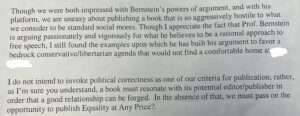
Cato tried very hard to place the book with a publisher, but constantly ran into ideological opposition. I couldn't help but think how ironic it was that book editors, of all people, thought a book was too favorable to freedom of expression. Indeed, one publisher even suggested that the book's relatively tame libertarian theme was "aggressively hostile … to standard social mores." (see excerpt below, from when the book had a different working title).
This past term, in the 303 Creative case, the Supreme Court explicitly rejected the notion that freedom of speech can be infringed by the government in the name of the government's asserting compelling interest in ensuring "equal access to publicly available goods and services." While I can't take personal credit for this holding, I'm pleased to say that the position I took twenty years ago, which struck book editors as so radical as to be "aggressively hostile … to standard social mores," is now the law of the land.
No Pseudonymity for Plaintiffs Seeking to Respond to School's "Black Lives Matter" Posters
From yesterday's decision in Cajune v. Indep. School Dist. 194, by Judge Jerry Blackwell (D. Minn.) (for more on the First Amendment issue raised in the case, see this post):
Believing the posters carried political messages, some parents and students objected to [a Minnesota school board's] hanging "Black Lives Matter" posters without also displaying posters offering various other viewpoints.
Some plaintiffs sought to sue pseudonymously, "for fear of reprisal from political activists in the southern suburban Minneapolis metropolitan community," but the court said no:
Federal Rule of Civil Procedure 10(a) requires that the complaint "must name all the parties." It is fundamental that "the public has a right to know who is using [its] courts." Accordingly, "[t]here is a strong presumption against allowing parties to use a pseudonym." …
"The threat of hostile public reaction to a lawsuit, standing alone, will only with great rarity warrant public anonymity." The Unnamed Plaintiffs have not presented such a rare case.
The Unnamed Plaintiffs vaguely reference "cancel culture" and two incidents that occurred outside of the District as evidence that they reasonably fear "reprisal from political activists" for participating in this case: interference with a bakery's business in Eagan, and a Shakopee bank employee who lost their job after criticizing a school district superintendent online. But the two alleged incidents lack any connection to the phrase "Black Lives Matter" and bear no similarity to the Inclusive Poster Series at issue here. The Unnamed Plaintiffs also claim that Plaintiffs had been physically blocked from entering school board meetings, but the alleged misbehavior stopped after Plaintiffs complained. Finally, the named Plaintiffs in this case have litigated two federal lawsuits asserting their viewpoints for nearly two years without apparent incident. The motion to proceed pseudonymously is denied.
The precedents on this are a mix. For a contrary result on similar facts, see Menders v. Loudoun Cty. School Bd. (E.D. Va. 2021), which allowed a pseudonymous challenge to a school board's policies on teaching views associated with Critical Race Theory:
Public School May Hang "Black Lives Matter" Posters Without Displaying Other Viewpoints
The government gets to pick and choose which speech it displays on its property, and doesn't have to give others a right to reply (except in public fora, which don't include school walls).
From yesterday's decision in Cajune v. Indep. School Dist. 194, by Judge Jerry Blackwell (D. Minn.):
Following George Floyd's murder in May 2020, school administrators, staff, and teachers joined much of the country in finding ways to support their students, including Black students. For its part in those efforts, in April 2021, the school board for the Lakeville, Minnesota public school district vetted and authorized a multicultural poster series that included two posters with the phrase "Black Lives Matter."
Not everyone supported the decision. Believing the posters carried political messages, some parents and students objected to hanging "Black Lives Matter" posters without also displaying posters offering various other viewpoints. After the school board denied those requests, the objectors challenged the school board's action by filing this lawsuit, claiming First Amendment violations…. Because display of the posters constitutes government speech not subject to First Amendment challenge, the school board's motion is granted, and Plaintiffs' lawsuit is dismissed with prejudice.
I think that's correct: A school is entitled to decide what messages it wants to spread—whether about science, history, morality, or anything else—without having to spread contrary messages. (There's a narrow exception as to religious messages by a public school, because of the Establishment Clause, and some opinions have suggested that there might be an exception as to outright partisan election-related speech, e.g., "Vote Democrat," but these are indeed narrow exceptions to the general rule.)
Court Reduces $1.4M Verdict to $71.5K in #TheyLied Renaissance Faire Libel Case
Defendant had accused plaintiffs, "the King and Queen of [the Pittsburgh] Renaissance Faire," of failing to properly deal with allegations of sexual harassment, and of retaliating against sexual harassment victims; the jury found that the defendant knew the statements were false, or at least recklessly disregarded the risk of falsehood.
From Friday's decision in Amor v. Conover (E.D. Pa.) by Judge John Gallagher:
In this case, the Court must decide whether defamation damages sustained by Plaintiffs, the King and Queen of a Renaissance Faire, cut to the bone, or are merely "just a flesh wound." {See Jones, T., & Gilliam, T. (1975). Monty Python and the Holy Grail. Cinema 5 Distributing. [Wait, what's Camelot doing in the Renaissance? -EV].}
Here, Plaintiffs accused the Defendant of defamation, for publishing online accusations about Plaintiffs in their capacities as renaissance faire performance directors. After a jury found for Plaintiffs, Defendant now seeks to vacate the judgment and $1.4 million damages award assessed by the jury. Because a reasonable jury, making its own determinations as to credibility of witnesses, and applying the applicable legal standard, could have found for the Plaintiffs in this action, Defendant's motion will be denied insofar as it seeks to completely vacate the judgment or award of damages. However, because the jury's damages award was unreasonably excessive in light of the evidence presented at trial, the total damages award is remitted to $71,500.
For the reasons that follow, the Court remits the compensatory damages award to Plaintiff Dr. James Amor from $750,000 to $50,000, the punitive damages award to Plaintiff Dr. James Amor from $250,000 to $1,000, the compensatory damages award to Plaintiff Ms. Patricia Amor from $300,000 to $20,000, and the punitive damages award to Plaintiff Ms. Patricia Amor from $100,000 to $500….
Plaintiffs … initiated this defamation action by filing a complaint on December 30, 2021, alleging pro se Defendant … "deliberately, recklessly, and maliciously" published defamatory statements against Plaintiffs online…. Plaintiffs … both worked as assistant directors at the Pennsylvania Renaissance Faire, and performance directors at the West Virginia and Pittsburgh Renaissance Faires. As performance director, Dr. Amor testified his responsibilities are to supervise the Renaissance Faire cast/actors, as well as coordinate with independent or national acts that participate in the Faire as well. In addition to his Renaissance Festival involvement, Plaintiff Dr. Amor is a dentist with a business practice located in Pennsylvania.
Defendant, Ms. Conover, was a paying guest at the Pittsburgh Renaissance Festival who maintained an online blog where she wrote about, among other topics, Plaintiffs.
The blog statements in question claim the Plaintiffs refused to take seriously allegations that renaissance festival cast members/employees under their supervision committed sexual misconduct against other renaissance festival cast members/employees, some of whom were minors under the age of 18 at the time of the alleged abuse. According to Plaintiffs' Complaint, Defendant's statements further allege Plaintiffs "retaliated against said rape and/or sexual assault victims by, amongst other things, publicly humiliating them, calling them crazy, refusing to rehire them, and/or terminating them from employment."
The court concluded that plaintiffs were limited purpose public figures, which means that the jury, to find for plaintiffs, had to find that defendant knew her allegations were false or at least likely false. The jury did find for plaintiffs, "awarded Dr. Amor $750,000 in compensatory damages and $250,000 in punitive damages …, and awarded Ms. Amor $300,000 in compensatory damages and $100,000 in punitive damages." The court affirmed the verdict:
Should the Philadelphia D.A.'s Office Have Been Sanctioned for Failing to Protect Crime Victims' Rights?
My amicus brief to the Third Circuit argues that the district court appropriately sanctioned the Philadelphia D.A.'s Office for making misleading representations about whether they had conferred with a crime victims' family.
Yesterday, I filed an amicus brief in the Third Circuit, arguing for affirmance of a sanctions order against the Philadelphia District Attorney's Office for failing to protect crime victims' rights. The D.A.'s Office told a federal district court that it had been in communication with the victims' family before deciding to confess error in a capital case—a representation that the district court found was misleading. After the district court sanctioned the D.A.'s Office, the Office appealed to the Third Circuit. Yesterday's brief—filed on behalf of the family by attorneys from Gibson Dunn, the National Crime Victims' Law Institute, and me—argues that the Third Circuit should affirm the district court's sanctions order.
The brief recounts facts tracking back to January of 1984. In that month, Robert Wharton and his accomplice brutally murdered Bradley and Ferne Hart in their own home and left their seven-month-old baby daughter, Lisa, to die—the horrific climax of a months-long campaign of terror against the family. After Wharton strangled and drowned Ferne in a bathtub, and his accomplice stomped and strangled Bradley in the basement, Wharton sadistically shut off the home's heat in the dead of winter, leaving baby Lisa to freeze and starve. Miraculously, she survived—discovered three days later among the carnage when Bradley's father visited the home and heard her cries.
A jury found Wharton guilty of two counts of first-degree murder in 1985 and returned two death sentences. After a reviewing court vacated his sentences on a technicality, a second jury again determined that he should be sentenced to death in 1992.
For nearly forty years, Lisa and her family have awaited justice. Wharton, however, has dragged out the proceedings at every step, filing numerous baseless claims for post-conviction relief in state and federal court. His sole remaining claim, which he brought on federal habeas, is that his lawyer at his 1992 penalty hearing was ineffective because he failed to present "mitigation" evidence of Wharton's supposedly positive adjustment to prison. (On that point, it is notable that Wharton had attempted to escape twice, and in one attempt provoked gunshots as officers sought apprehend him.)
The interminable delay in holding Wharton accountable for his crimes has been agonizing enough for Lisa and her family. But the recent actions of the Philadelphia District Attorney's Office have only compounded their suffering. Despite zealously opposing Wharton's efforts to overturn his conviction and death sentence for over three decades, the D.A.'s Office, with no explanation, suddenly announced that it would no longer contest the only remaining penalty-phase claim. The D.A.'s office then led the district court to believe that the Hart family supported this about-face—representing to the court that the D.A.'s Office decided to concede Wharton's claim only "[f]ollowing . . . communication with the victims' family."
That statement was deeply misleading. As the district court found, "the only communication was to inform a single family member that the D.A.'s office was considering conceding. None of the family members supported the decision to concede, and several expressed shock and indignation that the District Attorney's Office had suggested otherwise." Lisa—the sole survivor of Wharton's heinous crimes—was "confused," "hurt," "outraged," and "had no idea what was going on." Bradley's sister, Patrice Carr, found it "unbearably painful and shocking" to learn that the concession was "even a consideration." And Bradley's brother, Dr. Tony Hart, was "taken [a]back" when he learned the truth. Contrary to what the D.A.'s Office led the district court to believe, the family "is of one accord in asking . . . that the District Attorney do all he can to maintain the death penalty in this case."
In response to that shocking misrepresentation—which impeded the district's court ability to comply with its own statutory obligation to ensure crime victims are treated with dignity and respect—the court imposed the mildest of sanctions. It merely ordered the District Attorney to apologize to the family in writing, and the D.A.'s Office to present "a full, balanced explanation of facts" in future habeas proceedings. Yet the D.A.'s Office has appealed the court's order and contends that it discharged its legal and ethical obligations all along. Read More

Explicit Sexual Proposition to 16-Year-Old Can Be a Crime, Even if Sex with the 16-Year-Old Isn't
From yesterday's decision in Ohio v. Sebring, decided by the Ohio Court of Appeals, in an opinion by Judge Jill Flagg Lanzinger, joined by Judge Jennifer Hensal (and with Judge Donna Carr concurring in the judgment):
Mr. Sebring was friends with the parents of C.S., a 16-year-old girl. C.S. had a sixteenth birthday party at her house. Several of C.S.'s friends, including Q.H. and E.B., attended the birthday party. Mr. Sebring, who was 34 years old at the time, also attended the birthday party.
According to E.B., the teenagers at the party (all of whom were in high school) swam, ate, and then went to the basement to watch a movie. The adults stayed upstairs, but Mr. Sebring went to the basement with the teenagers. E.B. testified that there were three couches in the basement, and that she was sitting on one of them while Mr. Sebring was sitting on another couch. Mr. Sebring asked E.B. to come sit next to him, but she declined. Mr. Sebring then "squeezed" himself between E.B. and another person on the same couch. Mr. Sebring rested his hand on E.B.'s knee and started playing with her hoodie. E.B. testified that Mr. Sebring gave her an alcoholic beverage, which E.B. explained contained Tito's and orange juice. E.B. testified that she was familiar with the taste of alcohol, and that she saw Mr. Sebring pour Tito's into the drink. When questioned by the trial court, E.B. clarified that Tito's is a brand of vodka.
E.B. testified that Mr. Sebring asked to drive her home at least twice, but she declined. Mr. Sebring then had E.B. add him to Snap Chat, a messaging app. E.B. left the party and Q.H. drove her home. Mr. Sebring then started messaging E.B. through Snap Chat. In one of the messages, Mr. Sebring asked E.B. to return to the party, indicating that he "misse[d] his drinking buddy." E.B. did not immediately respond to Mr. Sebring's messages. Mr. Sebring then messaged E.B.: "Tell your mom that you want to spend the night here and let me eat that Pussy * * *." E.B. took a picture of the message, which the State introduced as an exhibit at trial. E.B. testified that Mr. Sebring apologized to her the next day for sending inappropriate messages, and that she blocked him on Snap Chat. On cross-examination, E.B. testified that the content of that message was not the type of thing that she discussed with her adult friends.
Appellate Court Vacates "Harassment Prevention Order" Aimed at Protecting Police Officer
M.B. v. T.E., decided Aug. 11 by the Appeals Court of Massachusetts (Justices Vickie Henry, Kenneth Desmond & John Englander), reverses a harassment prevention order issued under Mass. General Laws ch. 258E; the factual backstory:
In apparent retaliation for T.E.'s cooperation with a Federal drug prosecution, a third party, S.B., established "whosarat.com," a website dedicated to identifying and posting personal information about government informants. This situation and harassment by S.B. has, quite understandably, caused T.E. considerable distress. {Any stress that T.E. has experienced, of course, would not justify his harassing someone else.} T.E. believes that because certain details known only to the police appeared on the website, a particular police department must be providing his information to the website.
M.B. is a police officer of that department, shares the same last name as S.B., and is his distant relative. T.E. theorized that M.B. and the police department are part of a conspiracy to harass him. He sent a series of emails to the department's Chief about the situation, some of which were intemperate and counterproductive, and some of which M.B. perceived as a threat.
M.B. sought and received a harassment prevention order against T.E., but the appellate court vacated the order. The statute authorizes such orders based on a finding of "[three] or more acts of willful and malicious conduct aimed at a specific person committed with the intent to cause fear, intimidation, abuse or damage to property and that does in fact cause fear, intimidation, abuse or damage to property," and the appellate court concluded that such acts were not sufficiently shown: