

I was a guest on this episode, together with Niall Ferguson and John Cochrane (moderated by Bill Whalen), discussing Students for Fair Admissions (from last Term), Missouri v. Biden and the Netchoice cases (which are pretty likely to come up this coming Term), and more. I much enjoyed doing it, and I hope some of you might enjoy watching (or listening).
The Volokh Conspiracy
Mostly law professors | Sometimes contrarian | Often libertarian | Always independent | Est. 2002
Today in Supreme Court History: September 26, 1986
9/26/1986: Chief Justice Warren Burger resigns.
Fifth Circuit Panel Reconsidering Part of Its Missouri v. Biden Decision
[UPDATE: Don't blog when tired or in a hurry! I regret to say the original post erroneously said the Fifth Circuit granted rehearing en banc -- the panel just granted panel rehearing, and I've corrected the post accordingly. My apologies for the error.]
[UPDATE 9/27/23: It appears that the order granting rehearing was a result of a clerical error by the Fifth Circuit Clerk of Court's office; the grant has been withdrawn.]
Here's my post from Sept. 9 on the then-recent panel decision, which the panel is now reconsidering (thanks to Howard Bashman [How Appealing] for the pointer), though who knows whether this will be a major change or only a minor one. Note that the petition that the panel just granted was filed by the challengers (Missouri et al.), and argues that the panel erred in finding no First Amendment violation by the Cybersecurity and Infrastructure Security Agency and the State Department's Global Engagement Center.
[* * *]
In yesterday's decision in Missouri v. Biden, the Fifth Circuit (Judges Edith Clement, Jennifer Elrod, and Don Willett) held that the federal government violated the First Amendment by causing social media platforms to block posts on various topics (including "the COVID-19 lab-leak theory, pandemic lockdowns, vaccine side-effects, election fraud, and the Hunter Biden laptop story").
The court acknowledged that the First Amendment doesn't bar social media platforms from acting on their own to restrict user speech, since the First Amendment applies only to the government and not to private parties (including large corporations). But the court concluded that the First Amendment may be violated "when a private party is coerced or significantly encouraged by the government to such a degree that its 'choice'—which if made by the government would be unconstitutional—'must in law be deemed to be that of the State.' This is known as the close nexus test."
As to what constitutes "significant[] encouragement by the government" to restrict speech, the court held:
For encouragement, we read the law to require that a governmental actor exercise active, meaningful control over the private party's decision in order to constitute a state action. That reveals itself in (1) entanglement in a party's independent decision-making or (2) direct involvement in carrying out the decision itself. In any of those scenarios, the state has such a "close nexus" with the private party that the government actor is practically "responsible" for the decision, because it has necessarily encouraged the private party to act and, in turn, commandeered its independent judgment.
As to what constitutes "coerc[ion]," the court held:
Monday Open Thread
What's on your mind?
"Strangers on the Internet" Podcast Episode 44: Fighting Image-Based Sexual Abuse and Online Harassment
Prof. Mary Anne Franks lays out the legal changes needed to protect people on the Internet
The forty-forth episode (Apple Podcasts link here) of "Strangers on the Internet" with co-host and psychologist Michelle Lange features Prof. Mary Anne Franks from the George Washington University Law School.
We sit down with our esteemed guest to take stock of the state of Internet safety (or lack thereof) today. Mary Anne explains why "revenge porn" is generally a misnomer, why women are particularly at risk in a variety of online settings, and what has made it so difficult to pass federal legislation to protect individuals from having naked images of themselves distributed nonconsensually.
The law professor and Krav Maga instructor also discusses what readers will find in her forthcoming second book "Fearless Speech," why only criminalization is likely to incentivize potential online abusers to stay put, and what encourages her to continue advocating for women's rights in the face of death threats. Join us for a conversation about both individual safety measures and the broader structural changes needed to prevent further victimization!

Better Call Saul Episode Doesn't Infringe "Liberty Tax Services" Trademark
From JTH Tax LLC d/b/a Liberty Tax v. AMC Networks, Inc., decided today by Judge Paul Gardephe (S.D.N.Y.), rejects plaintiff's claim of trademark infringement in AMC's Better Call Saul:
[Season 6,] Episode 2 depicts a fictional tax preparation business called "Sweet Liberty Tax Services," which is operated by "convicted felon, Craig Kettleman, and his wife, Betsy Kettleman." Craig Kettleman was a client of Saul Goodman in Season 1 of Better Call Saul who was imprisoned after being convicted of embezzlement. The Kettlemans and Sweet Liberty defraud their clients "by skimming money from their tax refunds." Kim Wexler—one of the Show's central characters and Saul's wife—refers to the fictional tax business as a "rundown little mom and pop outfit." Wexler blackmails the Kettlemans by threatening to reveal their crimes to the IRS.
In the Amended Complaint, Plaintiff alleges that the Show's Sweet Liberty Tax Services "is an obvious imitation of an actual Liberty Tax location, but twisted to paint Liberty Tax in a negative and disparaging light[,]" with "just the word 'Sweet' added." According to Plaintiff, similarities between the fictional Sweet Liberty Tax Services and the real Liberty Tax Service include the use of an inflatable Statue of Liberty, the use of checks bearing a Statue of Liberty logo, a Statue of Liberty wall mural inside the tax preparation office, and the use of a red, white and blue motif on the location's exterior ….
No, says the court:
Foreigners: When You File in U.S. Courts, You Should Expect U.S. Rules of Public Access to Your Filings
"Plaintiff states that he was not aware that his complaint would be made public, and he suggests that, under Korean law, the personal information of litigants is not made public." But "[w]hether or not he intended to do so, by initiating this action in a United States District Court, Plaintiff has made his name a matter of public record."
From the decision earlier this month by Chief Judge Laura Taylor Swain (S.D.N.Y.) in Hong v. Sun:
Plaintiff, who resides in the Republic of Korea, brings this action pro se. For the reasons set forth below, the Court denies Plaintiff's request to limit the public's access to his court filings …. On September 5, 2023, the Court received from Plaintiff two email letters asking the Court to "change [his] case to 'private.'" Plaintiff states that he received an email, and possibly a phone call, from a "man claiming to be a journalist," who was inquiring about his case. The journalist told Plaintiff that he obtained his contact information from Plaintiff's "litigation file" available on the Public Access to Court Electronic Records ("PACER") system. Plaintiff states that he is "scared and worried that [the journalist] contacted" him. He asks the Court to "treat my case as 'private' (not 'public')."
The Court construes Plaintiff's letter as a motion to proceed anonymously or under a pseudonym and a request that all documents in his case be placed under seal….
Rule 10(a) of the Federal Rules of Civil Procedure provides that "[t]he title of [a] complaint must name all the parties." "This requirement, though seemingly pedestrian, serves the vital purpose of facilitating public scrutiny of judicial proceedings and therefore cannot be set aside lightly." Courts have … permitted a party to proceed anonymously or under a pseudonym in a limited number of circumstances…. [But] {the circumstances here are not sufficiently extraordinary to outweigh the presumption of public access.}
First and Fourth Amendment Claims Over Arrest at Protest of Police Chief Can Go Forward
From the decision earlier this month by Judge F. Kay Behm (E.D. Mich.) in Rideout v. Shelby Twp.:
This case arises from Rideout's arrest after a series of protests against the Shelby Township Chief of Police, Robert Shelide, a defendant here. On June 16, 2020, Chief Shelide was suspended for thirty days after having made multiple posts on a Twitter Account using a pseudonym supporting racist ideals and endorsing police brutality. On July 1, 2020, July 15, 2020, and July 20, 2020, Rideout participated in protests against Shelide. On the evening of July 20, 2020, local media interviewed Rideout, who criticized Shelide's return from suspension and called for his resignation.
According to the SAC [Second Amended Complaint], in response to Rideout's criticisms, the named Defendants worked together to retaliate against him for exercising his constitutional rights under the First Amendment. Rideout alleges that Shelide and the police officer defendants colluded to conduct a pretextual investigation of his activities on July 20, 2020 to fabricate a misdemeanor charge of violating Mich. Comp. Laws § 257.602 (failure to comply with the order or direction of a police officer) and presented false or misleading facts to the prosecutor's office. No other protester was arrested for their participation in the July 20, 2020 protests/demonstrations.
The SAC alleges that Defendant Ermir Villa's police report, which served as the basis for the warrant, was untruthful and failed to include exculpatory evidence. The SAC further alleges that Villa, the other Defendant officers, and Shelide were all aware at the time the arrest warrant was obtained that Rideout sought to cooperate with officers at the protest, asked for more time to disperse the crowd, and the officer on the ground granted that request. Despite this knowledge, Defendants colluded to omit this information from the presentation of evidence to the prosecutor and magistrate who issued the warrant.
In 2021, Rideout filed a motion to dismiss the charges based on a lack of probable cause and insufficient evidence. After an evidentiary hearing, the state court judge dismissed the charges, ruling:
Religious Marriage-Related Agreements Can Be Enforced by American Courts, but Only When They Comply With State Law
From Khan v. Hasan, decided Wednesday by the New York intermediate appellate court (Judges Angela G. Iannacci, Cheryl E. Chambers, William G. Ford & Lillian Wan), a good illustration of how American law generally treats religious agreements:
The parties were married in a civil ceremony on March 2, 2016, and subsequently held a religious ceremony on September 12, 2016. The parties' religious certificate of marriage, which was signed by two witnesses and an imam, but was not acknowledged, lists an amount of $50,000 for "Meher." The parties assert that a Meher or Mahr agreement is an agreement between the parties to a marriage, in accordance with Islamic law, that the husband will pay to the wife a specified sum in the event of a divorce.
The parties eventually divorced, and the husband sought to set aside the Mahr; the court agreed:
"It is without question that when courts must touch upon questions of religious concerns, they may not consider religious doctrine." "[H]owever, the [United States] Supreme Court, in holding that a State may adopt any approach to resolving religious disputes which does not entail consideration of doctrinal matters, specifically approved the use of the neutral principles of law approach as consistent with constitutional limitations. This approach contemplates the application of objective, well-established principles of secular law to the dispute, thus permitting judicial involvement to the extent that it can be accomplished in purely secular terms."
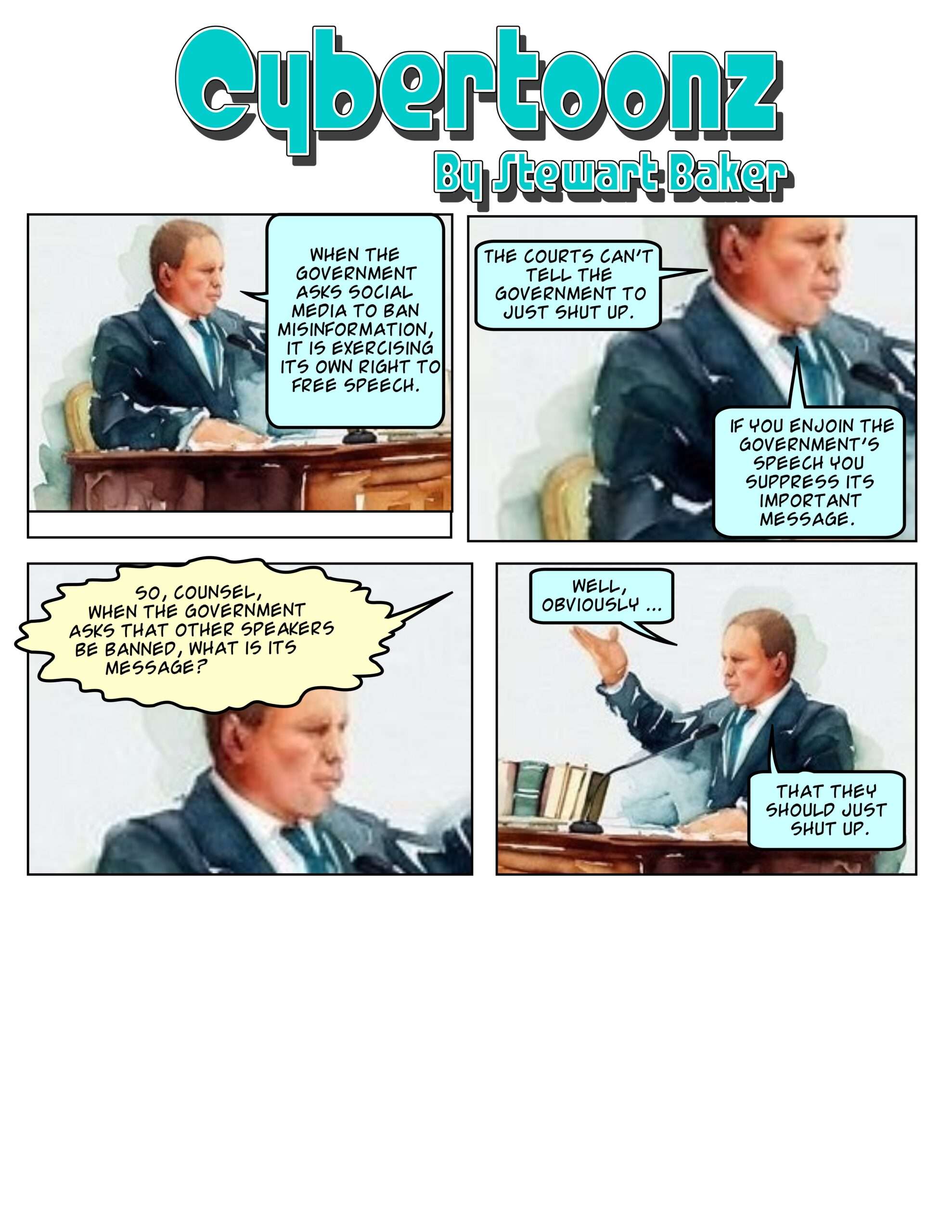
Cybertoonz explains the government's right to speak
And why government communications to social media about content moderation shouldn't be enjoined
There's already a tangled legal history to the Biden administration's aggressive campaign aimed at persuading social media companies to restrict certain messages and ban certain speakers. Judge Doughty issued a sweeping injunction against the government. The Fifth Circuit gave Judge Doughty's order a serious haircut but left its essence in place. Still unsatisfied, the Solicitor General obtained a further stay from the Supreme Court.
All in all, several hundred pages of legal talk about the US government's right to call on social media to suppress speech.
As a public service, Cybertoonz has reduced the entire controversy to four panels.
(Note: Based on legitimate criticism of the original, I've substituted a different set of cartoons, also created on Bing Image Creator.)
Court Refuses to Dismiss Lawsuit Stemming from Parent's Speech About COVID Policies
The parent's comments at a school board meeting led to a "no trespass notice" that blocked him from school district premises (apparently including his children's school).
From Hotchkiss v. Cedar Rapids Comm. School Dist., decided Thursday by Judge C.J. Williams (N.D. Iowa), the plaintiff's allegations (note that they are just allegations):
Plaintiff … had a child enrolled at a District elementary school during the 2021-2022 school year. On November 15, 2021, defendant District held a school board meeting. Plaintiff attended the meeting and followed the procedures to speak at the meeting by signing up to speak during the public comment period and then speaking for his allotted five minutes.
Plaintiff spoke about his belief that the District's policies relating to COVID-19 were harmful to his child and others. The complaint characterizes plaintiff's comments as "pointed" while refraining from "profanity, aggressive language, or any conduct that could be perceived as disruptive or threatening." During this time, he called defendant Borcherding "Miss Psychology," specifically stating "Miss Psychology down there doesn't want to seem to tell you people what's going on with our kids."
Today in Supreme Court History: September 25, 1981
9/25/1981: Justice Sandra Day O'Connor takes the oath.
Police Officer's Hanging Up on Caller Isn't a First Amendment Violation
"[T]he First Amendment does not require government actors to listen to citizens' speech or guarantee the right to communicate one's views to a government audience for any length of time that the speaker desires," and this applies equally "when the audience is a police officer." So holds last week's decision (quite correctly) in Sgaggio v. Diaz, by Chief Judge Philip Brimmer (D. Colo.).
Volokh Conspiracy Gets Results on Immigration and Zoning Policy
Federal and New York City officials recently adopted policy changes on migrant work permits and zoning reform similar to those advocated here (though probably not because I advocated them!)..
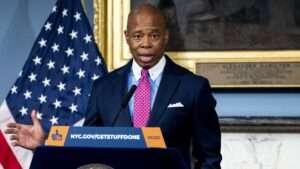
On August 17, I wrote a Volokh Conspiracy post explaining how New York City's migrant shelter crisis could be alleviated by a combination of letting migrants work legally and cutting back on zoning rules that block construction of new housing. Less than a month later, on September 20, the Biden administration granted Temporary Protected Status (TPS) to almost 500,000 Venezuelan migrants in the United States; Venezuelans are a large proportion of new migrants in New York and other major cities. And TPS includes the right to work legally. Administration officials must have read my post and seen the light!
The day after the feds announced their new Venezuelan TPS policy, New York City Mayor Eric Adams proposed the most sweeping NYC zoning reform in many decades. If enacted by the New York city council, it would allow the construction of many thousands of new housing units throughout the City, by - among other things - allowing construction of larger apartment buildings, letting homeowners add second units on their lots, and scrapping parking mandates for new housing construction. Adams' speech announcing the proposal forcefully denounces exclusionary zoning and explains how it stifles development, promotes racial segregation, and harms immigrants and natives alike. He must be a regular VC reader, too! I've been saying these sorts of things for years.
In reality, it's highly unlikely my advocacy had any meaningful effect on either Biden's actions or Adams'. The former is likely the result of sustained pressure by various Democratic officials and policy experts (including Mayor Adams), who have been pushing Biden to let asylum-seeking migrants have immediate access for work permits (as opposed to the traditional policy of making them wait six months or more). Adams' policy is part of a broader struggle over exclusionary zoning being waged across the country. But, whatever the reason, it's a good thing Biden and Adams took these important steps in the right direction.
But much more remains to be done. Venezuelans are not the only migrants fleeing horrible violence and socialist oppression who need work permits in order to support themselves and benefit our economy. Many Cubans, Nicaraguans, and others are in much the same position. Biden should grant TPS status to them, as well.
In the long run, Congress should pass adjustment acts giving these groups permanent residency and work rights, as has been done for many others fleeing war and oppressive socialist regimes in the past. That will benefit the migrants themselves, bolster the US economy, and strengthen our position in the international war of ideas against socialist dictatorships and other enemies.
On the zoning side, I am not sure that Adams' proposed reforms go far enough. It would be better to simply allow property owners to build whatever kinds of housing they want, subject to minimum safety and public health standards. That would enable significantly more construction than Adams' more limited (though still extensive) proposals. It would also be a valuable boost to property rights. In New York, as in many other jurisdictions, zoning restrictions are the single biggest constraint on property owners' rights to use their land as they see fit.
Finally, as noted in my August post, NYC would also do well to end its guaranteed shelter policy, which creates bad incentives for migrants and native-born Americans alike. Rather than offering free shelter at taxpayer expense, local and federal governments should instead let people work to support themselves, and let property owners build new housing to accommodate them. Both Adams and New York Governor Kathy Hochul have come out in favor of ending or at least limiting the shelter guarantee. Hopefully, that policy will be curtailed and eventually phased out.
Today in Supreme Court History: September 24, 1755
A Rare Case Where the Court's New Threats Case (Counterman) May Make a Difference
In this year's Counterman v. Colorado, the Supreme Court held that "true threats" of illegal conduct are constitutionally unprotected but only if the speaker was reckless, i.e., "consciously disregarded a substantial risk that his communications would be viewed as threatening violence." Before that, many states had allowed such threats to be punished on just a showing that the speaker was negligent, i.e., "should [have been] aware of a substantial risk … that others will understand his words as threats."
In practice, it's hard to find cases where such a standard would likely change the outcome; but Thursday's Washington Court of Appeals decision in State v. Beal (written by Judge Robert Lawrence-Berrey, joined by Chief Judge George Fearing and Judge Rebecca Pennell), might be one such case. An excerpt:
Sara Beal lived with her 15-year-old daughter, K.F., in a multilevel townhome in Spokane. On the morning of September 13, 2021, K.F. awoke before her mother. She went into her mother's room a couple of times to check to see if her mother was awake and to ask when she would be getting up.
Later that morning, Ms. Beal entered K.F.'s room and asked why she was "poking" her while she was asleep. During this exchange, Ms. Beal jabbed K.F. three times on her leg with what appeared to be a screwdriver or nail. K.F. pushed her mother away, and Ms. Beal returned to her room.
Today in Supreme Court History: September 23, 1971
Insurrectionists Who Think they are Upholding the Constitution are Still Insurrectionists - and Still Subject to Disqualification Under Section 3 the Fourteenth Amendment
If false beliefs about legality exempt people from Section 3 disqualification, leading Confederates would have been exempt as well.
Some argue that Donald Trump is not subject to disqualification from holding public office under Section 3 the Fourteenth Amendment because Trump and those who attacked the Capitol on January 6, 2021 did not think of themselves as trying to overthrow the government. They instead believed Trump was the true winner of the 2020 election, and they were upholding the Constitution by preventing that victory from being "stolen" from him.
Section 3 states that "No person" can hold any state or federal office if they had previously been "a member of Congress, or… an officer of the United States" or a state official, and then "engaged in insurrection or rebellion against the same, or given aid or comfort to the enemies thereof." Critics of Section 3 disqualification argue that people who used force and fraud to try to keep Trump in power after he lost the 2020 election were not "engaged in insurrection" because they sincerely believed he had won.
Thus, Harvard law Prof. Larry Lessig writes that "the act they [the people who stormed the Capitol] were engaging in was not rebellion. It was an effort to assure what they wrongly believed was the rightful result." He adds that "the vast majority of them thought not that they were overthrowing a government but that they were pressuring their government to do the right thing—at least as they (wrongly) saw it." Stanford law Professor Michael McConnell made a similar point in our recent televised debate on Trump and Section 3.
In the case of Trump, there is a lot of evidence indicating he did know he had lost the election, and his public statements to the contrary were lies. But, for now, let's set that aside. A false belief that you are acting in accordance with the Constitution does not exempt you from disqualification under Section 3. If it did, many of the leading Confederates who fought against the United States in the Civil War would also be exempt.
Section 3 was enacted in the immediate aftermath of the war, included in the Fourteenth Amendment because many feared that, otherwise, ex-Confederate political leaders might return to power. If there's anyone who is disqualified under Section 3, it's leading Confederates who had held public office before the war.
Yet under the reasoning advanced by Lessig and McConnell, many, perhaps even most, Confederates also weren't insurrectionists! After all, Confederate leaders repeatedly argued they were just exercising a right of secession guaranteed to their states by the Constitution. Far from seeking to violently and illegally overthrow the government, they were simply making use of their legal rights. On this view, violence only resulted because the federal government itself violated the Constitution and illegally tried to force the seceding states to stay in the Union.
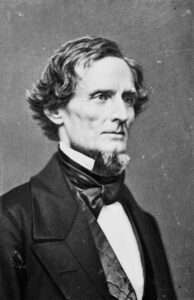
Soon-to-be Confederate President Jefferson Davis made this argument in his January 1861 farewell speech to the US Senate, where he defended his state's decision to secede. He contended that, under the Constitution, "the right of a State to secede from the Union" is an "essential attribute of State sovereignty." Confederate Vice President Alexander Stephens made similar claims. After the war, he even wrote a book-length defense of them, which he entitled, A Constitutional View of the Late War Between the States.
As a legal matter, the Confederates actually had a stronger argument than Trump and his supporters did. The Constitution is famously silent on the question of secession. Before the Civil War, there was a longstanding debate among experts over whether states could legally secede or not. By contrast, there was never any plausible basis for thinking that Trump was the true winner of the 2020 election. By the time of January 6, that point had been reinforced by numerous court decisions rejecting his claims, including many written by conservative Republican judges, some of them appointed by Trump himself.
Morally, the Confederates were even worse than Trump. Whether they had a legal right to do so or not, Davis and the others seceded for the deeply evil purpose of perpetuating and extending the horrific institution of slavery. That's worse than Trump's motivation of keeping himself in power. But many of the Confederates genuinely believed they were exercising rights guaranteed by the Constitution, and their legal rationale was much less implausible than Trump's.
In sum, any claim that the January 6 attack and related attempts to keep Trump in power was not a true insurrection because of the perpetrators' subjective beliefs, also implies that many Confederates weren't true insurrectionists, either. They too thought they were merely upholding the rules of the Constitution, exercising a right that document guaranteed.
And this implication of the theory is enough to reject it. If your interpretation of Section 3 suggests that Jefferson Davis was not a true insurrectionist subject to disqualification, that's a strong sign you got something wrong!
Whether the Confederates, Trump, or anyone else engaged in insurrection or aided one turns not on subjective states of mind, but on objective reality. Whatever Trump and the January 6 rioters might have subjectively believed, objectively they were trying to use force and fraud to overthrow the duly elected president and replace him with the man he had defeated.
This point also addresses Lessig's concern that "every leader who might resist a future coup attempt risks disqualifying themselves from serving in any subsequent government." If what they are resisting is a true coup attempt (i.e. - an effort to use force or fraud to install in power someone who was not duly elected), then the resistance is not insurrection against the United States and its legally legitimate government. Facts, not feelings, are determinative here.
There are a number of other arguments against applying Section 3 disqualification to Trump, including some that may be weightier than the one addressed here. I have previously criticized some of them here and here.




