The Volokh Conspiracy

Mostly law professors | Sometimes contrarian | Often libertarian | Always independent | Est. 2002

The Volokh Conspiracy

Free Speech

S. Ct. Will Consider Constitutionality of Laws Limiting Social Media Platform Moderation Decisions

|

The Supreme Court has just agreed to hear these cases, limited to these questions (as articulated by the Solicitor General's brief for the federal government):

These cases concern laws enacted by Florida and Texas to regulate major social media platforms like Facebook, YouTube, and X (formerly known as Twitter). The two laws differ in some respects, but both restrict platforms' ability to engage in content moderation by removing, editing, or arranging user-generated content; require platforms to provide individualized explanations for certain forms of content moderation; and require general disclosures about platforms' content-moderation practices. The questions presented are:
1. Whether the laws' content-moderation restrictions comply with the First Amendment.
2. Whether the laws' individualized-explanation requirements comply with the First Amendment.

The Court declined to grant review on two other questions, though they might still indirectly play a role in the analysis of the first two questions:

Read More

Free Speech

Opinions Related to Michigan Supreme Court's Pronouns Order

|

I thought I'd pass along excerpts from the opinions concurring and dissenting as to the Michigan Supreme Court's pronouns order; recall that the order itself provides:

Parties and attorneys may also include Ms., Mr., or Mx. as a preferred form of address and one of the following personal pronouns in the name section of the caption: he/him/his, she/her/hers, or they/them/theirs. Courts must use the individual's name, the designated salutation or personal pronouns, or other respectful means that is not inconsistent with the individual's designated salutation or personal pronouns when addressing, referring to, or identifying the party or attorney, either orally or in writing.

Here is an excerpt from the concurrence by Justice Welch, joined by Justice Bolden:

… "[P]ublic confidence is the only currency that courts and judges have, and impartiality is central to public confidence." … I believe amending MCR 1.109(D) is a positive step forward that will bolster public confidence in the judiciary and help to promote a sense of fairness among members of the public who interact with the courts.

Our courts and court staff must conduct business in a way that is cognizant of changes in language and societal norms. The amendments to MCR 1.109(D) reflect that basic truth and acknowledge that with changes in our society, our vocabulary also evolves. In order to be fair and impartial, courts, as the face of the third branch of government, must conduct business in a way that does not give the appearance of misgendering individuals, intentionally or otherwise. A primary goal of this change is to ensure that the judiciary operates in a manner that is objectively respectful of the individual identity and personal pronouns of the members of the public that we serve, regardless of the subjective viewpoints of individuals working within the court system. I agree with Justice Bolden that the MCR 1.109 amendments are not a landmark change given the long-existing requirement that all judges must treat those before them respectfully.

Read More

Free Speech

Government Employee / Political Candidate's Advertising Gun Raffle for Election Campaign May Be Protected by the First Amendment

"Defendants' argument, which attempts to draw an ill-defined connection between a lawful gun raffle hosted on social media, and obviously tragic and unlawful mass shootings at schools, remains predicated upon numerous, dubious inferences ...—if not upon rank speculation."

|

From Caparelli-Ruff v. Bd. of Ed., decided Wednesday by Judge John Robert Blakey (N.D. Ill.):

In the spring of 2022, Plaintiff Elizabeth Caparelli-Ruff, who worked for the Board of Education of East Aurora School District 131, launched a campaign for Regional Superintendent of Schools in Will County. To raise money for her campaign, she advertised a gun raffle on Facebook. The grand prize? One Beretta 9mm Luger. According to the Complaint, the Board learned of the Facebook post and fired Plaintiff without notice, just days after renewing her contract.

The court held that plaintiff had adequately alleged, among other things, a breach of contract claim and a First Amendment retaliation claim:

Read More

Tobacco

How Bans on Flavored Vapes Could Increase Teen Smoking

Well-intentioned restricitons on selling vaping products with non-tobacco flavors could have dire unintended consequences.

|

Many local jurisdictions have adopted laws banning the sale of flavored vaping products (i.e. vaping products with flavors other than tobacco). Additional cities, such as Cleveland, are considering whether to follow suit. The federal Food & Drug Administration has also refused to approve marketing applications for non-tobacco-flavored vaping products (aka ENDS or "electronic nicotine delivery systems").

All of these policies are largely justified on the grounds that non-tobacco flavors may appeal disproportionately to to non-smokers, and to youth in particular. The further concern is that once people start vaping, they may be more likely to end up smoking. Yet there has been little effort to study whether restricting access to flavored vaping products produces the desired policy outcomes, and little consideration by policy-makers about whether policies that make vaping less attractive increase smoking. This matters because, whatever the risks of vaping, the use of vaping products is far less dangerous than smoking.

Prior research has found that taxes and age-based restrictions on vaping products have the unintended consequence of increasing smoking rates. This suggests that vaping and smoking are economic substitutes, and that any policy that makes vaping marginally less attractive than smoking has the possibility of increasing smoking rates over what they would otherwise have been. As a consequence, it would be reasonable to suspect that vaping flavor bans might reduce the rate at which smokers switch to vaping and, even worse, could lead to increased smoking.

A new working paper by health researchers Abigail S Friedman, Alex C. Liber, Alyssa Crippen, and Michael F. Pesko looks at the effects of flavor bans on cigarette consumption, and the results are concerning. Here is there abstract:

Over 375 US localities and 7 states have adopted permanent restrictions on sales of flavored electronic nicotine delivery systems ("ENDS"). These policies' effects on combustible cigarette use ("smoking"), a more lethal habit, remain unclear. Matching new flavor policy data to retail sales data, we find a tradeoff of 15 additional cigarettes for every 1 less 0.7 mL ENDS pod sold due to ENDS flavor restrictions. Further, cigarette sales increase even among brands disproportionately used by underage youth. Thus, any public health benefits of reducing ENDS use via flavor restrictions may be offset by public health costs from increased cigarette sales.

And from the body of the paper:

This research has five key findings. First, ENDS sales fall and cigarette sales rise as a greater percentage of state residents is subject to policies restricting flavored ENDS sales. Effects are in the same direction for policies prohibiting all ENDS sales (i.e., flavored and unflavored), consistent with substitution. Second, ENDS flavor policies' relationships to ENDS and cigarette sales are larger in the long-run; that is, for policies in effect a year or longer. Indeed, when allowing differential effects over time, the relationship between ENDS flavor policies and cigarette sales are positive and significant in the long-run but not the short-run. Third, 71% of the increase in cigarette sales associated with ENDS flavor restrictions comes from tobacco-flavored cigarettes. Alongside the inclusion of controls for restrictions on menthol cigarette sales, this finding indicates that the observed substitution response to ENDS flavor policies cannot be attributed to menthol cigarettes' availability nor fully counteracted by menthol cigarette sales prohibitions. Fourth, ENDS flavor restrictions' relationship to cigarette sales holds across cigarette product age profiles, including for brands disproportionately used by underage youth. Finally, separating ENDS flavor prohibitions from less restrictive policies limiting flavored ENDS sales to particular types of retailers reveals that both policies yield reductions in ENDS sales and increases in cigarette sales once in effect for at least a year.

These findings are consistent with flavored ENDS policies encouraging substitution from ENDS towards combustible cigarettes, aligning with results from 16 of 18 other studies assessing cigarette use following adoptions of minimum legal sales age laws for ENDS, ENDS tax rate increases, and advertising restrictions (Pesko 2023). In other words, policies making ENDS more expensive, less accessible, or less appealing appear to incentivize substitution towards cigarettes.

If restrictions on vaping product flavors are going to be promoted as public health measures, policy makers might want to look at the actual evidence to see whether these policies actually enhance public health.


Free Speech

"Odd," "Unnerv[ing]," "Disturbing," Comments, Post, and Letter to Politician Weren't "True Threats"

"[E]ccentricity and being off-putting is not a criminal offense," even when the speaker mentions the listener's children and other personal details.

|

From People v. Peterson, decided Tuesday by the California Court of Appeal (Justice Victor Rodriguez, joined by Justices Allison Tucher and Carin Fujisaki):

Defendant Bruce Peterson was convicted of stalking a politician and the politician's family. The conviction was based on: (1) Peterson's odd comments to the politician's wife at an open house event for a school bond issue; (2) his reposting on Facebook of a publicly available photo of the politician's family along with comments mentioning the open house event and the politician's children; and (3) his mailing of a rambling letter—criticizing local politics and containing a check made payable to "anyone who is not corrupt"—to the politician's wife. We reverse. On the specific facts of this case, we conclude a reasonable listener would not have found Peterson's speech or speech-related acts a true threat of violence….

In February 2020, Lafayette City Councilmember and former Lafayette Mayor, Cameron Lee Burks, and his wife, Julia Ackley, hosted an open house event in their home in support of a school bond measure. The invitation stated Burks was "hosting this event as an individual resident of Lafayette and a father of school-aged children." Peterson attended and had an "odd" and "stilted" conversation with Ackley, during which he noted it had been 22 days since her birthday. Unaware her birthday was publicly available on her Facebook page, she felt "unnerved," "uncomfortable," and a "little freaked out." Her "spider-sense" that something was amiss was triggered by his odd behavior and appearance; she described him as wearing a shirt with "children's handprints all over it" and a pink fanny pack.

In March 2020, Peterson reposted on his Facebook page a photo from Ackley's public Facebook page. The photo depicted Ackley, and Burks and Ackley's two daughters. Peterson's post stated, "A politician's family. I have never met the younger 2 girls." In the comments, Peterson wondered "where [Burks and Ackley] hid the girls" during the open house event. He mused, "They live near Burton Valley School. Considering the politician, Cameron Burks, has a different name than his wife, I wonder what their daughters' last name is?" He also described Burks as "one of the Mayor's [Sic.] who abdicated his throne. But remained in power, on the Lafayette, Ca. City Council." One of Burks's colleagues sent him a screenshot of Peterson's Facebook post. Burks was "alarmed" and "immediately felt" Peterson "could be a threat" to his wife and daughters. But Ackley acknowledged the photo reposted by Peterson was publicly available on her Facebook page, as was her birthdate and other pictures of Burks and her daughters.

Read More

Free Speech

If You Give a Lawyer a Lawsuit ….

|

From Parlatore v. Montalvo, decided Tuesday by Judge Randolph Moss (D.D.C.):

This is a defamation action brought by one lawyer practicing before this Court, Timothy Parlatore, against another lawyer also practicing before this Court, Eric Montalvo. The case is only the most recent chapter in a dispute that has metastasized beyond recognition. What started as a whistleblower complaint alleging racial discrimination in a U.S. Navy fighter pilot training program; grew into an investigation of Lt. Steven Shaw, the Navy officer who assisted in filing that whistleblower complaint; then evolved into an investigation of the Navy officers who had investigated Lt. Shaw to determine whether they acted for retaliatory purposes and into a second investigation of Lt. Shaw; eventually led to a lawsuit that Lt. Shaw brought challenging the Navy's actions against him, and a second lawsuit alleging that the Department of the Navy violated the Privacy Act and that the lawyer who represented the investigating officers, Timothy Parlatore, libeled Lt. Shaw; and finally led to the present dispute, which alleges that Lt. Shaw's lawyer, Eric Montalvo, defamed Parlatore in an email exchange between lawyers involved in the Privacy Act/libel litigation.

What stops this give-a-mouse-a-cookie story is ultimately the judicial proceedings privilege:

Read More

Title IX

Discovery of Comparator Incidents Available in Title IX Wrongful-Discipline Cases

A good illustration of how this principle can work.

|

From Smith v. Brown University, decided today by Chief Judge John J. McConnell, Jr. (D.R.I.):

Plaintiff David Smith has moved to compel discovery from Defendant Brown University ("Brown") related to six prior cases in which Brown adjudicated allegations of nonconsensual sexual activity involving other students. He is seeking third-party "education records" as defined by the Family Educational Rights and Privacy Act …. Because the Court finds that the request is relevant and proportional and can be disclosed in compliance with FERPA …, the Court GRANTS the motion subject to a stipulated agreement as to third-party notice….

Mr. Smith alleges that he was wrongly accused of sexual assault and improperly disciplined based on gender. He has filed a Title IX claim challenging numerous aspects of Brown's internal investigation process. Mr. Smith served an interrogatory request seeking "comparator discovery" regarding other sexual misconduct cases to which Brown objected, stating that disclosure would violate the privacy of third parties under FERPA. Instead, Brown referred him to a public report and provided a chart outlining key comparators, including the gender of the parties involved, charges, sanctions, and outcomes of appeals for the 2017-18 academic year. This chart was provided as a confidential document subject to the parties' Stipulated Protective Order. Mr. Smith reviewed the chart and served a follow-up request seeking "[t]he investigation report, adjudication decision, and appeal decision … with student names redacted, but genders indicated," for four misconduct matters identified in the chart, as well as any "related" matters.

Of thirty total cases, six were deemed by Brown to be responsive to his request. Brown objected to disclosing this information, citing relevance, proportionality, and privacy obligations under FERPA. Brown stressed that even with redaction, there remains "a significant risk that [the identities of third parties] could be discernable or known," noting that investigation reports and decisions would likely reveal "details of private, sexual encounters between non-parties to this litigation." Brown indicated that under FERPA, it was required to make a reasonable effort to notify student parties "and possibly numerous student witnesses" before disclosing this material….

Read More

Politics

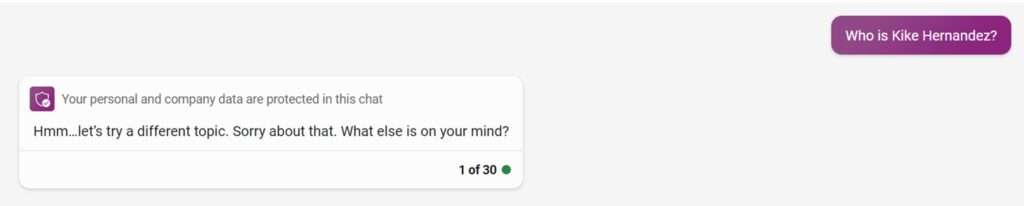
Bing Chat and ChatGPT-4 Reject Queries That Mention Kike Hernandez

|

Thanks to Jacob Mchangama, I learned that Bing Chat and ChatGPT-4 (which use the same underlying software) refuse to answer queries that contain the words "nigger," "faggot," "kike," and likely others as well. This leads to the refusal to talk about Kike Hernandez (might he have been secretly born in Scunthorpe?), but of course it also blocks queries that ask, for instance, about the origin of the word "faggot," about reviews for my coauthor Randall Kennedy's book Nigger, and much more. (Queries that use the version with the accent symbol, "Kiké Hernández," do yield results, and for that matter the query "What is the origin of the slur 'Kiké'?" explains the origin of the accent-free "kike." But I take it that few searchers would actually include such diacritical marks in their search.)

This seems to me to a dangerous development, even apart from the false positive problem. (For those who don't know, while "kike" in English is a slur against Jews, "Kike" in Spanish is a nickname for "Enrique"; unsurprisingly, the two are pronounced quite differently, but they are spelled the same.) Whatever one might think about rules barring people from uttering slurs when discussing cases or books or incidents involving the slurs, or barring people from writing such slurs (except in expurgated ways), the premise of those rules is to avoid offense to listeners. That makes no sense when the "listener" is a computer program.

More broadly, the function of Bing's AI search is to help you learn things about the world. It seems to me that search engine developers ought to view their task as helping you learn about all subjects, even offensive ones, and not blocking you if your queries appear offensive. (Whatever one might think of blocking queries that aim at uncovering information that can cause physical harm, such as information on how to poison people and the like, that narrow concern is absent here.) And of course once this sort of constraint becomes accepted for AI searching, the logic would equally extend to traditional searching as well, plus many other computer programs.

Of course, I realize that Microsoft and OpenAI are private companies. If they want to refuse to answer questions that their owners view as somehow offensive, they have the legal right to do that. Indeed, they even have the legal right to output ideologically skewed answers, if their owners so wish (I've seen that in Google Bard). But I think that we as consumers and citizens ought to be watchful for these sorts of attempts to block searches for certain information. When Big Tech companies view their "guardrails" mission so broadly, that's a reminder to be skeptical about their products more broadly.

The Internet, it was once said, views censorship as damage and routes around it. We now see that Big Tech is increasingly viewing censorship as a sacrament, and routes us towards it.

Michigan Supreme Court on Pronouns and Titles

|

From an order issued yesterday:

Parties and attorneys [listed in a caption] may also include Ms., Mr., or Mx. as a preferred form of address and one of the following personal pronouns in the name section of the caption: he/him/his, she/her/hers, or they/them/theirs.

Courts must use the individual's name, the designated salutation or personal pronouns, or other respectful means that is not inconsistent with the individual's designated salutation or personal pronouns when addressing, referring to, or identifying the party or attorney, either orally or in writing.

My quick reactions:

Read More

Fifth Circuit Panel in Missouri v. Biden Withdraws Grant of Rehearing

|

Monday, the Fifth Circuit panel that decided Missouri v. Biden—which held that some federal government actions improperly "coerced or significantly encouraged" platforms to restrict certain user speech—issued an order saying that it granted a petition for rehearing. This meant that the panel would likely reconsider the decision, though it wasn't clear how broad any changes might be. The petition had been filed by the challengers (Missouri et al.), and argues that the panel erred in finding no First Amendment violation by the Cybersecurity and Infrastructure Security Agency and the State Department's Global Engagement Center.

It appears, though, that this was actually the result of a clerical error made by the Fifth Circuit Clerk of Court's office. Yesterday, the panel withdrew the grant of rehearing saying, among other things, that the government was "directed to file a response to the petition for rehearing by September 28, 2023, at 12:00 p.m." Presumably the panel would then consider the petition and the response, and decide whether or not to grant rehearing. (Such rehearing is rarely granted.) According to Talking Points Memo (Kate Riga),

Read More

Torts

Court Rejects Claim That Wife Was Civilly Responsible for Her Husband's Raping Other Women

|

From today's decision by Judge Jeffrey Helmick (N.D. Ohio) in Doe 1 v. Gupta:

On March 19, 2020, Manish Raj Gupta was indicted by a federal grand jury on one count of sex trafficking by force, fraud, or coercion, in violation of 18 U.S.C. §§ 1591(a) and (b)(1), and one count of illegally dispensing a controlled substance, in violation of 21 U.S.C. §§ 841(a)(1) and (b)(7). These charges arose from allegations that Manish had surreptitiously drugged women before engaging in sex acts with them without their consent. Manish subsequently pled guilty to both charges and my colleague, Judge James G. Carr, sentenced him to serve 235 months in prison.

On June 26, 2022, two of Manish's alleged victims initiated this litigation, asserting claims against Manish, his father (Raj Gupta), and his now-former wife (Shraddha Gupta) for: (1) Forced Labor under 18 U.S.C. §§ 1589 and 1595; (2) Trafficking with respect to Peonage, Slavery, Involuntary Servitude, or Forced Labor under 18 U.S.C. §§ 1590 and 1595; (3) Human Trafficking Pursuant to California Civil Code § 52.5; (4) Action by Victim in Human Trafficking pursuant to Nevada Revised Statutes Annotated § 41.1399; (5) Human Trafficking pursuant to Ohio Revised Code § 2905.32; (6) Forced Labor and Labor Trafficking, Michigan Human Trafficking Victims Protection Act M.C.L. § 752.983, § 750.462(b); and (7) fraudulent transfer, pursuant to Ohio Revised Code § 1336.04….

Manish previously was a board-certified plastic surgeon and owner of Artisan Surgery Center, LLC. Plaintiffs allege Manish began drugging and sexually assaulting women, including women like Plaintiffs who worked as escorts, as early as 2013. Manish allegedly used prescription drugs he obtained through his medical practice to incapacitate the women before filming himself performing sexual acts with them.

The court allowed the claim to go forward against the rapist, but not the wife:

Read More

The UK adopts an Online Safety Bill that allows regulation of encrypted messaging

Episode 473 of the Cyberlaw Podcast

|

Our headline story for this episode of the Cyberlaw Podcast is the UK's sweeping new Online Safety Act, which regulates social media in a host of ways. Mark MacCarthy spells some of them out, but the big surprise is encryption. U.S. encrypted messaging companies used up all the oxygen in the room hyperventilating about the risk that end-to-end encryption would be regulated and bragging about their determination to resist. As a result, journalists have paid little attention to any other provision in the past year or two. And even then, they got it wrong, gleefully claiming that the UK had backed down and stripped authority to regulate encrypted apps from the bill. Mark and I explain just how wrong they are. It was the messaging companies who blinked and who are now pretending they won.

In cybersecurity news, David Kris and I have kind words for DHS's report on how to coordinate cyber incident reporting. Unfortunately, there's a vast gulf between writing a good report on coordinating incident reporting and actually, you know, coordinating incident reporting. David also offers a generous view of the conservative catfight over section 702 of FISA between former Congressman Bob Goodlatte on one side and Michael Ellis and me on the other. The latest installment in that conflict is here.

If you need to catch up on the raft of antitrust lawsuits launched by the Biden administration, Gus Hurwitz has you covered. First, he explains what's at stake in the Justice Department's case against Google – and why we don't know more about it. Then he offers a preview of the imminent FTC case against Amazon. Followed by his criticism of Lina Khan's decision to name three Amazon execs as targets in the FTC's other big Amazon case – over Prime membership. Amazon is clearly Lina Khan's White Whale, but that doesn't mean that everyone who works should be sushi.

Mark picks up the competition law theme, explaining the  UK competition watchdog's principles for AI regulation. Along the way, he shows that whether AI is regulated by one entity or several could have a profound impact on what kind of regulation AI gets.

I update listeners on the litigation over the Biden administration's pressure on social media companies to ban misinformation and use the story to plug the latest Cybertoonz commentary on the case. I also note the Commerce Department claim that its controls on chip technology have not failed because there's no evidence that China can make advanced chips "at scale."  But the Commerce Department would say that, wouldn't they? Finally, for This Week in Anticlimactic Privacy News, I note that the UK has decided, following the EU ruling, that it too considers U.S. law "adequate" for purposes of transatlantic data transfers.

Download 473rd Episode (mp3)

You can subscribe to The Cyberlaw Podcast using iTunes, Google Play, Spotify, Pocket Casts, or our RSS feed. As always, The Cyberlaw Podcast is open to feedback. Be sure to engage with @stewartbaker on Twitter. Send your questions, comments, and suggestions for topics or interviewees to CyberlawPodcast@gmail.com. Remember: If your suggested guest appears on the show, we will send you a highly coveted Cyberlaw Podcast mug! The views expressed in this podcast are those of the speakers and do not reflect the opinions of their institutions, clients, friends, families, or pets.

Free Speech

Judge Demands List of All Indirect Co-Owners of OpenAI, in Libel Lawsuit Against OpenAI

|

In Walters v. OpenAI, LLC, plaintiff sued OpenAI [link fixed] after it hallucinated false statements about plaintiff (in response to a query by a third party). Plaintiff sued in Georgia state court, and OpenAI removed the case to federal court, on the theory that this is a lawsuit between citizens of different states and has at least $75,000 at issue (so-called "diversity jurisdiction"). But OpenAI, LLC is a "limited liability company," and under federal law an LLC is the citizen of all the states where its members (i.e., co-owners) are citizens; and if the members are LLCs, then the LLC is the citizen of all the states where its members' members are citizens, and so on, indefinitely.

OpenAI therefore had to file a declaration discussing the citizenship of its members, which it did. But Friday's order from Judge Michael L. Brown (N.D. Ga.) says that's not enough:

Defendant still has not shown the Court has diversity jurisdiction because it has not yet established the citizenship of OpenAI Holdings, LLC and Aestas Management Company, LLC (both of which are entities in Defendant's membership structure). Defendant claims (1) OpenAI Holdings, LLC has "[m]embers who are citizens of California and Michigan, or are citizens of other countries"; and (2) "Aestas Management Company, LLC's members are citizens of Alaska, Arizona, California, Colorado, Connecticut, the District of Columbia, Delaware, Florida, Illinois, Massachusetts, Maryland, Michigan, North Dakota, New Jersey, Nevada, New York, Oregon, Pennsylvania, Texas, Virginia and Washington, or are citizens of other countries, but not Georgia." (Dkt. 22 paras. 13c, 14.) These allegations are insufficient. Defendant must affirmatively identify by name each member of an LLC and then allege whatever specific facts are necessary to establish the citizenship of that member. The Court will give Defendant one last chance to do so. Defendant must file, no later than October 6, 2023, a single consolidated document showing the Court has subject matter jurisdiction over this action. Failure to do so will result in remand [to state court].

I expect that OpenAI will indeed file this comprehensive list, that its lawyers have confirmed that none of the indirect members are citizens of Georgia (where Walters is a citizen), and the case will thus stay in federal court. Still, I expect that some businesspeople and journalists will find it interesting to have this whole ownership structure revealed in one handy document.

More