The Volokh Conspiracy

Mostly law professors | Sometimes contrarian | Often libertarian | Always independent | Est. 2002

The Volokh Conspiracy

Does the Inevitable Discovery Exception Include Imagined Revised Attempts to Get Warrants?

The Tenth Circuit says "yes," but I think the answer is "no."

|

Under the inevitable discovery exception to the exclusionary rule, evidence is admitted, even if it's the fruit of an unconstitutional search, if the government would have discovered the evidence through constitutional means if the unconstitutional search hadn't occurred.  The basic idea is what lawyers call a "but for" causation principle: If the constitutional violation didn't cause the discovery of the evidence, the public shouldn't be worse off (made so by useful evidence being suppressed) just because a constitutional violation occurred.

Last week's decision by the Tenth Circuit in United States v. Streett considers whether the inevitable discovery exception applies when the government obtains a defective warrant—in this case, a warrant based on an affidavit that lacked probable cause.  The government argued that inevitable discovery applies because they would have done better the second time if the magistrate judge had pointed out their error.  If the magistrate judge had spotted the error in the warrant affidavit, the government argued, investigators would have corrected the mistake and submitted a proper affidavit.  In that case, agents would have obtained a constitutional warrant and the search would have been constitutional.  Given that investigators would have responded to the magistrate judge's pointing out the defect by submitting a proper application, the inevitable discovery exception should apply.

The Tenth Circuit agreed with the government's argument, rejecting the defendant's three arguments that the inevitable discovery exception did not apply in these circumstances:

Mr. Streett makes three primary arguments against the application of the inevitable discovery doctrine to cases of a defective warrant. He first contends that this ruling will defeat the probable cause requirement. This is unpersuasive because in deciding the applicability of the inevitable discovery doctrine, courts must still consider "the strength of the showing of probable cause at the time the search occurred." United States v. Souza, 223 F.3d 1197, 1204 (10th Cir. 2000) (quoting United States v. Cabassa, 62 F.3d 470, 473–74 (2d Cir. 1995)). Without a showing by the Government that the officer had probable cause at the time the warrant application was submitted, the Government could not show that an alternative properly obtained warrant inevitably would have been issued.

Mr. Streett next claims that this ruling will diminish officers' incentive to craft a proper warrant affidavit in the first place. We see nothing in our ruling that would give an officer incentive deliberately to file an inadequate initial affidavit in support of a search warrant. Stabile, 633 F.3d at 246. Officers will still be best served by including all material facts in initial warrant applications.

Finally, Mr. Streett argues that applying the inevitable discovery doctrine in defective warrant cases will require too much hypothetical reasoning, since courts will have to consider whether a proper warrant would have been issued after an improper warrant was denied. But hypothetical reasoning is required whenever the inevitable discovery doctrine is at issue. For example, in United States v. Christy, we determined that the officer there likely would have obtained a warrant in a hypothetical world since he had strong probable cause and was cross-designated to obtain state and federal search warrants—even though he had taken "no steps to obtain a warrant" when the search occurred. 739 F.3d at 543. This case involves no more hypothetical reasoning than Cristy.

In the Street case, the Tenth Circuit concludes, the government would have obtained a proper warrant if the magistrate judge had denied the initial warrant application.  The government would have figured out the reason the affidavit was defective, and it could have easily corrected the defect:

In a hypothetical world where the warrant application was denied on [the ground that probable cause was lacking], though, Hartsock would have only had to add a single sentence to the Warrant Affidavit to render it proper. Rather than say "who lives in Bernalillo County," the affidavit would have established probable cause if it had simply added something to the effect of "who, according to the T-Mobile records, resides at 4260 Plume Rd. NW, Albuquerque, NM." That would have been an easy fix and Hartsock already had all the information to add that specificity. Since the Warrant Affidavit resulted in the issuance of the Search Warrant even though it ultimately failed to establish probable cause, it is likely that an even more detailed amended affidavit would have secured a warrant as well. Thus, we conclude that the third factor favors the Government because a proper warrant likely would have been obtained had the original application been denied.

I think this analysis is wrong, although for a reason the defendant apparently did not flag. It seems to me that Streett's reasoning conflicts with the Supreme Court's ruling in United States v. Leon (1984), on another exception to the exclusionary rule—the so-called "good faith exception."  Here was the question in Leon, as stated in its opening paragraph:

This case presents the question whether the Fourth Amendment exclusionary rule should be modified so as not to bar the use in the prosecution's case in chief of evidence obtained by officers acting in reasonable reliance on a search warrant issued by a detached and neutral magistrate but ultimately found to be unsupported by probable cause. To resolve this question, we must consider once again the tension between the sometimes competing goals of, on the one hand, deterring official misconduct and removing inducements to unreasonable invasions of privacy and, on the other, establishing procedures under which criminal defendants are acquitted or convicted on the basis of all the evidence which exposes the truth.

Leon reasoned that if the government submits a defective warrant application, it's ordinarily the magistrate's error if the magistrate signs it and issues the warrant.  After all, the government is just submitting the application; it's the court's order if the court signs on.  On the other hand, if the error is egregious, then it's the government's fault for that and for relying on the obviously-defective warrant materials to search.

Under Leon's framework, the exclusionary rule applies if the government gets a warrant with major defects but not with only minor defects.  The former is the government's fault, the latter isn't.  And there's a specific rule for the scope of the exclusionary rule when affidavits lack probable cause: a defect in probable cause in the warrant application does not lead to suppression unless the affidavit is "so lacking in indicia of probable cause as to render official belief in its existence entirely unreasonable."

As I see it, the Tenth Circuit's analysis in Street conflicts with the reasoning of Leon.  The holding in Streett matters only if Leon doesn't apply.  That is, it matters only when the probable cause defect is egregious.  And in those cases, Streett rests on a very different picture of officer culpability than Leon.

According to Leon, if the error is big, the government needs to be deterred and is at fault for executing a warrant.  But Streett replaces that with a new picture. Instead of Leon's blaming the government for submitting and relying on an obviously defective warrant, Streett imagines the magistrate judge spotting the error, patiently explaining it to the government, and then the government correcting the error so that no constitutional violation occurred.  Under that view, the culpable action by the police is effectively erased.  Instead of officers being reckless about violating the Fourth Amendment, now they are careful stewards of the Fourth Amendment—if only the magistrate judge had tipped them off to their earlier inadvertent mistake.

To be clear, I am not saying that the ultimate outcome in Streett should be different.  If the error was so easy to correct in Streett, then presumably the good faith exception of Leon should apply.  The government argued that point in Streett, but the Tenth Circuit didn't reach the good-faith exception issue because they ruled for the government on inevitable discovery grounds.  But I think Streett should have been decided as a good-faith exception case, not an inevitable discovery case.   It may not matter to the outcome in Streett.  But it will matter in the next case where Leon does not apply and Streett gives the government a way around the Supreme Court's framework in Leon.

By the way, I realize that some readers have strong views for or against the exclusionary rule.  To some, the exclusionary rule is stupid. To others, the exceptions are stupid.  That's a longstanding debate on which many will disagree.  But I see this post as outside that.  I'm just making a small-minded point about legal doctrine, for the handful of law nerds who are interested: Whatever you think of the exclusionary rule or its exceptions in general, I don't think a lower court should take the inevitable discovery exception that far in light of Leon.
Free Speech

Colorado Supreme Court Will Hear Latest Masterpiece Cakeshop Case, Involving Pink-and-Blue Cake for Gender Transition

|

Last week's order grants review of the lower court decision (which had come out against Masterpiece Cakeshop) as to three issues:

Whether Scardina's CADA [Colorado Anti-Discrimination Act] claim is barred because Scardina did not appeal the Commission's dismissal of the administrative complaint before suing Masterpiece Cakeshop, Inc. and Phillips….

Whether the decision by Masterpiece Cakeshop, Inc. and Phillips not to create a pink cake with blue frosting that was to be used to celebrate a gender transition violated CADA's prohibition on transgender-status discrimination….

Whether the decision by Masterpiece Cakeshop, Inc. and Phillips not to create a pink cake with blue frosting that was to be used to celebrate a gender transition was protected by the First Amendment.

Read More

Free Speech

"Large Libel Model" Lawsuit Against OpenAI Headed Back to Georgia Court

OpenAI tried to remove Mark Walters' lawsuit to federal court, but has now withdrawn that attempt.

|

In Walters v. OpenAI, LLC, plaintiff sued OpenAI after it hallucinated false statements about him (in response to a query by a third party). Plaintiff sued in Georgia state court, and OpenAI removed the case to federal court, on the theory that it was a lawsuit between citizens of different states and involved at least $75,000 in potential damages (so-called "diversity jurisdiction"). But OpenAI, LLC is a "limited liability company," and under federal law an LLC is the citizen of all the states where its members (i.e., co-owners) are citizens; and if the members are LLCs, then the LLC is the citizen of all the states where its members' members are citizens, and so on, indefinitely.

OpenAI therefore had to file a declaration discussing the citizenship of its members, which it did. But Judge Michael L. Brown (N.D. Ga.) concluded that wasn't enough:

Defendant still has not shown the Court has diversity jurisdiction because it has not yet established the citizenship of OpenAI Holdings, LLC and Aestas Management Company, LLC (both of which are entities in Defendant's membership structure). Defendant claims (1) OpenAI Holdings, LLC has "[m]embers who are citizens of California and Michigan, or are citizens of other countries"; and (2) "Aestas Management Company, LLC's members are citizens of Alaska, Arizona, California, Colorado, Connecticut, the District of Columbia, Delaware, Florida, Illinois, Massachusetts, Maryland, Michigan, North Dakota, New Jersey, Nevada, New York, Oregon, Pennsylvania, Texas, Virginia and Washington, or are citizens of other countries, but not Georgia." These allegations are insufficient.

Defendant must affirmatively identify by name each member of an LLC and then allege whatever specific facts are necessary to establish the citizenship of that member. The Court will give Defendant one last chance to do so. Defendant must file, no later than October 6, 2023, a single consolidated document showing the Court has subject matter jurisdiction over this action. Failure to do so will result in remand [to state court].

Friday, OpenAI responded:

OpenAI withdraws its notice of removal, as OpenAI is not in a position to provide further information beyond its prior filings.

Read More

The Single Best Article (So Far) on the Hamas-Israel War

|

It's by perhaps Israel's best national security journalist, Haviv Rettig Gur:

Theories abound about Hamas's reasons for the assault. Many suggested it was an Iranian-ordered disruption of Israeli-Saudi normalization. Others focused on internal Palestinian politics and suggested Hamas was positioning itself, even at the cost of an inevitable and crushing Israeli retaliation, as the unquestioned leader of the Palestinian struggle after Mahmoud Abbas's death. Still others said the reasons were simpler: The two Hamas leaders in Gaza who prepared and launched the operation were military chief Muhammad Deif and political head Yahye Sinwar. The first lost his family to an Israeli airstrike aimed at him, the second sat for 22 years in an Israeli prison. Neither needed an overwrought geopolitical rationale to piece together such an operation.

There is probably some truth in all these theories. All make sense. But none are how Hamas itself explained the operation in real-time.

Here lies a part of Palestinian thinking and discourse that many of Palestine's Western defenders ignore, both because it's a hard sell to Western audiences and because they don't really understand it themselves. Palestinian "resistance," as conceived by Hamas, is about much more than settlements, occupation or the Green Line. A larger theory of Islamic renewal is at work.

This reclamation of Islamic dignity through the ultimate defeat of the Jews occupies a great deal of Hamas's political thought, permeates its rhetoric and profoundly shapes its thinking about Israeli Jews and its strategy in facing Israel. Israel is more than a mere occupier or oppressor in this narrative, it is a rebellion against God and the divinely ordained trajectory of history. And by showing Israelis in their weakness, the thinking goes, Israelis are somehow actually made weak. Redemption requires only the faith of its believers to be fulfilled, and seeing is believing….

Israelis can handle humiliation; they are less moved by the politics of honor than are their enemies. But these heirs of a collective memory forged in the fires of the 20th century cannot handle the experience of defenselessness Hamas has imposed on them. Hamas seemed to do everything possible to shift Israeli psychology from a comfortable faith in their own strength to a sense of dire vulnerability.

And it will soon learn the scale of that miscalculation. A strong Israel may tolerate a belligerent Hamas on its border; a weaker one cannot. A safe Israel can spend much time and resources worrying about the humanitarian fallout from a Gaza ground war; a more vulnerable Israel cannot.

A wounded, weakened Israel is a fiercer Israel.

Hamas was once a tolerable threat. It just made itself an intolerable one, all while convincing Israelis they are too vulnerable and weak to respond with the old restraint.

Read the whole thing.

"Antizionists" Show Their Genocidal Colors

|

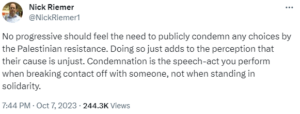
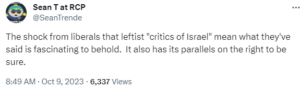
(Two background notes. (1)Nick Riemer is a very prominent Australian "progressive" "antizionist" and his views expressed here are relatively moderate compared to those who are celebrated Hamas' "act of resistance" though less moderate than those engaging in "both sideism"; (2) Everyone knows that the slaughter, rape, kidnapping, and so on of hundreds of Israelis is precisely what Hamas would do to the entire Jewish population of Israel if it had the power to do so. So, with that said…)

There has been too much pointless debate over whether those who call for Israel's destruction are necessarily antisemitic. The important point is that such people know that the end of Israel most likely means genocide for 7.5 million Israeli Jews, and they are okay with that.

Whether they are motivated by Islamism, leftist bs "anticolonialism," hostility to the West with Israel as their first target, or pure hatred of Jews is immaterial, it's much worse than mere antisemitism. Most antisemites aren't full-on Nazis, and as much as they dislike Jews would object to mass murder (just like most people who have racist opinions of black people would object to mass murder). The so-called antizionists do not, and therefore are much worse.

It's a weird tic of American progressivism to worry more about people's expressed moral intentions than their actions, which explains why, for example, moderate liberals are more likely to ally with radical anti-liberal leftists than with moderate conservatives--they think the former but not the latter are "well-meaning.") I really don't care if someone doesn't like Jews. But someone who claims and may sincerely think that they have nothing against Jews, but is content to see my friends and relatives in Israel murdered in the name of some idiotic ideology, that's a real problem.

Here's a test, which in my experience almost all leftist "antizionists" fail. Most of them will claim that they have some solution in mind to the Israeli-Palestinian conflict that will protect the rights of what would become the Jewish minority in an imagined future "Palestine." So you ask them, "well, what if it turns out as a practical matter that your one-state solution, if implemented, will likely result in the murder/ expulsion/oppression of the 7.5 million Jews in Israel. Would you still support it?" This should be an easy question to answer, especially given that it's a pure hypothetical, the answer to which could not be binding. I've asked this many times to "antizionists," and I've never received an unequivocal "no." They are ok with genocide.

(A slightly different version of this post was cross-posted at Instapundit)

"Honesta Homo," a Short Film About Diogenes

My contribution to the Esperanto film festival.

|

A few months ago, my then-ten-year-old son and I filmed a short film in Esperanto and submitted it to an Esperanto film festival. (It's really short: under 3 minutes long. And don't worry: it has English subtitles.) It's about Diogenes (the Greek philosopher who went around with a lantern searching for an honest man), and it's called "Honesta homo" ("An honest person").

I'm embedding the video below, but most importantly, please click through to YouTube and "like" ("thumbs-up") the video there: "audience favorite" gets a special prize in this film festival! (I don't think you can "like" a YouTube video when you watch it on this blog: click on the title at the top of the video to open it in YouTube.)


Thanks to Alexander Vaughn Miller, former vice president of Esperanto USA and indefatigable longtime organizer of this film festival (called the "Fifth American Good Film Festival", or, in Esperanto, "La 5a [pronounced 'kvina'] Usona Bona Film-Festivalo"). Click here to see the full set of 50 films submitted to the festival. (Alex also organizes the local Atlanta Esperantist scene -- if you find Esperanto interesting and are in the Atlanta area, let me know and I'll hook you up.)

Esperanto is the most popular of the constructed languages (and has been around longer than Klingon, Elvish, and High Valyrian), is extremely easy to learn, and is even easier to learn these days now that there's an Esperanto course on Duolingo. (Back in 1997-98, I had to learn it using a book. Now, I've finished the Esperanto and Klingon courses on Duolingo.) I might go to the national congress next year in L.A., and I might also visit Esperantists next March in Białystok, Poland, where Ludwik Zamenhof, the guy who founded the language in the 1870s-80s, was born.

And remember, please click through to YouTube and "like" my video!

Joe Biden

Biden's Cruel Resumption of Deportation Flights for Migrants Fleeing Venezuela's Socialist Dictatorship

The policy is simultaneously unjust and at odds with other administration policies on Venezuelan migration.

|

Venezuelans fleeing the socialist regime of Nicolas Maduro. (NA)


Although it has been overshadowed by other recent news, last week the Biden Administration resumed deportation flights for Venezuelan migrants detained at the border:

The U.S. is resuming direct repatriation flights for Venezuelans who unlawfully cross the border and "do not establish a legal basis to remain" in the country, the Biden administration announced Thursday.

The Venezuelan government has agreed to take back deported migrants, a senior administration official said.

The effect of this policy is to forcibly return migrants back to the control of a brutal socialist dictatorship whose oppressive policies and human rights violations have resulted in the largest refugee crisis in the history of the Western Hemisphere, with some 7 million people fleeing since 2015.

That isn't just my evaluation of the situation in Venezuela. The Biden Administration itself recognized these realities when it recently expanded Temporary Protected Status (TPS) for Venezuelans who arrived in the US prior to July 31, 2023. TPS status is based on the presence of terrible conditions in the migrants' countries of origin. In January, the administration also allowed up to 30,000 migrants per month from four Latin American countries (including Venezuela) to enter the United States under the CNVH parole program, so long as they have US-resident sponsors. The parole program is also based, in part on Venezuelan migrants' "urgent humanitarian reasons" for needing refuge.

In this respect, there is no meaningful distinction between Venezuelans who arrived before July 31, and those who arrived since then. The Venezuelan government hasn't suddenly changed. The excuse that the migrants in question "don't have a legal basis to remain" also won't fly. The legality of their status depends in large part on the Administration's own actions in using (or not using) its parole and TPS powers. If the White House wanted to, it could easily expand parole, TPS, or both to encompass additional Venezuelan victims of socialist tyranny.

While the US government isn't responsible for the awful conditions in Venezuela, it is morally responsible for its own actions in forcibly preventing refugees from escaping those conditions. It is unjust to use coercion to consign people to a lifetime of poverty and oppression merely because they were born in the wrong place, to the wrong parents.

In a better world, Republicans would be up in arms about the administration's abusive actions towards migrants fleeing socialism. GOP leaders - including those behind an ill-conceived lawsuit challenging the legality of the CNVH program - well know the nature of the Venezuelan regime. As Florida Gov. Ron DeSantis  said last year, Venezuela's socialist president Nicolas Maduro is a "murderous tyrant" who "is responsible for countless atrocities and has driven Venezuela into the ground." But in the Trump era-Republican Party, nativism usually takes precedence over fighting socialism, whenever the two conflict. Still, Republican hypocrisy on this point doesn't justify Biden's own.

The likely motive for Biden's new policy is political: trying to reduce negative publicity from illegal migration and disorder at the border. But that disorder is itself largely caused by the near-impossibility of legal entry for most of the migrants in question. The combination of horrific poverty and oppression in their home countries and labor shortages in the US understandably lead people seeking opportunity and freedom to enter illegally if there is no other way to do so.

It's the same dynamic by which alcohol prohibition led people to resort to smuggling, and to getting booze from the likes of Al Capone. Barring legal markets in goods or services millions of people seek access to predictably creates vast black markets. When Prohibition was abolished, alcohol smuggling and the role of organized crime in the industry  greatly diminished. Making legal migration easier has similar effects on the black market in immigration.

For months, the CNVH program greatly reduced illegal entry by migrants from the four countries involved, a finding confirmed by both government data and a study by the conservative Manhattan Institute. More recently, that effect has diminished because the 30,000 per month cap has predictably led to a massive backlog. Desperate Venezuelans with little or no hope of legal entry once again have little choice but to try the other kind.

The Biden Administration could mitigate the problem by abolishing or at least greatly increasing the cap. They and Congress could also make legal entry easier in a variety of other ways. Doing so would simultaneously help migrants fleeing oppression, benefit the US economy (thereby increasing economic freedom, wealth, and opportunity for native-born Americans), and reduce pressure on the southern border. Instead, the White House has chosen the cruel and unjust path of unjust deportation.

Overall, Biden's immigration policies are still a vast improvement on those of his predecessor, and in some crucial respects even on those of pre-Trump administrations. Even in the specific case of Venezuelan migration, Biden remains much better than Trump. But that doesn't mean he deserves a pass when he does wrong in this area.

Images that Bing Image Creator won't create

And what that means for AI trust and safety in practice

|

Like all the big AI companies, Bing's Image Creator software has a content policy that prohibits creation of images that encourage sexual abuse, suicide, graphic violence, hate speech, bullying, deception, and disinformation. Some of the rules are heavy-handed even by the usual "trust and safety" standards (hate speech is defined as speech that "excludes" individuals on the basis of any actual or perceived "characteristic that is consistently associated with systemic prejudice or marginalization"). Predictably, this will exclude a lot of perfectly anodyne images. But the rules are the least of it. The more impactful, and interesting, question is how those rules are actually applied.

I now have a pinhole view of AI safety rules in action, and it sure looks as though Bing is taking very broad rules and training their engine to apply them even more broadly than anyone would expect.

Here's my experience. I have been using Bing Image Creator lately to create Cybertoonz (examples here, here, and here), despite my profound lack of artistic talent. It had the usual technical problems -- too many fingers, weird faces -- and some problems I suspected were designed to avoid "gotcha" claims of bias. For example, if I asked for a picture of members of the European Court of Justice, the engine almost always created images of more women and identifiable minorities than the CJEU is likely to have in the next fifty years. But if the AI engine's political correctness detracted from the message of the cartoon, it was easy enough to prompt for male judges, and Bing didn't treat this as "excluding" images by gender, as one might have feared.

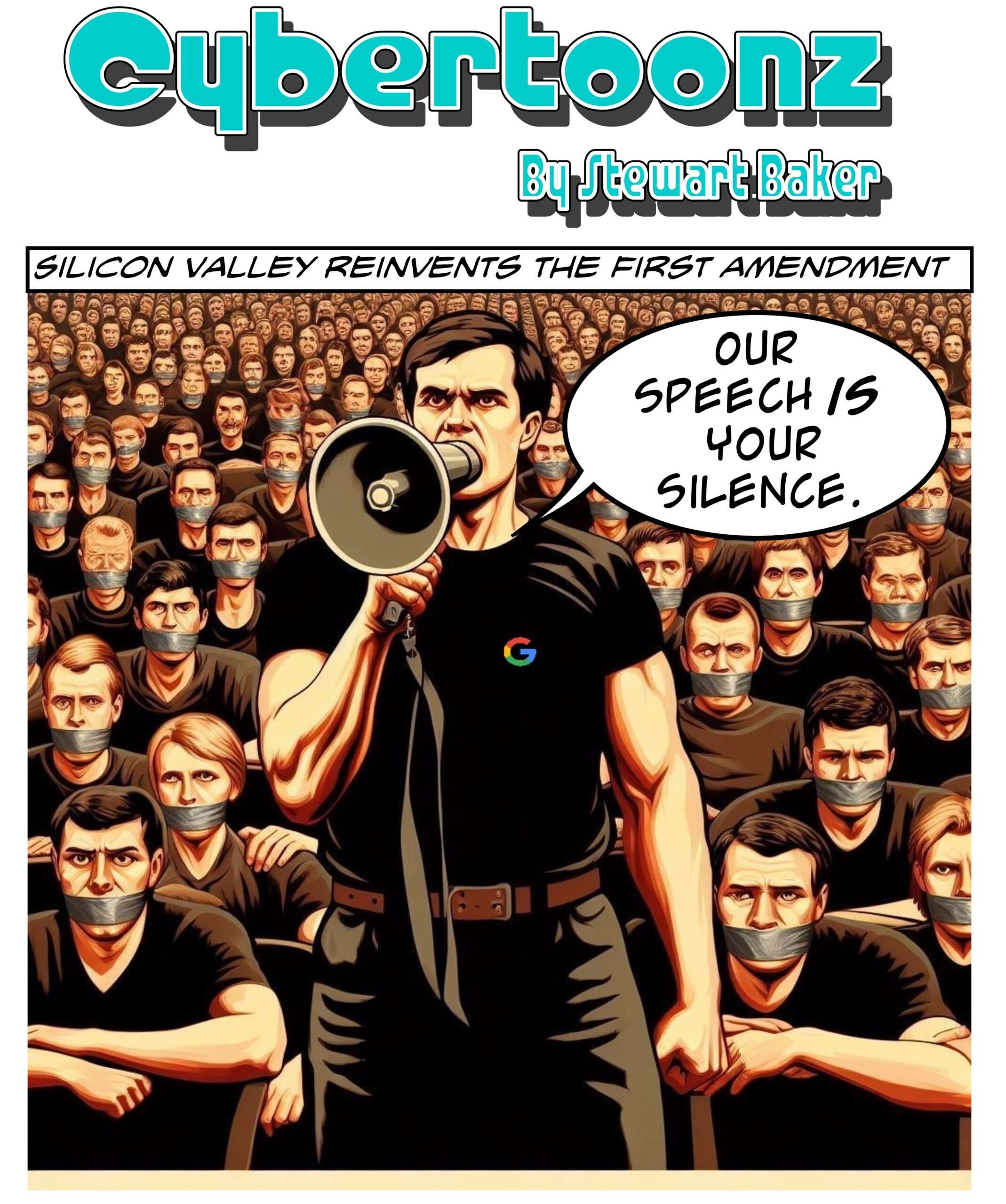
My more recent experience is a little more disturbing. I created this Cybertoonz cartoon to illustrate Silicon Valley's counterintuitive claim  that social media is engaged in protected speech when it suppresses the speech of many of its users. My image prompt was some variant of "Low angle shot of a male authority figure in a black t-shirt who stands and speaks into a loudspeaker in a large group of seated people wearing gags or tape over their mouths.  Digital art lo-fi".

As always, Bing's first attempt was surprisingly good, but flawed, and getting a useable version required dozens of edits of the prompt. None of the images were quite right.  I finally settled for the one that worked best, turned it into a Cybertoonz cartoon, and published it.  But I hadn't given up on finding something better, so I went back the next day and ran the prompt again.

This time, Bing balked. It told me my prompt violated Bing's safety standards:

After some experimenting, it became clear that what Bing objected to was depicting an audience "wearing gags or tape over their mouths."

How does this violate Bing's safety rules? Are gags an incitement to violence? A marker for "[n]on-consensual intimate activity"? In context, those interpretations of the rules are ridiculous. But Bing isn't interpreting the rules in context. It's trying to write additional code to make sure there are no violations of the rules, come hell or high water. So if there's a chance that the image it produces might show non-consensual sex or violence, the trust and safety code is going to reject it.

This is almost certainly the future of AI trust and safety limits. It will start with overbroad rules written to satisfy left-leaning critics of Silicon Valley. Then those overbroad rules will be further broadened by hidden code written to block many perfectly compliant prompts just to ensure that it blocks a handful of noncompliant prompts.

In the Cybertoonz context, such limits on AI output are simply an annoyance. But AI isn't always going to be a toy.  It's going to be used in medicine, hiring, and other critical contexts, and the same dynamic will be at work there. AI companies will be pressured to adopt trust and safety standards and implementing code that aggressively bar outcomes that might offend the left half of American political discourse. In applications that affect people's lives, however, the code that ensures those results will have a host of unanticipated consequences, many of which no one can defend.

Given the stakes, my question is simple. How do we avoid those consequences, and who is working to prevent them?

Cybertoonz explains Netchoice v. Paxton

|

One of the biggest Supreme Court cases this year will be a Big Tech challenge to Texas and Florida laws that seek to impose limits and transparency on social media content regulation.  Silicon Valley argues that these laws interfere with Big Tech's first amendment right to "cull and curate" what other people say on their platforms. The Biden administration agrees, arguing in its brief that deciding what users can and cannot say is not censorship but the constitutionally protected exercise of editorial judgment: "The act of culling and curating the content that users see is inherently expressive, even if the speech that is collected is almost wholly provided by users."

As a public service, Cybertoonz has boiled the argument down even further:

The Republican Presidential Primary Debates So Far

Why the third, fourth, and fifth GOP debates ought to happen.

|

There have been two Republican presidential primary debates so far, and I think we have learned a lot from them.   But, the Trump-dominated Republican National Committee is thinking of canceling the third debate, and I think that would be a huge mistake!   Things are only now just getting going!

I think the debates thus far reveal that Nikki Haley is the most articulate, principled, and charismatic candidate in the current Republican primary field.  She has the maturity, vision, experience, and communication skills that are required to be a superb President and to beat Joe Biden.  Others have also done well in the debates, like Mike Pence and Tim Scott, but Nikki Haley is overall the winner.

The two big losers in the debates held thus far are Donald Trump, for not showing up, and Ron DeSantis who just does not have Nikki Haley's charisma and star power on stage.  Already, polls in New Hampshire and South Carolina are showing Nikki Haley pulling ahead of Ron DeSantis for second place behind Donald Trump.

Read More

Free Speech

Criticisms of Obamas (Including Racist Ones), Plus Other Speech, Didn't Qualify as Race-Based Workplace Harassment

So holds an Eleventh Circuit panel; Judge Andrew Brasher's concurring opinion that notes the potential First Amendment problems with imposing liability for such speech.

|

From Yelling v. St. Vincent's Health System, decided Thursday by the Eleventh Circuit, in an opinion by Judges Elizabeth Branch and Andrew Brasher and District Judge Allen Winsor (N.D. Fla.):

In March of [2015], President Obama visited Lawson State Community College—a predominantly black school Yelling [a nurse at St. Vincent's] had attended. While nurses were chatting one day at the nurse station, charge nurse Jimmy Wilhite remarked, "What is he doing coming here? Is he handing out food stamps?"

After that, as Yelling explains, the CDU "got really kind of heated with … racially disparaging comments." Yelling overheard white pool nurse Sandy Sheffield say, "Michelle Obama looks like a monkey" and that the "President is a piece of shit." White staffer Tiffany Hardy made similar remarks. So too did white weekday nurse Linda Powell, who said President Obama was "stupid," was the "worst president ever," and "needs to go back to Africa."

Yelling also heard these three coworkers refer to black patients as "boy" or "girl," "crack heads," "welfare queens," or "ghetto fabulous." And three other white coworkers … talked at the nurse station about their "redneck status," owning guns, and being "confederate flag flyers."

Yelling does not remember having any racial insult or slur directed at her personally. Still, Yelling reported the comments as offensive to the house supervisor on June 14, 2015. She also complained that Dubose maintained a "quota" of only staffing one black nurse per shift. St. Vincent's did not investigate Yelling's complaints or discipline any CDU staff for racist comments or staffing practices.

Yelling was later suspended and eventually fired, based on other allegations; she sued alleging retaliation and discrimination (read the opinion for more on that) and racial harassment:

Read More

Kurt Lash: "The Meaning and Ambiguity of Section Three of the Fourteenth Amendment"

"Section Three does not expressly (1) apply to future rebellions or insurrections, (2) apply to persons elected as President of the United States, (3) apply to persons seeking to qualify as a candidate for the Presidency, or (4) indicate whether the enforcement of Section Three requires the passage of enabling legislation."

|

Professor Kurt Lash has posted an important new paper to SSRN, titled "The Meaning and Ambiguity of Section Three of the Fourteenth Amendment."

Here is the abstract of Kurt's article:

Section Three of the Fourteenth Amendment disqualified anyone from serving in the House or Senate, or as a presidential elector, if they had betrayed their oath of fealty to United States and joined the Confederacy during the American Civil War. Whether Section Three accomplishes anything more remains unclear as a matter of history and ambiguous as a matter of constitutional text. Section Three does not expressly (1) apply to future rebellions or insurrections, (2) apply to persons elected as President of the United States, (3) apply to persons seeking to qualify as a candidate for the Presidency, or (4) indicate whether the enforcement of Section Three requires the passage of enabling legislation.

Prior drafts of Section Three included versions that expressly named the office of the President of the United States, expressly banned presidential candidates from qualifying as a candidate, and expressly applied to both past and future rebellions. Congress omitted all of this language from the final version of Section Three. This final language led the best lawyer in the House to assume that the text did not include the office of the President. Although a single member disagreed, their exchange went unreported in the press, leaving open the possibility that less sophisticated members of the public might also read the text as excluding the office of the President. The exclusion would not have been "absurd" since the Electors Clause ensured that only loyal electors could vote for the President.

Key framers and ratifiers also expressly insisted that Section Three would not be self-executing. As Thaddeus Stevens explained, Section Three "will not execute itself," and at least some participants in the ratifying assemblies expressly agreed (no one claimed otherwise). As far as future rebellions were concerned, the historical record reveals both framers and ratifiers dividing over the text's possible application to future insurrections. In sum, the historical record supports Jacob Howard's explanation of the original understanding and scope of Section Three: The provision was "intended to put some sort of stigma, some sort of odium upon the leaders of this rebellion, and no other way is left to do it but by some provision of this kind." Whether the public understood the ambiguous text as allowing for anything more remains historically unclear.

I welcome this new addition to the literature. Lash's article responds to recent publications by Will Baude and Mike Paulsen, Mark Graber, Gerard Magliocca, and others. Many of Kurt's findings are consistent with the arguments that Seth and I presented in our article. (We will post an updated version of our article, which is forthcoming in the Texas Review of Law & Politics, early next week).

Common Good Constitutionalism

Brian Leiter on Adrian Vermeule

Is Common Good Constitutionalism anything more than politics by other means?

|

The University of Chicago Law Review has just published Brian Leiter's critique of Professor Adrian Vermeule's Common Good Constitutionalism. As you might expect, Leiter is not a fan. What is interesting is the extent to which this critique overlaps or intersects with those from the Right, such as that offered by Judge Bill Pryor.

Here is the abstract:

Adrian Vermeule proposes an alternative to the two dominant schools of constitutional interpretation in the United States: originalism and "progressivism" (i.e., "living constitutionalism"). Against these approaches, he argues courts (and other institutional actors) should explicitly interpret the text of the Constitution, statutes, and administrative decrees with an eye to promoting the "common good" as understood in what he calls the classical tradition, meaning that it should be understood in distinctly non-utilitarian and non-individualist terms. Officials should do so using something like Dworkin's method of "constructive interpretation" (hereafter CI), in which the aim is to reach the decision that would follow from legal principles that enjoy some degree of explanatory "fit" with prior official acts (court decisions, legislation, etc.), but in which the inevitable explanatory gap is filled by reliance on those principles that provide the best moral justification for the institutional history of the legal system. For Vermeule, those moral principles are ones that embody the natural law's idea of the "common good" rather than (as he puts it) Dworkin's "moral commitments and priorities…which [are] of a conventionally left-liberal and individualist bent." I argue that: (1) Vermeule's conception of the "common good" is neither plausible, nor even defended, except by misleading appeal to a supposed "natural law"; unfortunately (2) there is no reason to think a "natural law" exists, and, in any case, the "natural law" tradition does not speak univocally on what constitutes "principles of objective natural morality (ius naturale)" contrary to the misleading impression Vermeule gives; and (3) Dworkin's CI is not so easily severed from his moral commitments, and in any case, Vermeule never gives a reason to think it provides (even on Vermeule's preferred version) a more plausible account of what courts and agencies have been doing than the legal positivist view of law, which he mostly misunderstands and consistently maligns. In the absence of any serious jurisprudential foundations, Vermuele's so-called "common good constitutionalism" is just "politics by other means."

Administrative Law

What If They Amended the Administrative Procedure Act and No One Noticed?

Congress made a small addition to the requirements for notice-and-comment rulemaking.

|

With little attention, let alone fanfare, Congress made a small change to the Administative Procedure Act when it unanimously enacted the Providing Accountability through Transparency Act of 2023 in July of this year. The little bill inserted an additional requirement for notice-and-comment rulemakings in Section 553(b) of the Act. Specifically, it provides that the general notice of proposed rulemaking must include:

the Internet address of a summary of not more than 100 words in length of the proposed rule, in plain language, that shall be posted on the Internet website under section 206(d) of the E-Government Act of 2002 (44 U.S.C. 3501 note) (commonly known as regulations.gov).

This change is so new (and unnoticed) that it has not yet been incorporated into some commonly used online versions of the U.S. Code (such as LII).

I would assume folks at the White House Office of Information and Regulatory Affairs (OIRA) are aware of the change -- the President signed this into law, after all -- and will make sure that agencies comply. It will also be interesting to see what a reviewing court does the first time an agency rule is challenged for failing to fulfill this requirement. Remand without vacatur perhaps?

(Hat tip: Jeffrey Lubbers)

Short Circuit: A Roundup of Recent Federal Court Decisions

Carjacking, arson, and obscured license tags.

|

Please enjoy the latest edition of Short Circuit, a weekly feature from the Institute for Justice.

For those who enjoy rollicking crossover episodes, take a listen to Ken White (of Serious Trouble fame), who stopped by the Short Circuit podcast this past weekend.

  • District court (2018) sentences carjacking defendant to 195 months' imprisonment. Defendant on appeal: The district court wrongly factored in a bunch of my previous arrests, even though those arrests didn't actually lead to convictions. Gov't: Dude's right. First Circuit (2019): So he is. Sentence vacated and case remanded for re-sentencing. District court (2020): Welcome back, friend. While your case was on appeal, a couple of those previous arrests led to convictions, so now your criminal-history category is higher than it was when I sentenced you the first time. Your new sentence is now 240 months. First Circuit (2023): Seriously? "Sandbagging is not in fashion in this circuit." Remanded for a third try (and while the opinion itself is far too courtly to say so, the accompanying judgment quietly directs that the case be reassigned to a different judge on remand).
  • This Second Circuit decision is largely unremarkable, but for footnote *, which observes that Judge Alison Nathan was originally assigned to the appeal as a district-court judge sitting by designation but now appears on the panel decision as a full-fledged circuit-court judge.
  • Remember the Fifth Circuit panel that last month enjoined various actors within the Biden administration from pressuring social-media companies to take down posts the feds dislike? This week, that panel withdrew its opinion and substituted a new one. Unhelpfully, they do not summarize what was changed, and, for our part, we refuse to read it again. It looks like they mostly reach the same conclusion, but who knows? If you want to figure it out, we have created a track-changes version that you can access here.
  • Woman in Harris County, Tex., repeatedly calls the cops to complain about a neighbor's loud music. Every time officers respond, they hear nothing. As soon as they leave, the woman then calls back and insists that the neighbor has turned up the music again. After the third such call in one day, one officer purports to drive away, but in actuality lies in wait. A stakeout! Minutes later, the woman calls in another noise complaint. But the officer, lurking behind a fence, hears nothing and arrests the caller for "telephone harassment." The charge is ultimately dropped. A Fourth Amendment false-arrest violation? Fifth Circuit: Don't know don't care. Qualified immunity.
  • In which the Fifth Circuit honors the first rule of admiralty law: seafaring puns.
  • Appellant: I hereby move for an expedited appeal plz. Sixth Circuit: Sorry, we couldn't possibly make time for that, but here are nine pages on why you'll almost certainly lose on the merits once we get around to deciding your appeal on a non-expedited basis.
  • "We understand [the plaintiff's] frustration" is not the kind of thing that plaintiffs like to hear from a court. So it is in this Sixth Circuit case, in which a plaintiff with a (state) court judgment entitling him to proceeds from the sale of his farmhouse—forfeited after his son used it to grow marihuana—has no recourse on a (federal) takings claim. (Per Michigan's Cannabis Regulatory Agency, "[a]n act of the Michigan Legislature would be required in order to change the spelling of marijuana in Michigan statutes" from marihuana to marijuana, and we at Short Circuit are nothing if not sticklers for pedantry.)
  • Since 1979, Tennessee has made it a crime for anyone (other than an election official) to distribute the state's official form for applying to vote absentee. Labor unions and non-profits: We want to hand out the form during get-out-the-vote drives, and the prohibition infringes our First Amendment rights. Sixth Circuit: The law's fine. And we're unbothered by the fact that Tennessee now makes the application form freely available online. (We at Short Circuit are chilled from posting a hyperlink, lest it transform us into Class E felons in the Volunteer State, but Google it!) Dissent: Sure seems like sharing political documents is core political speech.
  • Lexington, Ky. inmate is repeatedly sexually assaulted by prison employee (who is now himself incarcerated). She sues his employer (the United States) for negligence under the Federal Tort Claims Act. Feds: We first learned about this situation when other inmates reported the employee, after which we sprang into action. Sixth Circuit: It's possible that the feds knew before then—and they are indeed required to act upon learning of such incidents—but that possibility isn't enough for the inmate's case to proceed.
  • In 2023, both Tennessee and Kentucky pass laws prohibiting healthcare-providers from administering certain treatments for minors experiencing gender dysphoria. Generally, the laws limit surgeries, puberty blockers, and hormones. Both laws are preliminarily enjoined (injunctions stayed pending appeal). Sixth Circuit: "Prohibiting citizens and legislatures from offering their perspectives on high-stakes medical policies, in which compassion for the child points in both directions, is not something life-tenured federal judges should do without a clear warrant in the Constitution." Dissent: The laws conflict with the prevailing standard of care, along with equal protection and due process. They should not take effect.
  • Pro tip to the defense bar: If your client is facing fifty years for cocaine possession, you're not going to want to see the Seventh Circuit later quoting your admission that you "really didn't do anything independently to develop any mitigation." (Unless you're playing ten-dimensional chess and falling on your sword to get your client a shot at habeas.)
  • Parents' group sues to challenge policy of Linn-Mar Community School District, Iowa, which provides that students' "Gender Support Plans" must be concealed from students' parents. Eighth Circuit: Well, Iowa schools aren't allowed to do that anymore, so that part of the case is moot. But a policy requiring students to "respect a student's gender identity" is probably void for vagueness.
  • In 2020, Idaho passed a law to prohibit most abortions in the state in the event the Supreme Court ever overturned Roe v. Wade. When the Supreme Court did just that, the law went into effect. Feds: Idaho's law is preempted by the Emergency Medical Treatment and Labor Act, which requires emergency-room doctors to stabilize patients' emergency medical conditions before transferring them. Ninth Circuit: There's no conflict here. Among other things, the Idaho law does not prohibit abortions that are necessary to save the life of the mother, and EMTALA expressly requires that doctors stabilize both the mother and the unborn child when possible.
  • After an outbreak of COVID-19 at a California prison, officials transfer 122 high-risk inmates to San Quentin State Prison, which had no known cases. Uh oh! The negative COVID tests for the transfer prisoners are more than three weeks old—essentially useless. The transferees cause an outbreak at San Quentin, infecting over 2,000 inmates and killing 26 inmates and one guard. The wife of a deceased inmate sues. Ninth Circuit: No immunity under the Public Readiness and Emergency Preparedness Act. And no qualified immunity either.
  • Following arson investigation by Tucson, Ariz. police, husband and wife sue the city and one of the officers for Fourth Amendment violations and violations of Arizona's public-records law. In response to the lawsuits (the couple allege), the police then reopen their original criminal investigation and try to induce the IRS to investigate the couple as well. Couple: Come on! That's First Amendment retaliation! Ninth Circuit: Maybe it is, maybe it isn't. The couple "identify no caselaw that clearly established that a retaliatory investigation per se violates the First Amendment," so (all together now!) qualified immunity.
  • Thai Buddhist meditation center wants to operate out of a converted residential house in Mobile, Ala., but it can't get zoning approval. It sues under the Religious Land Use and Institutionalized Persons Act, the Free Exercise Clause, and the Alabama Constitution's Religious Freedom Amendment, but loses all three claims on summary judgment. Eleventh Circuit: RLUIPA is a draw (i.e., must go to trial) and Free Exercise is a loss for the center. But ARFA is a win: The city failed to show a compelling interest in keeping the meditation center out of the neighborhood.
  • Pasco County, Fla. sheriff's deputy pulls over a vehicle towing a trailer because the trailer's license tag is obscured. He asks for ID from the driver, who complies, but when he asks for ID from the passenger, the passenger refuses, pointing out that he's not suspected of any wrongdoing. The passenger is arrested for "resisting without violence" and later sues. Eleventh Circuit: It would be mighty odd if the officer were allowed to order the passenger out of the car—as SCOTUS has said he is—but not allowed to ask for ID, so the officer gets qualified immunity. Dissent: It would be even more odd if an officer were prohibited from arresting a pedestrian for refusing to identify himself—as SCOTUS has said he is—but allowed to arrest a passenger for the same reason. Concurrence: The very fact that you two disagree means this right isn't clearly established.

State-constitution alert: IJ represents two hunting clubs who are tired of Pennsylvania game wardens' prowling around their land without a warrant. SCOTUS says such prowling is fine under the Fourth Amendment. But what about the Pennsylvania Constitution? We'll soon find out. A state appellate court just held that giving game wardens "unfettered discretion to enter upon and roam private land without consent, warrants, or probable cause" is all good. (Shoutout to the concurring judges, who "fundamentally disagree.") IJ now plans to appeal and see what the Pennsylvania Supreme Court has to say about that.

Second Amendment

Old gun controls that were constitutionally repealed are not precedents for modern gun control

Amicus brief in Supreme Court's Second Amendment Rahimi case

|

This week amicus briefs were filed in United States v. Rahimi, the only Second Amendment merits case currently before the Supreme Court. The docket page for the case is here. I will be blogging later about various briefs in the case. This post describes the amicus brief that I filed, available here.

The case involves the constitutionality of 18 U.S.C. sect. 922(g)(8), which imposes a federal prison sentence of up to 15 for persons who possess a firearm while subject to certain state-issued restraining orders. The amici are several law professors, including the VC's Randy Barnett, the Second Amendment Law Center, and the Independence Institute, where I am Research Director. My co-counsel on the brief was Konstandinos T. Moros, of the Michel & Associates law firm, in Long Beach, California.

The bottom line of the brief is that subsection 922(g)(8(C)(i) does not infringe the Second Amendment; it restricts the arms rights of individuals who have been found by a judge to be a "credible threat" to others. In contrast, subsection 922(g)(8(C)(ii) does infringe the Second Amendment, because it does not require any such judicial finding. The brief addresses the question of "who" may be restricted in the exercise of Second Amendment rights; the brief takes no position on questions of "how"--such as what due process is required, or whether the severity of 922(g)(8) ban is comparable to historic laws restricting the exercise of arms rights.

The main purpose of the brief is to describe what sorts of historic laws can serve as precedents or analogues for modern gun control laws. The brief agrees with the Solicitor General that modern laws against persons who have been proven to be dangerous are supported by the common law and by historic statutes against persons who carried arms to terrorize the public or threatening to breach the peace.

However, several amici in support of the Solicitor General, as well as the Department of Justice in cases in lower courts, also rely on old laws based on invidious discrimination--such as against Catholics, slaves, free people of color, and so on. The modern attorneys who cite old discriminatory statutes as precedents in favor of gun control always make a disclaimer that they don't agree with the old laws, but the attorneys then claim that these laws still guide the current meaning of the right to keep and bear arms.

The amicus brief explains the error of such thinking. Arms rights discrimination has been obliterated by constitutional enactments. It is the constitutional enactments that define our constitutional right to arms. The right is not defined by the old abuses that the constitutional enactments were designed to stop:

As legal historian Sir Henry Maine observed, "the movement of the progressive societies has hitherto been a movement from Status to Contract." Henry Maine, Ancient Law 182 (1861). Similarly, the progress of the right to arms has been constitutional enactments to repudiate unjust exclusions.

Here is the Summary of Argument:

This brief addresses "who" may be deprived of the right to arms. Some lower courts have had difficulty discerning lessons to draw from historical laws disarming various groups.

Constitutional enactments about the right to arms have added specificity to the right. When a constitutional enactment forbids depriving a particular group of the right to arms, the prior laws targeting that group are repudiated as legitimate precedents from which modern gun control analogies may be drawn.

The 1689 English Bill of Rights, which is part of the British Constitution and was applicable in America, repudiated deprivation of arms rights because of peaceful political disagreement or because of adherence to a Protestant denomination that was not the established Church of England. The 1689 enactment allowed some restrictions based on economic or social class, and did not protect non-Protestants.

The 1788 United States Constitution rejected arms restrictions for persons whose religious scruples did not allow them to "swear" an "oath."

The 1791 Second Amendment rejected arms rights limitations based on religion or class/income. Therefore, the short-lived 1756 anti-Catholic laws in two colonies have no validity as post-1791 precedents for limitations on Second Amendment rights.

The 1865 Thirteenth Amendment abolished all the "badges and incidents" of slavery. Being disarmed is an incident of being enslaved. Hence, the Thirteenth Amendment obliterated the precedential value of earlier statutes forbidding slaves to have arms or allowing possession only with a discretionary license.

All four clauses of section one of the 1868 Fourteenth Amendment finished the work. Prior statutes imposing arms restrictions on free people of color were thereafter negated as precedents for arms restrictions.

During the American Revolution, some "Loyalists" still considered themselves "subjects of the King of Great Britain," and not "the people of the United States." Textually, Second Amendment rights inhere only in "the people" of the United States.

Similarly, when the Constitution was ratified, Indians were members of foreign nations. Their relations with the United States were governed by treaties ratified by the Senate. Later, Indians became citizens of the United States, with the right to keep and bear arms. The colonial and Early Republic arms laws about Indians who were members of other nations are valid precedents today for arms laws applying to citizens of foreign nations.

The precedents about members of foreign nations are not useful here, because Mr. Rahimi is a U.S. citizen, and hence one of the people of the United States.

However, as accurately catalogued in the Solicitor General's brief, there is ample original meaning precedent for limiting an individual's arms rights based on a judicial finding that the person poses a danger to others. Therefore, state statutes addressing the same subject as 18 U.S.C. §922(g)(8)(C)(i) can comply with the Second Amendment.

While subsection (C)(i) requires finding of "a credible threat," subsection (C)(ii) does not, and therefore is an infringement. The problem could be solved by changing a single word between §922(g)(8)(C)(i) and (ii): "or" to "and." Making (C)(i) and (C)(ii) conjunctive instead of disjunctive would remedy the infringement in (C)(ii).


More