12/19/1940: U.S. v. Darby argued.

Mostly law professors | Sometimes contrarian | Often libertarian | Always independent | Est. 2002

12/19/1940: U.S. v. Darby argued.
A response to Josh Blackman on the new Texas immigration enforcement law.
In his post below, my friend and co-blogger Josh Blackman writes that there is only one sentence of Arizona v. United States that you need to know to answer whether federal law clearly preempts the new state Texas immigration enforcement bill. Here's the sentence:
There is no need in this case to address whether reasonable suspicion of illegal entry or another immigration crime would be a legitimate basis for prolonging a detention, or whether this too would be preempted by federal law.
Josh reads that as indicating that Arizona does not clearly conflict with the Texas law. On his reading of the sentence, this is a question left open by Arizona, with Texas fairly raising an interstitial question ripe for litigation that could go either way.
But I don't think that's what the sentence says or means.
The power to detain a person to investigate a crime based on mere "reasonable suspicion" is just a power to very temporarily detain them. It's a Terry stop authority, giving officers, say, 20 or 30 extra minutes to check out what is going on. That power does not allow the government to detain someone for much more than that time, or to bring them to a new place. Under Dunaway v. New York, that kind of stop is an arrest as a matter of Fourth Amendment law, and that requires probable cause.
As I read that one sentence, all it did was leave open whether a state is allowed to add on that extra 20-30 minutes or so to investigate an immigration offense.
I'm not an expert in the new Texas law, but it does not seem to be a Terry stop law. It appears to authorize arrests, which is a different ball of wax in the law of criminal procedure. As I recall, arrests were dealt with in another part of the Arizona decision, Section IV(C), which ruled that the Arizona law allowing arrests for committing removable offenses was preempted.
If we're looking for the one sentence from Arizona to read on that issue, this one seems particularly relevant:
By authorizing state officers to decide whether an alien should be detained for being removable, § 6 violates the principle that the removal process is entrusted to the discretion of the Federal Government.
Of course, I wouldn't just read that one sentence. But Section IV(C) seems like an important section to focus on, not the one sentence about Terry stops.
The new movie is a compelling film version of Suzanne Collins' prequel to the Hunger Games trilogy.

My wife and I recently watched The Ballad of Songbirds and Snakes, the film version of Suzanne Collins' prequel to her famous Hunger Games trilogy. It was really impressive, even more so than I expected. If you liked the original trilogy and/or the films based on it (starring Jennifer Lawrence as Katniss Everdeen), you will love this movie.
The original trilogy is set in a world where what's left of the former United States is ruled by a tyrannical central government (the "Capitol") that oppresses and exploits twelve subordinate districts. Every year, each district must send two children (known as "tributes") to participate in the Hunger Games, a nationally televised game show where they fight each other to the death until only one (the "Victor") survives. The government uses the Games to entertain the public and divert their attention away from its oppressive nature, while also reminding the districts that any attempt at rebellion is doomed to failure.
The prequel is set in the early days of the Hunger Games, soon after the Capitol suppressed a bloody rebellion by the districts. The main character is a young Coriolanus Snow - the future Capitol President who is the primary antagonist in the original trilogy. At the start of the prequel, Snow is an ambitious student from a prominent Capitol family that has fallen on hard times. He becomes a "mentor" to one of the tributes, responsible for helping her in the Games and promoting her to the viewing public.
The big challenge for both the movie and the book is that this is the origin story of a villain. Thus, it's hard for Suzanne Collins and the film screenwriters to make audiences empathize with the main character. But they pull it off brilliantly.
They succeed so well that I actually found it easier to empathize with Snow than with Katniss Everdeen in the original trilogy. Very few of us have Katniss's selfless heroism. On the other hand, many people face difficult tradeoffs between doing what is right and seeking power, prestige, and comfort - the kinds of choices Snow faces. We often have strong impulses in both directions, as Snow does. Viewers can see themselves in Snow. Most of us are more like him than like Katniss. Snow is not simply an out-and-out amoral villain (at least he doesn't start out that way or quickly become it). He struggles with the tradeoffs, and so do many of us.
These kinds of challenges are most obvious for ambitious people living under oppressive authoritarian regimes, like Snow under the Capitol. As Snow finds out, it's almost impossible to attain power and prestige in such a system without perpetrating evil. But these challenges come up in liberal democracies, as well. Think, for example, of the various conservative opinion leaders, activists, and politicians who have had to choose between maintaining their principles and getting ahead in the conservative movement in the Trump era.
The film and book also do a good job of showing the origins of the authoritarian Capitol regime, and why people in the Capitol see the world as they do. More than the original trilogy, The Ballad of Songbirds and Snakes gives us a window into the Capitol's ideology, which emerges as a kind of authoritarianism emphasizing security and order. In part because of the trauma of the earlier war, Capitol citizens simultaneously despise and fear the people of the districts. That makes it easier for them to accept something like the Hunger Games, especially once the Games become more exciting and entertaining (a process depicted in the prequel).
In addition to Snow, the other major characters are also compelling. Rachel Zegler effectively depicts the charismatic District 12 tribute Lucy Gray Baird, who wins over the Capitol audience and - for a time - inspires Snow to be a better person. There are obvious parallels between Lucy and Katniss Everdeen in the original trilogy. Both are District 12 tributes who become highly popular and pose a potential threat to the Capitol. But, while Katniss is an introvert and a highly skilled fighter, Lucy (who has little combat ability) is an extrovert and talented performer. The prequel implicitly compares the two in interesting ways.
Dr. Volumnia Gaul, well-played by Viola Davis, is a compelling cross between Hobbes and Dr. Mengele. Her worldview becomes a kind of foundation for the Capitol's ideology: people are naturally aggressive and violent, and therefore must be ruled by a strong hand. The actors playing other major characters also do a great job, including Peter Dinklage as Dean Casca Highbottom, the apparent inventor of the Games. Dinklage is most famous for playing Tyrion Lannister on Game of Thrones. But he played this very different character so well, that I never once thought of him as Tyrion while watching this movie.
In sum, if you like the Hunger Games world at all and/or science fiction generally, you should check out this movie.
For those interested, I reviewed previous Hunger Games movies here, here, and here. I have also written about political themes in the original trilogy (see here, here, and here).
"There is no need in this case to address whether reasonable suspicion of illegal entry or another immigration crime would be a legitimate basis for prolonging a detention, or whether this too would be preempted by federal law."
Today, Texas Governor Greg Abbott signed into law S.B. 4. This law makes it a state offense to illegally cross the border. Before you shout that this law clearly violates Arizona v. United States (2012), re-read this passage from Justice Kennedy's majority opinion:
However the law is interpreted, if §2(B) only requires state officers to conduct a status check during the course of an authorized, lawful detention or after a detainee has been released, the provision likely would survive pre-emption—at least absent some showing that it has other consequences that are adverse to federal law and its objectives. There is no need in this case to address whether reasonable suspicion of illegal entry or another immigration crime would be a legitimate basis for prolonging a detention, or whether this too would be preempted by federal law. See, e.g., United States v. Di Re, 332 U.S. 581, 589 (1948) (authority of state officers to make arrests for federal crimes is, absent federal statutory instruction, a matter of state law); Gonzales v. Peoria, 722 F.2d 468, 475–476 (CA9 1983) (concluding that Arizona officers have authority to enforce the criminal provisions of federal immigration law), overruled on other grounds in Hodgers-Durgin v. de la Vina, 199 F.3d 1037 (CA9 1999).
Arizona left open the question of whether Texas can detain aliens who violated federal immigration law. I made this point in the New York Times in October:
"The core question is whether the states can make it a crime to violate federal immigration law, and detain an alien for violating that law," said Josh Blackman, a constitutional law professor at South Texas College of Law Houston, who has written that Justice Anthony Kennedy, the author of the Arizona decision, left open the question of detentions.
I am skeptical that Arizona v. United States, a 5-4 decision, would come out the same way today. But there is no need to revisit the decision, as Justice Kennedy expressly left the issue unresolved. I still think there may be some wrinkles with the state law with regard to processing asylum claims, but that will come out in litigation. Speaking of which.
I expect the United States to file suit any minute in the Western District of Texas, Austin Division, where it will likely be assigned to Judge Roger Pitman, who tends to get most of the federal government's suits against Texas that are filed in Austin. The ACLU will also find a favorable division somewhere in the Valley. Conservatives are not the only ones who know how to forum-shop. All of which is to say that in the near future, the Fifth Circuit will be likely asked to stay a district court injunction. And at that point, the case will come to the Supreme Court's emergency docket. And we know how the Fifth Circuit tends to fare on the emergency docket.
Update: I appreciate the Orin wrote a brief reply to my post. He explains that this passage only concerned the duration of a Terry stop. He wrote, "all it did was leave open whether a state is allowed to add on that extra 20-30 minutes or so to investigate an immigration offense."
Justice Kennedy made two points.
First, the Court did not resolve "whether reasonable suspicion of illegal entry or another immigration crime would be a legitimate basis for prolonging a detention." That is the Terry issue. In other words, a suspicion that a person illegally entered would be subject to the usual constraints of the Fourth Amendment. No debate there.
Second, the Court declined to resolve an issue beyond the Fourth Amendment: "whether [prolonging a detention for] reasonable suspicion of illegal entry or another immigration crime … would be preempted by federal law." In other words, the Court could have held that a detention of any duration, indeed one less than the 20 or 30 minutes that Terry would otherwise allowed, would be preempted.
My post was referring to the second point. The parentheticals that follow also address the preemption issue.
If the short term detention for reasonable suspicion is not preempted, and the person is found to have illegally entered, then he violated state law, and a lawful arrest can be made.
Had Justice Kennedy said even a brief detention would be preempted, I don't think Texas could ever even detain the person to determine their immigration status. Is that right? I don't think this issue is clear, or open-and-shut. My only point was that the issue is not foreclosed by Arizona.
Speaker Mike Johnson was both right and wrong
Last month, House Speaker Mike Johnson caused a stir by stating in an interview that "the separation of church and state is a misnomer." Johnson was responding to a skeptical interviewer on CNBC who asked whether it was appropriate for Johnson to be seen praying on the House floor. In response, Johnson said the following:
The Founders wanted a vibrant expression of faith in the public square because they believed that a general moral consensus in virtue was necessary to maintain this grand experiment in self-governance….
The separation of church and state is a misnomer. People misunderstand it…. It comes from a phrase that was in a letter Jefferson wrote. It's not in the Constitution. And what he was explaining is, they did not want the government to encroach upon the church, not that they didn't want principles of faith to have influence on our public life."
We need more faith in public life, he continued:
Not an establishment of any national religion. But we need everybody's vibrant expression of faith, because it's such an important part of who we are as a nation.
Critics objected that Johnson's sentiments were dangerously ahistorical and un-American. But Johnson was at least partly right--which means, of course, that he was also partly wrong. He was right about the phrase "separation of church and state" not appearing in the First Amendment, but in a letter Thomas Jefferson wrote about a decade later. The Supreme Court picked up Jefferson's phrase more or less by accident in the mid-nineteenth century (you can read about it here). And he was right that many of the Framers thought religion essential for public morality and would not have objected to religion's influence on government.
Where Johnson went wrong, though, was presenting those views as the only ones. Plenty of people at the time of the Framing thought that the Establishment Clause was there to protect Christianity from state corruption. But others thought that the Clause was meant to keep government free from religious bigotry and fanaticism, which had ruined European politics for centuries. Indeed, Madison's famous Memorial and Remonstrance, written during the Virginia Assessment Controversy of the 1780s, argued against a tax for the payment of clergy on the ground that such a tax was dangerous both for the church and the state. Presumably, Madison knew he had to appeal to both sides if he wanted to prevail (as he did).
As Phillip Munoz has recently shown, Americans have been debating the point of the Establishment Clause from the beginning--and they continue to do so now. Johnson presented one side of that debate, but it's not the only one. My colleague, Marc DeGirolami, and I have recorded a podcast on Johnson's comments that explores the controversy in more depth. You can listen to the episode here.
What's on your mind?
The Fifth Circuit concludes that the violations of the Crime Victims Rights Act can provide grounds for refusing to dismiss the conspiracy charges against Boeing ... in later proceedings.
Late Friday, the Fifth Circuit ruled in an important Crime Victims' Rights Act (CVRA) case. The case challenges the Boeing deferred prosecution agreement (DPA) connected with Boeing's conspiracy to conceal safety issues surrounding its 737 MAX aircraft—a conspiracy that caused two 737 MAX crashes. Under the DPA, the Government and Boeing can move to dismiss the pending conspiracy charge against Boeing after the DPA concludes (in January). In its ruling, the Fifth Circuit held that the families who represent the victims killed in the two crashes could then challenge that dismissal motion. The ruling sets the stage for the families to continue their fight to hold Boeing accountable for its deadly conspiracy.
The case arises out of the crashes of two Boeing 737 MAX aircraft—crashes which killed 346 passengers and crew. The Justice Department later investigated Boeing for deliberately concealing safety problems with the 737 MAX. After the Department collected compelling evidence of Boeing's concealment, the Justice Department and Boeing secretly negotiated a deferred prosecution agreement (DPA) covering the crashes. In January 2021, the Department filed conspiracy charges against Boeing and, immediately thereafter, the DPA. The DPA provided that if Boeing committed no new crimes over the next three years, then the Justice Department would move to dismiss the charges at the conclusion of the three-year period. The Justice Department, working with Boeing, illegally concealed the DPA from the victims' families while they negotiated it.
After the DPA was filed, in December 2021, fifteen victims' families challenged the DPA. I filed motions on their behalf, arguing that the DPA had been negotiated in violation of their CVRA rights—including in particular their right to confer with prosecutors. Ultimately, in October 2022, the federal district court judge handling the case (Judge Reed O'Connor) ruled that the Justice Department had violated the families' rights in reaching the secret deal. But then, in February 2023, Judge O'Connor ruled, regretfully, that he could not enforce the victims' families' right to confer.
As authorized by the CVRA, I filed a petition with the Fifth Circuit, asking it to overturn Judge O'Connor's ruling. Following oral argument in July, on Friday the Fifth Circuit ruled that the families' petition was "premature." The appropriate time for challenging the DPA, the Fifth Circuit concluded, was when the parties (the Justice Department and Boeing) make a motion to dismiss the charges under the DPA.
The Fifth Circuit began by overturning Judge O'Connor's regretful conclusion that he lacked any power to enforce victims' rights:
We must … address the district court's additional conclusion that, despite its "immense sympathy" for the crime victims here, it lacks legitimate authority "to remedy the incalculable harm" those victims have suffered. To the extent that this conclusion determinatively denies application of the CVRA, that is inconsistent with the statute, the criminal rules, and court authority to resolve criminal proceedings commenced in court.
The Fifth Circuit then explained a parallel between the judicial authority that exists when the Government makes a motion to dismiss pursuant to a DPA and when it asks for dismissal of charges as part of guilty plea negotiations:
The emphasis we note, therefore, is that in both circumstances—full dismissal of charges to resolve a criminal prosecution or partial dismissal of charges to resolve a prosecution by guilty plea—courts retain adjudicatory responsibility, including an obligation to apply the CVRA. Public perception and confidence in the criminal justice system assume that when criminal charges are submitted for judicial resolution, the courts vigilantly will enforce the public interest, including Congress' command that crime victims are heard and protected.
…
…[I]n both cases—an accepted/rejected Rule 11 guilty plea or a granted/denied Rule 48(a) dismissal—the public interest, especially that of crime victims, rests crucially on court-approval. In short, the judicial role stays present and constant throughout, and courts must validate the public interest, above all, including rights that Congress has given to crime victims.
The Fifth Circuit found that its earlier ruling in In re Dean (5th Cir. 2008) provided a helpful analogy for resolving this case. In Dean, the Government and a corporate defendant secretly negotiated a plea deal in violation of crime victims' rights—and the Fifth Circuit instructed that the district court should carefully protect the victims' rights in subsequent proceedings. The same concern is present in this (the Boeing) case:
With the above in mind, the logic of our court's decision in In re Dean, is instructive and, in application here, determinative. As in Dean, the victims' families "should have been notified of the ongoing [DPA] discussions and should have been allowed to communicate meaningfully with the government . . . before a deal was struck." 527 F.3d at 395. That is particularly true if the deal, in ultimate outcome as approved by federal court, means no company, and no executive and no employee, ends up convicted of any crime, despite the Government and Boeing's DPA agreement about criminal wrongdoing leading, the district court has found, to the deaths of 346 crash victims.
Against this backdrop, the Fifth Circuit concluded that the families' petition challenging the DPA was "premature"—and the fact that the Boeing DPA had been negotiated illegally and in violation of crime victims' rights should be considered at the next stage of the process:
For this reason, as it was in Dean, we decide that mandamus intercession is premature. Thus far, the district court has demonstrated careful competence that, whereas it cannot substantively revise the DPA between the Government and Boeing, it nonetheless must uphold crime victims' statutory rights at every stage of the court's criminal proceedings. If a sought-for final stage is a Government motion to dismiss, we are confident, as in Dean, that the district court will assess the public interest according to caselaw as well as the CVRA, including violations already admitted to, as well as any other circumstances brought to its attention by the victims' families. See United States v. Hamm, 659 F.2d 624, 629 (5th Cir. Unit A Oct. 1981) (en banc) (reiterating Supreme Court and prior Fifth Circuit precedent that district judges are empowered to deny dismissal when "clearly contrary to manifest public interest" as assessed "at the time of the decision to dismiss") ….
The Fifth Circuit then dismissed the victims' families' petition—"without prejudice"—noting that it was "confident that the district court will uphold victims' CVRA rights throughout the instant criminal proceedings, above all when, how, and if judicial approval is sought to resolve this case."
Judge Clement concurred in the majority opinion and added an additional note about the importance of judicial enforcement of the CVRA:
I write separately to note that our decision should not be read as holding that the district court was prohibited from setting aside the DPA at an earlier stage of these proceedings—including upon motion from the victims' families—after finding that the victims' CVRA rights had been violated. Cf. Restatement (Second) of Contracts § 178 (providing that contracts entered in violation of public policy are void and unenforceable). Otherwise, we would be inviting criminal defendants and the government to violate victims' CVRA rights by negotiating DPAs in secret and taking their chances that the district court will accept Rule 48(a) dismissal years down the line.
Our holding is only that the district court was not required to do so. After all, the CVRA's "shall ensure" provision grants the district court discretion as to how it ensures that crime victims are afforded their statutory rights. See, e.g., 150 Cong. Rec. S4269 (Apr. 22, 2004) (statement of Sen. Feinstein) (stating that the "shall ensure" provision "is critical because . . . it is the courts that will be responsible for enforcing" victims' CVRA rights); 150 Cong. Rec. 22953 (Oct. 9, 2004) (statement of Sen. Kyl) (explaining that the "clear intent and expectation of Congress" was for district courts to "giv[e] meaning to the [CVRA] rights we establish"). And here, we are confident that the district court will ensure that the victims' families are afforded such rights prior to passing on any Rule 48(a) motion.
In light of the Fifth Circuit's decision, the case now effectively returns to the district court. If (as expected) the Justice Department moves to dismiss the conspiracy charge against Boeing, the effect of granting that motion would be (as the Fifth Circuit pointedly noted) that "no company, and no executive and no employee, ends up convicted of any crime, despite the Government and Boeing's DPA agreement about criminal wrongdoing leading, the district court has found, to the deaths of 346 crash victims." The families will strenuously object to any such resolution of the case, as it is impossible to see how such a result could be consistent with the public interest.
Some actual reporting by ProPublica.
I have been quite critical of the stories published by ProPublica over the past year. The articles are agenda-driven, and attempt to discredit the Supreme Court, and Justice Thomas in particular. However, ProPublica's latest piece has some newsworthy reveals.
In January 2000, Justice Thomas apparently told Representative Cliff Stearns, a Republican from Florida, that salaries for Supreme Court justices should be increased. Thomas also apparently said that one or more Justices would retire in the next year if salaries wre not increased. Stearns memorialized this conversation in a letter to Thomas:
Dear Justice Thomas: Just a note to let you know how much enjoyed visiting with you on the flight back from Jacksonville to Dulles. 1 intend to look into a bill to raise the salaries of members of The Supreme Court. As we agreed, it is worth a lot to American to have the constitution properly interpreted. We must have the proper incentives here, too.
In June 2000, Leonidas Ralph Mecham, the director of the Administrative Office of the United States Courts wrote a letter to Chief Justice Rehnquist about Thomas's exchange. (Mecham had served in that position since his appointment by Chief Justice Burger in 1985.) The letter begins:
It has been reported to the AO General Counsel's office that Justice Clarence Thomas at a reception talked to Representative Cliff Stearns (R-FL) and said that unless the compensation for Supreme Court justices is increased, "one or more justices will leave soon."
Thomas's request was announced at a meeting of the Federal Judges Association, and the news circulated in Washington. At the time, the 2000 election had not yet happened, but presumably this statement was made in anticipation of a Republican victory. Justice O'Connor was rumored to have wanted to step down during a Republican administration. Cue Bush v. Gore critics.
Mecham explained that Stearns was preparing legislation that would delink compensation for Supreme Court justices with compensation for lower court justices.
Apparently Stearns plans to offer an amendment to the Commerce, Justice, State, Judiciary appropriations bill to delink Supreme Court justices' pay from the pay of all other judges as well as from Congress and the Cabinet. He would create a pay commission devoted solely to Supreme Court justices which would study the pay needs of justices and report to Congress with the intent that Congress would then vote for a compensation increase solely for the justices.
For years, lower-court federal judges had complained that salaries had not been adjusted for inflation. Delinking the salaries could result in freezing compensation for inferior-court judges:
Is it wise, for example, to decouple justices both from the rest of the judiciary and Congress and then presumably have a congressional vote on a commission proposal devoted solely to increasing justices' compensation? Within the judiciary, that could run the risk of looking like a dog in the manger approach. To Congress, it could be seen as another judiciary effort at delinkage from congressional pay which even our best friends have refused to do, although it would be limited solely to justices which might make it more palatable. But I am not at all sure.
There is a far greater problem. Congress could wield this power to nudge Justices off the Court by refusing any pay increases. As a matter of realpolitik, Rep. Stearns's proposal carried a real risk: would Democrats really vote to increase salaries for the Justices, when the members most likely to retire would be conservatives?
From a tactical point of view, given the public statements made largely by Democratic lobbyists, it will not take the Democrats and liberals in Congress very long to figure out that the prime beneficiaries who might otherwise leave the Court presumably are Justices Thomas and Scalia. The Democrats might be perfectly happy to have them leave and would see little incentive to act on separate legislation devoted solely to Supreme Court Justices if the apparent purpose is to keep Justices Scalia and Thomas on the Court. Moreover, the fact that Representative Stearns is a conservative Republican may not help dissuade the Democrats and liberals from this view.
This political point seems so brazenly obvious. Would the Democrats really go out of their way to make the lifestyles of Justices Scalia and Thomas more comfortable? Of course not. If they could, the Democrats would have cut the electricity in Scalia and Thomas's chambers. Still, it is unusual to see an official correspondence to the Chief Justice that speaks in such overtly partisan terms.
There is one historical callback, as I recall. Before FDR's Court Packing scheme, Justice Van Devanter lobbied Congress to increase the pensions for Justices. Indeed, that supplemental income could have created incentives for Van Devanter to retire early. Congress did not increase the pensions, so Van Devanter stuck around. Those few thousand dollars could have created a vacancy far more easily the Court packing scheme. Eventually, Congress did increase the pension in 1937, which lead to Van Devanter's retirement.
Under the Presidential Compensation Clause, the President's salary can neither be increased nor decreased during the President's term in office. That prohibition is acceptable for a four-year term. I sometimes wonder whether a similar prohibition would make sense for the judiciary. It is problematic for members of the courts to lobby Congress for increases in their salaries. In light of the separation of powers, I see this sort of lobbying as an actual conflict of interest, and not like one of those manufactured ones that ProPublica likes to write about. Of course, given the fact that judges serve for decades, and inflation is rampant, a fixed salary would be untenable. Perhaps a Constitutional amendment to provide a cost-of-living adjustment would work. During the Constitutional Convention, Madison actually proposed pegging judge's salary to the price of a commodity like wheat. That could work also.
From Linthicum v. Wagner, decided Wednesday (correctly, I think) by Judge Ann Aiken (D. Ore.):
The Oregon Constitution requires that each chamber of the Oregon legislature have a quorum of two-thirds of the members to conduct business. Or. Const. art IV, § 12. In recent years, the legislature has been intermittently paralyzed by walkouts in which members of the minority party absent themselves to deny the legislature a quorum.
In response to these walkouts, Oregon voters overwhelmingly approved Measure 113 in 2022 to amend the Oregon Constitution to penalize excessive absences by legislators. Following the passage of Measure 113, Article IV, section 15 of the Oregon Constitution was amended to read as follows:
Either house may punish its members for disorderly behavior, and may with the concurrence of two thirds, expel a member; but not a second time for the same cause. Failure to attend, without permission or excuse, ten or more legislative floor sessions called to transact business during a regular or special legislative session shall be deemed disorderly behavior and shall disqualify the member from holding office as a Senator or Representative for the term following the election after the member's current term is completed.
Beginning on May 3, 2023, a group of Oregon state senators belonging to the minority party staged a walkout which deprived the chamber of a quorum…. The walkout lasted until late June 2023 and, by the time it came to an end, ten state senators, including the Senator Plaintiffs, had accrued more than ten unexcused absences. The state senators were disqualified from running for reelection based on Measure 113 and a challenge to that determination is currently pending before the Oregon Supreme Court….
For purposes of this motion [for a preliminary injunction, the parties focus their dispute on … whether participation in the legislative walkout by the Senator Plaintiffs is constitutionally protected activity. The First Amendment "has no application when what is restricted is not protected speech." … [T]hese walkouts were not simply protests—they were an exercise of the Senator Plaintiffs' official power and were meant to deprive the legislature of the power to conduct business.
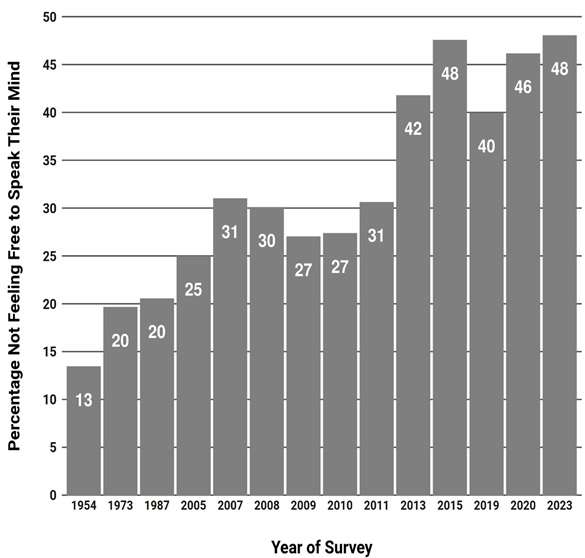
A very interesting new article, by Profs. James L. Gibson (Wash. U.) and Joseph L. Sutherland (Emory). Here's the key chart, updated to include 2023 data, gathered before the Oct. 7 Hamas attack on Israel (the 2023 data is credited to Peter Enns and Verasight):
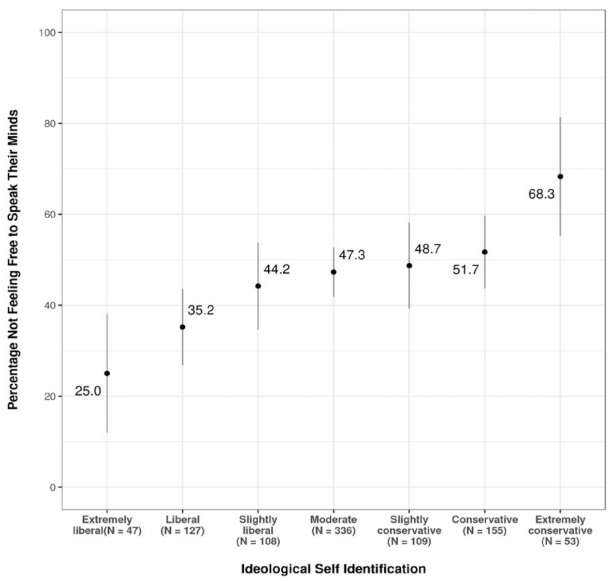
Here's the breakdown of the 2020 data by ideology (with the usual cautions about the small size of some of the subsamples, especially on the extremes, and the fact that different people will interpret vague terms such as "free to speak your mind" differently). What struck me is the magnitude of the felt lack of freedom among the three most moderate segments, even setting aside the different reactions on the extremes:
And here's an excerpt from the introduction to the article (read the whole thing here):
12/18/1944: Korematsu v. U.S. decided.
Some provisions remain enjoined, but the decision on “sensitive places” is problematic.
The U.S. Court of Appeals for the 2nd Circuit released its long-awaited decision in Antonyuk v. Chiumento – all 261 pages of it – on December 8. The court affirmed in part and reversed in part the decision of the Northern District of New York preliminarily enjoining major parts of New York's Concealed Carry Improvement Act, which was enacted to counter the Supreme Court's decision in N.Y. State Rifle & Pistol Ass'n v. Bruen.
The circuit court stripped down the district court's finding that plaintiffs are likely to prevail on the merits regarding the law's provisions on licenses to carry firearms and on sensitive places where firearms may not be possessed. It upheld the lower court's finding that plaintiffs are likely to prevail regarding restricted places where firearms may be possessed on private property open to the public only if the owner positively consents.
First, the court agreed that requiring license applicants to disclose even pseudonymous names under which they post online infringes on the Second Amendment and raises serious First Amendment concerns. Remember those three guys in 1787-88 who signed their names as "Publius"? The court let stand the requirement of "good moral character," which "is a spongy concept susceptible to abuse," but abuses "can still be vindicated in court as they arise."
Second, the court let stand the injunction against enforcement of a gun ban applicable to church members as a violation of the First Amendment's Free Exercise Clause. The ban is not neutral, as owners of retail businesses open to the public may decide whether to allow firearms on their premises, and the ban is not narrowly tailored to meet the state's interest.
Third, the court agreed that plaintiffs are likely to prevail on their claim that the ban on firearms on private property open to the public, unless the property owner posts a conspicuous sign that firearms are permitted, violates the Second Amendment. While historically, enclosed private lands were closed to the public, no historical analogue supports the law's default presumption against carriage on private property open to the public.
The much-cited Harvard-Harris poll question has flawed wording,and is at odds with other, better surveys.

A recent Harvard/Harris survey question indicating that 67% of Americans between the ages of 18 and 24 believe Jews "as a class" are "oppressors" has attracted widespread attention as an indicator of widespread anti-Semitism. There is indeed reason to be concerned about anti-Semitism, including that on the political left and on college campuses. But we should not give much weight to this survey question. It's badly worded and at odds with other data.
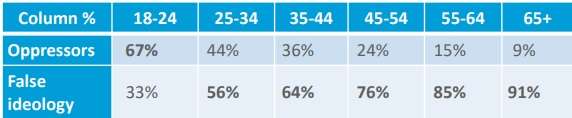
Here's the question in full and results, broken down by age group:
Do you think that Jews as a class are oppressors and should be treated as oppressors or is that a false ideology?
While most of the focus has been on the 18-24 result, it's worth noting that large percentages of every other age group under the age of 55 also gave the "oppressors" answer: 44% of the 25-34 category; 36% of those aged 35-44, and 24% of those aged 45-54. Overall, 27% of respondents chose the "oppressor" answer. This looks like an implausibly high level of anti-Semitism even aside from the 18-24 group.
A likely explanation is that the question is badly designed. Before going into this, I should note that I have considerable background in public opinion research, and am the author of a number of academic publications on voter knowledge and ignorance, including my book Democracy and Political Ignorance (Stanford University Press). That doesn't make me a source of infallible wisdom in this field. Far from it! But it does mean I have relevant expertise on such matters, more so than at least some of the other commentators opining about this question.
There are multiple flaws in the way the question is designed, each of which may lead to skewed results. First, the question asks about two things at once: whether Jews, "as a class" are "oppressors" and whether they "should be treated as oppressors." This is a survey no-no because it leads to inaccurate results among respondents who agree with one of the statements, but not the other, and because a compound question can easily confuse respondents who don't read it carefully (which many don't).
A second problem is that the question uses terminology ("oppressors," "ideology") that may not be familiar to respondents who don't follow politics closely (which many studies show a large percentage of the public does not). If you're reading this post, you probably do follow politics closely, and may find it hard to believe that anyone is unfamiliar with terms like "ideology." Perhaps that's also true of all or most of your friends and relatives. Maybe none of them would be confused about such things, either.
But, if so, you and your social circle are highly unrepresentative. Most of the general public is not like that. A majority of Americans can't name the three branches of government, don't know when the Civil War happened, and support mandatory labeling of food containing DNA (the latter probably because they don't understand what DNA is). Political scientists also find that most of the public has little understanding of such basic political concepts as "liberal" and "conservative." It would not be surprising if the same was true of many survey respondents' understanding of "oppressor" and "ideology," though admittedly I haven't seen research specifically focused on these terms.
Furthermore, the question doesn't include any intermediate or "don't know" option. The resulting "forced choice" between relatively extreme options increases the likelihood of distortion and of eliciting "opinions" that don't really exist.
Finally, as I explained in a recent post on public ignorance about the Holocaust, extensive survey evidence indicates that political ignorance is higher among younger people than older ones. This is not a recent phenomenon unique to the "Z" generation, but has been a consistent finding through decades of public opinion research.
These flaws might not be a big deal if the result were consistent with other data on public attitudes towards Jews. But in fact it is at odds with much other evidence. I will illustrate with a few examples.
A September 2022 Pew Research Center survey on public attitudes towards various religious groups finds that Jews have higher favorability ratings than any other group included in the survey:
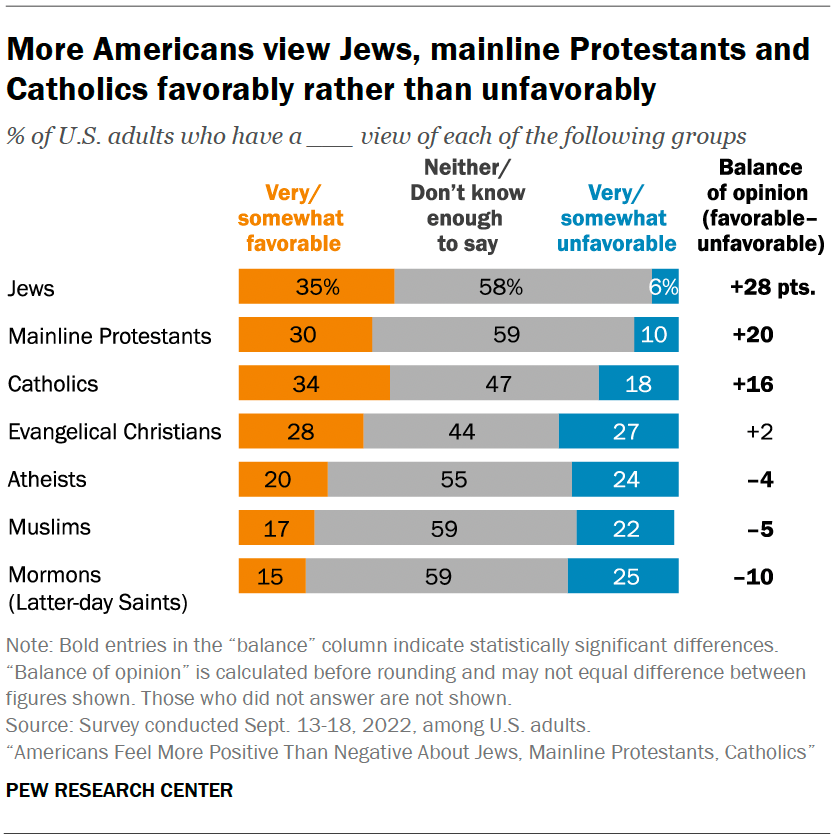
Significantly, only 6% of respondents had a "very" or "somewhat" unfavorable view of Jews - a lower percentage than for any of the other groups included in the survey (these figures change only marginally if we exclude respondents who are Jewish themselves, because Jews are only about 2% of the total population).
Unlike the Harvard/Harris survey, this one uses simple wording, and does offer intermediate options (both "neither" and "don't know enough to say"). Indeed, a large majority - 58% - chose one of them. That reflects the reality that much of the public (which, to repeat, is overwhelmingly non-Jewish) probably hasn't given a lot of thought to Jews either way, and may not have strong opinions about them.
This result is incompatible with a world where 27% - or anything close to it - believe the Jews are "oppressors" (and know what that term means). You don't generally have a favorable or even neutral view towards people you think of as oppressors.
The Pew result is not an aberration. It's similar to previous "feeling thermometer" surveys that found more favorable public attitudes towards Jews than other religious groups, including Pew's own findings in 2014, 2017 and 2019.
Treating Jews as analogous to religious groups like Mormons and Muslims is an oversimplification. Unlike Christianity or Islam, Jewish identity is actually a mixture of ethnic and religious components. I myself am simultaneously an ethnic Jew, and also an atheist. A Jewish atheist isn't necessarily a contradiction in terms, in the way a Christian or Muslim atheist would be. But people who hate Jews for ethnic or racial (as opposed to religious) reasons still probably would rate them unfavorably on this kind of survey.
By contrast, the most recent Anti-Defamation League survey of anti-Semitic attitudes found them to have gone up between 2019 and 2022, the first such increase in many years. But it also found lower anti-Semitism among the young than the general public, albeit by a smaller margin than in the past. Moreover, most of the anti-Semitic tropes tested by ADL are far less invidious than being an "oppressor" (e.g. - "Jews have too much power in the business world" and "Jews do not share my values"). One possible way of reconciling the ADL and Pew findings is that many people believe in some anti-Semitic stereotypes, but not enough to arrive at a generally unfavorable view of Jews.
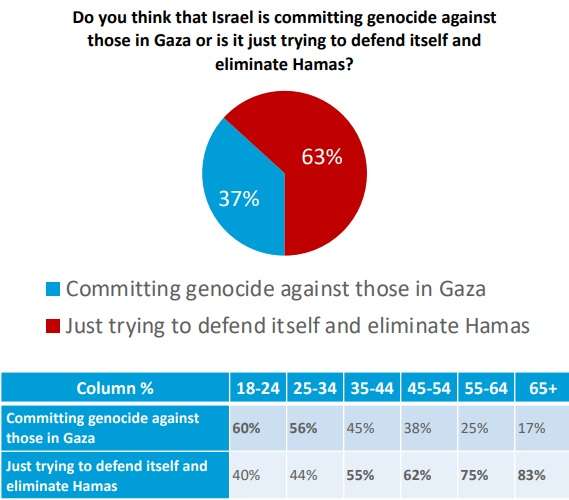
The "oppressor" finding is also in tension with some of the other results of the Harvard/Harris survey itself. For example, it also finds that 69% of 18-24-year-olds believe "Israel has a right to exist as the homeland of the Jewish people" and that 70% of the same group believe "protesters on university campuses calling for the genocide of Jews constitute hate speech." This seems like a high level of solicitude for a group where 67% think "Jews… as a class" are "oppressors" and should be treated as such. It suggests at least 36% believe the group they consider "oppressors" should have a homeland, and 37% think calling for its genocide is "hate speech." It is even the case that 70% of 18-24 year olds in the survey think Israel is trying to avoid civilian casualties in its war with Hamas.
Asked which side they sympathize with more in the conflict, the 18-24 group split evenly between Israel and Hamas, a much lower level of support for Israel than in the general public, but still high enough to imply many (at least 17%) sympathizing with the group they called "oppressors" in the question about that topic.
One difference between the Harvard/Harris survey and the Pew and ADL ones, is that the former was conducted during the current Israel-Hamas war, while the latter were before it. But this is unlikely to account for a vast increase in anti-Semitism of a kind necessary to validate the "oppressor" result, because polls (including the Harvard/Harris one) consistently show much greater public sympathy for Israel than Hamas. On net, the war has probably actually increased public sympathy for Jews and public concern about anti-Semitism (the latter is reflected in the Harvard/Harris poll itself).
If anti-Semitic sentiment is actually much lower than the result on the "oppressor" question suggests, why the dramatic increase in anti-Semitic incidents since the war started? The answer is that a small minority of the public does have anti-Semitic views, and those become more salient at a time when Israel and Jews are highly prominent in the news cycle. Much research shows that, when a set of attitudes become more salient due to current events, people are more likely to act on them. Moreover, the far-left variant of anti-Semitism is disproportionately represented on college campuses (which have a higher proportion of far-leftists than the general population), thus accounting for the relatively high number of incidents there.
The actions of a small but virulent and galvanized minority of bigots can still cause pain and - in extreme cases - lead to horrific hate crimes. That's a genuine problem. But it should not lead us to give undue credence to dubious survey results that make anti-Semitism seem much more widespread than is actually likely to be the case.
Another year of the the Volokh Conspiracy tradition of marking the occasion of this ancient Roman holiday.

Today is Saturnalia, an ancient Roman holiday with a long tradition here at the Volokh Conspiracy. Admittedly, it's tradition only in so far as I have put up a post about it every December 17 since 2006. But, by internet standards, that's a truly ancient tradition, indeed!
The Encyclopedia Romana has a helpful description of Saturnalia:
During the holiday, restrictions were relaxed and the social order inverted. Gambling was allowed in public. Slaves were permitted to use dice and did not have to work. . . Within the family, a Lord of Misrule was chosen. Slaves were treated as equals, allowed to wear their masters' clothing, and be waited on at meal time in remembrance of an earlier golden age thought to have been ushered in by the god. In the Saturnalia, Lucian relates that "During My week the serious is barred; no business allowed. Drinking, noise and games and dice, appointing of kings and feasting of slaves, singing naked, clapping of frenzied hands, an occasional ducking of corked faces in icy water—such are the functions over which I preside."
As in most years, we have no shortage of strong candidates for the position of Lord of Misrule. Plenty of politicians in both major parties qualify, as do many others in positions of power. This year, I fear, we are enduring even more misrule than usual.
Happy Saturnalia to all the friends, Romans, and Volokh Conspiracy readers out there!
NOTE: Most of this post is adopted from previous Saturnalia posts.
12/17/1910: Justice Joseph Rucker Lamar nominated to the Supreme Court.
On Friday, I wrote a post that totaled nearly 6,000 words about the New York Times bombshell report on Dobbs. My initial goal was to simply lay out all of the new disclosures--and there were many of them. Now, I've had some time to think about this new information. Here, I will offer ten reflections about how Justices Kavanaugh and Barrett voted in Dobbs. In this post, I will presume that the reporting is accurate, with all the usual caveats about assumptions, as explained by Felix Unger (for another classic TV reference that most readers will not get).
My new essay will be published in the inaugural issue of the Texas A&M Journal of Law & Civil Governance.
In July, I published a series of posts evaluating Justices Gorsuch, Kavanaugh, and Barrett. I've expanded those posts into an essay, which will be published in the inaugural issue of the Texas A&M Journal of Law & Civil Governance. My article is titled, Reviewing The Three Trump Appointees: Ex Ante and Ex Post. I am honored to serve on the Board of Advisors for this exciting new journal.
Here is the abstract:
Justice Neil Gorsuch has now been on the Supreme Court for six years; Justice Brett Kavanaugh for five years; and Justice Amy Coney Barrett for three years. By virtually any measure, today's Supreme Court is the most conservative bench in modern history. But it could have been far, far worse for progressives if President Trump had actually nominated Justices in the mold of Justices Scalia, Thomas, and Alito.
This essay, written for the inaugural issue of the Texas A&M Journal of Law & Civil Governance, provides a prospective and retrospective analysis of the three Trump appointees. Part I begins with cases on the Supreme Court's merits docket. Part II turns to the Supreme Court's emergency docket. Part III considers what could have been: denials of petitions for writs of certiorari. Part IV will revisit the records of these three justices ex ante and ex post. Very little has surprised me about the Supreme Court over the past several years.
I had to make a few last-minute changes in light of the Dobbs bombshell. More on that story shortly.
Most 18-to-24-year-old registered voters, a recent poll reports, view Israel's actions as "genocide."
Celebrate your independence with a subscription to Reason magazine, your most trusted source of honest, insightful news and analysis.