Private citizen Jack Smith lacks standing to petition the Supreme Court for a writ of certiorari before judgement in United States v. Trump for the same reason I do. Jack Smith is in the eyes of the Supreme Court a private citizen not an officer of the United States. Standing issues need not be raised by the parties to a case nor can they be waived. The Supreme Court justices must address them sua sponte.
The Supreme Court in United States v. Nixon overlooked Leo Jaworski's lack of standing because, if one consults the briefs in that case, one will find that no party ever raised the issue. The Court cursorily assumed Jaworski was legally appointed without ever examining the issue raised by me, former Attorney General Ed Meese, and Professor Gary Lawson. We discuss this issue at length in Steven G. Calabresi & Gary Lawson, Why Robert Mueller's Appointment as Special Counsel Was Unlawful, 95 Notre Dame Law Review 87, at pp. 118-125 (2019). The D.C. Circuit and District Courts have declined to readdress this issue because of erroneous precedent in the D.C. Circuit, which does not bind the Supreme Court, and in which the standing issue was never raised. See id., at 125-127.
A more recent D.C. Circuit and District Court affirmed the legality of Robert Muller's appointment without a sustained response to our argument that none of the statutes cited by the Justice Department in support of the legality of Robert Mueller's appointment. Jack Smith's case is a new case.
Standing issues never go away but may be raised at any point in any litigation. The fact of the matter is that everything Jack Smith has done as Special Counsel, since his appointment on November 18, 2022 has been unconstitutional and is null and void. Anyone now in jail, or subject to a plea bargain, with Jack Smith can ask to be released because Jack Smith is, in truth, a private citizen. The judge in the Florida District Court classified documents case is under the jurisdiction of the 11th Circuit and is not bound by D.C. Circuit precedent. Any litigant in a case before her can argue that Jack Smith is not a lawfully appointed officer of the United States.
Zorro is known for his stealth. He wears a mask, dons an all-black costume, sneaks around, and pops out of nowhere on his unsuspecting, soon-to-be-swashbuckling foes. As the complaint puts it, "[t]he character of ZORRO is one of the earliest examples of a fictional masked hero with a double identity." See Cplt., at ¶ 7 (Dckt. No. 1); see also Zorro, Wikipedia (describing Zorro as a "master of escape and camouflage"); id. (identifying The Curse of Capistrano, a Zorro book, as "one of the best-selling books of all time," with more than 50 million copies sold); watch generally The Mask of Zorro (1920) (starring Douglas Fairbanks). He strikes without warning, lurking in the shadows and using the element of surprise to his tactical advantage.
In that spirit, the owners of the Zorro trademarks now seek to take a page out of his book, and strike with stealth of their own. The owners of Zorro filed a complaint against hundreds of would-be counterfeiters, seeking damages for ripping off their intellectual property by selling fake Zorro goods. The list includes fake Zorro lighters, socks, masks, t-shirts, hoodies, onesies, leggings, mugs, hats, greeting cards, and throw pillows. And in the meantime, they ask for a temporary restraining order.
But they don't make that request out in the open. Instead, they request an ex parte TRO, and they filed a motion to seal, too. They want to seal the so-called "Schedule A" to the complaint, which is a list of 310 defendants and their websites. They also ask to seal the screenshots of the infringing websites attached to a declaration in support of the TRO.
In essence, the owners want to sneak up on the defendants and strike a blow to their counterfeiting operation, and do so under the cover of darkness. They want relief without giving defendants a chance to see what hit them – just like Zorro himself.
Judges, too, wear black. But by and large, the judiciary does its work out in the open. The entrance to the courthouse is open to the public every day, and so are the doors to each courtroom. The docket is publicly available, too. Anyone can see what the judiciary is up to, including who is asking the court for what, and how the judiciary responds.
From Luo v. Wang, decided last week by the Tenth Circuit, in an opinion by Judge Paul Kelly, joined by Judges Gregory Phillips and Carolyn McHugh:
Xingfei Luo brought this action against Paul Wang asserting various defamation-related claims. After a magistrate judge concluded Ms. Luo "unreasonably refused necessary efforts to conduct discovery and prepare [the] case for conclusion," and disobeyed the magistrate judge's order to answer questions at her deposition, the magistrate judge recommended dismissal of the action as a sanction…. [T]he district court agreed ….
Ms. Luo alleged that she and Mr. Wang began an intimate relationship during Mr. Wang's 2012 visit to China. Mr. Wang returned to the United States and the couple decided to continue their relationship. In July 2013, Ms. Luo moved to the United States to live with Mr. Wang in Colorado.
Ms. Luo alleged that in May 2013, while she was still in China, she was sexually assaulted by a man named Mr. Chen. She reported the assault to Chinese authorities and Mr. Chen was arrested and prosecuted. The rape charges were still pending when Ms. Luo traveled to the United States to live with Mr. Wang.
Proponents of bans on standard firearms magazines claim that the bans do not affect lawful self-defense, and do impair mass shooters. Supposedly, victims will be able to escape or fight back during the "critical pause" when a mass shooter is swapping magazines. The claims are not plausible, as explained in an amicus brief I filed on Nov. 30 in the U.S. District Court in Colorado. The case is Gates v. Polis, which challenges the Colorado legislature's 2013 ban on magazines over 15 rounds.
The brief was on behalf of Sheriffs and law enforcement training organizations: the International Law Enforcement Educators and Trainers Association, the Colorado Law Enforcement Firearms Instructors Association, the Western States Sheriffs Association, 10 elected Colorado County Sheriffs, and the Independence Institute (where I work).
Below are excerpts from the brief explaining how magazine bans endanger the innocent, and do not impede mass shooters.
The Top 250 list is an rough measure of recent influence of authors of law review articles, based on citations by articles (especially weighing those in the last 5 years), citations by courts (likewise weighted in favor of the last 5 years), and number of accesses at HeinOnline for the last 12 months. It includes scholars living and dead (#3, for instance, is the great torts scholar William Prosser, who died in 1972). My co-bloggers on the list are:
Orin Kerr (#11).
Will Baude (#26).
Steve Calabresi (#78).
Randy Barnett (#89).
Sai Prakash (#113).
Sam Bray (#136).
David Kopel (#187).
Stephen Sachs (#190).
Note that the top 250 are out of the tens of thousands of current and past law professors at U.S. law schools, as well as other law review article authors. Even many top 20 law schools have only a few names on the list (e.g., only four for Georgetown, including Randy). Obviously, the rankings have many limitations—for instance, they don't include citations to books and treatises—and they also vary from month to month; but I thought they were worth noting.
On November 18, 2022, Attorney General Merrick Garland purported to appoint private citizen Jack L. Smith to be a Special Counsel with the power of one of the 93 U.S. Attorneys but with nationwide jurisdiction. This makes Jack Smith more powerful than any of the 93 U.S. Attorneys even though they have been Senate-confirmed to their particular offices, and Jack Smith has not been Senate confirmed for the particular office, which he now claims to hold. A close examination of the Justice Department's (DOJ's) organic statute makes it clear that, unlike at least four other Heads of Cabinet Departments, the Head of the Justice Department has not "in, the words of the Appointments Clause, been "by Law" *** vested" with the power to appoint inferior officers like Jack Smith who have more power than any of the 93 Senate-confirmed U.S. Attorneys. This is made clear by an examination of the DOJ's organic statute, 28 U.S. C. Sections 509, 510, 515-519, 533, and, most importantly, Section 543. This latter statute, 28 U.S.C. Section 543, explicitly allows the appointment by the Attorney General of a Special Counsel to assist a U.S. Attorney but not to replace him. Comparison of the DOJ's organic statute with the organic statutes of at least four other Cabinet Departments illustrates the kind of clear laws by which Congress exercises its power "to by Law vest the Appointment of such inferior Officers, as they think proper, *** in the Heads of Departments."
Since 1999, when the Independent Counsel provisions of the Ethics in Government Act expired, the Department of Justice ("DOJ") has had in place regulations providing for the appointment of private citizens as Special Counsels who possess "the full power and independent authority to exercise all investigative and prosecutorial functions of any United States Attorney." Unlike a U.S. Attorney, however, private citizen Jack Smith has not been nominated by the President and confirmed by the Senate for the particular office of Special Counsel, which he now holds. This is blatantly unconstitutional and renders Jack Smith powerless to seek a writ of certiorari before judgment from the Supreme Court, as he is trying to do at the moment.
Appointments under these regulations, such as the May 17, 2017 appointment of Robert S. Mueller to investigate the Trump campaign, were patently unlawful, for reasons set forth in great detail in: Steven G. Calabresi & Gary Lawson, Why Robert Mueller's Appointment is Unlawful, 95 Notre Dame Law Review 87 (2019). The same argument renders the appointment of private citizen Jack Smith to prosecute Donald Trump right now unconstitutional. Private citizen Jack Smith, under the regulation, has all of the power of a U.S. Attorney, and also nationwide jurisdiction, but he was never nominated by the President and confirmed by the Senate for the particular office of Special Counsel, which he now holds, in the way that U.S. Attorneys are nominated and confirmed for their particular offices. This is blatantly unconstitutional. It is imperative that the Supreme Court rule on this question right now. I have co-written and co-signed an amicus brief with former Attorney General Ed Meese and Professor Gary Lawson, which was filed in the Supreme Court today in United States v. Trump, which is a petition for certiorari before judgment filed by private citizen Jack Smith purporting to speak for the government of the United States, and which is currently before the Supreme Court, and which makes the argument that Jack Smith's appointment was unconstitutional. Here is a link to the filed Amicus Brief: https://www.supremecourt.gov/DocketPDF/23/23-624/293864/20231220140217967_US%20v.%20Trump%20amicus%20final.pdf
From Doe v. Snap, Inc., filed Monday, following and repeatedly quoting Justice Thomas's separate statement respecting denial of certiorari in Malwarebytes, Inc. v. Enigma Software Grp. USA, LLC (2020):
Jennifer Walker Elrod, Circuit Judge, joined by Smith, Willett, Duncan, Engelhardt, Oldham, and Wilson, Circuit Judges, dissenting from denial of rehearing en banc:
John Doe was sexually abused by his high school teacher when he was 15 years old. {Doe's teacher, Bonnie Guess-Mazock, pleaded guilty to sexual assault.} His teacher used Snapchat to send him sexually explicit material. Doe sought to hold Snap, Inc. (the company that owns Snapchat) accountable for its alleged encouragement of that abuse. Bound by our circuit's atextual interpretation of Section 230 of the Communications Decency Act, the district court and a panel of this court rejected his claims at the motion to dismiss stage.
The en banc court, by a margin of one, voted against revisiting our erroneous interpretation of Section 230, leaving in place sweeping immunity for social media companies that the text cannot possibly bear. That expansive immunity is the result of "[a]dopting the too-common practice of reading extra immunity into statutes where it does not belong" and "rel[ying] on policy and purpose arguments to grant sweeping protection to Internet platforms." Declining to reconsider this atextual immunity was a mistake.
I wrote last week about an attempt to vanish my article about an attempt to vanish my article about an attempt to vanish other articles ("attempt to vanish" here referring to asking Google to remove items from its indexes, so that they disappear from search results). Now I see an attempt to vanish that article as well, submitted the day I posted the article. For more details, I reproduce that article below.
Of course, I'm not the only target of this attempted vanishing campaign. The backstory is that a somewhat noted lawyer Kelly Hyman (see, e.g., this 2021 People story) had sued her father and former Miami Beach mayor Alex Daoud, which led to a good deal of media coverage (see, e.g., this CBS News story).
In 2020 and 2021, there were attempts to get those stories discussing the lawsuit deindexed by Google; I wrote about those attempts. In recent months, there have been five more such attempts, including the one linked to in the first paragraph, the one I wrote about last week, and the ones here, here, and here.
Of course, I'm relatively small potatoes when it comes to the targets: The deindexing requests also target articles in CBS News, the Miami Herald, the Daily Mail, the real estate news site The Real Deal, and the Daily Business Review (South Florida), as well as a blog (ConlinPA.com) run by another lawyer. Two of the requests purport to come from "Kelly Hyman" and "The Hyman Law Firm, P.A.," though I should note that the sender's name isn't verifiable, so I can't be sure who sent them; all I know is that the requests were aimed to remove articles that mentioned Hyman's lawsuit.
The last request I mentioned, by the way, differs from the others, since it's not based on the court order I describe below. Rather, it says,
DESCRIPTION My name is trademark and they are using my name without my permission
ORIGINAL URLS: https://trademark-genius.com/3/searchDetails?id=62ac2fc048370f4c2c31b714
ALLEGEDLY INFRINGING URLS: https://conlinpa.com/2016/04/03/hyman-v-daoud/
As you might gather, you can't stop people from writing about you by registering your name as a trademark.
Donald Trump. ( Kyle Mazza/SOPA Images/Sipa USA/Newscom)
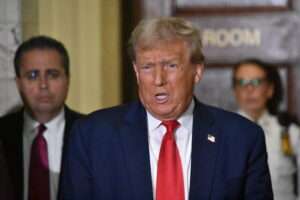
Today, the Supreme Court of Colorado ruled that Donald Trump is ineligible to be on the ballot for the 2024 presidential election because he is disqualified by Section 3 of the 14th Amendment. Section 3 states that "No person" can hold any state or federal office if they had previously been "a member of Congress, or… an officer of the United States" or a state official, and then "engaged in insurrection or rebellion against the same, or given aid or comfort to the enemies thereof." The Colorado court ruled that Trump "engaged in insurrection" because of his role in instigating the January 6, 2021 assault on the Capitol, and is therefore disqualified. This - and the lower court ruling it reviewed - are the first decisions that address the Section 3 case against Trump on the merits; several previous rulings in other states have dismissed Section 3 claims against Trump on varous procedural grounds.
I can't give anything like a complete analysis of the 213 pages of majority and dissenting opinions here. But I think the 4-3 majority got it right. Trump is indeed ineligible.
The per curiam majority opinion does an excellent job of handling all the major issues at stake: whether the January 6 attack was an insurrection, whether Trump's role in it was extensive enough to qualify as engagement, whether the president is an "officer of the United States," and whether Section 3 is "self-executing" (that is, whether state governments and courts can enforce it in the absence of specialized congressional legislation). In the process, the justices partly affirmed and partly overruled the trial court decision, which held that Trump did indeed engage in insurrection, but let him off the hook on the badly flawed ground that Section 3 doesn't apply to the president.
The case is now likely headed to the US Supreme Court. The justices may well hear it on an accelerated schedule, so as to resolve the case before we go too far into the GOP primary process. The Colorado Court has stayed its decision until at least January 4, to allow time for appeals to the US Supreme Court.
The 4-3 vote is not as close as it looks. Two of the three dissenting justices did so on the ground that Colorado state election law doesn't give the state courts the authority to decide Section 3 issues. They did not endorse any of the federal constitutional arguments on Trump's side. And these state statutory issues probably cannot be reviewed by the US Supreme Court, because state supreme courts are the final arbiters of the meaning of state law (with a few exceptions that do not apply here).
I think it's fairly obvious that the January 6 attack on the Capitol amounts to an insurrection, and the Colorado justices also concluded this is not a close issue:
[F]or purposes of deciding this case, we need not adopt a single, all-encompassing definition of the word "insurrection." Rather, it suffices for us to conclude that any definition of "insurrection" for purposes of Section Three would encompass a concerted and public use of force or threat of force by a group of people to hinder or prevent the U.S. government from taking the actions necessary to accomplish a peaceful transfer of power in this country.
This is an important point that I have tried to highlight in some of my own writings about the case. January 6 qualifies as an "insurrection" even under a fairly narrow definition of the term that is limited to the use of force to take over the powers of government. We don't need to rely on much broader definitions advocated by some legal scholars.
The Colorado Court didn't address the argument that there was no insurrection because the rioters and Trump sincerely believed he won the election, and therefore thought they were acting to protect the Constitution. But, under that reasoning, most of the ex-Confederates whom Section 3 was originally enacted to disqualify would also have been exempt, since they sincerely believed the secession of the southern states was legally authorized by the Constitution (and they had far better legal arguments for their position than Trump for his).
As I see it, the hardest issue raised in the case is whether Trump's involvement in the insurrection was extensive enough to count as "engaging" in it. On this question, the justices affirmed the detailed and compelling analysis of the district judge, much of which rests on factual findings that can only be reversed for "clear error." They also emphasized this important point:
As our detailed recitation of the evidence shows, President Trump did not merely incite the insurrection. Even when the siege on the Capitol was fully under way, he continued to support it by repeatedly demanding that Vice President Pence refuse to perform his constitutional duty and by calling Senators to persuade them to stop the counting of electoral votes. These actions constituted overt, voluntary, and direct participation in the insurrection.
As I pointed out in a recent Bulwark article about the case, this goes beyond encouraging violence (as Trump did before the attack) or failing to try to stop it. It amounts to using the attack as leverage to try to force Congress to keep him in power. Using a violent insurrection in this way surely qualifies as "engaging in it," even if Trump's other actions fell short of doing so. Even if this somehow still falls short of "engagement," this and Trump's other actions surely at least gave "aid and comfort to the enemies" of the United States.
The court also gave a thorough and compelling explanation for its rejection of the argument that the president is not an "officer of the United States" covered by Section 3. Here is a key excerpt:
When interpreting the Constitution, we prefer a phrase's normal and ordinary usage over "secret or technical meanings that would not have been known to ordinary citizens in the founding generation."DistrictofColumbiav. Heller, 554 U.S. 570,577 (2008).Dictionaries from the time of the Fourteenth Amendment's ratification define"office"as a "particular duty, charge or trust conferred by public authority, and for a public purpose,"that is"undertaken by .. . authority from government or those who administer it."Noah Webster, An American Dictionary of the English Language689 (ChaunceyA.Goodrich ed., 1853);see also5Johnson's English Dictionary646(J.E. Worcester ed., 1859) (defining "office" as"a publick charge or employment; magistracy");United Statesv. Maurice, 26 F. Cas. 1211, 1214 (C.C.D. Va. 1823)(No. 15,747)("An office is defined to be 'a public charge or employment,'....").The Presidency falls comfortably within these definitions…..
The preference for "ordinary meaning" is a standard tenet endorsed by most originalist judges. The quote from Heller to this effect is by the late Justice Scalia, a major icon of originalist jurisprudence.
And it's pretty obvious that the ordinary meaning of "officer of the United States" includes the holder of the most powerful office in the federal government! As the Colorado Supreme Court puts it, "President Trump asks us to hold that Section Three disqualifies every oath-breaking insurrectionist except the most powerful one and that it bars oath-breakers from virtually every office, both state and federal, except the highest one in the land. Both results are inconsistent with the plain language and history of Section Three."
The opinion also addresses the argument that the presidency was excluded because it wasn't specifically listed, but some other positions (e.g. - members of Congress) were:
It seems most likely that the Presidency is not specifically included because it is so evidently an "office." In fact, no specific office is listed in Section Three; instead, the Section refers to "any office, civil or military." U.S. Const. amend. XIV, § 3. True, senators, representatives, and presidential electors are listed, but none of these positions is considered an "office" in the Constitution. Instead, senators and representatives are referred to as "members" of their respective bodies.
I would add that senators, representatives, and electors are less clearly officers than the president, because they do not have individual authority to issue orders to subordinates, a point I expounded on in my Bulwark article.
The Court similarly addressed the issue of whether Section 3 is self-executing. The key point here is that every other part of the Fourteenth Amendment is considered self-executing, despite the fact that Congress can provide for additional enforcement through its power to enact "appropriate" enforcement legislation under Section 5. There is no good reason to exempt Section 3 from this general principle:
The Supreme Court has said that the Fourteenth Amendment "is undoubtedly self-executing without any ancillary legislation, so far as its terms are applicable to any existing state of circumstances." The Civil Rights Cases, 109 U.S. 3, 20 (1883). To be sure, in the Civil Rights Cases, the Court was directly focused on the Thirteenth Amendment, so this statement could be described as dicta. But an examination of the Thirteenth, Fourteenth, and Fifteenth Amendments ("Reconstruction Amendments") and interpretation of them supports the accuracy and broader significance of the statement….
There is no textual evidence that Congress intended Section Three to be any different…. Furthermore, we agree with the [plaintiffs] that interpreting any of the Reconstruction Amendments, given their identical structure, as not self-executing would lead to absurd results. If these Amendments required legislation to make them operative, then Congress could nullify them by simply not passing enacting legislation. The result of such inaction would mean that slavery remains legal; Black citizens would be counted as less than full citizens for reapportionment; non-white male voters could be disenfranchised; and any individual who engaged in insurrection against the government would nonetheless be able to serve in the government. government, regardless of whether two-thirds of Congress had lifted the disqualification.
Justice Samour, the only one of the three dissenters who based his position on any federal constitutional issue, argues that Section 3 cannot be self-executing because making it so would deprive candidates for office of the "due process of law." But the Due Process Clauses of the Fifth and Fourteenth Amendments only provides a guarantee of due process before a person can be deprived of "life, liberty, or property."
Disqualification under Section 3 doesn't threaten any of these. Loss of eligibility for holding various types of public offices pretty obviously doesn't threaten anyone's life or property rights. And it isn't a threat to liberty, either. No one claims that the Twenty-Second Amendment deprives people of "liberty" merely because they become ineligible for the presidency if they have already served two terms.
The Supreme Court has held (wrongly in my view) that a degree of constitutional due process is required for deprivation of some types government benefits, particularly those that provide essential needs, such as welfare benefits for the poor.
Eligibility for the presidency isn't an essential need in the same way. If Trump is no longer eligible for the presidency, he isn't going to starve or become homeless. And even when it comes to deprivation of vital welfare benefits for the poor, the Supreme Court has held that due process requires only an administrative hearing, not a "judicial or quasi-judicial trial." The five-day trial held by the district court in the Colorado case in which both sides presented extensive evidence and expert testimony easily meets any plausible due process requirements for a case like this, even if we assume that the Due Process Clause applies (which I think it does not).
I am not qualified to comment on the Colorado statutory issues raised by the other two dissenting justices. To me, it would be strange if the law did not give state courts the power to adjudicate cases over Section 3 disqualification, just as they routinely consider other candidate eligibility issues. But I am no expert on Colorado election law, and therefore might be missing something. I will only reiterate that the federal Supreme Court probably lacks the power to review the Colorado state court's resolution of these issues of state statutory law.
The same point applies to the Colorado court's conclusion that, under state law, candidates ineligible for the presidency are barred from appearing on primary ballots, as well as those for the general election.
More can be said. But this post is already too long, and I will stop - for now. I will probably have more to say as this case moves on to what is likely to be review by the federal Supreme Court.
I am traveling and so I offer only some brief and initial thoughts here about what the United States Supreme Court may and should do in light of the Colorado Supreme Court's determination that Donald Trump is ineligible to serve as president under Section 3 of the 14th amendment for encouraging insurrection.
My bottom line is that the Colorado opinion is a serious and careful opinion that reaches a reasonable conclusion that Trump is disqualified. Nonetheless the opinion reaches many novel legal issues that the U.S. Supreme Court could decide the other way should that court reach the merits. (The three dissenters on the Colorado court did not really reach the merits.) Trump would need to prevail on only one of these legal issues to win on any appeal, so in some ways the legal odds are with him.
It is far from clear that the U.S. Supreme Court will reach the merits—there are many legal doctrines like ripeness and mootness that would give the Court a way to avoid deciding the issues in the case. But it is imperative for the political stability of the U.S. to get a definitive judicial resolution of these questions as soon as possible. Voters need to know if the candidate they are supporting for President is eligible. And if we don't get a final judicial resolution before January 6, 2025 a Democratic-majority Congress could decide Trump is disqualified even if he appears to win the electoral college vote. That would be tremendously destabilizing.
In the end the legal issues are close but the political ramifications of disqualification would be enormous. Once again the Supreme Court is being thrust into the center of a U.S. presidential election. But unlike in 2000 the general political instability in the United States makes the situation now much more precarious.
Ilya Somin has posted a much more detailed analysis. I expect that Josh Blackman, Will Baude, or both will likewise blog about the case in much more detail (their work was cited in the opinions). I agree that this is a question of national importance, and that the U.S. Supreme Court should therefore review the Colorado Supreme Court's decision. [This paragraph was revised to include the link to Ilya's post.]
I was on the California Appellate Law Podcast discussing this, though my analysis isn't limited to California. An excerpt from the podcast summary:
Prof. Eugene Volokh joined us to discuss restraining orders, how many of them violate the First Amendment as unlawful prior restraints, and how you can spot the First Amendment problems. The purpose of a restraining orders is to get a person to stop harassing you, but "harassment" can be a pretty vague term—and the same goes for "bullying," "cyberbullying," "hate speech," etc.—especially when no physical violence threatened or happening. The result is that many restraining orders not only prevent the subject from speaking TO the plaintiff, but from speaking ABOUT the plaintiff, and last INDEFINITELY….
I haven't had anything to say on occasion of the death of Justice O'Connor; there just doesn't seem to be anything to add beyond what others have said. (I particularly recommend Jonathan Rauch's remembrance and reflection.) But I did notice that Bishop Mariann Edgar Budde's homily at the funeral quoted Justice O'Connor's speech in honor of one of her Stanford professors (Harry Rathbun), which in turn quoted Rudyard Kipling's If.
The Bishop thought the poem gave some insight into the Justice's character, and I think she was correct. Plus, it's a great poem; here's the excerpt that Justice O'Connor had included in her speech:
If you can keep your head when all about you
Are losing theirs and blaming it on you,
If you can trust yourself when all men doubt you,
But make allowance for their doubting too;
If you can wait and not be tired by waiting,
Or being lied about, don't deal in lies,
Or being hated, don't give way to hating,
And yet don't look too good, nor talk too wise:
If you can dream—and not make dreams your master;
If you can think—and not make thoughts your aim;
If you can meet with Triumph and Disaster
And treat those two impostors just the same;
If you can bear to hear the truth you've spoken
Twisted by knaves to make a trap for fools,
Or watch the things you gave your life to, broken,
And stoop and build 'em up with worn-out tools: …
If you can talk with crowds and keep your virtue,
Or walk with Kings—nor lose the common touch,
If neither foes nor loving friends can hurt you,
If all men count with you, but none too much;
If you can fill the unforgiving minute
With sixty seconds' worth of distance run,
Yours is the Earth and everything that's in it,
And—which is more—you'll be a Man, my son!
The police often rely on trained narcotics-detection dogs to alert for drugs. How far the police can use those dogs under the Fourth Amendment has led to a lot of cases. Today the New York Court of Appeals added an interesting one on an important question: Is a dog sniff of a person in a public area a Fourth Amendment search?
First, some context. The Supreme Court has held that a dog sniff in a public area is not a search. It reached that ruling in cases that happened to involve a sniff of luggage and a sniff around a car. When confronted with a dog sniff on a home front porch, however, the Court ruled that the entry of the dog on to the porch was a search because it went beyond the implied license of the area around the home, the so-called curtilage. The "search" was the entry of the dog within the private area of the curtilage with intent to do a sniff, not the sniff itself.
So what about a dog sniff of a person in a public area? The curtilage concept has only been applied to homes, not people. Does that mean dogs can sniff a person? It's clear that a dog sniff is a search if the dog actually touches the person. But what if the dog just comes close to the person, without touching them? Is that a search?
That was the issue in today's ruling in People v. Butler. After observing what they think is a hand-to-hand drug transaction, officers see the suspect get in his car. They pull him over for a traffic violation. He steps out of his car, and officers notice a big bulge in his pants that he claims is $1,000 in cash. Officers get the narcotics-detection dog, a Belgian Malinois named Apache, to smell around the car. Apache alerts.
They then let the dog sniff around the suspect, Butler. The dog alerted again, "put its nose in the defendant's groin/buttock region, and sat, alerting the officer that it had located narcotics." There was no evidence that Apache had actually touched Butler. But he had put his nose near Butler's groin.
Applying the Supreme Court's Fourth Amendment jurisprudence to the instant case, we hold that the use of a canine to sniff defendant's body for the presence of narcotics qualified as a search. This is true even if we accept County Court's apparent conclusion that when Apache put its nose in defendant's "groin/buttock region," the dog did not make actual contact with defendant and sniffed only the air closely surrounding his person. The lack of direct physical contact is not dispositive in this context because of the "heightened" interest society recognizes in the privacy and security of the human body, which can encompass space immediately surrounding the body and was clearly implicated by what occurred here (cf. Jardines, 569 US at 7 [majority op] and 13 [Kagan, J., concurring]).
It cannot be disputed that society treats many matters related to the body as private, or that individuals have a significant interest in the security and integrity of their persons . . . The Fourth Amendment protects those important interests from unreasonable intrusion by the government. . . .
Thus, the Supreme Court has long held that the Fourth Amendment is implicated when the government attempts to gather evidence of criminal activity from an individual's person. It has recognized that a search occurs whether the particular method employed by the government entails a "compelled surgical intrusion into an individual's body" (Winston v Lee, 470 US 753, 759 [1985]; see Schmerber, 384 US at 767); "gentle" or "light" contact with the body (see Maryland v King, 569 US 435, 446 [2013]); "brief" contact with "outer clothing" (Terry v Ohio, 392 US 1, 24-25 [1968]); mandated collection by the individual searched of matter emitted from their body for testing by the government (Skinner, 489 US at 617); or the "visual and aural monitoring" of private bodily functions (id.). In addition, multiple federal circuit courts have held that the use of magnetometers to detect concealed metal is a search, notwithstanding that the use of such technology does not involve physical contact and is "far less intrusive than the use of large dogs to sniff [people's] bodies" (Horton, 690 F2d at 478 [collecting authorities]; see United States v Albarado, 495 F2d 799, 803 [2d Cir 1974] ["Even the unintrusive magnetometer walk-through is a search in that it searches for and discloses metal items within areas most intimate to the person where there is a normal expectation of privacy"]).
The Brennan Center State Court Report has posted a symposium on the "2023's Most Significant State Constitutional Cases." My contribution focuses on the Washington Supreme Court's flawed ruling in holding that an eviction moratorium is not a taking of private property requiring compensation under its state constitution. Here's an excerpt:
My choice for a notable state constitutional case is Gonzales v. Inslee, where the Washington Supreme Court held that the state's long-running Covid-era eviction moratorium was not a taking of private property requiring compensation under the Takings Clause of the state constitution. For many months, the state barred landlords from evicting tenants for nonpayment of rent.
In Cedar Point Nursery v. Hassid, the U.S. Supreme Court ruled in 2021 that even temporary mandated physical occupations of privately owned land qualify as "per se" (automatic) takings under the Takings Clause of the Fifth Amendment. Gonzales only addresses claims under Article I, Section 16 of the Washington Constitution. But the state supreme court ruled that eviction moratoriums are not covered by the per se rule, even assuming it applies…. The justices reasoned the eviction moratorium was merely a "regulation" of a preexisting "voluntary relationship" between tenants and owners. They ignored the obvious point that, in the absence of the "regulation," the tenants would have no right to remain on the owners' land. Thus, an eviction moratorium undeniably does mandate a physical occupation of property.
The court's reasoning — which may be copied by other state and federal courts — has implications that go beyond eviction moratoriums (though those are significant in themselves). If there is no takings liability for physical occupations linked to "voluntary relationships," then there is no taking when conservative states require businesses and employers to allow employees and customers to bring guns onto their property, or when they enact laws barring employers from excluding workers who refuse to get vaccinated for Covid-19 or other contagious diseases….
The Gonzales decision also included a dubious ruling that eviction moratoria don't violate the state constitution's Contract Clause, an issue analyzed in an earlier Brennan Center essay by Anthony Sanders of the Institute for Justice.
In addition to my piece, the symposium on 2023 state constitutional cases includes contributions by a variety of prominent legal scholars and commentators, including Erwin Chemerinsky, Leah Litman, Meryl Chertoff, Anthony Sanders, and more. It's a helpful reminder that state constitutional law has a big impact, even though it rarely attracts the kind of attention that high-profile federal cases get.
Today, in District of Columbia v. Exxon Mobil Corp., a unanimous panel of the U.S. Court of Appeals for the D.C. Circuit rejected an attempt by oil company defendants to have a "greenwashing" lawsuit against them removed to federal court. Rejecting the oil companies' argument that the climate change-related claims should be heard in federal court, the D.C. Circuit instead concluded that the District of Columbia's district-law-based claims against oil companies could remain in district court where they were filed.
The unanimous opinion, written by Judge Neomi Rao, is quite clear and direct. It was joined by Judges Greg Katsas and Florence Pan. Here is how it summarizes the decision:
The District of Columbia sued several energy companies in the Superior Court of the District of Columbia, alleging the companies violated District law by making material misstatements about their products' effects on climate change. The defendants removed the case to the federal district court, which determined it lacked jurisdiction and remanded.
We agree that remand was proper. Under the time honored well-pleaded complaint rule, it is the cause of action chosen by the plaintiff that governs whether a lawsuit may be filed in federal court. Here, the District did not invoke a federal cause of action but relied instead on the District of Columbia's consumer protection statute. The companies raise what amount to federal defenses, but that is not enough to establish federal jurisdiction over the District's claims.
The opinion makes clear that this is not a particularly close question, and aligns with that of every other federal circuit court to consider the question. The panel that heard the claim was about as favorable for the oil companies as they could have hoped for, and their claims still still went nowhere. The ruling further supports the arguments I made in my post last week explaining why these cases are not cert-worthy.
State v. French, decided Wednesday by the N.J. appellate court (in an opinion by Judges Susswein and Vanek) reverses defendant's convictions for violating a COVID stay-at-home order in May 2020; the defendant had been "walking along the highway holding up signs to passing motorists stating 'PHUCK,' '#THIN BLUE,' and 'Slow Down Police Ahead." The order provided, in relevant part,
All New Jersey residents shall remain home or at their place of residence unless they are … leaving the home for an educational, religious, or political reason ….
The court's analysis:
At an April 4, 2020 press briefing, the Governor was asked specifically about the ability to protest under EO 107. He responded: "[D]on't protest as a group. We respect folks who want to protest, find some other way to do it virtually online, whatever it might be."
The Governor further clarified his position regarding protests under the relevant executive orders at a press briefing on April 29, 2020:
People have a right to protest. I wish they would do it from home …. The thing that really bothered me was they were congregating, and they weren't wearing masks for the most part and they were on top of each other and that's what led to the [violation of the executive order] …. I wish folks would protest from home and virtually, but if they're going to protest we're [going to] be tough on enforcing the … no congregation.
… [A] June 17, 2020 memorandum from the State of New Jersey Attorney General entitled "Guidance Regarding Municipal Prosecutors' Discretion in Prosecuting COVID-19 Related Offenses" … directs: