New York State Attorney General Letitia James' lawsuit against Donald Trump is unconstitutional and unfair. James is demanding that Trump, his business, his two oldest sons, and two business partners give back $370 million that she says they obtained through fraud. James wants to permanently ban Trump from running a business in New York State. And, she has obtained a ruling from the judge trying the case to place all of Trump's New York businesses in receivership and sold with Trump getting only the cash from a forced fire sale. James' lawsuit alleges that Trump fraudulently inflated the value of his assets in annual net worth statements to banks to obtain savings on loan interest. It must be noted at the outset that no bank has complained that Trump committed fraud and that James is charging Trump an enormous and unconstitutional penalty for what is essentially a victimless crime.
The New York State law, as it is being applied to Trump, raises the same due process of law problem as is raised by a classic politically motivated Bill of Attainder. Historically, a Bill of Attainder was a legislative act that singled out a politically unpopular person for punishment. In Trump's case, a general and over-broad state law is being used against him in a hitherto unheard of way depriving him of property without due process of law. And, everyone on both sides of the aisle knows that it is all because New York has a lot of people, especially in the Democratic Party, who hate Trump. The victimless crime that James has charged Trump with is basically that he is a liar, and she does not like his political views. State Bills of Attainder are banned under Article I, Section 10 of the Constitution, and the Fifth Amendment provides that no person can be deprived of property without due process of law.
The Constitution does not allow banning people from running a business or putting all their assets in receivership and auctioning them off in a fire sale with the victim getting back the resulting cash. I am not aware of any precedent that supports what James is doing. The Constitution does not allow hitting Trump with a $370 million fine for a victimless crime, which almost certainly violates the Excessive Fines Clause of the Eighth Amendment. Putting Trump's assets in receivership and auctioning them off in a fire sale is a violation of the Fifth Amendment's Takings Clause for which Trump must at a minimum receive just compensation. But, even then, private property can only be taken for "a public use", and there is no "public use" unless you hate Trump's politics and want to punish him as a result. And, at that point, you must confront the Bill of Attainder prohibition once again.
An excerpt from De Piero v. Penn. State Univ., decided Thursday by Judge Wendy Beetlestone (E.D. Pa.) (there are also other legal theories that the court rejects, which you can see discussed in the full opinion):
{De Piero{, a white man,} [argues] that his department's discussions of "antiracism," "white supremacy," "white privilege," and other concepts relating to discussions of race on campus, all of which "repeatedly singl[ed] out and demean[ed] faculty members on the basis of race," subjected him to a hostile work environment.} De Piero … began working at Penn State Abington as a non-tenure-track Assistant Teaching Professor of English and Composition in 2018. Penn State Abington holds itself out as "the most diverse campus within" the Penn State system "and the only majority minority campus." …
Title VII (along with the PHRA and Section 1981) renders employers liable for harassment that is "sufficiently severe or pervasive to alter the conditions of [the plaintiff's] employment and create an abusive working environment." … Whether a series of alleged incidents constitutes pervasive harassment is a circumstance-specific question: the "frequency of the discriminatory conduct; its severity; whether it is physically threatening or humiliating, or a mere offensive utterance; and whether it unreasonably interferes with an employees work performance" are all relevant to whether the discrimination the employee suffered was sufficiently "severe" or "pervasive." …
[De Piero alleges that he] was obligated to attend conferences or trainings that discussed racial issues in essentialist and deterministic terms—ascribing negative traits to white people or white teachers without exception and as flowing inevitably from their race—in June 2020, October 2020, November 2020, January 2021, and October 2021. His Amended Complaint contains at least some discussion of the content of each such meeting [bullets added -EV]:
in June 2020, in the aftermath of the murder of George Floyd, "Wong [Assistant Vice Provost for Educational Equity] expressed her intention to cause Penn State's white faculty to 'feel the pain' that [he] endured;"
in a "breathing exercise," Wong told "White and non-Black people of color to hold [their breath] just a little longer—to feel the pain;" that October, Naydan, [Chair of the English Department and] De Piero's supervisor, co-led a professional development meeting on multiculturalism that included "supposed examples of 'racist' comments" where every hypothetical perpetrator was white;
the following month included an event called "Arts and Humanities as Activism," where De Piero alleges the facilitator "condemn[ed] white people for no other reason than they spoke or were simply present while being 'white,'" including by "condemn[ing] … 'white elites' and 'white self-interest;'"
Naydan endorsed that training's message repeatedly;
in January 2021, at an "antiracism pedagogy" meeting, Naydan spoke of race conscious grading;
and, finally, in October of that year, Naydan and her co-facilitator led another training, which included an excerpt that "accused white faculty" of "unwittingly reproduc[ing] racist discourses and practices in our classroom." It was, according to Naydan's co-facilitator, "about a group."
"Physical differences between men and women … are enduring" and the "'two sexes are not fungible….'" United States v. Virginia (1996). In fact, "sex, like race and national origin, is an immutable characteristic …." Frontiero v. Richardson (1973) (plurality opinion). With these principles in mind, the Court tackles a question that has not yet been addressed by the Supreme Court of the United States or the United States Court of Appeals for the Tenth Circuit: whether separating the use of male and female restrooms and changing areas in public schools based on a student's biological sex violates the Equal Protection Clause … or Title IX ….
{In Bostock v. Clayton County, Georgia, the Supreme Court held that an employer who fires an individual for being homosexual or transgender unconstitutionally discriminates against that person because of sex under Title VII. However, the Supreme Court also made clear that its opinion did "not purport to address bathrooms, locker rooms, or anything else of the kind."}
The court upheld Oklahoma's S.B. 615, which provides:
From Nelson v. State, decided today by the Florida Court of Appeal, in an opinion by Judge Jordan Pratt, joined by Judges Eric Eisnaugle and John Harris:
This appeal presents the question whether a trial court may rely on a defendant's lawful firearm possession in sentencing him. We conclude that it may not. Courts deprive defendants of due process when they rely on uncharged and unproven conduct during sentencing, and this principle holds especially true where the uncharged conduct is the lawful exercise of a constitutional right….
Defendant had been convicted of selling marijuana and related charges. Then,
At the sentencing hearing, the court entertained argument from both Nelson and the State, with Nelson urging the court to impose 36 months, and the State urging the court to impose 87.23 months. During its argument, the State presented two photos of firearms found in Nelson's home, noting that "a possible murder a couple of months ago that was probably related to the sale of cannabis" had occurred in Citrus County. However, the State did not argue that Nelson himself was in any way connected to the murder, and it conceded that it did not bring any firearm-related charges against him.
After hearing a brief rebuttal argument from Nelson's counsel, the court announced his sentence. The court applied the discretionary trafficking enhancement and sentenced Nelson to 87.23 months of incarceration on counts 1 and 2 (to run concurrently). Immediately after pronouncing this sentence, the court stated: "And what hurts you the most, Mr. Nelson, was … the photographs of the guns. They did not charge with those. I did not take that into account; but why you did this, I do not know." The court then imposed three-year sentences on the remaining felony counts, with the sentences to run concurrently with the concurrent 87.23-month sentences….
It seems that a species that has been delisted as an endangered species has also been delisted from the official list of species that have been delisted. Here's the story (so far).
While working on my forthcoming symposium article evaluating the first fifty years of the Endangered Species Act (ESA), I looked at the number of species that have been designated as endangered or threatened species under the Act, as well as those that have been "delisted." Species are delisted either because they are no longer threatened or endangered (i.e. they have recovered), because they went extinct, or because they never should have been listed in the first place (perhaps due to a data error of some sort).
The Fish and Wildlife Service maintains data on species listing and delisting in its ECOS database.
I initially reviewed the data on ECOS in spring 2023, in preparation for a presentation. While reviewing and updating this data in the fall, however, I encountered a discrepancy. The number of species identified as "delisted" on ECOS seemed to come up short.
Reviewing the data on ECOS more carefully, I determined that the discrepancy was due to the removal of the Tumamoc globeberry (Tumamoca macdougalii). While the globeberry had been included in the list of delisted species as late as May 2023, it was no longer included in October. It's prior ECOS page is now blank. This is odd, for there is no reason the globeberry should not still be included as a delisted species.
As detailed elsewhere on the FWS website (and in the Federal Register), the globeberry was initially listed as an endangered species in 1986. In 1993, however, the globeberry was delisted because the FWS determined that the original data upon which the listing was based had been in error. (This sort of thing happens from time to time, as those species that are most endangered are often those about which less is known, and therefore it is understandable that data about such species may be inaccurate or incomplete.)
I contacted the FWS to find out why the globeberry was removed from the tally of delisted species on ECOS. While I have not yet received an official reply, one FWS staffer suggested that the globeberry may have been pulled from ECOS because the FWS is conducting a new status assessment for the globeberry, and there is some reason to believe it could be (re)listed under the ESA based upon more recent research.
I appreciate the update, but it seems to me that removing the globeberry from ECOS was an error. At present, the globeberry is a delisted species–it was once listed, and was subsequently delisted through the formal process provided for under the ESA. It may well be the case that, based upon new and more complete data, the globeberry should be (re)listed as threatened or endangered under the Act. But unless and until that happens, it remains a delisted species, and the FWS ECOS database should reflect that fact.
UPDATE: I have been informed by an FWS staffer that the Tumamoc Globeberry was inadvertently removed from the list of delisted species, and it has been restored to the ECOS database. Unfortunately, it now appears that multiple other species are now missing, such as the Braken Bat Cave meshweaver (delisted in 2000), and others are misclassified, such as the Snail darter, which was delisted because it has recovered, but is now listed in ECOS as "extinct." Time permitting, I will try to figure out what's going on with the ECOS data and sort it all out.
SECOND UPDATE (1/28/2024): The ECOS data appears to be restored. All 127 delisted species are included and appear to be properly characterized.
From today's decision by Judge Edward Davila (N.D. Cal.) in Haltigan v. Drake:
Plaintiff John D. Haltigan brings this action against Defendants university officers to challenge the diversity, equity, and inclusion ("DEI") statements required from prospective faculty candidates by the University of California, Santa Cruz. Plaintiff contends that the University's DEI statement requirement and guidance violate First Amendment principles of academic freedom….
Plaintiff alleges that he "desires a position at the University" but that the DEI statement requirement makes his application futile, due to his views on "colorblind inclusivity," "viewpoint diversity," and "merit-based evaluation." Plaintiff further alleges that, if he were to apply for the July 2022 opening or any other openings at UC Santa Cruz, he would be "compelled to alter his behavior and either remain silent … or recant his views to conform to the dictates of the University administration." Plaintiff does not allege that he applied or prepared any application materials for the July 2022 opening….
As a general premise, there is a "long-established rule" that a plaintiff "lacks standing to challenge a rule or policy to which he has not submitted himself by actually applying for the desired benefit.'" Because the Complaint indisputably does not allege that Plaintiff "submitted himself by actually applying for the desired benefit," Plaintiff attempts to overcome this standing obstacle in three parts: (1) he invokes the "competitor standing" doctrine, which confers standing on a plaintiff that is "able and ready" to apply or compete; (2) he argues that First Amendment rights can be vindicated without engaging in or risking a challenged course of conduct; and (3) any application submitted would have been futile….
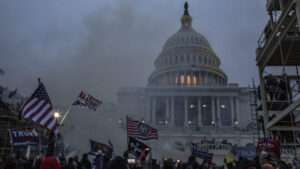
January 6, 2021 attack on the Capitol. (Probal Rashid/ZUMAPRESS/Newscom)
In an article published today, New York Times columnist Ross Douthat responds to my and others' arguments that the January 6, 2021 attack on the Capitol qualifies as an "insurrection" under Section 3 of the Fourteenth Amendment. To his credit Douthat recognizes that uprisings much smaller than the Civil War - including the Whiskey Rebellion and Adolf Hitler's 1923 Beer Hall Putsch " - meet a reasonable definition of insurrection." As I have pointed out previously, these cases featured violence on roughly the same scale as the January 6 attack.
But Douthat nonetheless claims such cases "are obviously different from Jan. 6":
[T]he 14th Amendment disqualifies anyone who engaged "in insurrection or rebellion against the same" — with "the same" referring back to "the Constitution of the United States" in the prior clause. This wording tracks with my own understanding: What transforms a political event from a violent riot or lawless mob (which Jan. 6 plainly was) to a genuinely insurrectionary event is the outright denial of the authority of the existing political order and the attempt to establish some alternative order in its place.
There is no question that this is what the Munich Beer Hall Putsch set out to do….
[T]here was no such equivalent declaration when the QAnon Shaman ascended to the Senate rostrum; no serious claim of military or political authority made on behalf of the assembled mob, no declaration of a dissolved Congress and a new Trumpist Reich. Had there been — had, say, one of Trump's aides rushed to the Capitol and announced that Congress was disbanded and that President Trump was declaring a state of emergency and would henceforth be ruling by fiat — then the riot would have been transformed into an insurrectionary coup d'état. But nothing like that happened: The riot did not culminate in an attempt to depose the Congress; it dissolved before lawful authority instead, remaining a mob until the end.
The problem with Douthat's reasoning is that it implies the Confederates who were the original targets of Section 3 weren't insurrectionists either! Far from rejecting the Constitution and "denying the authority of the existing political order," they argued the Constitution gave their states a legal right to secede, and that Abraham Lincoln and the federal government were the ones acting illegally. Moreover, they had a much better legal rationale for their position than Trump supporters for the utterly indefensible claim that their man was the true winner of the 2020 election. Violently attempting to block the constitutionally required transition of power to the winner of a presidential election is pretty obviously an insurrection against the Constitution - even if the perpetrators don't explicitly say so. I go into these points in greater detail in a post published in September.
Douthat's theory also has the absurd implication that people trying to seize power by force can escape disqualification under Section 3 so long as they claim - however implausibly - that they are actually following the Constitution and their opponents are the true lawbreakers. You don't have to be a constitutional lawyer to see why that's an implausible conclusion - one that would set a dangerous precedent.
Please enjoy the latest edition of Short Circuit, a weekly feature written by a bunch of people at the Institute for Justice.
Next week, the Supreme Court will hear oral argument in an IJ case, DeVillier v. Texas, that asks the question: Do states have to comply with the Takings Clause? Or is it more of a guideline than an actual rule? Click here to learn more.
The Cato Institute has posted a Spanish-language translation of my article "The Case Against Nationalism," co-authored with Cato Institute scholar Alex Nowrasteh. If you're reading this post, you probably don't actually need the Spanish translation to read the article. You can simply read the original English version, published in National Affairs. But perhaps you have Spanish-speaking friends, relatives, or acquaintances who might be interested. If so, please consider forwarding them the link. Many of the points made in the article are of obvious relevance to both Latin American countries and the situation of Hispanics in the United States.
Both the Spanish translation and the English original are available for free at the links above. There are not behind any paywall.
The answer is likely "no" for US military action so far, because it is a defense against attack. But a broader conflict or one of much longer duration would be different.
Yesterday, the US and UK launched air and missile strikes on Houthi forces in Yemen, in response to the latter's repeated attacks on shipping in the Red Sea. This action raises a variety of moral and policy issues. It also raises the question of whether President Biden has the authority to launch these strikes without congressional authorization (which, so far, he hasn't gotten). Several members of Congress - mainly on the far right and far left - have already claimed Biden acted unconstitutionally.
It is true that the Constitution gives Congess, not the president, the power to declare war. The president cannot initiate any large-scale military action on his own. But critics of Biden's action overlook the fact that the US strikes are not initiating a war, but responding to attack. For weeks, the Houthis have been launching indiscriminate attacks on shipping in the Red Sea, one of the world's most important waterways.
As legal scholar Michael Ramsey shows in his excellent article, "The President's Power to Respond to Attacks," the president does not need advance congressional authorization to respond to attacks on US troops, territory, or American ships on the high seas. In such cases, it is not the US that has initiated the conflict, but the enemy. Ramsey also makes clear that defensive responses may include tactically offensive actions, such as - in this case - targeting the bases and other facilities the Houthis used to launch their attacks on shipping.
There is, admittedly, a potential complication here, in that it's not entirely clear the Houthis were targeting US ships. At least initially, they claimed they were only attacking ships with connections to Israel. However, they have hit (or tried to hit) ships from a variety of nations. That strongly suggests that either they don't really care whether a ship has connections to Israel, or their definition of what qualifies as a connection is so broad that almost any ship in the Red Sea potentially qualifies.
Moreover, earlier this week a Houthi spokesman actually admitted that one of their recent attacks "targeted an American ship that was providing support to the Zionist entity." Needless to say, the US ship in question wasn't actually "providing support" to Israel in any but a highly tangential sense that could apply to almost any US ship. And even if the ship was in fact somehow helping Israel, the Houthi action still qualifies as an attack on the US.
In addition to targeting at least some US ships, the Houthis have also been attacking ships belonging to US NATO allies (such as Norway). Under Article 5 of the NATO treaty, the US has a legal obligation to help defend other members of the alliance if the latter are attacked. That provides further legal justification for Biden's strikes. By ratifying the North Atlantic Treaty, Congress has in effect preauthorized military action when necessary to carry out US obligations under Article 5.
In sum, there is likely solid legal justification for US strikes against the Houthis - at least so far. I have been highly critical of previous military actions that lacked proper constitutional authorization, such as Barack Obama's 2011 intervention in Libya (which lacked congressional authorization, and was not a response to attack). But this case is different.
That doesn't mean Biden has completely unlimited discretion to use as much force as he wants in this situation. If he tries to expand the conflict beyond anything that could reasonably be considered defense against attack (e.g. - a large-scale ground invasion of Yemen), that would likely require congressional authorization. That is especially true if the president wants to strike the Houthis' sponsor, Iran, as well as the Houthis themselves.
In addition, if this military intervention goes on for more than three months, it might run afoul of the 1973 War Powers Act, which requires the president to get congressional authorization for any use of military forces in "hostilities" abroad within 90 days. Some argue that the War Powers Act is unconstitutional. But the Biden Administration hasn't taken that position, and I think they are right not to. And this conflict pretty obviously qualifies as involving US troops in "hostilities."
For these reasons, the White House may be well-advised to try to get Congress to pass an authorization for the use of military force (AUMF) for this situation. It should not be hard to do. While congressional Republicans are at odds with Biden on many issues, when it comes to countering Iran and its proxies (including the Houthis), most of them are actually more hawkish than the White House, and have been hammering Biden for not doing enough. An AUMF might also have deterrent value by sending a signal of unity and resolve to the enemy.
Be that as it may, it seems likely that - so far - US military actions against the Houthis are legally justified. Unlike some previous military interventions, they don't violate the constitutional separation of powers. Whether that remains true depends in part on the scope and duration of any further military action.
UPDATE: Michael Ramsey comments on the legal issue and this post here. He in large part agrees with my analysis, but offers some caveats. The most notable is he doesn't think Article 5 of the NATO treaty allows the president to use military force to defend an alliance member from attack without additional congressional authorization. To my mind, ratification of the treaty qualifies as such authorization in the event of attack on treaty member, just as Congress can enact advance authorizations for the use of military force (AUMFs) for other situations - ones triggered by specific events. Examples include the 1991 and 2002 AUMFs giving advance authorization for the Gulf War and the Iraq War, respectively.
The Iowa Caucuses are on Monday, four days from now, and its down to a two person races Nikki Haley versus Donald Trump. Yes, Ron De Santis has not formally conceded yet, and he may even place second in Iowa, but his campaign is all washed up. He invested a year and much more than $100 million on winning in Iowa, and he is going to lose big time to Trump. He. will be lucky if he even places second. And, after investing his whole campaign on winning Iowa, he has nowhere else to go. De Santis is in a distant third place in New Hampshire and South Carolina. The real question now is whether Haley can pull off an upset with strong finishes in New Hampshire and South Carolina. With Chris Christie out of the race, my bet is that Haley will win an upset in New Hampshire just as 44 years ago Ronald Reagan won New Hampshire after George H.W. Bush won Iowa.
So, as a die hard Reaganite, I have to ask who would Ronald Reagan support in 2024 if he were still alive? Reagan's view was that the United States was a beacon of liberty to the rest of the world -- a shining city on a hill, which was an example to every other country on earth. Nikki Haley believes because she, like me, is the child of immigrants. Our families came to the United States because it stood for freedom and democracy. I thank God every day that I am an American and not an Italian, and I bet Nikki Haley thanks God every day that she is an American and not a citizen of India, a country which is backsliding into dictatorship.
Ronald Reagan would be thrilled that Nikki Haley wants to see freedom and democracy triumph in Ukraine. Reagan worked hard to win the freedom for Central and Eastern Europe that Donald Trump wants to throw away. Ronald Reagan would be repulsed by Trump's affection for dictators like Vladimir Putin who through Deutsche Bank bailed Trump out of many a business bankruptcy while offering him a Trump Hotel in Moscow.
I am going to quote below three paragraphs of Ronald Reagan's Farewell Address to the American people, which vividly show Nikki Haley's and Ronald Reagan's vision of America not isolated from the world but as the LEADER of the free world:
"And that's about all I have to say tonight, except for one thing. The past few days when I've been at that window upstairs, I've thought a bit of the ``shining city upon a hill.'' The phrase comes from John Winthrop, who wrote it to describe the America he imagined. What he imagined was important because he was an early Pilgrim, an early freedom man. He journeyed here on what today we'd call a little wooden boat; and like the other Pilgrims, he was looking for a home that would be free.
I've spoken of the shining city all my political life, but I don't know if I ever quite communicated what I saw when I said it. But in my mind it was a tall, proud city built on rocks stronger than oceans, wind-swept, God-blessed, and teeming with people of all kinds living in harmony and peace; a city with free ports that hummed with commerce and creativity. And if there had to be city walls, the walls had doors and the doors were open to anyone with the will and the heart to get here. That's how I saw it, and see it still.
And how stands the city on this winter night? More prosperous, more secure, and happier than it was 8 years ago. But more than that: After 200 years, two centuries, she still stands strong and true on the granite ridge, and her glow has held steady no matter what storm. And she's still a beacon, still a magnet for all who must have freedom, for all the pilgrims from all the lost places who are hurtling through the darkness, toward home."
A fascinating set of arguments from Justice Samuel Selden of the New York Supreme Court in 1851:
Nature has made some laws, and these it is difficult to repeal. No one can fail to see the relation which exists between trial by jury and compensation in damages for every injury. One is a necessary consequence of the other.
Could a jury adjust the equities and counter equities in a complicated case, and mete out the precise relief which justice might require? There is a moral impossibility in this. What twelve men would ever agree upon the terms of an equity decree?
Equally impracticable would it be for juries to find special verdicts in such cases embracing the details indispensable to be considered in making up the judgment of the court.
The agency of a jury, therefore, in the judicial process, is incompatible with the adaptation of the relief to the special circumstances of the case. Hence, compensation in damages for civil injuries, except in a few cases of proceedings in rem, was the only admissible mode of redress in the common law courts.
For similar reasons, issues to be tried by a jury were required to be single and decisive. Single, because double and complex issues would tend to embarrass and confuse, and lead to disagreement; and decisive, because otherwise no judgment could follow the finding.
Such issues could not be produced without rules adapted to that end. Hence we see the origin of some of the stringent rules of common law pleading.
It is thus, I think, made clear, that the form of trial by jury, the mode of compensation by damages, and the common law rules of pleading, all bore a natural and necessary relation to each other as cause and effect.
Here, then, is cause enough for the existence of the Court of Chancery. Compensation in damages being an utterly inadequate remedy in numerous cases, the prerogatives of the crown, and the principles of Roman jurisprudence were resorted to, for some other mode of redress in such cases. A court with ample equity powers was the result.
Wooden v. Waffle, 1851 WL 5230 (N.Y. Sup. Ct. 1851).
By the way, Selden's brother Henry Selden was an abolitionist, an attorney, and the person who "defended Susan B. Anthony in her 1873 trial for unlawfully voting as a woman" (per Wikipedia).
Holmberg v. Armbrecht, 327 U.S. 392, 395 (1946): "When Congress leaves to the federal courts the formulation of remedial details, it can hardly expect them to break with historic principles of equity in the enforcement of federally-created equitable rights."