

I was very sad to hear yesterday of the untimely death of Prof. Dan Burk (UC Irvine), a leading scholar of intellectual property and of Internet law. I often ran into him and his work, and always much appreciated his contributions. Eric Goldman (Santa Clara) has an excellent remembrance, which I highly recommend.
The Volokh Conspiracy
Mostly law professors | Sometimes contrarian | Often libertarian | Always independent | Est. 2002

Monday Open Thread
What's on your mind?
The Objection: "But He Hasn't Been Convicted Of Anything"
[Note: This is the fourth in a series of essays responding to objections that have been made to enforcing Section Three of the Constitution. The first three essays can be found here, here, and here.]
Some critics have made the argument that Section Three cannot or should not be used to constitutionally disqualify a person from office for having engaged in insurrection or rebellion without that person first having been charged and convicted of the statutory federal crime of insurrection, under 18 U.S.C. §2383.
Professor Michael McConnell appears to have been the first to make this argument, in a post on this blog shortly after we first posted our draft article on SSRN in August, 2023. As McConnell put it:
Congress has enacted a statute, 18 U.S.C. §2383, which covers participation in rebellion or insurrection, and which provides that those found guilty "shall be incapable of holding any office under the United States." This mode of enforcement has been enacted by the entity entrusted with responsibility to enforce the Fourteenth Amendment; it proceeds through the ordinary course of prosecution by the executive, trial by a court, decision by a jury, and appeal to appellate courts, with due process at every step. It is significant that the Department of Justice has prosecuted hundreds of persons for their involvement in the January 6 incursion at the Capitol, but has not charged anyone, including Trump, with insurrection under this or any other statute.
Others have echoed this suggestion. The Wall Street Journal in September 2023 editorialized against applying Section Three to disqualify Trump, saying that "[i]t is surely relevant that Mr. Trump hasn't been charged with insurrection under 18 U.S.C. Section 2383." Trump's brief on the merits in the Supreme Court in Trump v. Anderson asserts (pp. 38-40) that Section Three can only be enforced following a criminal conviction under 18 U.S.C. §2383. At least two amicus briefs supporting Trump make the same claim.
With all due respect, the argument is legally meritless, top to bottom. It is wrong as a matter of the text, history, and structure of Section Three. But it also is wrong on the details of §2383 itself.
"Times Less Than"
A Facebook comment reminded me again of this debate — some people argue that "A times less than B" is "mathematically incorrect," "simply wrong," and so on. The theory is that "times" refers to multiplication, so "5 times less than B" to mean "B/5" is mistaken, though "5 times more than" to mean "5xB" (or possibly "6xB") would be fine.
But somehow this logic was lost on, say, Isaac Newton ("If the Diameters of the Circles … be made three times less than before, the Mixture will be also three times less; if ten times less, the Mixture will be ten times less"), Sir William Herschel ("remember that the sun on Saturn appears to be a hundred time less than on the earth"), Erasmus Darwin, Robert Boyle, John Locke, and more. Nor is this some archaic usage; it remains routine today.
What's going on here? My sense is that many people's objections rest on an assumption that English is, or ought to be, like math. It's true that if you view "times" as "x" and "less" as "-" then "A times less than B" is either literally meaningless, or corresponds to "B-AxB." But of course in English, including the English used by scientists of the highest caliber, "times" doesn't always mean "x" and "less" doesn't always mean "-." We see that from the very examples I just gave, as well as from observed common usage.
Today in Supreme Court History: February 5, 1793
2/5/1793: Chisholm v. Georgia argued.
Congratulations to the Law Blog Mirror of Justice, 20 Years Old This Weekend
The blog primarily deals with Catholic legal thought; I've been following it since the beginning, and know and much respect many of its contributors. If you're at all interest in the subject, you should check it out.
In Trump v. Anderson, the Respondents' Theory Would Render Unconstitutional Every Speaker and President Pro Tempore Since 1789, as Well as President Grant's VP and Presidential Candidate George McGovern
Justice Scalia erred because there are no “Officers of the United States” appointed outside Article II, Section II.
[This post is co-authored with Professor Seth Barrett Tillman]
Since the outset of the Section 3 litigation, those seeking to disqualify Trump from the ballot have made two primary arguments concerning the Appointments Clause. First, they argued that whatever the phrase "Officers of the United States" meant in the Appointments Clause, it had a different meaning in Section 3. Second, they acknowledged that the President obviously does not appoint himself, but countered that the Appointments Clause does not define who are the "Officers of the United States." In the lower courts, the Respondents never attempted to discuss whether there are some "Officers of the United States" who are not referenced in the Appointments Clause. Indeed, we saw no need to address this point in our amicus brief, filed on January 9, 2024.
On appeal to the Supreme Court, the Colorado voters in Trump v. Anderson have pivoted to a new strategy. They now argue that the President, Vice President, Speaker of the House, and Senate President Pro Tempore are all appointed "Officers of the United States." Resp. Br. at 40 ("The Constitution 'otherwise provide[s]' for the 'appointment' of the President and Vice President by the electoral college, and the Speaker of the House and President pro tempore of the Senate by Congress.").
We can take a good guess why they have suddenly taken this position. No, it is not because a journalist at Lawfare and two attorneys who have experience in corpus linguistics suddenly discovered, after more than two centuries, the unifying theory of the Appointments Clause. Rather, it is the Scalia letter! Yes, the letter that Justice Scalia wrote to Tillman in 2014. We published that letter in an article nearly a year ago. We didn't have to publish the letter. It was a private correspondence. No one would have ever known if we didn't publish it. But we published it quite intentionally, in part, to demonstrate that even a legal giant, like Justice Scalia, can make a mistake. And we published it because, as scholars, we have a duty to pursue the truth.
Would you have published a private correspondence from Justice Scalia that was in tension with your own views?
After Noel Canning was decided, Justice Scalia responded to a letter by Tillman, and stated that the President, Vice President, Speaker of the House, and Senate President Pro Tempore are "officers of the United States" whose appointments are not provided for in the Appointments Clause. And wouldn't you know it? The Respondents have adopted exactly that position. Blackman told CNN that arguments based on the Scalia letter "have substantial problems." In this post, we will illustrate some of those problems. (We flagged these problems to the Court in paragraph 13 of our now-denied motion for leave to participate in oral arguments.)
One such problem is that the Respondents' theory would render unconstitutional every Speaker and President Pro Tempore since 1789, as well President Grant's Vice President and Presidential Candidate George McGovern. For that reason, and others, we maintain that Justice Scalia erred, because there are no "Officers of the United States" appointed outside Article II, Section 2. Instead, Article II, Section 2 is the exclusive means by which "officer of the United States" positions are filled. And this understanding of the Constitution's text is the only view consistent with Supreme Court precedent. See, e.g., Free Enter. Fund v. Pub. Co. Acct. Oversight Bd., 561 U.S. 477, 497–98 (2010) (explaining that "[t]he people do not vote for the 'Officers of the United States.'" (first quoting U.S. Const. art. II, § 2, cl. 2, and then citing Federalist No. 72 (Alexander Hamilton))). Respondents "offer no account [or theory] of how their argument fits within the landscape of [the Court's] case law." Haaland v. Brackeen, 599 U.S. 255, 279 (2023).
The Objection That Enforcing Section Three Would Be Too "Dangerous"
[Note: This is the third in a series of essays responding to objections that have been made to enforcing Section Three of the Constitution. The first two essays can be found here and here.]
Of all the objections that have been offered to our interpretation of Section Three, one stands out as far and away the most craven and insidious. It is the argument that, regardless of what the Constitution says and how it is correctly understood, we should not enforce Section Three's exclusion of insurrectionists from future office because doing so might provoke substantial political resistance and even violence by their supporters. To comply with the Constitution in this respect, therefore (it is said), is simply too dangerous. In short, it might tend to produce further, greater acts of insurrectionary violence or rebellion directed against our constitutional order. We should decline to enforce the Constitution's exclusion of insurrectionists from office because that might only make matters worse. Or as Professor Daniel Epps put it in jest: "The Supreme Court shouldn't rule that Trump is ineligible for the presidency for engaging in insurrection, because if they do Trump will definitely stage an insurrection."
Muller on Yoo and Delahunty on the Twelfth Amendment and the Counting of Electoral Votes
A critique of John Yoo and Robert Delahunty's suggestion that the Vice President has a role in counting electoral votes.
Could Kamala Harris resolve a dispute over competing electoral vote slates in the 2024 presidential election, perhaps choosing the slate supporting her own re-election as vice president? In a recent law review article in the Case Western Reserve Law Review, Professor John Yoo and Robert Delahunty argued that the vice president has a small, but significant, role in resolving such disputes (though not as great a role as Donald Trump or John Eastman claimed). Their article, while aligning with claims that had been made by other academics in the past, was quite controversial.
Notre Dame law professor Derek Muller responds to Yoo and Delahunty in the latest issue of the Case Western Reserve Law Review, explaining why their theory is wrong. Even if there had been competing slates of electors from individual states, the Vice President lacks the authority to resolve such disputes.
Here is how the article begins:
On January 6, 2021, the President of the Senate—Vice President Mike Pence—dutifully opened the electoral votes from the 2020 presidential election and read aloud the totals. He acted consistent with the direction of the Electoral Count Act of 1887, consistent with the congressional joint resolution approved three days earlier, and consistent with more than two centuries of congressional practice. Not everyone was convinced that the Constitution and laws of the United States obligated Pence to behave in this way—most notably, President Donald Trump, who had just lost the election and sought a way to turn defeat into victory.
On this, Professors Robert Delahunty and John Yoo agree with Pence. In their recent article here in the Case Western Reserve Law Review on the topic of the role of the Vice President in counting electoral votes, they conclude, "Pence was obliged to count the votes as submitted by the states." But they reach a different conclusion on who holds the legal power to count electoral votes and resolve disputes. They conclude, "Our theory leads to the conclusion that the best reading of the constitutional text, structure, and history assigns that role to the Vice President, not Congress or the judiciary." In contrast, "Congress has no substantive role in the process."
Congress has continually rejected this view for more than 200 years, and perhaps it is a reason Pence saw no such room for debate. Professors Delahunty and Yoo helpfully examine the history surrounding disputes over counting electoral votes and in places make appropriate conditions on the modesty of their claims. But this Essay explains why Congress, and not the President of the Senate, holds the power to count electoral votes and to resolve disputes over them.
Some details help frame the heart of the controversy. There are potentially three different responsibilities to consider when the House and the Senate join together before the President of the Senate for the counting of electoral votes. First, who presides over the joint session where counting takes place, and what is the role of that presiding officer? Second, who counts the electoral votes? Third, who resolves disputes about those electoral votes?
This Essay answers those questions. First, the presiding officer in the joint session is the President of the Senate, and she acts as any other presiding officer of a legislature. She initiates actions pursuant to precedent, parliamentary procedures, and the wishes of the chamber. And that means the chamber—here, the joint session—can constrain the President of the Senate as presiding officer. Congress did exactly that when it chose to further constrain the distraction of the President of the Senate in the Electoral Count Reform Act of 2022. Second, Congress counts electoral votes. The evidence in the text and structure of the Constitution and congressional practice before the ratification of the Twelfth Amendment supports this interpretation. Third, the power to resolve disputes runs with the power to count. And that means Congress also has the power to resolve disputes about presidential electors.
Separating these responsibilities is crucial because it can be too easy to conflate some of these activities, which in turn elides over the distinctions in responsibilities. When the presiding officer acts, she does so not to count votes, but to preside over the joint session and help it proceed according to the rules and precedents set by Congress. The actions she takes may resemble the substantive act of counting. But close scrutiny of the record reflects that the President of the Senate does not count, and has never counted, votes. That is because the power to count resides in Congress, where the Twelfth Amendment lodges that power.
The full article is here.
Today in Supreme Court History: February 4, 1824
2/4/1824: Gibbons v. Ogden argued.
"God Has Left"
This is by Diana Arbenina of the Night Snipers, a prominent Russian rock group; Arbenina, unlike many critics of the war, has stayed in Russia, where her career has unsurprisingly suffered because of her position. I thought I'd pass along my poor attempt at translating the song; naturally, its impact is much greater in its original rhymed and metered form.
Each day there are fewer words,
And more ellipses.
Everything serious is now
Not important and not urgent.
There is no need to go faster,
Where the road is there's now a trench;
The first one became bait
And the second fell as a target.
The Objection that Enforcing Section Three is "Undemocratic"
[Note: This is the second in a series of essays responding to objections that have been made to enforcing Section Three of the Constitution. The first, introductory essay, can be found here.]
What about democracy?! We should let the people vote for whomever they want!
Perhaps the most common objection to enforcing Section Three is that doing so would be "undemocratic" in some sense. Taking Section Three seriously, and applying its constitutional disqualification rigorously, it is said, would interfere with the right to vote. It would impair the right of the people to select their own leaders. It would be contrary to democracy. It would be downright unAmerican!
So the charge goes. In reality, this is more a political objection than a truly legal one (though it is sometimes cast in legal terms). It is ultimately an objection to Section Three itself – an objection to what the Constitution says and does. It is at bottom an anti-constitutional argument – an argument for not complying with what the Constitution requires. In the end, the argument, notwithstanding whatever rhetorical appeal it might have, is wholly unpersuasive as a legal matter.
This objection comes in many rhetorical forms:
These are different ways of saying much the same thing. However cast, the substance of the objection is always pretty much the same.
The argument has a certain intuitive appeal: everybody supports "democracy" as an abstract proposition. But all versions of the argument share a common analytic flaw: they beg the relevant legal question entirely.
Whether Chevron Stands or Falls, Any Deference Should Be Based Upon Delegation, Not Ambiguity
Some thoughts on the most important issue in Relentless and Loper Bright.
The Supreme Court recently heard argument in two cases in which the petitioners have asked the justices to reconsider the Chevron doctrine. The Court's willingness to reconsider Chevron has been a long time coming. As I explained in my opening remarks at a recent Solomon Center panel at Yale Law School, concern about Chevron, and in particular how it has been applied in lower courts, has been building for some time.
Recall that in 2018, in Pereira v. Sessions, in what would be one of his last opinions on the Court, Justice Anthony Kennedy raised deep concerns about the way Chevron has been understood and applied in lower courts.
At issue was the timing and amount of notice the federal government must give non-citizen, non-permanent residents to trigger the stop time rule, which can affect whether such individuals are allowed to remain in the United States.
Lower courts had initially adopted a rule requiring complete notice to trigger the rule. Ultimately, however, in the context of individual adjudications, the Board of Immigration Appeals disagreed. This prompted multiple circuit courts to adopt the contrary rule - a rule contrary to what courts had previously determined was the best interpretation of the statute (and the interpretation eight of nine justices would later conclude was compelled by the statutory text.)
Even though there was little statutory basis for the BIA's stingy, late-developed, pro-deportation interpretation, a majority of circuit courts had upheld it because the statute was ambiguous.
As Justice Kennedy remarked, the sort of analysis courts conducted in these cases to justify upholding the BIA's interpretation, relying upon Chevron, constituted "an abdication of the Judiciary's proper role in interpreting federal statutes."
Wrote Kennedy:
The type of reflexive deference exhibited in some of these cases is troubling. And when deference is applied to other questions of statutory interpretation, such as an agency's interpretation of the statutory provisions that concern the scope of its own authority, it is more troubling still.
Given the concerns raised by some Members of this Court, it seems necessary and appropriate to reconsider, in an appropriate case, the premises that underlie Chevron and how courts have implemented that decision. The proper rules for interpreting statutes and determining agency jurisdiction and substantive agency powers should accord with constitutional separation-of-powers principles and the function and province of the Judiciary.
If Justice Kennedy expressed such concerns in 2018, it should not surprise us that–some five years later with little evident change–the Court has is reconsidering Chevron.
As I see it, the Court has reached this point because of a range of concerns, some (but not all) of which Kennedy identified in Pereira.
First, in practice, Chevron is often used to uphold agency interpretations that have little to do with allowing agencies to exercise their delegated authority to make policy judgments based upon agency expertise. The procedural issue in Pereira would seem to be a good example of this.
Second, despite Supreme Court decisions suggesting that ambiguity alone is insufficient to trigger Chevron deference, lower courts often fail to engage in any meaningful "step zero" analysis in order to make sure that Congress had delegated the relevant authority to the agency. Instead, Chevron has become an excuse for courts to abdicate their responsibility to resolve legal questions in favor of agencies.
Third, as highlighted in the various recent major questions cases, agencies increasingly view Chevron as a license to go on a scavenger hunt for plausible statutory authority to implement policies favored by the executive branch, whether or not such policies have been authorized by Congress. Put another way, rather than facilitating the ability of agencies to faithfully execute the law Congress enacts, Chevron is used to enable agencies to go their own way.
A fourth concern, most acute in areas in which agencies make policy through adjudication (as in immigration and labor policy) is that agencies are able to change their interpretations–and thus change the applicable law– without going through the sort of open and deliberative rulemaking process that ensures those who will be subject to the rule have notice and an opportunity to be heard.
What these concerns have in common is that they all represent a failure of agencies and lower courts to take seriously the idea that Chevron deference is grounded in delegation, and that this idea necessarily entails limits on Chevron's domain. While some initially sought to justify Chevron on separation of powers or broad policy grounds, the Supreme Court's post-Chevron jurisprudence (including, but not limited to, cases like Mead) make clear that if Chevron is to be justified, it must rest on the conclusion that Congress delegated such authority to the agency in question, and that where there is no indication that such a delegation occurred, there is no basis for courts to defer to an agency interpretation. Put another way, Chevron deference should apply only in those instances where it can be presumed that Congress delegated authority to an agency to resolve what is essentially a policy choice – e.g. whether an air pollution "source" should be defined so as to accommodate "bubble" policies – and not because agencies have any inherent authority to make such choices.
A key question in Relentless and Loper Bright is whether the concerns outlined above require overturning Chevron. For myself, I am skeptical. I am on record suggesting that, in addition to the failure of courts to respect the limits of Chevron's proper domain, that the underlying issue is the scope of authority that Congress delegates to agencies. In other words, a doctrine that focuses on delegation as the source of deference – as opposed to mere ambiguity – would likely do the trick, but this requires clarifying how many understand Chevron. As Thomas Merrill noted on this blog, while parts of Chevron stress the need to determine whether Congress delegated a given policy choice to the agency in question, other parts of the opinion suggest ambiguity or silence is sufficient to justify deference. Some subsequent opinions, such as that in City of Arlington v. FCC, further muddied the waters.
As it happens, the question presented in both Loper Bright and Relentless gives the Court ample space to navigate these questions. The question presented deliberately and carefully presents two possible ways to resolve the case and address Justice Kennedy's concerns. Here's the QP for both cases:
Whether the Court should overrule Chevron or at least clarify that statutory silence concerning controversial powers expressly but narrowly granted elsewhere in the statute does not constitute an ambiguity requiring deference to the agency.
The QP suggests the Court overturn Chevron, but it also gives the Court room to clarify (and perhaps reorient) Chevron to focus on the delegation question–and to do so in a way that aligns nicely with the Court's recent major questions doctrine decisions. Specifically, the Court could emphasize that, before even considering whether to defer to an agency, they must first conclude that Congress delegated authority to the agency in question to resolve a policy issue with the force of law, and that when a statute is silent on the existence of agency of authority, courts should presume that such authority does not exist. Statutory silence is just that: Silence. It is not a delegation of power. (Admittedly, this is a position I have held for some time, and urged (unsuccessfully) in Arlington.)
As I see it, imposing this sort of limitation is the key step. Whether this is done by overturning Chevron, "Kisor-izing" Chevron, or merely adopting the Chief Justice's Arlington dissent is almost a stylistic choice. There is plenty in Chevron and subsequent cases to justify this outcome, even if it would overturn or repudiate some of the ways that Chevron has been applied.
Note that so long as the Court focuses on delegation as the source of agency authority, neither overturning nor modifying Chevron would limit the ability of Congress to entrust agencies with discrete policy questions in areas informed by agency expertise. As Chief Justice Roberts noted early in the Relentless argument, deferring to an agency on whether scientific or other evidence supports a particular conclusion is distinct from deferring to an agency's interpretation of statutory text. Indeed, even if the Court were to fully overturn Chevron in favor of a Skidmore-like regime, this need not foreclose reliance upon agency expertise, nor need it have any direct effect on how courts conduct arbitrary and capricious review and apply cases like State Farm.
This would suggest that some of the horror stories about a post-Chevron administrative state are quite overstated. The administrative state was able to operate before Chevron was decided (and before it was made the basis of a doctrine), and the administrative state will persist no matter how these cases are resolved.
What If Trump v. Anderson Is Treated Like an Election Law Case?
An interesting analysis of the former President's brief challenging his disqualification from the ballot in Colorado.
Most folks commenting on whether Section 3 of the 14th Amendment disqualifies Donald Trump from serving as President again approach the question as a constitutional law question. But as the question is emerging, and is being litigated, it also raises a range of traditional election law questions, such as when and whether candidates for federal office can or should be removed from the ballot under federal or state law and the like, even if few are focusing on the underlying election law issues. (Anderson-Burdick anyone?)
Over on the Election Law Blog, Derek Muller has a post examining Trump's merits brief in Trump v. Anderson, noting that, whatever the Court does with regard to Trump and the 2024 election, the case has "the potential to be the most significant ballot access case in over 30 years." Moreover, while Trump has not leaned into the election law questions, Muller suggests that election law doctrines may offer more support for Trump's position (at least in the posture in which Trump v. Anderson arises) than the constitutional claims he is trying to make.
it seems increasingly likely, to me, that if the Supreme Court rules in Trump's favor (and by if, the likelihood seems to be declining), it will be on an election law ground related to ballot access rather than a substantive Section 3 analysis.
If one goes back to see how Madison Cawthorn and Marjorie Taylor Greene handed the challenges to their eligibility back in 2022, it was a very different strategy. The original challenges, citing Section 3, were filed in state court. The defendants then went on the offensive. They filed collateral cases in federal court; they secured some delays and temporary victories; they secured sympathetic opinions from judges at the courts of appeals that leaned into some of their arguments on election law issues on the power of Congress to judge qualifications of its members, squarely the kind of election law issue that is a threshold to any substantive Section 3 analysis.
Trump, however, has handled the cases very defensively. He never filed collateral proceedings in federal court on election law issues. He's largely settled into framing the case along the lines the plaintiffs have framed it, as a constitutional law case under Section 3. . . .
It would seem that this significant ballot access dispute would attract a lot more election law attention. But it has not. Indeed, very few election law scholars have weighed in and the amicus briefs, and those that have with in support of neither party, reflecting some hesitation, to some degree, and some questions about the underlying merits. (Disclosure: I'm one of them.) [Here is Muller's brief.]
But I want to focus on Trump's arguments in the merits brief. And I think it seems increasingly likely (in my judgment, anyway) that while this case has not been principally litigated as an election law one, it might end up that way, if the court is inclined to rule in Trump's favor. But if it does not move in that direction. I think it's going to be very difficult for Trump to succeed on the merits, and it seems increasingly likely that the Court will hold that he could be barred from the ballot on the merits of Section 3. Indeed, watching the litigation unfold, my sense today is that Trump's chances of success are lower than they've ever been.
As Muller sees it, most of the arguments presented in Trump's brief do not have much force, but we will see how the justices respond when the Court hears oral arguments in Trump v. Anderson this coming week.
Post-Script: I have made no secret of my feelings about Trump, and those feelings have not changed. I did not support his election in 2016 or his reelection in 2020. I believe he should have been convicted and disqualified from holding future office after his impeachment (either one), and do not believe there is any constitutional bar on "late impeachment." And I would love to seem him disappear from our nation's political life altogether. I am nonetheless not (yet) convinced that he is disqualified from holding office again under Section 3, and I am quite skeptical that Section 3 bars him from appearing on the ballot.
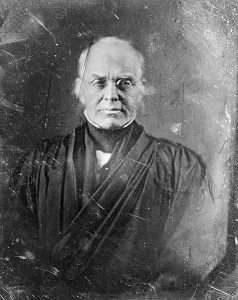
Today in Supreme Court History: February 3, 1812
2/3/1812: Justice Joseph Story takes oath.
Florida Limits on Ownership of Real Property by Chinese Citizens Are Preempted by Federal Law
So an Eleventh Circuit panel tentatively concludes, preliminarily enjoining the statute; one judge would hold that the limits violate the Equal Protection Clause.
From Shen v. Commissioner, decided yesterday by the Eleventh Circuit, in an opinion by Judges Adalberto Jordan, Kevin Newsom & Nancy Abudu:
In our view, the plaintiffs/appellants have shown a substantial likelihood of success on their claim that Florida Statutes §§ 692.201–692.204 are preempted by federal law, specifically 50 U.S.C. § 4565, the Foreign Investment Risk Review Modernization Act of 2018 ("FIRRMA"), and 31 C.F.R. § 802.701….
The defendants/appellees are preliminarily enjoined from enforcing the challenged statutory provisions against Ms. Shen and Mr. Xu. The motion for a preliminary injunction is otherwise denied.
Our decision, of course, does not bind the merits panel, which will hear oral argument in April.
Judge Abudu concurred:
While I agree with the above partial grant of the preliminary injunction, I write separately to explain why I also would have granted the preliminary injunction based on the Plaintiffs/Appellants' substantial likelihood of success on their argument that Fla. Stat. §§ 692.201–692.204 violate the Equal Protection Clause….
Court Refuses to Block West Point Use of Race in Admissions, Doesn't Express Any Substantive Opinion on Question
From today's order in Students for Fair Admissions v. USMA at West Point:
The application for writ of injunction pending appeal presented to Justice Sotomayor and by her referred to the Court is denied. The record before this Court is underdeveloped, and this order should not be construed as expressing any view on the merits of the constitutional question.
The District Court denied a preliminary injunction on Jan. 3, so the case remains pending there; part of the District Court's rationale was:
A full factual record is vital to answering this critical question whether the use of race in the admissions process at West Point furthers compelling governmental interests and whether the government's use of race is narrowly tailored to achieve that interest. The Court cannot enjoin West Point's use of race in admissions without a full understanding, informed by a complete factual predicate, as to what exactly are the compelling interests asserted, to whom those compelling interests belong, and how in this specific case they are or are not narrowly tailored to achieve those interests. Accordingly, Plaintiff has not met its burden, on the present record, to show a clear, or otherwise preponderant, likelihood of success on the merits.
There thus hasn't been either a final District Court decision nor a Court of Appeals decision.
Open Beaches Constitutional Amendment Challenge to Closing Beaches for SpaceX Launches Can Go Forward
From yesterday's decision in SaveRGV, Sierra Club & Carrizo/Comecrudo Nation of Texas v. Texas General Land Office, decided yesterday by the Texas Court of Appeals (Corpus Christi-Edinburg), in an opinion by Justice Clarissa Silva, joined by Chief Justice Dori Contreras and Justice Nora Longoria:
The Texas Constitution provides that "[t]he public, individually and collectively, has an unrestricted right to use and a right of ingress to and egress from a public beach. The right granted by this subsection is dedicated as a permanent easement in favor of the public." This provision, commonly referred to as the Open Beaches Amendment, permits the legislature to "enact laws to protect the right of the public to access and use a public beach and to protect the public beach easement from interference and encroachments" but "does not create a private right of enforcement." In 2013, the legislature enacted Texas Natural Resources Code § 61.132, which permits the commissioners in a county bordering the Gulf of Mexico or its tidewater to temporarily close a beach in reasonable proximity to a space flight launch site or access points to the beach in the county on launch dates.
According to SaveRGV's first amended petition, following the passage of § 61.132, appellees have allowed the closure of Boca Chica Beach in Cameron County for up to 450 hours per year to allow Space Exploration Technologies Corporation (SpaceX) to conduct activities related to space flight launches. Such closures prompted SaveRGV to file a suit seeking declaratory judgment that § 61.132 violates the Open Beaches Amendment and is thus unconstitutional….
The court rejected various procedural challenges, and remanded to the trial court to consider the merits. The court noted that it wasn't deciding what substantive test should be applied under the Open Beaches Amendment to evaluate beach closures. I look forward to seeing how open beaches jurisprudence evolves in the Texas courts—not a constitutional inquiry that you hear about every day.




