
2/15/1790: Justice John Rutledge takes oath.

Mostly law professors | Sometimes contrarian | Often libertarian | Always independent | Est. 2002
In recent years, climate activists have taken to pouring stuff (like paint or soup) on famous works of art to draw attention to their message. Of course, these artworks are behind thick glass, so these acts do not actually destroy the item. But symbolically, they get attention. As we learn in First Amendment doctrine, one way to garner attention is to destroy things that other people find valuable--such as burning draft cards and American flags. (As much as I respect Justice Scalia's vote in Texas v. Johnson, I'm still not sure he was right.)
Now, climate activists have turned to something that I--and I suspect you--find of the highest value: the United States Constitution. Two men poured some sort of red powder on the case housing the original Constitution at the National Archives.
Just now: the Rotunda of the National Archives in Washington DC was evacuated after two climate activists dumped red powder on themselves and the case holding the United States Constitution.
Both were arrested in minutes. pic.twitter.com/opeTJcs7GH
— Ford Fischer (@FordFischer) February 14, 2024
For generations, activists have tried to sully the Constitution, figuratively. Now, they are doing so literally.
These men should receive the maximum penalty allowed under law.
A recent poll finding that 18 percent of all Americans and 32 percent of Republicans believe Taylor Swift is part of a covert conspiracy effort to help Biden win reelection. This is just one example of the broader problem of political ignorance and bias.
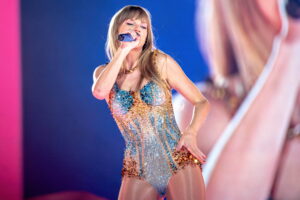
A recent Monmouth poll finds that 18% of Americans and 32% of Republicans believe there is a "a covert government effort for Taylor Swift to help Joe Biden win the presidential election." The percentage of believers is higher among the 46% of Americans who have previously heard of the Swift conspiracy theory, and is especially high among Republicans who had previously heard of it (44% of that subgroup said they believed such a covert effort exists). As more Republicans learn of this conspiracy theory, more might come to believe it.
Over the last few weeks, some conservative activists and online "influencers" have promoted the absurd conspiracy theory that Taylor Swift's relationship with Kansas City Chiefs player Travis Kelce is actually a "deep state" government "psyop" designed to help Biden win the election (presumably, Swift -grateful for being set up with Kelce and resulting publicity, will endorse Biden in exchange). Large numbers of Republicans (though still a minority) now apparently believe it! In fairness, some of those who told Monmouth they believed in the existence of the "covert government effort" might have had some other type of conspiracy in mind. But the one involving Kelce has gotten the broadest circulation.
I won't spend much time and effort refuting the Swift-Kelce conspiracy theory. Suffice to say that Swift is a billionaire and the most popular celebrity in the world. She doesn't need the help of Deep State Democrats to either find men to date or generate publicity for her music. And if the White House wanted Swift to endorse Biden, they could probably achieve that goal just by asking her. After all, she did endorse him in 2020, apparently without getting anything in exchange (though I suppose conspiracy theorists can argue that whoever she was dating back then was actually a Deep State plant).
In and of itself, widespread belief in the Taylor Swift conspiracy theory probably doesn't matter much. It almost certainly won't change the outcome of the presidential election. Nor is it likely to impact government policy in any meaningful way.
The problem is that the kind of credulousness on display here is also evident in many voters' beliefs in a wide range of other conspiracy theories. The Washington Post gives some examples in its story on the Monmouth poll:
An August 2022 YouGov poll after the search of Mar-a-Lago showed 38 percent of Republicans believed the FBI planted evidence there. Just 23 percent disagreed with that proposition (another 39 percent were "not sure").
A YouGov poll the next month showed a majority of Republicans said it was at least "probably true" that the FBI planted classified documents.
A Suffolk University poll shortly after Jan. 6, 2021, showed 58 percent of Donald Trump supporters said the Capitol riot was "mostly an Antifa-inspired attack that involved only a few Trump supporters." There remains zero evidence for this.
A recent Washington Post-University of Maryland poll showed 34 percent said it was at least "probably true" that the FBI organized and encouraged the attack on the Capitol. (About half that number believed there was "solid evidence" of this.)
YouGov polling in December showed 42 percent of Republicans believe "many top Democrats" are caught up in child sex-trafficking rings, 35 percent believe mass shootings have been faked to promote gun control, and 28 percent believe the government used covid vaccines to implant microchips in people.
The same poll showed fully 60 percent of Republicans believe there is "a single group of people who secretly control events and rule the world together." (Democratic support for the proposition was about half — 28 percent.)
And, of course, polls generally show around 6 in 10 or more Republicans continue to believe the 2020 election was stolen from Trump, despite the complete lack of evidence more than three years later.
These are all examples of right-wing voters' credulousness - none more consequential than continued widespread belief in Donald Trump's "Big Lie" about the 2020 election. But there are plenty of left-wing examples of widespread ignorance and belief in misinformation, as well. Notable cases include 9/11 "trutherism" (disproportionately embraced by people on the left) and belief that "the Jews" were at least partly responsible for the 2008 financial crisis (much more common among Democrats than Republicans). Overall, it appears left-wingers and right-wingers are about equally susceptible to conspiracy-mongering. Both tend to be more open to conspiracy theories that reinforce their preexisting views than those that cut against them.
As I've explained before (e.g. here, here, and here), this is part of the more general problem of voter "rational ignorance" and bias. Because there is so little chance that any one vote will influence an electoral outcome, most voters have little incentive to devote more than minimal time to learning about political issues. Their ignorance makes them more susceptible to conspiracy theories and other misinformation.
That problem is further exacerbated by the lack of incentive to objectively evaluate whatever information the voters do learn. In considering political information, many voters act not as objective truth-seekers, but as "political fans" who tend to overvalue any claims that cohere with their preexisting views, and downplay or ignore any that cut against them. Just as sports fans tend to be biased in favor of their favorite team, political fans are biased in favor of their preferred party, ideology, and leaders - and against their rivals.
At this moment in history, I think right-wing political ignorance and bias are greater menaces than that on the other side of the political spectrum. Over the last few years, lies and disinformation spread by Trump and his supporters - particularly the Big Lie - have had more impact than their left-wing counterparts. But, whether or not you agree with me on that, it's important to recognize the enormous scope of the problem - and the fact that it isn't limited to one side of the political spectrum.
Recognizing the problem cannot, by itself, solve it. But it's at least a step in the right direction. I consider a variety of potential ways to mitigate political ignorance and bias in this recent article and in my book Democracy and Political Ignorance.
UPDATE: I have made minor additions to this post.
UPDATE 2: I have fixed what was previously an incorrect link to the Monmouth poll.
From Kruse v. Karlen, decided yesterday by the Missouri Court of Appeals, in an opinion by Judge Kurt Odenwald, joined by Judges Michael E. Gardner and Renée D. Hardin-Tammons (for more on the earlier 13 cases, see these posts):
Jonathan R. Karlen ("Appellant") appeals from the trial court's grant of final summary judgment to Molly Kruse ("Respondent"). Due to numerous fatal briefing deficiencies under the Rules of Appellate Procedure that prevent us from engaging in meaningful review, including the submission of fictitious cases generated by artificial intelligence ("A.I."), we dismiss the appeal. Given the frivolousness of the appeal, we also award damages to Respondent pursuant to Rule 84.19.
The pro se appellant erred in many ways, but the court stressed the hallucinations:
Particularly concerning to this Court is that Appellant submitted an Appellate Brief in which the overwhelming majority of the citations are not only inaccurate but entirely fictitious. Only two out of the twenty-four case citations in Appellant's Brief are genuine. The two genuine citations are presented in a section entitled Summary of Argument without pincites and do not stand for what Appellant purports. A contextual example of Appellant's reliance on fictitious authority includes:
For instance, in Smith v. ABC Corporation, 321 S.W.3d 123 (Mo. App. 2010), the Court of Appeals held that it had the duty to review the grant of judgment as a matter of law de novo, stating that "the appellate court should not be bound by the trial court's determination and must reach its own conclusion based on the record."
Neither the case nor the specific quote it purports to contain exist in reality. As depicted in the chart below, Appellant also offers citations that have potentially real case names – presumably the product of algorithmic serendipity – but do not stand for the propositions asserted by Appellant, such as State ex rel. Johnson v. Clark, 288 Mo. 659, 232 S.W. 1031, 1035 (Mo banc. 1921), overruled by Younge v. State Bd. of Reg. for Healing Arts, 451 S.W.2d 346 (Mo. 1969), which Appellant claims discusses the standard of review for the grant of judgment as a matter of law but in fact reviews a state administrative board's decision suspending a physician's license. Similarly, the case name "Brown v. Smith" involves two common names and can be found twice in Missouri precedent, but neither case relates to what Appellant purports.
We have itemized each of the twenty-two inaccurate case citations below in order of their appearance [see the opinion for the details -EV] ….
2/14/1845: Justice Samuel Nelson takes judicial oath.
Alexander Hamilton, The Federalist No. 70:
Men often oppose a thing, merely because they have had no agency in planning it, or because it may have been planned by those whom they dislike. But if they have been consulted, and have happened to disapprove, opposition then becomes, in their estimation, an indispensable duty of self-love. They seem to think themselves bound in honor, and by all the motives of personal infallibility, to defeat the success of what has been resolved upon contrary to their sentiments.
Oliver Wendell Holmes, Jr., Ideals and Doubts, in Collected Legal Papers 303, 305 (1920), quoted in Michael Boudin's review of a volume of Louis Brandeis's letters, 85 Yale L. J. 591, 596 (1976):
[T]he mode in which the inevitable comes to pass is through effort. . . . And although with Spinoza we may regard criticism of the past as futile, there is every reason for doing all that we can to make the future such as we desire.
Episode 491 of the Cyberlaw Podcast
The latest episode of The Cyberlaw Podcast features guest host Brian Fleming, while Stewart Baker is participating in the Canadian Ski Marathon. Brian is joined for the news roundup by Jane Bambauer, Gus Hurwitz, and Nate Jones.
They begin by discussing the latest U.S. government efforts to protect sensitive personal data, including the FTC's lawsuit against data broker Kochava and the forthcoming executive order restricting certain bulk sensitive data flows to China and other countries of concern.
Nate and Brian then discuss whether Congress has a realistic path to end the Section 702 reauthorization standoff before the April expiration and debate what to make of a recent multilateral meeting in London to discuss curbing spyware abuses.
Gus and Jane then talk about the big news for cord-cutting sports fans, as well as Amazon's ad data deal with Reach, in an effort to understand some broader difficulties facing internet-based ad and subscription revenue models.
Nate considers the implications of Ukraine's "defend forward" cyber strategy in its war against Russia. Jane next tackles a trio of stories detailing challenges, of the policy and economic varieties, facing Meta on the content moderation front, as well as an emerging problem policing sexual assaults in the Metaverse.
Bringing it back to data, Gus wraps the news roundup by highlighting a novel FTC case brought against Blackbaud stemming from its data retention practices.
In this week's quick hits, Gus and Jane reflect on the FCC's ban on AI-generated voice cloning in robocalls, Nate touches on an alert from CISA and FBI on the threat presented by Chinese hackers to critical infrastructure, Gus comments on South Korea's pause on implementation of its anti-monopoly platform act and the apparent futility of nudges (with respect to climate change attitudes or otherwise), and finally Brian closes with a few words on possible broad U.S. import restrictions on Chinese EVs and how even the abundance of mediocre AI-related ads couldn't ruin Taylor Swift's Super Bowl.
You can subscribe to The Cyberlaw Podcast using iTunes, Google Play, Spotify, Pocket Casts, or our RSS feed. As always, The Cyberlaw Podcast is open to feedback. Be sure to engage with @stewartbaker on Twitter. Send your questions, comments, and suggestions for topics or interviewees to CyberlawPodcast@gmail.com. Remember: If your suggested guest appears on the show, we will send you a highly coveted Cyberlaw Podcast mug! The views expressed in this podcast are those of the speakers and do not reflect the opinions of their institutions, clients, friends, families, or pets
Mark Graber: “Instead, justices on both the left and right made deeply problematic historical assertions unaware of their foundations in the white supremacist commitments of the history profession for most of the twentieth century.”
[This post is co-authored with Professor Seth Barrett Tillman.]
On Monday, February 12, 2024, Professor Mark Graber published a post on Balkinization about the February 8, 2024 oral argument in Trump v. Anderson. He argued that the questions posed by Justice Jackson had their foundation in white supremacy. We refrain from characterizing his argument further. Instead, we report these excerpts:
Instead, justices on both the left and right made deeply problematic historical assertions unaware of their foundations in the white supremacist commitments of the history profession for most of the twentieth century. . . .
The questions from many Supreme Court justices in oral argument evinced a good deal of sympathy for Dunning School dogma, minus the overt racism. . . .
Jackson came too dangerously close to articulating Dunning School commitments when she suggested that Senator Reverdy Johnson of Maryland correctly thought Section Three exempted the presidency, even though Johnson immediately recanted after being corrected by a Republican. Dunning School historians thought Johnson the greatest lawyer in the Senate. He had, after all, convinced the Supreme Court as the victorious lawyer in Dred Scott that the Constitution forbade bans on slavery in American territories, prohibited freed slaves from becoming citizens of the United States and regarded African-Americans as having no rights white American citizens were obligated to respect. Johnson was one of many Democrats who continued to maintain after the passage of the Thirteenth and Fourteenth Amendments that the United States was committed to a white man's government. These sentiments, the Dunning School thought, made Johnson a brilliant lawyer. Contemporary historians disagree. Jackson when writing or signing opinions might consider finding a different authority on the meaning of the post-Civil War Amendments.
We are confident that Justice Jackson—along with each of her eight Supreme Court colleagues—is fully capable of understanding the "foundations" of "white supremacy," and Jackson can decide for herself which authorities are persuasive.
We, Blackman and Tillman, are both realists. We have real doubts whether our amicus brief will convince any single Justice to vote differently than that Justice would otherwise have voted. Likewise, we doubt our publications, taken separately or collectively, will likely influence any one or more Justices to vote differently than they would otherwise have voted. By contrast, as to Graber's Balkinization post, we think it much more likely to move Justice Jackson into the "Trump" camp and towards the "President is not an officer 'of' or 'under' the United States" position than anything we have written or are likely to write in the future.
What does this notation mean?
On days when the Supreme Court will issue an opinion, the calendar on the site announces, "The Court may announce opinions, which are posted on the homepage after announcement from the Bench."
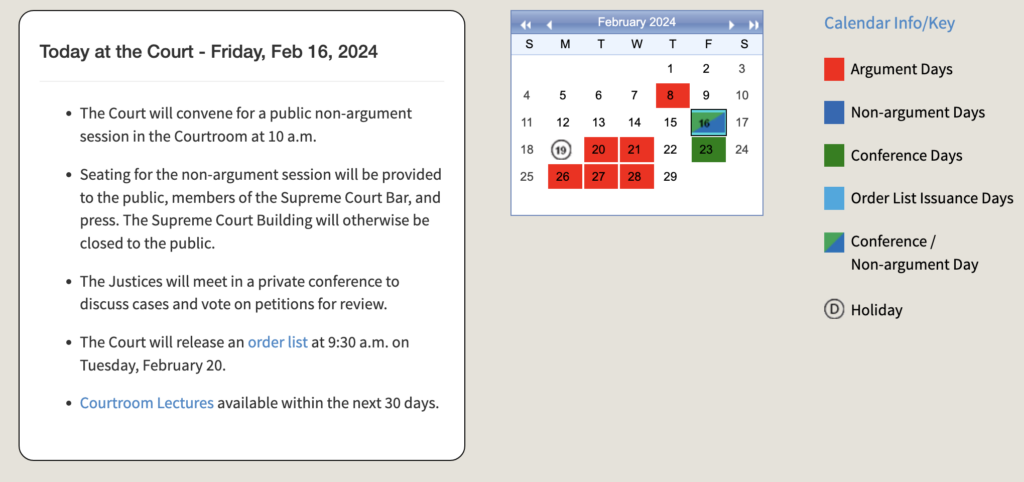
I checked the Court's calendar this morning, and there is a different notation for Friday, 2/16:
The Court will convene for a public non-argument session in the Courtroom at 10 a.m.
Seating for the non-argument session will be provided to the public, members of the Supreme Court Bar, and press. The Supreme Court Building will otherwise be closed to the public.
This probably means an opinion handdown will be posted at some point soon.
What will it be? The Section 3 case? As a rule of thumb, the earlier the Section 3 case comes, the more likely it is unanimous, or something close to it.
I am happy to pass along this announcement from the Becket Fund for Religious Liberty:
Becket is seeking 3 or more new attorneys for its 2024-25 Constitutional Law Fellowship. The fellowship is a one-year position that is open to exceptional recent judicial clerks. It provides immediate, hands-on experience litigating cutting-edge religious liberty cases under the mentorship of experienced Becket attorneys. Fellows participate in all aspects of trial and appellate litigation, gaining valuable experience in litigation strategy, research, writing, and oral advocacy. The Fellowship is also an excellent steppingstone to government service, private practice, the academy, or public interest law. Fellowship terms are for one year, typically beginning in August or September, and provide a competitive salary and benefits. You can find more details here: https://www.becketlaw.org/about-us/employment/constitutional-law-fellowship/
2/13/16: Justice Antonin Scalia died.
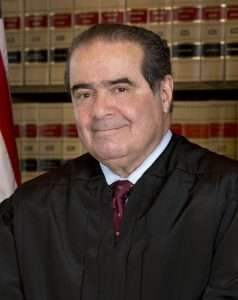
Not really, it was only wishful thinking.
On February 7, the Supreme Court of Hawai'i decided State v. Wilson, upholding state criminal laws confining handguns and ammunition to the "possessor's place of business, residence, or sojourn." A separate provision provides for permits to carry (which historically no one got), but the defendant had not applied for a permit and thus had no standing to challenge that provision.
Article I, § 17 of the Hawai'i Constitution has the same language as the federal Second Amendment, just deleting the first and last comma. Wilson held that § 17 "supports a collective, militia meaning," and thus "in Hawai'i there is no state constitutional right to carry a firearm in public."
Citing Justice Stevens' dissent in Heller and Justice Breyer's dissent in Bruen, Wilson claims that the U.S. Supreme Court "distorts and cherry-picks historical evidence. It shrinks, alters, and discards historical facts that don't fit." The Court's failings are not limited to the issue at hand – "the Dobbs majority engaged in historical fiction" as well. Wilson avers: "The United States Supreme Court disables the states' responsibility to protect public safety, reduce gun violence, and safeguard peaceful public movement."
Wilson fails to analyze the actual precedents when it asserts: "Until Heller, the Supreme Court had never ruled that the Second Amendment afforded an individual right to keep and bear arms." Well, the Court assumed that the right is individual in Scott v. Sandford (1857), U.S. v. Cruikshank (1876), Presser v. Illinois (1886), Robertson v. Baldwin (1897), U.S. v. Miller (1939), Johnson v. Eisentrager (1950), and U.S. v. Verdugo-Urquidez (1990).
According to Wilson, both § 17 and the Second Amendment "use military-tinged language – 'well regulated militia' and 'bear arms' – to limit the use of deadly weapons to a military purpose." However, "there are no words that mention a personal right to possess lethal weapons in public places for possible self-defense." But this ignores that the guarantee has two separate clauses – one declaring the necessity of the militia, the other declaring the right of the people to bear arms. Wilson implies that the militia are the only "people," as if the guarantee refers to "the right of the militia to bear arms."
What's on your mind?
From Weaver v. Millsaps, decided Wednesday by the Georgia Court of Appeals, in an opinion by Judge C. Andrew Fuller, joined by Judges Anne Elizabeth Barnes and Benjamin Land:
After Michael Weaver and others acting at his behest posted negative Google reviews of Valerie Millsaps's frame shop business, she published a response, calling Weaver a Neo-Nazi and known felon who was targeting her business and had "threatened to kill other shop members." …
Millsaps and her husband own a framing shop in Cartersville. One day in June 2022 while Millsaps was driving her company van, she saw Weaver standing on the street holding a sign that appeared to be antisemitic. Millsaps "displayed [her] middle finger" at Weaver. Weaver, having seen the business logo on the van, published a post on his personal blog asking his followers to leave negative Google reviews of the business. Within 12 hours, multiple negative reviews appeared on the business's Google review page. Weaver subsequently thanked his supporters who had left the reviews and stated, "I'm just getting warmed up! … Total f__king war!"
In response, Millsaps posted her own comment on her business's Google review page:
My business is being targeted by a Neo Nazi and a member of the KKK. Please disregard the reviews. None of those profiles have ever entered my shop. I am being harassed and bullied by Michael [Weaver]. A known felon of hate crimes. He has targeted many businesses in our town. I refuse to be intimidated by him and his hate literature that he has left at my shop and my home. He has threatened to kill other shop members and flooded their Google reviews with harassing, untrue reviews. You can decide to try my shop and let my experience speak. Please note all date stamps are in a concentrated period of time. I choose LOVE over HATE. Thank you kindly.
According to Millsaps, the frame shop's Google rating plummeted due to negative reviews left by Weaver and his followers, and the shop's business declined.
Weaver sued Millsaps for libel, alleging that she had made knowingly false statements about his criminal record, his affiliation with the KKK, and his "terroristic threats to her customers." Millsaps moved to dismiss the complaint …, arguing among other things that her statements were truthful protected speech made without actual malice.
The loudest voices bemoaning Palestinian suffering decline to call on Hamas to release the hostages and surrender.
It's kind of horrifying that the loudest voices bemoaning Palestinian civilian suffering in Gaza will harshly criticize everyone and anyone--Israel, the US, the EU, the UN Security Council, American Jews, you name it--except for Hamas (and its allies like Iran), and the one thing they won't do is suggest Hamas surrender, even though that would immediately end the war, and also end Gazans being ruled by an oppressive medieval theocracy that steals aid money to build weapons and villas for its leaders.
In short, no matter how much they purport to care for Palestinians, their biggest priority is that Israel not emerge victorious over Hamas. I won't go so far as to claim that they don't care about the Palestinians. I will claim, strongly, that they hate Israel much more.
A perfectly good (but hardly the only) example is Karen Attiah, who has a sufficiently influential position as world opinion editor at the Washington Post that someone like her deciding that hey, maybe Hamas should just surrender and release the hostages could help move the needle, given that Hamas is counting on world opinion to stop Israel's offensive and keep it in power. Even if Hamas is beyond world opinion, its patrons and allies in Turkey, Qatar, and even Iran are not.
And the folks I'm referring to won't even suggest that they want Hamas to surrender for rhetorical purposes. Like, "Of course my preference would be for Hamas to surrender and release the hostages, but if that can't happen, and it looks like it can't, to end the civilian suffering Israel should cease fire." Nope, they won't even suggest that they would *prefer* Hamas to surrender. How twisted does your mind have to be to think Hamas is the relative good guy here? And that you won't even pretend you think otherwise just to help persuade, because you can't bring yourself to even do that?
These are important opportunities for law students.
I am pleased to pass along opportunities for summer fellowships.
First, the James Wilson Fellowship will meet this summer in the Washington, D.C. area.
In partnership with First Liberty's CRCD, JWI Co-Directors, Profs. Hadley Arkes and Gerry Bradley, joined by other distinguished scholars, will offer an in-person seminar over seven days in the Washington, D.C. area, on Natural Law and its bearing on our jurisprudence. The course will focus on discussing the central points of a jurisprudence of Natural Law, such as the classic connection between the "logic of morals" and the "logic of law," the properties of moral truths and the principles of judgment, and how we would see certain landmark cases differently if they were viewed through the lens of Natural Law. Our main objective is to restore a moral coherence to our jurisprudence.
Fellowship topics fall into two categories: the first half of the week focusing on the foundational principles of Natural Law jurisprudential reasoning, and the second half centering on the practical applications of that reasoning to issues arising in our constitutional order.
Second, The Fund for American Studies Summer Law Fellowship, also in Washington, D.C.
The TFAS Summer Law Fellowship in Washington, D.C., is an intensive nine-week program that aims to prepare law students to defend the values and ideals of a free society rooted in individual liberty, limited government, free enterprise and constitutional originalism.
Through this immersive academic and professional experience, participants will engage in legal internships, academic coursework, networking events and career development sessions, as well as a law and public policy lecture series with leading constitutional scholars, judges and practicing attorneys.
Those selected to participate in the Fellowship program will receive a full scholarship covering tuition, housing and program fees. Awards are highly selective – only 25 students are selected to participate each year.
Apply today!
Copyright infringement hits home - a cautionary tale.

Some of you may have seen the article by David Segal in the Sunday NY Times several weeks ago [available here] about a rather sordid copyright fracas in which I have been embroiled over the past few months. [That's me, seated on the right in the photo].
It's a pretty wild story. If you don't feel like reading the whole NYT article, here's a brief summary of how it unfolded:
Off and on, for 30 years or so, I've been in a duo ("Bad Dog") with a friend, Craig Blackwell, here in Washington DC: Two acoustic guitars, two vocals, original songs. We take the music we make very seriously, but we are not professional musicians; we both had and have careers outside of music. We weren't and aren't in it for the money, but just for the pleasure of making music and the satisfaction one gets from creating something worthwhile and interesting and, perhaps, even beautiful.
In early 2023, we recorded an album containing nine new songs ("The Jukebox of Regret" - you can listen to it here) at a local recording studio (Mixcave Studios). After the recordings were mixed and mastered, we posted them (as we had posted other recordings that we had made over the years) on the "Bad Dog" page at Soundcloud.com, a music-sharing website.
Several weeks later, a friend told us that she had input a recording of one of our songs (entitled "Preston") into the Shazam app, and that Shazam identified the song right away -- as something called "Drunk the Wine" by someone called Vinay Jonge. It pointed her to the YouTube page where the recording was available to be streamed.
Well! The YouTube recording was, it was clear upon listening to it, an exact duplicate of the recording we had posted on SoundCloud. A quick Google search on "Vinay Jonge - Drunk the Wine" turned up his recording - i.e., our recording of "Preston" - at all the other major music streaming services (Spotify, Amazon Music, Apple Music, allmusic.com, etc.). [Curiously, Mr. Jonge didn't seem to have any other songs posted anywhere on the Internet. A one-hit wonder!].
We began the process of sending "takedown notices" to each of the streaming platforms, informing them that they, and Mr. Jonge, were infringing our copyright.
And then we learned that it wasn't only "Vinay Jonge," and it wasn't only one song; all of the songs on the album had been pirated and were posted on all of the big streaming platforms. Each one had a new song title and a new artist name:
- our "The Misfit" had become "Outlier" by Arend Grootveld;
- our "Verona" had become "I Told You" by Ferdinand Eising;
- our "A Drink Before I Go" had become "Drink When I'm Gone" by Amier Erkens;
- our "Pop Song" had become "With Me Tonight" by Kyro Schellen;
- etc.
You might ask: How did we figure this out? Good question! Searching for "Bad Dog - Preston" or "Verona" or "The Misfit" at Google or YouTube or Spotify or Apple Music etc. wouldn't have turned anything up, because the song names had all been changed, and each song was associated with a different "artist." Without knowing how our songs had been re-titled, or the names of those who were taking credit for our work, the infringements were completely invisible to us, out there in the great Internet ocean.
So how did we track them down? The answer is: We found these other infringing files after we sent the nine song files to Disc Makers, a commercial CD printing operation, to have them print up some CDs for us to hand out at our upcoming album release show. Disc Makers apparently uses some sort of file-matching software/system to check at least some of the streaming platforms for duplicate files; they found the infringing files, and they sent us a polite note with a list of everything they had found, and informing us that they had put our CD project on "Hold," because the files we sent them "contain previously copyrighted material."
Disc Makers, in other words, thought - not unreasonably, I suppose, given the evidence it had - that we were the infringers! Until we were able to persuade them that it was the other way around (which we were able to do by demonstrating that the upload date of the files we sent to SoundCloud pre-dated the upload dates for the infringing files) they wouldn't make the CDs for us.
One final plot twist. Now that we had the "artist" names and the new song titles, we could locate infringing files at the streaming platforms, and we started sending out more takedown notices. In response to one that we sent to Apple Music, we got a note back saying, in effect: "The songs you have identified were provided to us by a music distributor. If you have a copyright claim, please direct it to the distributor." And they identified the distributor: Warner Music Group.
Well! That was a surprise! Warner, of course, is one of the world's largest distributor of digital music, with thousands of musicians under contract, and a pipeline that extends to all of the big streaming platforms. Apparently, Warner had some sort of relationship with Vinay Jonge, Amier Erkens, Arend Grootveld, and the rest of them under which Warner distributed "their" music to the streaming platforms (and, I assume, took a small percentage of whatever streaming income those tracks generated). Also apparent: whatever system Warner uses to insure that the artists they represent own the copyrights in the material that they deliver to Warner did not function adequately in this case. [The folks at Warner declined my request to comment on this article]
From Magistrate Judge Robert Norway's report and recommendation in Frank v. Fine (M.D. Fla. Jan. 5), adopted by Judge Paul Byron on Jan. 19:
Plaintiff [Colby Alexander Frank] {a self-proclaimed "white civil rights advocate" and member of the "Goyim Defense League"} here alleges that Defendant [Randy Fine, a Florida legislator] defamed him by publishing certain statements on a social media platform. Those statements include:
- "I just got jumped by a Nazi with a camera walking into a widely publicized speaking event just now. I'm fine; not sure today will go down as one of his better days."
- "Clearly, he couldn't take it one on one, because as I left, four of his friends were hooting and hollering on the street corner. I got pictures, though being the cowards they are, most were masked."
- "Here's a pic of the Nazi who jumped me."
- "Here's the Nazi's background! Already being prosecuted for one violent felony. Such losers. Mom must not have hugged him enough."
- "The Nazis have released a two second clip from my ambush earlier this week, thinking it makes them look good. I don't think I've ever sounded more eloquent."
… [These statements cannot form the basis for a libel lawsuit] because they are opinions. Statements indicating a political opponent is a Nazi or coward are "odious and repugnant" and far too common in today's political discourse. But they are not actionable defamation "because of the tremendous imprecision of the meaning and usage of such terms in the realm of political debate." In other words, being called a Nazi or coward are not verifiable statements of fact that would support a defamation claim….
Celebrate your independence with a subscription to Reason magazine, your most trusted source of honest, insightful news and analysis.




