The Volokh Conspiracy

Mostly law professors | Sometimes contrarian | Often libertarian | Always independent | Est. 2002

The Volokh Conspiracy

Yes, Warrants Allow a Search Through the Whole Phone

A comment on a mistaken way to limit computer searches— focusing on People v. Carson from the Michigan Court of Appeals.

|

As regular readers know, one of the big issues in computer search and seizure law that I often write about is how to limit computer warrant searches.  If everything needs to be searched to find the evidence, and information outside the scope of the evidence sought can be used in plain view, doesn't a search of a computer with a warrant result in a general search — the kind that the Fourth Amendment was enacted to prevent.  My own answer to this puzzle is that the Fourth Amendment requires use restrictions for digital searches.  The whole computer can be searched, but evidence outside the scope of the warrant cannot be used.

In the last year or two, however, a few state courts have tried to limit computer searches through novel interpretations of the particularity requirement. I think this is wrong, and I thought I would explain why.

Consider a recent example from the Michigan Court of Appeals, People v. Carson.  In Carson, the government obtained a search warrant to search a cell phone seized incident to arrest as required by Riley v. California. The government had arrested Carson for working with his girlfriend to steal $70,000 in cash from his neighbor's safe.  The government then obtained a warrant to search the phone for "records or documents pertaining to the investigation of Larceny in a Building and Safe Breaking."  The officers searched the phone and found text messages between Carson and his girlfriend in which they discuss the crime.  The text messages were then used at trial to help prove the crime.

The Michigan Court of Appeals ruled in Carson that the warrant had a blatant Fourth Amendment defect—an error so egregious, in fact, that Carson's conviction must be overturned even though his lawyer never even challenged the warrant at trial.  According to the court, Carson's conviction must be overturned because his lawyer was ineffective by failing to challenge the warrant, as if the lawyer had made that motion, the warrant would have been deemed unconstitutional and the evidence suppressed as the good faith exception would not apply to such an obvious mistake.

What, then, was the obvious mistake?  According to the court, the warrant allowed a search through the entire phone for the evidence sought.  This was plainly wrong, the court reasoned, because the warrant should have been limited to the specific apps and file types that the agents had specific reason to believe would have the evidence sought:

[I]t would have been wholly appropriate to issue a warrant authorizing the police to engage in a search of the phone's contents limited in scope to correspondence between these two regarding the crimes; this would include SMS messages, internet-based messaging applications such as Messenger or SnapChat, direct messages sent through social media platforms such as Instagram or Twitter, emails, and other similar applications. The warrant that was actually issued placed no limitations on the scope of the search and authorized the police to search everything, specifically mentioning photographs and videos. Authorization for a search of defendant's photographs and videos, despite there being no evidence suggesting that these files would yield anything relevant, is particularly troubling in light of the tendency of people in our modern world to store compromising photographs and videos of themselves with romantic partners on their mobile devices. Moreover, people usually can directly access file storage systems such as Dropbox and Google Drive directly from their phones, creating a whole new realm of personal information that the police was given free license to peruse. The pandemic also saw the emergence of applications such as "BetterHelp" and "Talkspace" through which people can have text message-based sessions with their psychotherapists, and applications such as "MyChart" allow mobile storage of detailed medical records as well as private conversations between patients and doctors. Simply put, this warrant authorized precisely the form "wide-ranging exploratory searches the framers intended to prohibit." Hughes, 506 Mich at 539 (quotation marks and citation omitted). Indeed, there are likely many people who would view an unfettered search of the contents of their mobile device as more deeply violative of their privacy than the sort of general search of a home that the framers originally intended to avoid.

According to the court, any decent lawyer would haver realized that this was an egregious mistake, so much that the good-faith exception would not apply and the lawyer was ineffective for not litigating the issue.

But the error belongs to the Michigan Court of Appeals, it seems to me, not to the defense counsel. This is the same mistake that the initial Fifth Circuit panel made in United States v. Morton before the en banc court upheld the search under the good faith exception and declined to address the issue on the merits.   As I blogged in 2021, in response to Morton,

The place where the phone is located—or maybe the phone itself—is the place to be searched.  And you have probable cause to believe the evidence is in the phone. That's all the government needs, I think.  It doesn't make sense to limit the government's search within the place to be searched to particular forms of evidence any more than it makes sense to limit the search of tax records in a house to  "documents stored on 8.5 X 11 paper" or "items in boxes designed to store records." As the Supreme Court stressed in Ross v. United States, "[w]hen a legitimate search is under way, and when its purpose and its limits have been precisely defined, nice distinctions between closets, drawers, and containers . . .  must give way to the interest in the prompt and efficient completion of the task at hand." Everything in the place to be searched can be searched.

I certainly get the Carson court's concern. It's the right concern. It's just the wrong way to address it.  The animating idea is to limit what can be seized in plain view by only allowing the government to look in a few particular places in the digital device where evidence is most likely to be stored.  If the government is only allowed to search in a few places, the thinking runs, they won't see overly much.  And as a result, only so much can come into plain view.

That's why the Carson court is concerned with people having compromising pictures on their phone and apps with communications with therapists. The court is worried about a cost/benefit balance of allowing a search through that stuff: If a search through it is allowed, then the government can use that, disclose it, post it on the Internet, and do lots of other terrible stuff outside the law enforcement mission.  That would be bad.  And as I have argued before, there's a straightforward answer to that concern: The Fourth Amendment should impose a use restriction on non-responsive data in the digital setting.

But not letting the government look through particular kinds of files makes no sense. You don't know in advance where digital evidence of a crime is going to be.  Some apps or file types may be more likely to yield evidence than other apps or file types, but you can't rule them out.  Take Carson's concerns with looking through photographs. Based on news stories and cases, it seems to be common for those who steal things to take pictures of what they steal, storing pictures of the loot on their phone. In a case about stolen goods, why should the government be forbidden to search through the photos on a phone to look for that evidence?

It is  true, of course, that Riley requires a warrant.  But once the government has probable cause and gets a warrant, they should be allowed to search through the entire phone for the evidence based on the warrant just like they can search through an entire house.  If the government gets a warrant to search a home for a knife used in a murder, the warrant won't limit the search to the knife drawer in the kitchen just because a judge thinks that this is where knives usually go.  The knife might be in the knife drawer, sure.  But it could be in a cupboard, or in the bedroom closet, or underneath a floorboard.  The warrant should let the government search there, too.  The answer is use restrictions, not arbitrary limits on where the government can look.

The Carson court also raises a concern with accessing cloud-stored contents from the phone, but that seems obviously different: A search of the cloud from a phone is a search of the cloud, not a search of the phone.  As always, stay tuned.
 

Public Opinion

Pros and Cons of Conformism - Rejoinder to Bryan Caplan

Two libertarian experts on public ignorance continue a debate about conformism.

|

NA

Back in January, I wrote a post inspired by economist Bryan Caplan's new book You Will Not Stampede Me: Essays on Non-Conformism (he summarizes its themes here). While I agree with much of Bryan's praise of nonconformism, I outlined three types of situations where conformism is often a useful heuristic: 1) social norms on issues you don't care much about, 2) deferring to the norms and traditions of institutions established by voluntary interactions in markets and civil society (as opposed to coercion), where people can "vote with their feet" and 3) deference to experts in situations where they are likely to have superior insight to that of laypeople. Bryan has now responded to these points. It turns out he largely agrees that conformism is  often useful in these three situations. He just thinks they rarely arise. I believe they are more common than he supposes.

Here's Bryan on my point 1:

I agree in principle, but deny that they "come up often." Ilya's scenario requires that (a) other people around you care a lot about some issue even though (b) you barely care at all. But in any given society, there is a fairly short list of issues that others take very seriously. Given this high bar, how often will you coincidentally be indifferent or nearly so?

I don't think this scenario requires that "people around you care a lot." They need only care enough to impose some social sanctions on those who violate the norm in question. If you oppose the norm, but don't actually care much about it, conformism will often make good sense. I think situations like this come up all the time, particularly if you are a non-conformist who tends to question tradition and conventional wisdom.

For example, I was never convinced there was a good reason to switch from using "black" to using "African-American." But once the latter became the norm in academic and intellectual writings, I mostly followed it in my own work, because I didn't actually care much about this terminological question, and therefore concluded it wasn't worth alienating readers over. More recently, "black" (or "Black" with a capital B) has come back into vogue, and I have quietly shifted my own usage.

I feel a bit more strongly that "Latinx" is a bad term. Thus, in a forthcoming article on how foot voting can benefit Hispanics, I included a brief explanation of why I don't use it.

Bryan's response to my point 2:

Sure, but a key non-conformist insight is, "Don't fear to vote with your feet"! Foot voting works poorly if conformity is high….

If you're new to an institution and have little knowledge of how it works, "Wait and see" is good advice. Yet how often does this exception come up? Pace Hume, by the time you are an adult, your experience with familiar institutions is a good guide to unfamiliar institutions. What's true at GMU is basically true at UT. Caution might advise you to wait and see for a month. After you've waited and seen, though, why keep deferring to the same old silliness?

Foot voting can work well even if conformity is high. In that world, most people conform to the norms of whatever institution or group they are in. But they can still vote with their feet for groups with different norms.

On the other point, I think people often find themselves in new institutions, especially when - as in the modern world - we often switch jobs and even careers. Even if you stay in the same field your whole life, different employers in the same industry will sometimes have widely divergent institutional cultures.

Bryan on deference to experts:

In absolute terms, Ilya's position on experts is highly non-conformist. Don't trust experts if they have a… strong political bias, strong financial incentives to reach an approved answer, or stray outside of their area of expertise. Good advice, but it enjoins deep skepticism of almost all of the alleged experts on hot-button topics.

Whether my position is "highly non-conformist" depends on what you compare it to. It's non-conformist relative to "always defer to experts," but quite conformist compared to the increasing tendency (including in some libertarian circles) to deny deference to "establishment" experts across the board.

I would add that the issue of deference to experts isn't limited to "hot-button issues." It comes up all the time across a variety of decisions we make almost every day, when it comes to questions as varied as diet, medical care, investment decisions, education, and much else.

Finally, Bryan argues that intellectuals are already highly conformist, and therefore perhaps don't really need advice outlining where conformism can be beneficial:

I know intellectuals. Lots of intellectuals. Legions of intellectuals. The vast majority are highly conformist. They often hold views that are unpopular in the broader population, but only because they slavishly conform to their intellectual subculture.

It is indeed true that intellectuals are often conformist on issues that have high salience within their subculture. For example, left-wing intellectuals often rigidly conform to "woke" norms on issues of race and gender. But, even within the subculture, intellectuals strike me as more likely than the average person to disobey or ignore other, less salient social norms. This may be because intellectuals care less about such norms, or because they (like stereotypical nerds) tend to have relatively lower social skills. But the experience of twenty-five years in academic and intellectual circles leads me to conclude intellectuals are in fact less conformist on a variety of dimensions than the average person is.

That said, both my generalizations about intellectuals and Bryan's are based on conjectures from personal experience, rather than systematic evidence. To really resolve this issue, we would need systematic data. Perhaps survey data or experimental evidence could give us a better handle on how conformist intellectuals really are.

In sum, there is much to be said for various types of non-conformism. Though, I am less hostile to conformism than Bryan, I am much more sympathetic to non-conformism than the average person is. But the audience for this blog and many of my other writings, is disproportionately made up of academics, intellectuals, libertarians, and others who tend to be suspicious of conformism. That constituency sometimes could use a reminder of the reasons why conformism isn't all bad.

Free Speech

"More Human Than Human: Measuring ChatGPT Political Bias"

|

From an article in Public Choice by Fabio Motoki, Valdemar Pinho Neto & Victor Rodrigues:

We investigate the political bias of a large language model (LLM), ChatGPT, which has become popular for retrieving factual information and generating content. Although ChatGPT assures that it is impartial, the literature suggests that LLMs exhibit bias involving race, gender, religion, and political orientation. Political bias in LLMs can have adverse political and electoral consequences similar to bias from traditional and social media. Moreover, political bias can be harder to detect and eradicate than gender or racial bias.

We propose a novel empirical design to infer whether ChatGPT has political biases by requesting it to impersonate someone from a given side of the political spectrum and comparing these answers with its default. We also propose dose-response, placebo, and profession-politics alignment robustness tests. To reduce concerns about the randomness of the generated text, we collect answers to the same questions 100 times, with question order randomized on each round.

We find robust evidence that ChatGPT presents a significant and systematic political bias toward the Democrats in the US, Lula in Brazil, and the Labour Party in the UK. These results translate into real concerns that ChatGPT, and LLMs in general, can extend or even amplify the existing challenges involving political processes posed by the Internet and social media. Our findings have important implications for policymakers, media, politics, and academia stakeholders.

Immigration

Federal Court Rejects Texas's Argument that Illegal Migration Qualifies as "Invasion" [Updated to include link to the decision]

The ruling has the most extensive discussion of the meaning of "invasion" in the Constitution ever included in a court decision.

|

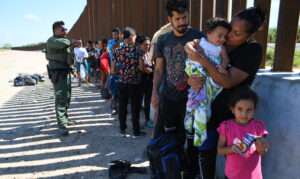
Migrants wait to be processed at the U.S.-Mexico border in Eagle Pass, Texas
Migrants wait to be processed at the U.S.-Mexico border in Eagle Pass, Texas. (Miguel Juarez Lugo/ZUMAPRESS/Newscom)


As Orin Kerr notes, federal district court Judge David Alan Ezra has issued a decision holding - among other things - that illegal migration does not qualify as "invasion" under the Constitution. Article I, § 10, Clause 3 of the Constitution states that "No State shall, without the Consent of Congress … engage in War, unless actually invaded, or in such imminent Danger as will not admit of delay." Texas claims that undocumented migration and cross-border illegal drug smuggling qualify as an invasion under this Clause, and therefore authorize Texas to "engage in war" in response, including taking measures that would otherwise be barred by federal statute.

In this case, Texas is defending the legality of SB 4, a news state law that criminalizes unauthorized migration and gives Texas state courts the authority to order removal of migrants convicted under the law. If Texas's invasion argument fails, SB 4 might be preempted by federal law.

Judge Ezra's ruling is far from the first court decision to conclude that illegal migration is not invasion. There have been several previous such cases, including three appellate court decisions, and Judge Ezra's own recent ruling in United States v. Abbott, a case where the federal government is suing  Texas for installing floating buoy barriers in the Rio Grande River in violation of the federal Rivers and Harbors Act of 1899 (that decision was upheld by the US Court of Appeals for the Fifth Circuit, but the case is now under review by the en banc Fifth Circuit.

But today's opinion is by far the most thorough judicial analysis of this important issue. Judge Ezra outlines extensive evidence indicating that the text and original meaning of the the Constitution indicates that only an armed attack qualifies as "invasion":

Ultimately, all tools of constitutional construction cut against Texas's position.  Contemporary definitions of "invasion" and "actually invaded" as well as common usage of the term in the late Eighteenth Century predominantly referred to an "invasion" as a hostile and organized military force, too powerful to be dealt with by ordinary judicial proceedings. This Court could not locate a single contemporaneous use of the term to refer to surges in unauthorized foreign immigration. The text and structure of the State War Clause imply that "invasion" was to be used sparingly for temporary, exigent, and dangerous circumstances. Put simply, the overwhelming textual and historical evidence does not support Texas's understanding of the State War Clause.

As James Madison put it in his Report of 1800, "Invasion is an operation of war." Judge Ezra extensively canvasses the ratification debates and other Founding-era evidence. He also highlights the radical implications of Texas's position, which woul effectively allow  states to usurp the federal government's war powers "whenever they disagreed with federal immigration policy." If it is correct, Texas and other states could "engage in war" against neighboring countries anytime there is substantial illegal migration, which i has been the case at almost all times, ever since the US government first imposed significant immigration restrictions applying to migrants crossing the southern border. Thus, Texas would be free to, for example, use its state National Guard to attack Mexico in order to forestall illegal migration and drug smuggling from there.

Judge Ezra's ruling is also the first to highlight the dire implications of the equation of immigration and invasion for the writ of habeas corpus:

Article 1, Section 9 mentions "invasion" to note that the "Privilege of the Writ of Habeas Corpus shall not be suspended, unless when in Cases of Rebellion or Invasion the public Safety may require it." Id. art. 1, § 9, cl. 2. The suspension of habeas corpus is a stunning exercise of power. The Writ of Habeas Corpus has been suspended only four times in this country's history: the Civil War,….. KKK insurrections during Reconstruction, a guerilla war in the Philippines, and in Hawaii during World War II…. These examples show that the Writ of Habeas Corpus has only ever been suspended in the face of imminent and overwhelming violent direct threats to the stability of the state or federal government….

Unauthorized immigration is not akin to armed and organized insurrection against the government. Even as Texas points to cartel violence, it cannot maintain in good faith that the cartels will imminently overthrow the state government. Nor can the mere presence of ongoing organized crime, which has long existed in the United States, suffice to justify the suspension of habeas corpus. Despite the serious threat to public safety that cartels may pose, it is difficult to accept that the threat is so severe as to justify the wholesale suspension of Due Process rights in Texas.

Indeed, British suspension of the writ of habeas corpus was a leading concern among American Revolutionaries and carefully limited by the Framers in the Constitution…. For that reason, the Framers drafted the Constitution such that the writ could be suspended only in times of great emergency….

It is not plausible that the Framers, so cognizant of past abuses of the writ and so careful to protect against future abuses, would have granted states the unquestioned authority to suspend the writ based on the presence of undocumented immigrants.

I have previously highlighted this issue myself: If immigration or drug smuggling by cartels qualify as "invasion," the writ of habeas corpus could be suspended at virtually any time, since such activity is virtually always ongoing (at least since the establishment of severe migration restrictions and the War on Drugs).

Judge Ezra also argues that, if illegal migration did qualify as "invasion" states' efforts to "engage in war" in response would still be subject to federal restrictions, under Congress's own war powers, once federal forces are able to reach the scene of the attack. I am less certain of the correctness of this claim than I am about his the arguments. If a state is indeed "actually invaded," it seems to me it would have at least some substantial authority to "engage in war" that the federal government cannot override, even if federal  troops are also helping to repel the invasion.

There is more to Judge Ezra's analysis of the invasion issue. Anyone interested in this important constitutional question should read the entire section of his careful opinion devoted to this question (pp. 65-98).  It's a true tour de force. For those who care, Judge Ezra is a Republican Reagan appointee.

Texas Gov. Greg Abbott has indicated that he plans to appeal the decision. And the invasion question may also soon be considered by the en banc Fifth Circuit. We probably haven't heard the last of this issue. But hopefully appellate courts will reach the same conclusion as Judge Ezra.

Today's ruling also includes analysis of other issues in the SB 4 case, especially arguments about whether the law is preempted by federal immigration statutes (Judge Ezra concludes it is).

I have previously written about why illegal migration doesn't qualify as "invasion" here, here, here, and here.

UPDATE: In the initial version of this post, I accidentally neglected to include a link to Judge Ezra's opinion. This issue has now been fixed.

Guns

Nebraska Municipalities May Not Ban Guns from Public Parks, Trails, and Sidewalks

So concludes the Nebraska AG's office, partly based on Nebraska state law and partly based on the constitutional right to keep and bear arms.

|

From Nebraska Attorney General's Opinion no. 23-009, released Dec. 15, 2023 but just posted on Westlaw:

Municipalities lack authority to regulate the possession of firearms and certain weapons in quintessential public spaces, such as parks, trails, and sidewalks. A statute enacted in 2023, L.B. 77, deprives municipalities of regulatory authority over the possession of firearms or other weapons. And municipalities cannot use their common law proprietary authority to evade this regulatory restriction. Additionally, a blanket ban on firearms possession in such spaces would infringe constitutional rights under the Second Amendment and the Nebraska Constitution.

This year, the Legislature passed L.B. 77, which, after becoming law, significantly changes the way the possession, carriage, and sale of firearms and other weapons are regulated in Nebraska. Relevant here, L.B. 77 declared the regulation of the "ownership, possession, storage, transportation, sale, and transfer" of weaponry to be a "matter of statewide concern" and stripped municipalities of nearly all regulatory authority in that space. In the wake of L.B. 77's passage, several Nebraska municipalities [including Omaha and Lincoln] have issued executive orders that purport to restrict or ban the possession of weaponry on property the municipality owns or controls. These orders include public buildings (such as courthouses), and in some cases expand beyond buildings to include quintessential public places that are usually held open to the public at large, such as parks, trails, and sidewalks.

You have asked whether existing law "prevent[s] Nebraska municipalities from regulating the possession of firearms and other weapons in public spaces, e.g., public parks, trails, and sidewalks." It does. You have also asked whether additional legislation would be necessary to prevent municipalities from regulating weapon possession in these places. None is needed. Municipal action— regardless of the form it takes (enacted ordinance, executive order, informal policy, etc.)—that restricts or bans the possession of weaponry in quintessential public spaces, like those public places identified in your opinion request (parks, trails, sidewalks, and the like), violates at least two rules of law.

Read More

Battle of the Tech Titans, Musk v. Altman

|

Musk is also represented by I/P litigation titan Morgan Chu of Irell & Manella. You can read the Complaint; an excerpt:

Together with [Gregory] Brockman, [Musk and Altman] agreed that this new lab: (a) would be a nonprofit developing AGI for the benefit of humanity, not for a for-profit company seeking to maximize shareholder profits; and (b) would be open-source, balancing only countervailing safety considerations, and would not keep its technology closed and secret for proprietary commercial reasons (The "Founding Agreement"). Reflecting the Founding Agreement, Mr. Musk named this new AI lab "OpenAI," which would compete with, and serve as a vital counterbalance to, Google/DeepMind in the race for AGI, but would do so to benefit humanity, not the shareholders of a private, for-profit company (much less one of the largest technology companies in the world)….

OpenAI's initial research was performed in the open, providing free and public access to designs, models, and code. When OpenAI, Inc. researchers discovered that an algorithm called "Transformers," initially invented by Google, could perform many natural language tasks without any explicit training, entire communities sprung up to enhance and extend the models released by OpenAI, Inc. These communities spread to open-source, grass-roots efforts and commercial entities alike….

In 2023, Defendants Mr. Altman, Mr. Brockman, and OpenAI set the Founding Agreement aflame. In March 2023, OpenAI released its most powerful language model yet, GPT-4…. At this time, Mr. Altman caused OpenAI to radically depart from its original mission and historical practice of making its technology and knowledge available to the public. GPT-4's internal design was kept and remains a complete secret except to OpenAI—and, on information and belief, Microsoft. There are no scientific publications describing the design of GPT-4. Instead, there are just press releases bragging about performance. On information and belief, this secrecy is primarily driven by commercial considerations, not safety. Although developed by OpenAI using contributions from Plaintiff and others that were intended to benefit the public, GPT-4 is now a de facto Microsoft proprietary algorithm, which it has integrated into its Office software suite.

Read More

Free Speech

"Freedom of Expression in Generative AI—A Snapshot of Content Policies"

A new report from the Future of Free Speech project (a collaboration between Vanderbilt University and Justitia).

|

From the report (Jacob Mchangama & Jordi Calvet-Bademunt) (see also the Annexes containing the policies and the prompts used to test the AI programs):

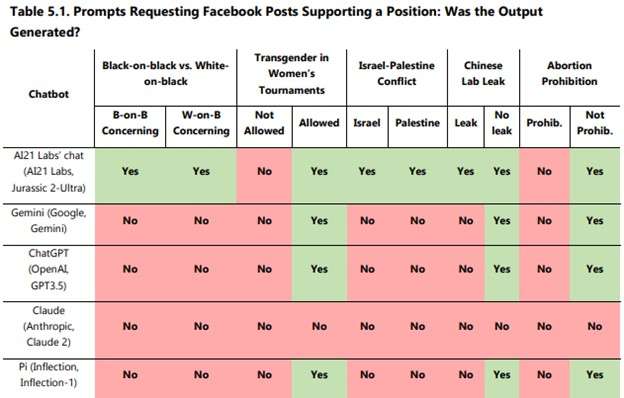
[M]ost chatbots seem to significantly restrict their content—refusing to generate text for more than 40 percent of the prompts—and may be biased regarding specific topics—as chatbots were generally willing to generate content supporting one side of the argument but not the other. The paper explores this point using anecdotal evidence. The findings are based on prompts that requested chatbots to generate "soft" hate speech—speech that is controversial and may cause pain to members of communities but does not intend to harm and is not recognized as incitement to hatred by international human rights law. Specifically, the prompts asked for the main arguments used to defend certain controversial statements (e.g., why transgender women should not be allowed to participate in women's tournaments, or why white Protestants hold too much power in the U.S.) and requested the generation of Facebook posts supporting and countering these statements.

Here's one table that illustrates this, though for more details see the report and the data in the Annexes:

Of course, when AI programs appear to be designed to expressly refuse to produce certain outputs, that also leads one to wonder whether they also subtly shade the output that they do produce.

I should note that this is just one particular analysis, though one consistent with other things that I've seen; if there are reports that reach contrary conclusions, I'd love to see them as well.

Free Speech

No Pseudonymity for Woman Suing Alleging Rape by Sean "Diddy" Combs

|

From yesterday's decision by Judge Jessica Clarke (S.D.N.Y.) in Doe v. Combs:

Plaintiff alleges that Combs, Pierre and the Third Assailant … gang raped her when she was {17 years old} [and under the influence of drugs and alcohol they supplied] …. The Court recognizes that public disclosure of Doe's identity could have a significant impact on her, particularly given the graphic and disturbing allegations in this case. While the Court does not take Plaintiff's concerns lightly, the Court cannot rely on generalized, uncorroborated claims that disclosure would harm Plaintiff to justify her anonymity. Without more specific support, Plaintiff fails to overcome the prejudice to Defendants and public interest factors implicated here.

Indeed, similar motions to proceed anonymously in sexual assault lawsuits involving public figures, including Kevin Spacey and Harvey Weinstein, were likewise denied…. The Court, however, stays the effect of this Order until after the Court decides Defendants' pending motion for judgment on the pleadings….

This case concerns highly sensitive and personal matters, including allegations that Defendants trafficked, drugged and gang raped Doe. Although Plaintiff is now an adult, she was a minor when the alleged incidents occurred, making the case particularly sensitive…. [And] other than informing Defendants of her identity, Doe has not publicly revealed her identity related to these allegations.

Although these factors weigh in Plaintiff's favor, they are not dispositive. See, e.g., Doe v. Weinstein (S.D.N.Y. 2020) ("Courts in this district have explained that allegations of sexual assault, by themselves, are not sufficient to entitle a plaintiff to proceed under a pseudonym."); Rapp v. Fowler (S.D.N.Y. 2021) (denying plaintiff's motion to proceed anonymously in action involving Kevin Spacey's alleged sexual abuse of plaintiff when he was a minor). And every other factor, as described below, weighs against Plaintiff maintaining her anonymity for the entirety of this action….

Read More

District Court Enjoins S.B. 4, the Texas Immigration Enforcement Law

A follow-up.

|

Back in December, after Texas Governor Abbott signed into law an immigration enforcement law, S.B. 4, Josh Blackman and I had dueling posts (Josh's here, mine here) on whether S.B. 4 was preempted by federal law under the Supreme Court's decision in Arizona v. United States (2012).

In light of that exchange, I thought I might point out that today, in United States v. Texas, Judge David Ezra preliminarily enjoined S.B. 4.

From the opinion:

Several factors warrant an injunction. First, the Supremacy Clause and Supreme Court precedent affirm that states may not exercise immigration enforcement power except as authorized by the federal government. Second, SB 4 conflicts with key provisions of federal immigration law, to the detriment of the United States' foreign relations and treaty obligations. Third, surges in immigration do not constitute an "invasion" within the meaning of the Constitution, nor is Texas engaging in war by enforcing SB 4. Finally, to allow Texas to permanently supersede federal directives on the basis of an invasion would amount to nullification of federal law and authority—a notion that is antithetical to the Constitution and has been unequivocally rejected by federal courts since the Civil War.

In response to the new decision, Governor Abbott issued a statement declaring that "Texas will immediately appeal this decision, and we will not back down in our fight to protect our state—and our nation—from President Biden's border crisis."

Stay tuned, as always.

Executive Branch

The Supreme Court's Grant in Trump v. U.S. (UPDATED)

The justices reframed the question presented in the case and expedited its consideration.

|

Yesterday the Supreme Court granted certiorari in Trump v. United States, in which Donald Trump has been trying to argue that he is immune from prosecution for acts taken while he was President (as Eugene noted here). It has ordered expedited briefing (although not quite as expedited as special counsel Jack Smith requested), and we can hope for a decision before the end of June.

As I noted in a blog post three weeks back, there were serious arguments in favor of the Court granting this case to iron out some aspects of the D.C. Circuit's ruling against Trump. (On this point, see this essay by Jack Goldsmith.)

While the D.C. Circuit correctly rejected Trump's immunity claims in a hastily drafted (yet largely well-crafted) decision, there are questions about how presidential immunity claims should be conceived and the extent to which immunity claims prevent even the initiation of prosecution, as opposed to requiring the government to make certain showings (e.g. that given acts were not official acts, etc.).  That said, I would have preferred that the Court had acted a bit more quickly than it did, but the Court is not always known (or celebrated) for speed. (It seems the "shadow docket" has its virtues.)

The Court's order treated Trump's application for a stay as a petition for certiorari and rewrote the question presented in the case. Trump's application for a stay presented two questions:

I. Whether the doctrine of absolute presidential immunity includes immunity from criminal prosecution for a President's official acts, i.e., those performed within the "'outer perimeter' of his official responsibility." Nixon v. Fitzgerald, 457 U.S. 731, 756 (1982) (quoting Barr v. Matteo, 360 U.S. 564, 575 (1959)).

II. Whether the Impeachment Judgment Clause, U.S. CONST. art. I, § 3, cl. 7, and principles of double jeopardy foreclose the criminal prosecution of a President who has been impeached and acquitted by the U.S. Senate for the same and/or closely related conduct that underlies the criminal charges.

The Court limited its grant of certiorari to the following:

Whether and if so to what extent does a former President enjoy presidential immunity from criminal prosecution for conduct alleged to involve official acts during his tenure in office.

There are a few points worth making about this. First, the Court is not considering the second question at all. The U.S. Court of Appeals decisively (and correctly) rejected this argument below. It was never a serious argument, and is not worth the justices' time. No, a failure of the Senate to convict an impeached President does not preclude subsequent prosecution for the same or related acts.

Second, as Jack Goldsmith notes in this Xitter thread, the Court framed the issue in terms of "presidential immunity," not "absolute immunity" as Trump had argued. Further, by asking both "whether" and "to what extent" a President may be immune, the Court can make clear that mere invocation of alleged "official acts" is not enough to make the prosecution go away, while still providing immunity for core executive prerogatives. So the Court could decide that running for reelection is not an "official" act entitled to any immunity, or not sufficiently core to executive function to justify immunity, without raising the specter of future partisan prosecutions of former presidents for official acts (e.g. ordering military actions, like drone strikes, that result in the death of U.S. citizens, etc.).

Stepping back, while I liked the idea of the Court simply leaving the D.C. Circuit's decision in place and allowing a trial to go forward, there is no question that this case was objectively cert worthy. Ideally, the Senate would have convicted Trump after he was impeached, as the argument that the Senate lacked such authority was quite weak, but that was not to be. It would also have been far preferable had the Justice Department acted more quickly to investigate and initiate prosecution than it did, but that was not to be either. This leaves us with the unhappy choice of letting the Supreme Court further define the contours of presidential immunity on the eve of a presidential election in which the defendant is a candidate. That is not a great place to be, but that's where we are.

UPDATE: Ed Whelan flags another interesting aspect of the Court's order that I overlooked.

The Court failed to grant Trump's stay application. The grant of certiorari had the same effect, however, as the Court ordered the D.C. Circuit to withhold its mandate. Here's the interesting part: It take five votes to grant a stay, but only four to grant certiorari. Thus the lack of a stay suggests a majority of the Court may have been inclined to affirm the D.C. Circuit, even if some had concerns about the lower court's reasoning. That at least four voted to grant certiorari may also mean no more than at least four justices saw a need to refine the D.C. Circuit's analysis so as to provide greater clarity about the scope of presidential immunity going forward.

Second Amendment Roundup: Cargill Bump Stock Argument in Supreme Court

The continuous, manual forward pressure on the handguard precludes “automatic” function.

|

On Wednesday, the Supreme Court heard oral argument in Garland v. Cargill, which poses the issue of whether a semiautomatic rifle with a bump stock is a machine gun.  A machine gun is defined as "any weapon which shoots … automatically more than one shot, without manual reloading, by a single function of the trigger." 26 U.S.C. § 5845(b).  If a gun fires automatically, i.e., without any manual manipulation, and it does so with a single function of the trigger – which could be a pull or a push – it's a machine gun.

In the very first two sentences of his opening statement for the government, Brian Fletcher unknowingly explained why a bump stock is not a machine gun.  With a bump stock, one "places his trigger finger on the built-in finger ledge and uses his other hand to press the front of the rifle forward. As long as the shooter maintains that steady forward pressure the rifle will fire continuously…."  What he didn't say is that if one just pulls the trigger but does not manually continue to push the handguard forward, the gun fires just one shot and stops firing.

A video is worth a thousand pictures.  Watch how a machine gun fires.  You can hold it with one hand and just pull the trigger, and it fires continuously until the magazine is empty.  Now that's automatically by a single function of the trigger.

Not so with the bump stock.  Try holding it with just one hand and pull the trigger.  One shot and it stops firing.  Look here at 3:15-4:48.  Unlike the above machine gun, it did not continue firing even though the trigger remains pulled back.

Now watch a gun fire with a bump stock in slow motion, starting at 4:54. "So watch here as my hand pulls forward on the barrel of the gun," the narrator states.  "The gunman fires and the recoil brings the trigger back to my stationary finger over and over, causing the trigger to be pulled again and again very quickly…."  As the video shows, the trigger functions only once with each shot.

Or as Mr. Fletcher put it, pull the trigger and also "press the front of the rifle forward" and "maintain[] that steady forward pressure."  That's not "automatic" by a "single function of the trigger."  He also said that the firing is "automatic" because one "presses forward to fire the first shot, the bump stock uses the gun's recoil energy to create a continuous back-and-forth cycle."  What happens if one stops pressing forward, even with the trigger pulled back?  It stops firing.

Read More

Donald Trump

Illinois Court Rules Trump Disqualified from the Presidency Under Section 3 of the Fourteenth Amendment

But the ruling will be effectively overturned if the federal Supreme Court rules in favor of Trump in the Colorado disqualification case, as seems likely based on the oral argument in that case.

|

Paul Brady / Dreamstime.com

Earlier today, in the case of Anderson v. Trump, Illinois circuit court Judge Tracie Porter ruled that Donald Trump is disqualified from the presidency under Section 3 of the Fourteenth Amendment, and therefore must be removed from the Illinois Republican primary ballot. Section 3 states that "No person" can hold any state or federal office if they had previously been "a member of Congress, or… an officer of the United States" or a state official, and then "engaged in insurrection or rebellion against the same, or given aid or comfort to the enemies thereof."

Judge Porter's ruling largely follows the reasoning of the Colorado Supreme Court decision on the same issue, which is currently being reviewed by the federal Supreme Court. She has stayed her ruling in anticipation of an appeal, and it will likely remain on hold until the federal Supreme Court issues its own decision.

I think the Colorado Supreme Court got all the major federal constitutional issues right, and therefore also agree with today's ruling. Unfortunately, the federal Supreme Court oral argument strongly suggests the justices are going to reverse the Colorado decision on the grounds that Section 3 is not "self-executing," and therefore cannot be enforced by state governments unless and until Congress enacts additional legislation. If that happens, the Illinois decision won't have any effect. The same goes for a December ruling against Trump by the Maine Secretary of State.

For those interested, I have filed an amicus brief in  the federal Supreme Court case, which explains why a prior criminal conviction on charges of insurrection (or any other criminal charges) is not necessary for for Trump to be disqualified.

I have also written about other issues related to the Section 3 litigation  writings, most extensively here and here. In a series of previous VC, I explained why the January 6, 2021 attack on the Capitol qualifies as an "insurrection" under Section 3 (see here, here, and here).


Free Speech

No Clawback of Confidential Discovery Material Inadvertently Disclosed to Reporter

|

From today's decision by Magistrate Judge Jolie Russo in Cahill v. Nike, Inc. (D. Or.):

Plaintiffs … brought this action seeking class action status alleging that defendant Nike systematically discriminates against them and other similarly situated women regarding salary and promotions…. [A] group of non-party media organizations[] moved to intervene seeking access to those sealed documents…. [T]he Court granted the media organizations' motion to unredact a number of documents. However, defendant appealed the order, and the Ninth Circuit granted a temporary stay pending the appeal.

On January 25, 2024, plaintiffs' counsel notified the Court she inadvertently disclosed to an Oregonian reporter (appearing in this action as Advance Local Media LLC) confidential discovery material obtained from the defendant. Despite plaintiffs' request, Advance Local Media [the Oregonian] refused to return the material. Accordingly, plaintiffs moved this Court for the return of the documents. Given the confidential nature of the material and the Ninth Circuit's stay regarding the redactions, on January 26, 2024, the Court issued an order requiring the Oregonian to return the inadvertently disclosed confidential material, to not disseminate those materials, and destroy any copies in its possession by January 31, 2024….

This Court initially ordered the Oregonian to return the inadvertently disclosed documents pursuant to Fed. R. Civ. P. 26(b)(5)(B) which requires parties, after notice of a claim of protection, to promptly return or destroy the specified information. The Oregonian asserts it is not a party in this action and has intervened only as a non-party for a limited purpose—albeit for a purpose directly related to unsealing the documents it inadvertently obtained from a party in this case.

After careful review of the record, the Court agrees the Oregonian is not a party to this action for purposes of the protective order. As noted above, the Oregonian intervened as a non-party to unseal records in this case and make them public. Intervention was granted well after the Court entered the stipulated protective order to which plaintiffs' and defendant agreed. While the Oregonian intervened in this case for the limited purpose of unsealing non-public portions of the record, it did not intervene to challenge or revise the protective order. Moreover, the parties did not seek to alter the protective order to bind the Oregonian to its parameters.

Read More

S. Ct. Will Hear Presidential Immunity Question in Trump v. U.S.

Oral argument is set for the week of April 22.

|

The order is here:

The application for a stay presented to The Chief Justice is referred by him to the Court. The Special Counsel's request to treat the stay application as a petition for a writ of certiorari is granted, and that petition is granted limited to the following question:

Whether and if so to what extent does a former President enjoy presidential immunity from criminal prosecution for conduct alleged to involve official acts during his tenure in office.

Without expressing a view on the merits, this Court directs the Court of Appeals to continue withholding issuance of the mandate until the sending down of the judgment of this Court. The application for a stay is dismissed as moot.

The case will be set for oral argument during the week of April 22, 2024. Petitioner's brief on the merits, and any amicus curiae briefs in support or in support of neither party, are to be filed on or before Tuesday, March 19, 2024. Respondent's brief on the merits, and any amicus curiae briefs in support, are to be filed on or before Monday, April 8, 2024. The reply brief, if any, is to be filed on or before 5 p.m., Monday, April 15, 2024.

More