A longish and interesting opinion by Justice Sotomayor, regarding the Court's decision not to review the matter for now (McCrory v. Alabama). According to Justice Sotomayor:
Petitioner Charles M. McCrory was convicted of murder in 1985 based on forensic bitemark testimony that has now been roundly condemned by the scientific community and retracted by the expert who introduced it at his trial.
Nickie Miller was charged with murder based on the false confession of a witness. The witness later recanted her coerced confession, including in jailhouse letters she sent to her husband. Upon learning about the letters, a court ordered the witness to retrieve and turn them over to Miller's defense team. The lead prosecutor on Miller's case, Keith Craycraft, instead allegedly encouraged the witness to destroy the letters in response to the court order. The witness destroyed the letters instead of turning them over.
Miller spent two years in prison before the State dropped the charges against him. Miller then sued Craycraft and others under 42 U. S. C. §1983 for malicious prosecution, fabrication and destruction of evidence, due process violations, and conspiracy. The District Court dismissed the claims against Craycraft, concluding that he had absolute immunity as a prosecutor. The Sixth Circuit agreed, but noted that Craycraft's "successful pressuring of [the witness] to destroy her jailhouse correspondence" was "difficult to justify and seemingly unbecoming of an official entrusted with enforcing the criminal law." Miller now asks this Court to decide whether absolute immunity is available under §1983 when, as here, a prosecutor knowingly destroys exculpatory evidence and defies a court order.
The Court's denial of certiorari should not signal tolerance of the prosecutor's conduct. {The Court may deny certiorari for many reasons, including that the facts presented by a petition do not clearly or cleanly implicate a division of authority among the lower courts.}
From today's statement by Justice Thomas in Harrel v. Raoul:
The State of Illinois enacted a law that makes it a felony to possess what Illinois branded "assault weapons," a term defined to include AR–15s. "The AR–15 is the most popular semi-automatic rifle" in America and is therefore undeniably "in common use today." Petitioners sought a preliminary injunction against the enforcement of the law, arguing that the law violates their Second Amendment right to "keep and bear Arms." The Court of Appeals for the Seventh Circuit rejected petitioners' request for a preliminary injunction, concluding "that the AR–15 … is not protected by the Second Amendment." According to the Seventh Circuit, the rifle selected by millions of Americans for self-defense and other lawful purposes does not even fall within the scope of the Arms referred to by the Second Amendment.
This Court is rightly wary of taking cases in an interlocutory posture. But, I hope we will consider the important issues presented by these petitions after the cases reach final judgment.
We have never squarely addressed what types of weapons are "Arms" protected by the Second Amendment. To be sure, we explained in District of Columbia v. Heller (2008), that the Second Amendment's protection "extends, prima facie, to all instruments that constitute bearable arms, even those that were not in existence at the time of the founding." And, we noted that "the Second Amendment does not protect those weapons not typically possessed by law-abiding citizens for lawful purposes," recognizing "the historical tradition of prohibiting the carrying of dangerous and unusual weapons." But, this minimal guidance is far from a comprehensive framework for evaluating restrictions on types of weapons, and it leaves open essential questions such as what makes a weapon "bearable," "dangerous," or "unusual."
From today's opinion by Justice Thomas, joined by Justice Gorsuch, dissenting from the denial of review in Doe v. Snapchat, L.L.C.:
When petitioner John Doe was 15 years old, his science teacher groomed him for a sexual relationship. The abuse was exposed after Doe overdosed on prescription drugs provided by the teacher. The teacher initially seduced Doe by sending him explicit content on Snapchat, a social-media platform built around the feature of ephemeral, self-deleting messages. Snapchat is popular among teenagers. And, because messages sent on the platform are self-deleting, it is popular among sexual predators as well.
Doe sued Snapchat for, among other things, negligent design under Texas law. He alleged that the platform's design encourages minors to lie about their age to access the platform, and enables adults to prey upon them through the self-deleting message feature. The courts below concluded that §230 of the Communications Decency Act of 1996 bars Doe's claims. The Court of Appeals denied rehearing en banc over the dissent of Judge Elrod, joined by six other judges..
The Court declines to grant Doe's petition for certiorari. In doing so, the Court chooses not to address whether social-media platforms—some of the largest and most powerful companies in the world—can be held responsible for their own misconduct. Section 230 of the Communications Decency Act states that "[n]o provider or user of an interactive computer service shall be treated as the publisher or speaker of any information provided by another information content provider." In other words, a social-media platform is not legally responsible as a publisher or speaker for its users' content.
Notwithstanding the statute's narrow focus, lower courts have interpreted §230 to "confer sweeping immunity" for a platform's own actions. Malwarebytes, Inc. v. Enigma Software Group USA (2020) (statement of Thomas, J., respecting denial of certiorari). Courts have "extended §230 to protect companies from a broad array of traditional product-defect claims." Even when platforms have allegedly engaged in egregious, intentional acts—such as "deliberately structur[ing]" a website "to facilitate illegal human trafficking"—platforms have successfully wielded §230 as a shield against suit. See Doe v. Facebook (2022) (statement of Thomas, J., respecting denial of certiorari).
The Court just agreed to hear this case, Free Speech Coalition v. Paxton. You can read the majority and dissenting opinions in the Fifth Circuit here, and the petition, response, and reply here. Here's the issue in a nutshell:
1. Ginsberg v. N.Y.(1968) held (in a majority opinion by Justice Brennan) that states may ban sales to minors of pornographic material that's "obscene as to minors" (even if it's fully protected for adults). This meant that stores and theaters that wanted to sell or exhibit such material would have to make "a reasonable bona fide attempt to ascertain the true age of" young-seeming patrons, even though that would of course in some measure affect the rights of adults (who might, for instance, be required to show identification cards, and thus lose part of their privacy). In the process, the majority applied the highly deferential "rational basis" test, though only after it essentially concluded that the law fell within a recognized First Amendment exception.
2. Ashcroft v. ACLU (II)(2004) upheld (in a majority opinion by Justice Kennedy) a preliminary injunction against enforcement of a federal law that required credit card or age verification for commercial online distribution of such "obscene as to minors" material. The majority concluded that the law burdened the rights of adults, and that the government hadn't shown that other alternatives (such as filtering) would be inadequate for protecting children. In the process, the majority applied the highly undeferential "strict scrutiny" test, and didn't discuss Ginsberg.
The core question is which approach is right for these kinds of restrictions aimed at shielding minors from pornographic material. (There's a lot more to the question, of course, which you can learn about from the opinions below.)
By the way, here's some more background detail on the "obscene-as-to-minors" category (also known as the "harmful-to-minors" category) and how it fits within First Amendment law more generally:
Herbert Butterfield, the historian often remembered for coining or at least popularizing the phrase "Whig history," published in 1950:
It is not open to any of us to say that we will postpone what philosophers call 'the good life'—postpone any of the higher purposes of mankind—until the world is more happily placed or the environment becomes more congenial. Some people have become accustomed to arguing, for example, that we must not pretend to have any art to-day—for how can a man write poetry when society is still so disjointed? I have even heard it said that we must put aside all thought of the arts until the world has been made safe for democracy. If men had taken that attitude in the past there never would have been a civilisation or a civilised ideal for us to inherit; and I do not know that Providence has ever promised to men either the Arcadian bliss or the reign of justice which this argument seems to have in view. All the time it has been a case of plucking beauty out of dangerous crags and crevices, and making sure that there should be music somewhere though apparently the world was generally near the edge of the abyss. And we must have our Elizabethan literature even though the Spanish Armada may be coming, because it is always part of the game that the good life must be attained now, no matter at what date in history you place the 'now.'
When Marsyas his brother had a lawsuit, and claimed the right to have the trial held at his house, Antigonus said, 'It shall be in the Forum and with everybody listening to see whether we do any injustice.'
(Spotted as a result of a conversation with my father, Vladimir.)
The defendant had alleged that he, his family, and his lawyer had been threatened by the public, but the Ohio Supreme Court concluded that the trial court wasn't given adequate evidence to justify sealing.
In February 2024, Jeremiah Stoehr was indicted in the Summit County Court of Common Pleas on one count of rape, two counts of kidnapping, one count of gross sexual imposition, and one count of disseminating matter harmful to juveniles. The record contains some ambiguity regarding how many alleged victims there were, but at least one alleged victim was under the age of ten. Stoehr was a high school student when the complaint in this action was filed, and the criminal case against him has received media attention. Judge [Alison] Breaux is presiding over Stoehr's pending criminal case….
On May 9, Stoehr filed a motion in the trial court to seal the docket and remove public access to case filings during the pendency of Stoehr's case. Stoehr's motion to seal states that after media began reporting on his case, Stoehr was assaulted and threatened, his parents were followed, and his address was published online. The motion was not supported by any affidavits. The same day the motion was filed, Judge Breaux issued an order granting it.
On May 16, Judge Breaux sua sponte issued an amended sealing order. The amended order states that before Stoehr filed his motion to seal, the trial court held a meeting in chambers with the prosecution and defense counsel. During the meeting, "it was brought to the attention of the Court" that Stoehr, his family, and his counsel had been threatened, intimidated, and confronted. The prosecution also expressed a concern about the minor victim being identified. The trial court "weigh[ed] the risk of injury to persons, public safety and fairness of the adjudicatory process against the presumption of allowing public access to the docket and [found], by clear and convincing evidence, that the restricting [of] access to information in this case is warranted to protect the parties and counsel."
The amended order directs the Summit County Clerk of Courts to remove any online public access to the docket or images in Stoehr's case and to remove any public access to the docket or images "regarding subpoenas, summons returns, search warrants, service returns, any court filing containing information protected under Marsy's Law, and any court filing containing private information of the Defendant or other records as provided by state, federal, or common law." …
"[Craig] Shubert, a former journalist and a member of the public interested in" the case sought review of the sealing order, and the Ohio Supreme Court agreed that the order had been improperly issued:
Generally, the Court tries to evenly distribute majority opinions. This term, four members of the Court had seven majority opinions: Roberts, Thomas, Sotomayor, and Kagan. Three members had six majority opinions: Gorsuch, Kavanaugh, and Barrett. Justice Jackson had five. And Justice Alito had four.
It would be unusual for the third-most-senior Justice to have so few majority opinions. My speculation is that Alito lost two majority opinions.
First, a few weeks ago, I wrote that Justice Alito may have lost the majority opinion in Gonzales v. Trevino. That case was argued in the March sitting. Alito did not have any majority opinions from that sitting. Every other Justices from that sitting had at least one opinion--Sotomayor and Thomas each had two! But Trevino was released as a per curiam opinion, with an Alito concurrence. I observed:
Why is this a per curiam opinion? It is possible that Justice Alito was assigned the majority opinion, but lost it, and the Chief came in to salvage the majority with a narrow per curiam. At present, Alito does not have any assignments from the March sitting.
Second, Justice Alito also may have lost the majority opinion in the two NetChoice cases. Those cases were argued in the February sitting. Alito did not have any majority opinions from that sitting. Every other Justice had at least one assignment--Sotomayor had two. Here is the vote breakdown in NetChoice:
KAGAN, J., delivered the opinion of the Court, in which ROBERTS, C. J., and SOTOMAYOR, KAVANAUGH, and BARRETT, JJ., joined in full, and in which JACKSON, J., joined as to Parts I, II and III–A. BARRETT, J., filed a concurring opinion. JACKSON, J., filed an opinion concurring in part and concurring in the judgment. THOMAS, J., filed an opinion concurring in the judgment. ALITO, J., filed an opinion concurring in the judgment, in which THOMAS and GORSUCH, JJ., joined.
My guess is that Justice Thomas assigned the majority opinion to Justice Alito. At conference, Justices Barrett and Jackson were with the majority. But Alito's opinion that tried to do too much. Justice Barrett became uneasy with the Alito opinion, and Justice Kagan accommodated her join. Then, Justice Jackson was able to join enough of the Kagan opinion to make it a solid, six-member majority. At that point, Justices Alito, Thomas, and Gorsuch were left concurring in judgment. And that 30-page concurrence sure looks a lot like a majority opinion.
All of this, of course, is speculation. But it would explain how Justice Alito had only four majority opinions. The story of this term has been Justice Barrett's moving away from the Court's conservatives and towards the welcoming arms of Justice Kagan. This movement probably happens more than we are aware--this is one spot where we can guess what happened. The other story of this term is that the Justices have absolutely no idea what to do with facial challenges--see Rahimi, Trump, and NetChoice. More on that later.
the implications for the NFA of recent and upcoming U.S. Supreme Court decisions (New York State Rifle & Piston Association v. Bruen, Garland v. Cargill, and others);
the NFA's role in the U.S. today;
conflict or cooperation between states; the NFA's history;
empirical study; and
implications relating to the use of suppressors ("silencers"), including in wildlife conservation and hearing loss prevention.
The Symposium will take place in the new facilities at the University of Wyoming College of Law in Laramie, Wyoming. Accepted final papers will be published in a symposium issue of the Wyoming Law Review. Speakers at the Symposium will be selected based on the abstracts authors submit in July. The articles published in the law review will be selected based on a review of the final drafts.
Submission Details:
Paper titles and abstracts should be submitted electronically to frc@uwyo.edu by July 29, 2024. Abstracts should be no longer than one page and should be submitted as a PDF file saved under the file name "[last name, first name] – [paper title]." Please use the subject line "NFA Submission" in your email.
Symposium speakers will be selected based on the abstracts submitted in July.
Authors are expected to submit a law review quality manuscript between 20 and 50 pages by August 29, 2024. The full manuscript will be subject to board review and vote, followed by a formal invitation to publish.
I've now finished reading and editing the Court's 119 page decision in Trump v. United States. Even though the Court is deciding fewer and fewer cases, I feel like I am reading more and more, but learning less and less. This one was a tough slog.
I distilled the case down to about 33 pages for the 2024 Barnett/Blackman supplement. You can download it here. I imagine this case will appear in the next edition of the casebook, replacing Clinton v. Jones and Trump v. Vance. More likely than not, we will just include Chief Justice Roberts's majority and parts of Justice Sotomayor's dissent. Justice Thomas's concurrence has important implications for the Appointments Clause (which I will write about later), but it doesn't have much bearing on the presidential immunity issue. Were Justice Barrett the fifth vote, her concurrence would be quite significant, but as the sixth vote, it probably will not have much lasting impact. ConLaw students will probably not have much interest in the evidentiary issue that she thought important. Sometimes, less is more. I thought Justice Jackson's dissent had some insights into the framework behind punishment, though it was largely duplicative of what Justice Sotomayor wrote.
I feel like a bit of a slacker. The term is over, and I still haven't finished reading Jarksey (98 pages), Grants Pass (74 pages), NetChoice (96 pages), and Corner Post (70 pages). That totals more than 300 pages. I wrote several posts on Chief Justice Roberts's majority opinion in Loper Bright, but I haven't had time to write about the concurrences and dissents. Those will come soon.
As the Moody v. NetChoice majority noted, the parties focused on Facebook's and YouTube's main feeds. The majority similarly focused on those main feeds in its extensive discussion of First Amendment principles, and, as co-blogger Ilya notes, it left little doubt about the unconstitutionality of the Texas and Florida statutes as applied to them. NetChoice didn't invalidate the laws on their face because of uncertainty about how the statutes apply to other services that were barely discussed (if at all) in the briefing below.
The article that co-blogger Eugene links to in his 12:19pm post today made probably the strongest argument in favor of the Texas and Florida laws at issue in NetChoice (and both states' lawyers cited Eugene's article in their oral arguments): that platforms can be treated like common carriers such that the regulation of the hosting of users does not implicate the First Amendment. The Alito opinion (concurring in the decision to remand but rejecting the majority's application of the First Amendment to the statutes as issue) largely agreed with Eugene's reasoning, but the majority did not.
Eugene says that "the majority did not decide whether the First Amendment extends to platforms' many other functions—such as platforms' decisions whether to 'deplatform' users in a way that keeps readers from seeing the user's posts even when they deliberately seek out those posts," and I think that's correct for platforms other than the curated ones like Facebook's and YouTube's main feeds. I could easily imagine that the Court might find that some platform like Gmail cannot deplatform anyone based on their viewpoint, on the theory that Gmail does not engage in expression for First Amendment purposes. But Texas and Florida did not enact these statutes to quash Gmail's exclusion of users based on their viewpoint.
Is there any argument that under NetChoice regulating the exclusion (i.e., deplatforming) of users from the kinds of main feeds that the majority focused on does not implicate the First Amendment? I don't think so. The passages that Ilya quotes (and many other passages like it in the opinion) are very clear about the application of the First Amendment to these platforms. Beyond that, the logic of applying the First Amendment to the exclusion of messages (which the majority clearly does) also applies to the exclusion of users. A platform can exclude pro-KKK messages as part of its own communication that it abhors those messages. Similarly, excluding the KKK as a group, or the Grand Wizard of the KKK as a person, such that their posts cannot be seen by other users, would communicate that it wants nothing to do with the KKK. As the majority stated,
Suppose, for example, that the newspaper in Tornillo had granted a right of reply to all but one candidate. It would have made no difference; the Florida [right-of-reply] statute still could not have altered the paper's policy.
As the majority noted, the platforms rely on algorithms to implement their exclusion standards. A decision to implement an algorithm excluding all messages relating to the KKK (or the Kentucky Derby) would be covered by the First Amendment. And if one of the ways they chose to implement that exclusion was to exclude all messages from the Grand Wizard of the KKK, or the Kentucky Derby organization, they are still making an editorial decision that constitutes speech for First Amendment purposes. We might object that their decision excludes more speech than we would like (what's wrong with the Kentucky Derby?), just as we might object to the decisions made by the parade organizers in Hurley or the newspaper in Tornillo. But that doesn't change the fact that they are communicating by doing so.
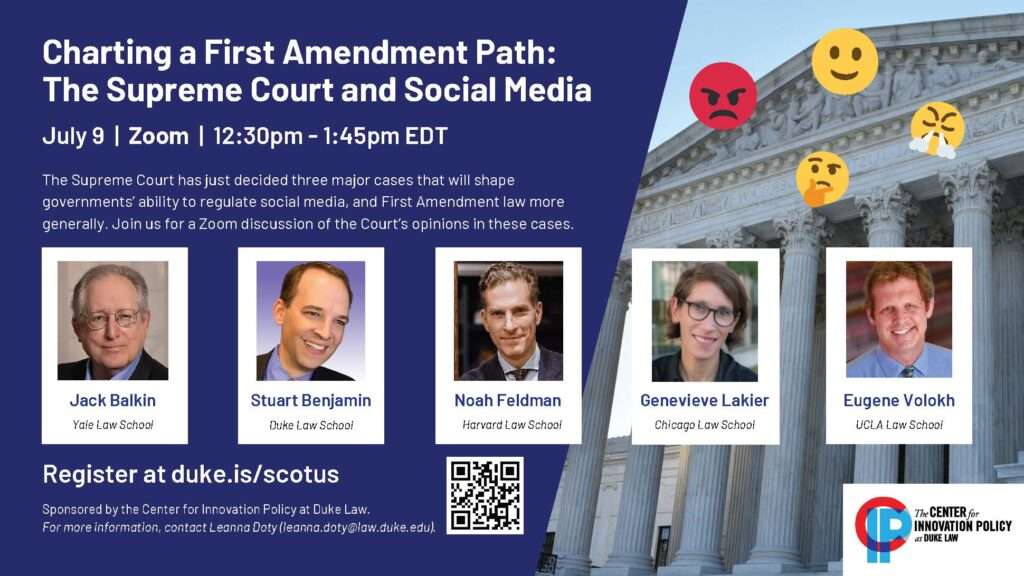
Anyway, I'm guessing Eugene and I will discuss this at the upcoming online symposium on these cases. See below to sign up for what passes for fireworks among law professors.
It was not my plan to publish two media articles on the same day, and certainly not on a day when there are also major Supreme Court decisions. But today, the Spectator, a British publication, posted my new article on why opening doors to immigration is not merely charity for immigrants, but also benefits receiving-country natives. I did not intend for this piece to come out on the same day as my Dispatch article on the somewhat related issue of wokeness and nationalism. But that's how the two publications' timing worked out. Conspiracy-mongers (and not justVolokh Conspiracy-mongers) will, of course, suspect collusion!
Unfortunately, the Spectator does not generally include hyperlinks, which is why there are none in this article. However, the article is based in large part on a longer paper that is scheduled to be published by Institute of Economic Affairs. The IEA paper builds on material from my 2023 Public Affairs Quarterly article, "Immigration and the Economic Freedom of Natives." I will post a link to the IEA paper when it's up. In the meantime, here's an excerpt from the Spectator piece:
The 2024 general election 'should be the immigration election', Nigel Farage has said. The Reform leader's wish has been granted: the topic of immigration is a major focus of debate. It's also a big issue in the United States' presidential election. Much of the debate in both countries depicts immigrants as a burden that receiving countries should accept (if at all) only out of altruism or a sense of obligation. But this is misleading, and ignores the many benefits of migration to Britain and other receiving countries.
Accepting migrants is the right thing to do, in part because it saves many thousands of people from what would otherwise likely be a lifetime of poverty and oppression…. But opening doors to such people also benefits Britain. Immigrants work, start businesses, and contribute to scientific innovation, often at higher rates than native-born citizens. That greatly benefits current UK citizens, as well as migrants themselves….
The United States is often considered the 'nation of immigrants'. But Britain also has a long history of welcoming immigrants and benefiting from their contributions. Huguenot Protestant refugees fleeing repression in 17th and 18th century France played an important role in the early development of Britain's economy, and the beginnings of the industrial revolution. More recently, Jewish and other refugees fleeing Nazi Germany contributed to scientific development, including weapons systems crucial to winning World War II. In the post-war era, British economic growth and scientific research was significantly bolstered by migrants from South Asia, Africa, the Caribbean, and elsewhere….
Today, in Britain, as in the US, immigrants play a disproportionate role starting new businesses. A 2023 study found that 39 per cent of the 100 fastest-growing UK companies have an immigrant founder or co-founder, even though immigrants are only 14.5 per cent of the UK population. UK immigrants are also substantially more likely to start businesses than natives, and engage in other types of entrepreneurship. Such businesses contribute to growth and innovation, and provide valuable job opportunities for both immigrants and natives….
The benefits of immigration can be literally life-saving. The first two successful Covid-19 vaccines were developed in large part thanks to immigrants or the children thereof. Some fear that immigration will overburden the government budget. But most immigrants actually contribute more to the public purse than they take out. The economist Jonathan Portes finds that government data showed that recent increases in migration (which allowed in about 350,000 more migrants than previously expected) could, on net, increase government revenue by about £5 billion per year. The long-term fiscal benefits of higher immigration are likely to be much greater….
Other parts of the article address the issue of illegal migration, and the argument (increasingly prominent in the UK) that migration causes housing shortages.
I am about to depart for a trip to the UK, where I will be giving several lectures and talks, including on migration-related topics.
The laws, from Florida and Texas, restrict the ability of social-media platforms to control whether and how third-party posts are presented to other users … [including by] requir[ing] a platform to provide an individualized explanation to a user if it removes or alters her posts….
Analyzing whether these requirements are sound, the majority held, "means asking," as to each kind of content moderation decision, "whether the required disclosures unduly burden" the platforms' own expression:
[R]equirements of that kind violate the First Amendment if they unduly burden expressive activity. See Zauderer v. Office of Disciplinary Counsel of Supreme Court of Ohio (1985). So our explanation of why Facebook and YouTube are engaged in expression when they make content-moderation choices in their main feeds should inform the courts' further consideration of that issue.
For more on that "main feeds" question, and on the Court's not deciding the First Amendment questions raised by any of the platforms' other functions, see this post. As to the Zauderer "unduly burden expressive activity" standard, especially as applied outside the original Zauderer context of commercial advertising, see NIFLA v. Becerra(2018).
All this suggests that the individualized-explanation requirement are more likely to be invalid as to decisions about what to include in the "main feeds," and more likely to be valid as to decisions about whether to delete a post outright, or ban a user outright. But even that is not entirely clear. For a thoughtful, detailed treatment of the laws' practical effects (which is what the majority seems to be calling for), see Daphne Keller's Platform Transparency and the First Amendment article.
The majority opinion makes clear that social media content moderation is an activity protected by the First Amendment. That likely dooms large parts of the state laws restricting content moderation.
In today's ruling in Moody v. NetChoice, addressing challenges to Texas and Florida laws severely limiting social media content moderation, the Supreme Court declined to issue a final ruling on the merits, for procedural reasons. But in remanding the cases to the lower courts, Justice Elena Kagan's majority opinion also established standards under which the major provisions of the two laws would almost certainly have to be ruled unconstitutional. I was highly critical of last week's decision denying standing to plaintiffs challenging the federal government's efforts to pressure social media firms to take down posts. Today's ruling is far better. Hopefully, the Court will eventually make clear that the government is presumptively barred from either forcing social media providers to take down posts it disapproves of or forcing them to post material the website owners object to.
The reason why the Court decided not to issue a final decision is that the lower courts did not engage in extensive enough fact-finding and analysis to consider a facial challenge to the constitutionality of the laws as a whole:
Today, we vacate both decisions for reasons separate from the First Amendment merits, because neither Court of Appeals properly considered the facial nature of NetChoice's challenge. The courts mainly addressed what the parties had focused on. And the parties mainly argued these cases as if the laws applied only to the curated feeds offered by the largest and most paradigmatic social-media platforms…. But argument in this Court revealed that the laws might apply to, and differently affect, other kinds of websites and apps. In a facial challenge, that could well matter, even when the challenge is brought under the First Amendment. As explained below, the question in such a case is whether a law's unconstitutional applications are substantial compared to its constitutional ones. To make that judgment, a court must determine a law's full set of applications, evaluate which are constitutional and which are not, and compare the one to the other. Neither court performed that necessary inquiry…..
To succeed on its First Amendment claim, NetChoice must show that the law at issue (whether from Texas or from Florida) "prohibits a substantial amount of protected speech relative to its plainly legitimate sweep." Hansen, 599 U. S., at 770. None of the parties below focused on that issue; nor did the Fifth or Eleventh Circuits. But that choice, unanimous as it has been, cannot now control. Even in the First Amendment context, facial challenges are disfavored, and neither parties nor courts can disregard the requisite inquiry into how a law works in all of its applications. So on remand, each court must evaluate the full scope of the law's coverage. It must then decide which of the law's applications are constitutionally permissible and which are not, and finally weigh the one against the other. The need for NetChoice to carry its burden on those issues is the price of its decision to challenge the laws as a whole.
But in remanding the cases, the majority lays out "relevant constitutional principles, and explain[s] how" the Fifth circuit "failed to follow them" when it upheld the Texas social media (the Eleventh Circuit had invalidated most of Florida's law). The Court's three principles are devastating to the states' laws:
First, the First Amendment offers protection when an entity engaging in expressive activity, including compiling and curating others' speech, is directed to accommodate messages it would prefer to exclude. "[T]he editorial function itself is an aspect of speech." Denver Area Ed. Telecommunications Consortium, Inc. v. FCC, 518 U. S. 727, 737(1996) (plurality opinion)….. And that is as true when the content comes from third parties as when it does not. (Again, think of a newspaper opinion page or, if you prefer, a parade.) Deciding on the third-party speech that will be included in or excluded from a compilation—and then organizing and presenting the included items—is expressive activity of its own. And that activity results in a distinctive expressive product. When the government interferes with such editorial choices—say, by ordering the excluded to be included— it alters the content of the compilation. (It creates a different opinion page or parade, bearing a different message.) And in so doing—in overriding a private party's expressive choices—the government confronts the First Amendment…
Second, none of that changes just because a compiler includes most items and excludes just a few…. That was the situation in Hurley. The St. Patrick's Day parade at issue there was "eclectic": It included a "wide variety of patriotic, commercial, political, moral, artistic, religious, athletic, public service, trade union, and eleemosynary themes, as well as conflicting messages." 515 U. S., at 562. Or otherwise said, the organizers were "rather lenient in admitting participants." Id., at 569. No matter. A "narrow, succinctly articulable message is not a condition of constitutional protection." Ibid. It "is enough" for a compiler to exclude the handful of messages it most "disfavor[s]." Id., at 574….
Third, the government cannot get its way just by asserting an interest in improving, or better balancing, the marketplace of ideas. Of course, it is critically important to have a well-functioning sphere of expression, in which citizens have access to information from many sources. That's the whole project of the First Amendment. And the government can take varied measures, like enforcing competition laws, to protect that access…. But in case after case, the Court has barred the government from forcing a private speaker to present views it wished to spurn in order to rejigger the expressive realm.
Central elements of the Texas and Florida laws are unconstitutional under this approach. Social media firms are undeniably "compiling and curating others' speech" and under the state laws, they are "directed to accommodate messages [they] would prefer to exclude." The firms may choose to exclude only a small percentage of the vast rage of speech users might want to post. But the Court's second principle rightly says that doesn't matter.
Finally, if "the government cannot get its way just by asserting an interest in improving, or better balancing, the marketplace of ideas," that destroys the central rationale for the two state laws. As the Court notes later in its opinion, "improving" or "better balancing" the "marketplace" of ideas is precisely the objective of Texas's law, which was largely motivated by concerns that the social media platforms were biased against various types of right-wing speech.
Later in the opinion, Justice Kagan notes the implications for the Texas law:
The platforms may attach "warning[s], disclaimers, or general commentary"—for example, informing users that certain content has "not been verified by official sources." Id., at 75a. Likewise, they may use "information panels" to give users "context on content relating to topics and news prone to misinformation, as well as context about who submitted the content…."
But sometimes, the platforms decide, providing more information is not enough; instead, removing a post is the right course. The platforms' content-moderation policies also say when that is so. Facebook's Standards, for example, proscribe posts—with exceptions for "news-worth[iness]" and other "public interest value"—in categories and subcategories including: Violence and Criminal Behavior (e.g., violence and incitement, coordinating harm and publicizing crime, fraud and deception); Safety (e.g., suicide and self-injury, sexual exploitation, bullying and harassment); Objectionable Content (e.g., hate speech, violent and graphic content); Integrity and Authenticity (e.g., false news, manipulated media). Id., at 412a–415a, 441a–442a…. The platforms thus unabashedly control the content that will appear to users, exercising authority to remove, label or demote messages they disfavor….
Except that Texas's law limits their power to do so. As noted earlier, the law's central provision prohibits the large social-media platforms (and maybe other entities6) from "censor[ing]" a "user's expression" based on its "viewpoint."§143A.002(a)(2); see supra, at 7. The law defines "expression" broadly, thus including pretty much anything that might be posted. See §143A.001(2). And it defines "censor" to mean "block, ban, remove, deplatform, demonetize, deboost, restrict, deny equal access or visibility to, or otherwise discriminate against expression." §143A.001(1).7 That is a long list of verbs, but it comes down to this: The platforms cannot do any of the things they typically do (on their main feeds) to posts they disapprove—cannot demote, label, or remove them whenever the action is based on the post's viewpoint….
And we have time and again held that type of regulation to interfere with protected speech. Like the editors, cable operators, and parade organizers this Court has previously considered, the major social-media platforms are in the business, when curating their feeds, of combining "multi-farious voices" to create a distinctive expressive offering. Hurley, 515 U. S., at 569. The individual messages may originate with third parties, but the larger offering is the platform's. It is the product of a wealth of choices about whether—and, if so, how—to convey posts having a certain content or viewpoint. Those choices rest on a set of beliefs about which messages are appropriate and which are not (or which are more appropriate and which less so). And in the aggregate they give the feed a particular expressive quality.
I think the Court's principles are broad enough to justify facial invalidation of the Texas and Florida laws, because ruling that the restrictions on social-media content moderation are unconstitutional is enough to show that the laws "prohibit… a substantial amount of protected speech relative to [their] plainly legitimate sweep." But even if the facial challenges fail, the social media firms could easily file as-applied challenges focusing more narrowly on content moderation. And those would almost certainly succeed.
In his opinion concurring in judgment, Justice Samuel Alito (joined by Gorsuch and Thomas) claims the Court's discussion of First Amendment standards is merely nonbinding dicta. But it pretty obviously sets out principles the lower courts must follow on remand.
Alito also argues that not enough is known about the firms' content moderation policies, and how their content moderation policies work, in part because the firms have not fully revealed how their algorithms function. But, as the majority shows, we do know enough to see that the major social media firms do restrict posts based on content, and that they favor some messages, while disfavoring others. That's exactly why the states decided to enact the challenged laws in the first place!
The dissent's argument that there are different social media platforms with different contents also doesn't do much to undercut the majority. All of the major platforms have extensive expressive content, and all impose editorial restrictions based at least in part on the subject matter and viewpoint. Perhaps this is less true of some platforms (such as Etsy) which mainly just let users sell products, rather than convey messages. But the Texas and Florida laws cover enough political and social commentary that they clearly "prohibit… a substantial amount of protected speech relative to [their] plainly legitimate sweep."
Justice Alito also alludes, briefly, to the major social media platforms' extensive reach and influence. Interestingly, this issue - much focused on by commentators on these cases - plays almost no role in the majority's analysis, and only a minor one in the dissent. The same goes for the argument that social media firms' content moderation policies can be regulated because the firms are similar to "common carriers." The majority doesn't explicitly mention this theory, though much of its analysis implicitly rebuts it, by pointing out the many ways in which social media firms do not simply serve all comers. Justice Alito only briefly mentions the common carrier theory in a footnote. I criticized the common carrier and influence arguments in detail here.
In sum, while the Court did not reach a decision on the merits, the standards it lays out are an important win for the social media firms - and for freedom of speech.
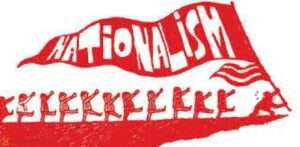
Today, The Dispatch published my article entitled "Wokeness is Awful. Nationalism is Far Worse." Many of my center-right and libertarian friends and acquaintances fear wokeness more than any other current ideological trend. I have long wanted to do a piece on why that prioritization is misguided. This is it. Here is an excerpt:
But concerns about wokeness have distracted many on the center-right from a more serious danger, one far more likely to gain widespread support and cause great harm: nationalism. Terrible woke ideas should be criticized. However, their impact is limited by the smaller numbers of their proponents. Nationalists are far more numerous. And if nationalists acquire the power they seek, they would implement an agenda that does great harm to the lives, freedom, and well-being of millions of people.
Wokeness should neither be neglected nor treated as harmless. But when comparing the two, the nationalist threat should take priority. It's long past time for right-leaning critics of both ideologies to treat nationalism for what it is: the greatest threat to liberal democratic institutions today….
For all their mutual hostility, right-wing nationalists and left-wing wokeists actually have much in common. Both groups treat racial and ethnic identity as fundamental and largely immutable. Both want the government to actively promote the interests of some ethnic or cultural groups relative to others. And most of all, both assume a zero-sum world where gains for one group can only come at the expense of others.
But though wokeists and nationalists engage in a similar identity politics, the latter are far more dangerous. Why? In large part, because an identity politics movement promoting the supposed interests of the ethnic majority has a much greater chance of political success in a democratic society than one focused on minority groups….
History also shows nationalist movements are a menace to liberal political institutions. Whether in 1930s Germany or present-day Russia, nationalist movements have subverted liberal democracy and installed brutal dictatorships in its place. By contrast, not a single wokeist egalitarian movement has achieved such a result….
The rest of the article substantiates these points in greater detail.
Worth noting, perhaps, that communists did, of course, install horrific dictatorships in many countries. But communism isn't a woke ideology focused on racial and ethnic grievances. It's a universalist ideology, one that routinely repressed ethnic minorities where it comes to power.
Sign up here to receive all of the new Volokh Conspiracy posts in a daily e-mail.
The All-Argentina Issue is Here
New from Reason: a look into what Javier Milei
has accomplished and what it will take to make the most of Argentina’s window for real change. Out now
for subscribers.