[We hold that] the Fearless Strivers Grant Contest, an entrepreneurship funding competition open only to businesses owned by black women, [likely] violates 42 U.S.C. § 1981, which prohibits private parties from discriminating on the basis of race when making or enforcing contracts …, [and] is … unlikely to enjoy First Amendment protection ….
[The] stated mission [of Fearless Fund] is to "bridge the gap in venture capital funding for women of color founders building scalable, growth aggressive companies." In pursuit of that mission, Fearless supplies grants to businesses under its "Foundation" arm. Fearless makes those grants on the basis of a competitive application process.
The "Fearless Strivers Grant Contest" offers four winners $20,000 apiece and digital tools to assist with business growth, as well as mentorship….
The panel majority began by concluding that the contest is likely covered by 42 U.S.C. § 1981, a federal law that has been read as generally banning race discrimination (but not discrimination based on sex, religion, sexual orientation, and so on) in all public or private contracts (not just employment, public accommodations, education, and the like):
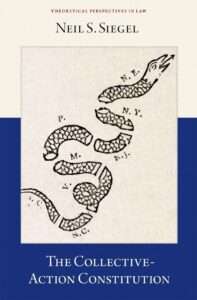
The Collective-Action Constitution blends law, history, political science, and economics to offer a broad, deep theory of the U.S. Constitution's federal structure. The book argues that the Constitution's primary structural purpose, both originally and today, is to empower the federal government to solve collective-action problems for the states and to prevent the states from undermining these solutions or causing such problems. Any faithful account of what the Constitution is for and how it should be interpreted should include this main structural function.
The Constitution was established principally because of the widely recognized failures of its predecessor, the Articles of Confederation, to adequately address multistate collective-action problems. These problems included funding the national government, regulating foreign and interstate commerce, and defending the nation. Such challenges are called collective-action problems because the states needed to act collectively, not individually, to solve them, and they often struggled to do so. By empowering Congress to solve collective-action problems and by creating a national executive and judiciary to enforce federal law, the Constitution promised a substantially more effective federal government.
In a fundamental sense, the U.S. Constitution is the Collective-Action Constitution. If Americans do not recognize this truth, government cannot adequately address the sobering problems facing America today. Examples include foreign aggression, immigration, terrorism, nuclear proliferation, inadequate access to health care, climate change, pandemics, opioid addiction, gun violence, racism, other bigotry, income inequality, and political extremism.
State governments can address aspects of these problems. The states are the default regulators in the American system, and they can handle many problems entirely or partially on their own. But states acting individually cannot succeed in solving the above problems no matter how effective their governance structures or political leaders are. The problems are too large—their scope transcends state borders. To solve them, the states must act collectively, not just individually.
Some states may succeed in acting collectively to some extent by creating interstate compacts or informal agreements if they can unanimously agree. There are contemporary examples of even many states acting collectively. But it is increasingly likely that states will fail to act collectively as the number of states that must cooperate or coordinate rises, and the number of states required to act collectively increases with the scope of the problem. According to the book's arithmetic, only around 200 interstate compacts exist today, and the median number of states per compact is 3. Moreover, even when some states do act collectively, they may harm other states or the federal government, and they may trigger disagreements over whether they are solving or creating a collective-action problem. These concerns explain why the third clause of Article I, Section 10, presumptively prohibits interstate compacts and requires Congress to approve them.
As noted, this is not the first time that the states have needed to act collectively to overcome daunting challenges. Under the Articles of Confederation, the Confederation Congress had no dependable source of tax revenue. It also lacked the powers needed to protect the states from commercial and military warfare waged by European powers, and from commercial (and potentially military) warfare waged by one another. The states proved largely unable to solve these difficulties on their own. They mostly acted individually when then needed to act collectively, and the most influential and insightful of the Constitution's Framers—including James Madison, Alexander Hamilton, James Wilson, and George Washington—concluded from experience that the states could not reliably achieve an end when doing so required two or more of them to cooperate or coordinate.
The solution they proposed was to establish a more comprehensive unit of government—a national government with robust authority to tax, regulate interstate and foreign commerce, raise and support a military, conduct foreign relations, perform other vital functions, and act directly on individuals, not indirectly through the states. The Constitutional Convention of 1787 thus instructed its Committee of Detail, which drafted constitutional text reflecting the decisions of the Convention, that Congress would possess power "to legislate in all Cases for the general Interests of the Union, and also in those Cases to which the States are separately incompetent, or in which the Harmony of the United States may be interrupted by the Exercise of individual Legislation." Called Resolution VI, the Committee took this language and, to actualize its primary objectives in more determinate form, produced Article I, Section 8, home to most of Congress's legislative powers. The Convention adopted Section 8 without much controversy. State ratifying conventions made Section 8 and many other constitutional provisions and principles that share its purposes "the supreme Law of the Land," to quote Article VI.
Supporters of the Constitution did not reference the modern term "collective-action problems," but many came close, including in Resolution VI. More importantly, they knew such problems when they saw them. When certain activities spilled over from one state to another, nationalist Founders recognized that the uncooperative or uncoordinated actions of individual states produced harmful results for the nation as a whole—the definition of a collective-action problem. In the system the Constitution created, the federal government is designed to be the smallest unit of government that fully internalizes the effects of these spillovers. Because the federal government can internalize the effects, and because it operates through (super)majority rule rather than unanimity rule, it will often be structurally better situated than the states to solve collective-action problems caused by intestate spillovers.
Such collective-action problems take three forms. First, cooperation problems arise when all members of a group of states prefer that every member cooperate rather than that every member not cooperate, but some or all group members prefer to achieve their most desired outcome without in effect paying for it—they prefer not to cooperate while others do. The Prisoners' Dilemma, a famous example of this kind of collective-action problem, captures situations in which states "free ride" off the contributions of other states to collective action or "race to the bottom" because some states disadvantage themselves relative to others by regulating businesses or individuals in ways that other states do not.
Second, coordination problems arise when some or all states would need to coordinate their behavior to solve a problem but there are multiple ways of doing so and there may be disagreements about how to do so. For example, creating national networks of transportation and communication would require the states to coordinate their regulatory behavior.
These classic collective-action problems of game theory can be called "Pareto collective-action problems" because all states would be better off by their own estimations if collective action succeeded. Given the number of states and the extraordinarily demanding requirement (called Pareto optimality) that all states be better off, Congress would almost never be able to act if it were authorized to solve only Pareto collective-action problems.
By contrast, a third category of collective-action problems, which The Collective-Action Constitution calls "cost-benefit collective-action problems," refers to certain situations in which some states would regard themselves as better off if collective action succeeded but other states would deem themselves worse off. Almost all multistate collective-action problems in U.S. history are of this variety. (For example, Rhode Island boycotted the Constitutional Convention.) When collective-action reasoning is relevant to the scope of federal power, Congress, as only governmental institution in which all states and individuals are represented, is authorized to resolve disagreements among states over whether collective action should succeed if Congress rationally determines that its intervention would help the one group of states more than it would harm the other. This requirement is called cost-benefit optimality. When the book references multistate collective-action problems, it includes both Pareto and cost-benefit collective-action problems.
Managing collective-action problems is not the Constitution's only structural function, and The Collective-Action Constitution honors the additional purposes of preserving state regulatory authority and separating and mixing federal powers to make the exercise of federal authority safe for state autonomy and individual liberty. Vindicating these purposes requires constitutional and practical limits on federal power, and the book endorses many of them. But when constitutional meaning is uncertain and there are conflicts among these purposes, the Constitution's collective-action objective should generally prevail. To a significant extent, the Constitution is the Collective-Action Constitution—both because a collective-action account possesses significant descriptive power originally and today, and because it is normatively attractive. The main goal of the Collective-Action Constitution is not to achieve economic efficiency, but to sustain political and economic union.
The book argues that the structural elements of the Constitution should be interpreted in a way that empowers the federal government to address collective action problems facing the states.
I am pleased to announce that Professor Neil Siegel (Duke University School of Law) will be guest-blogging this week about his important new book The Collective-Action Constitution. Neil is a prominent and widely cited scholar on a variety of structural constitutional issues, and his new book is a major contribution to the field. It is of obvious interest to students of federalism, constitutional theory, and related issues.
Here is the description provided by the publisher (Oxford University Press):
The United States Constitution was established primarily because of the widely recognized failures of its predecessor, the Articles of Confederation, to adequately address "collective-action problems" facing the states. These problems included funding the national government, regulating foreign and interstate commerce, and defending the nation from attack. Meeting such challenges required the states to cooperate or coordinate their behavior, but they often struggled to do so both inside and outside the Confederation Congress. By empowering Congress to solve collective-action problems, and by creating a national executive and judiciary to enforce federal law, the Constitution promised a substantially more effective federal government.
An important read for scholars, lawyers, judges, and students alike, Neil Siegel's The Collective-Action Constitution addresses how the U.S. Constitution is, in a fundamental sense, the Collective-Action Constitution. Any faithful account of what the Constitution is for and how it should be interpreted must include the primary structural purpose of empowering the federal government to solve collective-action problems for the states and preventing them from causing such problems. This book offers a thorough examination of the collective-action principles animating the structure of the Constitution and how they should be applied to meet many of the most daunting challenges facing American society today.
Back in 2011, I wrote a Jotwell essay recommending and reviewing the law journal article (coauthored by Neil with Robert Cooter) that first presented the argument developed far more extensively in the book.
We welcome Neil, and very much look forward to his guest posts!
This was written shortly after the death of Navalny (a leading Russian dissident) in a Russian prison in February, but I just heard it yesterday. The words were written by Leonid Kaganov, and the performer is the prominent Russian musician Vasia Oblomov (the stage name of Vasiliy Goncharov), who now lives in the U.S.
Here's my attempt at translation:
Now, far from here there lies an empty grave.
We waited for a miracle; well, this was it.
It spoke to us, gave us faith as a gift
By deeds and words, irony and example.
For us was performed again the Biblical evil drama,
Where they heal with a word and chase the frauds from the temple,
Where to be loved by millions, they submit to the prejudged indictments,
Surrender to the Sanhedrin, to be crucified on Friday—
For their not tolerating falsehood, for their passion for the cause,
And who can be surprised that the earthly body has vanished?
But the spirit will be resurrected on the screens and arises as a living icon,
And the tyrants will tremble under the thick concrete prison beds,
It's often instructive to compare entries in older and newer versions of Black's Law Dictionary—and on subjects I work on, the older ones are usually better. An example is the entry for equity.
Compare the fourth (1968) and eleventh (2014) editions. In particular, note that the older entry for equity (1) emphasizes more that equity is constrained internally, but also (2) emphasizes that equity is distinctive. The newer definition does not emphasize equitable constraints to the same degree, and it positively denies that equity is distinctive.
Both present equity as historically contingent (that's good). But the newer entry is much more equity skeptical--suggesting it is a pointless historical appendix, no longer connected to natural justice and no longer having any distinctive job to do. That is consistent with the regrettable epigram at the beginning of Reading Law, which quotes a false dichotomy from a great anti-equity lawyer of the eighteenth century. The older definition also gives more of the texture of equitable doctrine, including a brief elaboration of the three jurisdictions of equity, though without using the word ("That part of the law which . . . .").
One other interesting feature of the newer entry is that it can't be justified on the grounds that it cites more current authority. It reflects a sharply different conception of equity and its place within the contemporary legal firmament. But it does not rely on newer authority--I think no authority more recent than 1968 is even cited.
Most debates about judicial reform are predictable and pointless. Progressives, who are unhappy with the current right-leaning judiciary, propose reforms that make it harder for conservatives to prevail in court. Conservatives, who are pleased with the current right-leaning judiciary, oppose reforms that make it harder for conservatives to prevail in court. The federal courts cannot be reformed through unilateral disarmament. Rather, any federal judicial reform must be bilateral.
My new Article, titled Bilateral Judicial Reform, offers ten neutral proposals that would equally weaken the right and the left. The article will be published in the Texas A&M Journal of Law and Civil Governance.
Most of these reforms, including expansion of mandatory jurisdiction, would require statutory amendments, though some proposals could be achieved through court rules. Here at least, I'm agnostic where the reform comes from. It is always better if courts self-regulate. I'll admit up front that some of these proposals are off-the-wall, and are primarily intended to stimulate debate, rather than to create a decisive action plan. A few of these proposals may create problems with judicial independence and the separation of powers, though I think they ultimately pass muster, or at least occupy a gray zone. My hope is that through some outside-the-box thinking, I can put ideas into the ether that eventually coalesce into tangible proposals.
This article is still in draft form, so I welcome feedback and comments.
Part I introduces the first grouping of reforms about the Supreme Court Justices.
Proposal #1: Require Justices to ride circuit and preside when federal courts of appeals sit en banc.
Proposal #1 would bring the Justices closer to the inferior courts, and to the people. Under this proposal, whenever a circuit court sits en banc, the circuit justice would preside. Should the case then be appealed to the Supreme Court, the Circuit Justice would not need to recuse. And unlike the current practice, the circuit justices would rotate each year, so each member of the Court would, over time, visit courts throughout the nation. This proposal would promote both vertical and horizontal judicial comity. Moreover, the Justices may get a better sense of which petitions warrant a grant by hearing from colleagues on the lower court.
Proposal #2: Impose statutory caps for outside income earned through book royalties, advances, and other similar business dealings.
Proposal #2 limits a Justice's ability to profit off their position. In recent years, new Justices have signed lucrative book deals that pay millions of dollars. While there are caps on how much Justices can earn from outside sources, there is a glaring loophole for advances on royalties. As a result, book publishers can give a Justice what is in effect an indefinite interest free loan that is ten times greater than their annual salary. In theory at least, the Justices would have to pay back any unearned royalties, but I am skeptical that loan would ever be called on during a Justice's life. I am confident that outside groups will feel pressure to buy copies of the book to ensure a Justice's attendance at a public event, and book signing. There is no way to avoid this conflict when the pressure exists to repay the royalty advance. Proposal #2 would simply include advances on royalties in the current cap on outside income. The Justices can continue to write books, but cannot earn millions of dollars off the prestige of their judgeships. If the Justices lose the motivation to write books without cushy royalty payments, they can use that found time to read more cert petitions.
Part II introduces the second grouping of reforms about the Supreme Court's docket.
Proposal #3: Mandate that the Supreme Court remains in session year-round, with at least one public sitting for oral argument and one conference per calendar month.
Proposal #3 would eliminate the current October-June schedule. Instead, the Justices would remain in session year-round. Each month, the Justices would hold at least one public sitting for oral argument, which would entail at least one conference to vote on the argued cases. This proposal has several virtues. The Justices would no longer feel compelled to rush out a decision argued in April by the end of June, solely to meet some artificial vacation-induced deadline. This proposal would also allow the Court to grant cert petitions year round, and avoid the dead pool that is the long conference. This proposal can be implemented by the Court on its own, or through Congress.
Proposal #4: Establish a standard timeline for review of petitions and applications on the merits, emergency, and capital dockets.
Proposal #4 would make the Supreme Court's calendar more predictable, as the Justices would follow a timeline to resolve cases. First, on the merits docket, the Court would have to rule on a petition for certiorari within ninety days after it is filed. If the court does not act on the petition within that window, the petition would be denied as a matter of law. Second, if the Court fails to act on an emergency application on the emergency docket within the span of two weeks, the application will be denied as a matter of law. Third, on the capital docket, emergency appeals that are filed less than six days before the death warrant expires would (generally) be denied as a matter of law. (I say generally because there are exceptions.) This proposal would severely curtail the eleventh hour filings that force the courts to rush through capital cases in limited time.
Proposal #5: Appeals in the Court's mandatory jurisdiction must be scheduled for oral argument.
Proposal #5 would require the Court to hold oral argument for any case in the mandatory jurisdiction. (And Proposals #8 and #9 below will further expand the Court's mandatory jurisdiction.) In theory at least, the Court could still issue a one-sentence summary affirmance of a mandatory jurisdiction case. But I suspect that going through the motions of oral arguments will trigger the Justices to develop a fully-reasoned opinion. (I am less confident that Congress could mandate that the Justices write an opinion of some length in any particular case.)
Part III introduces the third grouping of reforms about litigation in the lower courts.
New York state courts must rule quickly and separately, if they can under New York law, on the constitutionality under the First Amendment of President Trump's recent criminal convictions.
As I wrote earlier on this blog site, President Donald Trump's First Amendment freedom of speech rights render his recent convictions in a Manhattan New York State trial court unconstitutional. The unconstitutional trial that President Trump was subjected to occurred in the most liberal borough, of the most liberal city, of one of the most liberal States in the country. This unconstitutional trial has poisoned the ongoing federal presidential election of 2024 based on a misinterpretation of federal election law making immediate federal Supreme Court review essential. The New York Court of Appeals must rule quickly on the constitutionality of President Trump's convictions, so that President Trump can get federal Supreme Court review of his First Amendment claims well before the November presidential election. American voters deserve to know as fast as possible if President Trump's criminal convictions are unconstitutional, as I believe them to be.
There are many issues of state law on which President Trump can and should appeal his convictions due to the improper behavior of both the trial judge and the district attorney. But, it is imperative that those issues be separated, if possible under New York law, from the federal question of the violation of President Trump's First Amendment rights so that that issue can be addressed quickly by the federal Supreme Court. President Trump should ask for a bifurcated appeals process whereby his First Amendment federal question gets ruled on immediately by the New York Court of Appeals, even as a longer appellate process takes place to consider President Trump's many New York State law claims on appeal.
28 U.S.C. Section 1257(a) provides that: "Final judgments or decrees rendered by the highest court of a State in which a decision could be had, may be reviewed by the Supreme Court by writ of certiorari *** where any title, right, privilege, or immunity is specially set up or claimed under the Constitution or the treaties or statutes of*** the United States." President Trump's claim that his recent convictions are in violation of the First Amendment are reviewable by the federal Supreme Court by a writ of certiorari once the New York Court of Appeals has ruled on them.
It is clear under U.S. Supreme Court caselaw that President Trump need not exhaust all of his many appeals under New York State law before the U.S. Supreme Court can rule on his First Amendment freedom of speech claims. In Cox Broadcasting v. Cohn, 420 U.S. 469 (1975), the Supreme Court held that a ruling by the highest court of a State on a federal question is a "Final judgment" even if there may still be state court proceedings going on under which President Trump could get his convictions reversed.
In fact, the Supreme Court in Cox Broadcasting v. Cohn said that "There are now at least four categories of *** cases in which the Court has treated the decision on the federal issue as a final judgment for the purposes of 28 U.S.C. Section 1257 without awaiting the completion of *** additional proceedings in the lower state courts." One such category is present here where President Trump's nationally important federal question as to the First Amendment might escape U.S. Supreme Court review if Trump prevails on one of his many State law grounds of appeal. See also Michigan v. Long, 463 U.S. 1032 (1983) and Radio Station WOW, Inc. v. Johnson, 326 U.S. 120 (1945) liberally construing the Final Judgment rule of 28 U.S.C. Section 1257(a).
As a matter of comity in our federal court system, it would be unconscionable for the New York State appellate courts to do anything other than to expedite U.S. Supreme Court review of President Trump's federal constitutional claims. American voters need to know as fast as possible whether the federal Supreme Court thinks the convictions produced in the most left-wing jurisdictions imaginable are, or are not, constitutional.
Susan Sullivan wrote an op-ed in the Philadelphia Inquirer, titled "I was a law clerk for Justice Alito. He must recuse himself from hearing cases involving Donald Trump." The subheadline is, "Flying the U.S. flag upside down, once a signal of distress, has become a symbol of those who reject the results of the 2020 presidential election. When Alito did so, it was indeed a distress call."
The op-ed introduces nothing new or original. She cites the New York Times reporting as gospel, and spends paragraphs talking about Dobbs, which has nothing to do with the flag. Let's be clear. The only reason why Sullivan placed this op-ed is that she is a former law clerk for Justice Alito. The only thing the press loves more than a conservative who criticizes conservatives is someone who worked for a conservative who criticizes her former conservative boss. Look no further than the endless stream of former people in Trump world who attack Trump.
Who is Susan Sullivan? I had never heard of her. She is an Assistant Professor in the Temple University College of Liberal Arts. She teaches classes in criminal procedure, constitutional law, and the Supreme Court. Her biography includes these lines:
Professor Sullivan graduated from Rutgers Law School, Order of the Coif in 1990. Following law school, she clerked for a federal Judge on the Third Circuit Court of Appeals (now a US Supreme Court Justice), and then practiced law as a litigator for in excess of ten years in New York and in San Francisco.
She can't even bring herself to say the name Samuel Alito in her biography. Say his name! She is willing to take the credit for the clerkship, but then throws her boss under the bus.
She describes herself this way in the Inquirer:
As a former law clerk to Justice Samuel A. Alito Jr., I often admired him as a person for his integrity and honesty. As a progressive liberal, however, I vehemently disagreed with the approach he takes to reading the Constitution, the narrow interpretation he adopts, and his reverence for the framers 'restrictive intent.'
Is it normal to say you "often" admire a judge you clerked for? When did you not?
Professor Sullivan has a special connection to Justice Alito and abortion. She graduated Rutgers in 1990, and began her Third Circuit clerkship in the fall of 1990, and finished in the summer of 1991. Planned Parenthood v. Casey was argued before the Third Circuit in February 1991, which was smack dab in the middle of Sullivan's clerkship. As all know, then-Judge Alito would have upheld the spousal notification privilege that the Casey plurality deemed unconstitutional.
In 2006, when Alito was nominated, Sullivan offered some faint praise for Alito:
Susan Sullivan of San Francisco clerked for Alito during the year he wrote his controversial Casey opinion, upholding portions of a Pennsylvania statute restricting abortion, a decision later overturned by the Supreme Court. Sullivan, who describes herself as "a social progressive who is pro-choice and anti-death penalty," says, "In general I would react with suspicion to any nominee of this administration. But having worked with him, I know he does not work toward a specific result. He is not intent on advancing his own agenda. He approaches cases in a very impartial way."
Jim Goneia and Susan Sullivan met while clerking for Judge Alito in 1990-91. They are now married, with two children. Their 9-year-old son says, "I like Judge Alito. If it weren't for him, I wouldn't exist."
Both Jim and Susan describe themselves as "social progressives" and they are both "pro-choice." But they adamantly support Judge Alito. And it's not just because of their son's existence, as good a reason as that might be. . . .
They both served with Alito during the Casey decision. And Susan replied that she would feel the same way if Roe is overturned that she did when she read Alito's dissent in Casey: she didn't agree, but she respected the process he went through to arrive at his decision.
She added that while on the 3rd Circuit, Judge Alito has both affirmed and applied Roe. . . so she doesn't believe anyone knows how he will rule in a specific case. And the fact that he has written opinions that are popular with some, and decisions that are popular with others shows his impartiality.
But things have changed. The clerk reunion will be a bit awkward.
There is a reason why conservative judges, in particular, have to screen out law clerks--progressive students will take the job, and the prestige, then proceed to attack their former boss to media plaudits.
Former New York Gov. Andrew Cuomo. (Lev Radin/ZUMAPRESS/Newscom)
In its recent decision in NRA v. Vullo, the Supreme Court unanimously ruled against the Superintendent of New York's Department of Financial Services in a case where that agency undertook various enforcement actions against financial institutions pressuring them to stop doing business with the NRA, because of that group's advocacy of gun rights. While these actions were seemingly neutral, evidence indicated that the motive behind them was an attempt to suppress the NRA's political speech.
Co-blogger Josh Blackman does not object to this result, but criticizes Justice Sonia Sotomayor's opinion for the Court for relying, in part, on tweets and other statements by then-New York Governor Andrew Cuomo. Josh complains that it's wrong to rely on Cuomo's statements because "he wasn't even a party" to the case, and fears this part of the opinion is "laying the groundwork for some future Trump litigation, where the chief executive's social media posts can be used to taint the action taken by some cabinet member…. it is almost a given that people would allege that President Trump and his administration will engage in some sort of retaliatory or coercive actions against protected speech."
As Josh notes, Trump's tweets and other statements promising a "Muslim ban" were central elements of the case against his travel ban policy, eventually upheld by the Supreme Court in Trump v. Hawaii(2018). I think the Court got that decision badly wrong. Significantly, however, Chief Justice John Roberts' majority opinion did not hold that statements like Trump's were irrelevant, merely that they would not get much weight in the context of immigration policy where the Court concluded (wrongly, in my view) that the executive should get special deference. Thus, statements indicating illicit intent could still potentially be decisive in other types of cases.
The Court was right to consider Cuomo's statements. And it should do the same in potential similar future cases involving Trump or other presidents.
Longstanding Supreme Court precedent holds - for good reason - that facially neutral policies can be unconstitutional if evidence indicates they were adopted for purposes of engaging in discrimination prohibited the Constitution, such as discrimination on the basis of race, religion, or - as in NRA v. Vullo - protected political speech. If such facially neutral policies were immune from challenge, the government could target almost any group for discrimination by focusing on some seemingly neutral characteristic that is correlated with group membership. Instead of explicitly targeting blacks, they could target people who live in majority-black neighborhoods. Instead of openly targeting Muslims, they could (as Trump did) target migrants from various Muslim-majority nations. And so on.
Such tactics were extensively used by advocates of Jim Crow segregation, when courts started striking down explicit segregation laws. More recently, educational institutions have used them as a tool for engaging in racial preferences banned by Supreme Court rulings.
Why consider a governor's or president's statements in cases challenging policies enacted by subordinate officials? The obvious answer is that the former often influence the latter. As Justice Sotomayor notes, Governor Cuomo was "Vullo's boss." Absent his advocacy and support, it is likely she would not have targeted the NRA so aggressively. This is even more clear in the case of Trump's travel ban, a policy which almost certainly would never have been enacted absent his "Muslim ban" campaign promises.
The case for focusing on presidential motives is even more compelling if - like many conservatives - you endorse the "unitary executive" theory of presidential power, under which the president is entitled to near-total control of other executive branch officials. In that framework, subordinates have even more incentive to try to implement the "boss's" directives than in Andrew Cuomo's New York. Officials who refuse to do the boss's bidding aren't likely to be around for long.
The case for scrutinizing presidents' unconstitutional motives is often even stronger than with state governors. In many states, the executive branch is less unitary than in the federal government. For example, New York, like many other state governments, has a separately elected attorney general who is independent of the governor. This played a major role in Andrew Cuomo's eventual downfall. In late 2021, he was forced to resign in large part because of an investigation into accusations of sexual harassment conducted by the New York AG's office. Although AG Letitia James is a Democrat, her independence enabled her office to do the investigation, and Cuomo could not prevent it. The president exercises far more control over the federal Department of Justice, and other parts of the federal executive branch.
In the case of both state and federal officials, the government can still successfully defend a challenged policy if it can prove they would have enacted it even in spite of the chief executive's illicit motives. Vullo has advanced that argument in the NRA case. But Supreme Court precedent rightly shifts the burden of proof to the government in a case where evidence of unconstitutional discriminatory motivation is found.
Back in 2018, during the travel ban litigation, Josh Blackman argued courts can afford to ignore presidents' unconstitutional motives because "I don't know that we'll ever have a president again like Trump, who says such awful, awful things on a daily basis." I was skeptical of such optimism at the time. And I think that skepticism has been vindicated by later events.
Obviously, Trump himself may well be elected again in 2024. And he has already promised to use the power of the federal government to punish his critics. If he does indeed return to power and subordinate officials take actions that appear to implement that promise, courts can and should consider Trump's statements when assessing their legality. Meanwhile, other Republican politicians have increasingly imitated Trump's behavior and policies. Even if he loses again and disappears from the political scene, this problem is unlikely to fully go away.
As NRA v. Vullo shows, left-wing officials also sometimes engage in such behavior. The Democrats may not be as far-gone as the Republicans. But they, too, aren't above using facially neutral policies to cloak unconstitutional motives, including in cases where the latter are evident from various public statements. Particularly in an age of severe polarization, where many on both sides are eager to use the power of government to target their enemies, such behavior is unlikely to go away anytime soon. Judicial review cannot completely prevent such abuses of power. But by paying due attention to illicit unconstitutional motives, it can help curb them substantially.
Many people have asked me whether my volokh at law.ucla.edu e-mail address will continue to keep working. It will, because I will remain affiliated with UCLA as an emeritus professor (effective July 1); my official title will be Gary T. Schwartz Distinguished Professor of Law Emeritus at UCLA School of Law, as well as Distinguished Research Professor ("Research Professor" in the UC system generally means someone who has retired from teaching but continues to do scholarship).
I will also be working full-time as a Senior Fellow at the Hoover Institution at Stanford University. My official title will be Thomas M. Siebel Senior Fellow, and my e-mail address there will be volokh at stanford.edu. I will be getting e-mail sent to either address.
There are new twists in the saga of algorithmic bias and the American Privacy Rights Act, or APRA. That's the privacy bill that would have imposed race and gender quotas on AI algorithms. I covered that effort two weeks ago in a detailed article for the Volokh Conspiracy.
A lot has happened since then. Most importantly, publicity around its quota provisions forced the drafters of APRA into retreat. A new discussion draft was released, and it dropped much of the quota-driving language. Then, a day later, a House commerce subcommittee held a markup on the new draft. It was actually more of a nonmarkup markup; member after member insisted that the new draft needed further changes and then withdrew their amendments pending further discussions. With that ambiguous endorsement, the subcommittee sent APRA to the full committee.
Still, it is good news that APRA now omits the original disparate impact and quota provisions. No explanation was offered for the change, but it seems clear that few in Congress want to be seen forcing quotas into algorithmic decisionmaking.
That said, there's reason to fear that the drafters still hope to sneak algorithmic quotas into most algorithms without having to defend them. The new version of APRA has four provisions on algorithmic discrimination. First, the bill forbids the use of data in a manner that "discriminates in or otherwise makes unavailable the equal enjoyment of goods and services" on the basis of various protected characteristics. Sec. 113(a)(1). That promising start is immediately undercut by the second provision, which allows discrimination in the collection of data either to conduct "self-testing" to prevent or mitigate unlawful discrimination or to expand the pool of applicants or customers. Id. at (a)(2). The third provision requires users to assess the potential of an algorithm "to cause a harm, including harm to an individual or group of individuals on the basis of protected characteristics." Id. at (b)(1)(B)(ix). Finally, in that assessment, users must provide details of the steps they are taking to mitigate such harms "to an individual or group of individuals." Id.
The self-assessment requirement clearly pushes designers of algorithms toward fairness not simply to individuals but to demographic groups. Algorithmic harm must be assessed and mitigated not just on an individual basis but also on a group basis. Judging an individual on his or her group identity sounds a lot like discrimination, but APRA makes sure that such judgments are immune from liability; it defines discrimination to exclude measures taken to expand a customer or applicant pool.
So, despite its cryptic phrasing, APRA can easily be read as requiring that algorithms avoid harming a protected group, an interpretation that leads quickly to quotas as the best way to avoid group harm. Certainly, agency regulators would not have trouble providing guidance that gets to that result. They need only declare that an algorithm causes harm to a "group of individuals" if it does not ensure them a proportionate share in the distribution of jobs, goods, and services. Even a private company that likes quotas because they're a cheap way to avoid accusations of bias could implement them and then invoke the two statutory defenses -- that its self-assessment required an adjustment to achieve group justice, and that the adjustment is immune from discrimination lawsuits because it is designed to expand the pool of beneficiaries.
In short, while not as gobsmackingly coercive as its predecessor, the new APRA is still likely to encourage the tweaking of algorithms to reach proportionate representation, even at the cost of accuracy.
This is a big deal. It goes well beyond quotas in academic admissions and employment. It would build "group fairness" into all kinds of decision algorithms – from bail decisions, and health care to Uber trips, face recognition, and more. What's more, because it's not easy to identify how machine learning algorithms achieve their weirdly accurate results, the designers of those algorithms will be tempted to smuggle racial or gender factors into their products without telling the subjects or even the users.
This process is already well under way -- even in healthcare, where compromising the accuracy of an algorithm for the sake of proportionate outcomes can be a matter of life or death. A recent paper on algorithmic bias in health care published by the Harvard School of Public Health recommended that algorithm designers protect "certain groups" by "inserting an artificial standard in the algorithm that overemphasizes these groups and deemphasizes others."
This kind of crude intervention to confer artificial advantages by race and gender is in fact routinely recommended by experts in algorithmic bias. Thus, the McKinsey Global Institute advises designers to impose what it calls "fairness constraints" on their products to force algorithms to achieve proportional outcomes. Among the approaches it finds worthy are "post-processing techniques [that] transform some of the model's predictions after they are made in order to satisfy a fairness constraint." Another recommended approach "imposes fairness constraints on the optimization process itself." In both cases, to be clear, the model is being made less accurate in order to fit the designer's views of social justice. And in each case, the compromise will fly below the radar. The designer's social justice views are hidden by a fundamental characteristic of machine learning; the machine produces the results that the trainers reward. If they only reward results that meet certain demographic requirements, that's what the machine will produce.
If you're wondering how far from reality such constraints wander, take a look at the "text to image" results originally produced by Google Gemini. When asked for pictures of German soldiers in the 1940s, Gemini's training required that it serve up images of black and Asian Nazis. The consequences of bringing such political correctness to healthcare decisions could be devastating – and much harder to spot.
The first amendment protects the alleged payment of hush money to a porn star to influence an election outcome as the u.s. supreme court will eventually rule
President Donald Trump was convicted yesterday of allegedly altering business records to conceal his alleged payment of money to a porn star, Stormy Daniels, in order to influence the 2016 presidential election. But, altering business records under New York State law is only a crime if it is done to conceal the violation of some other law. Manhattan District Attorney Alvin Bragg alleged that the documents were allegedly falsely altered to conceal a contribution of money in violation of federal campaign finance laws or in pursuance of winning the 2016 election by defrauding the voters of information they had a right to know. Neither argument passes First Amendment scrutiny.
The federal campaign finance laws were partially upheld in Buckley v. Valeo, 424 U.S. 1 (1976). In that case, campaign expenditure limits were ruled to be flatly unconstitutional as a violation of the First Amendment's protection of freedom of speech. Under Buckley v. Valeo, an individual like Donald Trump can spend an unlimited amount of his own money promoting his own campaign. But, the Supreme Court in Buckley did uphold contribution limits on how much an individual or a group could contribute to influence an election. Alvin Bragg argues that the Trump organization's contribution of $130,000 to pay Stormy Daniels hush money exceeded federal campaign finance limits on contributions. The federal government itself has adopted a policy of not prosecuting hush money payments as illegal campaign contributions in the wake of its embarrassing loss of such a prosecution brought against Democratic Vice Presidential contender John Edwards. Edwards had paid hush money during the 2004 presidential election to a mistress with who he had had a child out of wedlock.
In 2010, in Citizens United v. Federal Election Commission, 558 U.S. 310, the Supreme Court held 5 to 4 that the freedom of speech clause of the First Amendment prohibits the government from restricting independent expenditures for political campaigns by closely allied corporations and groups like The Trump Organization. Under Citizens United, it was perfectly legal for The Trump Organization to pay Daniels $130,000 in hush money to conceal her alleged affair with Donald Trump.
The opinion in Citizens United was written by former Justice, and liberal icon, Anthony M. Kennedy, and it was joined by Chief Justice John Roberts, Justice Clarence Thomas, and Justice Samuel Alito all three of whom are still on the Supreme Court. Given the Court's current membership, it is highly likely that the outcome in Citizens United would prevail again today by a vote of 6 to 3. If Buckley v. Valeo was argued to be an obstacle to Trump prevailing, the Supreme Court would today, in 2024, and should today, in 2024, overrule the campaign finance contribution limits of federal election law as violations of the freedom of speech. Groups contributing to election campaigns can pay for advertising to promote candidates, and they can also pay hush money to keep bad or false stories out of the news. The effect either way is to help the candidate. You can contribute money to generate good publicity. And, you can contribute money to avoid bad publicity. The First Amendment protects freedom of speech in both cases.
Campaign finance limits prevent speech by people who want to engage in it. They have changed Congress so badly that today Members of Congress spend 70% of their time raising money rather then legislating or meeting with their constituents because of absurdly low campaign finance limits that have not been adequately raised to match inflation since those laws were enacted in the 1970's. The post-Watergate campaign finance laws were and always have been flagrantly unconstitutional in their totality.
Federal Campaign Finance laws are an incumbent protection measure that makes it too hard for challengers to knock off incumbents who have much higher name id and who have franking privileges which allow them unlimited free correspondence with their constituents through the mail. That it is not to mention the power of incumbents to steer pork-barrel spending back to their own states and districts so that they will be endlessly re-elected.
The First Amendment Freedom of Speech Clause also rules out of order Alvin Bragg's argument that Trump defrauded American voters by preventing them from hearing about Trump's affair with Stormy Daniels. Theories as broad as this one is, of "defrauding voters" would end up eliminating the freedom of speech in American elections. Voters had no "right" to know about Donald Trump's sex life. He was obviously not monogamous being married to a third wife, and voters who adhere to traditional values voted for him anyway because of the kind of stellar conservative justices he went on to appoint to the Supreme Court.
There was thus no predicate crime that Trump could have been concealing when he allegedly altered business records at The Trump Organization. Trump's convictions in the Manhattan trial are unconstitutional because they violate the First Amendment as it was originally understood.
The U.S. Supreme Court needs to hear this case as soon as possible because of its impact on the 2024 presidential election between President Trump and President Biden. Voters need to know that the Constitution protected everything Trump is alleged to have done with respect to allegedly paying hush money to Stormy Daniels. This is especially the case because the trial judge in Trump's Manhattan case wrongly allowed Stormy Daniels to testify in graphic detail about the sexual aspects of her alleged affair with Trump. This testimony tainted the jury and the 2024 national presidential electorate, impermissibly, and was irrelevant to the question of whether President Trump altered business records to conceal a crime. The federal Supreme Court needs to make clear what are the legal rules in matters of great consequence to an election to a federal office like the presidency. A highly partisan borough, Manhattan, of a highly partisan city, New York City, in a highly partisan state, like New York State, cannot be allowed to criminalize the conduct of presidential candidates in ways that violate the federal constitution.
The Roman Republic fell when politicians began criminalizing politics. I am gravely worried that we are seeing that pattern repeat itself in the present-day United States. It is quite simply wrong to criminalize political differences.
Judge Welch presided over a civil action involving whether licensed attorneys in Arkansas are "officers of the court" and thus authorized under Arkansas Code Annotated section 5-73-122(b) to carry firearms in courthouses. The plaintiffs were Arkansas attorneys. Their complaint sought a declaratory judgment and injunctive relief. The defendants—the Pulaski County Sheriff and the Pulaski County Judge—filed a motion to dismiss the complaint. Judge Welch granted the motion to dismiss. Judge Welch ruled not only that the plaintiffs were procedurally barred from bringing the action but also that "an interpretation of ACA § 5-73-122 as suggested by the Plaintiff, [would] be [u]nconstitutional." Judge Welch also concluded that the "Plaintiff's [a]rgument fails, as it is founded upon a flawed premise that mis-reads the plain meaning of ACA § 5-73-122."
The plaintiffs appealed from the dismissal order. The appeal brought the interpretation of section 5-73-122 before this court. We affirmed in part and reversed and remanded in part. We held the statute's use of "officers of the court" included attorneys and that the statute allows them to possess handguns in courthouses. We therefore concluded that "the circuit court erred when it denied … plaintiffs' petition for a declaratory judgment." The charge on remand was not complex—Judge Welch was instructed to "enter an order consistent with this opinion."
Upon remand, Judge Welch entered a "Temporary Order on Lawyer/Officer-of-the-Court Carry, Partial Stay, Notice of Hearing, and Order of Partial Dismissal." The following includes some relevant excerpts from his order:
The Opinion [referring to this court's Corbitt decision] limits the Supreme Court's Superintending Authority over courts under Amendment 80. It also creates a new class of unlicensed, heretofore untrained, armed lawyers in courthouses of the State, in apparent conflict with the myriad of legislative enactments promoting carry permits….
The "Lawyer/Officer-of-the court Carry" Opinion ("LOCO," hereafter) ….
"Stakeholders" (In addition to the Sheriff, and the other parties), including Police Chiefs, and District Court Representatives will be invited to attend and submit input, on application, as Amici. The Court anticipates more than one hearing may be necessary to implement the vision of the Supreme Court….
IT IS ORDERED that PENDING THE HEARING, further implementation of "The Lawyer/Officer-of-the court Carry" Opinion in this case SHALL BE STAYED except as concerns the FIRST FLOOR of the Pulaski County Courthouse ….
Judge Welch proceeded to enter various additional stays of this court's opinion pending a hearing scheduled in August 2024…. [W]e issued notice to Judge Welch that his order may have violated the Code of Judicial Conduct….
Please enjoy the latest edition of Short Circuit, a weekly feature written by a bunch of people at the Institute for Justice.
New on the Short Circuit podcast: How to make a mandamus claim against the Capitol Police. Plus — parental advisory! — some spicy language in the Seventh Circuit, the first reported judicial opinion in America to drop the f-bomb, and a shoutout to Adeline, Countess of Cardigan.



 The consequences of bringing such political correctness to healthcare decisions could be devastating – and much harder to spot.



