The Volokh Conspiracy

Mostly law professors | Sometimes contrarian | Often libertarian | Always independent | Est. 2002

The Volokh Conspiracy

The Ignored Aesthetic Standing Argument In FDA v. Alliance for Hippocratic Medicine

The fauna that did not bark, the flora that did not bloom.

|

In FDA v. Alliance for Hippocratic Medicine, the Court rejected three theories of standing: (1) expected conscience objections, (2) expected monetary harms, and (3) diversion of resources. However, there was another theory of standing adsressed in the Fifth Circuit that the Court did not resolve.

Judge Ho's concurrence found standing based on an aesthetic injuries.

In addition to the injuries analyzed by the majority, Plaintiffs have demonstrated another basis for Article III standing: the aesthetic injury they experience in the course of their work. See, e.g., Sierra Club v. Morton, 405 U.S. 727, 734-35, 92 S.Ct. 1361, 31 L.Ed.2d 636 (1972) (recognizing aesthetic harm as "injury to a cognizable interest"); Lujan v. Defs. of Wildlife, 504 U.S. 555, 562-63, 112 S.Ct. 2130, 119 L.Ed.2d 351 (1992) ("[T]he desire to use or observe an animal species, even for purely esthetic purposes, is undeniably a cognizable interest for purpose of standing."); id. at 566, 112 S.Ct. 2130 ("[T]he person who observes or works with a particular animal threatened by a federal decision is facing perceptible harm."). It's well established that, if a plaintiff has "concrete plans" to visit an animal's habitat and view that animal, that plaintiff suffers aesthetic injury when an agency has approved a project that threatens the animal. See Lujan, 504 U.S. at 564, 112 S.Ct. 2130. . . .

Unborn babies are a source of profound joy for those who view them. Expectant parents eagerly share ultrasound photos with loved ones. Friends and family cheer at the sight of an unborn child. Doctors delight in working with their unborn patients—and experience an aesthetic injury when they are aborted.

Plaintiffs' declarations illustrate that they experience aesthetic injury from the destruction of unborn life.

In short, if naturalists can claim an aesthetic injury to see plants and animals, then pro-life doctors could claim a similar injury with regard to newborn babies.

The Supreme Court has recognized that "the person who observes or works with a particular animal threatened by a federal decision is facing perceptible harm, since the very subject of his interest will no longer exist." Lujan, 504 U.S. at 566, 112 S.Ct. 2130. Every circuit, including our own, has concluded that, when a federal agency authorizes third parties to harm flora or fauna that a plaintiff intends to view or study, that satisfies all of the requirements for Article III standing. . . .

I see no basis for allowing Article III standing based on aesthetic injury when it comes to animals and plants—but not unborn human life.

The aesthetics argument was actually advanced in Havens Realty, a precedent that received its last rites today.

The three individual plaintiffs, who, at the time the complaint was filed, were all residents of the city of Richmond or the adjacent Henrico County averred that they had been injured by the discriminatory acts of petitioners. Coles, the black renter, claimed that he had been "denied the right to rent real property in Henrico County." Further, he and the two tester plaintiffs alleged that Havens' practices deprived them of the "important social, professional, business and economic, political and aesthetic benefits of interracial associations that arise from living in integrated communities free from discriminatory housing practices."

In other words, the plaintiffs asserted an aesthetic injury in having a racially diverse neighborhood. The Havens Court did not pass on this issue, but it also was not rejected.

On appeal, the Supreme Court could have considered the "aesthetic" standing argument raised in Judge Ho's concurrence. But Justice Kavanaugh did not. Indeed, he favorably cited some form of naturalist standing:

Consistent with that understanding of how standing principles can develop and solidify, the Court has identified a variety of familiar circumstances where government regulation of a third-party individual or business may be likely to cause injury in fact to an unregulated plaintiff. For example, when the government regulates (or under-regulates) a business, the regulation (or lack thereof ) may cause downstream or upstream economic injuries to others in the chain, such as certain manufacturers, retailers, suppliers, competitors, or customers. . . . When the government regulates parks, national forests, or bodies of water, for example, the regulation may cause harm to individual users. E.g., Summers, 555 U. S., at 494.

Why did the Court not address the aesthetic standing argument? The fauna did not bark, and the flora did not bloom.

Perhaps the Court said nothing because addressing aesthetic injury would have broken up a unanimous decision. Or the Court could not meaningfully distinguish the arguments raised in Judge Ho's concurrence from the various environmental cases.

It is also possible that the Court thought the issue was forfeited or waived. As best as I can tell, ADF did not advance the "aesthetic" injury argument in its briefing before the District Court or the Fifth Circuit. But ADF did advance the argument before the Supreme Court:

If plaintiffs have an "undeniably … cognizable interest" in avoiding the distress of losing "an animal species," Lujan v. Defs. of Wildlife, 504 U.S. 555, 562– 63 (1992), or even the chance to "view[ ] the flora and fauna," Summers v. Earth Island Inst., 555 U.S. 488, 494 (2009), then Respondent doctors have a concrete interest in avoiding heartbreaking emergency situations that require them to be complicit in a process that ends an unborn life. Pet. App. 80a–83a (Ho, J., concurring and dissenting in part) (Respondents' "aesthetic injury from the destruction of unborn life" is "cognizable"). The emotional harm Respondents suffer "suffice[s] for Article III standing." TransUnion, 594 U.S. at 440.

It is not clear to me that this issue was preserved below, so perhaps it was forfeited. California v. Texas held that even if a jurisdictional argument is not raised below, it is still forfeited. (I am still steamed about that holding years later--the issue was preserved.)

If the issue was waived, then the Court's failure to pass on it is of no moment. I do not think you can read this opinion to say anything at all about aesthetic standing.

This argument seems available for some future case.
Alabama Law Review: A Tribute to Twenty Years on the Bench - Chief Judge William H. Pryor Jr.

With contributions by Justice Thomas, Attorney General Sessions, and many Pryor clerks/mentees who became judges.

|

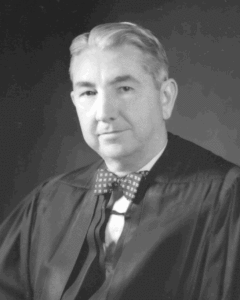
I was pleased to see that the Alabama Law Review published a symposium issue to celebrate Chief Judge Pryor's twenty years on the bench. There are essays from Justice Thomas, Attorney General Sessions, and several Pryor clerks and mentees who became judges. His accomplishments are remarkable. And Pryor, who graduated from Tulane Law School, proves how overrated Ivy League diplomas are. Pryor is one of the most influential of President Bush's circuit nominees--at least among those who were not elevated to the Supreme Court. (Another member of that list attended THE Ohio State University.)

I encourage you to read through the essays. They are short, humorous, and smart--exactly what we would expect from friends of Pryor.

Chief Judge William H. Pryor Jr.: A Tribute to Twenty Years on the Bench

Kenneth M. Rosen, A Scholarly Judge: The Honorable William Holcombe Pryor Jr.

Hon. Clarence Thomas, My Friend, Bill

Hon. Ed Carnes, Chief Judge William H. Pryor Jr. as Chief Judge

Hon. Jeff Sessions, A Man of Law, Principle, and Courage

Hon. Steven T. Marshall and Edmund G. LaCour Jr., Attorney General William H. Pryor Jr.

Hon. Andrew L. Brasher, From Clerk to Colleague

Hon. Kevin C. Newsom and Hon. Corey L. Maze, Chief Judge William H. Pryor Jr.: The Man, the Mentor, the Mensch

Hon. Anna M. Manasco, "You Can Do Better"

Hon. Sarah K. Campbell, William H. Pryor Jr.: Model of Judicial Virtue

Molly Glazner, Taylor Meehan, Kasdin Mitchell, and Hon. Kathryn Mizelle, Barbecue Mondays

Caroline Stephens Milner, From a Clerk's Perspective

Justice Kavanaugh Denies Standing For Docs Against Glocks

Doctors cannot claim an injury to challenge gun control laws because their patients may be affected by gun violence.

|

In 2011, Florida enacted a law that restricted when doctors could ask their patients if they owned a gun. The sentiment behind the law was that doctors, as a whole, were hostile to gun rights, and could not be trusted with this power. The so-called Docs v. Glocks law, however, did not survive. In 2017, the en banc Eleventh Circuit ruled that the law violated the First Amendment and violated Due Process (there were two majority opinions).

I thought of that case today while re-reading Justice Kavanaugh's standing analysis in FDA v. Alliance for Hippocratic Medicine. The doctors in that case clearly had standing because the law regulated their speech. But these same anti-gun doctors could assert standing in other cases. Imagine that some doctors who are hostile to gun rights sought standing to challenge some sort of gun control policy. The basis of their injury would be that with fewer restrictions on firearms, their patients are more likely to show up in the emergency room. I'm sure elite medical journals could pump out studies showing how that is a predictable, non-attenuated chain of consequences. That argument might have worked yesterday. But not today. AHM slammed that door shut:

In any event, and perhaps more to the point, the law has never permitted doctors to challenge the government's loosening of general public safety requirements simply because more individuals might then show up at emergency rooms or in doctors' offices with follow-on injuries. Stated otherwise, there is no Article III doctrine of "doctor standing" that allows doctors to challenge general government safety regulations. Nor will this Court now create such a novel standing doctrine out of whole cloth.

Consider some examples. . . . The government repeals certain restrictions on guns—does a surgeon have standing to sue because he might have to operate on more gunshot victims? The answer is no: The chain of causation is simply too attenuated. Allowing doctors or other healthcare providers to challenge general safety regulations as unlawfully lax would be an unprecedented and limitless approach and would allow doctors to sue in federal court to challenge almost any policy affecting public health.

I don't know if Justice Kavanaugh was thinking about Docs v. Glocks. But he is wont to reach out to decide issues that are not present. And I think this path for standing is foreclosed.

Update: On 6/14, I added these sentences: "The doctors in that case clearly had standing because the law regulated their speech. But these same anti-gun doctors could assert standing in other cases." I was making clear that in the Florida case, the doctors clearly hand standing. In this post, I was talking about a hypothetical case.

Free Speech

Prosecution for Alleged Stalking/Harassment of Israeli Tourists in N.Y. on Oct. 18, 2023 Can Go Forward

|

From New York trial judge Althea Drysdale's opinion Tuesday in People v. Amin:

This case stems from an incident where the Defendant is alleged to have stalked, taunted, and harassed a group of Israeli citizens for over ten minutes while they were sightseeing in Times Square, culminating in the assault of one of the tourists. As part of his omnibus motions, the Defendant moves to dismiss the charges of Stalking in the First Degree …, Stalking in the Third Degree …, and Aggravated Harassment …, arguing that the prosecution elicited insufficient evidence to constitute the necessary element of a "course of conduct" for those crimes. [The decision appeared not to deal with the assault charge. -EV] …

Statement of Allegations

On Wednesday, October 18, 2023 at approximately 9:30pm, the Complainant, an Israeli citizen, was visiting New York City with a group of six friends when they decided to stop by Times Square to sightsee. Several members of the group were wearing items that disclosed their religious affiliation: specifically, all five male members of the group were wearing "kippahs," traditional Jewish head-coverings also known as a "yarmulkes" as well as visible "tzitzits," which are strings that adorn the corners of a "tallit," a Jewish prayer shawl that is worn under clothing throughout the day.

After exiting the subway station located at 42nd Street and Times Square, the group was approached by a man, later identified as the Defendant, who appeared to be of Middle Eastern descent. The Complainant noticed that the Defendant was wearing what the Complainant described as a red and white "keffiyeh," a traditional headdress worn by men in the Middle East, around his head and face.

While the Defendant was initially playing what the Complainant described as "loud English music" on a speaker that he was carrying in his hand, the Complainant observed that, upon seeing the Complainant and his group of friends, the Defendant changed the music to a song in Arabic. Almost immediately after doing so, the Defendant said "Free Palestine" and stated that "the Jews have to die." The Complainant also recalled that the Defendant stated, in sum and substance, that he was "happy with what Hamas did to the Jews," and repeatedly yelled "Allah Kashi," which the Complainant understood to mean in Arabic "God is Great." The Complainant further heard the Defendant state that he was "willing to die for the sake of Gaza."

Read More

Standing

Justice Thomas Takes Aim at Associational Standing

In his AHM v. FDA concurrence, Justice Thomas suggests the Court needs to rethink associational standing and questions whether it comports with Article III.

|

Today the Supreme Court held unanimously that anti-abortion doctors lack standing to challenge the Food and Drug Administration's decisions to loosen the regulation of mifepristone. Justice Thomas wrote separately to reiterate his opposition to third-party standing and raise questions about the Court's long-standing acceptance of associational standing (and universal injunctions too). Given current pressure to rethink aspects of standing doctrine, his opinion is worth some attention.

Justice Thomas begins his opinion restating his objections to third-party standing.

Our third-party standing precedents allow a plaintiff to assert the rights of another person when the plaintiff has a "close relationship with the person who possesses the right" and "there is a hindrance to the possessor's ability to protect his own interests." . . . . Applying these precedents, the Court explains that the doctors cannot establish third-party standing to sue for violations of their patients' rights without showing an injury of their own. . .  But, there is a far simpler reason to reject this theory: Our third-party standing doctrine is mistaken. As I have previously explained, a plaintiff cannot establish an Article III case or controversy by asserting another person's rights. . . .. So, just as abortionists lack standing to assert the rights of their clients, doctors who oppose abortion cannot vicariously assert the rights of their patients.

He then goes on to note that associational standing (as opposed to organizational standing - in which an organization asserts standing to defend its own interests as an organization) can be seen as a species of third-party standing, and has some of the same problems.

Associational standing raises constitutional concerns by relaxing both the injury and redressability requirements for Article III standing. It also upsets other legal doctrines.

First, associational standing conflicts with Article III by permitting an association to assert its members' injuries instead of its own. . . . Article III does not allow a plaintiff to seek to vindicate someone else's injuries. . . . It is difficult to see why that logic should not apply with equal force to an association as to any other plaintiff. I thus have serious doubts that an association can have standing to vicariously assert a member's injury. . . .

Second, our associational-standing doctrine does not appear to comport with the requirement that the plaintiff present an injury that the court can redress. . . . The party who needs the remedy—the injured member—is not before the court. Without such members as parties to the suit, it is questionable whether "relief to these nonparties . . . exceed[s] constitutional bounds." . . . Because no party should be permitted to obtain an injunction in favor of nonparties, I have difficulty seeing why an association should be permitted to do so for its members. Associational standing thus seems to distort our traditional understanding of the judicial power.

As Justice Thomas notes, one way courts have addressed the concern about providing relief beyond the remedy to which an individual plaintiff would be entitled is through universal injunctions, but that does not really solve the underlying Article III concern.

Our precedents have provided a workaround for this obvious remedial problem through the invention of the so called "universal injunction." Universal injunctions typically "prohibit the Government from enforcing a policy with respect to anyone." . . . By providing relief beyond the parties to the case, this remedy is "legally and historically dubious." . . .  It seems no coincidence that associational standing's "emergence in the 1960s overlaps with the emergence of [this] remedial phenomenon" of a similarly questionable nature. . . . Because no party should be permitted to obtain an injunction in favor of nonparties, I have difficulty seeing why an association should be permitted to do so for its members. Associational standing thus seems to distort our traditional understanding of the judicial power.

Reliance on associational standing and universal relief, Thomas notes, "subverts the class-action mechanism" by providing a work-around to class-action rules and requirements and "creates the possibility of asymmetrical preclusion."

Associational standing may be justified and reconcilable with Article III constraints but, as Justice Thomas notes, such justification and reconciliation is not to be found in the Court's jurisprudence: "Despite its continued reliance on associational standing, the Court has yet to explain how the doctrine comports with Article III."

Justice Thomas is not the only one raising questions about associational standing. Andrew Hessick and Michael Morley make the case in opposition in a forthcoming University of Chicago Law Review article titled, appropriately enough "Against Associational Standing."

Justice Thomas concludes:

No party challenges our associational-standing doctrine today. That is understandable; the Court consistently applies the doctrine, discussing only the finer points of its operation. See, e.g., Students for Fair Admissions, Inc. v. President and Fellows of Harvard College, 600 U. S. 181, 199–201 (2023). In this suit, rejecting our associational standing doctrine is not necessary to conclude that the plaintiffs lack standing. In an appropriate case, however, the Court should address whether associational standing can be squared with Article III's requirement that courts respect the bounds of their judicial power.

The Standing Analysis in FDA v. Alliance for Hippocratic Medicine

The Court ducks the conscience theory of standing based on the government's new position, "abandons" Haven's Realty, and starts the deadpool for associational standing

|

Today the Supreme Court unanimously reversed the Fifth Circuit in FDA v. Alliance for Hippocratic Medicine. This outcome was not a surprise, since the Court granted a complete stay of the District Court's ruling in April 2023, allowing mifeprisotne to remain on the market.

After AHM was argued, I wrote that the Court should use this case as an opportunity to scale back two primary standing doctrines: Havens Realty "diversion of resources" standing and "Offended Observer" standing. The Court did just that.

Justice Kavanaugh wrote a very tight majority opinion. Part II is a very useful summary of standing doctrine. All Federal Courts students should read it for a quick review. He managed to keep all nine Justices on board, even where there were opportunities for them to jump ship. (By contrast, see Justice Thomas's fractured unanimous reversal in Vidal v. Elster.) And, as I'll explain below, there is some language here that may come back to bite progressives.

Read More

Free Speech

Justices Agree on Constitutionality of Trademark Restriction, Disagree on How to Approach Such Questions

The underlying methodological debate might also bear on free speech disputes more broadly.

|

Today's decision in Vidal v. Elster unanimously upheld a federal trademark law provision that bars federal registration of any trademark that "[c]onsists of or comprises a name … identifying a particular living individual except by his written consent." The law doesn't bar people from using others' names as part of a trademark, but bars federal registration of such marks, which would provide trademark owners special protect against infringement. (The case involved plaintiff's attempt to register the mark "Trump Too Small," but the legal issue went far beyond this mark.)

The Court unanimously agreed that this was a content-based, though viewpoint-neutral, classification. But while content-based speech restrictions are presumptively unconstitutional, the Justices agreed that this law is fine.

But the Justices sharply disagreed on the rationale for this conclusion.

  1. Justice Thomas, joined by Justices Alito and Gorsuch, concluded that the law is constitutional chiefly because of what they saw as a longstanding historical tradition of allowing such exclusions from trademark registration.
  2. Justice Barrett, joined by Justice Kagan and in considerable part by Justices Sotomayor and Jackson, concluded that the law is constitutional chiefly by analogy to the First Amendment doctrine having to do with government-provided benefits for private speakers, under which reasonable, viewpoint-neutral restrictions on the benefits are constitutional; they were quite skeptical of Justice Thomas's historical focus. (Justice Sotomayor also wrote a similar opinion, joined by Justices Kagan and Jackson.)
  3. And Justice Kavanaugh, joined by Chief Justice Roberts, tried as much as possible to abstain from this debate.

First, a bit of history that drew a majority, and that was joined by all the conservative Justices (including Justice Barrett):

Read More

Supreme Court

Unanimous Supreme Court Finds No Standing to Challenge FDA Regulation of Mifepristone (UPDATED)

Not a single justice was impressed by the unimpressive standing theories offered in Alliance for Hippocratic Medicine v. FDA.

|

Today the Supreme Court held that anti-abortion doctors lack standing to challenge the Food and Drug Administration's regulations governing mifepristone. This was as expected. Justice Kavanaugh wrote the opinion for a unanimous Court in Alliance for Hippocratic Medicine v. Food & Drug Administration. Justice Thomas also wrote a separate concurrence on third-party and associational standing.

As I documented in a series of posts (linked here and below) the arguments offered in support of standing by AHM and the lower courts were never particularly strong, particularly once courts concluded that challenges to the FDA's initial approval of mifepristone in 2000 were time barred. There was never much question that the Supreme Court would conclude that the plaintiffs lacked Article III standing in this case. The only question was whether it would be unanimous (as opposed to 8-1 or 7-2). Access to mifepristone was never at risk from this litigation.

Here is how Justice Kavanaugh summarizes his unanimous opinion for the Court:

In 2016 and 2021, the Food and Drug Administration relaxed its regulatory requirements for mifepristone, an abortion drug. Those changes made it easier for doctors to prescribe and pregnant women to obtain mifepristone. Several pro-life doctors and associations sued FDA, arguing that FDA's actions violated the Administrative Procedure Act. But the plaintiffs do not prescribe or use mifepristone. And FDA is not requiring them to do or refrain from doing anything. Rather, the plaintiffs want FDA to make mifepristone more difficult for other doctors to prescribe and for pregnant women to obtain. Under Article III of the Constitution, a plaintiff 's desire to make a drug less available for others does not establish standing to sue. Nor do the plaintiffs' other standing theories suffice. Therefore, the plaintiffs lack standing to challenge FDA's actions

As Justice Kavanaugh explains, AHM offered a variety of theories for Article III standing to challenge the FDA's decision to loosen the regulation of mifepristone, but none were adequate.

The plaintiffs do not allege the kinds of injuries described above that unregulated parties sometimes can assert to demonstrate causation. Because the plaintiffs do not prescribe, manufacture, sell, or advertise mifepristone or sponsor a competing drug, the plaintiffs suffer no direct monetary injuries from FDA's actions relaxing regulation of mifepristone. Nor do they suffer injuries to their property, or to the value of their property, from FDA's actions. Because the plaintiffs do not use mifepristone, they obviously can suffer no physical injuries from FDA's actions relaxing regulation of mifepristone.

Rather, the plaintiffs say that they are pro-life, oppose elective abortion, and have sincere legal, moral, ideological, and policy objections to mifepristone being prescribed and used by others. The plaintiffs appear to recognize that those general legal, moral, ideological, and policy concerns do not suffice on their own to confer Article III standing to sue in federal court. So to try to establish standing, the plaintiffs advance several complicated causation theories to connect FDA's actions to the plaintiffs' alleged injuries in fact.

The standing theory Justice Kavanaugh addresses first, and that received the most attention at oral argument, was that the FDA's decision to loosen restrictions on mifepristone would result in more emergency room visits by women suffering complications, and that this would result in conscience injuries to anti-abortion doctors forced to provide care in such situations. Without being dismissive of the genuine conscience-based objections some doctors may have to facilitating abortions, Justice Kavanaugh explained why these claims were insufficient to demonstrate standing.

Read More

Free Speech

Plaintiff Sufficiently Alleged Knowing/Reckless Falsehood in CNN Story About Evacuating Afghans During Withdrawal

"Young proffered CNN messages and emails that showed internal concern about the completeness and veracity of the reporting—the story is 'a mess,' 'incomplete,' not 'fleshed out for digital,' 'the story is 80% emotion, 20% obscured fact,' and 'full of holes like Swiss cheese.'"

|

From the Florida Court of Appeal's decision yesterday in CNN, Inc. v. Young, written by Judge Clayton Roberts and joined by Judges Thomas Winokur and Robert Long:

Young is a U.S. Navy Veteran and former U.S. government operative who operates a private security consulting practice through his company, Nemex Enterprises, Inc. (collectively, "Young"). Part of Young's work involved evacuating Afghan citizens during the United States withdrawal from Afghanistan.

On November 11, 2021, CNN's "The Lead with Jake Tapper" aired a video segment by reporter Alex Marquardt about Afghans attempting to flee the Taliban via private evacuation operators like Young. Over the next few days, Marquardt's reporting was republished on another CNN program, disseminated on Facebook and Twitter, and repackaged into a digital article on CNN's website….

Young sued for libel and related torts, and sought punitive damages; the appellate court held that he had offered sufficient evidence to support that request:

Section 768.72, Florida Statutes, and Florida Rule of Civil Procedure 1.190 require court approval before a claimant may plead entitlement to punitive damages. Before granting leave to amend, the trial court must determine the claimant has made "a reasonable showing by evidence in the record or proffered by the claimant which would provide a reasonable basis for recovery of such damages." The trial court acts as a "gatekeeper," both to ensure the claimant has shown a reasonable evidentiary basis to recover punitive damages and to protect the other party from unfounded punitive damage claims…. Young had to proffer evidence providing a reasonable basis that CNN published with actual malice, that is with knowledge of the falsity of its reporting or with reckless disregard for its probable falsity.

The totality of Young's proffered evidence met this burden. CNN chose to use language like "black market," "exploit," "exorbitant," and "desperate Afghans" on television and online. When introducing Alex Marquardt's segment, Jake Tapper stated:

Read More

Refugee Groups Sue Biden Administration Over Asylum Policy in DDC

The purported injury is based on diversion of resources.

|

Last week I flagged some of the ironies in that President Biden would soon be sued for enacting a travel ban. The ACLU was the first out of the gate with a suit. The ACLU does not even cite Trump v. Hawaii. Let's see if DOJ acknowledges the anti-precedent. The Plaintiffs in the ACLU case are two Immigration Advocacy groups in Texas. But they did not dare file the case in Texas, or anywhere near the border. Rather, the ACLU filed suit in the far more friendly-D.D.C.

There will be other similar suits. My predictions on venue: California will file suit in NDCA (San Francisco, not Sacramento), Maryland will file in DMD (Greenbelt, not Baltimore), and New York will file in SDNY (Manhattan, not Albany). The ACLU, and other plaintiffs, will likely seek national vacatur. So everyone, please switch sides on forum shopping and national injunctions.

One quick item to flag. None of the plaintiffs here are actual refugees seeking asylum protection. Rather, the refugee groups assert some kind of "diversion of resources" theory of standing that sounds in Havens Realty:

Under the Rule, Las Americas' clients must now "manifest" an intent to apply for asylum or a fear of return before receiving a credible fear interview. As a result, Las Americas must revamp its representation strategy and divert resources to preparing individuals who have a genuine fear to manifest such a fear before entering the United States, significantly limiting the number of clients it can serve.

These groups should be careful. The Court could have, but did not overrule Haven's Realty in Acheson v. Laufer. But this could  be a nice opportunity for the Court to rule in favor of a Biden policy while scaling back on self-inflicted Article III injuries.

Property Rights

New Atlantic Article on "The Constitutional Case Against Exclusionary Zoning"

It is coauthored with Josh Braver.

|

Wooden block homes with a ban sign
Andrii Yalanskyi/Dreamstime.com

Today, the Atlantic published my article on "The Constitutional Case Against Exclusionary Zoning" (coauthored with Prof. Josh Braver of the University of Wisconsin). It is based, in part, on our longer academic article on the same topic (forthcoming in the Texas Law Review).

Here's an excerpt from our Atlantic article:

America is suffering from a severe housing shortage, and one of the main culprits is exclusionary zoning: regulations that restrict the amount and type of housing that property owners are allowed to construct on their land. Exclusionary zoning slows economic growth, severely limits economic mobility, and imposes burdens that disproportionately fall on racial minorities.

No one simple solution to this problem exists. But a crucial tool may lie in the Constitution: the takings clause of the Fifth Amendment. The clause requires that, when the government takes "private property," it must pay "just compensation" (usually the fair market value of the property rights taken). As we argue in a forthcoming Texas Law Review article, because exclusionary zoning severely restricts property owners' right to use their land, we believe that it qualifies as such a taking, and is therefore unconstitutional unless the government pays compensation. Consistent enforcement of this interpretation would severely constrain exclusionary zoning….

Just as there is substantial cross-ideological agreement on the policy aspects of zoning reform, there can be similar broad agreement on the constitutional dimension of this issue. One of us, Ilya Somin, is a libertarian sympathetic to originalism. The other, Joshua Braver, is a progressive living constitutionalist. We differ on many things, but agree here….

When the Bill of Rights was enacted, in 1791, the right of private property was generally understood to include a right not just to exclude, but also to determine the use of that property. William Blackstone, the great British jurist whose Commentaries on the Laws of England enormously influenced the founding generation, famously wrote that "the third absolute right, inherent in every Englishman, is that of property: which consists in the free use, enjoyment, and disposal of all his acquisitions" (emphasis added). Use undoubtedly included building a house on one's own property. Blackstone's formulation was echoed by many of the American Founders, including—most notably—James Madison, the principal author of the takings clause. At the time of the founding, like today, housing was one of the most common uses of land….

For those who reject originalist arguments, the main alternative framework of living constitutionalism, championed by many progressives, may be more persuasive. Living constitutionalism is a broad tent of theories about how to interpret the Constitution, which permits change over time. We argue at length elsewhere that multiple versions of the theory support striking down exclusionary zoning. Here we focus on the representation-reinforcement theory….

Exclusionary zoning is a perfect example of [John Hart] Ely's fear of the "ins choking off the channels of political change to ensure that they will stay in and the outs will stay out." In this case, the "ins" are a community's current residents, and the "outs" are potential residents. To protect their home values and other perceived interests, residents vote for politicians who will work to prevent construction that would entice newcomers….

Here, judicial review can give voice to voiceless outsiders by providing them an opportunity to acquire the housing they need to move in, an idea Ely partly anticipated when he endorsed judicial protection for a "right to relocate." The takings clause is the best option for this, given that it is the constitutional provision that protects private property from uncompensated government interference. And it is thus best fitted to the problem of exclusionary zoning, which limits the use of property.

Ely also worried that certain groups, especially racial minorities, were subject to prejudice and hostility by the majority and would systematically be on the losing end of political decisions. The racist and classist history of zoning provides further justification for using judicial review to curb the practice, especially because the disproportionate impact on racial minorities persists to this day….

If all or even a large proportion of exclusionary zoning gets invalidated under the takings clause, the effect could be very great. If courts hold that a regulation is a taking, the government must pay compensation. Local governments could not afford to pay compensation to the many thousands of property owners whose rights are restricted by exclusionary zoning. They would likely be forced to repeal or severely constrain most exclusionary-zoning rules…..

Historically, successful constitutional-reform movements have combined legal and political action, and have not relied on one to the exclusion of the other. That was true for the civil-rights movement, the women's-rights movement, advocates of same-sex marriage, gun-rights advocates, and others. The cross-ideological YIMBY movement should do the same.

There is much more in the article!

I also recently wrote about the potentially valuable role of constitutional litigation in breaking down exclusionary zoning in this piece on Bryan Caplan's Bet On It substack.

Free Speech

Florida Court Rejects Pseudonymous Petition to Get Public Records

The case involved a public records request to identify the "six or seven pretty big legal conservative heavyweights" whom Gov. DeSantis labeled as "trusted advisors for his judicial appointments to the Florida Supreme Court."

|

From today's decision of the Florida Court of Appeal in Doe v. DeSantis, in an opinion by Judge Clayton Roberts, joined by Judges Stephanie Ray and Susan Kelsey:

In an August 2022 interview, Governor DeSantis referenced a group of "six or seven pretty big legal conservative heavyweights" who were trusted advisors for his judicial appointments to the Florida Supreme Court.

In October 2022, Appellant emailed an anonymous public records request to the Governor's Office. The request asked for:

Any and all materials, on official devices or personal devices used for official business, in whatever form, including but not limited to call logs, emails, or texts, between or among Governor Ron DeSantis, Casey DeSantis, the governor's chief of staff, his executive or personal assistants or aides, his general counsel or anyone within the general counsel's office, the director of appointments or anyone within the director of appointment's office, and the "six or seven pretty big legal conservative heavyweights" described by the governor in an interview with Hugh Hewitt on August 25, 2002 [sic].

The Governor's Office acknowledged that the request was in the queue along with a high volume of other requests. Over the next twenty days, Appellant attempted to have the Governor's Office expedite a response. On October 26, Appellant conveyed intent to file suit and suggested the Governor's Office just provide the names of the "heavyweights" to resolve the request.

The next day, Appellant, "J. Doe, anonymously and individually, a/k/a 'FloridaSupremeCourtPRR@protonmail.com'" filed a petition for writ of mandamus, a complaint to enforce the Public Records Act, and an ex parte motion for alternative writ of mandamus in the circuit court.

The court agreed with the trial court that plaintiff wasn't entitled to seek mandamus anonymously in this situation:

Read More

Higher Education

Federal Court Rules 3 of 11 Plaintiff States Have Standing to Challenge Biden's New Student Loan Forgiveness Program

The decision allows the lawsuit to proceed, albeit with fewer plaintiffs.

|

NA

Last Friday, the US District Court for the District of Kansas ruled that 3 of 11 red states challenging President Biden's latest big student loan forgiveness program (which would forgive at least $156 billion in federally backed student debt) have standing to sue. Judge Daniel Crabtree, a Democratic Barack Obama appointee, ruled that the states of Alaska, South Carolina, and Texas have standing due to the fact that they have "public instrumentalities" that service student loans, and those agencies income is likely to go down if the administration's loan forgiveness plan is implemented. Thus, the states have an "injury in fact" of the kind needed for standing.

This standing theory is similar to the one that prevailed in Biden v. Nebraska, the Supreme Court decision striking down Biden's previous big loan forgiveness plan adopted under the 2003 HEROES Act. There, the Court ruled that the state of Missouri had standing because it has a state agency (MOHELA) that services federally backed student loans, and MOHELA's income would be reduced if some of those loans were forgiven.

In this case, Judge Crabtree concludes, Alaska, South Carolina, and Texas have similar justifications for standing, even though weaker and "more attenuated" than Missouri's was:

[P]laintiffs had to show two things to show an injury: (1) the SAVE Plan makes it likely that borrowers will consolidate their loans and (2) if borrowers consolidate their loans, the states' public instrumentalities will suffer harm. Plaintiffs have shouldered their burden on both fronts….

First, plaintiffs have shown by a preponderance of the evidence that the SAVE Plan will cause FFEL [Federal Family Education Loan] borrowers to consolidate their loans into direct loans….

Alaska's ASLC declaration, in contrast, explains the SAVE Plan's incentives for borrowers to consolidate and testifies that the SAVE Plan already is causing borrowers to consolidate. And defendants haven't rebutted this evidence with any evidence of their own….

Second, plaintiffs have shown that, when borrowers consolidate their loans, the states' public instrumentalities—and therefore the states—will suffer harm in the form of reduced interest income.

Sounds right to me!

Usually, if even one of several plaintiffs in a case like this has standing, the others are allowed to remain, as well. That's what the Supreme Court did in Biden v. Nebraska. Judge Crabtree, however, concludes that district courts have discretion to reject the idea that "standing for one is standing for all," and thus decided to dismiss the other eight states from the case, after rejecting their standing arguments (which are weaker than those of the three states that get to continue). I  will leave that issue to commentators with greater relevant expertise on this aspect of standing doctrine.

In a previous post about this case, I noted that the state of Louisiana also has a state-run loan servicing agency that could potentially get standing based on a theory similar to that which prevailed in Biden v. Nebraska. Judge Crabtree dismissed Louisiana from the case without considering this potential basis for standing. I do not understand why, but welcome correction by readers who know more about Louisiana's student loan servicing policies.

Regardless, if this ruling stands up on appeal, the lawsuit will now continue, even if with fewer plaintiffs. While victory on the merits is far from guaranteed to the plaintiffs, I think they have a strong case, similar in many ways to that which succeeded in Biden v. Nebraska, even though this plan is adopted under a different statute (the 1965 Higher Education Act).

If Judge Crabtree's dismissal of eight of the plaintiff states holds up, the lawsuit will no longer be led by Kansas Attorney General Kris Kobach. That may be for the best, as he has been repeatedly sanctioned by federal courts for various types of misconduct.

Meanwhile, the state of Missouri, joined by seven other GOP-controlled states, has filed its own lawsuit challenging the new loan forgiveness program. Missouri is highly likely to get standing, because it is literally advancing the exact same theory as it did in Biden v. Nebraska, involving the exact same state loan servicer: MOHELA (see pp. 27-31 of Missouri's complaint).

Obviously, this is just the first of many rulings in the litigation over the new plan. It is certain to be appealed. Nonetheless, I am fairly confident that at least some of the plaintiff states will succeed in getting standing (Missouri has an especially strong case), and I am also guardedly optimistic (though less so) that courts will ultimately conclude the plan is illegal on the merits.

As with the plan invalidated in Biden v. Nebraska, courts would do well to strike down this one because it is dangerous and unconstitutional to allow the executive to raid the treasury to use it for purposes not authorized by Congress.  For similar reasons, I opposed Donald Trump's attempt to divert military funds to build his border wall.

Free Speech

Oklahoma S. Ct. Vacates Restraining Order Against Self-Described Pastor Who Was Sharply Condemning Pro-Gay-Equality Activists

The court concludes the pastor's posts were about the activists' organization (Oklahomans for Equality) and not about them personally; it thus avoided having to decide whether the First Amendment would have protected the speech if it was indeed about the activists personally.

|

From Hayes v. Penkoski, decided yesterday by the Oklahoma Supreme Court, in an opinion by Justice Darby:

The question before this Court is whether Defendant, Richard Penkoski, harassed or stalked Petitioners, Sheena Hayes and Morgan Lawrence-Hayes, as required for issuance of a protective order. Because Penkoski did not direct his actions toward any individual person, which the statute requires before the district court may enter an order of protection, we answer in the negative….

Penkoski is a public figure who holds himself out as a pastor, activist, and street preacher. Petitioners are also public figures; Morgan Lawrence-Hayes is President of Oklahomans for Equality and Sheena Hayes is Vice President of Oklahomans for Equality. Hayes is also the outreach committee chair for Petitioners' church, Disciples Christian.

On September 9, 2022, Penkoski created a post on Facebook. The post said: "This is NOT a church!! This is a satanic recruitment center to groom and indoctrinate children while they pervert the Word of God[.]" The post also contained two photographs, the first was a collaboration of photos of individuals with the overlying text "DISCIPLES CHRISTIAN CHURCH" in bold and below that in italics the text "Happy Pride Month[.]" The photograph cuts off halfway through the second line of text. The second photograph depicts a group of adults and children holding what appears to be photos or pieces of art. No text indicated the identity of the individuals in either photo. Petitioners testified that they and their minor child were pictured in both of the photos. The photographs were available on the church's public page.

The next day, on September 10, 2022, Penkoski attended the Bartlesville Pride Event in Bartlesville, Oklahoma. Penkoski allegedly stood on the street corner and yelled into a bullhorn for several hours, shouting slurs across the street toward the children's bouncy house. Penkoski testified that he stayed where the police asked the protesters to assemble during the Pride Event. Penkoski had no direct interaction with Petitioners and Penkoski did not mention Petitioners' names or Petitioners' church by name.

On November 7, 2022, both Petitioners and Penkoski chose to attend and speak at the Bartlesville City Council meeting. At the meeting, Penkoski did not speak directly to the Petitioners, mention them by name, or have any direct interaction with them. No videos or photos of the city council meeting were submitted into evidence.

On November 11, 2022, Penkoski again posted on Facebook. This post consisted of the text "Liar, liar, pants on fire!!" and a video. The thumbnail of the video in the post showed a woman standing at a lectern with a microphone. The woman had dark colored, long hair which covered most of her face making her virtually unrecognizable in the photo. No text in the post identified the woman in the video. Petitioners testified that the video showed Lawrence-Hayes speaking at the City Council meeting but did not submit a copy of the posted video into evidence.

Read More

Free Speech

Latest About UCLA Protesters

|

From the Associate Vice Chancellor for Campus Safety today:

Dear Bruin Community:

I write to share an update on demonstration activity on campus yesterday, which resulted in violence, destruction of property and the blocking of student access to parts of campus.

This was completely unacceptable. The demonstration activity disregarded our values as a community, violated our campus policies and broke the law. These actions injured people, threatened the safety of our community and vandalized our campus. These actions also prevented students from completing their final exams.

At around 3:15 p.m., activity started at the top of the steps leading to Royce Quad, where a group of people dyed the water in Shapiro Fountain red, used water-filled barriers and chicken wire to block the area, used amplified sound, and set up tents and canopies. When this group of individuals was told to disperse, they moved to Kerckhoff patio carrying wooden shields. At Kerckhoff patio, the group proceeded to vandalize property with permanent red paint and erected barriers that blocked students and the public from accessing that part of campus. At the same time, another group at Moore Hall disrupted final exams.

When the group on Kerckhoff patio was told to disperse, they moved to an area near Dodd Hall. This resulted in some students having to miss finals because they were blocked from entering classrooms. Additionally, some students had to be evacuated in the middle of taking their final exams.

Throughout the evening, there were also violent attacks on safety personnel and law enforcement, resulting in at least six injuries to UCPD [= UCLA Police Department] personnel and other safety officers. One security guard was left with his head bleeding after he was struck with an object. Simply put, these acts of non-peaceful protest are abhorrent and cannot continue.

Read More

More