The sanctions were imposed against Mark Finchem, "the Republican Party nominee for Arizona Secretary of State, [who] lost the November 8, 2022, election by more than 120,000 votes," and his lawyer.
From Thursday's Finchem v. Fontes, decided by the Arizona Court of Appeals (Judge Samuel A. Thumma, joined by Judges Michael J. Brown and Andrew M. Jacobs):
Mark Finchem appeals from two awards of attorneys' fees as sanctions totaling $47,706.50 based on his filing of this election challenge without substantial justification…. Finchem, the Republican Party nominee for Arizona Secretary of State, lost the November 8, 2022, election by more than 120,000 votes. On December 9, 2022, … Finchem filed a Verified Statement of Election Contest (VSEC), challenging that result and requesting a special election. Finchem's amended VSEC asserted (1) misconduct and (2) illegal votes…. After oral argument, in a thirteen-page Rule 54(b) final judgment entered in late December 2022, the court granted the motions to dismiss. The judgment concluded that the amended VSEC "fail[ed] to state a meritorious challenge," "cannot sustain an election contest," and that the allegations are "not well-pled facts; they are legal conclusions masquerading as alleged facts." …
[B.] The Superior Court Did Not Err in Finding Finchem's Claims Were Groundless.
… In finding Finchem's claims were groundless, the superior court properly noted sanctions in election cases are, and should be, rare, given "the potential chilling effect a sanctions award may have on legitimate challenges in the future." With that starting point, however, the court then looked at the record and concluded Finchem's claims were groundless.
After summarizing the allegations in the amended VSEC, the superior court concluded that none of the alleged "misconduct presented a 'fairly debatable' election challenge as Finchem did not and could not allege that any of these acts rendered uncertain the outcome of an election he lost by over 120,000 votes." Finchem has not shown that was wrong. Instead, … Finchem argues that the amended VSEC "specifically called into question more than 261,000 votes." … [T]he argument is not supported. Nowhere does the amended VSEC assert that 261,000 votes were missing or cast illegally, instead addressing 60,000 votes in Maricopa County and 20,000 votes in Pima County—a total of 80,000. That number is still 40,000 votes less than what Finchem would have needed to challenge the results of an election he lost by more than 120,000 votes.
One of several interesting questions that arises in a case involving regulations of pregnancy centers that seek to help pregnant women without offering abortions or abortion counseling.
From today's decision by Judge William K. Session III (D. Vt.) in Nat'l Inst. of Family & Life Advocates v. Clark, which allows plaintiffs' challenge to a Vermont regulation to go forward (denying defendants' motion to dismiss):
Plaintiffs challenge [a] provision[] in Vermont Senate Bill No. 37 …. [that] prohibits "unfair and deceptive" acts in commerce by LSPCs [limited services pregnancy centers], including dissemination of information to the public any "advertising about the services or proposed services performed at that center that is untrue or clearly designed to mislead the public." The subsection on legislative intent explains that "accurate information about the services that a limited-services pregnancy center performs … is essential to enable individuals in this State to make informed decisions about their care."
The Advertising Provision does not explicitly define what it means for an advertisement to be misleading. However, the statement of findings and legislative intent states that some LSPCs "provide confusing and misleading information to pregnant individuals contemplating abortion by leading those individuals to believe that [the LSPCs] offer abortion services and unbiased counseling," and that some LSPCs have promoted "patently false or biased medical claims about abortion." Such misleading advertising is "of special concern to the State because of the time-sensitive and constitutionally protected nature of the decision to continue or terminate a pregnancy." …
Defendants argue that the advertising provision only prohibits false and misleading commercial speech, which is not protected by the First Amendment, and accordingly ask the Court to dismiss Plaintiffs' Complaint. For the following reasons, that request is denied.
The threshold issue is whether the restricted speech is commercial in the first place. "The propriety of distinguishing commercial from noncommercial speech in evaluating a First Amendment claim derives from Supreme Court precedents affording the former only 'a limited measure of protection, commensurate with its subordinate position in the scale of First Amendment values.'" Commercial speech is generally defined as "speech that does no more than propose a commercial transaction." Courts have explained that this definition is a "starting point," and try to give effect to "a 'common-sense distinction between commercial speech and other varieties of speech."
A.M. Juster, whose work I've noted here before (and who in prosaic life is the former head of the Social Security Administration) wrote this poem, apparently in April of this year. It's called "Epistle to a Friend Confused about the Ivy League"; as Joseph Bottum (Poems Ancient and Modern) notes, it is in the form of "the elegiac couplet, … a hexameter line followed by a pentameter line." You can read the entire thing here.
I should note that my experience of law school deans at UCLA has not been the same as that which Juster describes, even when I have had substantial differences with them. But I've certainly heard such things before, especially accounting for the poetic license to engage in a certain degree of hyperbole; see, e.g., Jonathan Adler's "A Frightening View of Free Speech and Academic Freedom at Harvard."
The Supreme Court's 6-3 ruling in Garland v. Cargill was based purely on the statutory text. The National Firearms Act defines "machinegun" as "any weapon which shoots … automatically more than one shot, without manual reloading, by a single function of the trigger…." A bump stock is a device that allows a semiautomatic rifle to fire more rapidly by pulling the trigger and maintaining forward pressure on the handguard, which harnesses recoil to continue firing.
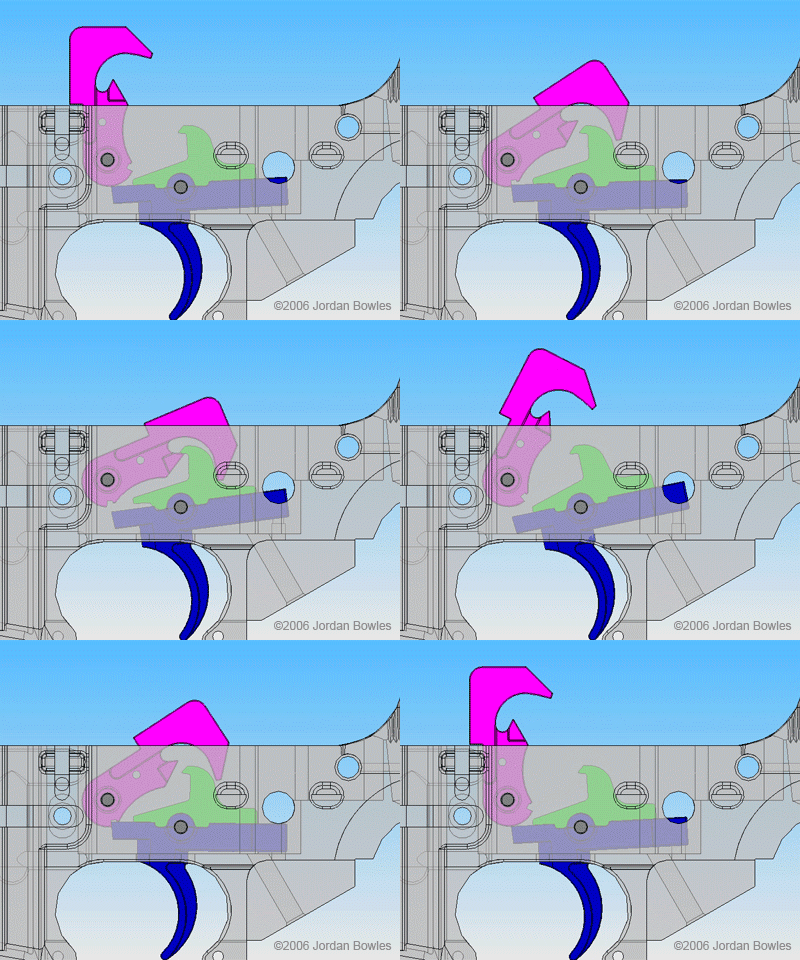
The opinion by Justice Clarence Thomas includes extensive technical information on how the internal parts of AR-15 rifles function, including diagrams and an animated graphic showing the movement of the parts. Firing a rifle with a bump stock still requires a separate function of the trigger for each shot, and it is not "automatic" because it will not fire without constant manual pressure on the handguard. The Court has never before ventured into such a detailed explanation about how a firearm works.
While the Court's discussion of how the trigger, sear, disconnector, and bolt interact in the firing sequence is quite technical, the decision embodies broader implications that are significant in other contexts.
First, it is settled once and for all that a semiautomatic is not a machinegun. That should be a no-brainer, but plaintiffs alleged that AR-15s are machineguns in the Las Vegas, Highland Park, and Mexico civil lawsuits. Here's what the Court said: "No one disputes that a semiautomatic rifle without a bump stock is not a machinegun because it fires only one shot per 'function of the trigger.'"
Is it outside the bounds of acceptable professional conduct for a faculty member to excoriate University leadership, faculty, staff, or students with the intent to arouse external intervention into University business? And does the broad publication of such views cross a line into sanctionable violations of professional conduct?
Yes it is and yes it does.
Vigorous debate is to be expected and encouraged at any University interested in promoting freedom of expression. But here is the rub: As the events of the past year evidence, sharply critical speech from faculty, prominent ones especially, can attract outside attention that directly impedes the University's function.
A faculty member's right to free speech does not amount to a blank check to engage in behaviors that plainly incite external actors — be it the media, alumni, donors, federal agencies, or the government — to intervene in Harvard's affairs. Along with freedom of expression and the protection of tenure comes a responsibility to exercise good professional judgment and to refrain from conscious action that would seriously harm the University and its independence.
In support of this position, he even notes "you can't escape sanction for shouting 'fire' in a crowded theater."
Conor Friedersdorf has an appropriate response to Dean Bobo's argument, tweeting: "Harvard Dean Lawrence D. Bobo's op-ed has incited me, an external actor, to publicly lament the subset of Harvard leaders who neither understand nor support free speech. By his logic, I guess he needs to be sanctioned."
One suggestion the article makes which is worth some consideration is that faculty should be sanctioned for encouraging students to engage in civil disobedience that violates university policies and puts the students at risk of sanction. I would agree that faculty who encourage that students put themselves at risk of punishment while they sit on the sidelines themselves are cowardly, but I disagree that encouraging others to engage in civil disobedience is itself civil disobedience that can or should be sanctioned.
Regrettably, this is not the first time I have heard university administrators suggest that speech by faculty or other members of the university community should be curtailed if it might generate controversy, provoke a response, or otherwise reflect poorly on the university. (I can also say, from personal experience, that if my university had ever adopted such a position, I would have been among those in the crosshairs.) That there are university administrators -- let alone prominent professors such as Dean Bobo -- who do not recognize the profound threat such a position poses to academic freedom and the truth-seeking function of a university is both sobering and depressing.
I was in the Court when Trump v. Hawaii was handed down. I remember the scorn with which Justice Sotomayor referred to "President Donald Trump" by name. It was visceral. However, in Cargill v. Garland, Justice Sotomayor name-dropped President Trump in a good way. She wrote:
Shortly after the Las Vegas massacre, the Trump administration, with widespread bipartisan support, banned bump stocks as machineguns under the statute.
Now, there is no reason to mention the President's name when referring to a rulemaking. It was a regulation promulgated by ATF, not signed by the President. But the import here is that even a right-wing fascist like Trump thinks this rule is sensible. Moreover, it is strange to think of a regulation having "bipartisan support." Usually, when people on both sides of the aisle agree on a policy, legislators pass a statute, which the President can sign. But there was no statutory amendment here. Indeed, President Trump was quite clear that he didn't want Congress to pass a statute, and directed ATF to change the rule. Presidential administration in action! (Justice Kagan probably was proud.)
However, I saw the dynamics as presidential maladministration. ATF had a long-standing interpretation in which bump stocks were not machine guns. After the Las Vegas mass killing, there were calls to abandon that long-standing interpretation. The President directed his agencies to abandon that long-standing interpretation. And wouldn't you know it, ATF reaches the exact result the President wanted. I called it a presidential reversal. In 2019, I advanced this position in amicus briefs filed on behalf of the Cato Institute back before the Tenth Circuit and the D.C. Circuit.
Justice Thomas gestured towards this maladministration:
"ATF abruptly reversed course in response to a mass shooting in Las Vegas, Nevada. In October 2017, a gunman fired on a crowd attending an outdoor music festival in Las Vegas, killing 58 people and wounding over 500 more."
"This tragedy created tremendous political pressure to outlaw bump stocks nationwide."
"While the first wave of bills was pending, ATF began considering whether to reinterpret §5845(b)'s definition of 'machinegun' to include bump stocks."
"ATF's about-face drew criticism from some observers, including those who agreed that bump stocks should be banned."
"The final Rule also repudiated ATF's previous guidance that bump stocks did not qualify as 'machineguns' under §5845(b)."
"Moreover, it is difficult to understand how ATF can plausibly argue otherwise, given that its consistent position for almost a decade in numerous separate decisions was that §5845(b) does not capture semiautomatic rifles equipped with bump stocks."
"Curiously, the dissent relegates ATF's about-face to a footnote, instead pointing to its classification of other devices."
And here is Justice Sotomayor's footnote, in part:
The majority emphasizes that ATF previously took the position that certain bump-stock devices were not "machinegun[s]" under the statute. See ante, at 3, 19. ATF, however, has repeatedly classified other devices that modify semiautomatic rifles by allowing a single activation of the shooter to automate repeat fire as machineguns.
All of the Court's six conservatives found this statute unambiguously does not support the bump stock ban. However, the en banc Fifth Circuit could only muster eight votes for that position—one short of a majority. Please recognize that the en banc Fifth Circuit is not as conservative as critics would tell you. The other Fifth Circuit appeals that the Supreme Court heard this year did not go through the en banc court: FDA v. AHM, Rahimi, NetChoice, and CFPB. In any high-profile en banc case, there are three of four moderate Republican appointees who can vote with the Court's Democratic appointees. If those Republican appointees judges end up taking senior status during a second Trump administration, I think the en banc court would look very different.
Of the three Trump appointees, Justice Barrett was the biggest wildcard. With Justices Gorsuch and Kavanaugh, what you saw is what we got. Very little that they've done so far has surprised me. Justice Gorsuch's approaches to LGBT rights and Indian law were evident in his lower-court record. And Justice Kavanaugh's restraint and compassionate conservatism—truly the hallmarks of the George W. Bush presidency—were on display in the Obamacare litigation and other cases. Again no surprises. But Justice Barrett had limited experience on the bench, wrote little as an academic, and never took any position on controversial matters of concern. She wasn't quite a blank slate, but she was as close to it as fathomable for a Republican Supreme Court appointment.
I get the genuine sense that Justice Barrett is figuring things out as she goes along. Each of her opinions seems like a new day. Brilliant as Barrett is—and I think she is extremely intelligent—she is learning on the job. With that development, I think she has come to regret some of her decisions in short order. For example, I think she backed off her vote in Roman Catholic Diocese after incessant "shadow docket" criticism, as evident in Does v. Mills. I also think she felt compelled to reimagine the major questions doctrine as some sort of semantic/textualist cannon following criticism of the Gorsuchian substantive cannon. I wouldn't be surprised if she develops doubts about the presidential removal power, though parting company with Justice Scalia's Morrison dissent may be too much to bear.
More pressingly, I think Justice Barrett is already having second thoughts about the text, history, and tradition framework in Bruen. She couldn't even join Justice Thomas's landmark opinion without reservations. We know she wrote a concurrence in Bruen that questioned whether the relevant timeframe was 1791 or 1868. Fair enough. But I thought her concurrence went further. She seemed to be casting some doubt on Justice Thomas's majority opinion, and the entire enterprise of looking at historical analogues. It is no surprise that Justice Breyer's Bruen dissent favorably cited Barrett's concurrence. More recently, in the CFPB case, Justice Barrett put more distance between herself and Justice Thomas by joining Justice Kagan's concurrence, which fixated on liquidation and post-enactment practice.
Justice Barrett doubled-down on her disagreement with Justice Thomas in Vidal v. Elster. This case tells us far more about the Court's originalist jurisprudence than it does about trademark law. I can't remember ever seeing a unanimous decision with such a fractured lineup. To paraphrase the T-Shirt, Thomas's majority was too small.
If the trend persists, it may lead to reconsideration of traditional partisan attitudes towards mandatory voting and other policies intended to increase turnout.
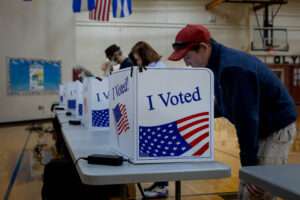
Voters cast ballots in South Carolina's 2024 presidential primary race. (Michael Nigro/Sipa USA/Newscom)
I have previously written about evidence indicating that, in the Trump era, Republicans are now the party that stands to benefit from relatively high voter turnout. A newNew York Times/Siena study provides further confirmation:
In a reversal of one of the most familiar patterns in American politics, it appears that Donald J. Trump, not President Biden, would stand to gain if everyone in the country turned out and voted.
In New York Times/Siena College polls over the last year, Mr. Biden holds a wide lead over Mr. Trump among regular primary and midterm voters, yet he trails among the rest of the electorate, giving Mr. Trump a lead among registered voters overall….
The NYT/Siena study finds that people who voted in 2022 midterm primary elections favored Biden over Trump by a 49% to 44% margin, those who voted in 2022 general elections, but not primaries favored Biden by a slight 46-45 margin, those who voted in the 2020 election, but not midterms favored Trump 44-42; finally those who never voted before supported Trump by a large 49-35 margin.
As noted in my earlier post, the standard explanation for this shift is that the Trump-era GOP is strongest among lesser-educated voters, and they - in turn - are less likely to turn out. There is now a large "diploma gap" between Democratic and Republican voters.
The NYT analysis adds the point that high-turnout voters tend to be more supportive of abortion rights and more concerned about democracy-preservation. These are relatively strong issues for Biden. By contrast, low-frequency voters are more focused on short-term economic trends. This year, short-term economic issues are helping Trump, in part because of widespread voter ignorance about the true state of the economy and the causes of inflation (such ignorance tends to be more common among less-educated and less-engaged voters).
If the trend towards Republicans doing better among low-propensity voters continues, perhaps this will lead partisans to reconsider their traditional attitudes towards various policies intended to increase turnout, including mandatory voting. I discussed this possibility in my earlier post:
Traditionally, Democrats and progressives have been sympathetic to policies intended to increase voter turnout, while conservative Republicans have been highly skeptical. Advocates of the most extreme such policy—mandatory voting—have also mostly been on the left…..
Both sides in this debate cite high-minded, nonpartisan rationales for their positions…. But cynics have long wondered whether the real motive was partisan gain: perhaps liberal Democrats supported efforts to increase turnout because it would help them win, while conservative Republicans opposed them for the very same reason….
Recent polling trends may put both cynical and idealistic explanations for these views to the test. In the Trump era, it is increasingly Republican candidates—especially Trump himself—who stand to benefit from higher turnout.
For those interested, I have long been an opponent of mandatory voting, and a skeptic the supposed virtues of higher turnout. I held that view back when increasing turnout was expected to benefit Democrats, and still hold it today, when high turnout seems to advantage the GOP. I summarized the reasons why in my previous post:
It isn't just that a more ignorant electorate is likely to make worse choices among the options before them. It is that those options are likely to be worse to begin with. Parties facing a relatively ignorant election are likely to select lower-quality candidates and policies than those facing a more knowledgeable one. I describe the logic behind this more fully in my book Democracy and Political Ignorance.
This connection between voter knowledge and relatively good policy outcomes is not an iron law. In Chapter 2 of my book, I go over some scenarios where voter ignorance can actually be beneficial. But I also explain why such situations are likely to be unusual.
It's possible that the Trump-era trend towards Republicans benefiting from higher turnout will prove to be an aberration. But if it continues and solidifies, I wonder if the partisans will gradually reverse positions on turnout issues. If it happens, it wouldn't be the first time that partisan advantage prevailed over consistent adherence to principle.
Three Florida residents pleaded guilty today to conspiring to injure, oppress, threaten or intimidate employees of pregnancy resource centers in the free exercise of the right to provide and seek to provide reproductive health services. The defendants selected reproductive health facilities that provided and counseled abortion alternatives and vandalized those facilities with threatening messages.
According to court documents, between May and July 2022, Caleb Freestone, Amber Smith-Stewart and Annarella Rivera engaged in a series of targeted attacks on pro-life pregnancy help centers in Florida. The defendants admitted they participated in the attack in the dark of night and, while wearing masks and dark clothing to obscure their identities, spray painted the facilities with threatening messages, including "If abortions aren't safe than niether [sic] are you," "YOUR TIME IS UP!!," "WE'RE COMING for U" and "We are everywhere."
We explore the legitimacy of chatbot law clerks by conducting a nationally representative survey experiment of Kenya, a society whose views on such matters have particular salience in light of the Kenyan judiciary's willingness to test the effects of e-justice measures. Our choice of population also responds to criticism that experimental jurisprudence has so far been focused on W.E.I.R.D. (White Educated Industrialized Rich and Democratic) populations (Tobia 2024), which have been found to deviate systematically from global trends along several metrics (Henrich et al 2010; Barrett 2020)….
The study compared the responses of four nationally representative cohorts (totalling 2,246) to a suite of four test cases, each of which featured the same fact situation but which varied according to a) whether the verdict aligned with either the law's text or its purpose, and b) whether the verdict relied on the legal analysis of either a human or an artificial law clerk….
For instance, the "No Bodabodas in the mall" vignette was presented as follows:
The government has issued a rule: "It shall be an offence to ride a bodaboda in a shopping mall". This rule is intended to prevent injuries to shoppers. {Bodabodas are bicycle or motorcycle taxis that are common in Kenya.}
Then, we described a situation in which an agent had acted contrary to the law's text but consistently with its purpose:
Witnessing a violent attack inside a mall, Martin rides his bodaboda into the mall to stop it. Martin is later charged with the offence of riding a bodaboda in a shopping mall.
Finally, we described a legal proceeding that varied both according to its outcome and according to the source of the legal research on which the court relied:
The court, guided by legal research performed by a legal researcher/special computer program, decides that Martin violated/did not violate the rule.
Participants were asked to indicate their agreement with the sentence, "The court's decision is legitimate", on a 5-point Likert scale….
I taught Federal Jurisdiction for at least fifteen years at Northwestern Law School, from 1990 to 2005, and I have written several law review articles on this subject. I have long admired the federal removal statutes, which allow allow federal officers and persons acting under a law of the United States to remove their cases from state to federal court. See generally In re Neagle, 135 U.S. 1 (1890). One such law was passed during Reconstruction, in 1875, in the wake of the Civil War, to prevent the eleven former Confederate states from harassing or oppressing federal officers or those with a duty to act under federal law.
State judges are often elected, and they can sometimes be biased for reasons of race, sex, politics, or religion. That bias is evident in both the New York State criminal and civil lawsuits brought against former President Donald Trump this year. Those cases were tried in the most liberal borough, of one of the most liberal cities, of one of the most liberal states in the nation.
Regional biases against former Presidents are sometimes quite pronounced. The NY civil and criminal cases brought against former President Donald Trump are evidence of this fact. This makes broader removal statutes necessary and proper so that talented people will not be dissuaded from running for the office of President of the United States.
The House of Representatives should pass a bill, which is now before the House rendering such cases removable to federal court. Former President Trump's conviction in a Manhattan trial court is unconstitutional under the First Amendment, as I have previously explained on this blog. Trump's conviction thus presents a major federal question, which ought to be decided before voters cast their ballots this November by the U.S. Supreme Court. The House of Representatives can expedite that process by passing the removal bill, which is now before the House.
Any final legislation passed should allow the removal of civil as well as of criminal cases. Former President Trump's loss of a civil suit with damages assessed at around $450 million also presents major federal questions under the Due Process Clause of the Fourteenth Amendment, as well as presenting an Eighth Amendment excessive fines claim. Congress should pass a broad removal statute that covers at least state criminal and civil claims brought against former Presidents of the United States. This is necessary and proper so that talented people will not be dissuaded from running for President in the future.
In my opinion, such a statute should apply not only to former Presidents of the United States. It should also apply to former Vice Presidents and to all former officers of the United States. One can easily imagine former Vice Presidents or officers of the United States being harassed by elected state prosecutors and judges. Even former members of Congress should probably be allowed to remove civil and criminal cases from state to federal court.
The sad truth is that state prosecutorial and judicial officials are, overall, somewhat more partisan and more lacking in legal wisdom than are life tenured federal judges. This is due to the fact that state judges and district attorneys are elected at the state level. There are many superb state Supreme Court and inferior court judges and district attorneys. But, at a minimum former Presidents of the United States ought to be guaranteed that they will have access to the federal life tenured judiciary if they are sued or prosecuted. This is not only just. It is also necessary to ensure that talented people will not be dissuaded from running for or holding federal offices in the future.
Today a divided panel of the U.S. Court of Appeals for the Sixth Circuit affirmed a preliminary injunction against multiple Department of Education guidance documents that would apply the Supreme Court's Bostock holding -- that discrimination on the basis of sexual orientation or gender identity constitutes discrimination on the basis of sex -- to Title IX. Of note, the decision did not address the substance of the Education Department's position, but rather focused on whether this action is the sort that needs to go through a notice-and-comment rulemaking. In other words, this was more of an administrative law decision than one about statutory interpretation or gender equality.
Judge Nalbandian wrote the opinion for the court in Tennessee v. Department of Education. He was joined by Judge Larsen. Senior Judge Boggs dissented.
The suit against the Department of Education was filed by 20 state attorneys general. While there is little question the plaintiff states object to the substance of the Education Department's position, the primary legal claim concerns whether the Department violated the Administrative Procedure Act in issuing the guidance documents without going through notice-and-comment. On this question, the court concluded that the plaintiff states were likely to succeed on the merits and that the district court did not abuse its discretion in issuing a preliminary injunction. In particular, the court concluded that the documents, while styled as guidances, were actually the sort of legislative rule subject to the APA's procedural requirements. Specifically, the court credited the states' arguments that the guidance documents effectively imposed new legal obligations upon them, and did not merely set forth how the Department interpreted and expected to apply pre-existing legal obligations.
Before reaching the merits, however, the panel had to address the government's arguments that the plaintiff states lacked standing, that the guidance documents were not final agency actions subject to judicial review, and that judicial review of these actions was precluded. These are both questions that commonly arise in suits challenging agency actions that may have the effect of legislative rules without being styled as such. It was these preliminary questions -- and standing in particular -- that divided the judges. In Judge Boggs' view, the documents at issue were more properly characterized as interpretive rules or policy statements, and thus not the sort of final agency action that is subject to judicial review or that can impose the sort of injury necessary for jurisdiction.
Given that the decision focuses on administrative law questions, there's is very little in either opinion that addresses the underlying question of whether Bostock's interpretation of Title VII applies equally to Title IX. If the states are ultimately successful with this procedural challenge to the Department of Education's position, it could be some time before federal appellate courts reach the merits of that question.
The Supreme Court issued six more opinions this week, bringing the total of decided cases to thirty eight. Twenty-three cases remain, which is a substantial number if the Court is going to complete its work before the end of June.
As was true two weeks ago, the rate at which cases have been decided matches that of last term, but is well behind the rate of decision-making we observed in prior years. In theory, there are nine remaining potential opinion days in June (setting aside the Juneteenth holiday), but as of this writing the Court does not plan to issue any more opinions until June 20. If that holds, we will likely see some opinions the first week of July. (It would be quite unusual for the Court to issue opinions after July 4, though that happened in OT 2019 due to Covid-19.)
The Court's opinions still show a surprising degree of unanimity, though (as expected) we are starting to see more divisions as the justices release opinions in the more difficult cases. The justices have been unanimous in the judgement in 25 of 38 cases decided so far -- approximately two-thirds of argued cases -- but some of those cases have seen sharp splits over rationale, and the proportion of unanimous cases is almost certain to drop between now and the end of the term.
While we have seen lots of unanimous cases, we still have not seen too many 6-3 cases decided along ideological lines. There have been a total of nine 6-3 decisions thus far, but only four have been along traditional right-left lines. Only two cases this term have been decided 5-4.
In terms of individual opinion authorship, here is where we stand.
Sotomayor: 7
Thomas: 6
Alito: 4
Kagan: 4
Kavanaugh: 4
Jackson: 4
Barrett: 3
Gorsuch: 2
CJ Roberts: 2
There have also been two per curiam opinions, and some cases are likely to be merged into a single opinion (e.g. the two Chevron cases, Relentless and Loper-Bright will almost certainly be decided in a single opinion).
Of the remaining cases, the lion's share will be written by conservative justices. The liberal justices represent one-third of the Court, but have been responsible for 40 percent of the Court's majority opinions thus far. I would not be surprised if liberal justices write no more than four or five of the remaining majorities.
For those who have read this far, here are some purely speculative predictions about what we may see. I suspect the Chief to have quite a few major decisions, in no small part because he has only authored two opinions for the Court thus far. I could see him having Rahimi, Relentless (the Chevron case), Moore, and the Trump immunity decision. I suspect Justice Gorsuch as SEC v. Jarkesy, Murthy, and Fischer, and I would be surprised if Kavanaugh does not take Ohio v. EPA. I have no prediction with regard to NetChoice, other than I think the two cases will produce a splintered mess.
Of course, these predictions are worth no more than you paid for them, and we should know whether I am right soon enough.
Please enjoy the latest edition of Short Circuit, a weekly feature written by a bunch of people at the Institute for Justice.
New cert petition! Friends, the gov't has broad latitude to use eminent domain to seize private land for public uses, like parks. But what if the park is a mere pretext and what officials are actually doing is harassing someone they don't like or forcing them out of town? What then? Well, most courts say that's unconstitutional, but earlier this year the Second Circuit disagreed, holding that as long as officials are willing to lie about why they are seizing someone's property all is well. We're asking the Supreme Court to resolve the split. Click here to learn more.