
8/19/1937: Justice Hugo Black takes the oath.

Mostly law professors | Sometimes contrarian | Often libertarian | Always independent | Est. 2002
With minor exceptions, their proposals are likely to do more harm than good.
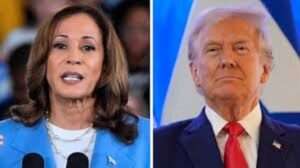
The housing crisis is one of the most important policy issues facing the nation. Housing shortages increase living costs for large numbers of people, and also prevent millions from moving to places where they would have better job and educational opportunities, thereby slowing economic growth and innovation. Both Kamala Harris and Donald Trump have taken positions on housing issues. But their ideas are mostly ones that would cause more harm than good. Sadly, neither candidate proposes any meaningful steps to break down the biggest barrier to housing construction in most of the US: exclusionary zoning rules that make it difficult or impossible to build new housing in response to demand.
Harris is the one that has offered more in the way of detailed proposals. She proposes giving $25,000 tax credits to first-time homebuyers and tax incentives for developers selling homes to first-time buyers. She also advocates restricting the use of algorithms to set rental prices, and capping rent increases and cracking down on "corporate" landlords. The rent control idea may be a reference to the Biden Administration's recent plan to cap rent increases at 5% per year, though it is not clear if Harris endorses it. Harris also promises to build 3 million new homes by 2029, but is extremely vague on how exactly she plans to do it.
These policy ideas range from mediocre to awful. A $25,000 subsidy for first-time homebuyers is unlikely to do much to ease housing shortages. The fundamental problem is one of regulatory restrictions on supply. In that environment, subsidizing demand will simply bid up prices. Moreover, the people who most suffer from housing shortages are mostly renters, not would-be homeowners. This subsidy plan does nothing for them. Much the same goes for the plan to provide tax incentives for developers. This won't do much for supply so long as developers are barred from building much in the way of new housing in many places, especially multi-family housing.
If zoning and other regulatory restrictions do get lifted, Harris's tax credit incentives would be unnecessary. And, indeed, there would be no good reason to have the tax code favor housing purchases over other types of consumption.
Rent control is a terrible idea that is actually likely to exacerbate shortages. This is an Economics 101 point broadly accepted by economists across the political spectrum. Don't take my word for it. Take that of prominent progressive ecoonomists, such as Paul Krugman, and Jason Furman, former chair of Barack Obama's Council of Economic Advisers, who points out that "[r]ent control has been about as disgraced as any economic policy in the tool kit."
Finally, there is no good reason to think that corporate landlords are any worse than other types of landlords, or that algorithmic pricing is somehow making the housing crisis worse. To the contrary, corporate landlords are usually as good or better than their "mom and pop" counterparts. Take it from a longtime renter with experience living under both types of landlords; the corporate ones usually maintain their properties better, and have better customer service. And algorithms can help owners identify situations where they can increase profit by lowering prices, as well as increasing them.
Harris is right to want to build 3 million new homes. Indeed, it would be great to build more than that. But, so far, she hasn't proposed much in the way of effective methods of doing it. Unless and until she does so, her aspiration for 3 million new homes is not much more viable than my desire to add 3 million unicorns to the nation's stock of magical animals.
At times she has made noises about cutting back red tape. I assume, also, that she supports President Biden's plan to make "underutilized" federal land available for housing construction. The latter is a good idea, but it's far from clear exactly which land will be opened up and on what terms.
Trump's housing agenda is less detailed than Harris's, but could well be even worse. The housing chapter of the Heritage Foundation's controversial Project 2025 emphasizes that "a conservative Administration should oppose any efforts to weaken single-family zoning." Single-family zoning, of course, is the most restrictive type of exclusionary zoning blocking new housing construction in many parts of the country. Donald Trump has disavowed Project 2025, and claims he "knows nothing about it." But the author of the housing chapter is Ben Carson, Trump's former secretary of Housing and Urban Development. During the 2020 election, Carson and Trump coauthored a Wall Street Journal op ed attacking efforts to curb exclusionary single-family zoning. He recently reaffirmed that position, promising to block "low-income developments" in suburban areas. On housing, at least, Project 2025 seems to reflect Trump's thinking, and that of the kinds of people likely to influence housing policy in a second Trump administration. The Trump worldview is one of NIMBYism ("not in my backyard").
Trump's immigration policies - a centerpiece of his agenda, if anything is - would also have negative effects on housing. Evidence shows that mass deportations of undocumented immigrants reduce the availability of housing and increase the cost, because undocumented immigrants are an important part of the construction work force (an effect that outweighs the potential price-increasing effect caused by immigration increasing the number of people who need housing). Trump and his allies also plan massive reductions in most types of legal immigration. Slashing work visas is also likely to negatively affect housing construction (as well as damage the economy in other ways).
If there is a saving grace to the Harris and Trump housing policies, it's that most of them cannot be implemented without new legislation, which will be extremely hard to push through a closely divided Congress. That's true of the Harris's rent control policies, and her plans to subsidize home purchases, and crack down on "corporate" landlords. Likewise, a Trump administration would probably need new legislation for any major effort to protect single-family zoning against state-level reform efforts.
But Trump's immigration policies are an exception. The executive could ramp up deportation and slash legal immigration without new legislation. Indeed, the Trump administration did in fact massively cut legal immigration during Trump's previous term in office. Deportation efforts could be partially stymied by state and local government resistance (as also happened during Trump's first term). But Trump could partly offset that by trying to use the military, as he and his allies plan to do (whether legal challenges to such efforts would block them is debatable). At the very least, ramping up federal deportation efforts would drive undocumented immigrants further underground, and reduce their ability to work on construction, where laborers are relatively out in the open and more vulnerable to detection than in some other jobs.
In sum, Harris and Trump are offering mostly terrible housing policies. Their main virtue is the difficulty of implementing them.
There are, in fact, steps the federal government can take to ease housing shortages. Most restrictions on new housing are enacted by state and local governments, which limits the potential of federal intervention. But Congress could enact legislation requiring state and local governments that receive federal economic development grants to enact "YIMBY" legislation loosening zoning rules. Perhaps a stronger version of the YIMBY Act proposed by Republican Senator Todd Young and Democratic Rep. Derek Kilmer (their version could be a useful start, but does not have enough teeth). Those who object to such legislation on grounds of protecting local autonomy should recall that YIMBYism is actually the ultimate localism.
The federal Justice Department could also support litigation aimed at persuading courts to rule that exclusionary zoning violates the Takings Clause (which it does!). Such litigation could do much to break down barriers to new housing construction. Federal government support wouldn't guarantee victory. But it could help by giving the argument instant additional credibility with judges.
Finally, the feds could help pursuing the opposite of Trump's immigration policies, and instead make legal migration easier. That would increase the construction workforce, and make housing construction cheaper and faster.
Sadly, neither major-party candidate is proposing to do any of these things. Instead, they mostly sell claptrap that is likely to make the housing crisis even worse.
Two tidbits from the New York Times that I did not know.
The New York Times, perhaps in something of a rush, is catching up with the usual profiles of a presidential candidate that would usually come during the nomination season. Of course, as Maureen Dowd points out, there was no such process for the current Democratic nominee. Nomination by acclimation, as it were. So the name of the game is backfill. Today's Times shared two tidbits about Kamala Harris that may be of interest to readers.
First, it turns out that John Eastman, of all people, helped Harris prevail in her razor-thin margin of victory for AG. For those who were not around fifteen years ago, Eastman was a leading figure in legal education. As dean at Chapman, Eastman was building a nucleus of leading conservative law professors. One of his more important hires was to poach Ron Rotunda, my professor, from George Mason. But in 2010, Eastman resigned as Dean to run for California Attorney General. Eastman would lose the Republican primary to Los Angeles County District Attorney Steve Cooley. During that primary, as the Times points out, Eastman landed a strong punch on Cooley. Apparently, Cooley would have been eligible to receive both the salary of Attorney General, and his pension from serving as District Attorney. Eastman attacked Cooley for "double dipping."
Later, during a debate between Cooley, and Kamala Harris, the Democratic nominee for AG, Eastman's "double dipping" point was brought up:
Dan Morain, who worked for The Sacramento Bee's editorial page, asked who would bring up double-dipping — that is, taking both a public salary and a public pension. It had been an issue in the Republican primary, first raised by John Eastman, Mr. Cooley's primary opponent. Mr. Eastman is better known now for his efforts to keep Mr. Trump in office after the 2020 election, which resulted in an indictment and disbarment.
"I'm going to ask that," replied Jack Leonard, a Los Angeles Times reporter who covered Mr. Cooley.
Collis gave the wrong answer, and said he "earned" the right to accept the salary and the pension:
Inside the practice courtroom, Mr. Leonard outlined that the $150,000 salary of the California attorney general was half of the $292,300 salary that Mr. Cooley was earning as the local district attorney. If he double-dipped by taking a taxpayer-paid pension as a former district attorney and a taxpayer-paid salary as the state attorney general, Mr. Cooley would be in line to make more than $400,000.
"Do you plan to double-dip by taking both a pension and your salary as attorney general?" Mr. Leonard asked.
"Yes, I do," Mr. Cooley said without hesitation.
He glanced at Ms. Harris. She said nothing.
"I earned it."
But Mr. Cooley was not yet done. "I definitely earned whatever pension rights I have, and I will certainly rely upon that to supplement the very low, incredibly low salary that's paid to the attorney general," he added.
"It was tone deaf," Mr. Riggs said. "It was startling," Mr. Leonard said. "It was awful," Mr. Morain said. "It was jaw-dropping," Mr. Smith said.
Harris would prevail by less than 1% in the race. I think it is safe to say that John Eastman, at least in part, helped Harris win her race for Attorney General. Had the primary gone differently, imagine if Eastman had bested Harris in the general election. What a different world we would be in.
The next tidbit concerns Harris's role in filling Justice Breyer's seat. As readers will recall, President Biden promised to select a black woman for the Supreme Court seat. (He previously also promised to select a black woman for the vice presidency.) The top three nominees were Judge Ketanji Brown Jackson, Justice Leondra Kruger of the California Supreme Court, and District Court Judge Michelle Childs from South Carolina. Both Jackson and Kruger had clerked on the Supreme Court. Childs was favored by Representative James E. Clyburn of South Carolina, who helped turn the 2020 Democratic primary in Biden's favor.
VP Harris played a role in the process, which the Times describes:
She was also deeply involved in Mr. Biden's only Supreme Court appointment, interviewing all three finalists and studying their legal records. While she considered Leondra R. Kruger, a California Supreme Court justice, a "very sharp lawyer," she concluded that the justice might be too cautious for the moment, according to a former White House official.
J. Michelle Childs, then a district judge, had the support of both Mr. Clyburn and Senator Joe Manchin III, then a Democrat from West Virginia, making her the choice of least resistance. But Ms. Harris concluded that Ketanji Brown Jackson, a federal appeals judge, would be the boldest option, the former official and Mr. Klain said. "Joe, you may only get one chance to do this as president, and you want to be proud of your legacy here," she told Mr. Biden, according to Mr. Klain.
There is a lot packed into this paragraph. First, Harris echoed what was the general consensus: Kruger, a former Deputy Solicitor General, was viewed as a "very sharp lawyer." As a former Deputy SG, she had developed a sterling reputation for intellect. But there were suggestions she would not be as willing to make waves. Apparently she was something of a moderate on the California Supreme Court! Kruger also very publicly declined President Biden's invitation to serve as Solicitor General. (I wrote about Kruger here, here, here, and here.) Second, Childs, who had been nominated to the D.C. Circuit, was viewed as candidate who would face the "least resistance." (I wrote about Childs here and here.) But did Harris recommend Kruger or Childs? No, she backed Jackson. Why? Third, Harris drew a contrast between Kruger and Jackson. The former was "cautious" and the latter was "bold."
I know I am widely ridiculed on the right when I discuss judicial courage. But progressives get it. They understand intrinsically that the primary limitation of a Supreme Court justice is not her intellect or precedent, but fortitude. Democrats are not interested in appointing an intellectual who exhibits caution to the Supreme Court. VP Harris recognized this dynamic fully. Caution may be fine for the lower courts, but it is not the order of the day for SCOTUS. Courage is. Really, courage is important on all levels, but especially on the Supreme Court where the stakes are higher, and pressure is stronger. And a judicial nominee's record must clearly demonstrate by word and deed their courage. In that regard, Justice Jackson was the ideal pick for the Supreme Court, and has justified her selection with everything she has done on the bench. Maybe we should ask Harris to help pick Republican nominees for the Supreme Court?
8/18/1920: The Nineteenth Amendment is ratified.
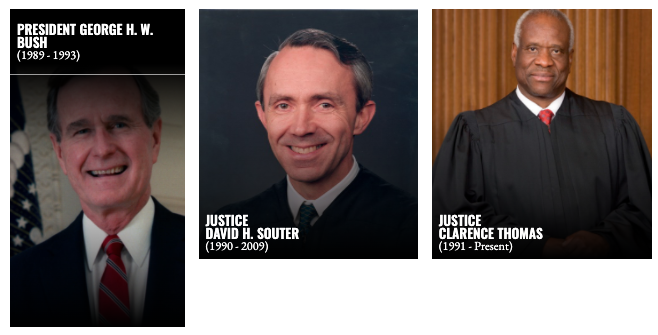
8/17/1988: Republican party nominates George H.W. Bush for President. He would appoint David Souter and Clarence Thomas to the Supreme Court.
Justice Gorsuch joins the three dissenters on severability. What about Justices Thomas and Barrett?
Recently, federal district courts in the Fifth and Sixth Circuits enjoined the new Title IX regulations in their entirety. These courts declined to sever three provisions that injure the plaintiff from the remainder of the scheme. Both courts of appeals declined to stay those rulings. The Solicitor General asked the Supreme Court to narrow those injunctions to three provisions that the plaintiffs allege injure them. By a 5-4 vote, the Court denied the SG's stay application in Department of Education v. Louisiana. The Court issued a per curiam opinion, which was joined by Chief Justice Roberts and Justices Thomas, Alito, Kavanaugh, and Barrett. Justice Sotomayor dissented, joined by Justices Kagan, Gorsuch, and Jackson.
It would be wrong to assume that Justice Gorsuch is Bostocking again on transgender rights. The four dissenters upheld the injunction against that three critical provisions that redefine sex discrimination to include gender identity, regulate sex-separated facilities like bathrooms, and redefine hostile environment harassment. Sotomayor's dissent explains that the plaintiffs' "alleged injuries flow from those three provisions." And this measured dissent, which lacks any of the vitriol we've seen of late, was probably tailored to keep Justice Gorsuch's join. Sotomayor explains:
For now, on the briefing and record currently before us, I would stay the preliminary injunctions except as to the three provisions above, in keeping with the traditional principle of equitable remedies that"relief afforded [to] the plaintiffs" must not "be more burdensome than necessary to redress the complaining parties." . . .
At this juncture, however, enjoining the application of any other part of the Rule needlessly impairs the Government from enforcing Title IX and deprives potential claimants of protectionsagainst forms of sex discrimination not at issue in respondents' suit.
What, then, was the disagreement? The Justices fractured on severability. Indeed, severability, along with vacatur and nationwide injunctions, are among the most unresolved areas of the Court. In recent years, Justices Thomas, and later, Justice Gorsuch, have called for a re-examination of severability doctrine. That Justice Gorsuch dissented here likely reflects his nuanced views on severability. He rejects the notion that courts can "vacate" rules, in large part because of standing doctrine. To Justice Gorsuch, if a provision does not injure a person, it cannot be enjoined.
But where is Justice Thomas on this issue? And Justice Barrett has been very skeptical about granting preliminary relief. She seems to be trending to the position advanced by Sam Bray that there should not be a fixation solely on the likelihood of the merits--or a preview of the merits question. But that is precisely what the per curiam opinion did here.
The majority per curiam opinion only had this to say about severability:
In this emergency posture in this Court, the burden is on the Government as applicant to show, among other things, a likelihood of success on its severability argument and that the equities favor a stay. On this limited record and in its emergency applications, the Government has not provided this Court a sufficient basis to disturb the lower courts' interim conclusions that the three provisions found likely to be unlawful are intertwined with and affect other provisions of the rule. Nor has the Government adequately identified which particular provisions, if any, are sufficiently independent of the enjoined definitional provision and thus might be able to remain in effect.
Here, Justice Kavanaugh's Labrador concurrence provided the rule: the Court focuses almost exclusively on likelihood of success on the merits. There is no discussion at all about irreparable harm. By contrast, Justice Sotomayor's dissent expressly discusses the balance of harms:
By blocking the Government from enforcing scores of regulations that respondents never challenged and that bear no apparent relationship to respondents' alleged injuries, the lower courts went beyond their authority to remedy the discrete harms alleged here. The injunctions this Court leaves in place will burden the Government more than necessary. The injunctions will also affect the public. Individuals in the respondent states will be deprived of guidance related to their rights under Title IX, of updates to the processes schools must follow in investigating their complaints of sex discrimination, of protections from retaliation should they file a complaint, and of much more.
These interests are absent in the majority's opinion.
The majority's only discussion of the "equities" concerns how quickly the lower courts will hear oral argument. That is not really a weighing of the equities. This analysis throws any sort of four-factor test out the window. Again, I think Justice Kavanaugh was correct in Labrador. But it provides further rejection of Justice Barrett's Does v. Mills analysis.
And what about Justice Thomas? Unless you believe that the Court has a writ of erasure, and can "vacate" rules, the notion of enjoining provisions of Title IX that inflict no injury needs to be explained. Now in Corner Post, Justice Kavanaugh zealously defended the vacatur, especially with regard to entities that are not regulated. But other members of the majority, including Justices Thomas, Gorsuch, and Barrett, were mum.
There is a lot here going on in the vacatur/severability debate. I think the Court did not want to get into that thicket with a shadow docket case. They likely thought it sufficient now to deny relief, without weighing in on whether other provisions should be put on ice. If I had to guess, Justice Kavanaugh and/or Chief Justice Roberts wrote this per curiam opinion.
This issue will likely come back to the Court probably later this term, with a cert grant before January. If Trump prevails, and the SG witches positions, the Court will probably DIG the case, and issue a Munsingwear vacatur. Skrmetti would likely suffer a similar fate. The Court can decide even fewer cases!
Just heard that one: "[H]e gives twice who gives promptly : payment rendered promptly is worth twice as much," though I take it that this can be used for anything (e.g., requested advice) and not just payment. Apparently stems from Publilius Syrus, though perhaps it was old when he was young.
Thanks to Fred Triem for passing this along.
Crypto disclosures, high-risk stops, and protecting the curtilage.
Please enjoy the latest edition of Short Circuit, a weekly feature written by a bunch of people at the Institute for Justice.
Peter and Annica Quakenbush want to use their 20-acre property in rural Brooks Township, Mich. as a green cemetery and nature preserve, but township officials banned all cemeteries to stop them. This week, however, a state trial court noted that it's "Zoning 101" in Michigan that officials can't ban legitimate land uses—and ruled from the bench that the county is violating the state constitution. A rational-basis win at the motion-to-dismiss stage? Eureka! Click here to learn more.
This was just announced today; if you're interested, please apply, and if you know people who might be interested, please pass this along to them.
Opportunity for Post-JD Scholars
The Hoover Institution at Stanford University is seeking an outstanding early-career legal scholar interested in researching free speech law, in preparation for seeking an academic position at a law school or elsewhere.
If selected, you would work on your own research with the guidance and supervision of Senior Fellow Eugene Volokh, who has moved to Hoover after 30 years as a Professor of Law at UCLA School of Law. You would be appointed a Research Fellow with the Center for Free Expression, for one year from July 2025 through June 2026. The term may be renewed, if both you and Hoover agree, for one extra year. You would be expected to be physically present at the Institution, working full-time, with no competing major professional commitments.
There is no teaching obligation, so you would have maximum time to research and write. However, you would be expected to help organize and participate in occasional conferences, workshops, and lectures, and to work on occasional projects with Volokh or other Senior Fellows. These tasks would all be related to free speech law and are expected to help promote your own research and future career.
Eligibility Criteria:
- You must have a JD or its equivalent by June 2025.
- You must commit to staying for at least one year (July 2025 through June 2026). The date range might be moved back slightly if required because of a judicial clerkship that will keep you occupied until July to September 2025.
- A judicial clerkship (past or upcoming) is not required, though it is a plus.
- Work experience as a lawyer is not required, though some such experience is a plus.
- A PhD in another discipline is not required, though neither is it frowned upon.
- You must have written a publishable law journal article already while in law school or shortly after. Whether it has already been published or not does not matter, so long as it is essentially complete. That article need not have been on free speech law.
- You must be planning to work on free speech law, understood broadly. This is not limited to First Amendment law, but includes federal or state statutes, common law rules, state constitutional provisions, transnational or international legal provisions, and rules of important private institutions—so long as they relate to the regulation (or deregulation) of speech, press, expression, assembly, expressive association, petition, and the like. Likewise, it includes doctrinal, historical, theoretical, and empirical scholarship.
- We prefer projects on important but insufficiently studied topics, rather than on ones that have already been heavily researched by others.
To Apply, Please Submit:
[1.] Some places have recently enacted restrictions on wearing masks in public. They generally stem from three related rationales:
Of course, all places have laws that ban trespass, vandalism, assault, and similar crimes. But the premise of the mask laws is that those laws are insufficient, precisely because masking can help evade detection for people who violate those laws.
Such laws have existed for a long time. The 1871 federal Ku Klux Klan Act forbade (and still forbids) people, whether Klan members or not, "go[ing] in disguise on the highway or on the premises of another" "for the purpose of" depriving people of "the equal protection of the laws, or of equal privileges and immunities of the laws." But later laws generally apply without a need for prosecutors to show a further prohibited purpose. Various laws enacted in 1900s, for instance, generally restrict mask-wearing (likewise historically usually motivated by the Klan's behavior, but not limited to the Klan). See, e.g., the 1924 Louisiana law discussed in State v. Dunn (La. 1926), the 1951 Georgia law upheld in State v. Miller (Ga. 1990), and many other such laws.
Here is the most recent such law I've seen, just enacted by Nassau County (N.Y.) (I think this is the version that was finally enacted), though other recent ones are quite similar:
8/16/1933: President Roosevelt adopts the Code of Fair Competition for the Governance of the Petroleum Industry. The Supreme Court declared those codes unconstitutional in Panama Refining Co. v. Ryan (1935).
A debate on a very important Fourth Amendment ruling.
I recently posted a long critique of the Fifth Circuit's ruling last week in United States v. Jamarr Smith, and specifically the court's ruling that Google's geolocation database is too big to search with a search warrant. It remains to be seen what might happen with the case. Just today, DOJ filed an unopposed motion asking for 60 days to file a petition for rehearing. Also, the court has withheld issuance of the mandate on the request of at least one judge.
With that pending, I'm delighted to feature a debate of sorts over the merits of the ruling. Jennifer Granick and Brett Max Kaufman, lawyers for the American Civil Liberties Union (ACLU) who are both very active litigating in this area, wrote to me today with an ACLU response defending the Fifth Circuit's ruling and asking if I might publish it here at the Volokh Conspiracy. Jennifer and Brett are both outstanding lawyers, and I'm delighted to host a debate on this question. With their permission, I am posting their response to my post, followed by my reply below that.
Here is their response, published in full:
The Fifth Circuit's Supposedly "Bananas" Ruling that Geofence Searches are Unconstitutional Is Correct
Jennifer S. Granick & Brett Max Kaufman, American Civil Liberties Union
Last week, the federal Fifth Circuit Court of Appeals issued a unanimous opinion that "geofence warrants"—which sweep through hundreds of millions of account holders' location data in the hopes of ensnaring people who are estimated to have been near the scene of a crime—violate the Fourth Amendment. In a blog post on this site, Orin Kerr criticized the court's holding as "bananas." But if this kind of ruling is bananas, we'll happily take more of them by the bunch.
The Fifth Circuit's decision, in a case titled United States v. Smith, is a reasonable response to the Golden Age of Surveillance ushered in by companies' unprecedented capture of previously ephemeral and unknowable facts about us. The Fifth Circuit held that police may not trawl through a database of hundreds of millions of people's sensitive location histories in the hopes that they will be able to find people who were, according to Google's computers, in the vicinity of a crime at some point in the past. The government uses this technique, geofence searching, with increasing frequency. It pulls out of the cloud people whose phones are estimated to have been near the scene of a crime—even if the person was actually somewhere else. It looks not just for suspects, but also witnesses, ensnaring a subset of individuals destined for further law enforcement scrutiny.
The Fifth Circuit held that such an overbroad search is akin to the kinds of "general warrants" that the Fourth Amendment was intended to prohibit. As a result, no warrant can make this novel surveillance technique legal.
Considering the analog equivalents of this kind of dragnet helps explain why: For example, police might know that some bank customers store stolen jewelry in safe deposit boxes. If they have probable cause, police can get a warrant to look in a particular suspect's box. But they cannot get a warrant to look in all the boxes—that would be a grossly overbroad search, impacting the privacy rights of many people as to whom there is no probable cause. (In one recent case, the government actually tried something similar, but the Ninth Circuit rejected the attempt.)
Likewise, police might know that some people sell drugs out of their homes in a certain neighborhood. If they have a target (whether an address or a person), they can get a warrant to search a house. But they may not search all the homes in the neighborhood based only on the knowledge that illegal drugs were sold in the area.
Kerr raises four main objections to the court's reasoning in Smith.
First, Kerr says that Smith is inconsistent with United States v. Karo, a 1980s case in which the Supreme Court held that law enforcement needed to get a warrant to track a radio-tracking beeper, which the government had placed inside a can of chemicals to be picked up by a suspect, into a private area like a home or locker. The government contended that that it needn't get any warrant at all to conduct this kind of surveillance, because the Fourth Amendment's particularity requirement was a poor fit for a situation in which police could never name in advance where the beeper might go. The Supreme Court swatted away that argument by explaining that it was sufficient for particularity purposes to specify the "object into which the beeper is to be placed, the circumstances that led agents to wish to install the beeper, and the length of time for which beeper surveillance is requested."
If police can get a warrant for that kind of tracking, Kerr suggests, surely they can get one for geofence searches, too. The Karo Court, he says, rejected an argument that beeper searches could never meet the particularity requirement—and that rejection should apply to geofence searches, too.
But the argument Karo rejected was the government's, and it was aimed at persuading the Court that particularity requirement was such a bad fit that the Fourth Amendment shouldn't regulate its beeper surveillance at all. Rather than permit unsupervised, warrantless beeper surveillance, the Court "articulated a way to draft warrants to allow the surveillance." But that is far cry from the argument the Fifth Circuit was evaluating in Smith—an argument from the defendants that geofence searches are so broadly invasive that they are akin to the long-reviled general searches banned by the Fourth Amendment entirely.
Not even the government, in its opposition brief on appeal, thought Karo was relevant enough to the geofence warrant issue to cite it even once.
Karo's facts are not analogous to geofence searches. While the final destination of a beeper tracker is unknown, police are tracking a particular object in real time. The government has possession of the object and installs a beeper. Only a few people subsequently will take possession of the object and it will only travel to a few places, as the police follow it. The police know what the object is, why it is relevant to the crime under investigation, who is likely to take possession of it, and for what criminal purpose.
But the Google location history database at issue in Smith contains location data from "592 million individual accounts". With geofence searches, all the police know is that a crime took place in the past, and where. Google's location history database is entirely comprised of constitutionally protected intimate location information, enabling comprehensive and retroactive surveillance of hundreds of millions of people. When the government searches the location database, it is searching through all of that information, after the fact. The people affected are all the people in the database, not just those whose information is a potential match.
Further, what the government learns is much more extensive than the location of a Karo-style beeper. When conducting a geofence search, the government doesn't even know whether the suspect's data will actually be found in the database—not that the government cares, since they are often not only looking for suspects, but for witnesses, too. The search will almost certainly rope in people who were not near the crime or merely passing by, due to the imprecision of some of the location data that Google collects. The government obtains information potentially revealing personal activities, habits, and associations about any number of people—suspicious or not. The breadth and technology involved in geofence-type database searches make them a whole new ballgame, worlds away from planting and tracking a beeper placed in a can of chemicals intended for use in drug trafficking.
Second, Kerr maintains that that the Fifth Circuit opinion clashes with United States v. Carpenter. In Carpenter, the Supreme Court held that police need a warrant to seek an identified suspect's cell phone location history. Of course, like geofence data, cell phone location data resides in a company's giant database. Kerr takes this to mean that any search through a massive database of location data must be permissible with a warrant. But there is very little in common between the targeted query pulling up one suspect's records in Carpenter, and the dragnet search for anyone whose phone was in or near a 24-acre area in Smith. Police can ask an email provider to turn over a particular person's messages with a valid warrant, but that doesn't mean police can direct the company to search through every email of every user in the hope of finding someone who was discussing a crime. And of course Carpenter did not address, let alone reject, a general warrant argument like the one at issue in Smith. To the contrary, the Court took pains to remind us that "The Founding generation crafted the Fourth Amendment as a response to the reviled 'general warrants' and 'writs of assistance' of the colonial era, which allowed British officers to rummage through homes in an unrestrained search for evidence of criminal activity."
Third, Kerr argues that whether the identity of a suspect is known at the time of a search is constitutionally irrelevant. That is generally true—some valid warrants are of course intended to gather evidence to identify a suspect. But that doesn't mean that all such searches are constitutional. In each of the hypothetical examples Kerr gives, there is a target—an account controlled by an unknown user.
In any case, the lack of a known suspect in a particular case is not what the Fifth Circuit complained about. Rather, the Fifth Circuit was describing the geofence search technique itself as an inherently suspicionless dragnet where police never have a target:
In other words, law enforcement cannot obtain its requested location data unless Google searches through the entirety of its Sensorvault—all 592 million individual accounts—for all of their locations at a given point in time. Moreover, this search is occurring while law enforcement officials have no idea who they are looking for, or whether the search will even turn up a result. Indeed, the quintessential problem with these warrants is that they never include a specific user to be identified, only a temporal and geographic location where any given user may turn up post-search.
That observation seems plainly correct to us.
Fourth, Kerr's last point is that the Smith decision may have implications for surveillance conducted by national security agencies, which regularly search through gigantic repositories and streams of data that include the private information of Americans. He predicts that we will soon read in the paper that the opinion has interfered with some presumably worthwhile national security surveillance program as a roomful of very worried national security lawyers, presumably with furrowed brows, struggle to figure out how to comply.
We have a prediction, too. We may see an unnamed national security official cited in a news story, lamenting the possible interruption to some purportedly essential surveillance program because of Smith. No one will tell us what the program supposedly is, or how exactly some limitations on the ability of law enforcement to search huge databases of private information without individualized suspicion interferes with the nation's security, but that is what the anonymous source will suggest.
Don't believe it. National security lawyers excel at exploiting legal loopholes to justify secret programs and insulate them from judicial scrutiny. We find it extraordinarily hard to believe that they will read the Fifth Circuit's opinion in an unnecessarily overbroad and self-defeating fashion to require the executive branch to shut down one of its ongoing national security surveillance programs. Instead, as they usually do, the lawyers will find a way to justify the program to themselves, even if only by saying that the Fourth Amendment applies differently to foreign intelligence surveillance than to criminal investigations. Nonetheless, advocates of Big Surveillance will still repeat the leaked, manufactured concern about national security to ensure it hangs over courts' future efforts to consider and apply constitutional protections to the hundreds of millions of individuals whose private lives are exhaustively documented in ones and zeros in gigantic corporate for-profit databases.
When it comes to national security surveillance, the government's litigation tactics are designed to prevent courts from reaching incredibly important Fourth Amendment questions, like the one in Smith, on the merits. In criminal cases, for example, the government has a long track record of improperly withholding notice of foreign intelligence surveillance from defendants. In civil challenges to national security surveillance, the government has aggressively relied on the standing and state secrets doctrines to seek dismissal at the earliest stages of litigation.
Following the Supreme Court's lead in cases like Riley and Carpenter, courts around the country have been striving to adapt constitutional privacy protections to novel surveillance enabled by advanced digital technologies. Things like conversations, reading, and travel used to be ephemeral, and were not recorded, and all-access has never been the rule. But now, law enforcement feels entitled to access all these new repositories of private information however it can. While it may be the job of government lawyers to push for access, it's the role of the Constitution and the courts to push back. That's what we see the Fifth Circuit doing in Smith.
Thanks very much to Jennifer Granick & Brett Max Kaufman for their response on these issues. Here's my reply, taking the order of the four points I made in my initial post. (Because the reply to me was written in the authors' official capacities as ACLU attorneys, I will respond to them a bit formally as "the ACLU," instead to Jennifer and Brett.)
(1) On the Importance of United States v. Karo
First, the ACLU notes that the government did not raise Karo in its brief:
Not even the government, in its opposition brief on appeal, thought Karo was relevant enough to the geofence warrant issue to cite it even once.
It's true that the government doesn't cite Karo. But that brings up a very interesting aspect of the litigation more broadly: Reviewing the briefs filed in the case, I don't think either side really briefed the question that the panel ruled on—whether the Google file was too big to be searched. Reading the defendant's initial brief, the statement of issues announces that it will argue that geofence warrants are unconstitutional categorically (p.2). But the brief never actually develops that argument, as far as I can tell. It states the argument at the. top of page 35, and hints at it in footnote 8. But it mostly argues other issues, such as that this particular geofence warrant was too broad. The reply brief is similar. It alludes to such an argument in passing (p.4), but it doesn't make it. No amicus briefs were filed in the case, either. From what I can tell, there was no serious briefing on the warrant issue that was resolved by the Fifth Circuit's opinion.
Indeed, after now listening to the oral argument, I don't think I hear the argument being made by Smith's counsel there, either. At about the 8-minute mark, Judge Ho asks defense counsel to say specifically why this was a general warrant. Smith's counsel does not respond that this was a general warrant because the Sensorvault database was too big, Instead, counsel makes a different argument, that the warrant sought too much data to be seized and handed over to much the government.
I should be clear that the issue of Sensorvault being too large to be searched does get discussed during the oral argument. Judge Ho raises and presses this claim during the questioning of the government, starting at about the 17:45 minute mark. And at the 23 minute mark, Judge Ho describes that claim as what, in his words, "I think" is the argument defense counsel is making. But unless I'm missing it, that's the first time it is discussed, at least more than in passing. In the rebuttal, defense counsel again focuses on the scope of what the government was looking for, not raising the size of Sensorvault or argues that the file was too large to search. As far as I can tell, the only time defense counsel talks about that is in the last minute of the argument, when Judge Ho asks counsel to respond to the government's responses to Judge Ho's earlier questions on that.
So it's true that the government did not cite Karo. But Karo is important as a response to a "no warrant can be issued" argument, and that's not an argument that appears to have seriously briefed by either of the litigants.
Back to the ACLU post.
ACLU next argues that Karo is distinguishable. The key difference, the ACLU claims, is that the geofence warrant can yield a lot more personal information than the tracking beeper did in Karo. Assuming this is true, though, I don't know how it's relevant to whether a warrant can be obtained. The arguments the ACLU is making are arguments about why the data should be protected under the Fourth Amendment in the first place. Assuming the panel was correct on that, those points are justifications to require a warrant, not a reason to refuse to allow a warrant.
But what about the idea that the search here is just too invasive? It seems important to note that warrant clause does not impose a general requirement that searches be narrow. As Justice Scalia stressed for the Supreme Court (overturning 9-0 a Judge Reinhardt decision from the Ninth Circuit) in United States v. Grubbs, particularity requires two specific things: Read More
Also, Judges Kacsmaryk and Ho seem vindicated on the statute of limitations to challenge mifepristone.
I apologize for the delay in writing about Corner Post. I started writing this post in July, and only now had a chance to finish it up before classes start next week.
I think Corner Post was probably the sleeper case of this term with regard to impact. Much ink has been spilled about Loper Bright, and the overruling of Chevron deference. Critically, though, Loper Bright only allows affected parties to challenge new regulations that perhaps deviate from an old regulation. But Corner Post tweaked when APA suits can be filed. Justice Barrett's majority opinion explains that a claim accrues "when the plaintiff is injured by final agency action."
An APA plaintiff does not have a complete and present cause of action until she suffers an injury from final agency action, so the statute of limitations does not begin to run until she is injured.
Regulations will generally injury regulated entities as soon as they go into effect--or perhaps even before that date. But under Corner Post, new regulated entities could claim, for the first time, an injury by some agency action that went into effect much earlier. And I'm sure industry groups are scanning through the federal register to find all sorts of old regulations that can now be challenged with the Corner Post statute of limitations. Moreover, to the extent that the regulations have "flip-flopped" over the years, those rules are no longer entitled to Chevron deference. If you combine Loper Bright and Corner Post, it is a one-two punch to challenge old, politicized agency actions. That much is clear.
But is there also a one-two-three punch? Corner Post allows you to challenge old regulations, Loper Bright eliminates Chevron, and the remedy of "vacatur" erases the rule from the federal register. The Court is divided on this third issue. Justices Gorsuch and Thomas take the Sam Bray view that vacatur is not a permissible remedy under the APA. Justice Kavanaugh takes the Mila Sohoni view that vacatur is a permissible remedy under the APA. Justice Barrett's majority opinion, which was joined in full by Gorsuch, Thomas, and Kavanaugh, tables the vacatur question.
There is a lot packed into Footnote 2:
The Board leaves open the possibility that someone could bring an as-applied challenge to a rule when the agency relies on that rule in enforcement proceedings against that person, even if more than six years have passed since the rule's promulgation. But Corner Post, as a merchant rather than a payment network, is not regulated by Regulation II—so itwill never be the target of an enforcement action in which it could challenge that rule. JUSTICE KAVANAUGH asserts that "Corner Post can obtain relief in this case only because the APA authorizes vacatur of agency rules." Post, at 1 (concurring opinion). Whether the APA authorizes vacatur has been subject to thoughtful debate by Members of this Court. See, e.g., United States v. Texas, 599 U. S. 670, 693–702 (2023) (GORSUCH, J., concurring in judgment). We took this case only to decidehow §2401(a)'s statute of limitations applies to APA claims. We therefore assume without deciding that vacatur is available under the APA.
The Court continues to dabble with the as-applied/facial challenge distinction. We've seen this line come up in Rahimi and NetChoice. This is an area of some doctrinal confusion. I think the Court will have to bring some more clarity. I'll come back to this distinction later in when I get to Justice Kavanaugh's concurrence. Far more important, and timely, is how the Court treats the vacatur debate. Justice Barrett refers only to the disagreement as a "thoughtful debate." This might be the most law-professorry-thing that Justice Barrett has ever written. "Thoughtful" is the sort of word that law professors love to use. What does it mean? The Justices simply do not agree on this issue, so they will let it linger as long as possible.
I think complicating that debate is Justice Kavanaugh's concurrence, which I found persuasive than I had expected. He writes:
I have a new paper out critiquing the "Law and Political Economy" Project. The Hewlett Foundation funds the project, based at the Yale Law School, as part of its nine-figure war on "neoliberalism."
As I describe in the paper,
LPE's website announces that the Project "brings together a network of scholars, practitioners, and students working to develop innovative intellectual, pedagogical, and political interventions to advance the study of political economy and law." The Project's goal is to cultivate "ideas and proposals to democratize our political economy and build a more just, equal, and sustainable future. The movement has its own journal, student groups at many elite law schools, and regular workshops and other events. It also boasts a network of several dozen law professors and a growing network of non-law professors who are affiliated with the Project. The LPE project is unusual because it has a clear founding text: Britton, Purdy, Grewal, Kapczynski, & Rahman's Building a Law-and-Political Economy Framework: Beyond the Twentieth-Century Synthesis.
My paper reviews this article, unfavorably:
Creating and implementing solutions to social problems requires a realistic assessment of the status quo. The authors of the Law and Political Economy Project movement's ur-text instead tilt at windmills. They believe that law professors have a tremendous influence on public policy, when our influence, though greater than the average citizen's, is insignificant relative to macro-trends in politics and society. They believe that the legal academy has been captured by Posnerians in private law and by neoliberals in constitutional law. In reaching this conclusion, they grossly exaggerate the influence of law and economics, misapprehend the focus of modern law and economics scholarship, and ignore the very strong leftward ideological leanings of public law scholars.
The authors believe that the American state has been "chastened" by neoliberalism, when it spends more and regulates more than ever. They think that economic policy is the font of inequality in America, while ignoring the changes in family dynamics that are the primary driver of multi-generational poverty and economic struggle. They blame public policy since the 1970s for oppressing women and non-white Americans, even though both groups are demonstrably better off today than they were fifty years ago. And their standard for a proper egalitarian democracy goes beyond the quixotic and into the impossible.
There may be a provocative, enlightening case to be made that the US needs to move its political and economic system closer to a left-progressive ideal. There may even be some reason to believe that an organized group of law professors interested in political economy is needed to move the US in that direction. But if either or both are true, the founders of the Law and Political Economy movement fail to demonstrate it.
That's just a summary of my conclusions. You can read the whole thing at the link provided.
What's on your mind?
A fine imposed on a passenger for allegedly hitting a flight attendant—the passenger says he was woken up by a cart hitting him, and accidentally swung his arm as a result—has led to a First Amendment controversy. From last week's decision by U.S. Department of Transportation Administrative Law Judge J.E. Sullivan in In the Matter of Assadourian:
On May 31, 2024, the FAA filed a Motion for Protective Order. In this May 31, 2024 Motion, the FAA requested that "any information that may identify any potential witness for the FAA … including the alleged victim and other crewmembers—not be released to anyone other than counsel for the Respondent." … [At argument on the motion], the Presiding Judge discussed the public policy favoring disclosure,[1] as well as relevant FAA Rules of Practice ("ROPs"), federal rules, and federal caselaw.
[1] It is understood that no litigant or witness wants negative allegations about them circulated in the public forum, particularly when such negative allegations may be strongly disputed. Nevertheless, common law tradition and current public policy promotes public access to federal litigation disagreements.
… [T]he Presiding Judge noted that most government prosecutions did not require protective orders, "[i]n part, because the counsel who appear before tribunals understand their obligations to manage information responsibly and respectfully." Even when counsel who appeared in media venues were simultaneously engaged in the active practice of litigation, they had repeatedly shown, in multiple jurisdictions throughout the country, that they could appear on media outlets to opine and/or "comment about matters of the day, whether political or legal," without litigation disclosure problems…. [T]he FAA's Motion was orally denied….
In [a] July 19, 2024 Renewed Motion, the FAA asserts that new evidence now supports its request that a protection order should issue that precludes the release of "any information that may identify any [FAA] potential witness … including the alleged victim and other crewmembers … to anyone other than counsel for the Respondent." In support of its Renewed Motion, the FAA proffers Attachment A as evidence, which is a July 18, 2024 informal email message by an ABC News producer/reporter addressed to the FAA's attorney. This July 18, 2024 informal email message states:
Wanted to reach out about an incident that occurred on May 2, 2023, between Vahe Assadourian, a passenger on Delta Flight 1779, and a flight attendant. We are aware of the litigation filed since then and the FAA's fine to the passenger. Does the FAA have any statement or context to provide?
… The FAA then argues that ABC News' July 18, 2024 informal email, and ABC News' possession of a motion document in this case, is proof that the Respondent has initiated his campaign "to annoy, to embarrass, to harass, and to oppress the alleged victim of the assault…and subject him to undue burden and expense." The FAA also argues that the ABC News reporter's July 18, 2024 email message is proof that Mr. Assadourian is engaged in actions that rise to "specific harm … aimed personally at the FAA's witnesses," and that the "FAA is also harmed" when its witnesses are chilled from testifying….
It's a 2009 case, McNair v. State (Ga.), but I just came across it. Georgia law provided:
The driver of a vehicle intending to turn left shall approach the turn in the extreme left-hand lane lawfully available to traffic moving in the direction of travel of such vehicle. Whenever practicable, the left turn shall be made to the left of the center of the intersection and so as to leave the intersection or other location in the extreme left-hand lane lawfully available to traffic moving in the same direction as such vehicle on the roadway being entered.
Do you see the ambiguity?
Plaintiff says he was "always willing to set up business deals with the rich for drugs."
From Chief Judge Laura Taylor Swain's opinion Tuesday in Gonzalez v. Bad Boy Entertainment (S.D.N.Y.):
Plaintiff Alfredo P. Gonzalez, who appears pro se and is currently incarcerated in the Centennial Correctional Facility in Canon City, Colorado, brings this action asserting claims of defamation. He seems to allege that he is a citizen of Colorado, and he sues: (1) Bad Boy Entertainment ("Bad Boy"), which, he alleges, "is a corporation duly organized and existing under the laws of the [S]tate of New York"; and (2) Sean "P. Diddy" Combs, Bad Boy's Chief Executive Officer, whom he alleges is a citizen of the State of New York. Plaintiff seeks $666,000 in damages….
Plaintiff alleges the following: Due to what appear to be his connections with the Sinaloa Drug Cartel, on or about May 5, 2021, Plaintiff received a telephone call from an unidentified business partner of Combs. The business partner told Plaintiff that Combs "was wanting to set up some business deals with [the] Sinaloa Cartel." {Plaintiff seems to allege that he is a member of that cartel.}
Plaintiff responded by saying that he was "always willing to set up business deals with the rich for drugs." Combs's "business partner stated that [Combs] was looking to make a deal to get some young [g]irls/[b]oys for a party in New York." While Plaintiff wanted to speak to Combs himself, he told the business partner that such an arraignment "could not happen" because the cartel did "not sex traffic under age kids." The business partner told Plaintiff "that he ha[d] nothing to worry about [because] … Combs ha[d] everything on lock street slang for no one can fuck with us [sic]." Plaintiff told the business partner that there was "no money" in sex trafficking; the business partner then told Plaintiff that he was making "a big mistake for not tak[ing] the offer from … Combs," and the call ended without an agreement.
Celebrate your independence with a subscription to Reason magazine, your most trusted source of honest, insightful news and analysis.




