The Volokh Conspiracy

Mostly law professors | Sometimes contrarian | Often libertarian | Always independent | Est. 2002

The Volokh Conspiracy

Criminal Justice

It's Time to Confront Failures of Justice (Part IV)

How should society balance competing interests in criminal justice policy?

|

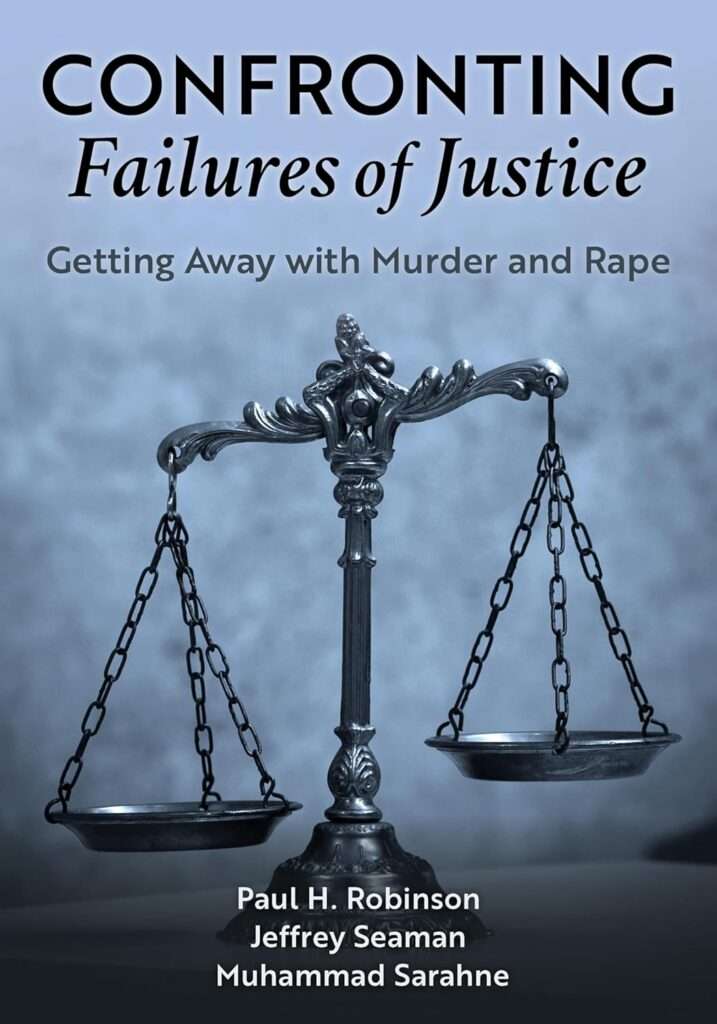
This is the fourth in a five-part series where we're guest blogging about our new book Confronting Failures of Justice: Getting Away With Murder and Rape, available here. In the previous posts we examined the frequency of failures of justice and their costs. Good public policy (including legal rules) needs to balance competing societal interests, and this is particularly true in the realm of criminal justice where lives are on the line. But as we argue in our book, many aspects of the legal system reflect an archaic or miscalculated balance of interests that needlessly frustrates justice.

For example, do statutes of limitation for rape make sense in a world with DNA evidence and untested rape kits? Should a serial killer really escape justice because a court suppressed all the evidence after concluding a traffic stop went on too long? Should courts even be the ones making such a rule?

One reason why many criminal justice rules are poorly balanced from the perspective of doing justice is that there was no attempt to make a nuanced calculation of societal costs and benefits—merely an effort by judges to create or apply a rigid rule. Indeed, a theme that emerges from studying the causes of failures of justice in the legal system is that judge-made criminal justice policy is rarely well-made criminal justice policy. Here are some excerpts from the book considering the question of balancing societal interests and who should do that balancing.

There are almost always some legitimate interests that can be identified in support of justice-frustrating rules or practices. Thus, rational policymaking cannot simply demand exclusive focus on doing justice but rather must balance competing societal interests. That said, the analyses in previous chapters suggest that the balance of societal interests in current rules and practices is commonly skewed and much in need of rational and thoughtful rebalancing. Even the interpretation of constitutional rules represents a balancing of interests—by judges—that is sometimes explicit and sometimes implicit. A proper balancing of interests is likely to produce more compromise policies than the partisans of a particular issue might like. On the issue of privacy, for example, a proper balancing of interests reflecting society's preferences would likely satisfy neither extreme privacy advocates nor extreme justice proponents.

Read More

Immigration

Public Ignorance and Misinformation About Immigration

A new study shows it is widespread on several issues, in ways that bolster restrictionism.

|

NA

Widespread political ignorance is a serious problem that both major-party presidential candidates are trying to exploit. A recent survey by the Kaiser Family Foundation finds extensive ignorance on the key issue of immigration. The study finds large numbers of people believe misinformation about immigration, while rejecting true statements about it.

For example, 51% believe it is "definitely true" or "probably true" that "Immigrants are causing an increase in violent crime in the U.S" (48% say this is definitely or probably false). In reality, immigrants, including undocumented immigrants, have much lower violent crime rates than native-born citizens. Similarly, 44% believe it is "definitely true" or "probably true" that "Immigrants are taking jobs and causing an increase in unemployment for people born in the U.S" (56% think this is definitely or probably false).  Most economists conclude that immigration does not increase unemployment among natives, and deportation of undocumented immigrants actually destroys more jobs for native-born workers than it creates than it creates (see also here).

The KFF study also finds that 59% believe it is false or probably false that "Undocumented immigrants pay billions of dollars in U.S. taxes every year" (40% think it is true or probably true). The truth is undocumented immigrants pay almost $100 billion in taxes per year, most of that going to the federal government.

The KFF survey does find respondents overwhelmingly get one point right: 84% believe it is "true" or "probably true" that "[i]mmigrants help fill labor shortages in certain industries like agriculture, construction, and health care." These are indeed all industries where immigrants are major contributors. A recent study finds that deportation of undocumented migrants reduces housing construction and thereby increases housing costs.  Immigrants are also disproportionately represented in health care, filling many critical needs. The same is true in agriculture.

There is a possible flaw in the KFF crime question. I think the intent of the question and the way most readers probably interpret it is to ask whether immigration increases the crime rate. But, read literally, it could potentially be interpreted as asking whether immigrants commit any violent crimes at all. If a million immigrants come in and even one commits a violent crime, that could be considered an "increase" in violent crime in the sense that it  increases the total number of violent crimes committed on US soil, even if the crime rate goes down substantially. I suspect most respondents are not interpreting the question that way. If they were, we would not see a massive partisan split in responses, with the vast majority of Republicans saying immigrants do increase violent crime, while most Democrats take the opposite position. Almost everyone presumably recognizes that some immigrants (like some members of virtually any large group) do commit violent crimes, even if the rate is low. But it's possible that the result here is skewed by a minority of respondents interpreting the question very literally, and thereby giving different answers than they would if they realized it was about crime rates.

Previous studies also find widespread ignorance on immigration policy issues, including the number of immigrants (voters tend to greatly overestimate it), their crime rate (ditto), and more.

Overall, public ignorance about immigration likely increases restrictionist sentiment. If many people realized that immigrants have low crime rates, pay more into the public fisc than they take out, and do not increase unemployment, public opinion would likely shift in a more pro-immigration direction. These false perceptions aren't the only possible justifications for immigration restrictions. But they are important considerations for many voters.

Obviously, there are other issues where ignorance skews public opinion in a more left-wing direction. Left-wing voters are far from immune to ignorance and bias. But that in no way mitigates the harm caused by ignorance on the right (and vice versa). Ultimately, political ignorance is a widespread problem on both sides of the political spectrum. It leads to both parties offering worse policies than they likely would otherwise.

There is no easy solution to the problem of political ignorance. But I assess a range of possible options in a recent article on "Top-Down and Bottom-Up Solutions to the Problem of Political Ignorance, and in my book Democracy and Political Ignorance: Why Smaller Government is Smarter.

Free Speech

Challenge to Nassau County Anti-Mask Ordinance Fizzles, Because …

(1) the particular plaintiffs, who wore masks for health reasons, were excluded from the ordinance's operation, and (2) the risk that officials would misapply the ordinance to them wasn't sufficient to give them preenforcement standing.

|

Today's decision by Judge Joan Azrack (E.D.N.Y.) in G.B. v. Nassau County dealt with a challenge to Nassau County's Mask Transparency Act, which generally makes it a misdemeanor to wear "any mask or facial covering whereby the face or voice is disguised with the intent to conceal the identity of the wearer" in "any sidewalk, walkway, alley, street, road, highway or other public right-of-way or public property or private property without the consent of the owner or tenant." The Act also expressly excludes, among other things, "facial coverings worn to protect the health or safety of the wearer."

Plaintiffs challenged the Act, arguing that they were disabled and needed to wear a mask for medical reasons:

Plaintiffs … have disabilities. S.S. has common variable immunodeficiency, kidney disease, respiratory impairments, and post-viral syndrome. G.B. has cerebral palsy, asthma, and uses a wheelchair for mobility. Plaintiffs' disabilities increase their risk of serious side effects and death from airborne illnesses. "Since the COVID-19 pandemic," Plaintiffs have worn masks when they leave their homes "to protect [themselves] from illness."

And that, the court concluded, meant they lacked standing to challenge the law:

Plaintiffs fail to sufficiently demonstrate that their "intended future conduct is 'arguably proscribed by the statute' they wish to challenge." … Plaintiffs wear masks to protect themselves from illness. That is expressly excluded from the MTA's reach by its health and safety exception. Plaintiffs also do not wear masks in the manner proscribed by the MTA, namely, "with the intent to conceal the identity of the wearer." Plaintiffs "lack standing to challenge the [MTA] because, simply put, it does not apply to them."

Nor could they prevail on the theory that the law would be "misapplied or ignored by law enforcement:

Read More

Kelo

New London Gives $6.5 Million in Tax Breaks to Developer Planning to Build Housing on Land Condemned in the Kelo Case

The property has remained empty for almost twenty years, after the Supreme Court's controversial ruling upholding its condemnation to promote "economic development."

|

The site of Susette Kelo's house, May 2014. Photo by Ilya Somin.


Last year, I wrote about how there might finally be some  development on the site of the property condemned as a result of the Supreme Court's 2005 ruling in Kelo v. City of New London, the controversial 5-4 decision in which the justices ruled that the condemnation of homes for private "economic development" is permissible under the Takings Clause of the Fifth Amendment, which only allows takings for a "public use." In January 2023, Renaissance City Development Association (the private nonprofit development firm formerly known as the New London Development Corporation, which took ownership of the property after it was seized by eminent domain) sold the condemned land to a developer, which was planning to build new housing on it. Up to that point, the only regular users of the condemned land since the last homeowners were forced out were a colony of feral cats. The supposedly carefully planned development project that justified the condemnations fell through, as also did a number of later proposed uses for the land.

Feral cat on the site of one of the properties condemned in the Kelo case, 2011 (photo by Jackson Kuhl).


The New London Day, recently reported that the development project is going ahead, but the city has given the developer a hefty $6.5 million tax break to facilitate it:

The City Council late Monday [Sept. 16] approved nearly $6.5 million in tax breaks over 20 years to a developer planning to construct 500 new apartments on two sections of the Fort Trumbull peninsula that have sat vacant for more than two decades.

The fixed tax agreement with RJ Development + Advisors, LLC, approved by a 5-2 vote, would offset about half the $13 million in estimated pre-construction costs needed to meet flood plain requirements and address remaining remediation and other sub-surface issues at the two sites.

In exchange, the city would receive approximately $18 million in tax revenue over the 20-year period of the agreement on parcels that Mayor Michael Passero noted have sat fallow and not producing taxes for a generation.

The vote was preceded by testy exchanges between council members and emotional rhetoric that referenced the peninsula's dark past as a national symbol for eminent domain.

A large swath of the Fort Trumbull area was left undeveloped after a controversial demolition and development push by the former New London Development Corp. That led to the landmark 2005 U.S. Supreme Court eminent domain decision, Kelo v. New London.

Passero, who called that decision a debacle that left the land an "open sore," said the housing project would serve as a salve to "help heal the wound."

Councilors Jefferey Hart and John Satti, who both voted against the tax agreements, echoed concerns raised by several citizens earlier in the meeting, including the prospect of giving a sweetheart deal to a developer who stood to make millions from a project being subsidized on the backs of taxpayers.

"It's important to show resistance to people offering you a bad deal," Hart said. "There's a lot of assumptions that no other developer is willing to take on this project (without a tax break)."

But Felix Reyes, the city's director of planning and economic development said no other viable investor has stepped forward since the property became marketable. Reyes acknowledged the trauma suffered by former residents of the peninsula and the "cruel things done" there as part of the city's effort to attract private development.

"There's no line out the door of developers willing to tackle this project," Reyes said, adding any such firm would face the same pre-construction costs as RJ Development, including a requirement to build the complexes on raised platforms.

Like most property scholars and land-use economists, I am skeptical of the value of targeted tax breaks and subsidies like this one. The better approach to promoting development is to have a good business climate across the board - and respect property rights. Also, projections of the benefits of such taxes and subsidies are often exaggerated. I am skeptical that the City will really get the promised $18 million in tax revenue.

Of course, the projected benefits of "economic development" takings like the one upheld in Kelo are also routinely exaggerated. There are few better examples than the Kelo condemnations themselves. Even if this new development project is a complete success, that would not be a vindication of the original Kelo takings. As I explained in my previous post on this topic:

Since 2005, several efforts to redevelop the condemned land have fallen through. Hopefully, this one will succeed. But even if it does, I don't think it will somehow vindicate the Kelo condemnations. The new development initiative is obviously different from the badly misconceived plan that led to the use of eminent domain over twenty years ago. Moreover, by the time any construction is completed, the land will have lain unused (except by feral cats!) for nearly twenty years. From the standpoint of promoting development, that's an enormous waste.

The region would almost certainly have been better off economically if the original owners had been allowed to keep living there, paying property taxes, and contributing to the local economy. And that doesn't even consider the enormous pain and suffering the original development project inflicted on those who lost their homes (including some who sold them "voluntarily" as a result of harassment and the threat of eminent domain).

I would add that if the City had simply left the property owners alone, they would not have had to give anyone targeted tax breaks to develop the land.

Unless you're one of the feral cats living on the property, it's hard to justify the Kelo takings!

I covered the history of the condemnation process and the harm it inflicted in depth  in  The Grasping Hand: Kelo v. City of New London and the Limits of Eminent Domain, my book about the Kelo case and its aftermath. In that book, I also explained why the Supreme Court's ruling was wrong from the standpoint of both originalism and living constitutionalism.

Sean Penn, Free Speech, and Labor Law

|

An interesting incident, which led to a National Labor Relations Board decision (CORE & Rojas) Sept. 20. First, an excerpt of the facts involving Community Organized Relief Effort, a charity co-founded by noted actor Sean Penn (known in part for his past anger management problems):

On January 29, 2021, the New York Times (NYT) published an article about [a COVID] Vaccination Day event [organized at Dodger Stadium by the L.A. Mayor, and staffed by, among others, some CORE employees]. The article detailed what occurred during the event and included interviews with various individuals, participating organizations, and others that attended and/or worked the event.

After that, two anonymous commenters, who either were CORE employees or at least were so perceived by Penn, posted:

[1.] I work at the Dodger Stadium site and this article is inaccurate. The line about no honking cars is true. However, I had patient after patient yelling and complaining about the four hour wait and lack of restrooms. Sure, no one honked their horn, but a driver threatened to run over one of our staff members unless he let them on site. What the article does not mention is that we have staff working 18-hour days, 6 days a week, without the backup coverage to be able to take time off. This is an OSHA violation and it exists because the mayor ordered that we transition from a test site to a vaccination site in less than a week. If we had more time to transition, we wouldn't have staff working these hours without the opportunity to take breaks - they are schedulers and are essential to the function of the site. Without them, we wouldn't be vaccinating. The mayor more or less ordered an OSHA violation. There is a shipping container on site that is a designated space for overworked staff to go cry in. If you're not let into this shipping container, it's because staff are crying inside. Garcetti created these conditions and looks like a hero for it. Additionally, Garcetti got to skip the line for vaccine doses. Our staff wait in a queue to receive drawn vaccines. Garcetti went to the front of the line every time and the patients in his line received expedited service. Additionally, the line about his phone number is a violation of our policies - no one gets special treatment.

[2.] I am working on the ground at Dodger. We do NOT get krispy kreme for breakfast. In fact, we usually DON'T get breakfast, just coffee. And the lunch is NOT subway. It's the same old lettuce wraps every clay. It's free lunch for staff/volunteers so I'm not complaining but still…not subway. Also, it's NOT wifi issues with the [iPads]. It's server issues/bugs with the Carbon. Health server that we are using to log people in. Other websites will load and the iPads work perfectly fine, but the Carbon Health app/site is still in beta and is EXTREMELY buggy and slow. Someone told me once they checked in 3 patients in 55 minutes because of how slow the Carbon website was. Lastly, the day the line was over 4 hours long was because the mayor decided to let over 1,000 police officers cut the line and get vaccinated without an appointment, throwing the entire system off. On a typical day the line will not be that long.

The administrative law judge concluded that this may have constituted "complaining about their terms and conditions of employment," which is protected by labor law against employer retaliation.

After the comments, Penn either wrote or had CORE's CEO write this email:

Read More

Campus Free Speech

ABA Standard 208, Law Schools, and the First Amendment

New guidance makes explicit what should have been clear already: Standard 208 obligates law schools to embrace First Amendment principles.

|

Last February, the American Bar Association adopted a new accreditation standard on academic freedom and freedom of expression: Standard 208. Under this standard, all law schools are required to protect academic freedom and freedom of expression as a condition for their accreditation. This was a "step forward" for free speech and open inquiry at American law schools.

Standard 208 obligates law schools to "protect the rights of faculty, students, and staff to communicate ideas that may be controversial or unpopular, including through robust debate, demonstrations, or protests," among other things. The clear implication of the standard's language (and accompanying interpretations) was that law schools should be expected to provide speech protections consistent with the First Amendment. In other words, private law schools and public law schools would be expected to meet the same standard (with appropriate accommodation for those schools with religious or other credal commitments). Alas, some private universities resisted this interpretation.

A new guidance memo from the ABA further explicates the reasons for adopting the new standard and makes explicit that Standard 208 incorporates First Amendment principles.

On the Standard's purpose:

Standard 208 was created to strengthen academic freedom and freedom of expression protections, as Standard 405(b) required a law school only to have "an established and announced policy with respect to academic freedom" and did not specifically require that a law school adhere to its policy on academic freedom. The Council believes that the development of the law and effective legal education require free and robust inquiry, exposition, and exchange of ideas and states this conviction in Interpretation 208-6 where it also explains that "becoming an effective advocate or counselor requires learning how to conduct candid and civil discourse in respectful disagreement with others while advancing reasoned and evidence based arguments."

Part 208(c) of the standard notes that the law schools may adopt some restrictions on expression. As the guidance memo makes clear, the ABA understands this language to track the contours of existing First Amendment doctrine.

The Council recognizes that the Standards it has prescribed for academic freedom and freedom of expression may involve discretion and interpretation of unresolved areas of the law. Subsection (c) seeks to address certain of these areas and to confirm the law school's substantial discretion to regulate or restrict academic freedom or expression within them. As provided in Interpretation 208-5, Subsection (c) will be interpreted consistent with the First Amendment of the U.S. Constitution. In areas where First Amendment law is unclear or debatable, the Council will likely find any policy arguably consistent with First Amendment doctrine to be compliant, unless and until the law school's policy (or one substantially similar to it) has been found inconsistent with the First Amendment in a judicial proceeding following the exhaustion of any available appeals. To the extent that this occurs, the law school will be expected to change its policy to be consistent with the First Amendment. This approach gives schools the maximum flexibility to adopt and adhere to policies that they find appropriate, whether articulated in a general or more detailed manner, so long as they comply with applicable constitutional law.

As I have noted before, there are prudential reasons why private law schools should embrace First Amendment standards on speech and expression. The new guidance makes clear that they have an obligation to do so as well.

Michigan Supreme Court Grants Review in People v. Carson

An important case on the particularity of digital-evidence warrants.

|

Back in March, I had a long post here, Yes, Warrants Allow A Search Through the Whole Phone, criticizing a Michigan Court of Appeals ruling in People v. Carson.  My post began:

As regular readers know, one of the big issues in computer search and seizure law that I often write about is how to limit computer warrant searches.  If everything needs to be searched to find the evidence, and information outside the scope of the evidence sought can be used in plain view, doesn't a search of a computer with a warrant result in a general search — the kind that the Fourth Amendment was enacted to prevent.  My own answer to this puzzle is that the Fourth Amendment requires use restrictions for digital searches.  The whole computer can be searched, but evidence outside the scope of the warrant cannot be used.

In the last year or two, however, a few state courts have tried to limit computer searches through novel interpretations of the particularity requirement. I think this is wrong, and I thought I would explain why.

I'm pleased to report that the state sought review of the ruling from the Michigan Supreme Court, and that today the Michigan Supreme Court agreed to hear the case:

On order of the Court, the application for leave to appeal the February 15, 2024 judgment of the Court of Appeals is considered, and it is GRANTED. The parties shall address whether the Court of Appeals erred by: (1) holding that the warrant to search the defendant's cell phone violated the Fourth Amendment's particularity requirement, see People v Hughes, 506 Mich 512, 538 (2020); (2) failing to sever any valid portions of the search warrant from any invalid portions, see People v Keller, 479 Mich 467, 479 (2007); (3) holding that the good-faith exception to the exclusionary rule did not apply, see People v Goldston, 470 Mich 523, 531 (2004), discussing United States v Leon, 468 US 897, 923 (1984); and (4) finding that trial counsel deprived the defendant of his right to the effective assistance of counsel by failing to move to suppress the evidence obtained from his cell phone on these grounds, see Strickland v Washington, 466 US 668, 687-688 (1984).

As always, stay tuned.

En Banc Fifth Circuit Tells Judge Ezra to RTFM

"The case is REMANDED with instructions to vacate the preliminary injunction and for further proceedings consistent with the majority opinion of the court."

|

Last month I wrote about Judge David Ezra's worrying behavior in the Buoy Case. I won't even attempt to rehash the unusual hijinks in his court. Rather, for present purposes, it is enough to recount how Judge Ezra was perplexed about why the en banc Fifth Circuit reversed him. He cited "chatter" from "law professors" who doubted whether Judge Willett's opinion was actually a controlling majority opinion.

On Monday, the en banc Fifth Circuit finally issued the mandate in the Buoy Case, with a two-sentence message for Judge Ezra:

IT IS ORDERED and ADJUDGED that the district court's order granting a preliminary injunction is REVERSED, and the case is REMANDED with instructions to vacate the preliminary injunction and for further proceedings consistent with the majority opinion of the court. The stay pending appeal is DISSOLVED.

In other words, RTFM. No, not that RTFM. Rather, Read The Following Majority opinion. I have never seen a mandate like this before. Mandates are usually boring documents that contain nothing of substance. But there is a clear signal here

Short and succinct, the Fifth Circuit says loud and clear that there is a "majority opinion of the court." And it is Judge Willett's opinion. All members of the Fifth Circuit agree on that much. This should not have been difficult. Chief Judge Richman's concurrence refers to Judge Willett's opinion as the "majority opinion." Judge Douglas's dissent refers to Judge Willett's opinion as the "majority opinion." When all of the members of the court label an opinion a "majority opinion," it is a majority opinion. But that message did not get through to Judge Ezra. Now, perhaps, the mandate will make that clear.

Judge Ezra's confusion seems to stem from the relationship between Judge Willett's majority opinion, and the concurrences from Judges Richman and Ho. It is true that Judge Richman did not join Judge Willett in all regards. But Judge Ho thought the federal suit was defeated by the U.S. Constitution. Indeed, Judge Ho also found that the district court lacked jurisdiction. In any case where Judge Willett would rule for Texas, so would Judge Ho. The upshot is that a majority of the en banc court said a PI cannot be granted. That much was clear in July, and it is crystal clear today. Judge Ezra should promptly issue a judgment in favor of Texas, and let Solicitor General Prelogar file her certain-to-be-granted cert petition so it can be granted before the inauguration. Move along.

Again, for all the outrage about rogue judges in Amarillo and Fort Worth, the eyes of Texas should be upon Judge Ezra.

Free Speech

No Legal Duty to Remove or Update Accurate Report of Arrest, Even After Charges Were Dismissed

|

From Holt v. Gray Television, Inc., decided Friday by Chief Judge David Proctor (N.D. Ala.):

This action arises from Plaintiff's arrest on January 7, 2021. Plaintiff was charged with three counts of child pornography—that is, sending, receiving, and possessing child sexual abuse material. Plaintiff alleges that, on that same day, Defendants reported this information on WTOK TV and posted it on their website. On September 15, 2022, Plaintiff's charges were dismissed. Plaintiff alleges that he contacted Defendant Harms, provided proof that the charges had been dismissed, and requested that the story on his arrest be removed or updated. Plaintiff further alleges that Defendant Harms refused to update the story or take down the information that had been posted on the website.

At the time of his arrest, Plaintiff alleges that he was a candidate for Ward 2 City Councilman for the City of Meridian, Mississippi. He also alleges that he was a political activist, and had a podcast called "Reaching Out With Eddie," where he exposed the "illegal acts and wrong doing of government officials, city officials, politicians, and the law enforcement community." …

Plaintiff sued for defamation, but the court rejected the claim; here is part of the reasoning:

Read More

Free Speech

Libel, College Students, and Garnished Wages: Even Entry-Level Workers Aren't "Judgment-Proof"

|

I wrote last November about a libel verdict in Cody v. Dirir, a lawsuit between two college students. To quickly excerpt the facts, from the court's opinion:

On October 12, 2022 [likely should say 2019 -EV], the plaintiff and the defendant were students at the University of Connecticut in Storrs, Connecticut (University). They did not know each other until October 12, 2022 [likely should say 2019 -EV], when the defendant attended a party at a home of a fraternity that the plaintiff was a member of and where he resided. During the party, the defendant believed that she was called a nigger (N-word) by another member of the fraternity, Frank V., a black male. When the defendant told the plaintiff, a white male, that Frank called her the N-word, the plaintiff tried to convince her that Frank would never say that and if he did, he did not intend it in a negative way as he used the N-word with an "a" at the end of the word and not with an "er" at the end of the word. Frank used the N-word in the defendant's presence, and she believed the word was directed to her.

The defendant was upset by this exchange at the party, and after the defendant left the party, she reported this encounter to her cousin, … Ellie …. With the defendant's assistance of providing a picture of the plaintiff and Frank, Ellie posted on her Twitter page the picture of Frank and the plaintiff with the following statement: "These two called my little cousin a nigga and continued to belittle her infront of their white friends at a UConn frat party. If anyone knows their names, please let me know. And tell them keep that energy." The statement with the picture (also referred to as "post" or "tweet") was seen initially by approximately 700 to 1000 people who are the cousin's Twitter followers. Those followers then forwarded the post/tweet to their Twitter followers, resulting in approximately 5000 or more people viewing the post.

The statement, plaintiff argued, was false, badly damaged his reputation, and distressed him. (For more details, see the longer excerpt here.) And the judge ultimately agreed, concluding (to oversimplify) that the statement was false and highly distressing. Because of this, the judge awarded $10K in compensatory damages to plaintiff, and left open the possibility of punitive damages. In May 2024, the judge indeed awarded $26K in punitive damages, reflecting 3/4 of the plaintiff's attorney fees (since plaintiff had prevailed on the most significant part of his claims but not all his claims).

Defendant thus owed $36K, and plaintiff moved to garnish defendant's wages, which is to say to have the judgment paid off (slowly) out of defendant's paycheck. Here's what happened, according to Judge Matthew Wax-Krell's order issued last week:

Read More

Criminal Justice

It's Time to Confront Failures of Justice (Part III)

Counting the many costs of failures of justice.

|

This is the third in a five-part series where we're guest blogging about our new book Confronting Failures of Justice: Getting Away With Murder and Rape, available here. The last two posts introduced the problem of failures of justice (instances of unpunished or inadequately punished crime) and discussed how the problem is not solving itself. Now it's time to talk about costs. Why should we care about failures of justice? One cost is moral—we, along with most people, believe that there is a moral obligation to punish serious crime. This argument could also be made in social contract terms—the government has a duty to its people to punish those who victimize them.

But in addition to these moral costs, failing to punish serious crime produces enormous real-world harms. These include trauma to victims and co-victims, as well as increased crime through loss of incapacitation, reductions in deterrence, and, perhaps most importantly, the consequences of a decline in the law's moral credibility with the community. Consider an excerpt from our book discussing the harms caused to victims and their families.

Many serious, violent crimes leave victims alive but scar them with emotional trauma, especially when justice is not served. Surviving a rape or attempted murder is merely the beginning of suffering for most victims. A victim may well find some measure of solace and healing in the thought that their attacker has been caught and punished, but most victims of serious crime never experience that comfort…. It is impossible to quantify the suffering victims experience when their victimizers escape justice, but the cost is real and significant.… Studies have found that rape victims are more likely to experience post-traumatic stress disorder if they have "negative experiences with the criminal justice system" compared with those who have positive experiences with the system or even those who had no interaction with the system. The knowledge that one's attacker still walks free can be infuriating and crippling to many victims.…

Rape is not the only crime with enormous personal costs. When a murderer or other serious violent offender gets away without deserved punishment, the victims' families and friends are emotionally scarred. The relatives and friends of someone lost to homicide are often referred to as "co-victims," a term that acknowledges that victimization extends far beyond the person killed. Anyone who has had a friend or a family member murdered will have to deal with lifelong grief, but a failure of justice adds anger, upset, and fear to that pain through the constant knowledge that the killer is free.

In the United States, it is estimated that roughly 9% to 15% of adults are co-victims of homicide and that roughly 8% to 18% of youths are co-victims of homicide. Since justice fails in more than half of such cases, around 5% or more of the population suffer from the knowledge that the killer of their loved one got away with murder. Worse, the co-victimization rates are staggeringly higher for other crimes, such as rape or aggravated assault, where the punishment rates are extremely low, even trivial.

But failing to punish serious crime does more than traumatize victims and their families. It also breeds more crime through several mechanisms.

Read More

Stephen Vladeck Replies to Judge Reed O'Connor on Forum Selection and Judge-Shopping

A different take.

|

A few days ago, my co-blogger Josh Blackman posted some very interesting remarks about forum selection and judge-shopping from Judge Reed O'Connor (NDTX).  I was interested to know, though, what the counterargument might look like.  In the spirit of furthering that debate, I am pleased to pass on this reply to Judge O'Connor from Professor Stephen Vladeck.  The remainder of the post is Professor Vladeck's reply.

* * * * * * * * * *

My sincere thanks to Professor Orin Kerr for inviting me to respond to Judge O'Connor's speech in this guest post. If nothing else, the more that we're publicly discussing and debating the virtues and vices of judge-shopping, the better. To that end, I'm also grateful to Judge O'Connor—not just for publicly addressing the critiques, but for allowing his remarks to be shared more broadly.

In trying to make the case for why judge-shopping should bother all of us, it might be useful to start with a context in which the cases are (and, thus, the entire debate is) less ideologically charged—patent litigation. Starting in 2019, Judge Alan Albright—a former patent litigator confirmed to the federal bench in 2018—began undertaking a series of efforts to attract patent litigators from all over the country to bring their patent cases to Waco, Texas. As Professors Jonas Anderson and Paul Gugliuzza documented, Albright adopted a series of procedural and case-management rules that gave special treatment to patent cases. And given his own experience prior to taking the bench, he could also guarantee that litigants would have a judge with an unusual amount of subject-matter expertise to preside over their claims. How could he guarantee that? Because, at that time, 100% of new civil cases filed in the Waco Division of the Western District of Texas were assigned to him. And it worked. By 2020, 23% of new patent cases in the country were being filed in the 23rd largest city in Texas.

Albright's efforts provoked a sharp and high-level bipartisan response. Those efforts culminated in November 2021, when Senators Patrick Leahy (D-Vt.) and Thom Tillis (R-N.C.) wrote to Chief Justice Roberts that this behavior "creates an appearance of impropriety which damages the federal judiciary's reputation for the fair and equal administration of the law." Roberts echoed the point six weeks later—writing in his 2021 Year-End Report that "the Judicial Conference has long supported the random assignment of cases and fostered the role of district judges as generalists capable of handling the full range of legal issues," even as "the Conference is also mindful that Congress has intentionally shaped the lower courts into districts and divisions codified by law so that litigants are served by federal judges tied to their communities." In his words, "Reconciling these values is important to public confidence in the courts." (The March 2024 Judicial Conference policy statement provoking Judge O'Connor's speech was the culmination of the process that Senators Leahy and Tillis had asked for.)

The Western District got the message. In July 2022, the Western District changed its case assignment rules to provide for the random assignment of all patent cases filed in Waco—so that litigants would have less than a 10% chance of drawing Judge Albright. Not surprisingly, the number of new patent suits filed in Waco has dropped precipitously.

I mention all of this to illustrate two points: First, when the subject-matter of the judge-shopping wasn't ideologically charged, folks didn't seem to have trouble separating out the Waco docket's terrible optics for public confidence in the federal courts, on the one hand, from the perfectly ethical behavior of the lawyers who filed their cases in Waco and the judge who made it known that he was receptive to them, on the other. Both things can be—and in that case, were—true.

Second, so far as I know, no one ever accused the long list of "commentators, so-called watchdogs, and even elected officials" who criticized what was happening in Waco of being engaged in "efforts to undermine public support for the judiciary," or of "increasingly teach[ing] students to presume malicious intention on the part of judges with whom they disagree." To the contrary, the concern was that the judge-shopping that Judge Albright was inviting was itself responsible for "undermin[ing] public support for the judiciary," even if it came from the best of motives and a good-faith belief that everyone would be better off with a patent law expert handling more patent cases with patent-friendly procedural rules.

The quotes in the last paragraph, in case it wasn't clear, are from Judge O'Connor's speech—in which he was quite critical of those, like me, who have been more generally critical of judge-shopping. And insofar as the quoted language is directed at people like me, I find the sentiments rather unfortunate—for at least three reasons.

First, they seem rather oblivious to the pervasiveness of the judge-shopping that's occurring in Texas courts these days. To take one example, just yesterday, Texas filed at least its 47th different lawsuit in Texas district courts challenging Biden administration policies. Of those 47, zero have been filed where the Texas government is actually located (i.e., Austin). 24, including yesterday's, have been filed in single-judge divisions; another six were filed in divisions where Texas had a 95% chance of drawing a specific judge. And when asked why it keeps filing in these geographically obscure (and unrelated) parts of the state, Texas has publicly conceded that it has nothing to do with that particular forum's connection to the litigation, but rather is entirely because it wants those judges to hear those cases. If it was problematic for patent litigants to be able to steer almost 25% of nationwide patent litigation to a single judge in Waco, it seems comparably problematic (if not worse) for Texas to be able to steer a significant percentage of nationwide litigation challenging new federal policies to hand-picked judges in other single-judge divisions in Texas. (I've written elsewhere about why, in my view, this kind of judge-shopping is different in both degree and kind from forum-shopping; some degree of the latter is inevitable in a system with permissive venue and jurisdictional rules.)

Read More

A Reminder Of What Will Happen When The Filibuster Is Gone

Harris says the quiet part out loud.

|

Today Vice President Harris announced that she would support eliminating the filibuster to codify Roe v. Wade:

"I think we should eliminate the filibuster for Roe [v. Wade], and get us back to the point where 51 votes would be what we need to actually put back in law the protections for reproductive freedom."

Senate Majority Leader Schumer likewise said eliminating the filibuster is "something our caucus will discuss in the next session of Congress." Translation: Democrats will nuke the filibuster if they win the White House and have majorities in both houses.

I agree with the Wall Street Journal that once the filibuster is eliminated for abortion, it will be eliminated for all other legislation.

She's couching this procedural coup as related only to imposing a national abortion law on all 50 states. But anyone paying attention knows that's a ruse. Once the 60-vote filibuster rule ends for one piece of non-budget legislation, it will end for everything.

Chuck Schumer, the Senate Majority Leader, recently said he wants to break the filibuster for a national abortion law and pass a bill that would impose California-style voting rules on all 50 states. Good-bye voter identification, and hello nationwide ballot harvesting.

It won't stop there. Sen. Sheldon Whitehouse says he wants to break the filibuster to restructure the Supreme Court. Sen. Bernie Sanders has recently given up on his former institutional objections and now favors 51 votes to pass his proposals.

Every interest group in the Democratic coalition will demand that its priorities pass with 51 votes too. Think statehood for the District of Columbia. And think Big Labor's PRO Act that would ban right-to-work laws nationwide, among other ideas that would normally require bipartisan majorities to pass the Senate.

This wishlist is not fanciful. Jeff Toobin offered a similar roadmap in 2020.

Once D.C. has statehood, it will become far more difficult for Republicans to obtain a majority in the Senate, and nearly impossible to confirm Republican-nominated judges. And once the lower courts and Supreme Court are packed, there will be no judicial check on whatever a simple majority of Democrats can muster. Within a span of a two years, our country would become nearly unrecognizable. If you think this sort of rapid change is impossible, look at what just happened in Mexico.

This blog is hosted by a non-profit, so I will resist making any sort of political endorsement. Instead, I would urge people who are generally right-of-center to think very carefully about which candidate actually poses the bigger threat to that which they care the most about. I know of several never-Trumpers who today became reluctant-Trumpers. You are not alone.

Free Speech

N.Y. Law Mandating That Delivery Services Share More Customer Data with Restaurants Violates First Amendment

|

From today's opinion by Judge Analisa Torres (S.D.N.Y.) in Doordash, Inc. v. City of New York:

When a diner orders food from a restaurant using the online platform of a third-party food delivery service …, the restaurant generally receives only the individual's first name, the first initial of her surname, and the order's contents—the minimum information required to fulfill the order. In August 2021, in an effort to support local restaurants that use Delivery Services, … the City of New York … enacted … [t]he Customer Data Law[, which] requires that Delivery Services provide restaurants with a diner's full name, email address, phone number, delivery address, and order contents.

The court concludes that the Customer Data Law compels commercial speech by Delivery Services, and must therefore be judged under the First Amendment intermediate scrutiny applicable to commercial speech regulations (at least ones not aimed at misleading statements):

The government can freely regulate commercial speech that concerns unlawful activity or is misleading. But where, as here, the information does not fall into those two categories, courts apply a balancing test to determine whether a commercial- speech regulation passes intermediate scrutiny. Courts inquire into (1) "whether the asserted governmental interest is substantial," (2) "whether the regulation directly advances the governmental interest asserted," and (3) "whether [the regulation] is not more extensive than is necessary to serve that interest." …

To evaluate whether an interest is substantial, the Court must "evaluate the City's asserted goal in enacting the regulation." "When the [g]overnment defends a regulation on speech as a means to redress past harms or prevent anticipated harms, it must do more than simply posit the existence of the disease sought to be cured." Intermediate scrutiny requires that the state "demonstrate that the harms it recites are real."

Read More

Artificial Intelligence

The Digitalist Papers (on AI and Democracy in America) Now Out from Stanford

|

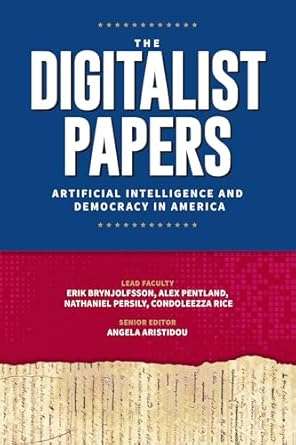
Check out the essays here, or buy a Kindle ($1.99) or paperback or hardcover copy on Amazon. The book was put together by Erik Brynjolfsson, Alex "Sandy" Pentland, Nate Persily, and Condoleezza Rice, and by the Stanford Digital Economy Lab, the Stanford Cyber Policy Center, the Project Liberty Institute, the Stanford Institute for Human-Centered Artificial Intelligence (HAI), and the Hoover Institution (Stanford).

The chapter authors include Eric Schmidt (formerly at Google), Reid Hoffman (LinkedIn), and many others, including—to give some names most likely to be familiar to our lawyer readers—Profs. Larry Lessig (Harvard Law), Nate Persily (Stanford Law), and me. Here's a full list, with links:

Erik Brynjolfsson, Alex Pentland, Nathaniel Persily, Condoleezza Rice, and Angela Aristidou, Introduction: Artificial Intelligence and Democracy in America
Lawrence Lessig, Protected Democracy
Divya Siddarth, Saffron Huang, and Audrey Tang, A Vision of Democratic AI
Lily Tsai and Sandy Pentland, Rediscovering the Pleasures of Pluralism: The Potential of Digitally Mediated Civic Participation
Sarah Friar and Laura Bisesto, The Potential for AI to Restore Local Community Connectedness, the Bedrock of a Healthy Democracy
Jennifer Pahlka, AI Meets the Cascade of Rigidity
Eric Schmidt, Democracy 2.0
John Cochrane, AI, Society and Democracy: Just Relax
Nathaniel Persily, Misunderstanding AI's Democracy Problem
Eugene Volokh, Generative AI and Political Power
Mona Hamdy, Johnnie Moore, and E. Glen Weyl, Techno-Ideologies of the Twenty-First Century
Reid Hoffman and Greg Beato, Informational GPS
James Manyika, Getting AI Right: A 2050 Thought Experiment

More