The Volokh Conspiracy

Mostly law professors | Sometimes contrarian | Often libertarian | Always independent | Est. 2002

The Volokh Conspiracy

Hoover History Skills Academy for High School Students (July 21 to Aug. 1, 2025)

|

From my colleague and historian Stephen Kotkin at Hoover (formerly at Princeton):

As part of the Hoover History Lab's commitment to the development of educational programs that address the needs of high school students, we have recently launched an exciting new program, the Hoover History Skills Academy.

This Academy will provide high school students with an unparalleled two-week learning opportunity on the Hoover campus to master best practices for designing, researching, and writing a substantive historical research paper, taking advantage of the extraordinary historical materials in the Hoover Library and Archives.

Students may also submit their finished paper for possible publication in The Concord Review (our partner for this event) as a pre-collegiate academic accomplishment….

As there are only 24 seats available, we expect this program to fill up quickly. Interested students should apply ASAP.

Learn more about the program: Hoover History Lab Launches History Skills Academy For High School Students | Hoover Institution

Apply for the program:  History Skills Academy 2025 | Hoover Institution

Tuition ranges is $3950 for commuter students and $4950 for those who need room and board (plus a bit extra for PayPal payments). The tuition payments are to The Concord Review, which runs the camp; I'm told that Hoover doesn't get any of the revenue.

My Amicus Cert Petition in the Horseracing Case

I argue, on behalf of the Reason Foundation and the Goldwater Institute, that the Supreme Court should take up an Appointments Clause question.

|

There's been a lot of recent legal action involving the Horseracing Integrity and Safety Authority. The Fifth Circuit found HISA unconstitutional in 2022; Congress changed the statute within about six weeks; in a parallel case, the Sixth Circuit found that the statutory change had fixed the problem; the Fifth Circuit found that the statutory change partially fixed the problem but still struck down HISA's enforcement (but not regulatory) power. Meanwhile, in yet another parallel challenge, the Eighth Circuit upheld HISA.

Because none of the parties in the latest Fifth Circuit iteration got exactly what they wanted, basically everyone is petitioning for cert—and what with the circuit split and the fact that the Fifth Circuit partly struck down a federal statute—a cert grant is very likely. But there's still some dispute about whether the cert grant should be limited to the "private nondelegation doctrine" question or also include an Appointments Clause question. I favor the latter approach, so I just filed a brief yesterday making this argument on behalf of the Reason Foundation (which owns the reason.com website that hosts this blog) and the Goldwater Institute. (My position on this supports that of the Gulf Coast Racing plaintiffs, represented by Ilan Wurman of University of Minnesota Law School, and Reeves Jordan, Greg Sapire, and Carlos Soltero of Maynard Nexsen PC.)

(For previous posts of mine on the topic, see here, here, here, and here. Also see my Notre Dame Law Review article, The Myth of the Federal Private Nondelegation Doctrine, which discusses these issues in depth.)

I reproduce the brief below, or you can read the nicely formatted version here.

*     *     *

Summary of Argument

1. This case is obviously certworthy. The Horseracing Integrity and Safety Authority is an unaccountable agency that exercises significant federal rulemaking, investigation, and enforcement authority, even though its members haven't been politically appointed and even though it doesn't have meaningful oversight by any other agency. There is a circuit split on the private nondelegation issue. A circuit court has struck down part of a federal statute. Parties from both sides, including the federal government, agree that a grant of certiorari is warranted.

However, this Court shouldn't merely grant certiorari on the private nondelegation issue. It should also grant certiorari on the Appointments Clause issue, because these two issues are closely related, and the Fifth Circuit reached the incorrect result on each of these issues.

2. The Fifth Circuit was wrong that the Authority's enforcement power violates the "private nondelegation doctrine." There is no such doctrine. The idea that delegations of power to private parties are judged by a stricter standard than delegations to public parties has no support in any holdings of this Court. Any decisions that seem to the contrary have either been misinterpreted or were in fact based on other doctrines, like the Due Process Clause. And the lack of such a doctrine makes sense, because the nondelegation doctrine, which is rooted in Article I, sensibly asks whether Congress has given up too much power, not who the recipient of such power is.

If the Authority is considered a private organization, the delegation to the Authority should be judged by the same "intelligible principle" standard as a delegation to a public agency—and the delegation here clearly passes that test.

3. However, the Fifth Circuit reached the partially right result, though for the wrong reason. Contrary to the Fifth Circuit's holding, exercises of power by the Authority, whether rulemaking or enforcement power, violate the Appointments Clause, because the members of the Authority are Officers of the United States but weren't appointed as Officers should be under Article II.

That the Authority members are nominally private is unimportant for Officer status. The statutory labeling of the Authority as private, and the fact that the Authority is organized as a private organization under state law, are constitutionally irrelevant, and in any event Appointments Clause doctrine doesn't demand that an Officer formally be a public employee.

4. Even if public status were relevant to the Appointments Clause—and even if the Fifth Circuit were correct to assume that "state actor" status under the State Action Doctrine is relevant here—the Fifth Circuit still erred in holding that the Authority isn't a state actor. On the contrary, this is an easy case for state action, because rulemaking, investigation, and enforcement of federal law are traditionally exclusive public functions. Therefore, an alternative way of deciding the case would be to hold that the Authority is public because it is a state actor, which would uncontroversially activate both the Appointments Clause and the traditional (public) nondelegation doctrine.

5. The difference between the "private nondelegation doctrine" and the Appointments Clause isn't just of academic interest.

First, the doctrines are motivated by different theories. The nondelegation doctrine is giver-focused, asking whether Congress has given up too much power; the public-private question fits poorly with this concern. By contrast, the Appointments Clause is recipient-focused, asking, from a democratic accountability perspective, whether the recipient of major power has been validly authorized by the proper political process. The problem here fits more naturally with the Appointments Clause issue.

Second, the doctrines won't always produce the same results. A private nondelegation doctrine requires tough judgment calls about whether an organization is public or private, so the results will depend on the vagaries of public-private doctrines. And when the doctrine finds private status, it would apparently invalidate all delegations of "government power" that aren't subordinate to a public agency. Horsemen's I, 53 F.4th at 878. By contrast, the Appointments Clause asks whether someone (public or private) is "exercising significant authority pursuant to the laws of the United States." Thus, an Appointments Clause approach will turn on how much power the agent exercises, ignoring trivial cases and requiring political accountability for significant ones. This is a sensible approach—otherwise, countless private delegations could be indiscriminately invalidated, from qui tam suits to private prison contracting to incorporation of private actuarial standards into healthcare regulation. Whether these are valid should depend on an inquiry into "significant authority."

6. Therefore, this Court should grant certiorari on the Appointments Clause question.

This Court could reach the right result by only considering the Appointments Clause issue, because the correct resolution of that issue (that the Authority wields power unconstitutionally) would correctly resolve the entire case. But because parties from both sides, including the federal government, are asking the Court to consider the private nondelegation issue, and because that issue is obviously certworthy, amici ask that the private nondelegation and Appointments Clause issues be considered as linked and decided together.

The Sixth Circuit case (Oklahoma v. United States, No. 23-402) didn't consider the Appointments Clause at all, so it would not be a good vehicle for a grant of certiorari. By contrast, the Eighth Circuit case (Walmsley v. FTC, No. 24-420) did consider the Appointments Clause, essentially incorporating the Fifth Circuit's analysis (though the Appointments Clause issue was not part of the Questions Presented in the petition in that case). Therefore, this Court should grant certiorari—making sure that the grant includes the Appointments Clause question—in this case or in the Eighth Circuit case (or in both cases together).

Read More

Politics

Part XII: The Free Exercise of Religion

An Introduction To Constitutional Law Video Library: Sherbert v. Verner (1963), Wisconsin v. Yoder (1972), Employment Division v. Smith (1990), Church of the Lukumi Babalu Aye v. City of Hialeah (1993), Burwell v. Hobby Lobby Stores (2014)

|

Generally Applicable Laws Burdening Free Exercise

⚖️ Sherbert v. Verner (1963)

⚖️ Employment Division v. Smith (1990)

⚖️ Church of the Lukumi Babalu Aye v. City of Hialeah (1993)

⚖️ Wisconsin v. Yoder (1972)

⚖️ Burwell v. Hobby Lobby Stores (2014)

Read More

Free Speech

Apparent AI Hallucinations in AI Misinformation Expert's Court Filing Supporting Anti-AI-Misinformation Law

|

Minnesota recently enacted a law aimed at restricting misleading AI deepfakes aimed at influencing elections; the law is now being challenged on First Amendment grounds in Kohls v. Ellison. To support the law, the government defendants introduced an expert declaration, written by a scholar of AI and misinformation, who is the Faculty Director of the Stanford Internet Observatory. Here is ¶ 21 of the declaration:

[T]he difficulty in disbelieving deepfakes stems from the sophisticated technology used to create seamless and lifelike reproductions of a person's appearance and voice. One study found that even when individuals are informed about the existence of deepfakes, they may still struggle to distinguish between real and manipulated content. This challenge is exacerbated on social media platforms, where deepfakes can spread rapidly before they are identified and removed (Hwang et al., 2023).

The attached bibliography provides this cite:

Hwang, J., Zhang, X., & Wang, Y. (2023). The Influence of Deepfake Videos on Political Attitudes and Behavior. Journal of Information Technology & Politics, 20(2), 165-182. https://doi.org/10.1080/19331681.2022.2151234

But the plaintiffs' memorandum in support of their motion to exclude the expert declaration alleges—apparently correctly—that this study "does not exist":

No article by the title exists. The publication exists, but the cited pages belong to unrelated articles. Likely, the study was a "hallucination" generated by an AI large language model like ChatGPT….

Read More

In the Seventh Circuit, Procedural Red Herrings Threaten the Second Amendment

|

The Seventh Circuit heard oral argument on November 12 in Viramontes v. County of Cook, Illinois, a challenge to Cook County's ban on semiautomatic rifles like the AR-15, inaccurately labeled as assault weapons. These bans are flatly unconstitutional under Heller, which establishes that the law-abiding citizens of this Nation have a right to possess firearms that are in common use. Semiautomatic rifles undoubtedly are in common use – indeed, the AR-15 has been the best-selling rifle in the Nation for years. Unfortunately, the Seventh Circuit departed from Heller in a case called Bevis to hold that arms that are predominantly useful for military purposes can be banned. But even under that reasoning, semiautomatic rifles cannot be banned. They are common civilian firearms, not military firearms, because they lack the capacity for automatic and burst fire.

 The questioning at the Seventh Circuit, however, did not focus much on the merits of the case. Rather, the panel (consisting of Judges Sykes, Brennan, and St. Eve) took a surprise detour through a series of procedural objections put forward in Cook County's briefs. (Take a listen here). Judges Sykes and St. Eve appeared to think that Viramontes' challenge should fail because he didn't put forward critical evidence about semiautomatic rifles in the district court. Viramontes' lawyer challenged that notion, including by citing to specific pages in the record containing key pieces of evidence. I decided to dig deeper into the history of the case to see who has the better of the argument. The short answer is that Viramontes does. Indeed, he has built one of the most robust records I have seen by a plaintiff in a case challenging a semiautomatic rifle ban.

Procedural History

Before turning to the record, it is helpful to take a step back to see how we got to this point. When Viramontes filed his case, the constitutionality of a ban on semiautomatic rifles was controlled by two Seventh Circuit precedents, Wilson and Friedman. Viramontes did not initially seek to build a record in the district court because his sole path to victory was to have the Seventh Circuit or U.S. Supreme Court declare that Wilson and Friedman were wrongly decided.

Cook County, however, requested the opportunity to build a record, and the district court obliged. Then, while the case was proceeding in the district court, the U.S. Supreme Court decided Bruen, arguably wiping out Wilson and Friedman as precedent. It was in this context that the parties put forward their evidence and engaged in summary judgment briefing. It was not until summary judgment was fully briefed that the Seventh Circuit decided Bevis, and the parties addressed that decision in short filings.

Summary Judgment Briefing

Viramontes and Cook County both filed summary judgment motions. In those motions, the parties differed in how they presented the materials that they claimed supported their affirmative cases. All the key facts at issue in the case are what are called legislative facts – that is, general facts about the world that are not specific to the parties in the action, such as the overwhelming extent to which law-abiding citizens own semiautomatic rifles and why they own them. The Seventh Circuit has said that legislative facts may either "be incorporated in the argument section of [a] brief" or "in [a] statement of facts." Wiesmueller v. Kosobucki, 547 F.3d 740, 742 (7th Cir. 2008).

Viramontes chose the first option. Thus, in the argument section of his summary judgment brief, he cited legislative fact materials that he claimed entitled him to prevail, including: surveys about the possession of semiautomatic rifles by the Washington Post, the National Shooting Sports Foundation, and William English; information about the criminal misuse of firearms from sources like the U.S. Department of Justice and scholarly publications; and information about the distinction between automatic and semiautomatic fire and the defensive value of the latter from sources like the U.S. Army and scholarly publications.

Cook County chose the second option, putting in a lengthy statement of material facts setting forth its legislative fact material. Viramontes, accordingly, responded to Cook County's statement by identifying contrasting legislative fact material. This is expressly contemplated in the local rules, which provide that a response to a statement of material facts may include facts that are "fairly responsive to the asserted fact to which the response is made." N.D. Ill. LR 56.1(e)(2). Viramontes' response to Cook County's statement of facts is a 105-page document, backed by 105 exhibits spanning over 2,000 pages.

All of the specific sources referenced in the Seventh Circuit argument on November 12 can be found in these exhibits:

  • Gregory Wallce, "Assault Weapon" Lethality, 88 Tenn. L. Rev. 1, 13–14 (2020): dkt. 98, ex. 12 (PageID 1835).
  • Dennis P. Chapman, The AR-15 Controversy: Semiautomatic Rifles and the Second Amendment (2nd ed. 2022): dkt. 98, ex. 82 (PageID 3117).
  • William English, 2021 National Firearms Survey: Updated Analysis Including Types of Firearms Owned at 33–34, Geo. Univ. (May 13, 2022): dkt. 98, ex. 15 (PageID 2004).
  • Poll of current gun owners, Wash. Post-Ipsos (Mar. 27, 2023): dkt. 98, ex. 16 (PageID 2051).
  • Commonly Owned: NSSF Announces Over 24 Million MSRS in Circulation, NSSF (July 20, 2022): dkt. 98, ex. 50 (PageID 2639).

These sources establish that semiautomatic rifles like the AR-15 are commonly-possessed firearms that law-abiding citizens keep in their homes for self-defense; that the military does not use semiautomatic-only rifles as standard service rifles; and that automatic fire is used for military operations that require laying down suppressive fire. There is much else besides, and material from the exhibits is referenced in the responses to the statement of facts, which are then incorporated as appropriate into the response to Cook County's summary judgment brief.

Assessment

Having reviewed the record, Viramontes' lawyer was clearly right: Viramontes built a substantial record in the district court; Cook County had ample opportunity to address the materials in the record; and Viramontes should prevail based solely on the materials in that record.

Of course, because legislative facts are at issue there is no reason to limit the materials considered by the Court of Appeals to what was in the district court record. Both Viramontes and Cook County supplemented those materials with new materials in their appellate briefing. But regardless of whether a broader body of information or only the district court record is considered, Viramontes should prevail, whether under the Bevis test or under the Heller common use test. My hope is that the Seventh Circuit does not get sidetracked by spurious procedural objections but instead decides the case that has been presented to it on the merits.


1% Swing in Vote Would Have Changed Presidential, House Results

|

I expect this is obvious to most of our readers, but I thought I'd just flag it again, given the occasional talk of the decisiveness (or occasionally even "landslide" quality) of President-Elect Trump's victory: If 1% of voters nationwide switched from Trump to Harris,

  • Harris would have won Pennsylvania, Michigan, and Wisconsin (where the margin of victory was under 2%), thus winning the Electoral College 270 to 268.
  • The House would likely have gone 220 to 215 Democrat, as opposed to the current expected tally of 221 to 214 Republican.
  • The Senate would have still gone Republican by 52 to 48, as opposed to the current expected tally of 53 to 47.

The 312 to 226 Trump victory in the electoral college is obviously enough for victory in this particular election. But it's easy to imagine how even slight changes in public attitudes, or slightly more or less appealing candidates, could shift the results radically in 2028 or, in the House in 2026. (Of course, the 2026 results will likely also be influenced by the usual tendency of the party in power to lose ground in midterm elections, and by the difference between the makeup of the electorate in Presidential-election years and in non-Presidential-election years.)

Read More

Last chance to vote for "Mesaĝo en botelo" on YouTube!

Please help me win the "audience choice" award in the Esperanto film festival.

|

Last week, I posted about a new Esperanto film I made, which I submitted to an Esperanto film festival (the 6th American Good Film Festival). (It's really short: under five minutes long. And don't worry: it has English subtitles.) It's called "Mesaĝo en botelo," or "Message in a bottle." My kids (and a couple of others) have acting or voice roles in it, and my twelve-year-old son Mark did the video and sound editing. You might remember my Esperanto film from last year, "Honesta homo" ("An honest person"), which was about Diogenes.

Voting closes today (Monday)—the film with the most "likes"/"thumbs-up" on YouTube gets the "audience choice" award in the film festival. So please click through to YouTube and like the video there. And spread the word!

(I don't think you can "like" a YouTube video when you watch it on this blog: click on the title at the top of the video to open it in YouTube.)

Free Speech

College Baseball Coach's Defamation Case, Alleging School Said He Was Fired Because He Acted in Racist Ways, Allowed to Go Forward

After the federal judge denied the university's motion for summary judgment, the case settled. Among other things, the judge concluded that allegations that a coach acted in a racist way were "defamation per se," so that plaintiff didn't have to show specific damages stemming from the allegations.

|

From Judge David Alan Ezra's decision in Penders v. St. Edward's Univ. (W.D. Tex.), decided in March but just recently posted to Westlaw; the case has since settled, for an amount that to my knowledge has not been made public:

Penders is a white male who formerly worked as the head baseball coach of SEU from the fall of 2006, until his termination on December 3, 2021. According to Penders, he is the winningest coach in SEU history and was a model employee of SEU.

Prior to the 2020 baseball season, Penders alleges that he recruited Jacques Palmer, a black male, to play baseball at SEU, but the 2020 season was abruptly cancelled due to the COVID-19 pandemic. During the 2021 season, according to Penders, Palmer went 0 for 8, but had limited playing time, and his eligibility expired at the end of that season. Palmer asked SEU to petition the NCAA for an additional year of eligibility. SEU apparently made the decision not to do so; Penders alleges that although the decision whether to petition the NCAA for the extra year of eligibility was not up to him, Palmer learned he would not be eligible and decided to make a complaint to SEU accusing Penders of racism and discrimination against Palmer as a black male.

Thereafter, SEU hired an external investigator to investigate Palmer's allegations. According to Penders, the investigator determined that Penders did not engage in any racist or discriminatory acts and that he had not violated any SEU rule or policy. Despite knowing the outcome of the independent investigation, Penders alleges that SEU and SEU President Montserratt Fuentes ("Fuentes") worked to conceal the outcome of the investigation and intentionally misled the community in an effort "to falsely portray herself [Fuentes] as fighting … for 'social justice.'" Penders contends that SEU and Fuentes "deliberately led students, faculty and the community to conclude that Penders had engaged in racist and discriminatory acts even though an external investigator and Fuentes herself concluded precisely the opposite."

According to Penders, SEU had a communication plan to conceal from the community the outcome of the investigation and to deploy "optics" which would mislead students into believing Penders had been found guilty of discrimination, and that certain "consequences," including watching training videos on communicating with players and cultural awareness, had been imposed on Penders for discriminatory conduct. Penders suggests SEU intentionally and dishonestly portrayed Fuentes as fighting against Penders for "social justice" to display SEU in a good light following the events of the May 25, 2020 murder of George Floyd by a police officer in Minneapolis, Minnesota, which triggered national conversations about racial violence and inequality, including in university settings such as SEU.

Subsequent to the investigation, Penders alleges that after SEU notified Palmer of the outcome of the investigation exonerating Penders, Palmer took to social media in an effort to put pressure on Fuentes to fire Penders. On October 4, 2021, Penders asserts that Palmer and his friend posted an online petition with the headline "Remove Coach Penders of St. Edward's University for Racist Comments and Discrimination." Penders contends that the petition inaccurately states that he was "found guilty" of several claims, including saying the "N-word" in front of the team before a practice, telling black student athletes to remove their head coverings, and telling black players about his family's racist history and being insensitive to the experiences of black people." The petition goes on to read that "[d]espite the University finding [Penders] guilty, they have chosen not to suspend or remove him from his position" and that the petition seeks to remove Penders from his position to make SEU "understand the severity of [Penders'] actions and the consequences his discrimination has on Black players."

Read More

Civil Procedure

Why Suing LLCs in Federal Court Under Diversity Jurisdiction Can Be So Complicated

Seems hard to justify, especially since corporations are treated quite differently; but there it is.

|

From Wednesday's decision by District Judge Cogan (E.D.N.Y.) in Coward v. Nat'l Railroad Passenger Corp.:

The lack of knowledge of the membership of a limited liability company or limited partnership has at times caused an enormous waste of judicial and party resources when a party purports to invoke diversity jurisdiction and it turns out later that there wasn't any. As the Seventh Circuit held in Belleville Catering Co. v. Champaign Market Place, LLC (7th Cir. 2003):

Once again litigants' insouciance toward the requirements of federal jurisdiction has caused a waste of time and money…. Counsel tells us that, because the lease between Belleville Catering and Champaign Market Place refers to Belleville Catering as "a Missouri corporation," he assumed that it must be one. That confesses a violation of Fed. R. Civ. P. 11…. [C]ounsel must secure jurisdictional details from original sources before making formal allegations.

The Court sees no reason to take that risk here….

Plaintiff brought this purported diversity case alleging he is a "resident" of Sicklerville, New Jersey {an inadequate jurisdictional allegation[ because jurisdiction turns on citizenship and not mere residence]} and that defendant Second Street Leasing, LLC is a "limited liability company formed and existing under the laws of the [s]tate of Connecticut."

As plaintiff subsequently recognized, this was an inadequate allegation of defendant's citizenship because the citizenship of an LLC has nothing to do with its state of formation or principal place of business; rather, the citizenship of an LLC consists of the imputed citizenship of each one of its members. This Court therefore issued an Order requiring plaintiff to show cause why the cause of action should not be dismissed for failing to adequately plead subject matter jurisdiction.

Read More

Politics

Part XI: Freedom of Speech

An Introduction To Constitutional Law Video Library: Schenck v. United States (1919), Debs v. United States (1919), Gitlow v. People of the State of New York (1925), Abrams v. United States (1919), Stromberg v. California (1931), United States v. O’Brien (1968), Texas v. Johnson (1989), R.A.V. v. City of St. Paul (1992), Buckley v. Valeo (1976), McConnell v. Federal Election Commission (2003), Citizens United v. Federal Election Commission (2010), New York Times Co. v. Sullivan (1964), Snyder v. Phelps (2011), U.S. v. Stevens (2010), Brown v. Entertainment Merchants Association (2011), Tinker v. Des Moines Independent Community School District (1969), New York Times Co. v. United States (1971)

|

Sedition and Prior Restraint

"Clear and Present Danger"

⚖️ Schenck v. United States (1919)
⚖️ Debs v. United States (1919)
⚖️ Abrams v. United States (1919)
⚖️ Gitlow v. People of the State of New York (1925)
⚖️ Stromberg v. California (1931)

When Is Conduct Speech?
⚖️ United States v. O'Brien (1968)
⚖️ Texas v. Johnson (1989)
⚖️ R.A.V. v. City of St. Paul (1992)

Read More

Free Speech

Is a Slur Just an Insult, or (in Context) a Slanderous Implication of Incompetence?

|

From Fagan v. Faulkner, decided Thursday by the Mississippi Supreme Court, in an opinion by Justice Josiah Coleman, joined by Justices James Maxwell, Dawn Beam, Robert Chamberlin, and Kenneth Griffis:

The issues before the Court arose from a dispute between [Judy] Faulkner and [Dr. Bryan] Fagan at North Mississippi Surgery Center in Tupelo, Mississippi. The two parties worked together for fourteen years. Fagan has an individual ownership interest in the center and has conducted orthopedic surgeries there since 2010. Faulkner works at the center as a clinical manager, a role she has held for approximately twenty years. As clinical manager, Faulkner is tasked with scheduling surgeries and assigning operating rooms for various surgeons affiliated with the center, including Fagan.

The matter in question occurred on February 16, 2016, when Fagan had two surgeries scheduled, first a knee reconstruction surgery and then a shoulder surgery that typically involves the use of a piece of equipment called a "Spider." Since that particular knee reconstruction surgery was estimated to take significantly longer than the shoulder surgery, and the shoulder surgery patient had already arrived, Fagan approached Faulkner, seeking to swap the surgeries for efficiency. Faulkner informed Fagan that the surgeries could be swapped but that he could not use the Spider because it was scheduled for another surgeon at that time.

Fagan did not wish to perform the surgery without the Spider, and he became upset when he realized that he would not be able to switch the surgeries and have the use of it. Fagan then repeatedly told Faulkner that she should be the one to inform the patient and the patient's family that they would have to wait until after the knee surgery. Faulkner refused, and Fagan demanded that she call her boss and discuss the matter with him. Importantly, Faulkner did not put on any evidence at trial that the persons present in the operating room later had any knowledge of the above-described events leading up to the subject utterance.

Evidently still upset with the situation, according to his own testimony, Fagan called Faulkner a "f*****g c**t" during a surgery later on in the day in the presence of four or five staff members. No witnesses other than Fagan himself testified regarding events in the operating room, and no witness, including Fagan, offered any other testimony quoting any other statements made by him in the operating room….

Faulkner's claim fails at the threshold because name-calling is simply not actionable in Mississippi, and Faulkner's proof fell short of a prima facie case of defamation per se. While Fagan voiced complaints about Faulkner's job performance on the morning in question, the record contains no evidence that he made statements rising to the level required to prove slander per se by imputing to Faulkner "a want of integrity or capacity … in the conduct of [her] profession, trade or business …." …

Read More

A Tribute to Gene Meyer

|

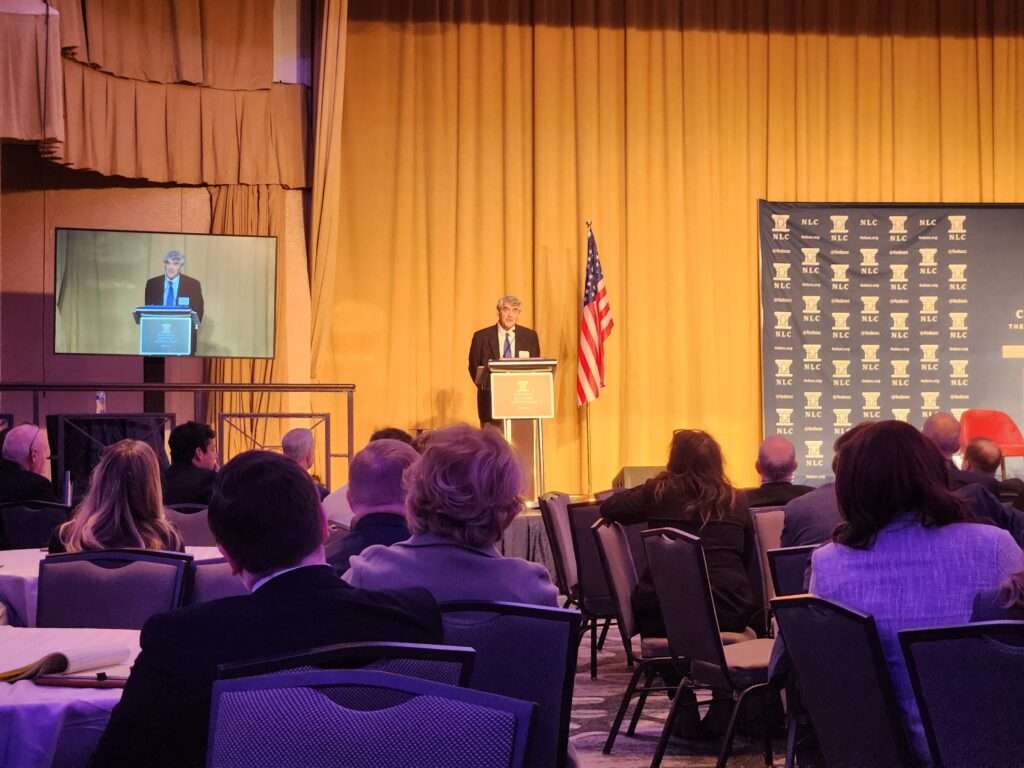
The 2024 Federalist Society National Lawyers Convention is a wrap. I already wrote about our change of venue from the Mayflower to the Washington Hilton. Yet, there is a far more monumental change looming on the horizon. For the past four decades, Gene Meyer has served as the President of the Society. Indeed, he was the first employee hired by Steve Calabresi, Lee Liberman Otis, and David McIntosh. Over that time, FedSoc has flourished in ways that were simply unimaginable in the early 1980s. The Society's influence on the law, the courts, the academy, and our society, is difficult to quantify. This will be the final national convention with Gene Meyer at the helm. Gene has announced that he plans to step down. The search for his successor is drawing to a close, as I understand.

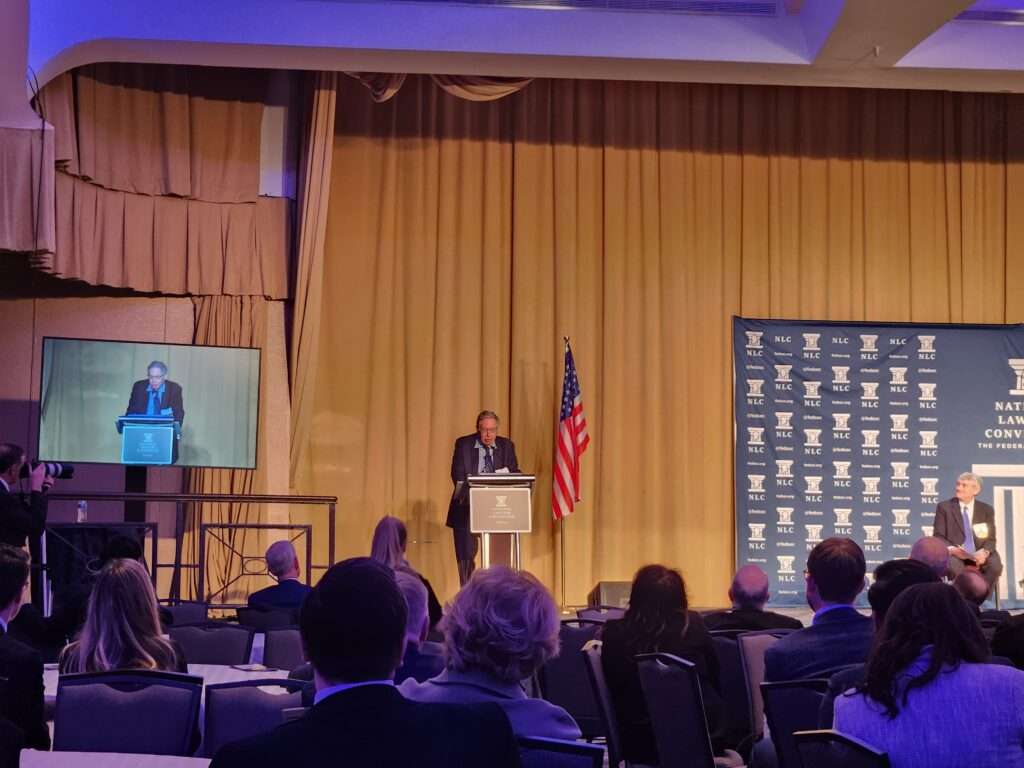
At the end of the convention, after Steve Sachs's excellent Bork Lecture, a tribute was given to Gene Meyer by Steve Calabresi, Chris DeMuth, and Richard Epstein. The video of that tribute does not appear online, though I hope it is posted soon. All three tributes were so moving. The ballroom became quite emotional.

Steve compared Gene to Queen Elizabeth II. Both led their institutions for decades without making a mistake. Both adopted an approach to governance, and stuck with that plan through very difficult and trying times. Steve also explained that Gene demonstrated all of attributes of ancient virtue, and none of the seven sins. Despite being in the center of power and money for decades, Gene did not succumb to any scandals, did not try to enrich himself, and maintained true to his principles.

Richard spoke from his notes which he admitted were non-existent. Richard compared Gene to Ed Sullivan--a comparison that was probably lost on most people in the room. Sullivan was the host of a popular variety show for more than twenty years. He was always the host, but the guests were the main attraction. Gene, ever so humble, fits the bill. Richard also explained Gene's method. FedSoc would be, at bottom, a debating society. And in order to have a debating society, you need people willing to debate. Such debates requires inviting people you disagree with. But at the same time, the tent cannot be so large to become meaningless. FedSoc adheres to a few basic principles on which most conservative and libertarians can agree. But the group welcomes debates, both within and outside of the tent.

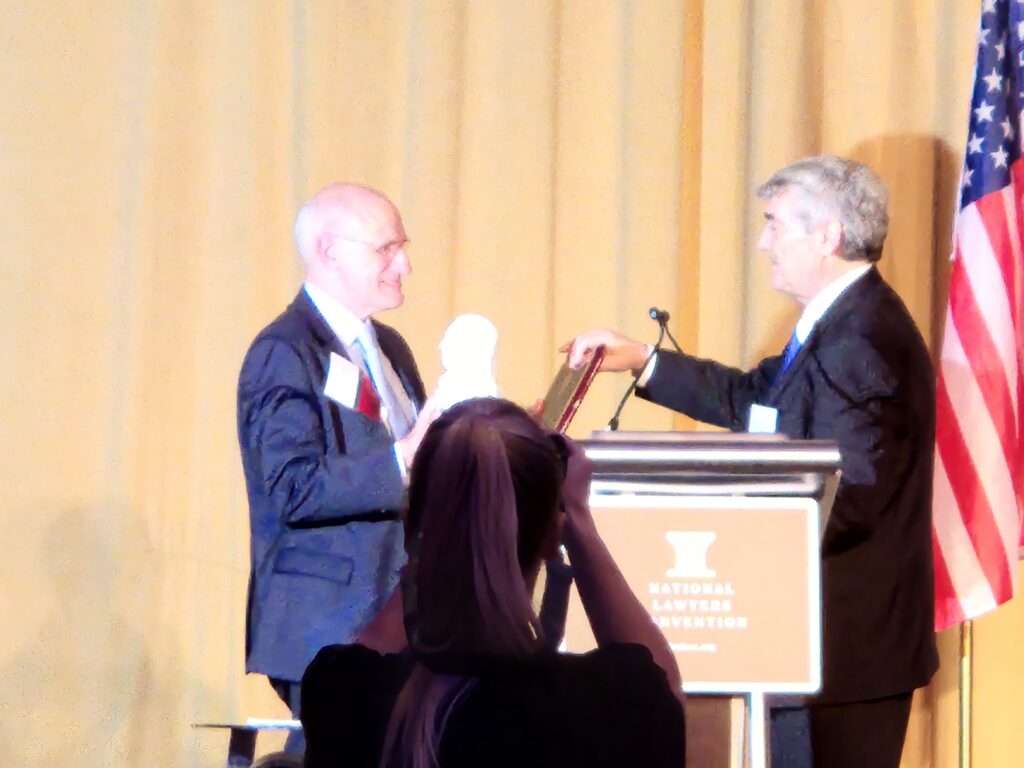
At the end of the ceremony, Gene was presented with a bust of James Madison. The standing ovation was profound. Gene touched every life in that room. After the event, I thanked Gene. Without him, I would not be where I am today.

This truly is an end of the era. And the selection of the next President will have a large impact on the future of the Society, likely for decades to come.

Free Speech

Free Speech Unmuted: Free Speech in European (and Other) Democracies, with Prof. Jacob Mchangama

|

How does European free speech law differ from American free speech law, when it comes to "hate speech," blasphemy, and misinformation? Jane Bambauer and I welcome Jacob Mchangama, who is CEO of The Future of Free Speech; research professor of political science at Vanderbilt; the author of Free Speech: A History from Socrates to Social Media and other works on free speech; Senior Fellow at the Foundation for Individual Rights and Expression; and a trained Danish lawyer who is one of the leading experts in comparative free speech law.

You can also watch our past episodes:

My Apologies for an Erroneous Post Faulting a N.Y. Times Article

|

I erroneously put it up before rechecking it, and fortunately caught the error quickly and deleted the post. The post basically faulted this New York Times article for characterizing the resignation of Laura Helmuth at the Scientific American as just "Editor Resigns After Calling Some Trump Supporters 'Fascists,'" without discussing the vulgar nature of the editor's posts. But the Times article did note the comments were "expletive-laden," and I realize that my criticism was misguided.

My apologies to the Times, the author of the article, and our readers. I'm just glad that I spotted the error relatively promptly (and wish I had spotted it more promptly).

More