The Volokh Conspiracy

Mostly law professors | Sometimes contrarian | Often libertarian | Always independent | Est. 2002

The Volokh Conspiracy

Immigration

Trump's Plans to Coerce Sanctuary Cities Likely to Run Afoul of the Constitution - Again

The incoming administration's plans to use withhholding of federal funds to pressure sanctuary cities are reminiscent of ones that werre invalidated by courts during Trump's first administration.

|

NA

Media reports indicate the incoming Trump administration plans to try to pressure sanctuary cities by withholding federal funds unless they agree to help the federal government deport undocumented immigrants.  If the new administration tries to do this, it might reprise legal battles that occurred during Trump's previous term in office. At that time, the administration tried to pressure sanctuary cities by denying them a variety of law enforcement and other grants allocated by Congress. These efforts resulted in extensive litigation, with Trump losing the vast majority of the cases, in decisions handed down by both liberal and conservative judges. I surveyed the relevant cases and their implications in a 2019 Texas Law Review article.

The first Trump administration lost most of these cases because it ran afoul of constitutional limits on federal power and on executive power over the budget. Thanks to a series of Supreme Court decisions (most written by conservative justices), the federal government cannot simply commandeer state and local authorities into helping enforce federal law. Under current Supreme Court precedent, it can try to use financial incentives to secure such assistance. But any such conditions on federal grants must, among other things, 1) be enacted and clearly indicated by Congress (the executive cannot make up its own grant conditions), 2) be related to the purposes of the grant in question (e.g. - grants for health care or education cannot be conditioned on immigration enforcement), and 3) not be "coercive."

Virtually all of Trump's first-term efforts to pressure sanctuary jurisdictions ran afoul of one or more of these constitutional constraints. I went over the details in my article. Whether his second-term efforts fare any better remains to be seen. But, at the very least, any effort to withhold all or nearly all grants from sanctuary jurisdictions is likely to violate the relatedness requirement and the admittedly vague rules against coercion. That would be true even if the new Republican-controlled Congress enacts such sweeping conditions by legislation. Such legislation could satisfy the need for congressional authorization, but not get around restrictions on relatedness and coercion.

As I emphasized in various writings during the first Trump administration, the issues at stake here go far beyond immigration policy. If the administration can make up its own new conditions for federal grants to state and local governments, it would severely undermine the separation of powers, allowing the executive to usurp Congress's spending power. In addition, given the dependence of state and local governments on federal funds, it would create a massive club that the executive could use to coerce states and localities on a vast range of issues, thereby gravely imperiling federalism. Conservatives who support such coercion when a GOP administration does it are unlikely to be happy when the same tools are utilized by a Democratic president to compel support for left-wing policies.

And for those keeping score, I have made similar points in defense of conservative "gun sanctuaries," which refuse to help the federal government enforce some federal gun laws.
Free Speech

No Defamation Liability for False Statement That Congressional Witness's Lawyer Was Partly Paid for by Trump PAC

So a federal judge rules in a case brought by Tony Bobulinski, who testified about the Bidens before the House Oversight Committee, against Jessica Tarlov, a Fox News commentator and co-host of The Five.

|

From yesterday's opinion by Judge Paul Oetken (S.D.N.Y.) in Bobulinski v. Tarlov:

The following facts are drawn from the allegations in Plaintiffs' complaint, which are presumed true for the purpose of resolving Tarlov's motion to dismiss.

Anthony Bobulinski is a "successful businessman" and former "business partner" of Hunter Biden. Stefan Passantino is an attorney and founder of Elections LLC who represented Bobulinski in front of the United States House of Representatives Committee on Oversight and Accountability ("House Oversight Committee"). Jessica Tarlov is a commentator on Fox News and co-host of its popular television program, The Five.

Bobulinski worked with Hunter Biden in 2017, when Bobulinski served as the CEO of SinoHawk Holding, "a [Chinese] company designed to find investments in the United States." During the course of this business partnership, Bobulinski became "concerned" that Hunter Biden was allegedly misusing company funds and "profiting off of his father's name when [his father] was Vice President of the United States."

Bobulinski began "speaking publicly against the Biden family" in 2020. Since he "came forward" about the Bidens' alleged misconduct, Bobulinski has "spent over $500,000 of his own money on legal fees." And, according to Bobulinski, "[n]either President Trump, nor any persons or entities affiliated with President Trump, have ever paid" for Bobulinski's legal fees.

On March 20, 2024, Mr. Bobulinski appeared as a witness before the House Oversight Committee to testify about "the conduct he witnessed by Joseph Biden, Hunter Biden, and Biden Family business associates." Passantino represented Bobulinski for the appearance and attended the hearing with his client. Bobulinski paid Passantino directly both for this matter and "several years of previous representation."

During the hearing, Representative Jasmine Crockett said on the floor of the House:

Mr. Bobulinski, I know that you take exception to the fact that your credibility has been called into question over and over[.] [D]o you know who Elections LLC is? … I'd ask unanimous consent to enter into the record a document indicating that the law firm representing Tony Bobulinski was paid $10,000 as recently as January of this year by the Save America PAC, which you may recognize as Donald Trump's PAC.

Later that day, during Fox News's live taping of its nightly show, The Five, Tarlov commented on the House Oversight Committee hearing and said: "Ok, Tony Bobulinski's lawyers' fees have been paid by a Trump Super PAC. That's as recently as January."

In response to that statement, Plaintiffs sent Tarlov a letter "demand[ing] that Ms. Tarlov retract and apologize for her defamatory comments" about Bobulinski's legal fees. During the March 21st airing of The Five, Tarlov said:

I would like to clarify a comment I made yesterday during our discussion of Tony Bobulinski's appearance at the congressional hearing. During an exchange with my colleagues about the hearing, I said that Mr. Bobulinski's lawyer's fees have been paid for by a Trump Super PAC as recently as January. What was actually said at the hearing was that the law firm representing Mr. Bobulinski was paid by a Trump PAC. I have seen no indication that those payments were made in connection to Mr. Bobulinski's legal fees, and he denies that they were. Alright.

Bobulinski didn't find the follow-up statement to be adequate, and sued for defamation and a related tort. No liability, the court concluded, in part of the following grounds:

Read More

Constitutional Interpretation

Symmetry in Equal Protection, Fundamental Rights, and the Law of Democracy

|


My last post offered examples of areas where symmetry could help guide future doctrinal development. This final post on my book addresses three of the most fraught areas of constitutional law:  equal protection, fundamental rights, and the law of democracy. In all these areas, as in the others I already addressed, highlighting symmetric possibilities makes clear that framing constitutional debates in maximally rivalrous terms is a choice; less polarizing options are available too.

Regarding equal protection, questions of group identity and legal equality are obviously a major point of ideological division in the contemporary United States. The conservative constitutional vision understands the Fourteenth Amendment's Equal Protection Clause to require a strict "colorblind" focus on individual characteristics rather than group identities. By contrast, the progressive vision interprets the same guarantee to allow, or perhaps even require, governmental privileging today of groups who suffered discrimination and disadvantage in the past.

Even as the divide between these perspectives has grown more acute in American society, the Supreme Court has aligned itself more squarely with the conservative vision. It thus held in Students for Fair Admissions, Inc. v. President and Fellows of Harvard College (SFFA) in 2023 that racial preferences in higher education are unconstitutional.

Read More

Constitutional Interpretation

Symmetry in Interpreting the First Amendment and the Structural Constitution

|

My earlier posts on my book Constitutional Symmetry explained the basic idea of favoring symmetry and summarized the practical and theoretical reasons for this approach. In addition to advancing this theoretical case for symmetry, the book includes chapters applying the theory to five contested areas of constitutional law:  speech, association, and religion; separation of powers and federalism; equal protection; guns and fundamental rights; and the law of democracy.

The chapters themselves are more illustrative than exhaustive. As I explain, they do not address every relevant case or holding in the areas they cover, and they omit entirely major areas of constitutional law. The chapters do aim, however, to demonstrate that comparatively symmetric approaches remain open in many areas as potential pathways of case law development, if the courts will only take them.

In these posts, I can only briefly sketch the book's argument, so I encourage readers to consult the relevant chapters for more detail. I designed the book so that the chapters are self-contained. You could read the introduction and the chapters on particular substantive areas without necessarily reading the rest.

With respect to the First Amendment, the book makes two main points. The first is that symmetry should support maintaining current doctrine's focus on requiring neutrality in laws regulating free expression.

Read More

Second Amendment Roundup: The Second Amendment Dialogue at Fed Soc's National Convention

|

"Applying the Text and History Methodology to Looming Second Amendment Battles After Rahimi" was the topic of a session on November 16 at the Federalist Society's 2024 National Lawyers Convention. You can listen to the remarks here.

The moderator was Sixth Circuit Judge Amul Thapar, author of the delightful book The People's Justice: Clarence Thomas and the Constitutional Stories that Define Him. The panel featured three leading voices in the Second Amendment space.

Speaker Mark W. Smith is a Senior Fellow at the Ave Maria School of Law and Host of the Four Boxes Diner Second Amendment Channel. (That refers to the four boxes of American liberty, the soap box, ballot box, jury box, and cartridge box.)

Smith focused on the text first-history second approach applied by the Supreme Court in Heller and elaborated in Bruen. As the Supreme Court has now taught in some detail in both Bruen and Rahimi, the historical work of understanding the Second Amendment involves examining laws that impacted the right to keep and bear arms historically and asking both "how" and "why" those laws limited the right. Then, as Rahimi makes clear, the question is whether the "principle" underlying those historical laws—the synthesis of "how" and "why" they regulated the right while remaining consistent with it—would, today, justify whatever modern firearm law is at issue in ongoing litigation.

The key question, as Justice Barrett mentioned in her concurrence in Rahimi, and about which Smith spoke at the conference, is what level of generality is the right one to draw these principles? Rahimi itself shows that error lies on either extreme—the Fifth Circuit drew its analogies too narrowly and required a "historical twin," while the government in Rahimi pushed for a rule that would swallow the Amendment whole in permitting the Government to bar firearm possession by anyone judged "irresponsible."

In talking about this problem, Smith suggested a way for courts and litigants to check their homework and make sure they have not drawn too broad of lessons from histories, by comparing them against what he called the "third rails" of the analogical process. (Touching the third rail on a railroad track will electrocute you.) A principle would touch a "third rail" if:

    1. The principle is directly contrary to the founding era understanding of the text of the Second Amendment.
    2. The principle would violate Supreme Court precedent, such as Heller's holding that arms in common use are protected and may not be banned.
    3. The principle would be based on a concern for criminal misuse rather the rights of the law-abiding (recall the Scalia-Breyer debate in Heller).
    4. The principle would disregard the purpose of the Amendment to protect the right of self-defense and thwart tyranny, invasion, and criminality.
    5. The principle would permit restrictions on what were common firearms-related activities at the Founding. In other words, if the Founders engaged in a practice, courts should not endorse a principle that would let the government turn the Founders into felons.

David Thompson, who also presented, is a partner at Cooper & Kirk, which is conducting a large share of the Second Amendment litigation today. Thompson also spoke to the need to check historical principles for error in the level of generality at which they are drawn. He gave, as an example of a regulation with justifications that touch these "third rails," bans on arms in common use.

The D.C. Circuit recently blessed such a ban, and in the process invented the principle that arms "capable of unprecedented lethality" may be banned, regardless of their commonality.

As Thompson pointed out, such a historical principle touches just about every one of the "third rails" identified by Smith. It violates Supreme Court precedent. In Heller, Justice Scalia found such arguments to "border on the frivolous," and specifically held that firearms "in common use" cannot be banned (and Bruen reaffirmed that holding). In fact, the history of firearms development is the search for more lethality and accuracy. People want more effective tools with which to defend themselves. By treating lethality as a bad thing, the U.S. Court of Appeals for the D.C. Circuit derived a principle that focused on how criminals misuse firearms, not on how law-abiding citizens use them, which violates another "third rail." The Second Amendment, Thompson stated, allows us to live free, not as slaves. Heller teaches us to consider the desirable increased accuracy and lethality for law-abiding citizens, not for criminals. The D.C. handgun ban was based on criminal misuse and disregarded justifiable use by the law-abiding.
The nationwide popularity of the AR-15 rifle illustrates why the common use test is consistent with the true principles underlying the Second Amendment. With 44 million in circulation, it goes without saying that AR-15s are commonly possessed by law-abiding citizens for lawful purposes. Of course, the AR-15 is popular precisely because it is a useful tool for self-defense, which is one of the purposes underlying the Second Amendment as well as resisting tyranny. And, to state the obvious, the Founders owned and used a lot of "common" firearms that were also lethal, and they never once thought to do something so self-defeating as to ban the very tools that had freed them from British rule.

Professor William Merkel of the Charleston School of Law, the coauthor, with the late Richard Uviller, of the 2002 book The Militia and the Right to Arms, Or, How the Second Amendment Fell Silent, provided a counterpoint to Smith and Thompson,  arguing that the Heller was wrongly decided and that the Second Amendment does not protect an individual right to arms at all.

The Federalist Society's National Lawyers Convention has included a segment on the Second Amendment for several years now, and this one did not disappoint. Hopefully the dialogue will continue.

Free Speech

NRA v. Vullo Update: Second Circuit Weighs Reviving $100M+ Damages Claim

|

Readers of the blog may I recall that I was counsel of record for the NRA in the Supreme Court stage of NRA v. Vullo, and that the ACLU's David Cole presented oral argument before the Court. The Court unanimously held that the NRA stated a claim, and remanded the case to the Second Circuit as to qualified immunity; the Second Circuit held oral argument two weeks ago, and I thought some of you folks might be interested in what happened there. Bill Brewer (the NRA's lead lawyer on this) and his team and I therefore put together this quick post; I should note that my role here is an advocate and not as an impartial academic, but my sense was that our readers might still find this analysis interesting:

On Wednesday November 13, 2024, the Second Circuit held oral argument in National Rifle Association v. Vullo, No. 21-636, on the issue of qualified immunity. Commenced by the Brewer law firm on behalf of the National Rifle Association of America (NRA) in 2018, the Vullo lawsuit advances First Amendment claims against former New York Governor Andrew Cuomo and the state's former head financial regulator, Maria Vullo, over an alleged censorship scheme that coerced banks and insurers to blacklist the gun group.

Although some allegations in the lawsuit are disputed, Vullo never denied urging regulated firms to sever their services to the NRA, based explicitly on the NRA's pro-gun speech. In official regulatory guidance to the CEOs of entities she supervised, Vullo insisted that New York's banks and insurers owed "a commitment to society as a whole," which (in her view) disfavored letting gun-rights advocates have bank accounts or health insurance. Surprisingly, the Second Circuit seemed to countenance this reasoning in 2022, when it rejected the NRA's First Amendment claims—citing, among other things, a DEI-consulting whitepaper on corporate social responsibility.

We were joined by the American Civil Liberties Union (ACLU), as the NRA appealed this ruling to the United States Supreme Court for the NRA. In a rebuke from a unanimous Court, Justice Sonia Sotomayor revived the NRA's claims this past June, emphasizing decades of precedent that "[a] government official cannot coerce a private party to punish or suppress disfavored speech on her behalf." Moreover, the Court said, Vullo's alleged conduct struck at the heart of this prohibition. In light of the Court's guidance on the First Amendment merits of the NRA's allegations, Sotomayor added, the Second Circuit was free to reconsider the issue of qualified immunity, i.e., whether Vullo's alleged violations were such that the NRA should be able to sue her individually for damages.

Read More

Constitutional Interpretation

Theoretical Reasons to Favor Symmetry

|

My last post on my new book Constitutional Symmetry discussed how a preference for symmetry would operate in practice. It also suggested that a preference for symmetry is already an inchoate feature of our law: it is a value embodied in contemporary interpretive practice, just not with sufficient clarity and rigor.

But if symmetry is already a part of interpretive practice, is this practice justified? In fact, as I mentioned, at least three sets of conventional theoretical considerations support a preference for symmetric constitutional understandings.

First, preferring symmetry accords with the character of our Constitution. We have what some scholars have called a "framework" constitution: for the most part, our constitution, unlike some others around the world, sketches the basic structure of our government without providing many details about its practical operation.

Read More

Free Speech

Why the California Ban on "Disseminat[ing] Information" "Relating to a Sealed Arrest" Violates the First Amendment

The heart of our argument for a preliminary injunction in First Amendment Coalition, LaRoe & Volokh v. Chiu.

|

An excerpt from FIRE's memorandum filed last night:

Both as applied to Plaintiffs and on its face as to everyone who disseminates lawfully obtained information about sealed arrests, the anti-dissemination statute violates the First Amendment as a presumptively unconstitutional content-based speech restriction that cannot withstand strict scrutiny. Reed v. Town of Gilbert (2015); see also IMDb.com v. Becerra (9th Cir. 2020) (prohibition on "dissemination of one type of speech: 'date of birth or age information'" was a content-discriminatory restriction on a category of speech). This is all the more so given binding Supreme Court precedent protecting dissemination of lawfully obtained information, and holding that penalizing dissemination as pertains to sealed arrests is not the least restrictive means to achieve a compelling state interest. See Smith v. Daily Mail Publ'g Co. (1979) (other states had "found other ways of accomplishing the objective" of protecting the identity of juvenile offenders)….

The anti-dissemination statute regulates speech in covering only "disseminat[ing] information" and is content-based in reaching only speech "relating to a sealed arrest." Cal. Penal Code § 851.92(c). The "dissemination of information [is] speech within the meaning of the First Amendment." Sorrell v. IMS Health Inc. (2011)…. As the Supreme Court held decades ago, a state may not "punish publication" of "lawfully obtain[ed]" "truthful information about a matter of public significance," such as information about an arrestee. Daily Mail Publ'g Co.; see also, e.g., Worrell Newspapers of Ind. v. Westhafer (7th Cir. 1984) (striking down as overbroad a statute prohibiting any person from disclosing the existence of a sealed indictment before the defendant is arrested)….

[The statute] is also presumptively unconstitutional on its face. By its content-based terms, the statute penalizes disseminating lawfully obtained information about sealed arrests in an extensive number of its applications. True enough, the statute also covers those who disseminate information about sealed arrests they obtained through independently unlawful means. But more predominantly, the anti-dissemination statute punishes only what the First Amendment protects—publishing lawfully obtained information about matters of public concern. See Daily Mail Publ'g Co. And as detailed next, penalizing that range of protected expression cannot survive constitutional scrutiny because it is facially unconstitutional as to a substantial amount of the dissemination of lawfully obtained information. See United States v. Stevens (2010) (a law will be "invalidated as overbroad if 'a substantial number of its applications are unconstitutional, judged in relation to the statute's plainly legitimate sweep'")….

Read More

Constitutional Interpretation

How Symmetry Works—and Why It Is Already Part of Our Law

|

As my last post explained, my new book, Constitutional Symmetry: Judging in a Divided Republic, argues that judges should favor, when possible, constitutional understandings that offer valuable protections on opposite sides of key current divides, instead of just one side. Our current divided and acrimonious politics have produced a perilous tendency to politicize constitutional law and advance wholly partisan visions of the Constitution's meaning. Symmetric interpretation aims to counteract that tendency.

As I also explained, favoring symmetry is not a hard and fast rule; it is instead a preference. That means judges should favor symmetry only insofar as their primary interpretive commitments allow. In that sense, it resembles other second-order values in interpretation such as judicial restraint. A judge committed to restraint will invalidate democratic choices only when the Constitution is clear, but determining when the Constitution is clear requires a theory of interpretation that restraint alone cannot provide.

Symmetry is the same: because symmetry cannot override clear constitutional requirements, judges will each have to decide when their primary interpretive commitments do and do not permit symmetric understandings. Furthermore, the Constitution itself is not symmetric with respect to all conceivable ideological divisions. It is not neutral, for example, between representative democracy and dictatorship, nor between racial equality and racist oppression.

Read More

Politics

"What Is Government Itself, but the Greatest of All Reflections of Human Nature?"

|

That's a famous line in Federalist No. 51, generally attributed to James Madison—but not quite. The line is actually, in context,

But the great security against a gradual concentration of the several powers in the same department, consists in giving to those who administer each department the necessary constitutional means and personal motives to resist encroachments of the others. The provision for defense must in this, as in all other cases, be made commensurate to the danger of attack. Ambition must be made to counteract ambition. The interest of the man must be connected with the constitutional rights of the place. It may be a reflection on human nature, that such devices should be necessary to control the abuses of government. But what is government itself, but the greatest of all reflections on human nature? If men were angels, no government would be necessary. If angels were to govern men, neither external nor internal controls on government would be necessary. In framing a government which is to be administered by men over men, the great difficulty lies in this: you must first enable the government to control the governed; and in the next place oblige it to control itself. A dependence on the people is, no doubt, the primary control on the government; but experience has taught mankind the necessity of auxiliary precautions.

The phrase is "reflections on human nature," and I take it that "reflection" there means—to quote the Oxford English Dictionary—

9. a. Something which brings discredit on (also upon) a person or thing.

Read More

Free Speech

Court Decision About Discovery in Libel Lawsuit Against Council on American-Islamic Relations Foundation

CAIR's allegedly libelous press release about a dismissed former high-level employee "opened the door" to discovery about various allegations the employee had made about CAIR.

|

From today's order by Magistrate Judge David T. Schutz (D. Minn.) in Saroya v. CAIR Foundation, Inc.:

Plaintiff Lori Saroya … moves to compel discovery from Defendant CAIR Foundation, Inc. … and its affiliated regional non-profit organizations…. Because Saroya's allegations raise claims that define a broad scope of discovery, her motion to compel is granted with limited exceptions….

CAIR is a Muslim civil rights organization in Washington, D.C. that has twenty-six affiliates across the country, including CAIR Minnesota. Saroya worked as the Executive Director of CAIR Minnesota from 2007 until 2016. In 2016, Saroya joined CAIR as the National Chapter Development Director and a member of its Board of Directors. She resigned in 2018.

After her resignation, Saroya took to the internet accusing CAIR of various misconduct. Among other things, Saroya accused CAIR of discrimination, harassment, retaliation, union busting, financial mismanagement, lack of board oversight, board incompetence, creating a hostile work environment, negatively portraying Muslims, making mistakes on legal cases, receiving foreign funding, and withholding money it owed her. Neither party disputes that Saroya made these accusations.

In 2021, CAIR sued Saroya for defamation, defamation per se, tortious interference with business relationships, and breach of contract…. Saroya moved for partial judgement on the pleadings as to CAIR's claims of defamation, defamation per se, and tortious interference with business relationships. In relevant part, she argued the defamation claims were time barred, were based on non-actionable statements, and that CAIR had failed to identify the actionable statements with specificity.

The Court denied Saroya's motion, ordering CAIR to file an amended complaint to specifically identify the actionable defamatory statements at issue. The Court explained that "what is actionable and not actionable is not clear at all from the face of the complaint," and it directed CAIR to clarify which statements it believed were actionable, separating those out from statements of opinion or statements outside the statute of limitations. Instead of filing an amended complaint, however, CAIR voluntarily dismissed its case with prejudice.

On January 20, 2022—less than ten days after dismissal of the 2021 litigation— CAIR issued a press release titled: "Community Update on Cyberstalking by Lori Saroya, Ex-Staffer." It described "a situation that CAIR has been working to resolve for some time"—namely, Saroya's use of email and social media to "cyberstalk, smear, and undermine" the organization, its affiliates, and its members.

Read More

Constitutional Interpretation

Constitutional Symmetry

|

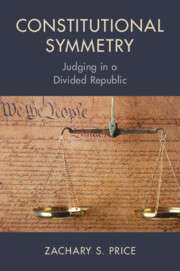
I'm grateful to Eugene and the other Volokh Conspiracy bloggers for hosting these guests posts on my new book, Constitutional Symmetry: Judging in a Divided Republic.

As readers may have noticed, the United States is closely divided over politics, and each political coalition advances a distinct constitutional vision that largely aligns with its political objectives.

Conservatives interpret the Constitution to protect religion, limit gun control, and obstruct federal administrative governance while allowing state-level regulation of moral questions like abortion. Progressives see a mirror-image constitution that advances social justice, confers broad federal power, and allows flexible administrative regulation while limiting state and local police authority and guaranteeing sexual and reproductive autonomy. As national politics have grown divided and polarized, achieving partisan goals through federal legislation has grown more difficult, so the two parties have dreamed, in effect, of capturing the courts and implementing their vision through constitutional interpretation instead.

This dynamic is not new and has existed at other times in the past, but it is perilous. It treats a document that should be source of shared commitments and stable ground rules as a vehicle for extending political conflict.

Read More

Constitutional Interpretation

Zachary Price Guest-Blogging About His New Book, "Constitutional Symmetry: Judging in a Divided Republic"

|

I'm delighted to report that Prof. Zachary Price (UC Law San Francisco) will be guest-blogging this week about his new book. The publisher's summary:

Intense political disagreements over constitutional law and the Supreme Court have divided America. Constitutional Symmetry offers a fresh perspective by urging judges to make decisions that work 'symmetrically' across major partisan and ideological divides instead of favoring one partisan coalition over the other. Zachary S. Price argues this approach will aid the political process, align with the role morality of judging, and advance the framers' hopes for the Constitution. Chapters explore how this approach can encourage new solutions to fraught debates over free speech, religious liberty, separation of powers, federalism, affirmative action, gun rights, abortion, parental rights, and the law of democracy. Timely and innovative, this book is must-read for anyone seeking to understand the sources and implications of constitutional polarization in the contemporary United States.

And the jacket blurbs:

Read More

More