The Volokh Conspiracy

Mostly law professors | Sometimes contrarian | Often libertarian | Always independent | Est. 2002

The Volokh Conspiracy

President Biden Regrets Selecting Merrick Garland As Attorney General

|

The Washington Post has an in depth profile of President Biden's administration. Apparently, Biden regrets selecting Merrick Garland as Attorney General, and would have preferred former Alabama Senator Doug Jones.

In private, Biden has also said he should have picked someone other than Merrick Garland as attorney general, complaining about the Justice Department's slowness under Garland in prosecuting Trump, and its aggressiveness in prosecuting Biden's son Hunter, according to people familiar with his comments.

During the 2020 presidential transition, Biden's attorney general selection pitted some of his closest aides against each other. Former senator Ted Kaufman (D-Delaware) and Mark Gitenstein, both longtime friends of Biden, advocated for the president naming then-Sen. Doug Jones (D-Alabama) as attorney general, arguing that as a politician he would be better able to navigate the bitterly partisan moment.

But Ron Klain, Biden's incoming chief of staff, pushed for Garland. He stressed that Garland — a federal judge with a sterling reputation for independence and fairness — would show Americans that Biden was rebuilding a department badly shaken by Trump's political attacks.

Biden was persuaded, and some Democrats believe the decision had devastating results. Had the Justice Department moved faster to prosecute Trump for allegedly seeking to overturn the 2020 election and mishandling classified documents, they say, the former president might have faced a politically damaging trial before the election. (Others blame the Supreme Court and a Trump-appointed judge in Florida for repeatedly siding with the former president and delaying the cases; the Justice Department declined to comment.)

This episode demonstrates that this notion of the Department of Justice as "independent" has always been a ruse. The Attorney General works for the President. Garland's efforts to make the institution separate from the President backfired, in a way that left no one happy. Moreover, Biden expressly viewed the criminal prosecution of Trump as a way to harm his primary political opponent. The stuff about protecting democracy was just a veneer, as evidenced by the silence about insurrection and fascism in the lead-up to January 6, 2025.

By the way, when is Garland going to resign? Garland should have stepped down when Biden criticized him for the Hunter Biden prosecution, but didn't. Attorney General Loretta Lynch stayed on until January 20, 2017. Will Garland continue to ride this out till the bitter end?

The Unprecedented Dynamics of Trump's TikTok Brief

Trump wants to make a deal so SCOTUS doesn't have to.

|

On Friday, Present Elect Trump filed an amicus brief supporting neither party in TikTok v. Garland. The brief was submitted by John Sauer, who will be the nominee for Solicitor General. In short, Trump wants the Court to leave the law in effect, at least till he takes office, so he can negotiate a better deal.

On January 20, 2025, President Trump will assume responsibility for the United States' national security, foreign policy, and other vital executive functions. This case presents an unprecedented, novel, and difficult tension between free-speech rights on one side, and foreign policy and national-security concerns on the other. As the incoming Chief Executive, President Trump has a particularly powerful interest in and responsibility for those national-security and foreign-policy questions, and he is the right constitutional actor to resolve the dispute through political means.

The dynamics of this brief are unprecedented, and may actually scramble the Court's calculus here.

To recap, the law goes into effect on January 19, unless President Biden grants an extension, or if the Supreme Court grants some sort of temporary injunction beforehand. I wrote about the timeline here.

First, why did Trump even file a brief here? Maybe he was reading this blog. Last week, Will Baude and Richard Re suggested that Trump should file an amicus brief in the case, and perhaps the Court could even call for his views:

The statute effectively banning TikTok goes into effect on January 19, the day before President-Elect Donald Trump is slated to begin his second presidential term. Recognizing that deadline, the justices have crafted an expedited briefing schedule with oral argument on January 10.

The Biden administration will of course litigate the case. But Trump has made public statements indicating that he may be more supportive of TikTok. In this situation, it might make sense for Trump to appear as an amicus. As the imminent president, he would hardly be a run-of-the mill friend of the court.

I for one am grateful that Will describes Trump as "president-elect," notwithstanding my colleague's views that Trump has been disqualified from the presidency since January 6, 2021.

Second, Trump is asserting his inchoate interest in setting national policy:

In light of these interests—including, most importantly, his overarching responsibility for the United States' national security and foreign policy—President Trump opposes banning TikTok in the United States at this juncture, and seeks the ability to resolve the issues at hand through political means once he takes office. . . . The 270-day deadline imposed by the Act expires on January 19, 2025—one day before President Trump will assume Office as the 47th President of the United States. This unfortunate timing interferes with President Trump's ability to manage the United States' foreign policy and to pursue a resolution to both protect national security and save a social-media platform that provides a popular vehicle for 170 million Americans to exercise their core First Amendment rights. The Act imposes the timing constraint, moreover, without specifying any compelling government interest in that particular deadline.

Trump's filing of a brief creates a conflict between the once and future DOJ. Current SG Prelogar wants the law to go into effect right away. Future SG Sauer wants the Court to grant some sort of injunction to give future President Trump some room to negotiate. I can't think of a comparable example where the incoming President has sought to counteract the current President before the Supreme Court. Yet, we are living in strange times. President Biden has severely diminished capacities. It is not clear who is actually running the show. Foreign leaders are now visiting with Trump at Mar-A-Lago to discuss policy concerns. Perhaps this sort of brief is consistent with the broad role that Trump is already playing over our polity. Trump may be the de facto President at this point. We had a constitutional amendment to reduce the lame duck period. Maybe we should shrink it even more.

Third, Trump is not relying on law here, but on his deal-making powers.

Furthermore, President Trump alone possesses the consummate dealmaking expertise, the electoral mandate, and the political will to negotiate a resolution to save the platform while addressing the national security concerns expressed by the Government—concerns which President Trump himself has acknowledged. See, e.g., Executive Order No. 13942, Addressing the Threat Posed by TikTok, 85 Fed. Reg. 48637, 48637 (Aug. 6, 2020); Regarding the Acquisition of Musical.ly by ByteDance Ltd., 85 Fed. Reg. 51297, 51297 (Aug. 14, 2020). Indeed, President Trump's first Term was highlighted by a series of policy triumphs achieved through historic deals, and he has a great prospect of success in this latest national security and foreign policy endeavor. . . .

President Trump, therefore, has a compelling interest as the incoming embodiment of the Executive Branch in seeing the statutory deadline stayed to allow his incoming Administration the opportunity to seek a negotiated resolution of these questions. If successful, such a resolution would obviate the need for this Court to decide the historically challenging First Amendment question presented here on the current, highly expedited basis.

This may not be as crazy as it sounds. I don't think the Supreme Court actually wants to decide this case. I suggested that the Court could simply affirm the D.C. Circuit to avoid having to write a majority opinion. But if it looks like Trump can actually negotiate some sort of deal, the issue comes off the Court's plate. Would the Chief Justice really be turned off by some of the puffery in the brief?

Fourth, there is some precedent for the Court letting the political branches work things out. Were Justice Breyer on the Court, I'm sure he would be eager to let this one play out. Sauer cites one recent example from the wake of Justice Scalia's death:

Indeed, the Court recently pursued a similar course in Zubik v. Burwell, vacating lower-court decisions and pausing the enforcement of HHS's contraceptive mandate against religious organizations to "allow the parties sufficient time to resolve any outstanding issues between them." 578 U.S. 403, 408 (2016) (per curiam).

Recall that the eight-member Court punted this issue to let the next administration figure things out. Little did they know that it would be Trump, and not Hillary Clinton. And, lo and behold, Trump expanded exemptions from the contraception mandate, which led to Little Sisters of the Poor v. Pennsylvania (2020). In a way, this example proves that compromises at the Court can work, sometimes.

Fifth, I'm not sure what an injunction would look like. Would it be set for a certain number of days--to give Trump a negotiating window? Or would the Court leave the injunction open for some unspecified time. The closest analogue I can think of is Northern Pipeline Constr. Co. v. Marathon Pipe Line Co. (1982), where the Court stayed its ruling for a year.

The judgment of the District Court is affirmed. However, we stay our judgment until October 4, 1982. This limited stay will afford Congress an opportunity to reconstitute the bankruptcy courts or to adopt other valid means of adjudication, without impairing the interim administration of the bankruptcy laws. Buckley v. Valeo, 424 U.S., at 143, 96 S.Ct., at 693; *89 cf. Georgia v. United States, 411 U.S. 526, 541, 93 S.Ct. 1702, 1711, 36 L.Ed.2d 472 (1973); Fortson v. Morris, 385 U.S. 231, 235, 87 S.Ct. 446, 449, 17 L.Ed.2d 330 (1966); Maryland Committee for Fair Representation v. Tawes, 377 U.S. 656, 675–676, 84 S.Ct. 1429, 1439–1440, 12 L.Ed.2d 595 (1964).

Justice Alito referenced the stay from Norther Pipeline in King v. Burwell, as a way to give Congress the power to adjust the Affordable Care Act subsidies.

Sixth, the statement of interest has garnered some criticism. For example, the brief states:

Moreover, President Trump is one of the most powerful, prolific, and influential users of social media in history. Consistent with his commanding presence in this area, President Trump currently has 14.7 million followers on TikTok with whom he actively communicates, allowing him to evaluate TikTok's importance as a unique medium for freedom of expression, including core political speech. Indeed, President Trump and his rival both used TikTok to connect with voters during the recent Presidential election campaign, with President Trump doing so much more effectively. As this Court instructs, the First Amendment's "constitutional guarantee has its fullest and most urgent application precisely to the conduct of campaigns for political office." Susan B. Anthony List v. Driehaus, 573 U.S. 149, 162 (2014) (quoting Monitor Patriot Co. v. Roy, 401 U.S. 265, 272 (1971)). . . .

Further, President Trump is the founder of another resoundingly successful social-media platform, Truth Social. This gives him an in-depth perspective on the extraordinary government power attempted to be exercised in this case—the power of the federal government to effectively shut down a social-media platform favored by tens of millions of Americans, based in large part on concerns about disfavored content on that platform. President Trump is keenly aware of the historic dangers presented by such a precedent.

Jack Goldsmith describes Sauer as "kissing" Trump's ring, and "diminish[ing] his credibility before the Court even before assuming office." I read the brief differently. Though the case is commonly known as TikTok v. Garland, there is a companion case called Brian Firebaugh v. Garland. Who is Brian Firebaugh, you may ask? He is a person who uses TikTok, apparently. Not a particularly compelling plaintiff. Trump, by contrast, is perhaps the most significant person to have ever used social media. I don't think that is hyperbole. He has won two presidential elections, and those victories would have been impossible without social media. Trump, more than perhaps anyone else, can speak to what happens when access is lost to a social media platform. The brief cites the example of Twitter in Brazil, but another example could be his suspension from Twitter and Facebook in the wake of January 6.

***

After nearly a decade, I think people still do not understand Trump. He doesn't play like everyone else does, and that is what infuriates people. When he says something that people deem outlandish, it is merely an opening bid, not the final offer. I think he views this case like he views just about everything else--as a deal to be made. In the normal course, Supreme Court litigation is not a mediation. But this statute contains an express provision to allow a compromise to be reached--and Trump is trying to reach it. It is painfully clear that Biden certainly cannot engage in such dealmaking.

I think the money is still on the Court affirming the D.C. Circuit, but Trump's brief at least ups the odds for TikTok, ever so slightly. Will Sauer seek leave to participate in oral argument?


Free Speech

Shareholder Derivative Lawsuit Against Fox Officers and Directors Over Fox $787M Libel Settlement Can Go Forward

"[T]he complaint alleges facts sufficient to raise a reasonable doubt that at least three other directors lack independence from Murdoch."

|

From In re Fox Corp. Derivative Litigation, handed down yesterday by Vice Chancellor Travis Laster of the Delaware Court of Chancery:

This pleading-stage decision addresses whether the stockholder plaintiffs have standing to pursue a derivative action. When making that determination, the court must accept the complaint's well-pled allegations as true and grant the plaintiffs the benefit of all reasonable inferences. The complaint casts the defendants in a poor light, but at this stage of the case, the court cannot assess the truth of the allegations. The question instead is whether, taking those allegations as true, the plaintiffs have standing to assert their claims.

The plaintiffs have sued over events surrounding the 2020 presidential election. Late on November 3, 2020, the Fox News Channel declared Joseph Biden the winner of Arizona's electoral votes. Then-President Donald Trump contested the call based on allegations about election fraud. Hours later, Trump declared himself the winner. Despite Trump's claim, Fox News called the election for Biden on November 7. The daytime and primetime audiences for Fox News plummeted by over one-third.

Starting the next day, Fox News began airing stories sympathetic to Trump's election-fraud claims. Fox News also hosted guests who championed those claims. Trump advisors Sidney Powell and Rudy Giuliani appeared repeatedly on Fox News and asserted that Dominion Voting Systems and Smartmatic USA provided voting machines and voting software that illegally switched votes from Trump to Biden.

Dominion and Smartmatic sent cease-and-desist letters to Fox News' parent corporation, Fox Corporation ("Fox" or the "Company"). In the "Brainroom"—the Fox News fact-checking department—no one could find evidence to support the accusations against Dominion or Smartmatic. Yet Fox News continued to air the election-fraud narrative and host guests who advanced it.

In February 2021, Smartmatic sued Fox for defamation. Dominion sued Fox in March. The Dominion trial moved forward more quickly. On the first day of the trial, Fox settled with Dominion for $787.5 million. The Smartmatic litigation remains pending.

Corporations don't have minds or bodies. They only act when humans cause them to act. But like humans, corporations can act in ways that harm themselves. Delaware law gives its corporations expansive freedom to pursue any lawful business in pursuit of profit. But Delaware law does not permit a corporation to operate unlawfully. Not only that, but corporate fiduciaries breach their duty of loyalty when they decide to violate the law. Thus, when humans cause a corporation to violate the law in a way that harms the corporation, the corporation can recover from the humans who knowingly caused the corporation to violate the law and suffer harm.

Read More

Politics

Here We Go Again: Federal Judges Should Review Prosecutions From The Trump DOJ "Through a Different Lens"

No "Presumption of Regularity" for Trump 2.0

|

A common thread during the first Trump Administration was that this presidency was not "normal" and courts should not "normalize" it. Advocates and scholars on the left argued that the Trump administration should not be entitled to the "presumption of regularity." Professor Dawn Johnson, for example, lectured the Seventh Circuit Judicial Conference that "Courts attend to reality and context, and they can and should adapt their screens of deference when circumstances so indicate." And so on. I wrote about these developments at some length.

Now, with Trump 2.0 about to start, we are already seeing similar pleas. In The New York Times, Nancy Gertner (a retired Clinton appointee) and Joel Cohen (a retired prosecutor) offer advice of how judges should review prosecutions by the Trump DOJ:

In previous administrations, federal trial judges have had generally well-founded confidence that the Justice Department and the post-Hoover F.B.I., under presidents from either party, have not been employed to attack political enemies. Most district judges — especially those who have served as federal prosecutors, as most have — believe that the prosecutors appearing before them act with integrity, that their offices are not being manipulated to undermine those who challenged the current administration or its leader.

A judge could assume that the warrant has gone through layers of approval within the Justice Department, even reaching the assistant attorney general in charge of the criminal division, an extremely high ranking official in the department. That judge could also be reasonably confident that very little, if anything, would be amiss after passing through the layers of the approval process, including senior department officials.

But with the astonishing comments from the president-elect and his appointments, it is reasonable to ask if judges can still assume that level of confidence in the review process. The previous assumption that prosecutions would be undertaken only against individuals suspected of committing crimes may be wrong.

Now, when judges are asked to review warrant applications, or any other ex parte submissions from the government, they should do so through a different lens, much more scrupulously than ever before.

Nothing new here. We've heard it all before.

Free Speech

Trump Urges Stay of S. Ct. Proceedings in TikTok Case, Delay of Statutory Effective Date

|

From Trump's just-filed friend-of-the-court brief in the TikTok divestment case:

Introduction and Interest of Amicus Curiae …

Amicus curiae President Donald J. Trump ("President Trump") is the 45th and soon to be the 47th President of the United States of America. On January 20, 2025, President Trump will assume responsibility for the United States' national security, foreign policy, and other vital executive functions. This case presents an unprecedented, novel, and difficult tension between free-speech rights on one side, and foreign policy and national-security concerns on the other. As the incoming Chief Executive, President Trump has a particularly powerful interest in and responsibility for those national-security and foreign-policy questions, and he is the right constitutional actor to resolve the dispute through political means.

President Trump also has a unique interest in the First Amendment issues raised in this case. Through his historic victory on November 5, 2024, President Trump received a powerful electoral mandate from American voters to protect the free-speech rights of all Americans—including the 170 million Americans who use TikTok. President Trump is uniquely situated to vindicate these interests, because "the President and the Vice President of the United States are the only elected officials who represent all the voters in the Nation."

Moreover, President Trump is one of the most powerful, prolific, and influential users of social media in history. Consistent with his commanding presence in this area, President Trump currently has 14.7 million followers on TikTok with whom he actively communicates, allowing him to evaluate TikTok's importance as a unique medium for freedom of expression, including core political speech. Indeed, President Trump and his rival both used TikTok to connect with voters during the recent Presidential election campaign, with President Trump doing so much more effectively. As this Court instructs, the First Amendment's "constitutional guarantee has its fullest and most urgent application precisely to the conduct of campaigns for political office."

Further, President Trump is the founder of another resoundingly successful social-media platform, Truth Social. This gives him an in-depth perspective on the extraordinary government power attempted to be exercised in this case—the power of the federal government to effectively shut down a social-media platform favored by tens of millions of Americans, based in large part on concerns about disfavored content on that platform. President Trump is keenly aware of the historic dangers presented by such a precedent. For example, shortly after the Act was passed, Brazil banned the social-media platform X (formerly known as Twitter) for more than a month, based in large part on that government's disfavor of political speech on X. See, e.g., Brazil's Supreme Court Lifts Ban on Social Media Site X, CBS NEWS (Oct. 8, 2024).

In light of these interests—including, most importantly, his overarching responsibility for the United States' national security and foreign policy— President Trump opposes banning TikTok in the United States at this juncture, and seeks the ability to resolve the issues at hand through political means once he takes office. On September 4, 2024, President Trump posted on Truth Social, "FOR ALL THOSE THAT WANT TO SAVE TIK TOK IN AMERICA, VOTE TRUMP!"

Read More

Immigration

Address Border Chaos by Making Legal Migration Easier

Cato Institute immigration analyst Alex Nowrasteh has an excellent piece on this subject.

|

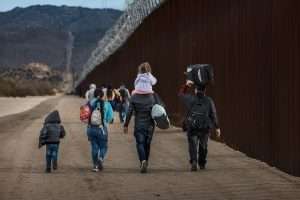
A group of asylum seekers walk along the U.S.-Mexico border near San Diego, California
A group of asylum seekers walk along the U.S.-Mexico border near San Diego, California. (Qian Weizhong/VCG/Newscom)

Since the election, a conventional wisdom has emerged to the effect that Democrats lost in large part because Joe Biden adopted lax border policies, which led to voter backlash against an influx of immigration, and therefore that tougher immigration restrictions are the road to political success. In an insightful recent piece, my Cato Institute colleague Alex Nowrasteh pushes back on some key parts of this narrative.

As Alex points out, Biden in fact did adopt numerous restrictive border policies, including continuing draconian Title 42 expulsions under bogus "public health" pretexts until May 2023, Trump-lite asylum restrictions, and more:

[David] Leonhardt ignores Biden's numerous actions on the border, from maintaining Title 42, reinstating Remain in Mexico, curtailing asylum, boosting deportations and removals over the level of Trump, and over 100 other actions to shut illegal immigration. Leonhardt blames Biden's campaign statements that imply immigrants should come to the United States. Still, Leonhardt ignores his numerous statements to the contrary since the election – such as in March 2021 when he said, "I can say quite clearly: Don't come."

President Biden even sent his VP and eventual Democratic presidential candidate Kamala Harris to Central America to repeat the message "Do not come" in 2021 – a tour that primarily highlighted the administration's inability to stop illegal immigration. Leonhardt has no explanation for why Biden's words mattered when they seemed to encourage illegal immigration, and they didn't matter when he sought to more clearly and forcefully persuade people not to come.

As Alex explains, these policies could not prevent extensive illegal border-crossing, because the latter was primarily dictated by strong US labor-market demand, and horrific oppression and economic conditions in many of the migrants' countries of origin. Indeed, restrictive policies making legal entry difficult or impossible for most would-be migrants predictably exacerbated the illegal kind. That, in turn led to the kind of disorder and chaos at the border that angers many voters, and make it politically difficult to expand opportunities for legal migration, even though the latter are the best way to prevent the chaos voters dislike.

As Alex puts it:

Border chaos is an ally of ideological immigration restrictionists like Stephen Miller, who use it to support restrictions on legal immigration. Reducing legal immigration was the greatest achievement of the Trump administration's immigration policy from Miller's perspective, and it will be again. The president has control over legal immigration; he doesn't have nearly so much power over illegal immigration…..

This is the Catch-22 of expanding legal immigration. Border chaos is caused by restrictive US immigration laws that make legal immigration impossible for most, but border chaos prevents liberalization because voters are understandably repelled by disorder. More enforcement reduces illegal immigration, but only temporarily and at high costs. With the economic benefits of migration as high as they are, it's truly incredible that the government is able to reduce immigration as much as it currently is able to, but it will always look like an utter failure.

In cases where Biden did make legal entry easier, as with the creation of the CHNV program for migrants from four Latin America nations, illegal entries from those countries declined greatly. Unfortunately, as David Bier and I explained in a 2023 article, arbitrary numerical caps and the limitation of this program to only four countries severely limited its effects.

For what it's worth, Alex, David Bier, and I have long argued that disorder at the border strengthens restrictionist sentiment, and that increasing legal migration opportunities is both good in itself, and a valuable strategy for reducing chaos and disorder. As Alex likes to put it, we need to "make immigration policy boring." His new article includes a useful thought experiment illustrating this point:

Imagine the 2024 election without the over 7.2 million border encounters during Biden's administration. Imagine a lack of shocking videos of thousands of migrants streaming across the Rio Grande, rushing Border Patrol agents, or turning themselves in to law enforcement in the desert. There are no images of barbed wire, fortifications that look like they're being stormed, soldiers, tear gas, or smugglers dropping children off on the US side of the river.

Imagine, instead, 7.2 million more legal immigrants and temporary migrant workers flying into the US on lawful visas to live, work, and start businesses during Biden's administration (encounters and individuals aren't the same, but work with me). They mostly came from a dozen Latin American countries and arrived in hundreds of locations across the US as families or as individual workers. No dramatic bussing by Texas' governor, no mass chaos at the border. Just millions of more people orderly entering through a legal immigration system simplified and expanded by Congress and an administration seeking more order and legal immigration.

No reporters would be making their careers filming border chaos because there wouldn't be much to film. Calls to build a wall would sound like fanciful calls to build a giant space laser to ward off space aliens. Immigration would have dropped from a top-tier issue to third or fourth-tier – at best.

The Democrats might still have lost the election thanks to inflation and price increases (The most important issues for voters, according to surveys). But immigration would not have been a significant cause of their woes.

Obviously, disorder at the border isn't the only cause of anti-immigration sentiment. There are also various economic and cultural arguments, plus generalized xenophobia. But disorder is nonetheless a major factor, that easing legal migration could greatly reduce.

Alex makes many more good points, which are not easily summarized here. If you're interested in these issues, read the whole thing!

I would just a couple points to his analysis. First, much of the trouble supposedly caused by migration in various "blue" cities is actually a result of asylum-seekers not being allowed to work legally in the US for many months after arrival,  and zoning rules that make it difficult or impossible to build new housing in response to demand. Letting migrants work immediately and developers build new housing would simultaneously bolster the US economy and reduce anti-immigration sentiments caused by seeming burdens on city budgets.

Second, like Alex, I favor reducing migrant access to welfare (though, as he notes, migrants already use it at much lower rates than natives). But I am not, so far, convinced this will make a big difference to public opinion. Most voters are "rationally ignorant" about policy details and don't know to what extent migrants (or even natives) have access to various welfare benefits. Chaos at the border has more of an impact on public opinion because it is dramatic, and often readily visible even to people who don't follow politics closely and don't know much about most policy issues.

Parental Rights

Bringing Shame on the Family Name

"The articles, from the York Daily Record and FOX43 websites, detailed an incident in which Father was 'found sleeping half-naked in his car at a Rutter's store' and offered an investigating officer $50 instead of his license. The articles indicate that Father was charged with DUI, indecent exposure, open lewdness, and other related charges."

|

From In re: Name Change of L.L.N., decided Monday by Pennsylvania Superior Court Presiding Judge Anne Lazarus, joined by Judges Jill Beck and John Bender:

The trial court set forth the factual and procedural history of this case as follows:

[Child] was born [in May 2020,] during the marriage of [the parties, who] divorced on December 19, 2022[. Mother] resumed using her prior surname of K[.], and [ ] desire[d] to change the name of [Child] from L.L.N. to L.L.K. for the following reasons: [

  1. Father has not had contact with Child since shortly before her first birthday, in May 2021;
  2. Father has been convicted of multiple counts of DUI as well as harassment, is currently in prison, and will not be released from prison until November 2026, at the earliest;
  3. Father is precluded from having contact with Mother as a condition of his probationary sentence for harassment;
  4. Mother desires to protect Child from any stigma and/or emotional or psychological trauma that may result from having Father's last name while living in the same community in which he committed the above crimes; and
  5. Mother desires to share the same last name with Child, as well as to have Child share the same last name with her 8-year-old half-brother.] …

[Father filed a response to Mother's petition.] While [Father] does not deny his record of criminal convictions as alleged by [Mother], he does note that[, due to a correction in one of his sentencing orders, he "]should be released from SCI not later than November 2025." [Father] also alleges that [Mother] ["]has been shamelessly alienating [ ] Child from [him] long before Father ever pled guilty to DUI and began serving his sentence for it. [Mother] is apparently using this name change petition as part of her ongoing and stubborn attempt to [a]lienate [ ] Child from [ ] Father.["] …

[At the hearing, Mother presented two news articles that were returned in a Google search of "[Father's name] Mechanicsburg, Pennsylvania." The articles, from the York Daily Record and FOX43 websites, detailed an incident in which Father was "found sleeping half-naked in his car at a Rutter's store" and offered an investigating officer $50 instead of his license. The articles indicate that Father was charged with DUI, indecent exposure, open lewdness, and other related charges.] …

Read More

Free Speech

Guilty Plea for Death Threats to Synagogue Related to Israeli-Palestinian Conflict

|

From a press release by the federal prosecutor's office in Massachusetts, released Nov. 25 but just posted on Westlaw:

A Millis, Mass. man pleaded guilty today in federal court in Boston to threatening to kill members of the Jewish community and bomb Jewish synagogues….

On the morning of Jan. 25, 2024, Reardon called a synagogue in Attleboro, Mass. and left a voicemail that included threats of violence.

Within 10 minutes of leaving the voicemail at the Congregation Agudas Achim, Reardon called another local Synagogue in Sharon, Mass. and left a voicemail that included threats of violence.

Reardon was arrested by law enforcement after the calls were made. Following his arrest, investigators learned that Reardon had called the Israeli Consulate in Boston 98 times between Oct. 7, 2023 and Jan. 29, 2024. In many of those calls, Reardon made harassing and intimidating statements.

The guilty plea is to three counts, which cover threats to the two synagogues and acting "with the intent to harass and intimidate" and cause substantial emotional distress to Israeli Consulate employees. The press release doesn't discuss the details of plaintiff's threats of violence, but here is what an FBI agent's affidavit in support of the criminal complaint says as to the statements to Synagogue 1:

Read More

Free Speech

No Sealing of Transgender Prisoner's Case

The prisoner had argued that other inmates were accessing the case documents, and as a result were urging other inmates to beat, rape, and kill the prisoner, apparently because of information in the court file related to the crime of which the prisoner had been convicted.

|

From Judge Scott Rash (D. Ariz.) Monday in Fly v. Diaz:

As relevant here, in the First Amended Complaint, Plaintiff asserted claims of sexual assault, threat to safety, and equal protection based on events that occurred while she was in custody at the United States Penitentiary (USP)-Tucson. {Plaintiff identifies as transgender and is also known as Toni Fly. The Court will use feminine pronouns to refer to Plaintiff.}

In Count One, Plaintiff alleged Defendants Campbell, Vasquez, and Christiansen used excessive force against her. In Count Three, Plaintiff alleged Defendants Vasquez, Gutierrez, and Wade failed to protect her from an imminent threat of assault. In Count Five, Plaintiff alleged Defendants treated her differently; placed her at risk of sexual abuse, sexual and physical assault, sexual harassment, and rape; and denied her medical treatment, access to administrative remedies and the courts, due process, equal protection, and security in her person solely because of her transgender status. Plaintiff claimed she had been denied medical care and a safe housing assignment at a female facility because she is transgender. Plaintiff alleged she had been denied medically necessary "social role transition therapy," including gender affirming surgery, as well as assignment to a female facility for her health and safety.

In her Motion for Temporary Restraining Order, Plaintiff sought an order requiring Defendants to: immediately provide all "gender confirmation surgeries"; immediately transfer and place Plaintiff in a female housing unit or facility with non-violent females; immediately restore Plaintiff to a single cell; restore all Plaintiff's medical treatments; restore all medical duty status accommodations and medications; restore all email, telephone, visit, and postal correspondence privileges to Plaintiff; provide all "social role" transition therapy; stop the abuse, harassment, mutilation, and rape of Plaintiff; keep Plaintiff separate from all male prisoners and staff; and stop obstructing Plaintiff's mail correspondence. In addition, Plaintiff sought an order barring Defendants from ever placing Plaintiff in a Special Housing Unit, Special Management Unit, or Administrative Maximum cell, or any USP, Federal Correctional Institution (FCI) medium, or FCI low custody facility for male prisoners….

The court rejects the claim (for more, read the opinion), but also has this to say about plaintiff's motion to seal:

In Plaintiff's Motion to Seal, filed while she was in custody at FCI-Fairton, Plaintiff asks the Court to seal "the entire record" because she has been sexually and physically assaulted "due to the findings of the Court" in her criminal proceedings; Defendants previously moved to seal information threatening the safety, security, and orderly administration of the BOP, its prisoners, and Plaintiff in particular; and prisoners at FCI-Fairton are now threatening Plaintiff and "telling other inmates to pull this case" and another one of Plaintiff's cases that was sealed in North Dakota at the request of the United States Attorney "to read what it says about Plaintiff's criminal charge."

Read More

Politics

Did Defendant and His Girlfriend Marry Just so She Could Refuse to Testify Against Him?

Yes, says the court, partly because of evidence that the defendant really didn't like her any more.

|

From U.S. v. Bolen, decided Friday by Judge Mary Dimke (E.D. Wash.), an interesting illustration of how the legal rules related to the spousal testimonial privilege sometimes play out:

The spousal testimonial privilege "prohibits one spouse from testifying against the other in criminal cases during the course of their marriage, and 'the witness-spouse alone has a privilege to refuse to testify adversely.'" "[T]he privilege is not favored, and in consequence is narrowly construed."

"The Ninth Circuit recognizes a sham marriage exception to the marital privilege of not having to testify against a spouse." This exception is a "narrow" one "that has typically arisen when there has been a close temporal proximity between the date of a marriage and the date when a witness-spouse has been expected to testify."

While the "timing of a marriage will always be a factor," it is "only one of the factors." Other factors include whether "the marriage was entered into in good faith" and whether the spouses "plan to continue their marital relationship." … [T]he spousal testimonial privilege is not available when "the purpose of the marriage was for the purpose of invoking the marital privilege." …

Defendant Greer and MacGregor began dating in July 2015 and quickly moved in together because MacGregor had been homeless. Defendant Greer was arrested and detained on state charges, which form the basis for these federal charges, on January 15, 2022. MacGregor was interviewed by law enforcement shortly after Defendant Greer's arrest and made several incriminating statements about him. {The Court was not aware of the substance of these statements at the time it orally denied MacGregor's motion. However, MacGregor subsequently testified that she provided law enforcement photos of Defendant Greer's penis and identified Defendant Greer's penis in the photos of alleged child pornography.}

The court concluded that "the couple's May 8, 2022, marriage was designed for the purpose of MacGregor avoiding having to testify and Defendant Greer had no other intent to marry MacGregor"; here's an excerpt of the fairly long discussion:

[1.] Timing of the Marriage

Read More

Constitutional Questions in South Korea (Updated)

The opposition is trying to impeach the Acting President for insurrection, who claims he lacks the power to make appointment to constitutional court, which may not have enough members to remove the impeached President.

|

I do not know the first thing about the Constitution of South Korea. But this report from the New York Times reads like an exam fact pattern.

First, the acting President refuses to make appointments to the constitutional court. And the opposition party seeks to impeach the acting president for failing to make those appointments.

Opposition lawmakers in South Korea were planning to vote on Friday to impeach the prime minister and acting president, Han Duck-soo, the latest turn in a political crisis that has created a power vacuum in the country.

Mr. Han had been made acting president just earlier this month, after the National Assembly impeached and suspended President Yoon Suk Yeol on Dec. 14 for putting the country under military rule for the first time in 45 years.

Now, barely two weeks into Mr. Han's tenure as acting president, the main opposition party has filed a motion for his impeachment as well. The move came after Mr. Han refused on Thursday to appoint three judges to fill vacancies in the Constitutional Court, the body that will be deciding whether to reinstate or remove Mr. Yoon.

This is almost like the Merrick Garland scenario in reverse. But instead of the Senate refusing to give Garland a hearing, the Acting President is refusing to make the appointment.

Second, does the Acting President have the duty to fill the vacancies? At least in our system, the President is under no obligation at all to make an appointment. He can just leave the office open. I can't speak to the Korean system.

Third, does the Acting President have the power to fill the vacancies?

The opposition has pushed for Mr. Han to sign off on nominees to fill the bench in the nation's highest court, but Mr. Yoon's governing party has argued that only an elected president has the power to appoint justices. . . .

Mr. Han said in a televised address that he would hold off on appointing the nominees until the rival parties — that is, Mr. Yoon's People Power Party and the opposition bloc comprising the Democratic Party and other smaller parties — came to an agreement on whether he had the authority to do so as the acting president.

An acting president should "refrain from exercising the president's own significant powers, including the appointment of constitutional institutions," said Mr. Han, a career bureaucrat.

The United States confronted related questions after the death of President William Henry Harrison. Did Vice President John Tyler merely become Acting President, who could exercise all of the President's powers? Or was he actually the President? In Korea, the governing party says that only the elected President can appoint the judges. I sense there is some sort of "officer" issue at play. Maybe an analogy might be whether a recess appointee can exercise all of the powers of a confirmed officer.

Fourth, these appointments are especially important since the nine-member constitutional court can decide whether to remove the impeached President from office. Letting a court decide whether to remove the President strikes me as a very risky decision. Indeed, it is even worse that the Acting President has the power to deny the court a quorum to remove the President.

At the heart of the matter is how the court might rule on Mr. Yoon's impeachment. Six or more justices out of the nine-member court must vote in favor of impeachment to remove Mr. Yoon from office. The top court currently has only six justices, after three others retired earlier this year, meaning that the impeachment could be overturned with just one dissenting voice in Mr. Yoon's trial, which is scheduled to start on Friday.

During the constitutional convention, there was some debate about letting the Supreme Court try all impeachments. One of the arguments against that option was that there would be so few judges. By contrast, there would be more Senators to cast the vote. Our Framers were wise to abandon this proposal. And, Tillman and I explained that if the Chief Justice position is vacant, the Senate trial can proceed with the Senior Associate Justice.

Fifth, the quorum rule for this court is extremely problematic. Removal is apparently premised on having 2/3 of the full court vote to remove, not only those who are present. But due to three retirements, only six judges remain. As a result, all six present judges must vote to remove. If a single judge declines to participate, the President will not be removed. And what happens if another judge retires. It would be impossible to remove the President. By contrast, under our Constitution, it takes a vote of "two thirds of the Members present," not two thirds of the total body. Again, chalk another victory for the Framers.

Sixth, the opposition party claims that the Acting President's failure to make the appointment is an act of insurrection.

Park Chan-dae, the Democratic Party's floor leader, said to reporters that Mr. Han's words were "not those of an acting president, but of one who is admitting to insurrection."

The opposition has accused Mr. Han of aiding Mr. Yoon in his brief declaration of martial law on Dec. 3. Lawmakers accused Mr. Yoon of perpetrating an insurrection by sending troops into the National Assembly to block them from voting down his martial law and to detain his opponents. The Constitutional Court has up to six months to decide whether to reinstate or remove Mr. Yoon.

Sound familiar? During the Section 3 debates, critics argued that President Trump's failure to take certain actions to put down the riot at the Capitol was itself engaging in insurrection--or as Baude and Paulsen put it, aiding and abetting an insurrection. Seth Barrett Tillman and I responded that the President's exercise of discretion to not take certain action was not itself insurrection. In South Korea, the opposition argues that the failure to make a judicial appointment is insurrection! Query whether South Korea law provides any clearer definition of insurrection than American law.

Seventh, the parties do not even agree on how many votes it would take to impeach an acting President! If there is something that should be clear, it should be the voting thresholds. But not so in South Korea.

As for Mr. Han, the rival parties have disagreed on how many votes would be needed for him to be impeached. The ruling party maintains that a two-thirds threshold must be met since Mr. Han is the acting president. The opposition asserts that a majority vote would be enough to remove him from his office as prime minister as outlined by the Constitution. The speaker of the National Assembly, Woo Won-shik, a member of the Democratic Party, will decide before the vote.

Professor Cha Jina, a law professor at Korea University in Seoul, said that Mr. Han should be subject to a majority vote because "the acting president in South Korea is not actually the president and is just working in their stead as the prime minister."

She also noted that this was the first time in the nation's history that an acting president has faced impeachment.

Thankfully, our framers created clear standards for how many votes it takes to impeach and to remove. (The question of how many votes it takes to disqualify is fuzzier.) But, there remains an open question whether a recess appointee can be impeached. Is such a position an "Officer of the United States"? Sorry, I couldn't resist the "officer stuff." Most people stopped caring about this issue once Trump v. Anderson was decided. But "officer stuff" matters in America, and in other countries.

Update: I am happy to post some corrections and comments from Jeong-In YUN, a South Korean Constitutional Law Professor:

I read your post with great interest. As you are aware, several constitutional questions have emerged and are debated—necessarily or unnecessarily—in South Korea. Lots of work has fallen into the hands of constitutional lawyers now.

As an insider, if I may, I'd like to share some relevant info and little corrections with you. (My comments are below your text in blue)

First, the acting President refuses to make appointments to the constitutional court. And the opposition government seeks to impeach the acting president for failing to make those appointments.

Correction: opposition parties

Second, does the Acting President have the duty to fill the vacancies? At least in our system, the President is under no obligation at all to make an appointment. He can just leave the office open. I can't speak to the Korean system.

Info: In South Korea, the Constitutional Court is composed of 9 Judges: 3 are recommended by the Chief Justice of the Supreme Court, 3 are elected by the National Assembly, and 3 are appointed by the President. So, the National Assembly has the authority to nominate the three Judges, and the President has the formal authority to appoint them—in other words, the National Assembly has the power to appoint while the President has the duty to appoint. As for now, the National Assembly has already undergone the processes of election of nominees and hearings, the Acting President must appoint them as his duty.

Sixth, the opposition party claims that the Acting President's failure to make the appointment is an act of insurrection.

Correction: It seems an obvious misunderstanding. The Acting President was accused of aiding insurrection, not by refusing to appoint Constitutional Court Judges. Two are different things. The latter, the refusal to fill the vacancies at the Constitutional Court, interferes with the proper process of Presidential impeachment, constituting an obstruction of justice, thus he was impeached today.

Sound familiar? During the Section 3 debates, critics argued that President Trump's failure to take certain actions to put down the riot at the Capitol was itself engaging in insurrection--or as Baude and Paulsen put it, aiding and abetting an insurrection. Seth Barrett Tillman and I responded that the President's exercise of discretion to not take certain action was not itself insurrection. In South Korea, the opposition argues that the failure to make a judicial appointment is insurrection! Query whether South Korea law provides any clearer definition of insurrection than American law.

Correction & Info: Same is true for this. Neither President Yoon nor Acting President Han were charged with insurrection because they refused to appoint judges to the Constitutional Court. President Yoon is being criminally investigated and impeached for abusing martial law power and directly committing the insurrection, and Prime Minister Han is being investigated for aiding the insurrection. The Criminal Act of South Korea defines insurrection as acts raising a riot to overthrow government organs established by the Constitution or to make render the exercise of their functions impossible by force (Arts 87 and 91) and punishes the crime stringently with a maximum penalty of death. The Constitution excludes the President's criminal immunity from prosecution in cases of insurrection or treason (Art 84). You may refer to my post. 2024 Martial Law in South Korea — The Crossroads Between Democratic Regression or Proof of Strong Democracy — IACL-IADC Blog

Seventh, the parties do not even agree on how many votes it would take to impeach an acting President! If there is something that should be clear, it should be the voting thresholds. But not so in South Korea.

Correction: Article 65 of the Korean Constitution clearly stipulates a quorum for the impeachment of the President or Prime Minister respectively. However, the question is whether the quorum for impeachment should be based on the status of the President or the status of the Prime Minister when the Prime Minister is the Acting President. The general view of Korean constitutional scholars is that the Prime Minister is temporarily acting in exceptional circumstances—as Harris did for 85 minutes during Biden's surgery—and therefore the quorum should be based on the status of the Prime Minister.

Additional info: Differently from the US with the bicameral Congress, in South Korea, as the National Assembly is a unicameral legislature, it cannot exercise both the power to impeach and adjudicate. So, the Korean Constitution grants the National Assembly the power to impeach the President and other high officials, and an impeachment trial is conducted by the Constitutional Court.

Your interests and thoughts on constitutional issues in South Korea are really appreciated. I do hope my sincere feedback will be of help to you.

Many thanks,

Jeong-In

______________________________________

Jeong-In YUN (윤정인) Ph.D. 
Research Professor, Legal Research Institute & Party Law Research Center, Korea University

Distinguished Senior Research Fellow, Constitutional Studies Program, The University of Texas Austin

Co-chair, South Korea Chapter, International Society of Public Law (ICON-S)

Free Speech

Woman Pleads Guilty for Threat Left on Voice-Mail of Judge Tanya Chutkan, Who Was Presiding Over Trump's Election Interference Trial

|

[UPDATE 12/26/2024, 7:36 pm: I erroneously titled this post "woman sentenced for …" (likely because I had been reviewing some other posts about sentencing in other cases), but at this point she has just pleaded guilty; my apologies—I've just corrected this.]

From a Justice Department press release distributed Nov. 13, 2024 but just posted on Westlaw:

A 44-year-old woman has pleaded guilty to transmission in interstate commerce containing a threat to injure the person of another …. Abigail J. Shry admitted that on Aug. 5, 2023, she placed a call to the chambers of a federal judge and made derogatory statements and threats to anyone that went after then former President Donald Trump. She also made a direct threat to a then sitting congresswoman, all democrats in Washington D.C. and all people in the LGBTQ community.

At the hearing, Shry claimed that at the time she made the calls, she did not think it was illegal to do so. She said she thought it was freedom of speech and that she did not intend to act on the threats.

In her calls, Shry stated, "You are in our sights, we want to kill you. If Trump doesn't get elected in 2024, we are coming to kill you, so tread lightly…" She added that "you will be targeted personally, publicly, your family, all of it."

Read More

Free Speech

Plaintiff Suing Sean Combs / P. Diddy and Shawn Carter / Jay-Z Can Proceed Pseudonymously

This further adds to the split among Manhattan federal judges as to pseudonymity in the various Doe v. Combs cases.

|

From today's order by Judge Analisa Torres (S.D.N.Y.) in Doe v. Combs:

On December 8, 2024, Plaintiff amended her complaint [in which she had originally sued Sean Combs] to add Shawn Carter, known professionally as Jay-Z, as a Defendant…. Carter's counsel appeared and moved to deny her motion …. The next day, Carter's attorney filed a letter containing a declaration from an associate at his law firm recounting a phone conversation she had with an unnamed woman who claimed that Plaintiffs counsel encouraged her to lie about her experience of sexual assault. Carter's lawyer asked the Court consider this additional info1mation in connection with Plaintiffs motion to proceed anonymously. Plaintiff's counsel denied Carter's allegations against him.

On December 13, 2024, Carter's attorney filed an additional letter alerting the Court to a recently published interview of Plaintiff on NBC News. In the interview, Plaintiff, speaking anonymously, explained her allegations against Defendants and her reasons for coming forward now. Carter's lawyer points to the interview—in which Plaintiff admitted to inconsistencies in her story—as evidence that Plaintiff's claims have "no factual basis whatsoever." …

In deciding whether a plaintiff may proceed anonymously, courts balance "the plaintiff's interest in anonymity" against "both the public interest in disclosure and any prejudice to the defendant." … Here, the weight of the factors tips in favor of allowing Plaintiff to remain anonymous, at least for this stage of the litigation….

In her amended complaint, Plaintiff alleges that Defendants drugged and raped her when she was only thirteen. Courts in this District have recognized that allegations concerning sexual assault are "highly sensitive" and "of an extremely personal nature." Plaintiff is "particularly vulnerable to the possible harms of disclosure": according to her amended complaint, she continues to experience depression, post-traumatic stress disorder, and a seizure disorder associated with the stress of her sexual assault. Moreover, Plaintiff's counsel asserts that many of his other clients who have filed similar lawsuits against Sean Combs claim to have been threatened by Mr. Combs for their decision to speak out. And finally, although Plaintiff sat for an interview with NBC News concerning her case, NBC allowed her to conduct the interview anonymously.

Granted, several factors weigh against allowing Plaintiff to proceed anonymously.

Read More

Free Speech

Defendant "Admitted to Wearing the White Hood and Saying the Racial Slur," but Claimed "He Had Worn the White Hood Because It Was Cold Outside"

|

From Whitaker-Blakey v. State, decided two weeks ago by Indiana Court of Appeals Judge Rudolph Pyle III, joined by Judges Leanna Weissmann and Paul Felix:

In January 2024, … [police] Officer Phillips …, who is a black woman, parked her unmarked police car in the Muncie City Hall parking lot. Officer Phillips was dressed "business casual" with her "gun and badge on" over her blouse. Officer Phillips exited her car and began walking around the rear of it. Suddenly, a man "popped up" from behind a parked, marked police car in the parking lot about ten feet away from Officer Phillips.

The man was wearing a "white hood" with the "eyes cut out" and had a backpack. While Officer Phillips was looking in the man's direction, the man stepped closer to her and said the word "nigger[.]" The man did not say anything else to Officer Phillips and did not make any gestures or hand movements towards Officer Phillips. Officer Phillips was the only person in the parking lot with the man.

Officer Phillips "tried to keep an eye on" the man while walking "briskly" into the building. The man started walking away and removed the white hood….

When the man was later found and arrested,

Officers found in Whitaker-Blakey's possession a white pillowcase with holes cut out for the eyes. During the interview, Whitaker-Blakey admitted to wearing the white hood and saying the racial slur. However, Whitaker-Blakey told Sergeant Winningham that he had worn the white hood because it was cold outside.

Read More

More