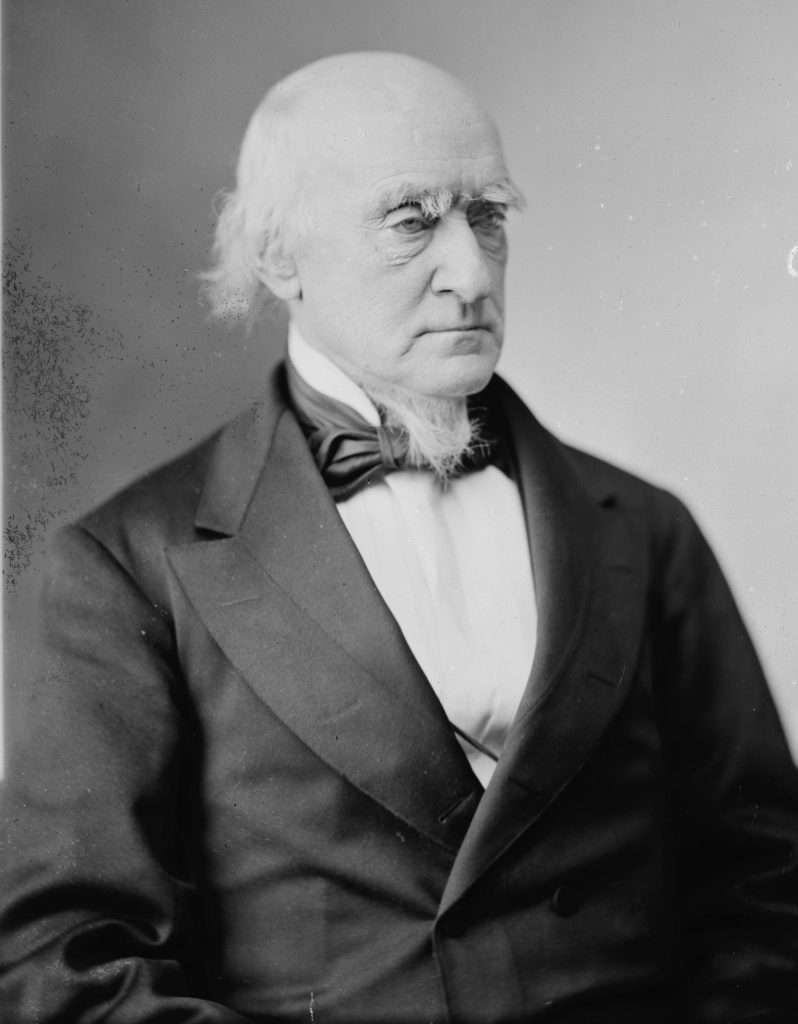
3/14/1932: Justice Benjamin Cardozo takes oath.

Mostly law professors | Sometimes contrarian | Often libertarian | Always independent | Est. 2002

3/14/1932: Justice Benjamin Cardozo takes oath.
On Thursday, the Acting Solicitor General filed emergency applications in three birthright citizenship cases (24A884, 24A885, and 24A886). These are appeals from the First, Fourth, and Ninth Circuits. The government has sought only a partial stay. First, the SG argues that the universal injunctions improperly granted relief to non-parties. Second, the SG contends that it was not proper to grant relief to the states. Third, the SG argues that the lower-court injunctions are overbroad insofar as they prevent the Executive Branch from even developing implementation guidance.
Even measured against other universal injunctions, those at issue here stand out. The universal injunctions here extend to all 50 States and to millions of aliens across the country—even though tailored interim relief for the plaintiffs to these suits would fully redress their alleged harms. The courts granted these universal injunctions to States who plainly lacked standing to raise Citizenship Clause claims—defying the bedrock principle that States (like other litigants) may assert only their own rights, not the rights of third parties.
The government does not seek any remedy based on a likelihood of success on the merits. Rather, the "modest" relief sought is purely procedural.
At various junctures, five members of the Court have criticized nationwide injunctions. The brief doesn't just list the name of the authoring justice. The brief names-names:
Universal injunctions transgress constitutional limits on courts' powers, which extend only to "render[ing] a judgment or decree upon the rights of the litigants." United States v. Texas, 599 U.S. 670, 693 (2023) (Gorsuch, J., joined by Thomas and Barrett, J.J., concurring in the judgment) (citation omitted). Universal injunctions are also incompatible with " 'foundational' limits on equitable jurisdiction." Department of State v. AIDS Vaccine Advocacy Coalition, No. 24A831, slip op. 7 (2025) (Alito, J., joined by Thomas, Gorsuch, and Kavanaugh, J.J., dissenting) (citation omitted).
The brief favorably cites Brackeen for the proposition that states lack standing to assert the rights of third parties:
The courts granted these universal injunctions to States who plainly lacked standing to raise Citizenship Clause claims—defying the bedrock principle that States (like other litigants) may assert only their own rights, not the rights of third parties. See, e.g., Haaland v. Brackeen, 599 U.S. 255, 294-295 (2023). . . . In Haaland v. Brackeen, 599 U.S. 255 (2023), [the Court] rejected Texas's claim that a federal statute violated the Equal Protection Clause because a State "has no equal protection rights of its own" and "cannot assert equal protection claims on behalf of its citizens." Id. at 294- 295. . . . This Court has repeatedly rejected States' "thinly veiled attempt[s] to circumvent the limits on parens patriae standing." Murthy, 603 U.S. at 76 (citation omitted); see Brackeen, 599 U.S. at 295 n.11.
The brief cites Does 1-3 v. Mills, and says this case is certworthy:
This Court has frequently granted complete or partial stays of universal orders issued by district courts. See McHenry v. Texas Top Cop Shop, Inc., 145 S. Ct. 1 (Jan. 23, 2025); Garland v. Vanderstok, 144 S. Ct. 44 (2023); Labrador v. Poe, 144 S. Ct. 921 (2024); Wolf v. Innovation Law Lab, 140 S. Ct. 1564 (2020); DHS v. New York, 140 S. Ct. 599 (2020); Barr v. East Bay Sanctuary Covenant, 140 S. Ct. 3 (2019); Trump v. Hawaii, 583 U.S. 1009 (2017); Trump v. International Refugee Assistance Project, 582 U.S. 571 (2017) (per curiam). The usual stay factors support granting similar relief here. See Ohio v. EPA, 603 U.S. 279, 291 (2024) (discussing stay factors); Does 1-3 v. Mills, 142 S. Ct. 17, 18 (2021) (Barrett, J., concurring) (same). . . . Again, the underlying issues are certworthy. See Does 1-3, 142 S. Ct. at 18 (Barrett, J., concurring). . . . This question too is certworthy. See Does 1-3, 142 S. Ct. at 18 (Barrett, J., concurring). Whether a district court may properly enjoin the Executive Branch's development and publication of policies is a weighty separation-of-powers question that warrants this Court's attention.
The brief cites Murthy v. Missouri to prevent states from asserting interests on behalf of its residents:
Universal injunctions also contravene this Court's precedents on Article III standing. "[S]tanding is not dispensed in gross," so plaintiffs must establish standing "for each form of relief that they seek." Murthy v. Missouri, 603 U.S. 43, 61 (2024) (citations omitted). . . . And in Murthy v. Missouri, 603 U.S. 43 (2024), [the Court] rejected Missouri's claim that the federal government had violated the First Amendment by censoring its citizens' speech because Missouri lacked "third-party standing" to sue for those citizens. Id. at 76.
The import here is clear. In the bad old days, Erwin Chemerinsky used to joke that if he could put Justice Kennedy's photo on the front cover of a brief, he would. But as I observed two years ago, briefs are now being directed to Justice Barrett. Will Justice Barrett deny standing to the blue states, as she did to Texas in Brackeen? Will Justice Barrett deny universal relief to the blue states, as she did to Texas in Texas? Will Justice Barrett scrutinize the blue state's claim for standing as meticulously as she scrutinized Missouri's claim in Murthy?
These would be the sorts of neutral principles that should govern on the emergency docket. Again, Justice Barrett has downplayed any assessment of the merits on the emergency docket. And the government has not made any merits arguments. Granting a party-specific injunction would ensure the parties are not injured by the policy. Of course, lurking in the background is that there are potentially millions of aliens who are not part of the litigation, whose unborn children might stand to lose birthright citizenship. Would this be a merits question? Or one of maintaining the status quo? Does the Supreme Court have the power to avoid irreparable harm to non-parties?
This is not the sort of case where discovery or percolation will make much of a difference. The facts are known, the history has been discussed for generations, and the issue is ripe for review. The only question here is whether the injunctions are too broad.
This passage from Justice Gorsuch's Texas concurrence, which Justice Barrett joined, is worth repeating:
Traditionally, when a federal court finds a remedy merited, it provides party-specific relief, directing the defendant to take or not take some action relative to the plaintiff. If the court's remedial order affects nonparties, it does so only incidentally. See, e.g., Doran v. Salem Inn, Inc., 422 U. S. 922, 931, 95 S.Ct. 2561, 45 L.Ed.2d 648 (1975) ("[N]either declaratory nor injunctive relief can directly interfere with the enforcement of contested statutes or ordinances except with respect to the particular federal plaintiffs."); Alemite Mfg. Corp. v. Staff, 42 F.2d 832 (CA2 1930) (L. Hand, J.) ("[A] court of equity … cannot lawfully enjoin the world at large."); see also Trump v. Hawaii, 585 U. S. ––––, ––––, 138 S.Ct. 2392, 2427, 201 L.Ed.2d 775 (2018) (THOMAS, J., concurring). This tracks the founding-era understanding that courts "render a judgment or decree upon the rights of the litigant[s]." Rhode Island v. Massachusetts, 12 Pet. 657, 718, 37 U.S. 657, 9 L.Ed. 1233 (1838). It also ensures that federal courts respect the limits of their *694 Article III authority to decide cases and controversies and avoid trenching on the power of the elected branches to shape legal rights and duties more broadly. After all, the "judicial Power" is the power to "decide cases for parties, not questions for everyone." S. Bray, Multiple Chancellors: Reforming the National Injunction, 131 Harv. L. Rev. 417, 421 (2017).
The brief does offer this stunning statistic:
Universal injunctions have reached epidemic proportions since the start of the current Administration. Courts have graduated from universal preliminary injunctions to universal temporary restraining orders, from universal equitable relief to universal monetary remedies, and from governing the whole Nation to governing the whole world. District courts have issued more universal injunctions and TROs during February 2025 alone than through the first three years of the Biden Administration. That sharp rise in universal injunctions stops the Executive Branch from performing its constitutional functions before any courts fully examine the merits of those actions, and threatens to swamp this Court's emergency docket.
I will repeat what I wrote last week. Lower courts are issuing universal orders with impunity, and are not granting stays to seek appellate review. There has been an inversion of Article III. I know the Court does not want to be accused of another Dred Scott (and you know that criticism is coming). The Court could have cleaned up this mess in the USAID case, but we all know how that one turned out. When you keep kicking the can down the road, eventually the can is no longer a can.
If ever a universal injunction makes sense, it's in a case like this.

Four different federal courts have issued rulings blocking Donald Trump's executive order denying birthright citizenship to children of undocumented immigrants and immigrants in the US on the temporary visas. Three of them have issued nationwide injunctions, blocking enforcement of the the order throughout the country. The Trump Administration has filed nearly identical emergency applications asking the Supreme Court to intervene in all three cases (see here, here, and here): not to overturn them on the merits, but to narrow the scope of the injunctions so they apply only to specific parties in the case, and also exclude state governments, who are among the plaintiffs (they have standing because the order affects their public finances).
There is a longstanding debate among jurists and legal scholars about whether nationwide injunctions (also often called "universal injunctions") are appropriate. If you oppose nationwide injunctions on principle, I don't expect you will make an exception in these cases. While I am admittedly not an expert on the subject, I have always held the view that nationwide injunctions are not only permissible but essential in some situations. Nationwide lawbreaking by the federal government requires a nationwide remedy. And that's especially true if the illegality affects the rights of large numbers of people, many of whom could not easily or quickly bring individual suits to challenge it. Justice delayed - in some cases indefinitely - is justice denied.
The case for nationwide injunctions is also strong in situations where the resolution of the issue in question doesn't depend on variations in circumstances across states and localities. If the government's actions are illegal in the same way across the nation, then the best way to get justice is to strike it down everywhere at once. University of Virginia law Prof. Amanda Frost develops this point in much greater detail in her well-known 2018 article on this subject. As she summarizes her position:
In some cases, nationwide injunctions are the only means to provide plaintiffs with complete relief, or to prevent harm to thousands of individuals similarly situated to the plaintiffs who cannot quickly bring their own cases before the courts. And sometimes anything short of a nationwide injunction would be impossible to administer. When a district court is asked to pass on the validity of a federal policy with nationwide effects—such as one affecting the air or water, or the nation's immigration policy—it can be extremely difficult to enjoin application of the policy to some plaintiffs but not others. Furthermore, nothing in the Constitution's text or structure bars federal courts from issuing a remedy that extends beyond the parties. To the contrary, such injunctions enable federal courts to play their essential role as a check on the political branches. Indeed, the recent surge in nationwide injunctions could be seen as a symptom of the real problem—the executive branch's increasingly common practice of unilaterally making major policy changes outside of the legislative process.
I agree. And I am not much moved by the opposing concern that one overreaching district judge can unjustifiably block a federal policy. If the judge's ruling is indeed badly wrong, it can be overturned on appeal, if necessary on an expedited basis. It is much less of a burden for the government to seek such appellate review than for many thousands of people to have to file individual lawsuits to vindicate their rights.
And the birthright citizenship cases are virtually textbook examples of Frost's points. Trump's executive order imperils the rights of hundreds of thousands of innocent children. Many of their families lack the resources to bring a lawsuit quickly, if at all. And a situation where the order is in force for some people, but not others (or, alternatively, in some states but not others), creates obvious confusion and anomalies, especially when it comes to a policy (citizenship rules) that is supposed to be uniform throughout the nation. As one of the rulings imposing a nationwide injunction explains:
Only a nationwide injunction will provide complete relief to the plaintiffs. ASAP [one of te plaintiff organizations] has "over 680,000 members . . . who reside in all 50 U.S. states and several U.S. territories."… ASAP expects that "[h]undreds or even thousands of ASAP members will give birth to children in the United States over the coming weeks and months…." Because ASAP's members reside in every state and hundreds of them expect to give birth soon, a nationwide injunction is the only way "to provide complete relief" to them….).
Further, "a nationwide injunction may be appropriate when the government relies on a 'categorical policy…'" See HIAS, 985 F.3d at 326. The Executive Order is a categorical policy. A nationwide injunction against the categorical policy in the Executive Order is appropriate. It also is necessary because the policy concerns citizenship—a national concern that demands a uniform policy. See Arizona v. United States, 567 U.S. 387, 394–95 (2012)….. A nationwide injunction is appropriate and necessary.
I would add that an injunction limited to a particular state or set of states would result in a situation where many children are considered US citizens in some states, but not others.
If the Supreme Court wants to put an end to nationwide injunctions generally, they can do so. But if not, there are extraordinarily compelling reasons to maintain the injunctions in these cases.
I have written about the substantive issues at stake in the birthright citizenship cases in a Just Security article, and several previous posts at this site (see here, here, and here).
His apparent plan to do so is illegal and would set a dangerous precedent if allowed to stand.
Media reports indicate the Trump Administration may be about to invoke the Alien Enemies Act of 1798 as a tool to facilitate deportation:
The Trump administration is expected to invoke a sweeping wartime authority to speed up the president's mass deportation pledge in the coming days, according to four sources familiar with the discussions.
The little-known 18th-century law, the Alien Enemies Act of 1798, gives the president tremendous authority to target and remove undocumented immigrants, though legal experts have argued it would face an uphill battle in court.
CNN previously reported that the authority was being widely discussed at several agencies as administration officials prepared to implement the law. The primary target remains Tren de Aragua (TDA), a Venezuelan organized crime group that is now operating in the United States and other countries….
Trump had ordered his administration to designate TDA as a foreign terrorist organization and use the measure to remove those identified.
The announcement, which could come as soon as Friday, has been a moving target as officials finalize the details. The move would likely pave the way for quicker removals of certain immigrants.
I have previously written about why such a use of the Alien Enemies Act would be both illegal and set a dangerous precedent here and here.
The Act is the only part of the notorious Alien and Sedition Acts of 1798 that remains on the books. If courts let the Administration use it, they could potentially detain and deport even legal immigrants with little or no due process. However, the Act can only be used in the event of a declared war, or an "invasion" or "predatory incursion" perpetrated by a "foreign nation or government." As explained in my earlier writings about this issue, illegal migration and cross-border drug smuggling do not qualify as an "invasion" or "predatory incursion." Even if they did, they aren't being perpetrated by a "foreign nation or government." Tren de Aragua and other organized crime groups engaged in drug smuggling are pretty obviously not nations or governments.
I previously wrote about why drug cartel activities don't qualify as an "invasion" here:
The Administration uses the involvement of cartels in cross-border drug trade to buttress their position. But the fact that some cross-border smuggling is conducted by organized crime does not make it the equivalent of an armed attack. Otherwise, the United States was constantly under "invasion" under Prohibition, when armed organized crime organizations smuggled illegal alcoholic beverages across the Canadian border. Smuggling by organized crime groups is a virtually inevitable consequence of prohibition regimes, whether for alcohol in the Prohibition era or drugs today. By this theory, there is a constant, never-ending state of "invasion."
If illegal migration and drug smuggling do qualify as an "invasion," there would be dire implications that go far beyond immigration issues. States would be authorized to "engage in war" in response (even without congressional authorization), and the federal government would empowered to suspend the writ of habeas corpus, and thereby detain people - including US citizens - without charges or trial.
If Trump does try to use the Alien Enemies Act as a tool for deportation, courts should strike it down.
For more on the Alien Enemies Act, see this helpful analysis by Katherine Yon Ebright of the Brennan Center.
The Seventh Circuit so held yesterday; the case also involved other controversial statements besides the expurgated slur.
From yesterday's decision by Seventh Circuit Judge Thomas Kirsch, joined by Judges Ilana Rovner and David Hamilton, in Kilborn v. Amiridis:
This appeal arises out of a motion to dismiss, so we accept the well-pleaded facts in the complaint as true and draw all reasonable inferences in the plaintiff's favor….
Jason Kilborn is a tenured professor at the University of Illinois Chicago School of Law, where he regularly teaches a course on civil procedure. For the past decade, he has included the same question on the final exam. The question concerns a fictional former employee who says she "quit her job at Employer after she attended a meeting in which other managers expressed their anger at Plaintiff, calling her a 'n____' and 'b___' (profane expressions for African Americans and women) and vowed to get rid of her." The exam question appears exactly like this, with the racial and gender slurs expurgated.
Unlike in prior years, students who took the exam in December 2020 were upset by Kilborn's use of the expurgated slurs and shared their displeasure with the law school dean. In response, Kilborn reached out to students to discuss the exam question. He sent a note of regret to his class for any distress caused by the expurgated references, exchanged emails with a student about the incident, and participated in a cordial, constructive, four-hour Zoom meeting with a member of the Black Law Students Association (BLSA).
During the Zoom meeting, the BLSA member asked Kilborn why the dean had not shown him a student petition criticizing the exam question. Kilborn replied that perhaps the dean had not shared the petition with him because she feared he might "become homicidal" if he read it. Kilborn made the comment in jest, and the conversation continued for another three hours without any indication that the student felt threatened or distressed by the statement. However, the student later told the dean and other University administrators that Kilborn had said that he "was feeling homicidal" or "would become homicidal."
Asserting that they feared a possible threat of imminent violence, University officials placed Kilborn on indefinite administrative leave, cancelled his classes for the term, and barred him from campus. Kilborn was ultimately released to unrestricted duty a few days later, but only after he submitted to drug testing and a medical examination. His classes remained cancelled. Kilborn believes that the University officials' concern about his homicidal jest simply provided a pretext to punish him for his exam question and to mollify complaining students.
Jane Bambauer and I discuss the First Amendment and immigration law: deportation, exclusion, denial of citizenship, and more.
See also our past episodes:
From the materials:
Applications for the UC National Center for Free Speech and Civic Engagement's fellowship program are now open (due March 21). Each year, the Center selects fellows from a broad range of disciplines and backgrounds such as law, journalism, higher education, social science, technology and government. The Center welcomes candidates from all backgrounds to apply and invites a wide range of innovative projects.
This is a one-year, non-residential program that gives selected fellows $20,000 in addition to up to $5,000 in research funds. Find details here.…
This year we are particularly interested in the following issues:
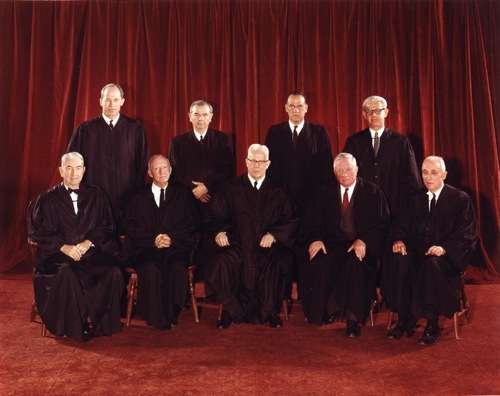
3/13/1963: Ernesto Miranda is arrested.
I have a very hard time getting worked up over revoked security clearances.
For the past two decades or so, conservatives have been systematically excluded from big law. Paul Clement was pushed out of two big law firms for his representation of conservative causes. A lawyer at Hogan Lovells was fired after defending Dobbs. Associates are routinely forced to do pro bono work on progressive causes, including abortion. But you will not find AMLAW 100 firms that filed an amicus brief in support of abortion restrictions. With good reason, boutique firms like Consovoy McCarthy and Clement Murphy have flourished. Big law firms have decided they would take a position on ideological issues, conservatives be damned. Maybe that was a good business judgment in the past, though those tides may have turned.
I don't think anyone would quibble with what I wrote above. But they would probably draw a distinction between a law firm making a business decision to favor progressive causes, and the government taking actions against a firm because of their political decisions. The Trump Administration's revocation of security clearances for attorneys at certain firms would be an example of the latter issue.
Is this sort of action unprecedented? Not really. I will repost below I wrote in 2016 about the origin of House of Representatives v. Burwell. This post was based on my 2016 book, Unraveled: Obamacare, Executive Power, and Religious Liberty. The bottom line: the Obama Administration indirectly pressured Baker Hostetler to drop its representation of the House. And that pressure worked. I'll add a coda at the end of the post.
Republicans have a problem. Since the Nixon Administration, Republican Presidents have appointed sixteen out of twenty-one Supreme Court justices. But only about a third of those sixteen nominees have been principled conservative jurists. The rest either were not very conservative in the first place or simply drifted to the left. Perhaps the most confounding selection has been Chief Justice John Roberts. In his never-ending pursuit to depoliticize the judiciary, Roberts renders these faux-Solomonic decisions based on his own sense of political compromise. His decision to save the Affordable Care Act by rewriting the law's individual mandate and Medicaid expansion was just the tip of the iceberg.
These problems with Republican appointed judges are well known, and have been the source of massive frustration on the right. Ironically enough, the current Court's two most conservative members were flukes. Justice Samuel Alito was only picked after the nomination of Harriet Miers (thankfully) flamed out. And I am confident that President George H.W. Bush would have never selected Clarence Thomas had he known how conservative the jurist would be.
President Trump was gifted a golden opportunity in his first term with three Supreme Court nominees. As Trump's second term begins, with potential vacancies on the horizon, it is not too early to assess the three nominees. But how best to measure their performance? One possible benchmark is whether they built a conservative majority on the Court. On that front, they unquestionably succeeded. Justice Antonin Scalia, the conservative lion, was replaced by another conservative, Justice Neil Gorsuch. Justice Anthony Kennedy, who swung from left to right in any given case, was replaced by a more-reliable conservative in Justice Brett Kavanaugh. And Justice Ruth Bader Ginsburg, the leader of the Court's progressive wing, was replaced by Amy Coney Barrett, who briefly served on the court of appeals after a career in academia. These three jurists have cast votes in landmark cases that have unquestionably shifted the law to the right: they voted to overrule Roe v. Wade, abandoned the dreaded Lemon test, nixed most affirmative action policies, and more.
If we limit our focus to these high-level cases, the Trump trio are resounding successes. But we can look deeper. In my view, the relevant metric is not whether they have made the Court more conservative, but how they compare to the Court's most conservative appointees: are they voting with Justices Thomas and Alito, or drifting towards Chief Justice Roberts? I documented their records meticulously in a 2024 article, and have carefully tracked recent developments. On this front, the Trump appointees can be easily ranked. First, Justice Gorsuch is the member most likely to join Thomas and Alito, though he has led the liberals on significant cases concerning LGBT rights and Indian tribes. Second Justice Brett Kavanaugh started off a bit rocky, and was more likely to vote with Chief Justice Roberts, though more recently, he has settled down to preserve certain legal principles. Third, Justice Barrett has been the biggest wildcard. From her earliest days, she has consistently voted opposite Thomas, Alito, and Gorsuch with regard to emergency applications and denials of certiorari. More recently, Justice Barrett has been trending towards Chief Justice Roberts's mode of alternative dispute resolution.
You don't have to take my word for it. In the spirit of DOGE, here is the wall of receipts.
The move is part of a broader suite of deregulatory actions announced by the EPA Administrator, and is likely the least advisable item on the list.
Today Environmental Protection Agency (EPA) Administrator Lee Zeldin announced 31 deregulatory actions it was undertaking to reduce the burden of environmental regulations on the American economy. Many of the announced actions represent efforts to reconsider Biden Administration policies and adopt less burdensome alternatives. "Today is the greatest day of deregulation our nation has seen. We are driving a dagger straight into the heart of the climate change religion to drive down cost of living for American families, unleash American energy, bring auto jobs back to the U.S. and more," Zeldin said in the EPA's release.
One of the more significant actions Zeldin announced is also the most foolish: Reconsidering the EPA's "endangerment finding" with regard to greenhouse gas emissions. Focusing on this finding is understandable, as this finding is what triggers GHG regulation under the Clean Air Act. Yet given the relevant statutory language, trying to undo this finding is a fool's errand that threatens to divert limited agency resources and staffing away from the other announced initiatives.
Under various provisions of the Clean Air Act, the EPA is required to regulate any emissions that "cause, or contribute to, air pollution which may reasonably be anticipated to endanger public health or welfare." In Massachusetts v. EPA, greenhouse gases are air pollutants under some of the Act's provisions, so whether they must be regulated turns on whether GHG emissions "may reasonably be anticipated to endanger public health or welfare." This is not a high threshold to meet, and it is one that GHG emissions easily satisfy (something the EPA has, in effect, conceded for decades).
Note that for purposes of the Clean Air Act, the question is not whether climate change is catastrophic, nor whether climate adaptation is preferable to mitigation, nor whether federal regulation of sector-specific emissions is rational or cost-beneficial, nor whether such regulations represent a serious or rational way to address the threat of climate change. Nor is the question whether the science is unequivocal, nor is it whether there is certainty about the likely effects of increased atmospheric concentrations of GHGs over any given time period. Rather the question is simply whether the EPA Administrator can "reasonably anticipate" that the accumulation of GHG emissions can cause negative effects -- i.e. threaten "public health or welfare." (And note further that "welfare," under the Clean Air Act, is an expansive term explicitly defined to include effects on climate, "economic values," and "personal comfort and well-being.")
What this means is that none of the justifications for reconsidering the endangerment finding in the EPA's press release are remotely relevant to the question at hand, as none address the relevant statutory language which defines and delimit EPA's inquiry. Indeed, the Trump EPA seems to be repeating the same mistake made by the Bush Administration prior to Massachusetts v. EPA when it claimed it could simply decline to regulate GHGs simply because it concluded there were better ways to address climate change than utilizing the Clean Air Act. The Bush Administration was correct as a policy matter, but wrong on the law--as the Supreme Court ultimately concluded. [N.B.: the EPA release quotes Acting OIRA Administrator Jeff Clark who helped spearhead the Bush Administration's failed legal strategy in Massachusetts v. EPA.]
A further obstacle to reconsidering the endangerment finding is that it would effectively require the EPA to repudiate virtually everything it has said about greenhouse gas emissions and climate change for the past several decades--and then convince federal courts that these disavowals represent the sort of reasoned decision-making that courts should uphold. Again, it will not be enough for the EPA to now claim some studies exaggerated risks or reached improper conclusions, for that would not be enough to unring the endangerment bell. Rather, the EPA has to claim--with a straight face--that the Administrator cannot "reasonably anticipate" that anthropogenic GHG emissions do not even "contribute" to any adverse impacts on health or welfare. OIRA's Clark may believe that the endangerment finding should require "a consideration of downstream costs imposed on both mobile sources like cars and stationary sources like factories," but that's not what the Clean Air Act says, nor is it how the statute has been interpreted by the courts.
The Trump Administration is correct that seeking to stabilize atmospheric concentrations of greenhouse gases through the Clean Air Act is costly and unwise. I am long on record calling such policies unserious and destined for failure. But that is largely irrelevant to the legal question before the EPA. Like it or not (and I do not), the Supreme Court concluded the greenhouse gases are pollutants under the Clean Air Act, and the relevant statutory language is highly precautionary and easily triggered. That the result is a raft of costly regulations that increase prices, constrain innovation, and suppress energy use is legally irrelevant.
The bottom line is that if the Trump Administration wants to fully disarm the EPA from climate regulation, it will have to go to Congress. The Clean Air Act may be a poor way to try and adjust the planetary thermostat, but that is the sort of problem that the legislature needs to fix.
Update: This post does not address the claim that the IRA amended the Clean Air Act to cement the EPA's regulatory authority over greenhouse gases. I don't address that point for two reasons. First, endangerment is a separate question from whether greenhouse gases are pollutants under the Act. The latter is a predicate for the former. Second, this common claim about the IRA is not true, for reasons I explained here.
I would also note that those hoping a reconsideration of endangerment prompts a reconsideration of Massachusetts v. EPA should be careful what they wish for. Overturning Massachusetts would vitiate AEP v. Connecticut, and allow nuisance suits against GHG emitters under federal common law.
The decision involved administration attempts to withhold spending on foreign aid contracts, but has much broader implications.
On Monday, US District Judge Amir Ali ruled against the Trump Administration in an important case involving control over the spending power. The court held the administration could not withhold payments from foreign aid contractors, that had been allocated by Congress. The issues in the case go far beyond the relatively modest sums of money immediately at stake. Indeed, this is just one of many cases where the administration is being sued for illegally withholding funds, in defiance of Congress. Judge Ali has a valuable summary of the broader constitutional principle involved:
The provision and administration of foreign aid has been a joint enterprise between our two political branches. That partnership is built not out of convenience, but of constitutional necessity. It reflects Congress and the Executive's "firmly established," shared constitutional responsibilities over foreign policy, Zivotofsky ex rel. Zivotofsky v. Kerry, 576 U.S. 1, 62 (2015) (Roberts, C.J., dissenting), and it reflects the division of authorities dictated by the Constitution as it relates to the appropriation of funds and executing on those appropriations. Congress, exercising its exclusive Article I power of the purse, appropriates funds to be spent toward specific foreign policy aims. The President, exercising a more general Article II power, decides how to spend those funds in faithful execution of the law….
This case involves a departure from that firmly established constitutional partnership. Here, the Executive has unilaterally deemed that funds Congress appropriated for foreign aid will not be spent. The Executive not only claims his constitutional authority to determine how to spend appropriated funds, but usurps Congress's exclusive authority to dictate whether the funds should be spent in the first place. In advancing this position, Defendants offer an unbridled view of Executive power that the Supreme Court has consistently rejected—a view that flouts multiple statutes whose constitutionality is not in question, as well as the standards of the Administrative Procedure Act ("APA"). Asserting this "vast and generally unreviewable" Executive power and diminution of Congressional power, Defendants do not cite any provision of Article I or Article II of the Constitution….
Judge Ali has a more detailed discussion of the constitutional issues later in the opinion (pp. 29-38).
I have previously covered the issues at stake in Trump's effort to usurp the spending power here. It's a massive power grab that must be blocked, even if you believe (as I do) that federal spending is way too high and needs to be cut. As noted in my earlier post, much of the administration's agenda is not really about cutting spending, but about using the threat of withholding to bend state and local governments and various private organizations to the administration's will. See also this discussion by Georgetown law Prof. Meryl Chertoff. Even if you think a Republican president should be able to wield such vast, unconstrained power, I bet you don't have similar confidence in the next Democratic one.
The actual savings achieved by DOGE cuts (about $9 billion, once we strip away errors and distortions), are relatively piddling, in the context of the gargantuan nearly $7 trillion federal budget. This isn't about balancing the budget, or even about reducing waste and fraud. It's a massive unconstitutional power grab.
For those keeping score, I have also been highly critical of Democratic administrations' attempts to usurp spending authority, as with Biden's student loan forgiveness program (rightly invalidated by the Supreme Court, in a decision I defended here). But Trump's assault on the spending power is distinctive for its sweeping nature. He doesn't just claim that vague statutes give him vast discretion over some particular spending category (as, e.g., Biden did with student payments). He's claiming a general power to "impound" any federal funds for almost any reason. That claim is badly wrong, and extremely dangerous.
Judge Ali also concluded that the Administration violated the Administrative Procedure Act. I will leave that issue to APA experts.
Just posted to SSRN.
I have recently posted a new draft article, Data Scanning and the Fourth Amendment, to SSRN. The abstract:
A crucial question of Fourth Amendment law has recently divided courts: When government agents conduct a digital scan through a massive database, how much of a "search" occurs? The issue pops up in contexts ranging from geofence warrants and reverse keyword searches to the installation of Internet pen registers. When a government agent runs a filter through a massive database, resulting in a list of hits, is the scale of the search determined by the size of the database, the filter setting, or the filter output? Fourth Amendment law is closely attuned to the scale of a search. No search means no Fourth Amendment oversight, small searches ordinarily require warrants, and limitless searches are categorically unconstitutional. But how broad is a data scan?
This essay argues that that Fourth Amendment implications of data scans should be measured primarily by filter settings. Whether a search occurs, and how far it extends, should be based on what information is exposed to human observation. This standard demands a contextual analysis of what the output reveals about the dataset based on the filter setting. Data that passes through a filter is searched or not searched depending on whether the filter is set to expose that specific information. The proper question is what information is expressly or implicitly exposed, not what raw data passes through the filter or the raw data output. The implications of this approach are then evaluated for a range of important applications, among them geofence warrants, reverse keyword searches, and Internet pen registers.
The idea for this article started with my blog posts here reacting to the Fifth Circuit's geofence warrant ruling in United States v. Smith, but I think the issue is one that applies more broadly. Indeed, the more that lower courts construe the Fourth Amendment broadly on what data is protected, the more Fourth Amendment protection depends on how you answer the scanning question.
This is a first draft, and comments are very welcome. I especially welcome comments on the technology discussions (mostly in Section I), including about whether I get the basics correct, whether the examples and analogies work, and whether the terminology is on or off. Thanks.
In his recent book and an oped column, he channels Nazi and other antisemitic propaganda about the Purim Holiday
The basic story of the holiday of Purim, which starts Thursday night, is this. The King of the Persian empire takes a Jewish bride, Esther, who conceals her Jewish identity. Meanwhile, the king's evil vizier, Haman, plots a genocide of Jews throughout the empire, and wins the king's blessing to undertake the massacre on the 14th day of the month of Adar. Esther's uncle Mordechai gets wind of the plot, and beseeches Esther to intervene. Esther persuades the king to execute Haman, but the decree approving the massacre cannot be revoked. The king instead gives Jews throughout the empire the right to defend themselves, and the following transpires:
For the Jews that were in Shushan gathered themselves together on the fourteenth day also of the month Adar, and slew three hundred men at Shushan; but on the prey they laid not their hand. But the other Jews that were in the king's provinces gathered themselves together, and stood for their lives, and had rest from their enemies, and slew of their foes seventy and five thousand, but they laid not their hands on the prey on the thirteenth day of the month Adar; and on the fourteenth day of the same rested they, and made it a day of feasting and gladness
The text could not be clearer that the Jews rose in self-defense, and killed not random people, but the enemies who were preparing the genocide.
Nevertheless, for centuries antisemites have distorted the text to suggest that Jews were inherently bloodthirsty chauvinists who sought to massacre the people around them. The Nazis, for obvious reasons, particularly loved to rely on a story about Jews fighting back against genocidal enemies to libel Jews. The holiday loomed so large in Nazi consciousness that just before Hitler henchmen Julius Streicher was hanged, he shouted out, "Purimfest 1946!" But you don't have to take my word for it:
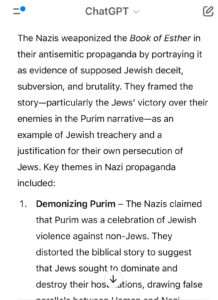
So what sort of vicious antisemite would spread similar libels about Purim in 2025? For one, New York Times writer Peter Beinart. Beinart has evolved over the years from "liberal Zionist" to "non-Zionist" to "anti-Zionist" to his later iteration, which is "deranged antisemitic anti-Zionist."
Here he is in a column in the Guardian, based on his recent book, explaining Purim in the same terms as the Nazis and other antisemites:
On the 13th day of the month of Adar, the Jews kill 75,000 people. They declare the 14th "a day of feasting and merrymaking". With the blood of their foes barely dry, the Jews feast and make merry. That's the origin of Purim.
Purim isn't only about the danger Gentiles pose to us. It's also about the danger we pose to them.
For most of our history, when Jews had little capacity to impose our will via the sword, the conclusion of the book of Esther was a harmless and even understandable fantasy. Who can blame a tormented people for dreaming of a world turned upside down? But the ending reads differently when a Jewish state wields life and death power over millions of Palestinians who lack even a passport. Today, these blood-soaked verses should unsettle us. When we recite them aloud in synagogue, we should employ the anguished, sorrowful tune in which we chant the book of Lamentations, which depicts the destruction of our ancient temples.
Instead, most of us ignore the violence that concludes the Esther scroll. Some contemporary Jews justify it as self-defense. On the far right, some revel in it. But they're the exception. More often, we look away. We focus on what they tried to do to us.
No, Peter, we don't look away. According to the story (which is, fwiw, historical fiction), armed mobs of 75,000 people came to murder the entire Jewish population of the Persian Empire, who were innocent of any wrongdoing. The Jews killed them before they could do it. Hooray! If only someone had done this to the Nazis in 1938, we could be celebrating Purim II, instead of mourning on Yom HaShoah.
If this doesn't cost Beinart his job on the New York Times op-ed page, it's a terrible sign of how antisemitism has been normalized in elite discourse.
From Northwestern law professor Andrew Koppelman (The Hill) (this is the unexpurgated version that I received by e-mail, so I'm including it instead of just linking to the Hill version):
John Wilkes Booth was a racist murderer, but that apparently wasn't the worst thing about him. The worst thing was that he used "the N-word."
Isn't that a bizarre thing to say? Not too bizarre, evidently, for the social media campaign that pressured a Northwestern University theater group into cancelling its production of Stephen Sondheim's classic musical "Assassins." The cancellation was part of a misguided effort to fight racism, and it is a window into how counterproductive such efforts have sometimes become.
"Assassins" is a deeply ironic depiction of America's presidential assassins, attempted and successful, and their place in the national imagination. It flopped when it first opened on Broadway in 1990 but has since been recognized as one of Sondheim's major works.
At one point in the show, Booth, who killed Abraham Lincoln, calls his victim a "niggerlover." It comes at the end of a soliloquy full of the familiar bilge about the noble lost Southern cause, and it is intended to shock the audience. It does. No substituted euphemism could have the same effect. It is an ugly moment, and it is historically accurate. But racist murder is an ugly thing.
The panel’s ruling that suppressed firearms aren’t protected should be reconsidered.
A petition for rehearing en banc has been filed seeking review of the Fifth Circuit's panel decision in United States v. Peterson, which held that noise suppressors (aka silencers or mufflers) are not "Arms" protected by the Second Amendment. As I recently posted about the case here, the decision overlooked that millions of law-abiding Americans use suppressed firearms for ear protection and reduction of recoil, attributes just as relevant to the scope of the Second Amendment as other important firearm features.
The Court has ordered the United States to file a response by March 17. This is an opportunity for the Attorney General to comply with the President's Executive Order to examine all actions of executive departments and to present a plan to protect the Second Amendment rights of Americans. That includes review of "The positions taken by the United States in any and all ongoing and potential litigation that affects or could affect the ability of Americans to exercise their Second Amendment rights."
The Brief of the United States previously filed under Attorney General Garland is the familiar excuse list of why the Second Amendment never impedes any restriction: suppressors are not "bearable arms," but even if they are, they are "dangerous and unusual," but even if they're not, the registration requirements of the National Firearms Act do not "infringe" on Second Amendment rights, and in any event, the registration requirements are analogous to historical regulation of commerce in firearms.
The same excuse list could be applied to any other firearm feature, including those that anti-gun advocates depict with exaggerated rhetoric to dupe judges who are unfamiliar with firearm technology. Such false depictions including the horrifying conspicuously-protruding pistol grip on a rifle, the devastating .223 caliber cartridge that blows up people to pieces, or the sniper scope designed to take out enemies two miles away.
The United States should file a response to the petition to rehear that addresses the very serious arguments made in the petition and should change the position of the Merrick Garland-run Department of Justice. It should acknowledge that suppressors reduce but do not eliminate the noise emitted from a firearm, which supports the safe and effective use of a firearm by reducing damage to one's hearing. Millions of Americans possess and use suppressed firearms for target practice, self-defense, and hunting, which thus meet Heller's common-use test.
The panel acknowledged that the case was a matter "of first impression in [this] circuit," but with little reasoning held that suppressors are afforded no Second Amendment protection whatsoever. The panel adopted a broad categorical rule: certain firearm parts, which the panel labeled as "firearm accessories," are not "covered by the plain text of the Second Amendment" because they do not fire projectiles. Neither do ammunition magazines, adjustable stocks, sights, and braces, but they are standard parts that are used to assemble a firearm.
More fundamentally, the court ignored that suppressed arms are "arms" under the plain text. The court treats suppressors as optional accessories that do not fire bullets. The court did not consider that while many suppressors may be installed on and removed from threaded barrels or quick attachable/detachable locks, others are integral with the barrel. Generally, an integral suppressor is permanently fixed to and is part of the barrel, and it may not be removed from the barrel. For more details, see "The Truth About Integral Suppressors."
There are plenty of firearms with integral suppressors on the market. Examples include the S&W SW22 Victory pistol and the Ruger 10/22 rifle. Both being in .22 rimfire, they are excellent firearms to use to train beginners as well as to use for target shooting and hunting. To reduce chaos and preserve hearing, a homeowner might choose an integrally-suppressed 9 mm pistol for self-defense. Given that the suppression feature is part of the functioning firearm itself, just as are the firing pin and the ejector, that feature cannot be characterized as a mere "accessory."
As for firearms with attached suppressors, it no more makes sense to depict them as "accessories" than it would be to call a scope attached to a firearm a mere "accessory." The former is a suppressed firearm and the latter is a scoped firearm. These features are integrated into the functioning of the firearm and they are part of the firearm. The fact that they can be removed and the firearm can still be fired no more removes them from Second Amendment protection than would the fact that a rifle stock can be removed and the rifle will still fire.
The Supreme Court has provided no categorical exception for "accessories." Bruen held that the "general definition [of 'arms'] covers modern instruments that facilitate armed self-defense." That necessarily includes instruments equipped with various features, whether characterized as so-called "accessories" or not, that affect the functionality of a firearm. Indeed, by restricting suppressors, the NFA really is restricting suppressed firearms.
Heller's "common-use" test applies generally to firearms without regard to whether they are suppressed or unsuppressed. Heller held that handguns in general are in common use by law-abiding persons for lawful purposes, rendering the District of Columbia's handgun ban unconstitutional. That rule would not countenance a ban on subcategories of handguns, such as those with a semiautomatic function, a red-dot sight, a magazine well for a detachable magazine, or a suppressor. With or without those features, they are handguns.
In support of its opinion, the panel cited Ninth and Tenth Circuit opinions that predated Bruen, an unpublished Fourth Circuit opinion, and two opinions from district courts in other Circuits. None of those decisions seriously address the Supreme Court's statement in Bruen that "the Second Amendment extends, prima facie, to all instruments that constitute bearable arms, even those that were not in existence at the time of the founding."
Textually, it is undisputable that a suppressed firearm is an "Arm." The Second Amendment is not restricted to a bare-bones contraption that will expel a projectile and no more. Moreover, the Constitution implicitly protects those closely related acts necessary to their exercise. That's why, for instance, shooting ranges have Second Amendment protection, as Ezell v. City of Chicago (7th Cir. 2011), held.
En banc review would allow the Court to consider the viewpoints of other judges that are inconsistent with the panel decision. The panel in this case held that "accessories" are not protected, while Judge Willett, concurring in Mock v. Garland (5th Cir. 2023), reasoned that the use of "accessories that make an otherwise lawful weapon safer" likely is "protected Second Amendment 'conduct.'" He was repeating ATF's use of the term "accessories" to describe attachments on pistols, not suggesting that the term described a separate category other than the features of a firearm.
As the petition concludes, the case presents exceptionally important questions. Suppressed firearms are among the most common, popular, and safe firearm designs in the United States. But the panel decision went far beyond the issue of suppressers. As the petition states:
The panel laid down a broadly stated rule that all firearm "accessories" are due no Second Amendment protection…. If that ruling were to stand, the Government could ban all manner of integral components of firearms, effectively rendering a nullity of the fundamental Second Amendment right under the guise of banning "accessories." All the while, the government could continue to prosecute individuals like Peterson on the assertion that such parts are firearms. The Second Amendment's protections are not so flimsy.
The response to the petition by the United States should flip positions from those advocated by the anti-Second Amendment previous Administration. It should unabashedly confirm that suppressed firearms are protected arms under the Second Amendment. It should acknowledge that Heller's common-use test is the proper test in arms prohibition cases. And it should concede that restrictions on suppressors do implicate the text of the Second Amendment, even if it then argues that history justifies the NFA's taxation and registration requirements and that it should be up to Congress to change that.
Celebrate your independence with a subscription to Reason magazine, your most trusted source of honest, insightful news and analysis.