Verfassungsblog just published my article "The Nondelegation Case Against Trump's New Travel Ban." This site is a prominent German academic forum devoted to analysis of public law issues. Here is an excerpt from the article:
Last week, President Donald Trump imposed a massive travel ban, barring nearly all immigration and other entry into the United States by citizens of twelve nations, and imposing severe restrictions on seven more. The twelve nations subjected to near-total bans are Afghanistan, Burma, Chad, the Republic of Congo, Equatorial Guinea, Eritrea, Haiti, Iran, Libya, Somalia, Sudan, and Yemen. The other seven are Burundi, Cuba, Laos, Sierra Leone, Togo, Turkmenistan, and Venezuela.
As the American Immigration Council explains, barring nearly all migrants from these countries will significantly damage the US economy, and have negative humanitarian effects, as well. Migrants from many of these countries – including Afghanistan, Cuba, Iran, and Venezuela – are fleeing horrific poverty and oppression by communist, radical Islamist, and other authoritarian regimes. If Trump and the Republican Party truly cared about combating communism and radical Islamism, as they like to claim, they would not shut America's doors to their victims.
Despite the enormous harm likely to be caused by the travel ban, many assume there is no effective way to challenge it in court. The Supreme Court's badly flawed ruling in Trump v. Hawaii (2018) – addressing Trump's first-term "Muslim ban" – probably precludes challenges based on discriminatory intent. Other factors may block that sort of challenge, as well. Nonetheless, there is an alternative path to striking down the new travel ban: the nondelegation doctrine. That path remains open because Trump v. Hawaii did not consider nondelegation issues; indeed, the word "nondelegation" is not even mentioned in any of the five majority, concurring, and dissenting opinions in that ruling. So, while it may not be easy to mount a successful legal challenge to the ban, the combination of its enormous scope and the weaknesses of its ostensible rationales could open the door to a successful nondelegation claim.
The rest of the article explains the basis for a nondelegation claim, and addresses potential objections, including the idea that the power to restrict immigration is actually an executive authority, rather than a congressional one.
"Federal judges and their court staff are not legal pawns to be deployed in secret by wealthy disputants trying to get private answers to their problems."
From Monday's decision by Magistrate Judge Reid Neureiter (D. Colo.) in Black v. Emerson:
This case involves a Petition to Compel Compliance with an Arbitral Subpoena …, filed March 31, 2025. In connection with that filing, Petitioner Leon Black also filed a motion to seal (restrict from public access) the entire proceeding—including the petition itself….
According to the Petition, this matter concerns Mr. Emerson's alleged failure to comply with a subpoena for the production of documentary evidence that was duly signed and issued by a JAMS arbitration panel (the "Panel") pursuant to the Federal Arbitration Act ("FAA"). The Panel is presiding over an arbitration currently pending in New York County, New York, entitled Leon Black v. Joshua Harris (the "Arbitration"). The arbitration clause of the relevant agreement provides that discovery issues are to be "guided generally by … the United States Federal Rules of Civil Procedure," and specifically authorizes the Panel to issue third-party subpoenas ….
As justification for the restriction, Mr. Black argues that the Arbitration is a dispute over a contract which is subject to a mandatory confidentiality provision. Discovery in the Arbitration is, as required by the contract, subject to a confidentiality order which restricts the use of confidential or proprietary documents or information produced by any party or nonparty, including Mr. Emerson. And, Mr. Black, as a party to the Arbitration, is subject to the jurisdiction of the Panel, which has further ordered Mr. Black to use reasonable efforts to file all confidential information under seal….
"Although courts have discretion, sealing litigation documents, to say nothing of entire cases, is disfavored in the United States." … The public has a fundamental interest in understanding the disputes presented to and decided by our courts, so as to assure that they are run fairly and that judges act honestly. Sealing an entire case prevents critical public monitoring of the judge and judicial process:
From Wednesday's decision by Judge Audrey Fleissig (E.D. Mo.) in Hinds v. Trump:
Self-represented Plaintiff Terry Lee Hinds filed a complaint in this matter titled "Petition For [Judicial] Review, Judgment or Decree and for all Writs Necessary or Appropriate to this Case as well Issue Writs Agreeable to Usages & Principles of Law." The complaint comprises 249 pages and 1,226 paragraphs, and it is substantially similar to a lawsuit he previously filed, which this Court dismissed in 2017. In this lawsuit, like the last one, Plaintiff generally alleges that the Internal Revenue Code (the "Code") establishes a religion and, as such, violates the First Amendment's Establishment and Free Exercise Clauses….
In his current complaint, Plaintiff reiterates many of the same allegations raised in Hinds I. Specifically, he alleges that the Code establishes a religion of "taxism" and a "Systematic Theology of THEIRS," and that Internal Revenue System ("IRS") functions such as auditing, issuing refunds, and approving credits all create a religious relationship between the taxpayer and the government. Plaintiff believes that these facts demonstrate Defendants acting in their official capacities violated Plaintiff's religious freedom rights under the First Amendment….
The court unsurprisingly rejected the claim, mostly on sovereign immunity grounds and statutory grounds, but it also noted:
Earlier tonight, in Newsom v. Trump, Federal District Court Judge Charles Breyer issued a ruling against President Donald Trump's federalization of some 4000 California National Guard troops for the ostensible purpose of quelling violent protests against ICE deportations in Los Angeles. Judge Breyer's opinion strikes me as impressive and compelling, especially considering how quickly it was produced. The issue raised here is an important one, and part of a broader pattern of abuse of emergency powers by the Trump Administration.
As Judge Breyer explains, National Guard troops are normally under the control of their state governments, and can only be federalized in narrowly specified emergency circumstances. The statute Trump relied on to federalize California National Guard troops, 10 U.S.C. Section 12406, can only be used in one of the following situations:
1) the United States, or any of the Commonwealths or possessions, is invaded or is in danger of invasion by a foreign nation;
(2) there is a rebellion or danger of a rebellion against the authority of the Government of the United States; or
(3) the President is unable with the regular forces to execute the laws of the United States
There is obviously no "invasion" of LA by a foreign nation. Trump relies mainly on the claim that there is a "rebellion." Judge Breyer effectively rebuts it. Utilizing definitions from the period around 1903 (when this law was enacted), he conclude a "rebellion" must have 4 characteristics:
First, a rebellion must not only be violent but also be armed. Second, a rebellion must be organized. Third, a rebellion must be open and avowed. Fourth, a rebellion must be against the government as a whole—often with an aim of overthrowing the government—rather than in opposition to a single law or issue.
In addition to fitting contemporary understandings at the time of enactment, this definition has the virtue of ensuring that a "rebellion" is an unusual emergency situation, not an everyday occurrence. If "rebellion" is defined as any violent resistance to law enforcement, then rebellions are occurring in virtually every city virtually every day; for example, any time suspects forcibly resist arrest by police.
By this standard, events in LA obviously do not qualify as a "rebellion":
The protests in Los Angeles fall far short of "rebellion." Defendants refer repeatedly to "violent rioters," and "mobs," see, e.g., Opp. at 1, and so the Court pauses to state that there can be no debate that most protesters demonstrated peacefully. Nonetheless, it is also beyond debate that some individuals used the protests as an excuse for violence and destruction. Some bad actors on June 6 threw "concrete chunks, bottles of liquid, and other objects at … officers," Santacruz Decl. ¶ 11, and used "chairs, dumpsters, and other items as weapons," id. ¶ 14. Others threw rocks and other objects, including a Molotov cocktail, on June 7….
Violence is necessary for a rebellion, but it is not sufficient. Even accepting the questionable premise that people armed with fireworks, rocks, mangoes, concrete, chairs, or bottles of liquid are "armed" in a 1903 sense—the Court is aware of no evidence in the record of actual firearms—there is little evidence of whether the violent protesters' actions were "open or avowed…"
Nor is there evidence that any of the violent protesters were attempting to overthrow the government as a whole; the evidence is overwhelming that protesters gathered to protest a single issue—the immigration raids…..
While Defendants have pointed to several instances of violence, they have not identified a violent, armed, organized, open and avowed uprising against the government as a whole. The definition of rebellion is unmet. Moreover, the Court is troubled by the implication inherent in Defendants' argument that protest against the federal government, a core civil liberty protected by the First Amendment, can justify a finding of rebellion…..
The Administration's advocacy of an ultra-broad definition of "rebellion" here is similar to its promotion of an ultra-broad definition of "invasion" to invoke the Alien Enemies Act and the Invasion Clause of the Constitution. Courts have uniformly rejected the view that illegal migration and drug smuggling qualify as an "invasion" (see overview of relevant precedent and original meaning in my recent Fifth Circuit amicus brief) and Judge Breyer was right to reject a similarly overbroad definition of "rebellion." Interestingly, he cites recent Alien Enemies Act decisions by various federal courts in support of his position. Both the AEA rulings and Breyer also rightly reject the notion that presidential determinations of whether an "invasion" or a "rebellion" exists are unreviewable political questions.
There are also parallels to Trump's claims, in the tariff cases, that the International Emergency Economic Powers Act of 1977 gives him unconstrained authority to declare anything he wants a "national emergency" and an "unusual and extraordinary threat," thereby authorizing him to start a massive trade war. Two federal courts have rightly rejected that position as well (including in a case where I am co-counsel for the plaintiffs).
Longtime readers may wonder whether my defense of Breyer's narrow definition of "rebellion" is consistent with my earlier arguments that the January 6, 2021 attack on the Capitol qualifies as an "insurrection" ("insurrection" and "rebellion" are synonyms). The answer is "yes"! In my article criticizing the Supreme Court's ruling in Trump v. Anderson, I specifically rejected a broad definition of "insurrection" encompassing any and all violent resistance to enforcement of federal laws. I instead advocated a narrower definition "that covers only violent attempts to illegally seize control of the powers of government." By that definition, which is similar to Judge Breyer's definition of "rebellion," January 6 was clearly an "insurrection" (and also a "rebellion"), while current events in Los Angeles are not.
Judge Breyer also rightly rejects the notion that events in LA qualify as a situation where "the President is unable with the regular forces to execute the laws of the United States." He correctly concludes that this phrase refers to a largely complete breakdown of law enforcement, not merely a state of affairs where laws cannot be enforced fully. I would add that, like Trump's broad definitions of "invasion" and "rebellion," a broad definition of inability to "execute the laws" would lead to a perpetual state of emergency that exists at all times. In virtually every community, there are substantial numbers of people who get away with violating various federal laws, and the authorities are unable to catch most of them. For example, almost half of adult Americans have used marijuana at some point in their lives - in violation of federal criminal law - and the vast majority have never been caught or punished.
Judge Breyer also finds that Trump's federalization of the National Guard violated the Tenth Amendment, and the statutory requirement that federalization orders must be issued "through the governor of the respective State … from which State … such troops may be called." I won't go through the details here. But I think his analysis is compelling on these points, as well.
Much more can be said about this case and the important issues it raises. And I hope to do so in future writings.
The litigation over this issue will surely continue. An appellate court (the Ninth Circuit) has already issued an "administrative stay" briefly blocking implementation of Judge Breyer's ruling. The stay order outlines an accelerated briefing and hearing schedule.
I do not know how this litigation will turn out. But I hope that, as in the Alien Enemies Act cases, courts will reject the administration's bogus invocations of emergency powers. Judge Breyer's powerful opinion is an excellent start.
NOTE: Judge Breyer is the brother of retired Supreme Court Justice Stephen Breyer.
UPDATE: I should have noted Judge Breyer's important point that "the federal government cannot be permitted to exceed its bounds and in doing so create the very emergency conditions that it then relies on to justify federal intervention." This refers to the dynamic by which federal intervention here has actually exacerbated the very problems that supposedly justified it.
As passed by the House, the FY25 reconciliation bill, H.R. 1, § 112029, would amend the National Firearms Act (NFA), by striking "any silencer" from the definition of "firearm." It also provides that "there shall be levied, collected, and paid on firearms" transferred or made a tax of certain amounts on various firearms, including "$0 for each firearm … in the case of a silencer." The effect would remove silencers from taxation and registration under the NFA, which is chapter 53 of the Internal Revenue Code. The bill is now pending in the Senate.
Opponents wrote a letter on June 5 to Mike Crapo, Chairman, Senate Committee on Finance, and Chuck Grassley, Chairman, Senate Committee on Judiciary, seeking to strike the amendment, which would "eliminate excise taxes on firearm silencers and remove their regulatory structure under the National Firearms Act (NFA)…." It asserts that the amendment violates the Congressional Budget Act – know as the "Byrd Rule" – under which "non-budgetary provisions cannot be included in reconciliation legislation." It also makes policy arguments not relevant to that issue.
The pertinent provision of the Byrd Rule provides that a reconciliation bill "shall be considered extraneous if such provision does not produce a change in outlays or revenues…." 2 U.S.C. § 644(b)(1)(A). Yet the only effect of the amendment would be to produce a change in revenues, by lowering revenues. The current NFA tax on transfer or making of a silencer of $200 would be stricken.
As noted, the June 5 letter opposing the amendment also makes policy arguments. It suggests that silencers were include in the NFA as passed in 1934 because Congress determined they did not have "a legitimate lawful use." It identifies three instances in which silencers have been used "in crimes across the country." And it claims that in 2023 numerous silencers were "recovered and traced from violent crime scenes." According to Axios, Senate Minority Leader Chuck Schumer is leading opposition in the Senate.
As a factual matter, silencers were barely mentioned in the 1934 Hearings of the House Ways and Means Committee which reported the bill that was enacted as the NFA. Moreover, studies show that silencers are rarely used in violent crimes. This is documented in my articleThe Power to Tax, The Second Amendment, and the Search for Which "'Gangster' Weapons" To Tax, 25 Wyoming Law Review 149 (2025).
Moreover, removing silencers from the NFA in no way deregulates them. In the Gun Control Act (GCA), the term "firearm" is defined to include a silencer or muffler, rendering them subject to all of the GCA restrictions, including checks under the National Instant Criminal Background Check System (NICS) and a prohibition on possession by felons.
But the only issue here is whether the amendment would violate the Byrd Rule. That it does not is verified by Supreme Court precedent on the NFA itself. In Sonzinsky v. United States, 300 U.S. 506 (1937), the Court found the NFA on its face to be a revenue measure and nothing more, explaining that it contained no "regulatory provisions related to a purported tax" constituting a "penalty resorted to as a means of enforcing the regulations," "nor is the subject of the tax described or treated as criminal by the taxing statute…." It "contains no regulations other than the mere registration provisions, which are obviously supportable as in aid of a revenue purpose. On its face it is only a taxing measure."
Moreover, Sonzinsky refused to speculate on any reasons why Congress might have taxed certain firearms: "Inquiry into the hidden motives which may move Congress to exercise a power constitutionally conferred upon it is beyond the competency of the courts…. They will not undertake, by collateral inquiry as to the measure of the regulatory effect of a tax, to ascribe to Congress an attempt, under the guise of taxation, to exercise another power denied by the Federal Constitution."
Sonzinsky was reaffirmed as a valid precedent as late as National Federation of Independent Business v. Sebelius, 567 U.S. 519, 573 (2012). QuotingSonzinsky, Chief Justice Roberts added that the fact that Obamacare "seeks to shape decisions about whether to buy health insurance does not mean that it cannot be a valid exercise of the taxing power."
The bottom line: the NFA is a pure taxing measure, currently a silencer is taxed as a "firearm" in the NFA, the amendment would remove a silencer from the definition of a firearm, and that would remove it from being taxed under the NFA. Nothing more. The amendment would thus not be "extraneous" under the Byrd Rule because it would "produce a change in … revenues."
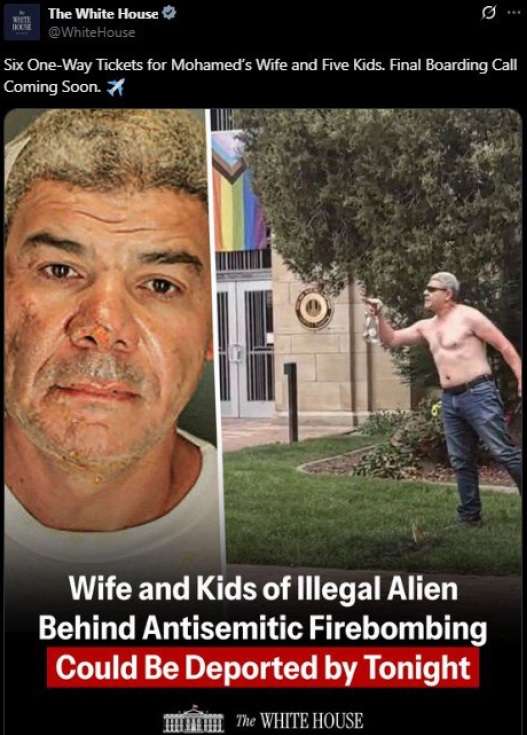
Soliman is the man "charged with a horrific June 1, 2025 antisemitic fire-bombing attack 'against a peaceful gathering of individuals commemorating Israeli hostages.'"
From today's decision by Judge Gordon Gallagher (D. Colo.) in Dvortsin v. Noem:
Ms. El Gamal is the spouse of Mohamed Soliman, a man accused of and charged with a horrific June 1, 2025 antisemitic fire-bombing attack "against a peaceful gathering of individuals commemorating Israeli hostages." This Court is aware that Mr. Soliman was taken into custody on June 1, 2025, at the scene of the attack. At some point on June 3, 2025, immigration authorities detained Ms. El Gamal and her children….
On June 3, 2025, at 2:12 p.m. MDT, the official Twitter/X account for the White House posted an update on the family's detention:
Then, at 2:42 p.m. MDT, the official Twitter/X account for the White House posted a further update:
The Petition alleges that "Ms. El Gamal and her five children—E.S., A.S., H.S., O.S., H.S.—entered the United States with B-1 visitor visas in 2022, have resided continuously in the United States for more than two years, and are therefore not subject to expedited removal.
And the Petition, which attaches a copy of the relevant visa application (D. 2-3 at 2), goes on to state that "Ms. El Gamal is a network engineer with a pending EB-2 visa, available to professionals with advanced degrees. Mr. Soliman filed an asylum application, and Ms. El Gamal and all five children are dependents on that application. The application is still pending." …
Prof. Michael McConnell at the Stanford Law School, a leading constitutional law scholar (and former Tenth Circuit judge), passed this along, and I'm delighted to be able to post it; note that this is about the constitutional objection to the President's actions, not about the particular statutory scheme that's involved or about the wisdom of the actions:
Critics claim that President Trump's use of National Guard troops to quell the violence in Los Angeles over the opposition of the governor is contrary to the Constitution's principles of federalism. This particular line of criticism is mistaken.
This issue was debated at the Constitutional Convention in 1787. The National Guard is the modern form of what the Constitution calls the "militia." The delegates voted to empower Congress to "provide for calling forth the Militia to execute the Laws of the Union, suppress insurrections, and repel invasions," in which case the President would be their Commander in Chief. (Article I, Section 8, Clause 15; Article II, Section 2, Clause 1.) Consent of the state governor is not required. To be sure, Article IV, Section 4 imposes a duty on the United States to protect the States against "domestic Violence" only on application of the state legislature or governor, but the power, as opposed to the duty, of the federal government to use the militia to enforce federal law was not made subject to the will of state authorities.
Some delegates—led by Elbridge Gerry and Luther Martin, both of whom later opposed ratification of the Constitution—took the opposite position, the one now espoused by some critics of President Trump. Luther Martin urged that states be left "to suppress Rebellions themselves." II Farrand 48. Elbridge Gerry, sounding much like Governor Newsom, stated that he was "against letting loose the myrmidons of the U. States on a State without its own consent." Referring to Shay's Rebellion, which was suppressed without federal help, he averred that "[m]ore blood would have been spilt in Massts in the late insurrection, if the Genl. authority had intermeddled." II Farrand 317.
That position was rejected by the majority of the Convention, who adopted instead the provisions quoted above allowing deployment of the militia to enforce federal law and suppress rebellion. Nathaniel Gorham of Massachusetts (who may be little known today but was Chairman of the Convention's Committee of the Whole), best expressed the majority view: "With regard to different parties in a State; as long as they confine their disputes to words they will be harmless to the Genl. Govt. & to each other. If they appeal to the sword it will then be necessary for the Genl. Govt., however difficult it may be to decide on the merits of their contest, to interpose & put an end to it." In other words, peaceful protest is permitted, but when protest spills over into violence, the national government is entitled to intervene. That is the rule today.
Whether President Trump's actions are justified as a matter of prudence may well be debated, but the notion that the Constitution's rules of "federalism" are offended by federal intervention absent gubernatorial request is contradicted by the words and history of the Constitution.
So concludes Guobadia v. Williams, decided Mar. 31 by Judge Mark Cohen (N.D. Ga.):
Plaintiff is an entrepreneur and philanthropist who currently resides in the United Arab Emirates, and is the founder and CEO of SIMCOL Group, an investment company involved in various industries, including energy and hospitality…. Defendant is known for her role on the Real Housewives of Atlanta and large social media presence, which includes 7.7 million followers on Instagram.
Plaintiff and Defendant were married on November 26, 2022, in a widely publicized ceremony. In February 2024, "news broke" that Plaintiff and Defendant "were splitting," an announcement that came after news that Defendant would return to RHOA. On or about July 9, 2024, Defendant published a series of statements about erectile dysfunction ("ED") on her Instagram account.
The first statement was a black background with "ED" written in bold white letters. Defendant's posts continued and provided definitions of ED and details about its symptoms and treatments, including statements such as, "ED can cause stress, affect self-confidence, and contribute to relationship problems," and "it is common for men with ED to feel anger, frustration, sadness, or lack confidence." These statements included the hashtag #MensHealthAwareness.
One of the Orders calls on federal agencies to use the International Holocaust Remembrance Alliance definition, which would label certain criticisms of Israel as anti-Semitic.
From Monday's decision by Judge Douglas Harpool (W.D. Mo.) in McClanahan v. Trump, which I think reaches the correct result:
On December 11, 2019, President Donald Trump issued Executive Order 13899, directing federal agencies to use the International Holocaust Remembrance Alliance ("IHRA") definition of antisemitism in enforcing Title VI of the Civil Rights Act. On January 29, 2025, President Trump issued Executive Order 14188 titled Additional Measures to Combat Anti-Semitism. It states that it shall be the policy of the United States to combat anti-Semitism vigorously, using all available and appropriate legal tools, to prosecute, remove, or otherwise hold to account the perpetrators of unlawful anti-Sematic harassment and violence.
Plaintiff alleges Executive Order 14188 orders the Department of Education and Department of Justice to investigate individuals and institutions critical of Israel and to withhold federal funding from universities that allow such criticisms. Plaintiff alleges that Executive Order 13899 and its expanded enforcement constitute a direct violation of his civil[] rights….
Plaintiff expresses concern that the executive order he challenges calls for the Government to retaliate against those who hold beliefs or express opinions critical of the State of Israel or the Jewish community or religion. If that is how the Government interprets the measure or enforces the measure as so applied is certainly problematic under the First Amendment of our Constitution. [For more on how certain ways of enforcing the IHRA definition can violate the First Amendment, see here and here. -EV]
However, the Court interprets the measure as prioritizing efforts to curtail acts of violence, harassment or discrimination directed toward the Jewish faith and those supportive of the Jewish state rather than to punish those who merely hold opinions critical of these groups. The First Amendment does not protect acts of violence, harassment, or discrimination. In fact, laws long ago enacted prevent acts of violence, harassment and discrimination based on religious beliefs or political opinion. To that extent the Court views the executive orders as a statement of priority or emphasis rather than a change in substantive law.
Monday's decision by Judge Liles Burke (M.D. Ala.) in Boe v. Marshall dealt with whether the defendants should be able to publicly disclose documents that they had obtained in discovery. (The underlying case involves a challenge to Alabama's restrictions on youth gender medicine.) First, the factual background:
The World Professional Association for Transgender Health ("WPATH") touts its guidelines and standards of care for treating transgender children as the product of rigorous science and broad consensus. Given this wide acceptance of what WPATH claims to be reliable evidence, one would think it would be willing and eager to demonstrate as much. It is not….
This case began in 2022 when the Plaintiffs filed their complaint and moved for a preliminary injunction to block enforcement of an Alabama law restricting the use of certain medications in children diagnosed with gender dysphoria. Over the course of three days, the Court heard testimony from multiple expert witnesses who touted WPATH as the leading authority responsible for developing the prevailing guidelines and standards of care for physicians treating children with gender dysphoria. In an affidavit, one of the Plaintiffs' medical experts stated that WPATH "has been recognized as the standard-setting organization for the treatment of gender dysphoria for more than forty years." [Further details omitted. -EV] … In other words, the Plaintiffs and many of the amici believe that WPATH is the preeminent leader in the field of transgender medicine for children.
Unsurprisingly, the Defendants sought discovery from WPATH regarding, among other things, the evidence it used to develop its guidelines and standards of care. But surprisingly, the organization allegedly responsible for creating the benchmark for gender dysphoria treatment was not so keen on turning over the evidence it used to develop that standard. WPATH resisted the Defendants' subpoena at every turn. Given its own characterization of its guidelines and standards, one would expect WPATH to welcome the opportunity to put the supporting evidence on display.
I've known Michael Rosman at the Center for Individual Rights for 30 years; he has litigated many important cases, including with regard to racial preferences, and was one of the lawyers in Grutter v. Bollinger. I'm therefore delighted to pass along his short reaction to Ames v. Ohio Dep't of Youth Services; all the remaining text of the post is Michael's:
In Ames v. Ohio Dept. of Youth Services, the Supreme Court unanimously rejected the "background circumstances" rule that some circuits had applied in Title VII cases when the plaintiff claiming employment discrimination was a member of a "majority" group (like whites). The "background circumstances" rule required such "majority" plaintiffs to present some evidence showing that their employer was the "unusual" employer that discriminated against the majority.
Title VII, the Court held, had one text, that text applied to everyone and, accordingly, the same requirements for proving discrimination applied to everyone. Pretty straightforward, and, in my view, undoubtedly correct. So correct that Ohio did not really bother to defend the "background circumstances" rule.
What I have not read in the aftermath of the opinion, though, is the Court's own role in inspiring this bizarre interpretation, and allowing it to fester as a blot on statutory interpretation and Title VII. Not to mention the Court's less-than-candid discussion of its own responsibility.
The appeal in Ames was from the Sixth Circuit. In its first footnote, the Court noted the other circuits that had adopted the rule: the Seventh, Eighth, Tenth, and D.C. Circuits. It cited cases decided between 1992 and 2004 from those circuits. But, as Justice Thomas's concurrence pointed out, the "background circumstances" requirement was first adopted by the D.C. Circuit in 1981 in a case called Parker v. Baltimore and Ohio Railroad Co. So, for over forty years, majority plaintiffs in at least some jurisdictions had to meet an additional requirement that the Supreme Court unanimously rejected in 2025 in a quick eight-plus page opinion. And the "circuit split" has existed since at least 1999, when the Third Circuit explicitly rejected the "background circumstances" requirement.
This episode features a conversation with Brian Galle, the Agnes Williams Sesquicentennial Professor of Tax Policy at Georgetown University Law Center, an expert on taxation and nonprofits. Galle recently served as a senior fellow in the division of corporation finance at the Securities and Exchange Commission.
He joins us to talk about the proposed tax on university endowments now making its way through Congress. The Republican House Ways & Means Committee issued a press release proclaiming that their bill "holds woke, elite universities that operate like major corporations . . . accountable." The House bill would impose dramatic new taxes on universities, hitting a number of wealthy universities particularly hard.
What is the endowment tax and what is its significance for the future of higher education? The new episode can be found here.
As legislative efforts to limit fossil fuel consumption falter, environmental activists have turned to the courts with increasing frequency and ever-more-expansive legal theories. Some of this litigation relies upon state tort law. Other suits rely upon more innovative arguments.
Several groups have pressed constitutional arguments that the failure to control various forms of pollution violate federal or state constitutional rights. Such arguments have gone nowhere in federal courts (and with good reason), but some have succeeded at the state level. Most notably, the Montana Supreme Court concluded that state citizens have a judicially enforceable right to environmental protection that constrains state-level environmental policies.
In 2023, a group of environmental activists represented by the Center for Biological Diversity filed suit in New Mexico arguing that the state constitution requires greater regulation of the oil and gas industry within the state and the suspension of new oil and gas well permits until the state complied with its constitutional obligations. The suit relied upon a state constitutional provision which provides:
The protection of the state's beautiful and healthful environment is hereby declared to be of fundamental importance to the public interest, health, safety and the general welfare. The legislature shall provide for control of pollution and control of despoilment of the air, water and other natural resources of this state, consistent with the use and development of these resources for the maximum benefit of the people
Last year, in Atencio v. New Mexico, a trial court denied the state's motion to dismiss the suit, prompting an appeal.
Last week, a New Mexico appeals court granted the state's motion to dismiss on the grounds that the plaintiffs failed to state a claim upon which relief may be granted under state law.
The Pacific Legal Foundation and Catholic University Law Review have posted a call for papers for a symposium on "Searching for Constitutional Limits on Environmental and Natural Resources Law." Here is the write-up:
Even in its most flattering light, the modern administrative state coexists uneasily with the core constitutional principle that the federal government possesses only limited enumerated powers, while the States and the people retain the remainder. "The Framers could hardly have envisioned today's vast and varied federal bureaucracy and the authority administrative agencies now hold over our economic, social, and political activities," as famously observed by Chief Justice Roberts.
Nowhere is our contemporary regulatory apparatus more pervasive than in the realm of environmental and natural resources policy. Several prominent statutes—including the Clean Water Act and the Endangered Species Act—routinely reach intra-state and non-commercial activity lacking any apparent nexus with interstate commerce. The federal government, moreover, exercises absolute power over 30% of all land, including 46% of the contiguous eleven western States and 61% of Alaska.
At some point, the growing tension between the Framers' design and modern reality must breach the Constitution's boundaries.
Accordingly, they are seeking "papers that explore the limits of Congress's regulatory authority over environmental and natural resources policy."
Papers will be presented at a symposium in Spring 2026 and published in the Catholic University Law Review. Full details are here.