Prohibiting the distribution of porn to minors, the Court says, legitimately carries with it some burdens on adults as well, when the burdens are closely linked to distinguishing the adults and the minors.
The majority in today's Free Speech Coalition v. Paxton began with the established principle (see Justice Brennan's majority opinion in Ginsberg v. N.Y. (1968)) that certain material may be constitutionally protected for adults but unprotected when distributed to minors:
When regulating minors' access to sexual content, the State may broaden Miller's "definition of obscenity" to cover that which is obscene from a child's perspective. To be more precise, a State may prevent minors from accessing works that (a) taken as a whole, and under contemporary community standards, appeal to the prurient interest of minors; (b) depict or describe specifically defined sexual conduct in a way that is patently offensive for minors; and (c) taken as a whole, lack serious literary, artistic, political, or scientific value for minors. [The Miller definition for what can be prohibited even for adults would omit the italicized text from each prong of the test. -EV] …
The majority acknowledged that any age verification requirements "burden" the rights of adults in some measure—whether of the adult distributors (such as the vendor in Ginsberg) who must check patrons' age, or of adult patrons who have to prove their age. But it concluded that, because the speech was restrictable as to children, sufficiently narrow age verification requirements need not be judged under the highly demanding "strict scrutiny" test:
Age-verification laws like H.B. 1181 fall within States' authority to shield children from sexually explicit content. The First Amendment leaves undisturbed States' traditional power to prevent minors from accessing speech that is obscene from their perspective. That power necessarily includes the power to require proof of age before an individual can access such speech. It follows that no person—adult or child—has a First Amendment right to access speech that is obscene to minors without first submitting proof of age….
Requiring age verification is common when a law draws lines based on age … [citing as examples] proof of age to obtain a handgun license; to register to vote; and to marry. In none of these contexts is the constitutionality of a reasonable, bona fide age-verification requirement disputed.
Obscenity is no exception to the widespread practice of requiring proof of age to exercise age-restricted rights. The New York statute upheld in Ginsberg v. New York (1968) required age verification: It permitted a seller who sold sexual material to a minor to raise "'honest mistake'" as to age as an affirmative defense, but only if the seller had made "'a reasonable bona fide attempt to ascertain the true age of [the] minor.'" Most States to this day also require age verification for in-person purchases of sexual material. And, petitioners concede that an in-person age verification requirement is a "traditional sort of law" that is "almost surely" constitutional.
The facts of Ginsberg illustrate why age verification, as a practical matter, is necessary for an effective prohibition on minors accessing age-inappropriate sexual content. The statute in that case prohibited the knowing sale of sexual content to a minor under the age of 17. The defendant was convicted of knowingly selling a pornographic magazine to a 16-year-old. But, most of the time, it is almost impossible to distinguish a 16-year-old from a 17-year-old by sight alone. Thus, had the seller in Ginsberg not had an obligation to verify the age of the purchaser, he likely could have avoided liability simply by asserting ignorance as to the purchaser's age. Only an age-verification requirement can ensure compliance with an age-based restriction.
The Supreme Court may have reached the wrong result in FCC v. Consumers Research. But ruling emphasizes there are significant constitutional limits to legislative delegation to the executive.
In today's Supreme Court ruling in FCC v. Consumers' Research, a 6-3 majority upheld the Federal Communications Commission's authority to impose levies on telecommunications carriers to support a "Universal Service Fund" intended to subsidize telecommunications services for low-income consumers, people in rural areas, and some others who might not otherwise get them. The Court rejected the argument that the 1996 law authorizing this levy violates the nondelegation doctrine, which constrains delegation of legislative power to the executive. But, in the process, the majority also emphasizes important constitutional limits on delegation.
Importantly, Justice Elena Kagan's majority opinion emphasizes that a delegation of "boundless power" to impose fees would be unconstitutional. The majority upholds the universal service fee only because they conclude that the 1996 statute authorizing it imposes a variety of mandatory constraints on the FCC's discretion, including imposing both a "floor" and a "ceiling" on how much money can be raised, and what purposes it can be used for:
Consumers' Research argues that, even under our usual nondelegation test, the term "sufficient" does not do enough. That is because, in the Consumers' Research view, it sets only "a floor—not a ceiling—on the FCC's revenue-raising power…." Or to put the point differently, Consumers' Research thinks that the statute gives the FCC power, all on its own, to raise our hypothetical $5 trillion. And not unreasonably, it thinks that would pose a constitutional problem.
But in fact the word "sufficient" sets a floor and a ceiling alike. An amount of money is "sufficient" for a purpose if it is "[a]dequate" or "necessary" to achieve that purpose. Black's Law Dictionary 1447 (7th ed. 1999). That means, of course, that the FCC cannot raise less than is adequate or necessary to finance the universal-service programs Congress wants. But it also means that the FCC cannot raise more than that amount. Were the FCC to raise, say, twice as much as needed, the revenue would not be "sufficient" but instead excessive.
Elsewhere in the majority opinion, Justice Kagan points out that even a strict ceiling is not, by itself, enough to avoid nondelegation problems, if it leaves the executive with sweeping, effectively unconstrained authority:
[A] greater problem inheres in the shared position of Consumers' Research and the dissent: Whatever it applies to (just taxes or fees as well), its focus on numeric limits produces absurd results, divorced from any reasonable understanding of constitutional values. Under that view, a revenue-raising statute containing non-numeric, qualitative standards can never pass muster, no matter how much guidance those standards provide and how tight the constraints they impose. But a revenue-raising statute with a numeric limit will always pass muster, even if it effectively leaves an agency with boundless power. Consider a hypothetical raised at oral argument: Congress tells the FCC it can demand payments from carriers of any amount it wants up to $5 trillion. (The actual cost of universal service is, of course, a tiny fraction of that amount.) According to Consumers' Research, that statute is permissible because . . . well, because Congress has set the $5 trillion figure…. But so what? The purpose of the nondelegation doctrine is to enforce limits on the "degree of policy judgment that can be left to those executing or applying the law." Mistretta v. United States, 488 U. S. 361, 416 (1989) (Scalia, J., dissenting). The anywhere-up-to-$5-trillion tax statute would not do that, whereas a statute with qualitative limits well might.
In other words, nondelegation requires significant constraints on the "degree of policy judgment that can be left to those executing or applying the law." A seeming limitation that fails to do that is not enough!
These points put at least some real teeth into the Court's problematic "intelligible principle" standard for assessing nondelegation. It can no longer be argued that virtually anything will pass muster. In a concurring opinion, Justice Brett Kavanaugh likewise emphasizes "the intelligible principle test is not toothless," though he also notes that the scope of nondelegation constraints is narrower in "the national security and foreign policy realms."
Under Trump's interpretation of IEEPA, there is neither a floor nor a ceiling to the amount of tariffs he can impose under that legislation. And there are also no enforceable limits to the administration's exercise of "policy judgment" under that law. IEEPA can only be invoked in the event of a "national emergency" that is an "unusual and extraordinary threat" to the US economy or national security. But the administration claims all determinations of what qualifies as a "national emergency" or an "unusual and extraordinary threat" are left to the president's unreviewable discretion. That sure seems like a claim to "boundless authority" to me! And the Court's decision in Consumers Research seems to bar such things.
In his dissenting opinion, Justice Neil Gorsuch argues that the majority misinterprets the relevant law here, and also that laws imposing taxes are subject to tighter nondelegation constraints than other powers. He may well be right on both points, especially the former.
But the majority decision is still a potentially valuable resource to those of us who want strong enforcement of nondelegation doctrine. Gorsuch himself notes that, even though the Court upheld this particular delegation, it "also signals, unmistakably, that there are some abdications of congressional authority, including in the very statute before us, that the present majority isn't prepared to stomach."
I explained why strong enforcement of nondelegation is necessary and valuable in an article published in Just Security, just yesterday.
UPDATE: It's worth nothing that the majority opinion also states that the degree of "guidance" required from Congress "is greater…. when an agency action will affect the entire national economy than when it addresses a narrow, technical issue" [internal quotation omitted]. This suggests stronger nondelegation constraints in situations where the executive claims broad, sweeping powers, which is certainly relevant to the IEEPA tariff situation.
"Strict scrutiny is unforgiving because it is the standard for reviewing the direct targeting of fully protected speech.... [A]s a practical matter, it is fatal in fact absent truly extraordinary circumstances."
Today's majority upholds an age verification requirement for online porn, which is of course the more speech-restrictive option in this case. And it upholds the law by concluding that the "strict scrutiny" test—which the Court generally uses to evaluate content-based restrictions on speech that falls outside the First Amendment exceptions—doesn't apply to such age verification rules. (More on that later, but basically the Court concludes that the long-recognized First Amendment exception for distributing to minors material that's obscene as to them also justifies some burdens on adults, when the burdens are limited to age verification requirements.)
But in the process, the majority reaffirms just how demanding the "strict scrutiny" test is in the wide range of situations where it does apply. Indeed, the majority's definition of strict scrutiny appears to be slightly narrower but slightly (or maybe even significantly) stronger than the dissent's. As a First Amendment lawyer, I'll likely be citing the majority's passage a lot in cases where I'm challenging content-based speech restrictions:
Strict scrutiny—which requires a restriction to be the least restrictive means of achieving a compelling governmental interest—is "the most demanding test known to constitutional law." In the First Amendment context, we have held only once that a law triggered but satisfied strict scrutiny—to uphold a federal statute that prohibited knowingly providing material support to a foreign terrorist organization. See Holder v. Humanitarian Law Project (2010). That case involved an unusual application of strict scrutiny, since our analysis relied on the "deference" due to the Executive's "evaluation of the facts" in the context of "national security and foreign affairs."
I write separately to express my skepticism that the private nondelegation doctrine—which purports to bar the Government from delegating authority to private actors—is a viable and independent doctrine in the first place. Nothing in the text of the Constitution appears to support a per se rule barring private delegations. And recent scholarship highlights a similar lack of support for the doctrine in our history and precedents. See, e.g., A. Volokh, The Myth of the Federal Private Nondelegation Doctrine, 99 Notre Dame L. Rev. 203 (2023).
But I also wanted to note that the amicus brief that I wrote for the Reason Foundation (which publishes Reason Magazine and hosts this blog, and where I worked for four years before grad school, from 1994 to 1998) also got quoted twice, in Justice Gorsuch's dissent. Here's what Justice Gorsuch has to say on the matter, in his footnote 6:
Before proceeding further, note some of the questions this case does not present. . . . Second, the Administrative Company's directors overwhelmingly represent entities with a financial stake in expanding universal service: those who benefit from universal-service programs (like schools and hospitals) and those who get paid to supply the benefits (the carriers). See Part I–B–2, supra. Some amici suggest that seemingly conflicted arrangement may offend the Fifth Amendment's Due Process Clause. See, e.g., Brief for Reason Foundation as Amicus Curiae 18–23. But neither the court of appeals nor respondents took up that argument. See 109 F. 4th, at 768, n. 14. Third, one might ask whether the Administrative Company's leaders qualify as officers of the United States and, if so, whether their role complies with the Appointments Clause, U. S. Const., Art. II, §2, cl. 2. See Brief for Reason Foundation as Amicus Curiae 13–18. But, again, neither the court of appeals nor the parties addressed those questions.
At first glance, this may seem unimpressive, because Justice Gorsuch is just listing issues we flagged which weren't part of the case because the appellate court didn't rule on them. But that was precisely the challenge: our view was that (1) the private nondelegation doctrine doesn't exist so they shouldn't strike down this arrangement on that ground, but (2) the arrangement really is problematic on various other grounds (like Due Process or the Appointments Clause) that unfortunately aren't part of the case. We suggested various ways that the Court could get around this problem, and one of them was to "reject both the public and private nondelegation challenges, note that there are plausible Due Process and Appointments Clause arguments that remain open, and leave those arguments for another day." That's more or less what the Court did (except that noting the problems was left to Justice Gorsuch's dissent), so I declare victory!
One final note: the Supreme Court has been sitting on a cert petition in the horseracing case, presumably pending its decision in Consumers' Research. I also wrote an amicus brief in that case for Reason Foundation and Goldwater Institute, raising many of the same issues as in Consumers' Research. Now we'll have to see what they do with the horseracing case (GVR, maybe?). The horseracing cases (along with a number of other cases where I have an interest) were rescheduled to yesterday's conference, but the orders in those cases haven't come out yet.
Again, the link to the Supreme Court opinion is here, the link to my Notre Dame Law Review article is here, the link to my Reason Foundation amicus brief in Consumers' Research is here, and the link to my Reason/Goldwater horseracing case amicus brief is here.
Today's Supreme Court ruling barring nationwide injunctions could empower the federal government to engage in large-scale violations of the Constitution. Exactly how bad the consequences will be depends on the extent to which other remedies can be used to forestall them.
Today's 6-3 Supreme Court decision in Trump v. CASA, Inc. barring nationwide injunctions is a grave mistake. It risks allowing the executive to engage in large-scale violations of constitutional rights, potentially in perpetuity. Exactly how bad it is depends on the extent to which other remedies might fill the gap left by the elimination of nationwide injunctions.
Universal injunctions are judicial orders that bar illegal conduct by the defendants with respect to everyone who might be victimized by it, not just the specific parties to the case. The majority opinion authored by Justice Amy Coney Barrett concludes that the "equity" jurisdiction created by the Judiciary Act of 1789 does not include universal injunctions or anything sufficiently analogous to allow them:
The Judiciary Act of 1789 endowed federal courts with jurisdiction over "all suits . . . in equity," §11, 1 Stat. 78, and still today, this statute "is what authorizes the federal courts to issue equitable remedies," S. Bray & E. Sherwin, Remedies 442 (4th ed. 2024). Though flexible, this equitable authority is not freewheeling. We have held that the statutory grant encompasses only those sorts of equitable remedies "traditionally accorded by courts of equity" at our country's inception. Grupo Mexicano de Desarrollo, S. A. v. Alliance Bond Fund, Inc., 527 U. S. 308, 319 (1999)….
We must therefore ask whether universal injunctions are sufficiently "analogous" to the relief issued " 'by the High Court of Chancery in England at the time of the adoption of the Constitution and the enactment of the original Judiciary Act.' " Grupo Mexicano, 527 U. S., at 318–319….
The answer is no: Neither the universal injunction nor any analogous form of relief was available in the High Court of Chancery in England at the time of the founding. Equity offered a mechanism for the Crown "to secure justice where it would not be secured by the ordinary and existing processes of law." G. Adams, The Origin of English Equity, 16 Colum. L. Rev. 87, 91 (1916). This "judicial prerogative of the King" thus extended to "those causes which the ordinary judges were incapable of determining." 1 J. Pomeroy, Equity Jurisprudence §31, p. 27 (1881). Eventually, the Crown instituted the "practice of delegating the cases" that "came before" the judicial prerogative "to the chancellor for his sole decision." Id., §34, at 28. This "became the common mode of dealing with such controversies….
Nor did founding-era courts of equity in the United States chart a different course…. If anything, the approach traditionally taken by federal courts cuts against the existence of such a sweeping remedy. Consider Scott v. Donald, where the plaintiff successfully challenged the constitutionality of a law on which state officials had relied to confiscate alcohol that the plaintiff kept for personal use. See 165 U. S. 107, 109 (1897) (statement of case); id., at 111–112 (opinion of the Court). Although the plaintiff sought an injunction barring enforcement of the law against both himself and anyone else "whose rights [were] infringed and threatened" by it, this Court permitted only a narrower decree between "the parties named as plaintiff and defendants in the bill."
The principal dissent by Justice Sotomayor argues at length that universal injunctions are, in fact, deeply rooted in history and closely analogous to Founding-era remedies, such as "bills of peace." I think she may have the better of the debate. But both sides make some good points, and this is a question I must leave to those with greater relevant expertise. In any event, I do not believe the case should turn on the resolution of this hypertechnical issue, but rather should be decided based on much more fundamental principles.
The real heart of the matter here is not the technical debate about historical analogies, but a core principle of constitutional government: the state must not be allowed to engage in large-scale systematic violations of the Constitution, especially when it comes to basic constitutional rights, like the birthright citizenship rights at issue in this case. And courts must be able to impose the remedies necessary to prevent that. That principle is vastly more important than any historical details about the exact nature of remedies available British courts in 1789.
It is particularly ironic that the majority allows British precedents about remedies to undercut this principle. America fought the Revolutionary War to be free of arbitrary government power of the sort often wielded by the British monarchy. And part of the purpose of having a written Constitution (as opposed to Britain's hodgepodge of traditions and potentially revocable statutory rights) is to impose binding constraints on government power that cannot be evaded.
Justice Sotomayor puts it well in this passage from her dissent:
The Court's decision is nothing less than an open invitation for the Government to bypass the Constitution. The Executive Branch can now enforce policies that flout settled law and violate countless individuals' constitutional rights, and the federal courts will be hamstrung to stop its actions fully. Until the day that every affected person manages to become party to a lawsuit and secures for himself injunctive relief, the Government may act lawlessly indefinitely.
In a separate dissent Justice Ketanji Brown Jackson makes some additional relevant points:
It is important to recognize that the Executive's bid to vanquish so-called "universal injunctions" is, at bottom, a request for this Court's permission to engage in unlawful behavior. When the Government says "do not allow the lower courts to enjoin executive action universally as a remedy for unconstitutional conduct," what it is actually saying is that the Executive wants to continue doing something that a court has determined violates the Constitution - please allow this. That is some solicitation. With its ruling today, the majority largely grants the Government's wish. But, in my view, if this country is going to persist as a Nation of laws and not men, the Judiciary has no choice but to deny it.
Stated simply, what it means to have a system of government that is bounded by law is that everyone is constrained by the law, no exceptions. And for that to actually happen, courts must have the power to order everyone (including the Executive) to follow the law—full stop. To conclude otherwise is to endorse the creation of a zone of lawlessness within which the Executive has the prerogative to take or leave the law as it wishes, and where individuals who would otherwise be entitled to the law's protection become subject to the Executive's whims instead.
Later in her opinion she notes that this "zone of lawlessness" is likely to be particularly dangerous for victims of illegal action who are not well-positioned to bring lawsuits:
[T]he law-free zone that results from this Court's near elimination of universal injunctions is not an unfamiliar archetype. Also eerily echoing history's horrors is the fact that today's prerogative zone is unlikely to impact the public in a randomly distributed manner. Those in the good graces of the Executive have nothing to fear; the new prerogative that the Executive has to act unlawfully will not be exercised with respect to them. Those who accede to the Executive's demands, too, will be in the clear. The wealthy and the well connected will have little difficulty securing legal representation, going to court, and obtaining injunctive relief in their own name if the Executive violates their rights.
Consequently, the zone of lawlessness the majority has now authorized will disproportionately impact the poor, the uneducated, and the unpopular—i.e., those who may not have the wherewithal to lawyer up, and will all too often find themselves beholden to the Executive's whims.
I made similar points - much less eloquently - in an earlier post defending nationwide injunctions. As I noted there, the impact may be especially grave in situations where the government's illegal actions harm large numbers of people - in this case hundreds of thousands of children born every year, denied birthright citizenship, and thereby potentially subject to deportation. When the number of victims is that large, it is likely to be difficult or impossible for all of them to bring individual lawsuits.
The majority does leave open three potential paths for plaintiffs in this and other cases to secure broad relief. First, "complete relief" for parties to the case sometimes requires remedies that protect many others, too, especially in situations where policies affect people in interconnected ways. Second, victims can still file class actions. Whether that is possible will vary a lot from case to case, depending whether those harmed by an illegal policy in question can meet various class certification requirements.
Finally, state government plaintiffs can potentially secure broad remedies. As the majority recognizes, that might potentially involve not only a complete ban on the relevant illegal conduct with the plaintiff states' territory, but also a nationwide ban if that is the only way to prevent harm to the plaintiffs:
As the States see it, their harms—financial injuries and the administrative burdens flowing from citizen-dependent benefits programs—cannot be remedied without a blanket ban on the enforcement of the Executive Order…. Children often move across state lines or are born outside their parents' State of residence…. Given the cross-border flow, the States say, a "patchwork injunction" would prove unworkable, because it would require them to track and verify the immigration status of the parents of every child, along with the birth State of every child for whom they provide certain federally funded benefits.
The Court did not, however, rule on how broad a remedy the states are entitled to, or even address the issue of whether the states have standing to sue over this issue, at all. Those questions are - at least for the moment - left to the lower courts to determine.
The same goes for the underlying substantive issue of whether children of undocumented immigrants and those here on temporary visas are entitled to birthright citizenship under the Fourteenth Amendment. The majority did not resolve that issue, in large part because the Trump Administration (probably expecting to lose on it) did not ask them to do so.
Finally, Congress could potentially enact a new law authorizing nationwide injunctions. As I read it, the majority decision does not preclude this. It doesn't hold that nationwide injunctions are unconstitutional, but merely that they are not authorized by current law.
There is more to be said about the 119 pages of majority, concurring, and dissenting opinions. But this post is already very long, so I will stop for now.
In sum, today's decision is badly wrong, and could have terrible consequences. Exactly how terrible depends on the extent to which class actions, remedies for "complete relief" for the parties, and lawsuits brought by states, can fill the void left by the demise of nationwide injunctions.
To account for that concession in its analysis—and yet avoid strict scrutiny, as it wishes—the majority relies on a well-known distinction in First Amendment law between direct and incidental restrictions on speech. See (sorry) E. Kagan, Private Speech, Public Purpose: The Role of Governmental Motive in First Amendment Doctrine, 63 U. Chi. L. Rev. 413, 491–505 (1996).
Then-Professor Kagan's article is quite a legit cite here, by the way; it was an important and heavily cited work even before the author became a Justice.
Age-verification laws like H. B. 1181 fall within States' authority to shield children from sexually explicit content. The First Amendment leaves undisturbed States' traditional power to prevent minors from accessing speech that is obscene from their perspective. Ginsbergv. New York (1968). That power necessarily includes the power to require proof of age before an individual can access such speech. It follows that no person—adult or child—has a First Amendment right to access speech that is obscene to minors without first submitting proof of age.
The power to verify age is a necessary component of the power to prevent children's access to content that is obscene from their perspective. "No axiom is more clearly established in law, or in reason, than that … wherever a general power to do a thing is given, every particular power necessary for doing it is included." The Federalist No. 44 (J. Madison). Hence, where the Constitution reserves a power to the States, it also reserves "the ordinary and appropriate means" of exercising that power. J. Story, Commentaries on the Constitution of the United States (1833). For example, in the Eighth Amendment context we have explained that, because "capital punishment is constitutional, … 'there must be a constitutional means of carrying it out.'" Similarly, because the First Amendment permits States to prohibit minors from accessing speech that is obscene to them, it likewise permits States to employ the ordinary and appropriate means of enforcing such a prohibition. Requiring proof of age to access that speech is one such means.
Requiring age verification is common when a law draws lines based on age…. Fundamental rights that turn on age are no different. Texas, again like many States, requires proof of age to obtain a handgun license; to register to vote; and to marry. In none of these contexts is the constitutionality of a reasonable, bona fide age-verification requirement disputed. See New York State Rifle & Pistol Assn., Inc. v. Bruen n. 9 (2022) [guns]; Crawford v. Marion County Election Bd. (2008) (opinion of Stevens, J.) [voting]; Zablocki v. Redhail (1978) [marriage].
Now that the Supreme Court has issued its final opinion of the term, we can see which justices wrote the most, and which wrote the least.
Majority opinion assignments were fairly uniform: All of the justices had six or seven opinions for the Court, save for the most junior justice, Justice Jackson, who had five.
The Chief Justice did not write any signed opinions other than his six opinions for the Court, but I assume this was due (in part) to his writing the lion's share of the Court's per curiam opinions (there were six, not including shadow docket orders).
Justice Thomas wrote the most signed opinions -- a whopping twenty-eight -- including eight dissents. Justice Jackson was the most frequent dissenter, however, authoring nine. Justice Kavanaugh only wrote two dissents.
Most interesting to me, however, is that Justice Kagan only wrote ten opinions this term -- six opinions for the Court and four dissents. One possible explanation for this is that she was doing more work behind the scenes, or that she was more active writing memos or even opinions related to shadow docket orders. Justice Barrett had the next fewest number of opinions -- fourteen -- seven of which were opinions for the Court (including Trump v. CASA) and four dissents.
Justice Barrett's opinion for the Court in Trump v. CASA responds forcefully to Justice Jackson's solo dissent, in what is likely the most pointed language we have seen from Justice Barrett since she joined the Court. Here is the relevant portion of her opinion.
The principal dissent focuses on conventional legal terrain, like the Judiciary Act of 1789 and our cases on equity. JUSTICE JACKSON, however, chooses a startling line of attack that is tethered neither to these sources nor, frankly, to any doctrine whatsoever. Waving away attention to the limits on judicial power as a "mind-numbingly technical query," post, at 3 (dissenting opinion), she offers a vision of the judicial role that would make even the most ardent defender of judicial supremacy blush. In her telling, the fundamental role of courts is to "order everyone (including the Executive) to follow the law—full stop." Post, at 2; see also post, at 10 ("[T]he function of the courts—both in theory and in practice—necessarily includes announcing what the law requires in . . . suits for the benefit of all who are protected by the Constitution, not merely doling out relief to injured private parties"); see also post, at 11, n. 3, 15. And, she warns, if courts lack the power to "require the Executive to adhere to law universally," post, at 15, courts will leave a "gash in the basic tenets of our founding charter that could turn out to be a mortal wound," post, at 12.
Rhetoric aside, JUSTICE JACKSON's position is difficult to pin down. She might be arguing that universal injunctions are appropriate—even required—whenever the defendant is part of the Executive Branch. See, e.g., post, at 3, 10–12, 16–18. If so, her position goes far beyond the mainstream defense of universal injunctions. See, e.g., Frost, 93 N. Y. U. L. Rev., at 1069 ("Nationwide injunctions comewith significant costs and should never be the default remedy in cases challenging federal executive action"). As best we can tell, though, her argument is more extreme still, because its logic does not depend on the entry of a universal injunction: JUSTICE JACKSON appears to believe that the reasoning behind any court order demands "universal adherence," at least where the Executive is concerned. Post, at 2 (dissenting opinion). In her law-declaring vision of the judicial function, a district court's opinion is not just persuasive, but has the legal force of a judgment. But see Haaland v. Brackeen, 599 U. S. 255, 294 (2023) ("It is a federal court's judgment, not its opinion, that remedies an injury"). Once a single district court deems executive conduct unlawful, it has stated what the law requires. And the Executive must conform to that view, ceasing its enforcement of the law against anyone, anywhere. 17
FN17 Think about what this position means. If a judge in the District of Alaska holds that a criminal statute is unconstitutional, can the United States prosecute a defendant under that statute in the District of Maryland? Perhaps JUSTICE JACKSON would instinctively say yes; it is hard to imagine anyone saying no. But why, on JUSTICE JACKSON's logic, does it not violate the rule of law for the Executive to initiate a prosecution elsewhere? See post, at 2 (dissenting opinion). Among its many problems, JUSTICE JACKSON's view is at odds with our system of divided judicial authority. See, e.g., this Court's Rule 10(a) (identifying conflict in the decisions of the courts of appeals as grounds for granting certiorari). It is also in considerable tension with the reality that district court opinions lack precedential force even vis-à-vis other judges in the same judicial district. See Camreta v. Greene, 563 U. S. 692, 709, n. 7 (2011).
We will not dwell on JUSTICE JACKSON's argument, which is at odds with more than two centuries' worth of precedent, not to mention the Constitution itself. We observe only this: JUSTICE JACKSON decries an imperial Executive while embracing an imperial Judiciary.
No one disputes that the Executive has a duty to follow the law. But the Judiciary does not have unbridled authority to enforce this obligation—in fact, sometimes the law prohibits the Judiciary from doing so. See, e.g., Marbury v. Madison, 1 Cranch 137 (1803) (concluding that James Madison had violated the law but holding that the Court lacked jurisdiction to issue a writ of mandamus ordering him to follow it). But see post, at 15 (JACKSON, J., dissenting) ("If courts do not have the authority to require the Executive to adhere to law universally, . . . compliance with law sometimes becomes a matter of Executive prerogative"). Observing the limits on judicial authority—including, as relevant here, the boundaries of the Judiciary Act of 1789—is required by a judge's oath to follow the law.
JUSTICE JACKSON skips over that part. Because analyzing the governing statute involves boring "legalese," post, at 3, she seeks to answer "a far more basic question of enormous practical significance: May a federal court in the United States of America order the Executive to follow the law?" Ibid. In other words, it is unnecessary to consider whether Congress has constrained the Judiciary; what matters is how the Judiciary may constrain the Executive. JUSTICE JACKSON would do well to heed her own admonition: "[E]veryone, from the President on down, is bound by law." Ibid. That goes for judges too.
Respondents in this case have challenged the Federal Communications Commission's universal-service program under both the traditional nondelegation doctrine and the private nondelegation doctrine. The Court properly rejects both challenges today, and I join the Court's opinion in full. I write separately to express my skepticism that the private nondelegation doctrine—which purports to bar the Government from delegating authority to private actors—is a viable and independent doctrine in the first place. Nothing in the text of the Constitution appears to support a per se rule barring private delegations. And recent scholarship highlights a similar lack of support for the doctrine in our history and precedents. See, e.g., A. Volokh, The Myth of the Federal Private Nondelegation Doctrine, 99 Notre Dame L. Rev. 203 (2023).
in a major decision this morning, the Supreme Court has put the kibosh on the growing practice of issuing universal injunctions. In a 6-3 decision by Justice Amy Coney Barrett (the former civil procedure professor, natch), the Court grants the Trump Administration's request to narrow the injunction in Trump v. CASA (the Birthright Citizenship case). [Note, however, the opinion says nothing about the merits of the Trump Administration's position on birthright citizenship.]
The Court split on ideological lines. .Justice Thomas concurred (joined by Justice Gorsuch); Justice Alito concurred (joined by Justice Thomas), Justice Kavanaugh concurred. Justice Sotomayor dissented (joined by Justices Kagan and Jackson), and Jackson wrote a separate dissent (to which the majority replies quite forcefully).
a dissenting opinion.
Justice Barrett's decision for the Court begins:
The United States has filed three emergency applications challenging the scope of a federal court's authority to enjoin Government officials from enforcing an executive order. Traditionally, courts issued injunctions prohibiting executive officials from enforcing a challenged law or policy only against the plaintiffs in the lawsuit. The injunctions before us today reflect a more recent development: district courts asserting the power to prohibit enforcement of a law or policy against anyone. These injunctions—known as "universal injunctions"—likely exceed the equitable authority that Congress has granted to federal courts.1 We therefore grant the Government's applications to partially stay the injunctions entered below.
Justice Barrett explains the core of the rationale:
The Government is likely to succeed on the merits of its argument regarding the scope of relief. See Nken v. Holder, 556 U. S. 418, 434 (2009) (holding that for a stay application to be granted, the applicant must make "'a strong showing that [it] is likely to succeed on the merits'"). A universal injunction can be justified only as an exercise of equitable authority, yet Congress has granted federal courts no such power.
The Judiciary Act of 1789 endowed federal courts with jurisdiction over "all suits . . . in equity," §11, 1 Stat. 78, and still today, this statute "is what authorizes the federal courts to issue equitable remedies," S. Bray & E. Sherwin, Remedies 442 (4th ed. 2024). Though flexible, this equitable authority is not freewheeling. We have held that the statutory grant encompasses only those sorts of equitable remedies "traditionally accorded by courts of equity" at our country's inception. . . . We must therefore ask whether universal injunctions are sufficiently "analogous" to the relief issued "'by the High Court of Chancery in England at the time of the adoption of the Constitution and the enactment of the original Judiciary Act.'" . . .
The answer is no: Neither the universal injunction nor any analogous form of relief was available in the High Court of Chancery in England at the time of the founding.
Equity offered a mechanism for the Crown "to secure justice where it would not be secured by the ordinary and existing processes of law."
The opinion closes, explaining the relief offered:
Some say that the universal injunction "give[s] the Judiciary a powerful tool to check the Executive Branch." Trump, 585 U. S., at 720 (THOMAS, J., concurring) (citing S.Amdur & D. Hausman, Nationwide Injunctions and Nationwide Harm, 131 Harv. L. Rev. Forum 49, 51, 54 (2017); S. Malveaux, Class Actions, Civil Rights, and the National Injunction, 131 Harv. L. Rev. Forum, 56, 57, 60–62 (2017)). But federal courts do not exercise general oversight of the Executive Branch; they resolve cases and controversies consistent with the authority Congress has given them. When a court concludes that the Executive Branch has acted unlawfully, the answer is not for the court to exceed its power, too.
The Government's applications to partially stay the preliminary injunctions are granted, but only to the extent that the injunctions are broader than necessary to provide complete relief to each plaintiff with standing to sue. The lower courts shall move expeditiously to ensure that, with respect to each plaintiff, the injunctions comport with this rule and otherwise comply with principles of equity. The injunctions are also stayed to the extent that they prohibit executive agencies from developing and issuing public guidance about the Executive's plans to implement the Executive Order. Consistent with the Solicitor General's representation, §2 of the Executive Order shall not take effect until 30 days after the date of this opinion. See Tr. of Oral Arg. 55.
Check back to the blog for more on this important case, including how it jibes with theories that Justice Barrett is drifting or lacks "courage."
In his complaint, Plaintiff seeks relief under Title IX and other theories following his suspension from the Carle Illinois College of Medicine at the University of Illinois Urbana Champaign following the University's determination that he was responsible for a sexual assault. At the outset of this litigation, the Court granted Plaintiff's unopposed motion to proceed under a pseudonym. The Court entered a Protective Order which provided that Plaintiff would pursue this litigation under the pseudonym "John Doe" and that the parties would refer to Plaintiff's ex-girlfriend as "Jane Roe."
On December 11, 2024, following the Seventh Circuit's decisions in Doe v. Trustees of Indiana University, 101 F.4th 485 (7th Cir. 2024) and Doe v. Loyola University Chicago, 100 F.4th 910 (7th Cir. 2024), Defendant Board of Trustees of the University of Illinois … moved for reconsideration of the Order granting Plaintiff's motion to proceed under a pseudonym, which Plaintiff and non-party Jane Roe oppose….
A unique issue presented in this case is that Plaintiff was found responsible for sexual misconduct and, on a different occasion, after filing a complaint against Jane Roe, Plaintiff also was found to be a victim of sexual misconduct perpetrated by Roe. Roe disputes the allegations against her while also contending the process was unfair to her. She also states that her sanction was to write a paper and remain on probation for one year, after which her record was cleared of misconduct.
While the Court presumes that greater confidentiality protections are warranted for sexual misconduct victims as the Seventh Circuit suggested, see Loyola University, the Court concludes that anonymity on that basis does not extend to Plaintiff here because his complaint focuses on what he alleges were improper and unfair proceedings which resulted in a finding that he was responsible for sexual misconduct, thereby leading to his dismissal from the University. This case does not concern the allegations made by John Doe against Jane Roe. {For the same reason, to the extent that Jane Roe bases her opposition to disclosing Plaintiff's identity on the fact that this litigation includes allegations about Roe's alleged conduct toward Doe with which she disputes and claims are false, the Court is not considering any argument by Roe that Doe's identity should not be disclosed on that basis.}
The Court will turn to whether the disclosure of Plaintiff's real name in this case would allow others to identify Jane Roe….
Jerry is the managing partner of the Girley Law Firm, and Brooke, who is Jerry's daughter, holds an "of counsel" position at the firm. In 2021, Jerry represented Baiywo Rop in a civil lawsuit against Adventist Health System before the Ninth Judicial Circuit. Rop, a native of Kenya, alleged that Adventist Health wrongfully terminated him from its residency program due to discrimination based on race, national origin, and disability. The complaint also alleged retaliation. After Jerry presented Rop's case in chief, Adventist Health moved for directed verdict on all claims. The presiding judge, Judge Kevin Weiss, granted Adventist Health's motion on Rop's claims of discrimination based on national origin and disability. However, he reserved ruling on Rop's claims of discrimination based on race and retaliation.
At the conclusion of the trial, the jury returned a verdict in favor of Rop, finding that he proved that his race was a motivating factor in the decision to terminate him, and awarded him compensatory damages in the amount of $2.75 million. After the jury's verdict, Judge Weiss ruled on Adventist Health's earlier motion for directed verdict based on the racial discrimination claim and entered a directed verdict in favor of Adventist Health, finding that Rop failed to prove a prima facie case of unlawful discrimination based on race under the Florida Civil Rights Act. {Judge Weiss's order cited a decision in which this Court recognized the practice of reserving ruling on motions for directed verdict until after the jury returns a verdict … in order to avoid the need for a costly new trial in case of a reversal on appeal ….}
After the trial court entered its Order on Directed Verdicts, Brooke reposted on her social media the following posts by her brother Brian Girley, who handles social media for the firm: "Today in Orlando Florida a white Judge stole justice from a black doctor. After being awarded by a jury $2.75 million for discrimination a judge reversed their verdict. We need help getting this out," and "The Girley Law Firm won a case against @AdventHealth where a jury found that they had discriminated against a black doctor and awarded him $2.75 million. Today a white judge stole justice from him. This needs attention!" Brooke posted a picture of Judge Weiss with the message that "a white judge stole justice from a black doctor."
In the days following the trial, Brooke made several comments on social media regarding Judge Weiss and the Rop case, such as "[t]his is an injustice. One judge shouldn't be able to overturn a jury verdict," and "the judge did this own [sic] his on [sic] too. No one filed any post-trial motions." Brooke further stated: "I don't believe he had the authority to make this ruling and we need to hold him accountable." In other posts, Brooke commented, "[s]ounds like he needs to be investigated. #RemoveJudgeWeiss," and "[t]he court system is a sham!"
She also stated in one post that "[t]he Dres [sic] Scott rule still applies in 2021: 'A black man has no rights which a white man is bound to respect.' Y'all, we can't let this stand. #RemoveJudgeWeiss." In another post, Brooke posted a message claiming that "[e]ven when we win, it only takes one white judge to reverse our victory…. This is an injustice and cannot stand." Brooke also posted about organizing a protest rally to "bring attention to fact [sic] that judges are allowed to overturned [sic] jury verdicts and erode our civil rights."
From today's decision by Judge William Stickman IV (W.D. Pa.) in Jakes v. Youngblood(note that the lawyer, Tyrone Blackburn, "was arrested Wednesday and accused of hitting a process server with his car in New York City," in seemingly an otherwise unrelated matter [NBC News, Marlene Lenthang]):
Defendant Duane Youngblood ("Youngblood") filed a Notice of Motion to Dismiss, a supporting brief, and a reply brief requesting the dismissal of Plaintiff Thomas Dexter Jakes' ("Jakes") complaint with prejudice. Youngblood is represented by Attorney Tyrone A. Blackburn ("Blackburn"), the signatory of the motion and briefs…. While reviewing Blackburn's briefs, the Court became aware of the fact that they contain wholly fabricated quotations from caselaw—including fabricated quotations from the Court's own prior opinion. In addition to including non-existent quotations, the briefs repeatedly misrepresent case law.
Jakes also noticed the issues with Youngblood's brief and addressed them in his brief opposing Youngblood's motion to dismiss. In his reply, Blackburn failed to offer any explanation for the deficiencies and fabrications in his brief. Instead, he brazenly attempted to mount a tu quoque defense, asserting that "a LexisNexis Document Analysis of Plaintiff's own opposition brief reveals a pattern of misquotation, superficial citation, and invocation of authorities that are either inapposite or do not support the propositions for which they are cited." The Court thoroughly reviewed Jakes' response brief, and did not find any fabricated quotations or misrepresented case law.
Only Youngblood, through attorney Blackburn, submitted a brief replete with non-existent quotations and repeated misrepresentations of actual case law. Even more outrageously, a review of Youngblood's reply brief demonstrates that it too includes fabricated quotes and misrepresents case law. In other words, when accused of a serious ethical violation, attorney Blackburn chose to double down. This is very troubling. The Court views Blackburn's conduct as a clear ethical violation of the highest order. On June 25, 2025, Blackburn filed a Withdrawal of Appearance….
The fact that Blackburn submitted fabricated quotations and misleading analysis of case law is plain to see from the face of the briefs. When reviewing Blackburn's briefs, the Court was perplexed to see quotes attributed to the Court's own prior opinion in this case, as well as other case law, that was wholly fabricated. The Court was also troubled to find that Blackburn repeatedly misrepresented case law to support his contentions. By way of example, the following italicized portions of Blackburn's brief supporting the motion to dismiss represent a sampling of the fabricated quotes:
Each Justice has his or her own unique style of asking questions at oral argument. Justice Jackson, as this video relays, says "I don't understand" and "I'm trying to understand" quite a lot.
???? INBOX: If there's one thing we know about Justice Ketanji Brown Jackson this term - it's that she doesn't understand.
The Just Security website just published my article entitled "Nondelegation and Major Questions Doctrines Can Constrain Power Grabs by Presidents of Both Parties." Here is an excerpt:
On May 28, the U.S. Court of International Trade (CIT) issued a unanimous ruling against President Donald Trump's massive "Liberation Day" tariffs, in a case filed by Liberty Justice Center and myself on behalf of five U.S. businesses harmed by the tariffs. The ruling also addressed a related case filed by twelve states led by Oregon. The decision was in large part based on the nondelegation and major questions doctrines: two legal doctrines backed by many conservatives and libertarians, but viewed with suspicion by many on the left. That opposition is misguided. The CIT's tariff decision illustrates how the two doctrines help protect the constitutional separation of powers, and curb abuses by presidents of both parties….
In Federalist 47, James Madison warned, that "The accumulation of all powers, legislative, executive, and judiciary, in the same hands . . . may justly be pronounced the very definition of tyranny," and emphasized that the president "cannot of himself make a law." The nondelegation doctrine helps keep these safeguards in place by preventing Congress from giving away its authority to the executive….
The nondelegation and major questions doctrines have long been criticized by progressives as mere tools for conservative judges to strike down liberal policies. But, in the IEEPA cases, both conservative and liberal judges used them to strike down a major initiative of a Republican president. The nationwide eviction moratorium struck down under the major questions doctrine during the Biden administration was actually first adopted by Trump (Biden extended it with minor modifications). These examples show the two doctrines can be used to counter power grabs by presidents of both parties, forestalling the kind of monarchical one-person rule the Framers of the Constitution sought to prevent. Indeed, Trump's IEEPA abuses in some ways reenact King Charles I's imposition of "Ship Money" taxes without parliamentary authorization, a power grab that helped precipitate the English Civil War.
Nondelegation is also often criticized because of the difficulty of determining when delegation goes too far. That problem is real. But we can at least agree that delegation of vast, sweeping authority like that claimed by Trump under IEEPA is excessive.
Major questions doctrine has likewise been criticized for being arbitrary and a deviation from normal rules of statutory interpretation. But there are two compelling rationales for it. If the Supreme Court remains unwilling to impose more than minimal nondelegation constraints, MQD is a more modest alternative, which at least requires Congress to be clear about its intention to delegate broad authority. In addition, as Supreme Court Justice Amy Coney Barrett emphasized in a concurring opinion in the student loan case, MQD is justified by the "commonsense principle… of communication" that we generally expect clearer, more precise statements of intent when we delegate broad power to an agent than when we delegate relatively narrow authority….
The IEEPA tariffs are not the only right-wing power grab that could be curbed by nondelegation and MQD. Trump has also claimed vast sweeping powers over immigration and imposing conditions on recipients of a staggering array of federal spending grants, including state governments and private institutions such as universities and schools. More generally, the "national conservatives" who have come to dominate the Republican party have an extensive agenda of federal government intervention in many aspects of society.
Trump's newly announced travel ban barring nearly all or most immigration from 19 countries is the kind of measure that may be vulnerable to a nondelegation challenge. It relies on an interpretation of immigration law that gives the president virtually unlimited power to restrict migration for virtually any reason he deems to be in the "interests of the United States." If an unlimited grant of tariff power is unconstitutional, the same may be true for unlimited executive power to impose immigration restrictions.
In currently ongoing litigation over his federalization of the California National Guard, and use of the military for domestic policing in Los Angeles, Trump is claiming Congress has delegated virtually unlimited authority to deploy the military domestically, and use it for ordinary law enforcement. If so, it would be a boundless delegation of Congress' constitutional authority to "provide for calling forth the Militia to execute the Laws of the Union, suppress insurrections, and repel invasions." Trump essentially claims he has been granted unreviewable authority to determine whether an "invasion," a "rebellion," or other grounds for federalizing the National Guard exists. Such massive, sweeping power surely violates nondelegation, much like a grant of unlimited authority to impose tariffs. And, for obvious reasons, it is extremely dangerous for any one person to have unconstrained authority to use the military domestically. Such power can easily be abused to target political opponents of the incumbent president. Major questions doctrine might also apply here, in so far as the scope of the power granted by Congress is not completely clear on the face of the relevant laws.
The Supreme Court's ruling striking down laws banning same-sex marriage was a great victory for liberty and equality. But it should have been based on better legal reasoning.
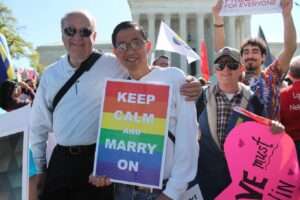
Celebration after Obergefell v. Hodges was decided. June 2015. (Howard University)
Today, is the tenth anniversary of Obergefell v. Hodges, the landmark Supreme Court decision striking down laws banning same-sex marriage. The ruling was a great victory for liberty and equality, and a striking example of how progress can be achieved by a combination of litigation and political action. The Court got the right result. But its reasoning should have been better. Instead of relying on a dubious mishmash of rationales, the Court would have done better to rule that laws banning same-sex marriage are unconstitutional because they discriminate on the basis of sex.
Obergefell was a great triumph for the civil rights of a long oppressed and despised minority. For decades, gays and lesbians had been discriminated against in a wide range of ways, and even subjected to criminal prosecution. Only with Lawrence v. Texas (2003) did the Supreme Court strike down anti-sodomy laws. I am old enough to remember widespread homophobic prejudice when I was growing up in the late 1980s and 1990s - not in a socially conservative area, but in an overwhelmingly liberal Boston suburb.
At the time of Obergefell, 37 states had same-sex marriage rights. But in 21 of them those rights depended on recent federal court decisions that would have been overturned had Obergefell come out the other way. Without Obergefell, many states would have continued to deny marriage equality for a long time to come, even up to the present day.
For gays and lesbians throughout much of the country, Obergefell was essential to ensuring they had secure marriage rights. In addition to the vastly important symbolism of this step towards equality, access to marriage enabled many thousands of same-sex couples to secure such practical benefits as adoption rights, inheritance rights, tax benefits, the ability to make medical decisions for sick or incapacitated partners, access to property rights reserved for married couples, and more. Most heterosexuals took these rights for granted, but gays and lesbians could not.
Obergefell was more than just a victory secured by lawyers making arguments in court. It was also the product of a longstanding civil rights movement. For decades, the gay rights movement had worked to influence public and elite opinion in favor of equality. Thanks to their efforts, public support for same-sex marriage rose from just 27% in 1996 to around 60% just before Obergefell was decided. At the same time, legal scholars and others advanced a variety of constitutional arguments for marriage equality which prevailed in several state supreme courts interpreting their state constitutions, and led to the invalidation of the federal Defense of Marriage Act in United States v. Windsor (2013), striking down a law that barred federal recognition of same-sex marriages performed in states where they were legal.
It took the combined force of shifts in public opinion and developments in legal argument to make Obergefell possible. The former allowed the justices to take the step they did, confident that most of society would back their decision. Just a few months before Obergefell, Supreme Court Justice Ruth Bader Ginsburg openly stated that the shift in public attitudes had paved the way for such a ruling, whereas earlier she had feared the public would not accept it. The arguments developed by scholars and advocates made it possible for the Court to issue a decision in favor of marriage equality consistent with professional norms.
It is important to remember that the same-sex marriage movement did not triumph by promoting "identity politics" validating a distinct LGBT cultural identity, but by emphasizing how same-sex marriage is fundamentally similar to opposite-sex marriage; and gays and lesbians, more generally, are fundamentally similar to heterosexuals. As an Iowa Supreme Court ruling in favor of marriage equality put it, the plaintiffs in the case were "in committed and loving relationships, many raising families, just like heterosexual couples."
In this respect, they followed in the footsteps of the racial equality and gender equality movements before them. There is a crucial lesson here for future movements seeking to expand liberty and equality to new groups, such as transgender people and undocumented immigrants.
Neither the Republican Party nor the more conservative Supreme Court has shown much enthusiasm for overturning Obergefell in recent years, even as the Court did overturn Roe v. Wade, the 1973 decision establishing abortion rights, in the 2022 Dobbs decision. Justice Samuel Alito's majority opinion in Dobbs carefully distinguished Obergefell from Roe, and - significantly - no other justice joined Clarence Thomas's concurring opinion advocating Obergefell's reversal.
Obergefell does have one important shortcoming: the Court's reliance on flawed legal reasoning. Justice Anthony Kennedy's majority opinion relied on a combination of "substantive due process" liberty arguments under the Due Process Clause of the Fourteenth Amendment (which bars states from depriving people of "liberty" without "due process of law"), and equality arguments under the Equal Protection Clause (which forbids deprivation of the "equal protection of the laws"). Notoriously, the Court failed to make clear the scope of the liberty in question, or exactly why it applies to same-sex couples, but not to other marriages long barred by law, such as polygamous marriages or those between close blood relatives. On the equality side, the Court failed to explain exactly what the forbidden classification was, even though equal protection analysis normally requires courts striking down a law to specify a "suspect classification," such as race, gender, or religion. Justice Kennedy also failed to specify what level of scrutiny he was applying to laws banning same-sex marriage, even though that determines the burden of proof the government must meet to justify its laws.
This hodgepodge has damaged Obergefell's reputation among legal experts, and made it unclear whether the decision precludes other types of state discrimination against gays and lesbians. The Court could have avoided this problem by simply ruling that laws banning same-sex marriage discriminate on the basis of sex, as Northwestern law Prof. Andrew Koppelman and I advocated in an amicus brief we filed in the case on behalf of a cross-ideological group of legal scholars. Koppelman (a liberal living constitutionalist) and I (a libertarian originalist) agree on little else; but we are united on this issue. Since 1976, the Supreme Court had held that laws discriminating on the basis of sex are subject to heightened "intermediate" scrutiny that laws banning same-sex marriage could not overcome.
And, as we explained, such laws undeniably do discriminate on the basis of sex. If same-sex marriage is forbidden, Anne is allowed to marry Bob, but Charles cannot. Charles is denied the right to marry Bob solely because Charles is a man. Denial of a legal right solely because of gender is the very essence of sex discrimination. It is much the same reasoning as that which earlier led the Court to hold that laws banning interracial marriage discriminate on the basis of race, because under such constraints who you are allowed to marry depends on your race. We also demonstrated how such a holding is justified under Supreme Court precedent, and the original meaning of the Fourteenth Amendment.
A ruling based on sex discrimination would have established a much stronger basis for same-sex marriage rights. It would also set a precedent clearly barring most other types of state discrimination against LGBT people, though difficult issues would still remain in cases where sex discrimination is permitted by law, as with transgender persons' access to womens' sports teams and single-sex bathrooms.
The Supreme Court has ruled that discrimination against gays, lesbians, and transgender people is sex discrimination under the Title VII federal employment discrimination law, in a 2020 decision written by conservative Justice Neil Gorsuch, It unanimously reaffirmed that conclusion this year. If the opportunity arises, it would do well to apply the same reasoning to the Equal Protection Clause.
United States v. Skrmetti, the Supreme Court's controversial recent 6-3 decision upholding state laws banning gender-affirming surgery for minors in does not undercut the sex discrimination theory. In Skrmetti, the majority carefully avoided any imputation that discrimination against LGBT people is not sex discrimination by holding that laws banning gender-affirming surgery present a special case, because they "prohibit… healthcare providers from administering puberty blockers and hormones to minors for certain medical uses, regardless of a minor's sex." The Court reasoned that the provision of such treatments for purposes other than facilitating a change of gender is fundamentally different, from a medical point of view, than their use to achieve that goal. Whatever the merits of that reasoning, it has few implications for more conventional forms of discrimination against gays and lesbians. Three conservative justices wrote concurring opinions arguing that transgender people are not a "suspect class" warranting special judicial protection. But even they did not say that discrimination against transgender people is not sex discrimination.
Despite flaws in reasoning, Obergefell still reached the right result, and remains a civil rights milestone. For the many thousands of families who benefit from it, the Court's reasoning understandably matters less than results. But better reasoning would make the decision a stronger precedent for the future.