I am very pleased that President Trump has announced that he will nominate Professor Jennifer Mascott to the Third Circuit.
I am pleased to nominate Jennifer Mascott to serve as a Judge on the United States Court of Appeals for the Third Circuit. Jennifer clerked for Justice Clarence Thomas and Justice Brett Kavanaugh, where she learned much about upholding the Constitution, and safeguarding our…
— Trump Truth Social Posts On X (@TrumpTruthOnX) July 16, 2025
I have known Jenn for more than a decade, and have always found her to be a thoughtful scholar, a sharp lawyer, and a kind person. Perhaps most importantly, Jenn has proven herself to be the rare academic with strong scholarly bona fides and practical experience in public affairs. Jenn served in the Office of Legal Counsel during Trump's first term, and now serves in the White House Counsel's Office. That background will serve her well on the federal bench.
Venezuelans fleeing the socialist regime of Nicolas Maduro. (NA)
In recent testimony before the House Subcommittees on Oversight, Investigations, and Accountability and Border Security and Enforcement, of the Committee on Homeland Security, my Cato Institute colleague David Bier presented a strong defense of the legality, justice, and effectiveness of immigration "parole programs," which allow broad categories of migrants fleeing war and oppression to enter the US legally. As he describes, there is a long history of such programs, most recently those created by President Biden for migrants from Ukraine fleeing Russian invasion (the Uniting for Ukraine program), and four Latin American nations beset by violence and socialist tyranny (the CHNV program).
David is one of the nation's leading immigration policy experts, and his testimony is must-reading for anyone interested in this issue. Here is a summary:
One legal way for immigrants to enter and participate in US society is parole, an immigration category first created by Congress in the Immigration and Nationality Act of 1952. Over the decades since then, millions of individuals have entered this country as parolees. Although parole is a temporary status, it allows immigrants to adjust to lawful permanent residence if they are eligible through another pathway, which many thousands of parolees have done. Many former parolees are now Americans and continue to contribute to their new home. It is an essential and important feature of America's legal immigration system.
Congress should:
protect current parolees from the president's mass deportation efforts;
reinstitute the parole processes suspended by the president; and
expand those processes to give more people a viable legal option to immigrate legally to the United States.
David explains the advantages of these programs, and ably addresses a variety of legal and policy objections.
I have defended the legality of CHNV in a Supreme Court amicus brief, and in an earlier amicus brief in Texas v. Department of Homeland Security, a lawsuit filed by twenty GOP-controlled states (that case was eventually dismissed by a conservative Trump-appointed federal judge for lack of standing). I also defended it in a 2023 article in The Hill, and criticized Trump's attempts to revoke it in a March 2025 post.
A new libel complaint in Clark v. Gygax(that would be Gary Gygax's son Luke Gygax), over a failed Kickstarter related to a planned new installment in a "tabletop game," "Castle Wolfmoon":
In the published post, Defendant made numerous knowingly false statements, including claims that Plaintiff was misappropriating Gary Gygax's name, that Plaintiff was lying to the public about the Castle Wolfmoon project's authorship, and that Defendant was not associated with the project.
This is of course just at the Complaint stage, so we know only the allegations. But it naturally piqued my interest (as a D&D player from back in the 1970s), and I thought it might likewise interest some readers.
From today's decision in Walls v. Sanders, by Eighth Circuit Judge Steven Grasz, joined by Judges James Loken and Raymond Gruender (which I think is generally correct):
[T]he government's own speech "is not restricted by the Free Speech Clause," so it is free to "choose[ ] what to say and what not to say." …
[Arkansas law, "Section 16,"] directs the Arkansas Secretary of Education to ensure the Arkansas Department of Education complies with Titles IV and VI of the 1964 Civil Rights Act by reviewing its communications and materials to see if they "promote teaching that would indoctrinate students with ideologies such as Critical Race Theory, otherwise known as 'CRT', that conflict with the principle of equal protection under the law or encourage students to discriminate" based on someone's protected characteristics. The Secretary must also "amend, annul, or alter" any "rules, policies, materials, or communications that are considered prohibited indoctrination" and "review and enhance the policies that prevent prohibited indoctrination." "Prohibited indoctrination" is defined as:
communication by a public school employee, public school representative, or guest speaker that compels a person to adopt, affirm, or profess an idea in violation of Title IV and Title VI of the Civil Rights Act of 1964, including that:
(1) People of one color, creed, race, ethnicity, sex, age, marital status, familial status, disability status, religion, national origin, or any other characteristic protected by federal or state law are inherently superior or inferior to people of another color, creed, race, ethnicity, sex, age, marital status, familial status, disability status, religion, national origin, or any other characteristic protected by federal or state law; or
(2) An individual should be discriminated against or receive adverse treatment solely or partly because of the individual's color, creed, race, ethnicity, sex, age, marital status, familial status, disability status, religion, national origin, or any other characteristic protected by federal or state law.
Section 16 expressly excludes from its prohibition: (1) discussions about "[i]deas and the history of concepts described" in the "prohibited indoctrination" definition; and (2) discussions about "[p]ublic policy issues of the day and related ideas that individuals may find unwelcome, disagreeable, or offensive." A teacher who violates Section 16 by engaging in "prohibited indoctrination" "could be punished (up to losing his or her license) by the State Board of Education."
Students challenged Section 16 on Free Speech Clause, but the Eighth Circuit rejected that argument:
After the Supreme Court decided Trump v. CASA, the Wall Street Journal editorial page took a victory lap. The editors, who have consistently defended Barrett, wrote "What an end-of-term rejoinder to the MAGA loudmouths who have been complaining that Justice Barrett is a pushover." On July 4, the WSJ published a letter to the editor as a follow-up:
A few months ago I ran into Justice Neil Gorsuch and lamented some of his colleagues' recent opinions. I criticized Justice Amy Coney Barrett and Justice Ketanji Brown Jackson in particular, both of whom had recently ruled against the Trump administration. Justice Gorsuch was characteristically gracious and spoke of how each was entitled to his own opinions.
I once was what your editorial "The Supreme Court Kills 'Universal' Injunctions" (June 28) refers to as a "MAGA loudmouth." After reading Justice Barrett's superb opinion in Trump v. CASA, I am a repentant MAGA loudmouth. She is a star—and I regret ever doubting it.
Joel Marks
Richmond, Va.
Did this encounter with Justice Gorsuch actually happen? I find this conversation so implausible. And I cannot find any record for a Joel Marks who is an attorney in Richmond. I searched the Virginia State Bar for a Joel Marks and found nothing. I did find a news story from Henrico County, Virginia, where a Joel Marks complained about a broken water main.
I provide this background to illustrate how poorly the criticism of Justice Barrett is understood. If Marks criticized Barrett for simply ruling against Trump, he has no idea what he is talking about. And if he thinks that Justice Barrett's decision in CASA suggests she will not rule against Trump in the future, then Marks really has no clue what he is talking about. Why then did the WSJ give Marks the time of day? Marks fit the template--those who doubted Justice Barrett now have no doubts.
My doubts remain. Indeed, they are reinforced. These doubts predated Trump's re-election, and were never premised on whether Barrett rules for Trump. Brackeen and Vidal are critical data points, combined with a string of emergency docket rulings, and a consistent record of denying cert on important cases. My concern is this: how much evidence does Barrett requires to reach an originalist ruling? Academics, as a whole, require fully-developed theories based on a volume of scholarly articles to reach a solid conclusion. Judges, generally, do not.
Trump v. CASA should not have been a particularly difficult case. There is fairly overwhelming evidence that universal injunctions are recent innovations, and that under Grupo Mexicano, such novelty is doubtful. Justices Thomas and Gorsuch reached this conclusion years ago with ease. I can imagine Justice Scalia disposing of this case pretty easily.
Yet, Justice Barrett's opinion reads like a law review article that summarizes the academic literature. On point after point, Barrett contrasts the views of Sam Bray, Will Baude, and Michael Morley on the one hand with the views of Mila Sohoni on the other. Indeed, Barrett refers to Amanda Frost as the "mainstream" view. For readers of this blog, these names may be familiar. But for most lawyers, this sort of scholarly debate is quite esoteric.
Footnote 7 illustrates the point.
7There is some dispute about whether Wirtz was the first universal injunction. Professor Mila Sohoni points to other possible 20th-century examples, including West Virginia Bd. of Ed. v. Barnette, 319 U. S. 624 (1943), Pierce v. Society of Sisters, 268 U. S. 510 (1925), and Lewis Publishing Co. v. Morgan, 229 U. S. 288 (1913). See M. Sohoni, 133 Harv. L. Rev., at 943; Brief for Professor Mila Sohoni as Amica Curiae 3; see also post, at 21 (opinion of SOTOMAYOR, J.). But see M. Morley, Disaggregating the History of Nationwide Injunctions: A Response to ProfessorSohoni, 72 Ala. L. Rev. 239, 252–256 (2020) (disputing these examples).
Justice Sotomayor in dissent argues that West Virginia v. Barnette and Pierce v. Societyof Sisters were examples of universal injunction. Yet, in a footnote, Justice Barrett leads off by citing Professor Sohonoi, with a see also to Justice Sotomayor's dissent! Doesn't that seem backwards? Shouldn't the Justice come first? And does Justice Barrett discuss those landmark cases, and explain why Sotomayor is wrong? No, she includes a But see citation to Michael Morley who "disputes" those examples. I suppose it is fair enough to cite a law review article that parses some history or arcana. But wouldn't it fall to a Supreme Court majority on how best to interpret landmark Supreme Court cases? I would like to know why Barnette and Pierce did not approve of universal injunctions. This is the sort of footnote that is all too common in academia. When there is contrary authority, just cite someone else who disputes it. But this is not how the Supreme Court usually handles a central disagreement.
I am grateful that Bray, Baude, and Morley have made such a compelling case against universal injunctions. But what if they hadn't? What if the theoretical framework was not so airtight? What if some earlier injunctions could plausibly have been characterizes as universal? Or what if this case came to the Court several years ago when many of these arguments were still being developed? Would Barrett have had enough of a theory to go on? I'm not sure. In short, Justice Barrett was able to write the strong opinion she did because of the scholarly work done by others. What would she have done in a case like Lopez, or even Heller, where the scholarly literature was not so solid?
We will have to wait for the next case that presents a novel constitutional question, and where there is not a clear scholarly consensus. That will provide the real test of where Justice Barrett is--and not the uncertain views of a MAGA loudmouth.
I appreciate my friend Ilya Shapiro's defense of Justice Barrett in the Washington Post. I find myself in agreement with much of it. Still, there are caveats. Ilya writes that Barret "will join the conservative majority on the substance of issues that are squarely presented [like] overturning Roe v. Wade." But Barrett voted to deny cert in Dobbs, and the Court only took the case after (likely) Justice Kavanaugh granted cert. Ilya writes that Barrett gave "Trump the immunity he needed to escape the lawfare he faced in the run-up to the last election." Sort of. It isn't clear which parts of the majority opinion she actually joined, and she would have allowed a trial to consider a range of otherwise immune conduct. Ilya writes that Barrett has "join[ed] the conservative majority" to "preserv[e] religious freedom." Except she refused to join Justices Thomas, Alito, and Gorsuch on overruling Employment Division v. Smith, and has shown no interest in revisiting the interest since Fulton. Ilya wrote that Barrett voted to "end[] racial preferences in college admissions." But she has denied review in cases where schools are flagrantly violating Students for Fair Admissions. Justice Barrett's Skrmetti concurrence read like the efforts of a law professor to make sense of Footnote Four--a Footnote that has no basis in the Constitution. I am still befuddled why Justice Thomas joined it, given that he agreed with Justice Scalia that Footnote Four should be jettisoned. And Ilya does acknowledge Barrett's opinion in Murthy, which erected an almost insurmountable standard for standing.
I could go on, but I won't. At a high level, Barrett's record look great. But if you drill down just a bit, things look differently. See the wall of receipts.
Still, OT 2024 was far better for Barrett than last term, or the term before. If we are grading terms, I would give her a solid B. I would give Justice Kavanaugh a B+. And Justice Gorsuch would get an A-. All three Trump appointees lose points for AARP. There is always hope for next term.
And with that, I have finished blogging about the decisions of the OT 2024 Term. Perhaps.
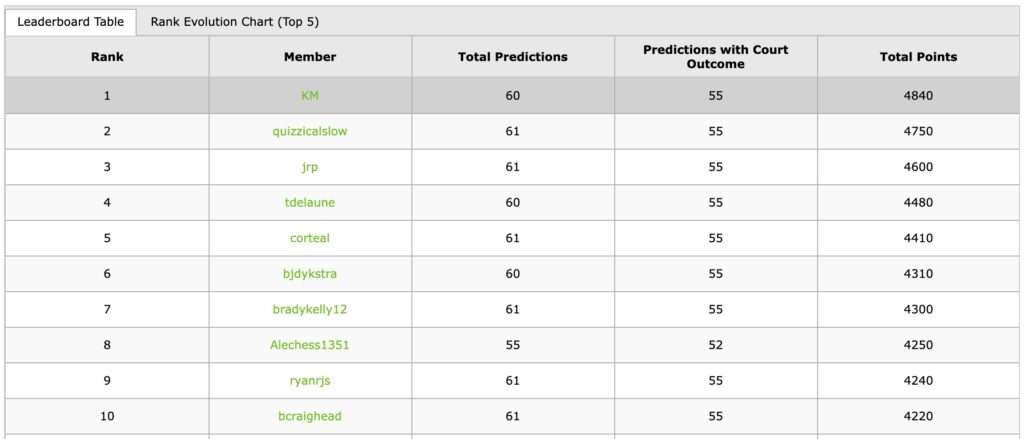
The October 2024 Term of FantasySCOTUS finally came to a close. On the whole, this term was a less predictable than some recent terms. In the aggregate, our crowd predicted 76.36% of the cases accurately, down from 83.05% of the cases accurately last term.
I am happy to announce that the Chief Justice is Kirill Muzyka. Players receive ten points for each correct prediction of a Justice's vote. We recorded 55 merits cases (DIGs do not count). A perfect score would have been 4,950 points. Kirill scored 4,840 points.
I usually ask the winner several questions to figure out their approach to predicting cases. Kirill's response was so thorough and insightful, that I reproduce it in its entirety:
My name is Kirill Muzyka. I'm from St. Petersburg, Russia, and I'm currently finishing my master's degree in Political Science at the London School of Economics.
My interest in American politics began quite some time ago, but I became especially focused on the U.S. Supreme Court in 2020, following the death of Justice Ginsburg. Her passing turned the Court into a major topic of public debate during the election, and that moment drew my attention. I eventually wrote a paper during my undergraduate studies on the Supreme Court's role in the polarization of American politics, and my interest in the Court has only grown since then.
What particularly drew me in was the contrast between the legal system in the U.S. and in my own country. The Supreme Court's dual nature — both legal and political — was fascinating to me. I was also struck by how the Justices manage to maintain respectful, even friendly, relationships despite deep ideological divisions. That kind of civility seemed rare and especially meaningful in today's political climate.
Since 2022, I've been listening to all oral arguments and making predictions about case outcomes for myself. In 2023, I began submitting predictions publicly through FantasySCOTUS. I've also read all of the Court's opinions from the past 2 terms. I really enjoy trying to understand the different perspectives each Justice brings, and I often try to reconstruct their arguments myself to determine which position I find most compelling. While I'm not a lawyer, I appreciate how the Justices generally write in a way that's accessible to an educated reader. In that sense, I'm especially fond of the opinions by Justices Kagan, Gorsuch, and Barrett — they're usually the clearest and most engaging to read.
When it comes to making predictions, I rely primarily on oral arguments. I think the post-COVID format — where each Justice has time to ask their questions — gives a clearer picture of how they're thinking about the case. If oral arguments don't reveal a clear outcome, I turn to other background factors, like the Justices' previous decisions or their overall judicial philosophy. Some Justices make prediction easier through their questioning. For instance, Justices Alito, Sotomayor, and Jackson often clearly signal their positions during arguments, which allows for solid predictions. Others — like Justices Chief Justice Roberts and Justices Thomas and Barrett, — tend to be more reserved and balanced in their questioning, so background information becomes more important. Justices Kagan, Gorsuch, and Kavanaugh fall somewhere in between.
When I listen to arguments, I pay particular attention to "friendly" questions — the kinds that help, rather than challenge, an advocate's position. While Justices may press both sides on weak points, they rarely throw supportive "softball" questions to the side they ultimately oppose. I also find Oyez especially helpful — having both the audio and the transcript available in the same place makes it easier to fully understand the Justices' wording and tone.
Because I've been closely following the Court only in recent years, the only personnel change I've directly experienced has been Justice Jackson's appointment. Her style is notably clearer than Justice Breyer's often convoluted questioning, and she typically makes her views evident during argument. That has made case prediction somewhat easier — though not significantly so, given that she's part of the liberal minority and doesn't often determine the outcome.
In terms of case types, I find that technical statutory cases are generally harder to predict than high-profile constitutional ones. For example, this term, cases like Feliciano, Advocate Christ Medical, Bufkin, and Stanley were among the most difficult for me. That's, in my view, because in such cases, oral argument really can make a difference — the Justices often come in without firm views and genuinely explore the issues. In contrast, in more ideological cases, the Justices often already hold strong positions and are less swayed by the details. A good example of this contrast was the one argument I attended in person while visiting the U.S. as a tourist. — Mahmoud v. Taylor. After waiting in line for seven hours, I finally got in. It was a fascinating experience, but I doubt the oral arguments had much influence on the Justices, as they seemed to have already made up their minds based on ideological grounds.
I realize it may seem unusual for a complete foreigner with no formal legal training in the U.S. to be so interested in the Supreme Court. But coming from a country where the rule of law is almost absent, it's genuinely inspiring to watch a legal institution function with such intellectual rigor. While I understand and respect the perspective of those who view SCOTUS as primarily a political institution — "politicians in robes," as some say — I believe that's only part of the story. In reality, the Justices often demonstrate complexity and depth in their reasoning, and their opinions frequently reflect that nuance.
As someone from an authoritarian background, I'm deeply impressed by a system in which judges must publicly explain their decisions (putting aside the shadow docket), where legal reasoning matters, and where debate — even among ideological opponents — can shape outcomes. While my personal political leanings tend to align more with the liberal side of the Court, I've found that many conservative opinions are more thoughtful and well-argued than they are often given credit for. In my view, the American judicial system — though far from perfect — is an institution of extraordinary interest, and I look forward to continuing to follow it closely.
Well said. The seventeenth season of FantasySCOTUS will launch on the first Monday in October 2025.
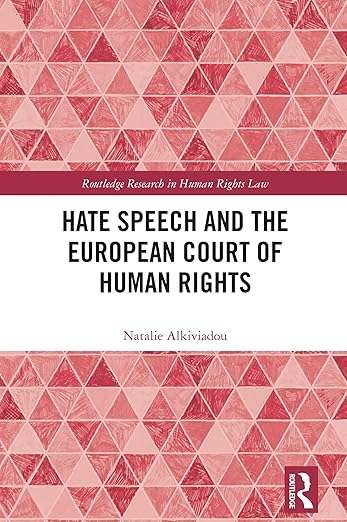
In this third post in The Volokh Conspiracy guest series, I examine a critical issue in the European Court of Human Rights' (ECtHR) hate speech jurisprudence: its embrace of what I term the "low threshold hatred paradigm." Under this approach, expressions that offend, insult, ridicule, or defame minority groups are routinely held to fall outside the protection of Article 10 of the European Convention on Human Rights (ECHR). This, I argue, has diluted the robust speech protections previously associated with the ECtHR's celebrated precedent in Handyside v The United Kingdom (1976), a landmark case on the freedom of expression and its boundaries. As a result, the ECtHR's jurisprudence increasingly reflects not a balancing of rights, but an asymmetric favoring of state-defined "tolerance" over pluralistic expression. This approach risks insulating majoritarian or institutional viewpoints from critique under the guise of promoting social cohesion.
From allowing speech that may "shock, offend, disturb" to prohibiting offense, insult and ridicule
The ECtHR famously held in Handyside that Article 10 on the right to freedom of expression protects not only inoffensive speech, but also that which "offends, shocks or disturbs." In theory, this forms the backbone of European free speech protection. In practice, however, the ECtHR's hate speech rulings suggest a growing willingness to subordinate the Handyside principles to vague concepts such as the values and spirit of the Convention, particularly when the speech in question targets protected characteristics such as religion, ethnicity, or sexual orientation.
The paradigmatic shift can be traced most clearly to Féret v Belgium(2009), where a far-right member of parliament was criminally convicted for distributing anti-immigration leaflets during an election campaign. The ECtHR upheld the conviction, holding that statements such as "Stop the Islamization of Belgium," were likely to arouse feelings of "distrust, rejection or hatred" and thus justified interference. In a blistering dissent, Judge András Sajó warned that the majority had abandoned the foundational principle that speech must be protected especially "when we face ideas that we abhor or despise." He cautioned that "humans, including judges, are inclined to label positions with which they disagree as unacceptable and therefore beyond the realm of protected expression." According to Judge Sajó, the Féret majority treated the public as susceptible "nitwits," incapable of resisting emotional manipulation. This marked the emergence of a paternalistic framework: citizens need protection not just from direct harm, but from exposure to ideas the ECtHR deems offensive.
The "Féret doctrine" spreads: Le Pen, Zemmour and beyond
A short excerpt from today's long opinion by Judge Arianna Freeman, joined by Judge Cheryl Ann Krause, in Qatanani v. Attorney General:
The Supreme Court has long recognized that the admission and exclusion of noncitizens is a "fundamental sovereign attribute exercised by the Government's political departments largely immune from judicial control." But in that endeavor, both political branches have particular roles to play.
On the one hand, the Executive has authority to enforce the immigration laws passed by Congress and to exercise the discretion Congress delegates to it. On the other hand, "the formulation of [immigration] policies is entrusted exclusively to Congress." Indeed, there is "no conceivable subject" over which the "legislative power of Congress [is] more complete" than the admission and exclusion of noncitizens. In this balance, it is the Judiciary's exclusive province to resolve separation-of-powers questions. So where an administrative agency purports by regulation to evade procedures mandated by Congress in the Immigration and Nationality Act ("INA"), it is incumbent upon us to intervene. We do so here.
In 1996, Mohammad M. Qatanani was admitted to the United States on a work visa. In 1999, he applied under 8 U.S.C. § 1255(a) to adjust his immigration status to that of a Lawful Permanent Resident ("LPR"). After lengthy proceedings regarding Qatanani's application, an Immigration Judge ("IJ") twice made fact findings and credibility determinations in Qatanani's favor and granted his application to adjust to LPR status. The IJ issued those orders in 2008 and 2020, respectively.
Estreicher and Babbitt are right to conclude that Trump's tariffs violate the nondelegation doctrine, but wrong to reject other arguments against them.
In a recent Just Security article, NYU law Prof. Samuel Estreicher and attorney Andrew Babbitt criticize the May 28 Court of International Trade ruling against Trump's IEEPA tariffs, in VOS Selections, Inc. v. Trump, a case brought by the Liberty Justice Center and myself, on behalf of five small businesses harmed by the tariffs. The case is now on appeal before the US Court of Appeals for the Federal Circuit.
Estreicher and Babbitt (EB) actually agree with us and the court that the tariffs are illegal! They just don't like much of the CIT's reasoning, and would prefer a ruling based on nondelegation doctrine. In this respect, they are similar to some previous critics of the ruling who support the result, but object to the reasoning, most notably John Yoo. He takes the exact opposite position: that CIT should have relied on the statutory text, rather than nondelegation and major questions doctrine (see my response to Yoo here).
EB overlook the fact that the CIT ruling did in fact rely, in part, in parton nondelegation. In addition, the other grounds for the court's decision are much stronger than they realize.
EB agree with us that Trump's interpretation of IEEPA grants the president virtually unlimited power to impose tariffs, and also agree that such boundless delegation violates constitutional constraints on delegation of legislative power to the executive. They chide the CIT for supposedly avoiding this constitutional issue. But CIT did not avoid it! The court's decision specifically states that "any interpretation of IEEPA that delegates unlimited tariff authority is unconstitutional." It clearly relied on this point as an additional reason to rule against the administration.
The CIT also relied on the closely related major questions doctrine (MQD), which requires Congress to "speak clearly" when authorizing the executive to make "decisions of vast economic and political significance." EB complain that MQD may not apply here, because it is not clear that it applies to presidential actions, as opposed to those of administrative agencies. But there is no good reason to exempt the president from MQD scrutiny, and three federal circuit courts have ruled that way. This point is further reinforced by the Supreme Court's increasing embrace of "unitary executive" theory, under which the president is entitled to near-total control over executive branch subordinates, thus making distinctions between them illusory. For more on this point, see our appellate brief in the case (pp. 51-53).
EB also note that MQD applies with greater force when an assertion of executive power is unprecedented. But, as they acknowledge, no previous president has ever used IEEPA to impose tariffs at all, much less on a scale large enough to start the biggest trade war since the Great Depression. It is true, as they emphasize, that President Nixon used IEEPA's predecessor statute, the Trading with the Enemy Act (TWEA), to enact more limited tariffs, and this was upheld by the predecessor court to Federal Circuit in United States v. Yoshida International Inc. (1975). But the Yoshida court specifically stated it was not endorsing unlimited tariff authority. It emphasized that the Nixon tariffs were linked to the preexisting tariff schedule set by Congress, and that "[t]he declaration of a national emergency is not a talisman enabling the President to rewrite the tariff schedules." It even noted that to "sanction the exercise of an unlimited [executive] power" to impose tariffs "would be to strike a blow to our Constitution."
Thus, Yoshida actually refused to interpret TWEA as endorsing the kind of unlimited tariff authority Trump asserts under IEEPA. Moreover, we cannot assume that the even the more limited tariff authority Yoshida allowed continues under IEEPA, merely because the latter statute used wording similar to TWEA. Congress wanted IEEPA to be more limited than TWEA, and specifically emphasized it could only be used to address an "emergency" that amounts to a "unusual and extraordinary threat…. to the national security, foreign policy, or economy of the United States" (concepts that were supposed to be narrowly defined and not a "normal" state of affairs). Trade deficits - the rationale for the Liberation Day tariffs at issue in our case - are neither an emergency, nor extraordinary, nor unusual, nor a threat (for more on these points see the excellent amicus brief in our case, filed by a cross-ideological group of leading economists).
Finally, it is worth emphasizing that IEEPA doesn't actually authorize tariffs at all. The statute does not even mention the word "tariff" or any synonym such as "duty" or "impost." All it allows is the power to "regulate" certain international economic transactions. Regulation and taxation are historically distinct powers, separately listed in the Constitution. The CIT decision deliberately chose not to address this issue. But in the Learning Resources case, decided a day later, Judge Rudolph Contreras of the US District Court for the District of Columbia (DDC) did address this question and correctly ruled IEEPA doesn't allow tariffs.
EB argue that Judge Contreras got this issue wrong, but they have no good reason for that claim, other than just relying on the Yoshida precedent (which itself provides little analysis justifying its conflation of taxation and regulation). If "regulate" inherently implies a power to impose taxes or tariffs, that would render the constitutional grant of power to Congress to "lay and collect… Duties, Imposts and Excises" superfluous, since the Constitution also gives Congress the power to "regulate" international commerce. Moreover, it would mean all of the many statutes that give some federal agency a power to "regulate" an activity also give it the power to impose taxes, which would be a massive expansion of executive branch taxation authority.
In addition, as Judge Contreras points out, this interpretation of IEEPA would render it unconstitutional, because the language of the statute applies to regulation of exports, as well as imports:
IEEPA provides that the President may "regulate . . . importation or exportation." 50 U.S.C. § 1702(a)(1)(B). The Constitution prohibits export taxes. See U.S. Const. art. I, § 9, cl. 5 ("No Tax or Duty shall be laid on Articles exported from any State."). If the term "regulate" were construed to encompass the power to impose tariffs, it would necessarily empower the President to tariff exports, too. The Court cannot interpret a statute as unconstitutional when any other reasonable construction is available. See Nat'l Fed'n of Indep. Bus. v. Sebelius, 567 U.S. 519, 563 (2012).
Given these realities, there is every reason to confine Yoshida's reasoning to the narrow range of tariffs it upheld under TWEA, and not apply it to IEEPA at all. Even if Yoshida does apply, it explicitly rejects the kind of sweeping tariff authority claimed by the Trump Administration.
In sum, I completely agree with EB that it would be good if appellate courts struck down Trump's IEEPA tariffs under the nondelegation doctrine. Indeed, I have said as much since my very first piece on the subject, back in February (the post that eventually led to the filing of our case).
But there are also multiple additional reasons to rule against the tariffs, including 1) IEEPA doesn't authorize tariffs at all, 2) trade deficits are not an "emergency" or an "unusual and extraordinary threat" 3) deficit-related tariffs are now governed by the Trade Act of 1974 (a point noted by the CIT), not IEEPA, 4) the major questions doctrine, and 5) constitutional avoidance (relied on by both CIT and Judge Contreras). We cover all these in much more detail in our Federal Circuit brief.
UPDATE: EB also criticize the part of the CIT decision striking down Trump's fentanyl-related IEEPA tariffs imposed on Canada, Mexico, and China, which held that the tariffs in question do not actually "deal with" the fentanyl problem (IEEPA states that the statute can only be used to "deal with" the "unusual and extraordinary threat" it is invoked to address). This part of the decision relates not to our case, but to that brought by twelve state governments (decided in the same ruling).
EB argue the CIT's reasoning on "deals with" would inhibit all other efforts to use IEEPA sanctions as leverage, such as their use against Russia's invasion of Ukraine. Not so. There is an obvious difference between the Russia sanctions and Trump's fentanyl tariffs. The Russian government is obviously responsible for its attack on Ukraine and pressuring Russia to stop its own wrongdoing is an obvious way of "dealing with" the threat it poses. In addition, reducing the flow of money to the Russian government reduces the resources available to it, and makes it harder for Vladimir Putin to continue his war. . By contrast, the flow of fentanyl from Canada to the US is negligible and pretty obviously not caused by the Canadian government; that from Mexico is overwhelmingly by US citizens returning home, and also not caused by the Mexican government. Thus, the fentanyl tariffs are not meaningfully dealing with the problem that supposedly justifies them, even assuming that cross-border drug smuggling qualifies as an "unusual and extraordinary threat" (which it doesn't, as such smuggling is a longstanding and virtually inevitable consequence of the War on Drugs, which predictably creates large black markets).
Third Circuit Judge Paul Matey argues yes, dissenting in Qatanani v. Attorney General. (The two judges in the panel majority seem to disagree, stating that "the [Board of Immigration Appeals] penalized Qatanani for quintessential First Amendment activity," but declines to discuss the matter in detail because it concludes Qatanani should prevail on statutory and procedural grounds.) Here's an excerpt:
Qatanani entered the United States in 1996 on a H-1B nonimmigrant visa with authorization to serve as an imam at The Islamic Center of Passaic Country (ICPC) until April 1, 1999. Rather than leave, he applied to adjust his status to lawful permanent residence (LPR). After almost two decades of administrative proceedings, an Immigration Judge (IJ) found Qatanani eligible for a status adjustment and deserving one as a matter of discretion. But the Board of Immigration Appeals (BIA) disagreed [in April 2024], noting Qatanani's lack of candor, admitted association with Hamas supporters, public call for a "new intifada," and failure to demonstrate yearly tax filings. As I explain below, I would not disturb the BIA's decision…. [Statutory and procedural details omitted. -EV]
Finally, I explain why the BIA's review of Qatanani's Times Square speech and admitted associations with Hamas supporters does not violate the First Amendment. Of course, an alien's speech can offer important insight into his character that informs the Executive's determination about whether the alien's presence will add to the common good. None disagree with that observation, nor does the First Amendment because Qatanani is not part of "the people" the First Amendment protects, nor is the denial of LPR status a punitive action….
[A]n alien "does not become one of the people to whom" the First Amendment applies "by an attempt to enter, forbidden by law." U.S. ex rel. Turner v. Williams (1904). That is because "[t]o appeal to the Constitution is to concede that this is a land governed by that supreme law, and as under it the power to exclude has been determined to exist, those who are excluded cannot assert the rights in general obtaining in a land to which they do not belong as citizens or otherwise." So there is no debate that excluded aliens cannot invoke the First Amendment.
Whether the First Amendment restrains government action against all aliens within our Nation's borders is less explored. Begin with Bridges v. California (1941), involving state contempt charges against a group including a resident alien lawfully within the country for at least two decades. With little analysis, the Court concluded the contempt charge was impermissible under the First Amendment. But the Court did not mention, let alone analyze, Bridges's alien status.
A leading scholar in constitutional law, Fallon was widely regarded for his insightful, prolific academic output and his commitment to thoughtful debate.
He has written extensively about the Supreme Court and constitutional interpretation, tackling how the more than 200-year-old document applies to the country today. In 2021, he was nominated to the Presidential Commission on the Supreme Court of the United States, a committee established by then-President Joe Biden to investigate legal questions and possible reforms to the Supreme Court.
"HLS can be grateful for the more than forty years in which Professor Fallon wrote, taught, mentored, counseled, and led with extraordinary distinction," Goldberg wrote in the Monday announcement of Fallon's death. "His passing leaves a hole in our community that cannot be filled."
Fallon was also remembered by former students and colleagues for his humor and his down-to-earth nature — qualities many said could be uncommon in the rarefied halls of Harvard Law School.
Cass R. Sunstein, a professor at HLS, wrote in a statement to The Crimson that Fallon combined his intellectual "brilliance" with "humility in a way I have never seen in all my years."
After the Supreme Court's Dobbs decision, West Virginia adopted a law, the Unborn Child Protection Act, that prohibits abortion in most circumstances. As enacted, the prohibition extends to medication abortions, such as those which may be performed with mifepristone.
GenBioPro, a manufacturer of generic mifepristone, challenged the West Virginia law, arguing that the prohibition is preempted by federal law, and the FDA's regulations governing the prescription and administration of mifepristone in particular, insofar as it prevents doctors from prescribing mifepristone for the purposes of terminating a pregnancy.
A federal district court rejected GenBioPro's claim. Today, in GenBioPro v.Raynes, a divided panel of the U.S. Court of Appeals for the Fourth Circuit affirmed. Judge Wilkinson wrote for the court, joined by Judge Alston (sitting by designation). Judge Benjamin dissented.
Judge Wilkinson's opinion for the court begins:
After the Supreme Court "return[ed] the issue of abortion to the people's elected representatives" in Dobbs v. Jackson Women's Health Organization, 597 U.S. 215, 232 (2022), West Virginia enacted a law prohibiting abortion in most circumstances. The question before us is whether certain federal standards regulating the distribution of the abortion drug mifepristone preempt the West Virginia law as it applies to medication abortions. The district court determined there was no preemption, and we now do the same.
For us to once again federalize the issue of abortion without a clear directive from Congress, right on the heels of Dobbs, would leave us one small step short of defiance. Appellant GenBioPro finds this clear directive in a maze of provisions in the Food and Drug Administration Amendments Act of 2007. It argues that these provisions vested the FDA with the exclusive authority to regulate access to mifepristone. We disagree. In our view, the Act leaves the states free to adopt or diverge from West Virginia's path. Because the Act falls well short of expressing a clear intention to displace the states' historic and sovereign right to protect the health and safety of their citizens, we affirm.
The body of the opinion briiefly addresses standing (an easy question here), and then applies the existing law of preemption (such as it is) in a rather straight-forward manner (albeit in a typical Wilkinsonian way), implicitly acknowledging that the current Supreme Court does not appear particularly sympathetic to preemption claims. (One of several ways in which the current Court is less "pro-business" than is commonly assumed.)
Given the general presumption against finding preemption of traditional state authority, absent a clear congressional directive, the argument that federal pharmaceutical regulations preempt state abortion laws is hard to make. As in many contexts, the federal regulations provide a "floor" of regulation that states may exceed, as West Virginia has here, placing far greater limitations on the use of mifepristone (a de facto prohibition for its use in abortion) than does the federal government.
In this post I look at my book's key findings on the effects of hate speech and the controversies surrounding its regulation. This analysis lays out the groundwork for understanding both the harms attributed to hate speech and the dangers of over-regulating it in democratic societies. The central question is twofold: Does hate speech cause real-life harm? And if so, should that harm be addressed through legal restrictions on speech? The ECtHR systematically answers "yes," often without the depth of inquiry such a consequential response demands.
Hate speech and harm
One of the key contributions the book's chapter on hate speech, its effects and the questions of regulation is to unpack the multi-level impact of hate speech on individuals (micro), groups (meso), and society (macro). Drawing on work by scholars such as Mari Matsuda, Jeremy Waldron, Alexander Tsesis, and others, I trace how hate speech is said to erode dignity, reinforce systemic inequalities, and, in some contexts, incite violence.
That's a new one on me, from a UK trademark appeal; the plaintiff, who was self-represented, admitted to using generative AI, and the defendant's lawyer was strongly suspected of so doing:
8. At the start of the hearing, I asked Dr Soufian if he had drafted the documents and he said he had drafted it with the assistance of Chat GPT. I pointed out the numerous errors in the citations and problems with the skeleton and he politely apologised and did so unreservedly. Before moving on, it is worth noting that most of the skeleton produced by Chat GPT was made up of arguments purportedly relating to the evidence in the case. However, the factual issues highlighted were largely not relevant to the issues before me and the proposed arguments were not very helpful. In other words, even aside from the fabricated citations, the output of Chat GPT was in fact unhelpful to him.
9. In the case of Mr Caddy, who is a trade mark attorney, his skeleton argument dated 6 June 2025 included three cases which existed and were correctly cited. But it was unclear to me the cases cited stand for the propositions claimed by Mr Caddy.
10. During the Hearing, I asked Mr Caddy to identify the part of the judgments which supported the propositions made. He said, "I cannot actually remember that now, to be honest with you". I gave him time to read the judgments so as to find the relevant paragraphs. He could not do so. He then said he got the references from a "previous edition of Kerly's Law on Trade Marks". I could not find any support for the propositions (or anything similar) in Kerly during the hearing. He then said he could not remember where he got them from, saying maybe it was Wadlow [on the Law of Passing Off] but said he went on to say that did not make much sense. After the hearing, I checked Wadlow and could not find anything matching the propositions.
Yesterday the Senate confirmed Whitney Hermandorfer to a seat on the U.S. Court of Appeals for the Sixth Circuit. A well-qualified nominee who I expect will make an excellent judge, Hermandorfer is the first judicial nominee to win confirmation in Donald Trump's second term.
As various news outlets have noted, judicial nominations are lagging in Trump's second term. The Administration has been slower to make nominations and the Senate has been slower to act than during the first Trump Administration. On top of that, there are fewer vacancies to fill, as many judges eligible for senior status are electing to remain on the bench (and there is speculation as to why that might be).
As of this morning, there are forty-nine current vacancies on the federal bench, and thirteen more future vacancies (which occur when judges announce their intent to retire or take senior status at a date in the future or upon confirmation of a successor). There are only eleven nominees pending before the Senate, however. (Three more nominees have been announced but have not been formerly submitted.) Of these, only five are on the circuit courts of appeals.
As for what could be, by my count there are forty circuit court judges eligible to take senior status, only two have which have announced their intention to create a vacancy. Of those twenty-six were appointed by Republican Presidents. What these judges decide to do could have a substantial effect on President Trump's ability to shape the judiciary during his second term.
The plaintiffs alleged that Uber knew the passenger had committed two carjackings about a month before, should have warned Lyft about that. (The killer used the same e-mail address for both his Lyft and Uber accounts.) The father drove for both Uber and Lyft, but the killer called him using the Lyft app. No liability, as a matter of law, Judge Stephen Clark (E.D. Mo.) concluded Friday in Newman v. Uber Technologies, Inc., denying plaintiffs leave to amend their complaint on the grounds that such an amendment would be futile:
In Ameer [a previous Missouri case], Rochelle Ameer sued Lyft, a rideshare platform, after a rider "fraudulently and anonymously requested through Lyft's mobile ridesharing application" a ride from Ameer's son and killed him. Ameer asserted, among other claims, a negligence claim based on a wrongful-death theory…. [T]he Missouri Court of Appeals [held the case could go forward].
The complaint in Ameer alleged that two minors, who were "supposed to be ineligible to order rides through the Lyft [a]pp, met and conspired together to use the [a]pp to carjack a Lyft driver." The minors requested a ride through the Lyft app, and Ameer's son accepted the request. After Ameer's son arrived, the minors announced a robbery, pulled guns on Ameer's son, attempted to force him out of the car, and eventually shot and killed him. Ameer alleged that the minors had previously, on multiple occasions, carried out the same carjacking scheme that they carried out on Ameer's son. Ameer also alleged that "Lyft knew or should have known that multiple rideshare drivers had been assaulted, attacked, and carjacked as a result of the same fraudulent scheme."
In addressing the negligence claims, the Missouri Court of Appeals first acknowledged the general rule that "[a] duty to protect against the criminal acts of third parties is generally not recognized because such activities are rarely foreseeable." But the court recognized that, where "a victim is injured at a location other than the defendant's premises," two exceptions to the general rule exist. First, a duty exists where "the defendant 'should realize through special facts within his knowledge…that an act or omission exposes someone to an unreasonable risk of harm through the conduct of another.'" Second, a duty exists where "the defendant 'has brought the victim into contact or association with a person or persons whom he knows or should know to be particularly liable to commit criminal acts, and under circumstances [that] afford a peculiar opportunity or temptation for such misconduct.'"